Introduction
The pea leaf weevil, Sitona lineatus (Linnaeus) (Coleoptera: Curculionidae) is a significant pest of field peas, Pisum sativum Linnaeus (Fabaceae), and faba beans, Vicia faba Linnaeus (Fabaceae), in many regions of the world (Vankosky et al. Reference Vankosky, Dosdall and Cárcamo2009). It was first found in North America in the 1930s and has recently become established in southern Alberta and Saskatchewan, Canada (Vankosky et al. Reference Vankosky, Dosdall and Cárcamo2009). The pea leaf weevil can cause economic damage due to feeding by adults on foliage in the spring (Schotzko and O’Keeffe Reference Schotzko and O’Keeffe1986) and, particularly, larvae on the root nodules (George Reference George1962). In North America, the pea leaf weevil is univoltine but exhibits two flight periods within a growing season (Fisher and O’Keeffe Reference Fisher and O’Keeffe1979). Adult weevils overwinter in field shelterbelts and fly into fields in the spring to feed and mate. After egg laying, larval development and pupation in the soil, new generation adults emerge in late summer and disperse by flight or walking (Hamon et al. Reference Hamon, Bardner, Allen-Williams and Lee1987) to feed and overwinter (Vankosky et al. Reference Vankosky, Dosdall and Cárcamo2009).
There is a need for research into monitoring tools to detect pea leaf weevil spread in the Canadian Prairie Provinces and relate population numbers to yield loss (Vankosky et al. Reference Vankosky, Dosdall and Cárcamo2009). The number of characteristic U-shaped notches along the periphery of the leaf created by adult pea leaf weevil feeding in the spring is correlated with adult weevil densities but is not related to subsequent larval densities or larval feeding damage on root nodules (Vankosky et al. Reference Vankosky, Cárcamo and Dosdall2011). Assessment of population density of overwintering weevils in the fall would provide growers with the information required to make informed decisions about insecticidal seed treatments the following spring.
Male pea leaf weevils produce an aggregation pheromone that is attractive to both female and male weevils in the spring (Blight and Wadhams Reference Blight and Wadhams1987); a synthetic copy of the pheromone (4-methyl-3,5-heptanedione) (Blight et al. Reference Blight, Pickett, Smith and Wadhams1984) is attractive and has been used to monitor the pea leaf weevil in Europe (Nielsen and Jensen Reference Nielsen and Jensen1993). Pea leaf weevils respond electrophysiologically and behaviourally to several plant compounds released from leguminous plants including (Z)-3-hexen-1-yl acetate, (Z)-3-hexen-1-ol, 2-hexenal, and 3-octanone (Landon et al. Reference Landon, Ferary, Pierre, Auger, Biemont, Levieux and Pouzat1997). Electrophysiological response to host volatiles is plastic and is most acute when weevils should be orienting to leguminous hosts in the spring for mating and oviposition and in the fall for feeding prior to overwintering (Landon et al. Reference Landon, Ferary, Pierre, Auger, Biemont, Levieux and Pouzat1997). The most abundant host volatiles released from pea are (Z)-3-hexen-1-yl acetate and (Z)-3-hexen-1-ol (Landon et al. Reference Landon, Ferary, Pierre, Auger, Biemont, Levieux and Pouzat1997). Linalool is released in addition to these compounds by the other reproductive host of the pea leaf weevil, faba bean (Blight et al. Reference Blight, Pickett, Smith and Wadhams1984). Weevil response to aggregation pheromone is synergised by incorporation of the bean volatiles (Z)-3-hexen-1-yl acetate, (Z)-3-hexen-1-ol, and linalool into the lure (Blight et al. Reference Blight, Pickett, Smith and Wadhams1984). Although weevils are known to respond to volatile plant cues in the laboratory during both periods of adult activity in the spring and fall, it is not known if pea leaf weevils use pheromonal cues in the fall to find feeding sites or to form overwintering aggregations.
In the current study, we test the attractiveness of the aggregation pheromone with and without bean volatiles to weevils in both the spring and fall flight periods in fields in southern Alberta. This study lays the foundation for further development of a semiochemical-based monitoring system to detect the spread of this invasive species in the Canadian Prairie Provinces and potential incorporation into pest management decisions.
Materials and methods
Semiochemicals: aggregation pheromone
4-methyl-3,5-heptanedione was synthesised following the procedure of Kalaitzakis et al. (Reference Kalaitzakis, Rozzell, Kambourakis and Smonou2006). Briefly, 4-methyl-3,5-heptanedione was prepared from 3,5-heptadione (Alfa Aesar, Ward Hill, Massachusetts, United States of America) by alkylation with methyl iodide. Following synthesis, 4-methyl-3,5-heptanedione was purified through its copper salt (Adams and Hauser Reference Adams and Hauser1944) before it was dispensed (21 mg) into 250 µL polyethylene Eppendorf tubes (Evergreen Scientific, Vernon, California, United States of America). The release rate of 4-methyl-3,5-heptanedione from these lures was determined gravimetrically to be 0.03 mg/day at 20 °C and 0.18 mg/day at 30 °C. Prepared lures were shipped in refrigerated containers to the University of Alberta (Edmonton, Alberta, Canada) where they were stored at −20 °C until transport to the field.
Semiochemicals: bean volatiles
The bean volatiles tested were those identified previously as released from faba bean shoots: (Z)-3-hexen-1-yl acetate, (Z)-3-hexen-1-ol, and linalool (Blight et al. Reference Blight, Pickett, Smith and Wadhams1984). Commercial sources of the bean volatiles ((Z)-3-hexen-1-yl acetate (Sigma Aldrich, St. Louis, Missouri, United States of America); (Z)-3-hexen-1-ol (Bedoukian Research, Danbury, Connecticut, United States of America); linalool (Lancaster, Ward Hill, Massachusetts, United States of America)) were used to formulate the lures in 250-µL polyethylene Eppendorf tubes. Polyethylene Eppendorf tubes were loaded with the bean volatiles at 21, 34, and 50 mg (Z)-3-hexen-1-yl acetate, (Z)-3-hexen-1-ol, and linalool per tube, respectively (Blight et al. Reference Blight, Pickett, Smith and Wadhams1984). The final bean volatile lure used to bait traps consisted of five polyethylene Eppendorf tubes: one each loaded with (Z)-3-hexen-1-yl acetate and (Z)-3-hexen-1-ol, and three loaded with linalool. The release rate of the bean volatiles from 250-µL polyethylene Eppendorf tubes was determined gravimetrically to be 0.35 mg/day at 20 °C and 1.6 mg/day at 30 °C for (Z)-3-hexen-1-yl acetate, 0.15 mg/day at 20 °C and 0.28 mg/day at 30 °C for (Z)-3-hexen-1-ol, and 0.04 mg/day at 30 °C for linalool. There was no detected release of linalool at 20 °C. Prepared lures were shipped in refrigerated containers from the manufacturer via courier from Delta, British Columbia, Canada to the University of Alberta, where they were stored at 4 °C until transport to the field.
Field tests
Two field trapping studies were conducted in each of 2011 and 2012. The attractiveness of semiochemical-baited traps to pea leaf weevils was tested during both the spring (May–June) and fall (August–September) periods of activity in each year. Field sites (n=8 in both years) were established in fields to be planted with field peas in southern Alberta between Brooks (50.5642°N, 111.8989°W) and Lethbridge (49.6942°N, 112.8328°W) in April 2011 and 2012. Sites were separated by at least 10 km. At each site in each year, four traps were positioned 15 m apart along a linear transect 3 m from the edge of the field as pea plants emerged from the soil in early to mid-May of each year. In 2011, traps positioned at field sites in May consisted of modified Leggett traps (non-sticky cone traps) (Leggett et al. Reference Leggett, Cross, Mitchell, Johnson and McGovern1975) that have been used to monitor pea leaf weevil in Europe (Blight and Wadhams Reference Blight and Wadhams1987; Nielsen and Jensen Reference Nielsen and Jensen1993). These traps did not retain weevils in the current study and they were exchanged for pitfall traps in early June 2011. Therefore, pitfall trap catch in 2011 did not include the beginning of the flight period. Pitfall traps consisted of 473-mL plastic cups (Solo, Lakeforest, Illinois, United States of America) dug into the ground so that the top of the cup was flush with the ground. Insects were preserved in propylene glycol (Home Hardware, Edmonton, Alberta, Canada) that was refreshed at each trap check. Lures were hung from a 15×15 cm piece of white plastic coroplast that was positioned above each trap and secured into the ground with 15-cm nails. The white coroplast also served as a canopy to protect the trap from rain. Pitfall traps were baited at the same sites with fresh lures at the beginning of each flight period in each study year. Each trap at each site was baited with one of four treatments, following a randomised block design: (1) aggregation pheromone: 21 mg 4-methyl-3,5-heptanedione, in a 250-µL polyethylene Eppendorf tube; (2) bean volatiles released from five 250-µL polyethylene Eppendorf tubes: one tube loaded with 21 mg (Z)-3-hexen-1-yl acetate, one tube loaded with 34 mg (Z)-3-hexen-1-ol, and three tubes loaded with 50 mg linalool each; (3) aggregation pheromone+bean volatiles; (4) blank control. Traps were checked weekly throughout the duration of adult activity from May through June and again August through September in each study year. Weevils were removed from the antifreeze, counted, and a subsample was separated by sex in accordance with the study by Jackson (Reference Jackson1919).
Statistical analyses
Data from spring and fall in 2011 and 2012 were analysed separately. The total number of weevils caught in traps baited with the aggregation pheromone and bean volatiles, bean volatiles alone, aggregation pheromone alone and the blank control traps were normalised using natural log and then analysed using a linear mixed-effects model with site specified as a random variable. If semiochemical treatment had a significant effect on the number of weevils caught, a post-hoc Tukey’s honest significant difference test was conducted to examine significant differences among treatments (P<0.05). Within each semiochemical treatment in each season and year, a χ2 test was used to determine if semiochemical treatment significantly affected the proportion of males versus females trapped (P<0.05). Analyses were conducted using R v3.2.0 (R Core Team 2015).
Results
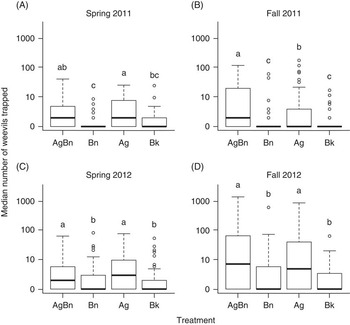
The current study shows that pea leaf weevils are responsive to semiochemicals during both periods of adult activity in the spring and the fall, suggesting that semiochemical-based lures can be used to monitor weevils during both flight periods. Traps baited with the aggregation pheromone, 4-methyl-3,5-heptanedione, alone or in combination with the bean volatiles consistently captured significantly more pea leaf weevils than the non-baited control traps (Fig. 1). Although some weevils were captured in traps baited with the bean volatiles alone in 2012, there was no instance in which significantly more weevils were captured in the bean volatile-baited traps than the control traps in either season in each study year (Fig. 1).
Median number of weevils per trap baited with aggregation pheromone and bean volatiles (AgBn), bean volatiles (Bn), aggregation pheromone (Ag), and blank (Bk) lures in A: Spring 2011, B: Fall 2011, C: Spring 2012, and D: Fall 2012. The midline of each boxplot indicates the median and the top and bottom of each box indicate the first and third quartiles, respectively. The whiskers represent 1.5 times the interquartile range or the maximum and minimum values, whichever is smaller, and outliers are represented by circles. Medians with different letters are significantly different among treatments, analysed separately by season and year (Tukey’s honest significant difference test, P⩽0.05).

The effect of combining the pheromone and plant cues on the attractiveness of lures appeared to vary with season, although statistical support for this claim is equivocal. The combined lure was equally attractive to pea leaf weevils as the pheromone lure alone in the spring, but the combined lure was more attractive than pheromone alone in the fall of 2011, but not 2012. In spring 2011, there was no significant difference in the number of weevils captured in traps baited with the aggregation pheromone alone or the combined lure (z=−0.1716, P=0.8907). The number of weevils captured in the traps baited with the combined lure, however, was not statistically different from that captured in the non-baited control traps (z=−1.828, P=0.2603) indicating that the bean volatiles may have reduced the attractiveness of the pheromone in spring 2011. In the spring of 2012, there again was no difference in the attractiveness of traps baited with pheromone alone or the combined lure (z=−0.4790, P=0.9636). Although there was a trend for fewer beetles to be captured in traps baited with the combined lure than the pheromone baited traps (Fig. 1), the combined lure still captured significantly more weevils than the non-baited control traps in the spring of 2012. In the fall of 2011, traps baited with the combined lure captured significantly more weevils than those baited with the pheromone alone (z=2.6650, P=0.0384) (Fig. 1). There was no difference, however, between the numbers of weevils captured in the two trap treatments in the fall of 2012 (z=1.2060, P=0.6230) (Fig. 1).
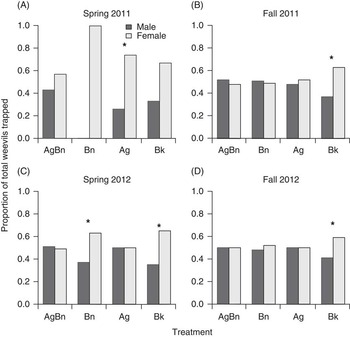
Blank traps captured more females than males in all seasons (fall 2011 (χ2 1=6.5000, P=0.0108), spring 2012 (χ2 1=27.9273, P<0.0001), and fall 2012 (χ2 1=10.4046, P=0.0013)), except spring 2011 when insufficient captures prevented analysis. No differences between captures of male and female weevils were found for other treatments, except for capture in traps baited with aggregation pheromone alone in spring 2011 (χ2 1=19.1739, P<0.0001) and bean volatiles alone in spring 2012 (χ2 1=27.6398, P<0.0001), both of which were female-biased (Fig. 2).
Proportion of male and female weevils trapped with aggregation pheromone and bean volatiles (AgBn), bean volatiles (Bn), aggregation pheromone (Ag), and blank (Bk) lures in A: Spring 2011, B: Fall 2011, C: Spring 2012, and D: Fall 2012. The proportion of males to females differs significantly within treatments noted with an asterisk (χ2 test, P⩽0.05). Note that AgBn, Bn, and Bk ratios in Spring 2011 were not analysed due to low catch numbers.

Discussion
This initial study illustrates that semiochemical-based monitoring of the pea leaf weevil has the potential to detect the spread of this invasive pest in the Canadian Prairie Provinces. Further, because weevils respond to semiochemicals in the fall prior to overwintering, it will be possible to monitor the overwintering stage to inform decision making on whether to use insecticide-treated seed for weevil control the following spring. Pitfall traps baited with the aggregation pheromone, 4-methyl-3,5-heptanedione, captured both male and female pea leaf weevils in both spring and fall in southern Alberta. Modified-Leggett (Leggett et al. Reference Leggett, Cross, Mitchell, Johnson and McGovern1975) traps baited with a similar pheromone lure were attractive to male and female pea leaf weevils when positioned in clover, alfalfa, wheat, or sugar beet fields in the spring in Denmark. Pheromone did not, however, enhance trap capture of pea leaf weevils on yellow sticky cards positioned 1.5 m above the ground in these same crops in Denmark (Nielsen and Jensen Reference Nielsen and Jensen1993). Yellow sticky cards used in Europe may have elicited a visual cue or acted to intercept dispersing weevils that are known to fly at ~1.5 m above the ground (Fisher and O’Keeffe, Reference Fisher and O’Keeffe1979). Synthetic pheromone lures placed in traps at ground level in this study and in Europe (Nielsen and Jensen Reference Nielsen and Jensen1993) significantly increased trap capture over unbaited traps in a similar position. Therefore, weevils that oriented to these pheromones did so by walking or flying within the crop. A modified-Leggett trap positioned on the ground and baited with bean plants and male pea leaf weevils also captured both sexes of pea leaf weevil in the spring in the United Kingdom (Blight and Wadhams Reference Blight and Wadhams1987). Interestingly, in the current study, modified-Leggett traps that were originally placed at field sites in the spring of 2011 did not retain pea leaf weevils. Weevils were captured and retained in pitfall traps but there was a large by-catch associated with these traps that would not be desirable in a commercial monitoring programme. Further experimentation is needed to determine the most appropriate trap type to use in a commercial monitoring programme for the pea leaf weevil.
This study is the first to illustrate that pea leaf weevils respond to aggregation pheromone in the fall before overwintering. Previous studies have shown that male pea leaf weevils produce aggregation pheromone (Blight et al. Reference Blight, Pickett, Smith and Wadhams1984; Blight and Wadhams Reference Blight and Wadhams1987) and both sexes respond to pheromone (Blight and Wadhams Reference Blight and Wadhams1987; Nielsen and Jensen Reference Nielsen and Jensen1993) in the spring. Adult weevils in the spring and fall are physiologically different. Weevils in the fall are reproductively immature and do not seek mates. The female reproductive tract develops gradually until the following spring when mate location and mating occur. Although development is slowed in the wintertime, pea leaf weevils do not undergo a true reproductive diapause as development continues under favourable conditions throughout the adult lifespan (Fisher and O’Keeffe Reference Fisher and O’Keeffe1979). Weevils in the spring migrate from overwintering locations in perennial legumes to their reproductive hosts of pea or faba bean where they feed and mate. Spring weevils are reproductively active and females have fully mature ovaries (Fisher and O’Keeffe Reference Fisher and O’Keeffe1979). Response of pea leaf weevils to synthetic sources of aggregation pheromone in the fall indicates that sexually immature weevils respond to pheromone during a time of year when they are not seeking mates. Pea leaf weevils in the fall may respond to aggregation pheromone to overwinter in groups. It still needs to be determined if male pea leaf weevils release pheromone in the fall.
Although host plant volatiles are likely important to direct pea leaf weevil migration and foraging behaviour in the spring and the fall (Landon et al. Reference Landon, Ferary, Pierre, Auger, Biemont, Levieux and Pouzat1997), the synthetic bean volatiles tested in the current study did not attract a significant number of weevils in either season or year of the study. Traps baited with the same doses of these same bean volatiles during the spring flight period in the United Kingdom (Blight et al. Reference Blight, Pickett, Smith and Wadhams1984) also did not capture significantly more weevils than unbaited control traps. Pea leaf weevil antennae respond electrophysiologically to volatile pea odour in both the spring and fall, but are less responsive during winter and after the spring migration in the summer (Landon et al. Reference Landon, Ferary, Pierre, Auger, Biemont, Levieux and Pouzat1997). Behavioural assays conducted in an olfactometer in the laboratory showed a similar plasticity in weevil orientation to natural pea odour and a synthetic source of (Z)-3-hexen-1-yl acetate, where attraction of a small percentage of weevils tested (5–50%) occurs only in the spring and fall (Landon et al. Reference Landon, Ferary, Pierre, Auger, Biemont, Levieux and Pouzat1997).
Host plant volatiles can also enhance responsiveness to species-specific insect-produced signals. The addition of common plant-produced green leaf volatiles enhances attraction of several species of male moths to female-produced sex pheromone (Light et al. Reference Light, Flath, Buttery, Zalom, Rice, Dickens and Jang1993; Reddy and Guerrero Reference Reddy and Guerrero2000). Compounds released from host trees are also essential for host colonisation by bark beetles and can attract beetles or synergise the effect of beetle-produced aggregation pheromones, depending on the beetle species (Pureswaran and Borden Reference Pureswaran and Borden2005). In the current study, the bean volatiles tested enhanced the response of weevils to aggregation pheromone-baited traps in the fall of 2011 but not in the fall of 2012. Weevil attraction to aggregation pheromone was not enhanced by bean volatiles in the spring. Blight et al. (Reference Blight, Pickett, Smith and Wadhams1984) illustrated enhanced response to pheromone with the addition of bean volatiles to traps in the spring, although that result was driven by trap catch at one site. As it is known that pea leaf weevils detect host plant volatiles in both the spring and fall (Landon et al. Reference Landon, Ferary, Pierre, Auger, Biemont, Levieux and Pouzat1997), it is likely that variation in response to the combined lure in the two flight periods is affected by the quality and quantity of host plant volatiles in the background of these semiochemical-baited traps. In the fall trapping period, pea plants are beginning to senescence and crops are harvested, which might make synthetic host plant volatiles positioned in the traps more apparent to weevils than in the spring when fresh pea plants potentially mask the synthetic signals. Similarly, diamondback moth, Plutella xylostella (Linnaeus) (Lepidoptera: Plutellidae), response to pheromone is enhanced by the addition of green leaf volatiles to the lure when traps are positioned in cabbage (Reddy and Guerrero Reference Reddy and Guerrero2000), but not in canola agroecosystems (Miluch et al. Reference Miluch, Dosdall and Evenden2014).
The semiochemical treatments tested in the current study attracted both male and female weevils. More females than males were captured in the aggregation pheromone-baited traps and the bean volatile-baited traps in the spring of 2011 and 2012, respectively. This, however, may simply reflect a higher activity level of female weevils on the ground, as the blank control traps captured more female than male weevils in three of the four trapping periods. The sex ratio of pea leaf weevils captured in semiochemical-baited traps in Europe is also variable. More male weevils were captured in aggregation pheromone traps positioned in clover and wheat fields, a 1:1 sex ratio was recovered from traps in sugar beets, and more females than males were captured in traps in alfalfa fields (Nielsen and Jensen Reference Nielsen and Jensen1993). A positive response to semiochemical lures by both male and female weevils indicates that semiochemical tools might also be developed in this system to control pea leaf weevils through attract and kill or mass trapping strategies.
The current study lays the foundation for the development of semiochemical-based monitoring of the pea leaf weevil in the Canadian Prairie Provinces. Aggregation pheromone-baited traps can be used to detect the spread of pea leaf weevil populations in its invasive range. As pea leaf weevils respond to aggregation pheromone and can be reliably captured in the fall, trap capture can be further developed for decision-making processes for producers before planting the following spring. Addition of bean volatiles to aggregation pheromone did not reliably enhance response as compared to the pheromone alone. Further work is necessary to test different doses of semiochemicals and to develop an easy-to-use, selective trap that is positioned on the ground.
Acknowledgements
The authors thank Shelley Barkley and Carolyn Herle and numerous field assistants for their extensive help with site location, site establishment and collection, and sorting of trap capture over the field season, especially in the first year of this study. The study was funded by the Agriculture Crop Industry Development Fund, the Alberta Pulse Growers Commission, and the Western Grain Research Foundation.