Introduction
Maternal mortality and morbidity are global public health concerns (Johnson et al., Reference Johnson, Obidike, Eroh, Okpon, Bassey and Patrick2020). Over 500,000 women lose their lives each year during pregnancy and delivery, and the situation is worse for women in poor countries compared with those from the developed nations (Piane, Reference Piane2019), with approximately 9 in 10 maternal mortality cases occurring in developing countries (WHO, 2019). The rate of maternal deaths in sub-Sahara Africa is the highest globally, and accounts for approximately two-thirds of all cases globally (WHO, 2019). In Nigeria, the rate of maternal deaths is 512 per 100,000 live births (NPC & ICF, 2019), while the neonatal mortality rate is 34 per 1000 live births (UNICEF, 2016). Many maternal and neonatal deaths have been attributed to inadequate use of maternal health care services (Ahuru, Reference Ahuru2019; Adedokun & Uthman, Reference Adedokun and Uthman2019; Gebregziabher et al., Reference Gebregziabher, Zeray, Abtew, Kinfe and Abrha2019; Sato et al., Reference Sato, Phongluxa, Toyama, Gregorio, Miyoshi and Nishimoto2019; Johnson et al., Reference Johnson, Obidike, Eroh, Okpon, Bassey and Patrick2020).
In Nigeria, child delivery can either be facility-based, i.e. in a medical health facility, or non-facility-based, i.e. at home, in a church or with traditional birth attendants (TBAs) (Udoma et al., Reference Udoma, Ekanem, Abasiattai and Bassey2008; NPC & ICF, 2019). The birth outcome and quality of life of women and newborn babies after delivery are often dependent on the place of child delivery (Gayawan, Reference Gayawan2014; Johnson et al., Reference Johnson, Obidike, Eroh, Okpon, Bassey and Patrick2020). For mothers, facility-based delivery helps to reduce obstetric complications (Yaya et al., Reference Yaya, Bishwajit, Uthman and Amouzou2018). For babies, facility-based delivery encourages, among other things, exclusive breastfeeding, as mothers are provided with knowledge about infant nutrition (Alabi et al., Reference Alabi, Adejoh, Atinge and Umahi2020). Despite this, less than half of child deliveries in Nigeria are facility-based (NPC & ICF, 2019).
With the current coronavirus pandemic, there are fears that the rate of reported facility-based delivery may drop as patients, including pregnant women, are delaying hospital visits and avoiding hospital premises due to a fear of contracting COVID-19 (Sarwari & Goode, Reference Sarwari and Goode2020). Health facilities are re-allocating human and other health resources to combat COVID-19 (Kumar & Dey, Reference Kumar and Dey2020), thereby reducing access to health care for other health seekers. By implication, many women may deliver at non-facility premises, which may further reduce the already low rate of facility-based delivery in the country.
Of great concern is the socio-cultural difference and inequality that exist between Northern and Southern Nigeria (Archibong, Reference Archibong2018). Yet, most health intervention programmes in the country adopt the same approach to solving the country’s national problems, which may account for the slow pace of progress and abandonment of policies and projects in some parts of the country. As countries attempt to achieve the Sustainable Development Goals, there is a compelling need to understand the differences between and within regions/countries that could account for striking disparities in certain developmental indices such as maternal mortality and health-seeking behaviours. This would enable context-specific interventions that will promote even and equal development. The North and South of Nigeria have diverse social, economic and cultural backgrounds, which make their reactions to phenomenon very different, and suggest that uniform intervention programmes may not be appropriate for the two regions.
The investigation of place of delivery is not new in Nigeria. In the last 10 years, studies have documented that education, women’s autonomy, age, marital status, attendance at antenatal clinics, number of previous children, knowledge of pregnancy complications, rural–urban residence, wealth level, attitude of health workers, distance to health facilities and religion are all associated with facility-based delivery (Dahiru & Oche, 2013; Envuladu et al., Reference Envuladu, Agbo, Lassa, Kigbu and Zoakah2013; Fapohunda & Orobaton, Reference Fapohunda and Orobaton2014; Gayawan, Reference Gayawan2014; Shehu et al., 2016; Ahuru, Reference Ahuru2019; Adedokun & Uthman, Reference Adedokun and Uthman2019; Yahya & Pumpaibool, Reference Yahya and Pumpaibool2019; Nwankwo et al., Reference Nwankwo, Ani, Akpoke and Ugwa2019). However, the direction of influence of these factors on place of delivery shows some variations, in Nigeria and other developing countries. For instance, while some studies found no or a negative association between age and facility delivery (Berhan & Berhan, Reference Berhan and Berhan2014; Fapohunda & Orabotan, Reference Fapohunda and Orobaton2014), others have established an association between increasing age and facility-based delivery (Dunlop et al., Reference Dunlop, Benova and Campbell2018; Adedokun and Uthman, Reference Adedokun and Uthman2019). Similarly, while most studies have linked early antenatal care (ANC) initiation to higher likelihood of facility-based delivery (Solanke et al., Reference Solanke, Rahman and Ogunjuyigbe2020), one study found early ANC to be more associated with home delivery (Akazili, et al., Reference Akazili, Doctor, Abokyi, Hodgson and Phillips2011). Studies on the influence of decision-making have reported varied findings. While some reported that women who make decisions with their partner or other relatives tend to use skilled birth attendants (Kabakyenga et al., Reference Kabakyenga, Östergren, Turyakira and Pettersson2012) and practise facility delivery (Kifle et al., Reference Kifle, Kesete, Gaim, Angosom and Araya2018), one reported that the odds of facility delivery were higher when women made the decision alone (Ameyaw et al., Reference Ameyaw, Tanle, Kissah-Korsah and Amo-Adjei2016). Most studies agree that higher maternal education (Yegezu & Kitila, Reference Yegezu and Kitila2015; Kebede et al., Reference Kebede, Hassen and Teklehaymanot2016; Seme & Sefiu, Reference Seme and Sefiu2017; Gebregziabher et al., Reference Gebregziabher, Zeray, Abtew, Kinfe and Abrha2019; Solanke et al., Reference Solanke, Rahman and Ogunjuyigbe2020); urban residence (Berhan & Berhan, Reference Berhan and Berhan2014; Awoyemi et al., Reference Awoyemi, Obayelu and Opaluwa2017; Banke-Thomas et al., Reference Banke-Thomas, Banke-Thomas and Ameh2017; Negero et al., Reference Negero, Mitike, Worku and Abota2018; Adedokun & Uthman, Reference Adedokun and Uthman2019) being Christian (Solanke et al., Reference Solanke, Oladosu, Akinlo and Olanisebe2015; Yegezu & Kitila, Reference Yegezu and Kitila2015); and exposure to media (Banke-Thomas, et al., Reference Banke-Thomas, Banke-Thomas and Ameh2017; Solanke et al., Reference Solanke, Rahman and Ogunjuyigbe2020) are associated with facility-based delivery.
In Nigeria, some of the earlier studies (Envuladu et al., Reference Envuladu, Agbo, Lassa, Kigbu and Zoakah2013; Shehu et al., 2016; Nwankwo et al., Reference Nwankwo, Ani, Akpoke and Ugwa2019; Yahya & Pumpaibool, Reference Yahya and Pumpaibool2019; Johnson et al., Reference Johnson, Obidike, Eroh, Okpon, Bassey and Patrick2020) collected primary data from respondents in one or a few states within a region, a few used previous NDHS data to analyse place of child delivery in a single state (Fapohunda & Orobaton, Reference Fapohunda and Orobaton2014) and others considered the entire country (Gayawan, Reference Gayawan2014; Ahuru, Reference Ahuru2019; Adedokun & Uthman, Reference Adedokun and Uthman2019; Dahiru & Oche, 2019), while Solanke et al. (Reference Solanke, Rahman and Ogunjuyigbe2020) analysed 2018 NDHS data but with a focus on delivery in the year preceding the survey.
Knowledge on regional variation in factors influencing place of child delivery in Nigeria is scarce. Gayawan (Reference Gayawan2014) attempted spatial analysis using 2008 NDHS data but did not investigate the timing of first ANC check, decision-making on health care and number of ANC visits during pregnancy as possible predictors. In addition, the study provided little explanation as to why differences may occur between Northern and Southern Nigeria. Many earlier studies on place of child delivery used logistic regression models where the predictor variables interacted and affected one another. The present study aimed to show the predicted probability for each respondent, computed the mean difference across groups for each variable and investigated the regional variation in the influence of age, education, religion, urban–rural place of residence, media exposure, timing of first ANC visit (first, second or third trimester), number of ANC visits during pregnancy and household decision-making on place of child delivery in Nigeria.
The Integrated Maternal, Newborn and Child Health (IMNCH) strategy is being adopted by Federal Ministry of Health in Nigeria. The framework aims, amongst other things, to reduce maternal and child mortality. The use of evidence in the implementation of IMNCH was investigated by Mbachu et al. (Reference Mbachu, Onwujekwe, Chikezie, Ezumah, Das and Uzochukwu2016), who found that evidence was sought from robust sources, including journal articles, and that the national government usually reserves the right to health policymaking and states often rely on the ideas of the national authority. It is not known if policymakers currently consider socio-cultural differences across regions in the implementation of the framework. The current study may inform the Federal Ministry of Health of the need to decentralize policymaking on health and allow regions and even states in the country to decide on their own strategies of implementation of the IMNCH in a way that meets the cultural peculiarities of local people. This is important because an implementation strategy may not yield the same result between a place where male health workers are allowed to attend to women, and another place where the culture suggests that a woman is better delivered by female health workers.
Theory
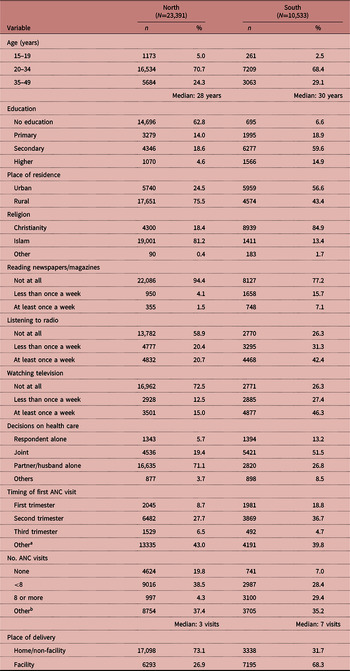
The study rests on the Cosmopolitan-Success and Conservative-Failure Hypothesis (CSCFH), which suggests that due to the liberal values of residents in metropolitan urban centres/states, health policies and innovation will thrive there more than in rural states, where residents tend to be more conservative and the socio-cultural make-up is closed to innovation (Kunnuji et al., Reference Kunnuji, Robinson, Shawar and Shiffman2017). The hypothesis is a variant of the metropocentric theory, which stipulates that ‘communities within major cities in Nigeria are better served by government in terms of provision of infrastructure and services than communities in the periphery of the state’ (Kunnuji et al., Reference Kunnuji, Eshiet and Nnorom2018, p. 3). Consequently, it is expected that states in Northern Nigeria – where 62.8% of mothers have no education compared with 6.6% in the South, and where three-quarters of mothers reside in rural areas compared with 43.4% in the South (NPC & ICF, 2019) – will be more conservative and hostile to innovation than those in the Southern part of the country.
The Northern and Southern protectorates existed as separate and autonomous entities, and the people of each region governed their own land according to their socio-cultural contexts and resources, until 1914, when Lord Frederick Lugard merged the two regions and named it ‘Nigeria’ for administrative convenience. Commentators agree that the marriage has yielded far more unrest than unity, and has been the bane of national development due to cultural dissimilarities (Campbell, Reference Campbell2011; Odiogor et al., Reference Odiogor, Ndujihe and Abdulah2013; Obi-Ani et al., Reference Obi-Ani, Obi-Ani and Isiani2016; Olowookere, Reference Olowookere2017). The distinctions that existed before colonialism survived through the country’s independence and are still in existence today. For example, the 2018 NDHS shows that, among married people, 58.8% of Northerners do not have any formal education compared with 6.8% in the South, and while more than three-quarters of those in the North are Muslims, 84.6% of those in the South are Christians (NPC & ICF, 2019). In some Northern states, where Shari’a law is practised, it is considered an offence to consume alcohol or smoke in public, and physical closeness between opposite sexes is not allowed in schools, places of worship or religious gatherings. The CSCFH considers these differences to say that, ceteris paribus, innovation and positive health-seeking behaviour will thrive more in the cosmopolitan South than in the more conservative North. In addition, factors that influence health-seeking behaviours may not be the same across the two regions, and even when similar factors account for behaviour in the two regions, the direction of association and magnitude of influence may vary, and this may have implications for policy implementation in each region.
Methods
Data and population
The study data were taken from the 2018 Nigeria Demographic and Health Survey (NDHS). This is the most recent DHS survey, designed to collect data on the health status and demographic characteristics of the Nigerian population. The nationally representative survey was conducted by the NPC of Nigeria in conjunction with the National Malaria Elimination Programme of Nigeria, with support from ICF and the United States Agency for International Development (USAID), World Health Organization, United Nations Population Fund, Global Fund and Bill and Melinda Gates Foundation. It adopted a stratified, two-stage clustered design using the Population and Housing Census as a sampling frame. Further information on the sampling design of the survey is available at https://www.dhsprogram.com/pubs/pdf/FR359/FR359.pdf.
The survey sampled 41,821 women of reproductive age (15–49 years) at the time of the survey. The major inclusion/exclusion criterion for the present study was delivery of at least one live birth in the 5 years preceding the survey, giving a study sample of 33,924 mothers.
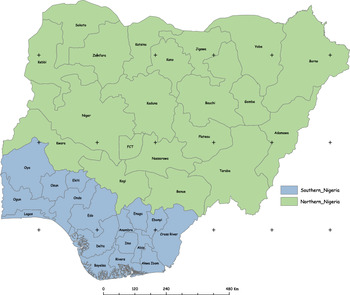
Nigeria is comprised of 36 states and the Federal Capital Territory (FCT), Abuja, which are subdivided into six geo-political zones: North Central, North East, North West, South East, South-South and South West. The northern region has nineteen states plus the FCT, while the South consists of seventeen states. For the purposes of this study, states were grouped into Northern and Southern regions as shown in Figure 1.
Map of Nigeria showing Northern and Southern states.

Outcome variable
The outcome variable was ‘place of child delivery’. Respondents were asked where they gave birth to their last child. Options included: respondent’s home, other homes and health facilities (public, private or NGO). Those who delivered at home and at other places outside hospital/medical settings were categorized as having a ‘non-facility delivery=0’ while those who gave birth at public, private or NGO medical facilities were treated as having a ‘facility delivery=1’, in line with the earlier study of Ahuru (Reference Ahuru2019).
Independent variables
There were eight predictor variables. Four demographic variables (age, education, religion and place of residence) were selected and their relatedness tested to avoid the problem of multicollinearity. Age was captured at both ratio and categorized levels. The outcomes were categorized into three at the descriptive level: 15–19 was described as ‘teenage mothers’, 20–34 as ‘young mothers’ and 35–49 as ‘old mothers’. Education was measured by whether respondents had no formal education, or had primary, secondary or tertiary education. For religion, five outcomes (Catholic, other Christian, Muslim, Traditional and other) were categorized into Christianity, Islam and Other. Place of residence referred to whether respondents lived in a rural or urban area, as given in the survey.
The four other variables were media exposure (frequency of reading newspapers, frequency of listening to the radio and frequency of watching television) with three responses ‘not at all’, ‘less than once a week’ and ‘at least once a week’; timing of first antenatal check, measured in actual month, with outcomes categorized into ‘first trimester’, ‘second trimester’ and ‘third trimester’, as in a previous study by Fagbamigbe et al. (Reference Sato, Phongluxa, Toyama, Gregorio, Miyoshi and Nishimoto2019); number of antenatal visits during pregnancy was categorized at the descriptive level into ‘none’, ‘1–7’ and ‘8 or more’, based on the WHO (2016) standard that a minimum of 8 contacts are recommended to reduce perinatal mortality. Regarding decision-making on health care, respondents were asked ‘who usually makes decisions about health care for yourself’ with three major options: ‘you’ (i.e. respondent alone), ‘your partner’ and ‘you and your partner’ (i.e. joint decision-making).
Data analysis
Data analysis was done using the SPSS Version 27. There were separate datasets: overall, North and South. Univariate analysis was done using simple frequencies, percentages and medians. At the multivariate level, three logistic regression models (overall, North and South) were estimated, and all independent variables were adjusted for at 95% level of significance. Region was included in the overall model. All the independent variables (except age and number of ANC visits during pregnancy) were categorical. To test for multicollinearity between the independent variables, a correlation matrix was run for all the independent variables to see how each was related to others. No evidence of multicollinearity was found as all the correlation coefficients were less than 0.7. To further understand the likelihood of a Nigerian woman of reproductive age giving birth at a health facility, the predicted probability was estimated based on the covariates in the regression models, and the analysis of variance (ANOVA) test was used to give the differences among groups in the independent variables at 95% level of significance. Ratio variables (age and number of ANC visits) were not categorized in the regression models, but were classified in the ANOVA analysis because an important condition in the latter is that the independent variable must be categorical.
Results
Socio-demographic and other variables
Table 1 shows that the majority of respondents were young mothers (70.7% in the North vs 68.4% in the South). The proportion of adolescent mothers in the North was twice that in the South. The median age was 28 years in the North and 30 years in the South. The majority (62.8%) of respondents in the North were illiterate, compared with less than one-tenth (6.6%) in the South; less than a quintile (18.6%) of Northern respondents had secondary education compared with 59.6% in the South. About three-quarters of the respondents in the North were living in rural areas, while the majority (56.6%) in the South resided in urban areas. Going by this rural–urban distribution and the assumptions of metropocentric theory (Kunnuji, Reference Kunnuji2014; Kunnuji et al., Reference Kunnuji, Eshiet and Nnorom2018), it would be expected that respondents in the South would have more access to basic amenities including delivery facilities. By the tenets of CSCFH (Kunnuji et al., Reference Kunnuji, Robinson, Shawar and Shiffman2017), it would be expected that, given equal access, respondents in the South will utilize health facilities more than those in the North, due to the less-friendly socio-cultural context of the latter, which might deter utilization and implementation (BBC News, Reference News2012). With respect to religion, an overwhelming majority (84.9%) of the respondents from the South were Christians compared with 18.4% in the South. As regards media exposure, the majority (94.4% in the North vs 77.2% in the South) of respondents in both regions did not read newspapers/magazines at all. However, the proportion of respondents who read newspapers sometimes in the South was a little above a quintile, compared with less than one-tenth (5.6%) in the North. Similarly, the frequency of listening to the radio and watching television in the South was higher. Approximately 6 in 10 persons in the North did not listen to the radio at all. Conversely, approximately 7 in 10 persons in the South did listened to the radio. The majority (72.5%) of Northern respondents did not watch television at all, while the majority (46.3%) in the South watched television at least once a week.
Distribution of respondents by socio-demographic, antenatal and delivery variables

a Included those with no ANC visits, those for which no response was recorded and those who responded ‘don’t know’.
b Included those for which no response was recorded and those who responded ‘don’t know’.
In the North, the majority of mothers (71.1%) relied on their partner to make decisions on their health, 19.4% jointly decided with their partner, while only 5.7% decided on their own. However, in the South, joint decision was practised by the majority (51.5%). A little over a quarter (26.8%) relied on their partner for such decisions, and 13.2% decided on their own. Considering the use of ANC services in both regions, more than a quarter (27.7% in the North vs 36.7% in the South) attended an ANC clinic for the first time during their second trimester. Approximately 9% of mothers in the North started attending clinics during the first trimester compared with 18.8% of those in the South. Approximately 20% of mothers in the North did not attend ANC clinics at all, compared with 7% in the South. While 29.4% of mothers in the South met the WHO’s recommendation of attending at least 8 ANC visits during pregnancy, only 4.3% did so in the North.
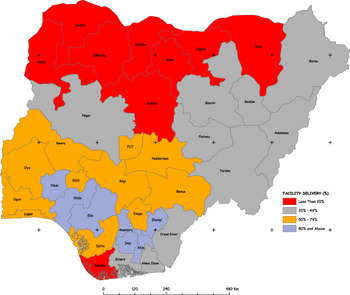
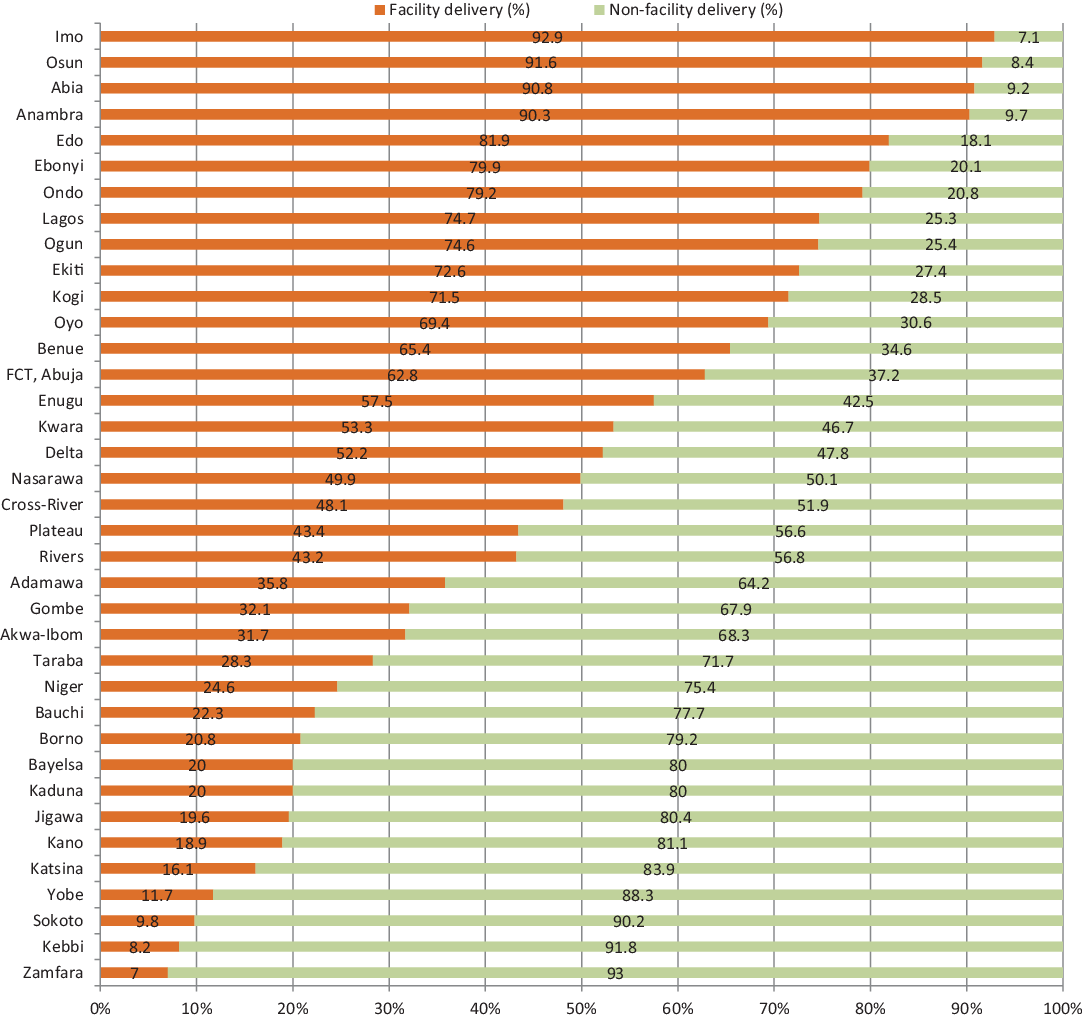
The majority (73.1%) of mothers in the North did not have a medical delivery in a facility. Meanwhile, about 7 out of 10 in the South delivered at a medical facility. Figures 2 and 3 show the variation in facility delivery by state; Figure 2 shows that neighbouring states tended to have similar proportion rate of facility delivery. For example, all six states in the South West (except Osun) had a facility delivery rate of 50–79%. Similarly, all seven states in the North Central (except Plateau and Abuja) had 50–79%. In the North East, all six states (except Yobe) had 20–49% rate of facility delivery, while in the North West, all seven States (except Jigawa and Kaduna) had a rate of less than 20%. Figure 3 shows that the twelve states with the highest rate of facility delivery were in the South of the country. Eight states with the lowest rates were from the North. The state of Imo (South East) had the highest facility delivery rate of 92.9%, followed by Osun (South West) with 91.6% and Abia (South East) with 90.8%. Zamfara State (North West) had the lowest rate of 7%, followed by two other states in the North West (Kebbi and Sokoto with 8.2% and 9.8% respectively).
Map of Nigeria showing the rate of facility delivery across states.

Rates of facility and non-facility deliveries across states in Nigeria.

Factors influencing utilization of facility delivery
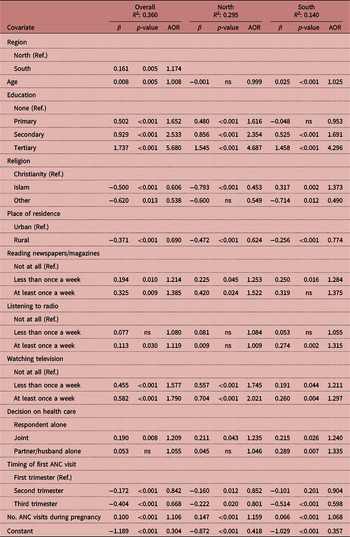
Table 2 shows that location was a significant predictor of utilization of facility delivery as mothers in the South were more likely to deliver their baby at a medical facility (β=0.161, p<0.01) than those in the North. In the overall model, age was positively related to facility delivery (β=0.008, p<0.01). Similarly, in the South, age was a significant predictor (β=0.025, p<0.001), but the association was not significant in the North. The association between education and use of delivery facilities had a similar pattern across the three models – consistently, the odds of delivery in a medical facility increased with mother’s level of education when ‘no education’ was the reference point. Mothers who had higher education were 5.7 times more likely in the overall model (β=1.737, p<0.001), 4.7 times more likely in the North (β=1.545, p<0.001) and 4.3 times more likely in the South (β=1.458, p<0.001) to use medical facilities for delivery than those who were illiterate. Religion was also a significant predictor of facility delivery across the models but with regional differences. In the overall model, Christians (reference category) were the most likely to utilize a delivery facility, followed by Muslims (AOR=0.606, p<0.001), then Other (AOR=0.538, p=0.013). The same pattern was observed in the North (Muslims: AOR=0.453, p<0.001; Other: AOR=0.549, p>0.05). In the South however, a reverse but significant association was observed. Muslims were 1.4 times more likely to have a facility delivery than Christians (β=0.317, p<0.01) while Others remained the least likely (AOR=0.490, p<0.01). Place of residence was significant across the three models with no observed difference in the pattern of association across regions. Mothers who lived in urban areas were more likely to practise facility delivery than mothers in rural areas (overall: β=–0.371, p<0.001; North: β=–0.472, p<0.001; South: β=–0.256, p<0.001).
Regression models showing the differences in the predictors of place of delivery

ns, non-significant.
As for media exposure, the frequency of reading newspapers appeared to be significant and a consistent pattern was observed across the models – the odds of practising facility delivery increased with the frequency of reading newspapers. However, some differences were observed in the frequency of listening to the radio between the North and South. The frequency of watching television was significant across the three models. However, the association was more significant in the North than in the South. Regarding decision-making on health care, it was found that joint decision-making increased the odds of facility delivery in the overall model (AOR: 1.209, p<0.01), North (AOR: 1.235, p<0.05) and South (AOR: 1.240; p<0.05). However, in the South, the highest odds of facility delivery (i.e. when compared with the reference category – respondent alone) was recorded when the partner alone decided (AOR: 1.335; p<0.01). Timing of first ANC visit was significant in the three models. The most likely to practise facility delivery were those who started visiting ANC clinics in the first trimester (reference category), while the least likely were those who started in the third trimester (overall: AOR=0.668, p<0.001; North: AOR=0.801, p<0.05; South: AOR=0.598, p<0.001). The number of ANC visits during pregnancy was also significant across the three models, but the magnitude of association was higher in the North (β=0.147) than in the South (β=0.066).
Differences in probability of facility delivery across groups
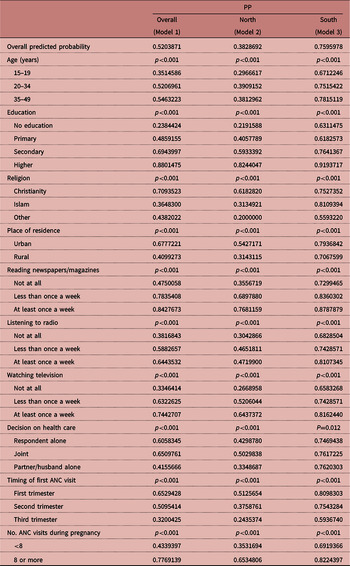
Table 3 shows the probability of mothers practising facility delivery in Nigeria and differences across regions and groups in the independent variables. The overall likelihood of a mother delivering in a medical facility in Nigeria was 52.5%. While the probability was 76% in the South, it was as low as 38.3% in the North. For age, the probability increased consistently with age in the South, with older mothers having the highest likelihood (78.2%) and young mothers have the highest likelihood in the North with 39.1%. In Nigeria, illiterate mothers had a 23.8% chance of delivering in a facility compared with 88% for those with tertiary education. In the North, there was a 82.4% chance that those who had tertiary education would deliver in a facility compared with 91.9% for the South. While Muslims in the North had a 31.3% chance of delivering in a facility, their counterparts in the South had a 81.1% chance.
ANOVA results showing mean differences in predicted probability of facility delivery across groups

Significance: p<0.05.
The probability of a mother living in a rural area delivering in a facility was 41%, as opposed to 67.6% for those in urban areas. Living in a rural area in the North posed a higher risk of delivery outside a facility. Media exposure showed a consistent trend across the three analyses, with those who read newspapers every day having the highest likelihood of facility delivery. Joint decision-making yielded the highest probability of facility delivery overall and in the North (65.1% and 50.3%, respectively, p<0.001 in both cases). However, the difference among groups in the South was not very large and lone decision by the partner yielded the highest probability (76.2%, p<0.012). Beginning ANC visits during the first trimester yielded a better chance of facility delivery. Living in the North and starting ANC visits at the third trimester resulted in a 24.5% chance of facility delivery, while living in the South and starting ANC visits early yielded a 81% chance. Mothers who met the WHO’s recommended number ANC visits had a 77.7% chance of delivering in a facility, compared with a 44% chance for those who did not. Variation existed across regions, however. Those who started ANC visits in the third trimester in the South had a 8% greater chance of a facility delivery than mothers who began in the first trimester in the North. Similarly, those who attended ANC clinics fewer than 8 times in the South were 4% more likely than those who did so in the North.
Discussion
This study investigated the influence of age, education, religion, place of residence, media exposure, decision-making on health care, timing of first antenatal visit and number of antenatal visits on mothers’ choice of delivery place and how those factors vary across the North and South of Nigeria. The chance of a Nigerian mother delivering her baby at a health facility in 2018 was found to be 52.6%. Mothers in the South were more likely to deliver at a medically recognized health facility than those in the North. While Northern mothers had a 38.9% chance of delivering at a health facility, the probability was 75.1% for those in the South.
The finding that mothers in Southern Nigeria utilized health facilities for delivery more than those in the North is supported by Gayawan (Reference Gayawan2014), who used the 2008 wave of NDHS, and Solanke et al. (Reference Solanke, Rahman and Ogunjuyigbe2020), who used the latest 2018 NDHS and reported that mothers in most Northern states had a lower likelihood of facility delivery than those in the South. Like Gayawan’s study, the current study also found that Bayelsa was the only Southern state among the worst thirteen states in terms of facility delivery, despite it being an oil-rich state. This shows that not much has really changed in the state for over the past decade. Further studies are need to explore the politics and dynamics of child delivery in Bayelsa state.
There are several reasons why mothers in the South utilize medical facilities for delivery more than those in the North. The first relates to the availability of, and attitude towards, the use of health facilities. There are insufficient health facilities in Nigeria relative to its population. Makinde et al. (Reference Makinde, Sule, Ayankogbe and Boone2018) reported that the number of government-owned health facilities per 100,000 persons in the country is less than 20. Considering all health facilities (both public and private), the North Central region has the highest number per 100,000 persons (25.8) followed by South East (23.4) and South West (20.4). The North West has the lowest figure (14.4). In all, the North has 19.6 health facilities per 100,000 persons compared with 19.3 in the South. Although the two regions have similarly insufficient numbers of health facilities, differences in utilization could be attributed to the availability of more private hospitals in the South than in the North. In the North, there is only one private hospital per 7.28 government-owned facilities compared with a ratio of 1.13 in the South (Makinde et al., Reference Makinde, Sule, Ayankogbe and Boone2018). By implication, pregnant women in the South have more alternatives should there be unavailability of resources at government hospitals – a common phenomenon in Nigeria. In addition, lower utilization of health facilities for child delivery in the North may be as a result of negative attitudes towards Western health systems. The BBC News (Reference News2012) echoed the assumption of CSCFH that, while residents in the South have access to better health care, as evident in the number of vaccines received for polio, tetanus etc., those in the North may not have similar access because some northerners see vaccination as a plot by the West to reduce the increasing Northern population.
A second reason for low use of hospital facilities for delivery in the North may be the fact Northern women consider it more comfortable to deliver at home and unnecessary to deliver at a health facility, partly due to the high cost (Gayawan, Reference Gayawan2014), and this explains why the number of private hospital in the North is lower compared with the South (Makinde et al., Reference Makinde, Sule, Ayankogbe and Boone2018). A third reason is that ignorance of the quality of services delivered in hospital may be common among mothers in the North considering that 62.8% of them do not have any formal education, and this may result in low usage of hospital facilities (Butawa et al., Reference Butawa, Tukur, Idris, Adiri and Taylor2010; Gayaman, Reference Gayawan2014). Another reason could be the Purdah system, which frowns on women being treated by male health workers. All these reasons are in tandem with the CSCFH as negative attitudes towards Western health systems, poverty and ignorance may be more prevalent in the North than in the South.
A fourth reason relates to population density and distance of residence from health facilities. Many states in the South are smaller in size compared with those in the North. Thirteen of the nineteen states in the North have bigger land masses than any of the seventeen states in the South. In fact, Niger State (North Central) is larger in size than eight states combined in the South (Lagos, Anambra, Imo, Ebonyi, Abia, Ekiti, Akwa Ibom and Enugu). By implication, the population in the North is more thinly dispersed than that in South, considering that agriculture, which is the major occupation in the North, requires large expanses of free land that cannot be easily found in the metropolitan centres, where health facilities are usually sited. Consequently, some residents in the North will live very far from available health facilities. Earlier studies have shown that far distance reduces usage of health facilities (Awoyemi et al., Reference Awoyemi, Obayelu and Opaluwa2017; Biswas & Kabir, Reference Biswas and Kabir2017). Therefore, it is important that health facilities are strategically situated putting in mind the ease of accessibility for the majority.
The study found that age was a significant predictor of facility delivery in Southern Nigeria, but not in the North. When treated separately from the influence of other factors, age was a significant predictor in both regions but in different directions. While the rate of facility delivery increased in the South as mothers grew from teenagers to old mothers, the rate increased in the North from 29.7% for teenage mothers to 39.1.6% for young mothers, then declined to 38.1% among old mothers (Table 3). The findings for the overall Nigerian sample, and for the South, are supported by previous studies (Adedokun & Uthman, Reference Adedokun and Uthman2019; Solanke et al., Reference Solanke, Rahman and Ogunjuyigbe2020). The finding in the North is supported by Fapohunda and Orabotan (Reference Fapohunda and Orobaton2014), who reported that in Northern Nigeria, the use of maternal health care services decreased as mothers’ age and parity increased to 3 and 4. Similar findings have been reported in other African countries (Moyer & Mustafa, Reference Moyer and Mustafa2013; Kyei-Nimakoh et al., Reference Kyei-Nimakoh, Carolan-Olah and McCann2017). This is because mothers may believe that they have learned enough, and gained sufficient experience, from having previous successful deliveries, and may not see any reason to deliver in the hospital where the costs are is likely to be higher, causing financial strain for mothers already caring for previous children (Kebede et al., Reference Kebede, Hassen and Teklehaymanot2016; Dunlop et al., Reference Dunlop, Benova and Campbell2018; Fapohunda & Orabotan, 2018). However, other studies reported that use of facilities for child delivery was not associated with maternal age (Berhan & Berhan, Reference Berhan and Berhan2014). Perhaps future quantitative studies should first compute the effect of age separately before including other covariates so that the moderating effects of other factors can be detected. More so, future qualitative studies should be conducted on the use of facilities among mothers who have had more than two children to ascertain their loss of interest in the use of health care after a few successful births. The fact that a consistent association exists between age and facility-based delivery in the South but not in the North may be explained by the CSCFH. There is a possibility that family planning and birth spacing are more likely in the South than in North due to the conservative nature of the latter. Consequently, mothers in the South may have made adequate provision, as they grow older, for subsequent births after the second one such that even at a fourth pregnancy they have enough resources to afford quality health care services, unlike their counterparts in the North who may not plan properly to ensure that their earnings are commensurate with their parity.
The study also found that mother’s higher education was associated with increased use of health care services for child delivery, and consistently for both regions highest odds and probabilities were recorded for mothers with tertiary education. This finding is consistent with those of earlier studies (Berhan & Berhan, Reference Berhan and Berhan2014; Gayawan, Reference Gayawan2014; Dunlop et al., 2016). It is expected because education improves the worldview of recipients and removes them from the shackles of ignorance. Consequently, educated people are more informed about the benefits of facility-based delivery and the negative consequences of not delivering in a hospital. Another reason could be that people with little or no education may be more afraid of delivery through Caesarean section (CS) as this is commonly seen as a ‘mishap’. Adejoh et al. (Reference Adejoh, Alabi, Osazuwa and Olufeyisan2020), in their qualitative study, found that 30% of mothers resorted to using TBAs after a previous experience of CS or upon being told by a health professional that CS delivery was safer for them and their baby due to complications. However, educated people may have a better understanding of the safety of CS and not be discouraged by it for hospital delivery. In addition, education enables people to read campaign posters about the availability and importance of delivery at a hospital.
The study model showed that with the presence of other covariates, even the least education (primary), had a significant effect for people in the North, but the effect was only noticeable at the secondary education level in the South. Consequently, even a low level of formal education may yield improvements in the health of Northern people. However, tertiary education would result in the most desired effects in the entire country. This is because tertiary education gives recipients the opportunity to learn independently, away from being monitored and tutored by parents/guardians. While in school, people learn about health and reproductive education, which are often discussed during health campaigns on campuses. Consequently, many life decisions such as marriage, number of children and career are decided during tertiary education. Having tertiary education has been found to significantly increase nursing mothers’ likelihood of practising exclusive breastfeeding compared with having secondary education or less (Alabi et al., Reference Alabi, Adejoh, Atinge and Umahi2020).
The study found that religion was associated with facility-based delivery in both regions but the directions of relationship was not the same. Muslims were significantly less likely than Christians to utilize health care services for delivery in the North. In the South, however, Muslims were significantly more likely to experience facility-based delivery than were Christians. Earlier studies support these findings in the North, where Christians, especially Catholics, have been reported to have the highest rates of health facility delivery (Gayawan, Reference Gayawan2014; Solanke et al., Reference Solanke, Oladosu, Akinlo and Olanisebe2015; Yegezu & Kitila, Reference Yegezu and Kitila2015; Gebregziabher et al., Reference Gebregziabher, Zeray, Abtew, Kinfe and Abrha2019; Atinge et al., Reference Atinge, Ogunnowo and Balogun2020). There are a few reasons for this. One, it is more common among Christian groups in Nigeria to organize free medical check-ups for their members (Solanke et al., Reference Solanke, Oladosu, Akinlo and Olanisebe2015) to the extent that some churches insist that potential couples must present a certificate of medical compatibility and fitness (i.e. genotype, pregnancy and HIV tests, among others) before they are pronounced married by the church. This practice sends a signal to church members about the importance of using health care facilities. Secondly, Muslims’ lower likelihood of practising facility-based delivery may be connected with the Purdah system practised in some states, where women are separated from men, and expectant mothers are only attended to by female doctors. Consequently, women whose nearest health facility does not have sufficient female health professionals may not use this for delivery. However, the finding that Muslims have a higher likelihood of experiencing a facility delivery in the South may be explained by the socio-cultural context of the region, as advanced by CSCFH. It is worth noting that differences exist in Islamic practice between the two regions. For example, many mosques in the South have space for female worshippers, unlike in the North where mosques are predominantly for men as women pray at home. Secondly, practices such as shaking hands with the opposite sex, listening to music and family planning are embraced more by Muslims in the South. This suggests that the socio-cultural context of cosmopolitan South Nigeria shapes Muslims to embrace diversity; therefore, it is not a problem for a Southern Muslim if a male doctor delivers a baby. The CSCFH is further supported by the fact that some Northern states practise Shari’a law, which frowns on public intimacy between the opposite sexes. This study showed that the seven states (Zamfara, Kebbi, Sokoto, Yobe, Katsina, Kano and Jigawa) with the lowest rate of facility-based delivery were in the North, where Shari’a law is practised. The reason why Muslim women utilize health facilities for child delivery more than Christians in the South may be a result of the latter’s preference for the spiritual church-based clinics that are prevalent in the South. Udoma et al. (Reference Udoma, Ekanem, Abasiattai and Bassey2008) reported that women in the South preferred a church delivery to ‘avoid satanic attacks’ during the delivery process, and due to their faith in God, who had previously ‘delivered them of their baby’ in the church.
The study showed that mothers living in rural areas had a lower likelihood of delivering their baby in a hospital than those living in urban centres. This is consistent with previous studies (Gayawan, Reference Gayawan2014; Tsawe et al., Reference Tsawe, Moto, Netshivhera, Ralesego, Nyathi and Susuman2015; Banke-Thomas et al., Reference Banke-Thomas, Banke-Thomas and Ameh2017; Adedokun & Uthman, Reference Adedokun and Uthman2019; Solanke et al., Reference Solanke, Rahman and Ogunjuyigbe2020). This is probably because rural women have less access to health care facilities than their urban counterparts, and the few available facilities usually do not have sufficient medical equipment (Seme & Sefiu, Reference Seme and Sefiu2017; Negero et al., Reference Negero, Mitike, Worku and Abota2018). This supports the CSCFH and metropocentric theory in that access to life-improving facilities is largely ‘metropocentric’ as they are concentrated in urban centres/states (Kunnuji, Reference Kunnuji2014; Kunnuji et al., 2017; Reference Kunnuji, Eshiet and Nnorom2018). In addition, private hospitals supplement government-owned centres and are profit-oriented. Consequently, they are more likely to be sited in urban centres where residents are able to afford the relatively high cost; hence, rural women resort to TBAs whose services are cheaper (Adedokun & Uthman, Reference Adedokun and Uthman2019; Adejoh et al., Reference Adejoh, Alabi, Osazuwa and Olufeyisan2020). There were some differences in the magnitude of association between the North and South. Although there are areas designated as rural in all states in Nigeria, rural areas in the South are better than urban areas in the North, as the probability of hospital delivery in the urban North was 54%, while in the rural South it was approximately 71%. In addition, the rural–urban difference was more pronounced in the North than in the South (22% and 9% respectively). This may be explained by the CSCFH, in that even if some residents in the South live in areas designated as rural, the overall cosmopolitan socio-cultural nature of their states favours positive health-seeking behaviour, and even if health facilities are widely available in the urban areas of conservative states, extensive health education programmes are needed for residents to accept health innovations.
The study showed that frequent exposure to mass media (newspapers, radio and television) is associated with improved use of health facilities for delivery. In the North, however, listening to the radio was not a significant predictor when other factors were adjusted for. This is in consonance with earlier studies (Gayaman Reference Gayawan2014; Shifraw et al., Reference Shifraw, Berhane, Gulema, Kendall and Austin2016; Kifle et al., Reference Kifle, Kesete, Gaim, Angosom and Araya2018; Solanke et al., Reference Solanke, Rahman and Ogunjuyigbe2020) in that all media exposure was found to be important for facility delivery. Zamawe et al. (Reference Zamawe, Banda and Dube2016) found that exposure to community mass media campaigns yielded desirable results towards utilization of maternal health care facilities in Malawi, and Ahuru (Reference Ahuru2019) recognized that health programmes launched through mass media could prove effective in improving women’s reproductive health behaviours in Nigeria. For exposure to newspapers and television, the magnitude of association was higher in the North, while that of listening to the radio was higher in the South. Surprisingly, those who did not listen to the radio at all in the South had a 20% higher probability than those who listened every day in the North of utilizing health care facilities for delivery. This again reinforces the assumption of CSCFH.
Regarding health care decision-making, this study found that, in the overall model, the odds of facility delivery were higher when decisions were jointly made by respondents and their partner than when they were made by the respondent alone. This is consistent with the findings of Kabakyenga et al. (Reference Kabakyenga, Östergren, Turyakira and Pettersson2012) and Kifle et al. (Reference Kifle, Kesete, Gaim, Angosom and Araya2018), who reported that collaborative decision-making with spouse or relatives yielded improved child delivery practice. However, in the South, the highest odds of facility delivery in comparison with the reference category (respondent alone) was recorded when the partner decided alone. This may be as a result of the fact that Southern women are more likely to be married to educated and wealthy partners whom they trust enough to make decision that will give them the best quality of health care. The point here is that, in any case, lone decision-making reduces women’s odds of facility delivery, and this is in contrast to the finding of Ameyaw et al. (Reference Ameyaw, Tanle, Kissah-Korsah and Amo-Adjei2016) who reported a high likelihood of hospital delivery for women who make decision autonomously in Ghana. It is important to note that earlier studies tend to equate lone decision-making by women to empowerment and self-dependence – but this may not be so in all cases as unhealthy marriage, and having an unsupportive partner, may leave a woman with no choice but to decide alone.
This study showed that, across the two regions, the odds of hospital delivery increased with early attendance at ANC clinics; that is, mothers who began ANC visits at the first trimester were the most likely to deliver their baby at a recognized facility, while the least likely were those who did so at the third trimester. Similarly, the number of ANC visits during pregnancy was also significant across the two regions as more ANC visits during pregnancy yielded improved facility-based delivery. There was inequality in the use of health care services in that those who started ANC at the third trimester in the South had a 8% greater chance of practising facility-based delivery than mothers who began at the first trimester in the North (59% and 51% for South and North respectively). Similarly, those who attended ANC clinics fewer than 8 times in the South were 4% more likely to have a facility delivery than those who attended more than 8 times in the North (69% and 66% for South and North, respectively). The finding that early attendance of ANC clinics yielded a desirable outcome for facility delivery is supported by earlier studies by Moyer and Mustafa (Reference Moyer and Mustafa2013) and Solanke et al. (Reference Solanke, Rahman and Ogunjuyigbe2020), but somewhat in contrast to that of Akazili et al. (Reference Akazili, Doctor, Abokyi, Hodgson and Phillips2011), who reported that mothers who attended ANC clinics during the first trimester were more likely to have a home delivery. This may be connected to the fact that pregnant women are taught at the ANC clinic about the science of the processes involved in pregnancy, from conception to delivery, including the danger of taking unapproved herbs and using unregistered facilities for maternal health care. Alabi et al. (Reference Alabi, Adejoh, Atinge and Umahi2020) reported that in some traditional care centres, newborn babies are given water before the breast, against the recommendation of the World Health Organization. Hence, health care workers strongly advise expectant mothers against using traditional homes for child delivery. Those who attend ANC clinics early and frequently may benefit better from this advice. However, the contrast finding by Akazile et al. (Reference Akazili, Doctor, Abokyi, Hodgson and Phillips2011) may be attributed to the fact that some mothers are wealthy enough to invite doctors and nurses to their own homes to deliver their baby, having begun ANC clinic at an early stage. The World Health Organization (WHO, 2016) recommends a minimum of 8 visits for a positive pregnancy experience (Tunçalp et al., Reference Tunçalp, Pena-Rosas, Lawrie, Bucagu, Oladapo, Portela and Gülmezoglu2017). Strictly followed, these contacts are meant improve perinatal outcomes and mothers’ experience of care (Tunçalp et al., Reference Tunçalp, Pena-Rosas, Lawrie, Bucagu, Oladapo, Portela and Gülmezoglu2017). As found in this study, fewer ANC visits have been found to be associated with a lower likelihood of facility delivery in earlier studies (Moyer & Mustafa, Reference Moyer and Mustafa2013; Dahiru & Oche, Reference Dahiru and Oche2015).
Clinical evaluation done at ANC onset can lead to the early detection and management of otherwise latent conditions that have the potential to significantly influence pregnancy outcomes. Awareness of this can result from a woman’s level of education, exposure to health services or access to media, all of which were demonstrated to be higher in the South than the North in this study. Another explanation for the observed differences across regions is that many barriers – such as geographic accessibility and affordability of services and social and religious proscriptions – that may cause failure to complete the required minimum ANC visits are more prevalent in the North. The relationship between fewer ANC contacts and low facility delivery may be due to the confounding effect of late onset of ANC and facility delivery. Late initiation of ANC will naturally result in fewer visits up to the time of delivery. Atinge et al. (Reference Atinge, Ogunnowo and Balogun2020), in their study in Northern Nigeria, opined that some women in the region see labour and delivery as a natural process that does not need medical intervention except when complicated. They therefore only attend ANC clinics to be assured that the pregnancy is normal so that they can deliver at home. Such women are likely to start ANC late and also have fewer visits – a phenomenon that supports the assumption of CSCFH and less likely to occur in the South.
Although Nigerian society is dynamic and rapidly changing, non-utilization of health facilities for delivery is still prevalent, especially in the North compared with the South Nigeria. The mass media should be encouraged to continue to educate and inform people about health- and pregnancy-related issues. Mass qualitative education should be provided to every citizen. The study shows that there is inequality in access to health care facilities in Nigeria, and the differences in the socio-cultural contexts of the Northern and Southern parts of the country suggest that uniform intervention programmes may not yield similar results across the two regions. The findings of the study give credence to, and expand, the Cosmopolitan-Success and Conservative-Failure Hypothesis. To increase the utilization of health facilities for delivery, efforts should be directed at engaging, encouraging and educating women and their partners on the need to use recognized health facilities for delivery. This could be from the multidimensional perspectives of the government, NGOs, the media and religious organizations. The present findings show that mothers in the North utilize health facilities less for delivery than their counterpart in the South, and this can be attributed partly to the conservative culture that forbids a woman from exposing her nakedness to a man who is not her partner. In essence, there is the gender dimension to treatment in health facilities. There is a need to provide health facilities in strategic locations with good road access for the majority of people.
The study has some limitations. First, Northern and Southern Nigeria have three geo-political zones each, and each zone is composed of different tribes and cultures. Hence, the study does not claim that all the entities in each of the two regions (i.e. North and South) analysed in this study have the same health-seeking behaviour or socio-cultural configurations. Geo-political zones, or even states within each broad region, may have some dissimilarities that may be of interest to future studies. Second, the study does not claim to have investigated all the possible predictors of place of child delivery as only eight of the innumerable possible factors were investigated.
Acknowledgment
Deep appreciation goes to Quadri Olawale Olaosebikan of the Department of Surveying and Geoinformatics, University of Lagos, for assisting with the final version of the maps.
Funding
This research received no specific grant from any funding agency, commercial entity or not-for-profit organization.
Conflicts of Interest
The authors have no conflicts of interest to declare.
Ethical Approval
The latest 2018 NDHS was approved by the Institutional Review Board of ICF with number ICF IRB FWA00000845. The survey was also approved by Nigeria’s National Health Research Ethics Committee (NHREC) with approval number NHREC/01/01/2007. Permission to use the data was sought from the DHS programme office. The rationale for using the data and country of research interest was stated in the online request form (https://dhsprogram.com/data/new-user-registration.cfm). Access to the data was granted after consideration of the researchers’ request. The researchers did not consider any ethical issues as the data were anonymous. Furthermore, the DHS programme office followed all necessary ethical guidelines before and during data collection. The authors assert that this work complies with the ethical standards of the relevant national and institutional committees on human experimentation and with the Helsinki Declaration of 1975, as revised in 2008.