Introduction and management
Labrador has been described as ‘worthless country’ by Bjarni Herjolfsson, the Norseman who is believed to have seen the country in 986, ‘the land God gave to Cain’ by Jacques Cartier, and ‘the most extensive and dreariest wilderness I have ever beheld’ by John James Audubon (as cited in Poole Reference Poole1993). Cartier's quote was used as the title of a well known novel by Hammond Innes published in 1958 (Innes Reference Innes1958). Similar to other destinations that have marketed the harsher and more remote aspects of their destinations, remarks such ‘as the land God gave to Cain’ are regarded as offering precisely the kind of historical, cultural and natural attractions that appeal to an emergent tourism market: the affluent, education seeking, adventure traveler. Thus, today, such harsh words can actually be used in marketing strategies to create an interest in these beautiful and unique landscapes and seascapes (see Petrie Reference Petrie2009 for an example in which the rugged landscapes of Labrador are marketed by a company specialising in such activities).
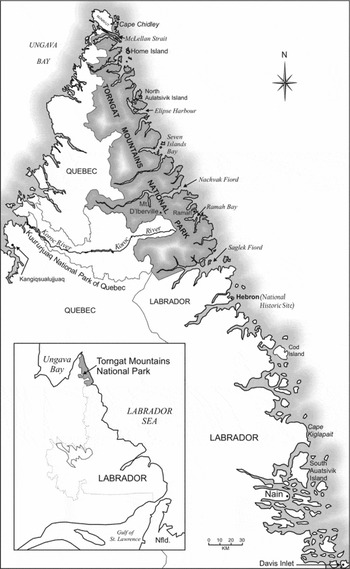
Torngat Mountains National Park (TMNP) (see Fig. 1) extends from Saglek Fjord in the south, to the northern tip of Labrador; and from the watershed boundary in the west, bordering the newly created Kuururjuaq Parc Nationale du Québec (KPNQ), to the waters of the Labrador Sea in the east (an area of roughly 9,700 km2) (Barbour Reference Barbour2008). TMNP has the highest mountains in Canada east of the Rocky Mountains, glaciers, fiords, and a variety of wildlife including caribou, seals, whales, raptors, and waterfowl (Parks Canada 2009). A large sub species of black bear (Barren-land variety) and the Arctic's primary ‘charismatic mega fauna’, the polar bear, are found throughout the park (Veitch and Harrington Reference Veitch and Harrington1996).
Torngat Mountains National Park and surrounding area. Source: C. Chapin, Lakehead University.

TMNP became a reality with the signing of the Labrador Inuit Land Claims Agreement forming the territory of Nunatsiavut in northern Labrador on 1 December 2005 (VanderKlippe Reference VanderKlippe2008a). The park is managed in partnership by a board wholly comprising Inuit members of Nunatsiavut and Nunavik (northern Québec); the Nunavik Inuit have traditionally used the area for hunting etc, and thus have equal representation in the parks impacts and benefits agreements. Considering that Inuit people in Labrador were dispossessed and relocated from their traditional harvesting areas from within what is today TMNP (Stix Reference Stix1982), the park should be viewed as a tremendous gift from the people of Nunatsiavut to Canada.
The current level of tourism
Tourism numbers in Labrador as opposed to Newfoundland are difficult to separate since provincial agencies generally do not make a distinction. Whilst the island of Newfoundland receives the bulk of visitors due to a variety of world renowned attractions, the mainland of Labrador has far fewer known attractions. Data provided by the provincial government (Newfoundland and Labrador 2009a) indicate that tourism is one of Newfoundland and Labrador's greatest economic drivers. From 2003–2007, non-resident visitation increased by 15%, and generated approximately $357 million (2007) in annual provincial revenue. As a whole, the industry contributes almost $790 million (2007) to the economy each year, supports 12,730 direct jobs in tourism, and generates significant economic and cultural spinoff (Newfoundland and Labrador 2009a).
Tourism in Labrador has been traditionally what many would describe as consumptive (generally fishing and hunting). However, since consumptive tourism has been in decline there is a growing desire amongst communities, government, operators and the like to expand and diversify current tourism offerings in a complimentary manner. Indeed, the province (both Newfoundland and Labrador) is gaining popularity as a destination for cruise ships as is evidenced by increased volumes of cruise traffic over the past decade. The number of cruise ship port calls totalled 152 during the 2008 cruise season compared to 102 in 2007 (Newfoundland and Labrador 2009b). While the number of port calls increased, the number of unique cruise visitors decreased by 31% to 19,800 during the 2008 cruise season. This decrease was mainly due to a lower load factor (the passenger capacity utilisation rate). The load factor was about 90% in 2008, down from 95% during the 2007 cruise season. Spending by non-resident cruise visitors also dropped 27.3% to $1.6 million over that time frame (Newfoundland and Labrador 2009b). As of January there were 136 port calls tentatively booked for the 2009 cruise season, down somewhat from 2008, but already exceeding 2007 levels, however, cruise traffic in Newfoundland and Labrador is still expecting to grow in 2009 (Newfoundland and Labrador 2009b).
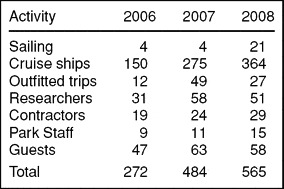
Hull (Reference Hull and Sahlberg2001) estimated that there were 21,000 adventure tourists to Labrador as a whole, and while the number of people spending time in TMNP is considerably lower it has steadily increased over the first three years of park designation (2006–2008). As there is no permanent settlement in the park, and no community to the south for more than 150 km (Nain), a large contribution to visitors in TMNP is the success of the Kangidluasuk/St. John's Harbour base camp. Kangidluasuk is located in Saglek Bay outside the park boundaries, but still within Nunatsiavut. This base camp is a staging point for researchers, contractors, park staff, and guests (Inuit elders, photographers, etc.), but is also a registration and education point for cruise visitors, sail boats and outfitted trips (see Table 1).
Visitor statistics (2006–2008) represented by activity groups (Source: Parks Canada, no date)

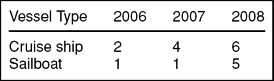
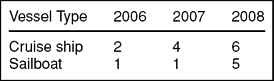
Visitors to the park have participated in many different activities including: backcountry skiing, canoeing, kayaking, backpacking, sightseeing, and activities associated with the base camp. By far the largest and fastest growing visitor group are those on expedition or ‘pocket’ cruise ships and sailboats (see Table 2). Longstanding visitation and partnerships with the expedition cruise industry are an important component of protecting, but also sharing, the landscape in TMNP.
Cruise ship and sailboats (2006–2008) (Source: Parks Canada, no date)
The reality is that current tourism has been somewhat limited due to what little has been portrayed in the media about the region. As the public, worldwide, becomes more aware of the plethora of opportunities available, Labrador, Nunatsiavut, and in particular TMNP are sure to see growth and development. As identified by the government of Nunasiavut (2006), both the opportunities and challenges are great, but there is a vision to manage this world class location through to 2014.
The tourism opportunities
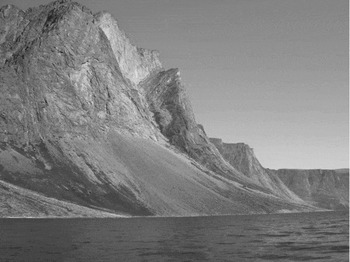
TMNP encompasses a spectacular landscape (see Fig. 2), and so there is speculation that it was partially created as a lucrative attraction to bring tourism income to the region (VanderKlippe Reference VanderKlippe2008a). The park, in addition to nearby historic sites, is a specific attraction opportunity listed in 2006 by the government of Nunatsiavut. Currently tourism opportunities are focused upon cruise tourism showcasing the natural landscape and wildlife of the area with brief on-site visits in some locations. Some specialised cruise tours actually focus upon seeing polar bears (for further information see Lemelin and Maher Reference Lemelin and Maher2009). While backcountry use is minimal at present, the opportunities provided by the newly established KPNQ to the west will increase access for canoeists, kayakers and hikers along the Koroc River corridor.
Looking up Northwest Arm in TMNP. Photo: P. Maher.

Another form of visitation, primarily offered in cooperation with Parks Canada, is for local Inuit to re-visit the park and to introduce the younger generation to the area. According to TMNP staff and proponents of the park this is essential if local people are going to understand the importance of protecting this area and reconnect to the land and its history. In order to achieve these goals, Parks Canada would like to establish a ‘watchmen’ type programme at the Hebron National Historic Site (outside TMNP), and is contemplating similar initiatives at other areas within the park (for example Ramah). A watchmen programme in TMNP is being designed partially along the lines of the Haida Gwaii watchmen programme at Gwaii Haanas National Park Reserve and Haida Heritage Site, a protected area on Haida Gwaii (the Queen Charlotte Islands) on Canada's west coast. In Gwaii Haanas, groups of Haida (the local indigenous nation) youth and adults, sometimes elders, are based at one of five traditional village sites from May to September each year. The Watchmen protect the sensitive heritage sites by simply living there and having adults teach youth traditional practices. However, they also manage the possibility of detrimental impacts to these sites and educate/interact with visitors (sometime they are visitors’ only contact with Haida culture while on Haida Gwaii).
There are a myriad of possibilities for tourism, some of which are already being utilised by tour operators, while others are only ideas at present. TMNP has very many polar bears, and from what the authors saw, they mostly avoid humans whenever possible. Observing this population may be a ‘next step’ for polar bear viewing enthusiasts after they have seen the considerably habituated polar bears of Churchill, Manitoba. However, it is the authors’ belief that polar bears should be, and will be, an add-on to trips to TMNP that have other primary purposes such as hiking, viewing the landscape and other flora/fauna. Viewing other large wildlife in the park is very possible as caribou abound in the interior and very large black bear roam along the coast. While the caribou numbers are prolific on the Labrador Peninsula, it is the opinion of the authors that seeing them will again be simply an add-on for coastal visitors. The population tends to stay in the interior of the park and thus may be more of a distinct attraction for hikers between TMNP and KNPQ. Unlike the polar bears, the TMNP caribou do not appear to be afraid of human activity, and may pose little to no threat to the visitors.
Nunatsiavut obviously has tremendous Inuit cultural heritage to share, but there is also Moravian missionary history in the region as well. Outside TMNP is the abandoned community of Hebron. This is an historic site partially managed by Parks Canada as well, and in recent years has seen a large amount of renovation activity (see Fig. 3). At present Hebron is a site well known to history enthusiasts and so once renovations are complete, and Inuit families potentially move back to the site for summer occupancy, it is certain that broader tourism growth will occur.
The multi-million dollar renovations at Hebron. Photo: P. Maher.

In light of the recent International Polar Year there appears to be interest by visitors to see science in action, available at sites such as the Kangidluasuk/St. John's Harbour base camp. However, once again it should be primarily an add-on to other primary tourism attractions because while some science occurs nearby, most takes place in areas that are not readily accessible from the coast and therefore not for tourists. Another issue is that scientists are obviously in the area to conduct science and are thus not always willing or available to interact with tourists. However, opportunities through volunteer tourism and learning vacations, in which participants are actively engaged in research projects with scientists, could be created.
With KPNQ bordering TMNP there is the opportunity for collaboration to draw tourism across the peninsula, but there is also potential competition, especially as the Nunavik parks system seems to be developing quickly and at quite a high level. Managed by Nunavik Parks, it is important to understand that while termed National Parks in Québec (for obvious political reasons), the park system in Nunavik is more like a regional or provincial system. With each community in Nunavik being assured a park to be developed nearby, due to landholdings agreements, it is only a matter of time before KPNQ (Nunavik's 2nd park; and linked to Kangiqsualujjuaq) sees the same level of development (see Fig. 4) as its first, Pingualuit Parc Nationale du Québec.
Hut system being developed for Pingualuit Parc Nationale du Québec, linking the park to the nearby village of Kangiqsujuaq. Photo: P. Maher.

The newly created KPNQ, established in May 2009, encompasses 4273 km2 of the Québec-Labrador Peninsula including the valley of the Koroc River and the spiritual grounds of the Torngat spirits after which TMNP is named (Kativik Regional Government 2009). The park protects the course of the Koroc River, from its source in the Torngat Mountains to its estuary at Ungava Bay, as well as Québec's tallest peak called Mount d'Iberville (named Mount Caubvik on the Labrador side) and the only forested valley in the Torngat peninsula (Kativik Regional Government 2005).
The tourism challenges
While the tourism opportunities in Labrador and TMNP are tremendous, like many other northern destinations in Canada, and indeed remote Arctic and Antarctic destinations globally, TMNP faces many challenges, including: short summers, transportation and access issues, and a lack of human and infrastructure capacity. TMNP is after all in a remote location serviced by very small communities. However, for some tourists, it is these particular factors that are the attractions. Specific to the opportunities noted earlier in this note, challenges for tourism in TMNP include: risk management and safety, competition from KPNQ, wildlife, developing culturally appropriate attractions and the fore mentioned issue of capacity.
Due to its remote location, the risk and safety issues for TMNP are obvious. Visitors need to be self-sufficient in their travel and only limited rescue capabilities exist through Parks Canada and the communities of Nain and Kangiqsualujjuaq. One of the largest risk and safety challenges for visitors to remote national parks in Canada, such as TMNP, is that they are not permitted to carry firearms and are encouraged to use appropriately licensed local guides (Lemelin and Maher Reference Lemelin and Maher2009). Local Inuit guides from Nunavik and Nunatsiavut are authorised to carry a firearm in the national park and have experience in polar bear territory (Brazil and Goudie Reference Brazil and Goudie2006), which is an excellent opportunity for local involvement and capacity building. However, as the number of visitors with different expectations increases, and as more national parks and protected areas are created in the Canadian Arctic and sub-Arctic, safety concerns for polar bear–human visitor interactions may force Parks Canada to re-examine their current firearm prohibitions in northern parks (Lemelin and Maher Reference Lemelin and Maher2009). This could mean that national parks in northern latitudes would be provided with a new set of rules permitting licensed non-indigenous guides to carry guns into the nine national parks spanning Canada's Arctic, including TMNP (VanderKlipp 2008b).
In terms of competition or collaboration, Nunavik Parks is moving quickly and decisively to develop KNPQ. An example of this is the forthcoming kayak expedition down the Koroc River offered by ABV Kayak and Excursion of Québec. Collaboration between the Nunatsiavut government, Makivik Corporation and Parks Canada is facilitated through the seven member co-operative management board for the TMNP. However, in the authors’ opinion it is quite important to take some of this informal good will and communication and put it on paper as formal agreements between the parks agencies regarding issues such as park fees, appropriate activities, search and rescue capabilities and responsibilities. If visitors become aware of the amazing potential of both KNPQ and TMNP beforehand, the signing of such formal agreements, which are absolutely necessary for appropriate management across the border, will probably fail as other practical tasks involving a growth in visitors become more urgent for park management.
Lemelin and Maher (Reference Lemelin and Maher2009) have discussed the challenges associated with viewing polar bears; an obvious wildlife attraction for TMNP. With recent scientific studies that tagged the bears and the limited interactions they have had with humans in general, the polar bear population in the Davis Straits tends to frighten easily. Due to this response it is usually difficult for visitors to see and photograph these bears. While smaller ships or zodiacs could provide better opportunities, these vehicles also create new challenges, which could cause stress the animals. If visitors are looking for a polar bear experience that goes beyond that of the polar bear viewing found in Churchill, then they will find it in TMNP, as in other remote global destinations such as Svalbard (see Lemelin and Maher Reference Lemelin and Maher2009; Lemelin and Dyck Reference Lemelin, Dyck, Higham and Lück2007). However, as visitors try to get closer and closer to the wildlife, the challenge of not carrying firearms becomes more problematic; this is not the case in Svalbard where carrying firearms is allowed. For the purposes of marketing tours, the challenge is also that polar bear viewing in TMNP will never be guaranteed, as it virtually is in Churchill. Therefore polar bears can really only be presented as a rather exciting add-on to a tour that is sold on its other merits (culture, history, landscape, etc.).
Another must for TMNP is that cultural attractions are presented in a market ready format; products and services must be at a high level of sophistication while being in a constant stage of development flux. Attractions should be strategically planned, complete with market research and risk management assessments; they should be able to handle an influx of visitors, be easily accessible by all types of visitor, and must not demonstrate a lack of cultural sensitivity. From government of Nunatsiavut (2006) documents it appears this is being planned for, but as is usually the case, the real challenge is putting it into action.
If sites (including burial sites) used by the Inuit are to be visited then perhaps there is a real need for a watchmen programme to protect such sites. As the first author has seen in Gwaii Haanas, if this type of programme is not well supported with financial and human capacity then it often becomes more of a challenge than an opportunity, and presents an attraction that may not be market ready. An on site programme is essential.
TMNP is a long way from major centres, and so depending on the growth of resources in Nain and Kangiqsualujjuaq there may also be problems with staffing a watchmen programme let alone providing for the other needs of visitors. Neither of the nearby communities is large, and there are factors that stretch community leaders in many directions, including consultation on mining, hunting, and other resource use in addition to tourism and protected areas. The lack of human capacity is an issue compounded by the lack of basic infrastructure such as sufficient hotels for workers and visitors alike, and food essentials for what could become a ‘horde’ of visitors at short notice given the right conditions, for example a visit from a large cruise vessel.
Conclusions
Stix (Reference Stix1982) and Veitch and Harrington (Reference Veitch and Harrington1996), foresaw that with the completion of land treaties and the creation of national parks in northern Labrador and northern Quebec there would be an increased awareness and interest in visiting the area. While TMNP is a new park with limited visitation at present there are considerable opportunities for future growth that will lead to inevitable challenges for the management board and the park staff. Given the status of polar bears as an iconic Arctic species, a nearly completed renovation at Hebron, and recently announced funding for the infrastructure in the park, much thought is necessary concerning how marketing strategies and management may improve tourist experiences and yet mitigate tourism impacts. TMNP is a phenomenal attraction for Nunatsiavut, and holds tremendous potential for cultural learning amongst visitors and economic sustainability for the Inuit. It must be hoped that tourism development in the region is done responsibly and with appropriate consultation of the local Inuit communities and other stakeholders.
Acknowledgements
The authors would like to thank all those who made their visits to TMNP in August 2008 and July 2009 possible and enjoyable: Parks Canada staff in Nain, Judy Rowell, Angus Simpson, Gary Baikie, and Rosie Lyall; logistics staff, kitchen staff, bear monitors and other visitors at the Kangidluasuk base camp. Thanks also to Cathy Chapin, cartographer at Lakehead University for creating Fig. 1.