Introduction
The genus Alpheus Fabricius, Reference Fabricius1798 with 307 species is the most specious genus of the family Alpheidae (De Grave & Fransen, Reference De Grave and Fransen2011; Almeida et al., Reference Almeida, Terossi and Mantelatto2014; Bracken-Grissom et al., Reference Bracken-Grissom, Robles and Felder2014; Anker & Pachelle, Reference Anker and De Grave2015; Anker, Reference Anker2018; Komai & Ohtomi, Reference Komai and Ohtomi2018), however, the number of species in the genus is estimated to be over 400 (Anker et al., Reference Anker, Ahyong, Noël and Palmer2006). This genus has not been well studied in the Persian Gulf (Anker & De Grave, Reference Anker, Hurt and Knowlton2009). The first study on alpheids of the Persian Gulf resulted in the description of two species, namely A. bucephaloides Nobili, Reference Nobili1905, and A. persicus Nobili, Reference Nobili1905 (now considered a junior synonym of A. malleodigitus (Spence Bate, Reference Bate1888)). Shortly afterwards, Nobili (Reference Nobili1906) in a detailed review of the material collected by J. Bonnier and Ch. Pérez from the region added two species: A. audouini Coutière, Reference Coutière1905 (currently considered to be a synonym of A. edwardsii (Audouin, Reference Audouin1826)) and A. alcyone De Man, Reference De Man1902. Later, Banner & Banner (Reference Banner and Banner1966) examined the unnamed Alpheus sp. of Nobili (Reference Nobili1906) and described this as a new species, A. nobili Banner & Banner, Reference Banner and Banner1966. Further, new records of A. distinguendus De Man, Reference De Man1909 (now considered a junior synonym of the Japanese A. digitalis De Haan, Reference De Haan1844 (in De Hann, 1833–1850)) and an Alpheus sp. were recorded from Kuwait by Motoh (Reference Motoh1975). Shortly afterwards, Basson et al. (Reference Basson, Burchard, Hardy and Price1977) recorded Alpheus dentipes Guérin, Reference Guérin1832 from the Persian Gulf coast of Saudi Arabia. The caridean material collected by the Danish Expedition in Iran from 1937 to 1938 was examined by Banner & Banner (Reference Banner and Banner1981), and six Alpheus species were recorded from the Persian Gulf. However, they provided no exact locality details. These are A. bisincisus De Haan, Reference De Haan1844 (in De Hann, 1833–1850), A. euphrosyne De Man, Reference De Man1897, A. lobidens De Haan, Reference De Haan1844 (in De Hann, 1833–1850), A. lottini Guérin-Meneville, Reference Guérin-Méneville1838 (in Guérin-Meneville, 1829–1838), A. rapax Fabricius, Reference Fabricius1798, and A. parvirostris Dana, Reference Dana1852. In the ‘Field Guide to Sea Shores of Kuwait’, Jones (Reference Jones1986) later recorded A. djeddensis Coutière, Reference Coutière1897. Recently, a new species was described from Kuwait as A. lutosus Anker & De Grave, Reference Anker and De Grave2009. An updated list of caridean shrimps was provided by De Grave & Ashelby (Reference De Grave and Ashelby2011), including 14 species of Alpheus. Three more species were recorded by Naderloo & Türkay (Reference Naderloo and Türkay2012) from the Iranian coast, namely A. edamensis De Man, Reference De Man1888, A. macrodactylus Ortmann, Reference Ortmann1890 and A. paracrinitus Miers, Reference Miers1881. Naderloo et al. (Reference Naderloo, Türkay and Sari2013) later recorded two new records as Alpheus spp. from the Qeshm Island. In total, 17 species of the genus Alpheus were known prior to the current study from the Persian Gulf, although some of the records appear to be rather dubious. However, the actual alpheid diversity of the Persian Gulf is clearly under-studied and comprehensive sampling and a thorough taxonomic review are required. In the present study, three medium-sized new species belong to the A. edwardsii species group are described.
Materials and methods
From May 2014 to June 2017, a series of surveys was carried out in Abu-Musa Island, as part of the projects ‘Crustacean diversity along the Iranian coast’ and ‘Biodiversity of the Intertidal Region of Abu-Musa Island’. Fresh material for the present study was collected from four stations around the island by hand. Colour photographs were immediately taken in the field. The samples were preserved in 95% ethanol, and then kept in a −20°C refrigerator for long-term preservation for molecular studies. The holotypes, allotypes and paratypes are deposited in the Zoological Museum, University of Tehran (ZUTC) and some paratypes will be deposited at Naturalis Biodiversity Centre (formerly Rijksmuseum van Natuurlijke Historie) (RMNH). Holotypes were examined for morphological characters, while two paratypes (male and female) specimens were used for drawings. All the drawings were made using a camera lucida fitted on a stereomicroscope Leica MZ6.
Systematics
Order Decapoda Latreille, Reference Latreille1802
Family Alpheidae Rafinesque, Reference Rafinesque1815
Genus Alpheus Fabricius, Reference Fabricius1798
Alpheus ankeri sp. nov.
(Figures 1A & B and Figure 2)
Type material: Holotype: adult male, carapace length (CL) 8.4 mm, ZUTC 6660, Qadir Park, Abu-Musa Island, Persian Gulf, Iran, 25°53′45″N 55°02′23″E, rock crevices, 10 May 2016, Coll. A. Dehghani, A. Sari, R. Naderloo and H. Ashrafi. Allotype: adult female, CL 9.1 mm, ZUTC 6661, same data as holotype. Paratypes (CL range 8–9 mm): 4 males, 5 females, ZUTC 6666, same data as holotype. Paratypes: 4 males, 2 females, ZUTC 6665, Siri Island, Persian Gulf, Iran, 25°53′48″N 54°32′21″E, rock crevices, Coll. A. Dehghani, A. Sari and S. Ashrafi, 5 November 2016.
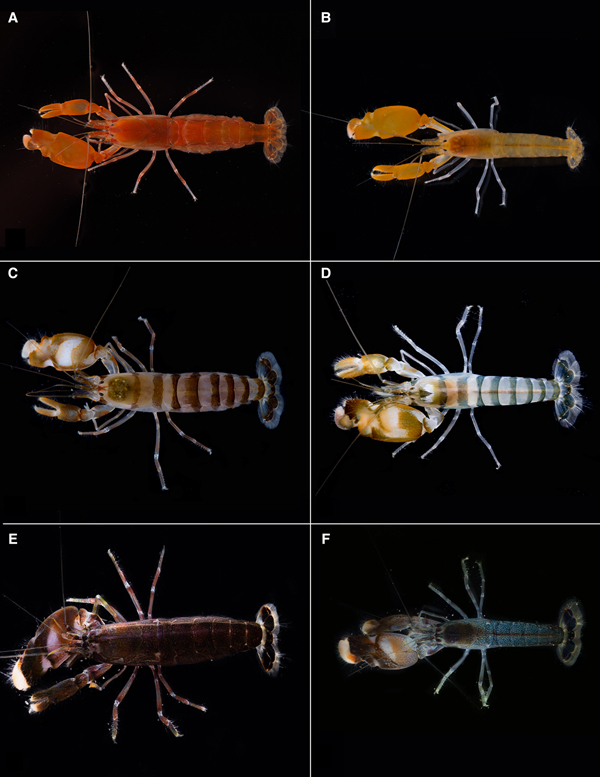
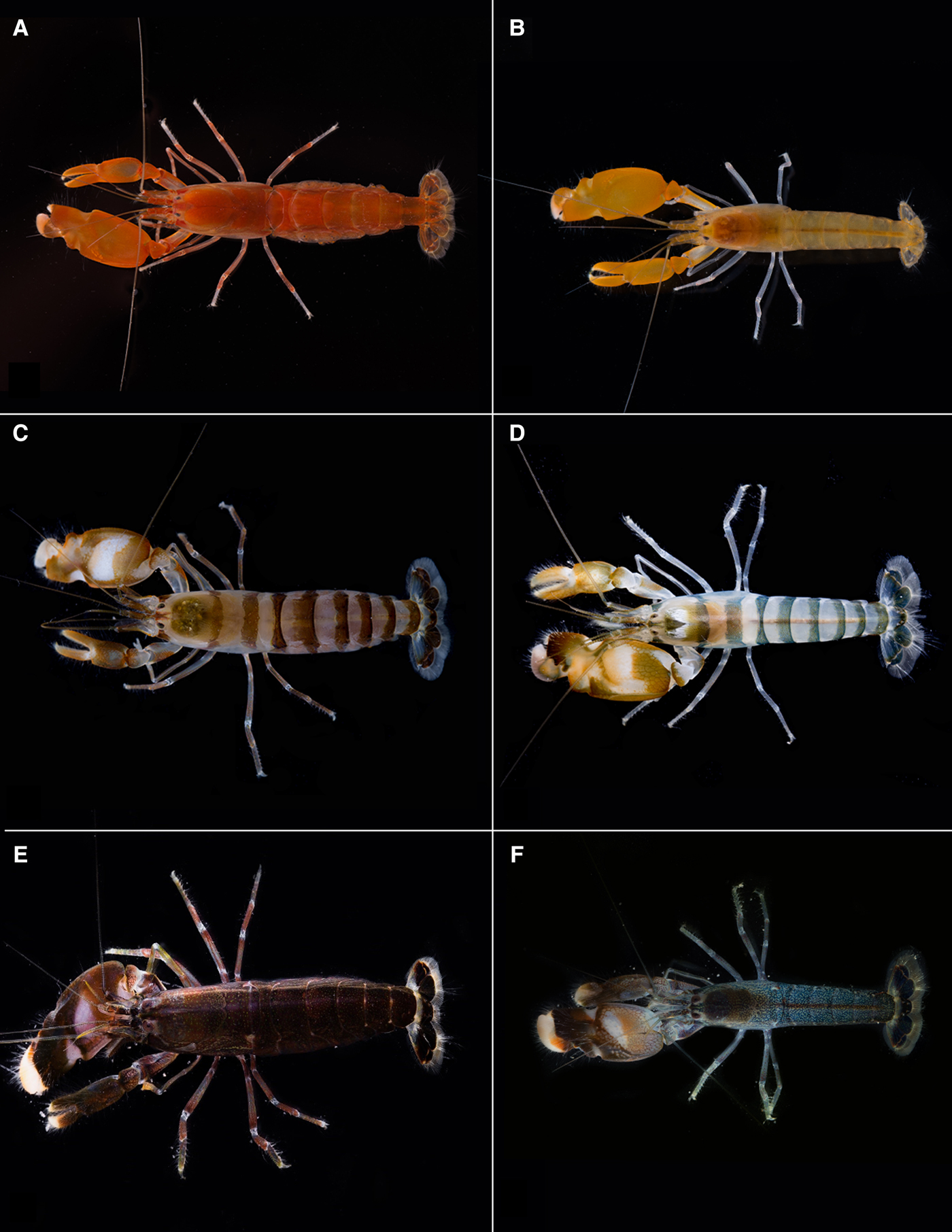
Three new species of the genus Alpheus from Abu-Musa Island, Hormozgan, Persian Gulf, colour pattern in life. (A) Alpheus ankeri sp. nov., male holotype CL 8.4 mm; (B) female CL 9.1 mm; (C) A. abumusa sp. nov., male holotype CL 8.9 mm; (D) female CL 8.8 mm; (E) A. mohammadpouri sp. nov., male holotype CL 8.3 mm; (F) female CL 9.4 mm.
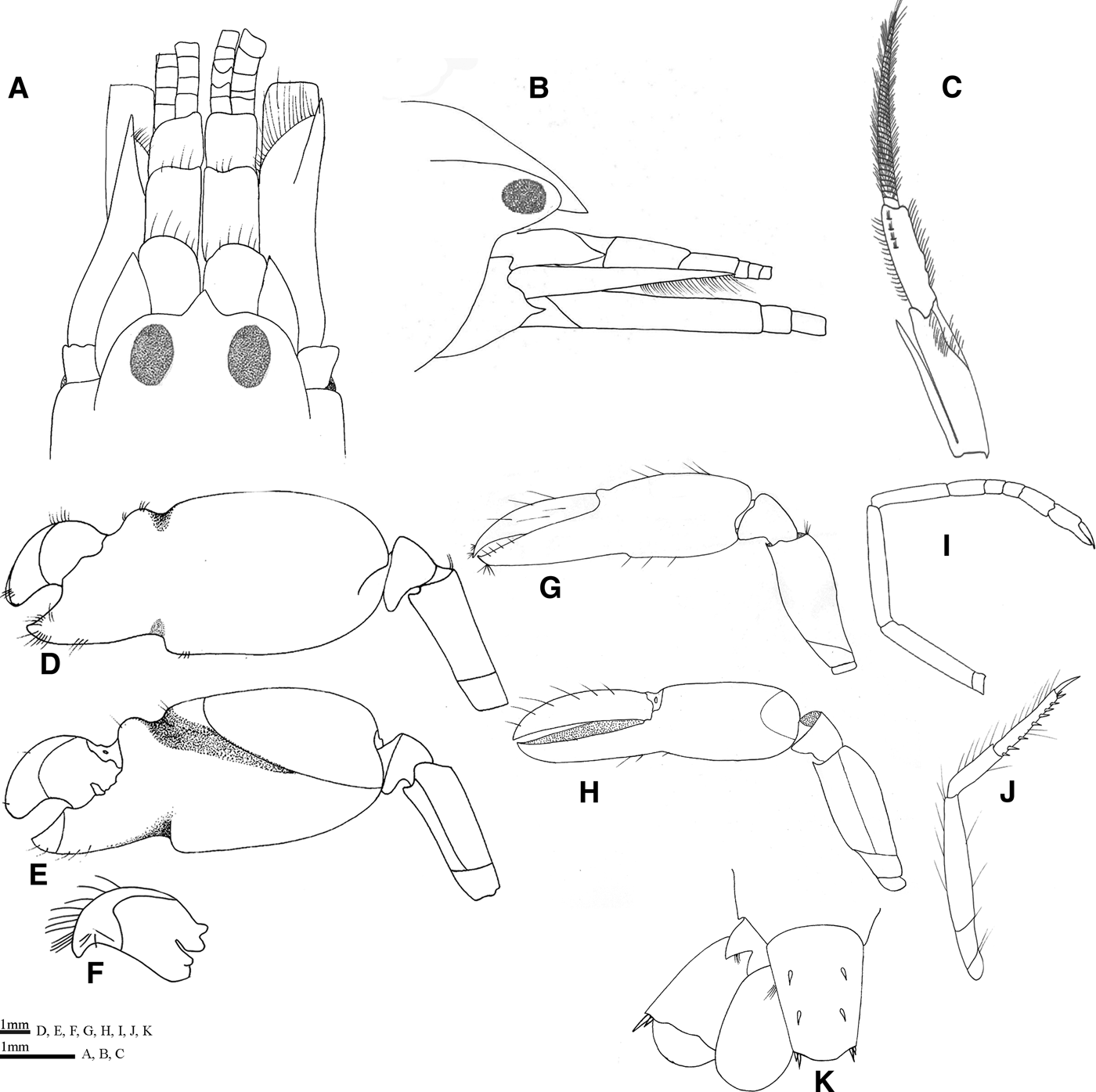
Alpheus ankeri sp. nov., male paratype. (A) frontal region, dorsal view and (B) lateral view; (C) third maxilliped, mesial view; (D) right major chela, lateral view and (E) mesial view; (F) dactylus showing plunger in lateral view; (G) left minor chela in lateral view and (H) mesial view; (I) right second pereiopod in lateral view; (J) right third pereiopod in lateral view; (K) telson and uropods in dorsal view.

Type locality: Persian Gulf, Abu-Musa Island, Iran.
Description
Medium-sized species of Alpheus (CL range 8–9 mm). Carapace smooth, not setose. Rostrum small and conical, slightly longer than broad at base, tip not reaching to middle of first article of antennular peduncle; rostral carina not distinct. Orbital hoods rounded and anterior margin unarmed, slightly concave near rostrum, no projections between rostrum and orbital hoods. Pterygostomial angle rounded, not protruding (Figure 2A & B). Cardiac notch well developed.
Antennular peduncle with second segment of about 1.5 times as long as visible part of first and about twice as long as third; stylocerites with sharp point reaching to end of first article; ventromesial carina with small and broadly triangular tooth. Antenna with stout basicerites bearing small and acute distoventral tooth; scaphocerite with concave lateral margin and well-developed blade, latter not over-reaching strong distolateral tooth; carpocerites remarkable and reaching beyond scaphocerite (Figure 2A & B).
Mouthparts (Figure 2C) not dissected, typical for Alpheus in external view; third maxilliped slender, pediform; when extended markedly longer than antennular peduncle and carpocerite; antepenultimate article flattened ventromesially; penultimate and ultimate segment as illustrated, not species-specific; exopod equal to distal margin of antepenultimate segment.
Major chela (Figure 2D–F) generally similar in both sexes, not significantly larger in males; ischium short, stout; merus relatively stout, about 2.9 as long as wide, distodorsal margin curved, distomesial unarmed, with blunt distal end; carpus short, cup-shaped, with broadly rounded distal lobes; dorsal groove of major chela almost abruptly rounded, not extending posteriorly on mesial face, dorsal shoulder rounded, not overhanging, ventral shoulder rounded, slightly protruding anteriorly (Figure 2E); dactylus longer than pollex, distally rounded, not twisted, with large stout plunger; adhesive discs well developed (Figure 2D–F).
Minor chela (Figure 2G &H) not sexually dimorphic, slender than major chela; ischium very short; merus stout, about 2.5 times as long as wide, distodorsal margin ending curved; distomesial without tooth, with broad dorsal lobe; carpus short, cup-shaped; palm almost equal to length of fingers; palm surface smooth, without any grooves and crests; fingers equal in length, crossing distally, covered with scattered long setae; dactylus almost flattened dorsally; pollex thicker than dactylus; opposing surface of fingers excavate (Figure 2H).
Second pereiopod (Figure 2I) slender; merus 1.1 as long as ischium; carpus with five joints; first segment about two times as long as second; second segment two times as long as third; third and fourth segments nearly equal in length; fifth segment about two times as long as fourth (6:3:2:2:3); chela simple, as long as two distal-most carpal joints combined. Third (Figure 2J) and fourth pereiopod generally similar, relatively slender; ischium without spine-like seta; merus around five times as long as wide; merus 1.75 as long as carpus, without spine-like seta; propodus about as long as carpus but shorter than merus, inferior margin with seven spine-like setae and one distal pair near dactylus, dorsolateral side with row of long setae; dactylus conical, long and pointed, about one fourth of propodus.
Telson (Figure 2K) subrectangular, tapering distally, about 1.75 times as long proximal width, lateral margin slightly convex; dorsal surface with two pairs of postero-lateral spine-like setae, first pair at about mid-length part, second pair on about 3/4 telson length; each posterolateral angle with pair of spine-like setae, mesial about twice as long as lateral. (Figure 2K).
Uropod with bifid protopod, inner and outer lobes ending in acute tooth, exopod and endopod more or less equal in length, rounded distally; exopodal diaeresis with three small lobes separated by two notches; corner of disto-lateral margin of protopod bearing tufts of setae (Figure 2K).
Colour pattern (Figure 2A & B): Based on living specimens, female and male individuals show dimorphism. Females with carapace, abdomen, major and minor chela and uropods dark brown orange. Male carapace, abdomen, major and minor chela and uropods with pale orange and walking legs semi-transparent with red patches.
Habitat: All specimens were collected from exposed rocky shores near to high intertidal in deep crevices of the bedrock made of coarse sand where they experience short periods of dry environment during low tide.
Distribution: Presently only known from the Abu-Musa and Siri Islands, Persian Gulf, Iran.
Etymology: The species is named after Dr Arthur Anker, a well-known carcinologist for his valuable contribution to caridean taxonomy.
Remarks. Alpheus ankeri sp. nov. is morphologically closest to four species, namely A. bunburius Banner & Banner, Reference Banner and Banner1982, A. pacificus Dana, Reference Dana1852, A. tasmanicus Banner & Banner, Reference Banner and Banner1982, and A. heronicus Banner & Banner, Reference Banner and Banner1982. These five species are characterized by lacking a tooth on the merus of the major chela and showing no balaeniceps in both sexes.
Alpheus ankeri sp. nov. can be separated from A. pacificus and A. heronicus mainly by the absence of an overhanging shoulder in the major chela.
The new species is also easily distinguishable from A. bunburius by the presence of markedly shorter fingers, which are one third as long as the palm, while in A. bunburius the fingers are equal to the palm. Alpheus tasmanicus differs from A. ankeri sp. nov. in lacking spine-like setae on the ischium of the third legs and in addition the superior shoulder is not subrectangular in cross section.
Alpheus abumusa sp. nov.
(Figures 1C & D and Figure 3)
Type material. Holotype: adult male CL 8.9 mm, ZUTC 6662, Qadir Park, Abu-Musa Island, Persian Gulf, Iran, 25°53′45″N 55°02′23″E, in holes or canals in massive dead coral, 10 May 2016, Coll. A. Dehghani, A. Sari, R. Naderloo and H. Ashrafi. Allotypes: adult female CL 8.8 mm, ZUTC 6663 same data as holotype; Paratypes (CL range 8–9 mm): 5 males, 7 females, ZUTC 6667, same data as holotype.
Type locality: Abu-Musa Island, Persian Gulf, Iran.
Description
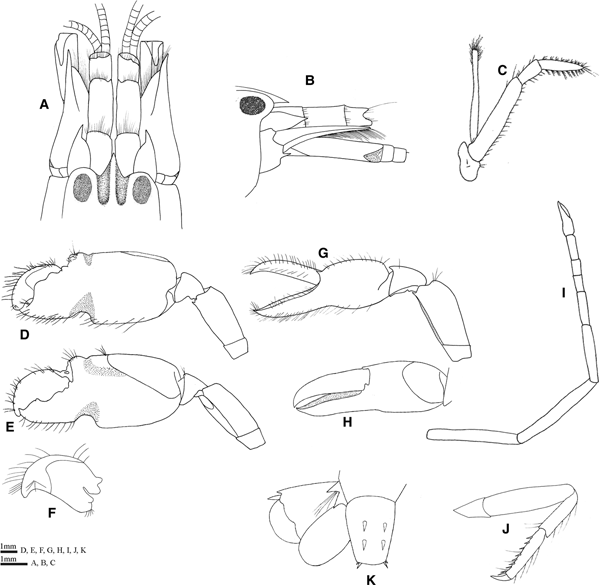
Medium-sized species of Alpheus (CL range 8–9 mm). Carapace smooth, not setose. Rostrum conical, slightly longer than broad at base, tip reaching to middle of first article of antennular peduncle; rostral carina distinct, slightly rounded dorsally, and continuing to base of eyes. Orbital hoods rounded and anterior margin unarmed, slightly concave near rostrum, no projections between rostrum and orbital hoods. Pterygostomial angle rounded, not protruding (Figure 3A & B). Cardiac notch well developed.
A. abumusa sp. nov., male paratype. (A) frontal region, dorsal view and (B) lateral view; (C) third maxilliped, lateral view; (D) right major chela, lateral view and (E) mesial view; (F) dactylus showing plunger in lateral view; (G) left minor chela in lateral view and (H) mesial view; (I) right second pereiopod in lateral view; (J) right third pereiopod in lateral view; (K) telson and uropods in dorsal view.

Antennular peduncle with second segment about 1.8 times as long as visible part of first and more than twice as long as third; stylocerites with sharp point extending beyond end of first article; ventromesial carina with small and broadly triangular tooth. Antenna with stout basicerites bearing small and acute distoventral tooth; scaphocerite with concave lateral margin and well-developed blade, latter not over-reaching strong distolateral tooth; carpocerites remarkable and extending beyond scaphocerite (Figure 3A & B).
Mouthparts (Figure 3C) not dissected, typical for Alpheus in external view; third maxilliped slender, pediform; when extended markedly longer than antennular peduncle and carpocerite; antepenultimate article flattened ventromesially; penultimate and ultimate segment as illustrated, not species-specific; exopod equal to antepenultimate segment.
Major chela (Figure 3D–F) generally similar in both sexes, not significantly larger in males; ischium short, stout; merus relatively stout, about 2.9 as long as wide, distodorsal margin curved, distomesial margin bearing an acute tooth terminally; carpus short, cup-shaped, with broadly rounded distal lobes; ventral margin with deep, broad transverse groove connecting to inverse V-shaped inferior lateral palmar depression, ventral shoulder not protruding anteriorly, rounded; dactylus longer than pollex, distally rounded, not twisted, with large stout plunger; adhesive discs well developed.
Minor chela (Figure 3G & H) similar to male but different in proportions, not sexually dimorphic, slender than major chela; ischium very short; merus stout, about 2.5 times as long as wide, distodorsal margin ending curved; distomesial with subacute tooth, with broad dorsal lobe; carpus short, cup-shaped; palm almost equal to length of fingers; palm surface smooth, without any grooves and crests; fingers equal in length, crossing distally, covered with scattered long setae; dactylus almost flattened dorsally; pollex thicker than dactylus; opposing surface of fingers excavate (Figure 3H).
Second pereiopod (Figure 3I) long and slender; merus and ischium almost equal; carpus with five joints; first segment about 1.5 times as long as second; second segment two times as long as third; third and fourth segments nearly equal in length; fifth segment 2.2 times as long as fourth segment (proximal to distal ratios: 4:2:1:1:2); chela simple, fingers nearly equal to palm.
Third (Figure 3J) and fourth pereiopods generally similar; ischium without spine-like seta; merus around five times as long as wide, without spine-like seta; carpus slightly longer than half of merus; propodus about 1.3 times as long as carpus but shorter than merus, ventral margin with seven spine-like setae and one distal pair near dactylus, dorsolateral side with row of long setae; dactylus conical, about 0.25 times as long as propodus.
Telson (Figure 3K) almost subrectangular, tapering distally, about 1.75 times as long as proximal width, lateral margin slightly convex; dorsal surface with two pairs of postero-lateral spine-like setae, first pair at about mid-length part, second pair on about 3/4 telson length; each posterolateral angle with pair of spine-like setae, mesial about twice as long as lateral.
Uropod (Figure 3K) with bifid protopod, inner and outer lobe ending in acute tooth, bearing tuft of long setae as illustrated, exopod and endopod more or less equal in length, rounded distally; exopodal diaeresis with three small lobes separated by two notches.
Colour pattern (Figure 1C & D): Based on live specimens, body generally translucent with brownish orange hands, hepatopancreas olive brown, abdomen with transverse broad dark green bands, fingers of major chela opaque white.
Habitat: This species characteristically is found in holes or canals in dead massive coral.
Distribution: Presently only known from the Abu-Musa Island, Persian Gulf, Iran.
Etymology: The species is named after the type locality, Abu-Musa.
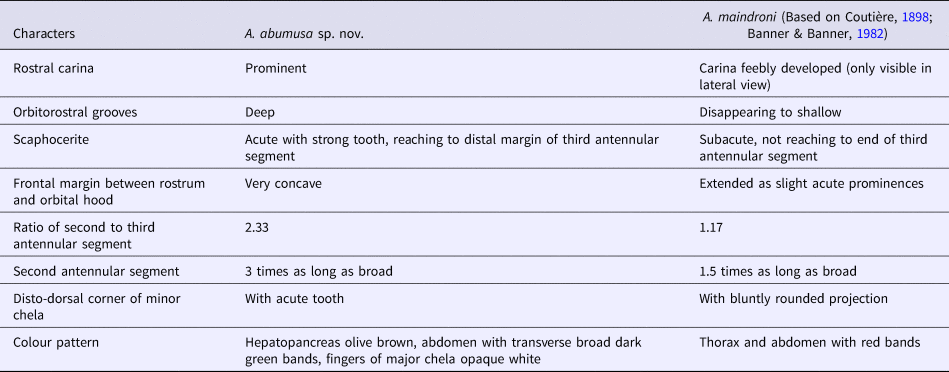
Remarks. Alpheus abumusa sp. nov., based on the palm shape, is closely allied to A. parvirostris Dana, Reference Dana1852, A. bannerorum Bruce, Reference Bruce1987 and A. maindroni Coutière, Reference Coutière1898. This new species differs from A. parvirostris by the lack of a spine on the merus of the third pereiopods, while the spine is markedly distinct in A. parvirostris. Alpheus bannerorum is readily distinguishable from A. abumusa sp. nov. by the presence of very obvious eye-like spots on the second and third somites of abdomen (see Anker & De Grave, Reference Anker and De Grave2016: 345, Figure 2). The new species is more similar to Alpheus maindroni Coutière, Reference Coutière1898, than any others in the A. edwardsii species group. Alpheus maindroni Coutière, Reference Coutière1898, was originally described from Muscat by Coutière (Reference Coutière1898), and was defined by short and carinate rostrum, third pereiopods with unarmed ischia, merus of major chela with a disto-mesial tooth, uropod with a distinctly bilobed transverse suture and the male minor chela with well developed balaeniceps fingers. The main diagnostic feature of A. maindroni is a prominently elevated area in front of the dorsal notch of the major chela (see Coutière, Reference Coutière1898; Banner & Banner, Reference Banner and Banner1982; Anker & De Grave, Reference Anker and De Grave2016). Using the last characteristics, A. abumusa sp. nov. is easily distinguished from A .maindroni in bearing a short, non-elevated area in front of the dorsal notch of the major chela (see Figure 3D & E). In addition, the second major discriminating feature that separates A. maindroni from A. abumusa sp. nov. is the deep orbito-rostral grooves and prominent carina, which is feebly developed in the latter species (Table 1).
Morphological discriminative features of A. abumusa sp. nov. compared to morphologically related species A. maindroni

Alpheus mohammadpouri sp. nov.
(Figures 1E & F and Figure 4)
Type material. Holotype: adult male CL 8.3 mm, ZUTC 6658, Qadir Park, Abu-Musa Island, Persian Gulf, Iran, 25°53′45″N 55°02′23″E, rock crevices, Coll. A. Dehghani, R. Naderloo and A. Sari, 10 May 2016; Allotype: adult female CL 9.4 mm, ZUTC 6659, same data as holotype; Paratypes: 2 males, 3 females, ZUTC 6664, locality data same as holotype, Coll. A. Dehghani and H. Ashrafi, 10 April 2016. Paratypes: 4 males, 2 females (CL range 8–9.5 mm), ZUTC 6708, Siri Island, Persian Gulf, Iran, 25°53′48″N 54°32′21″E, rocks crevices, Coll. A. Dehghani, A. Sari and S, Ashrafi, 5 November 2016.
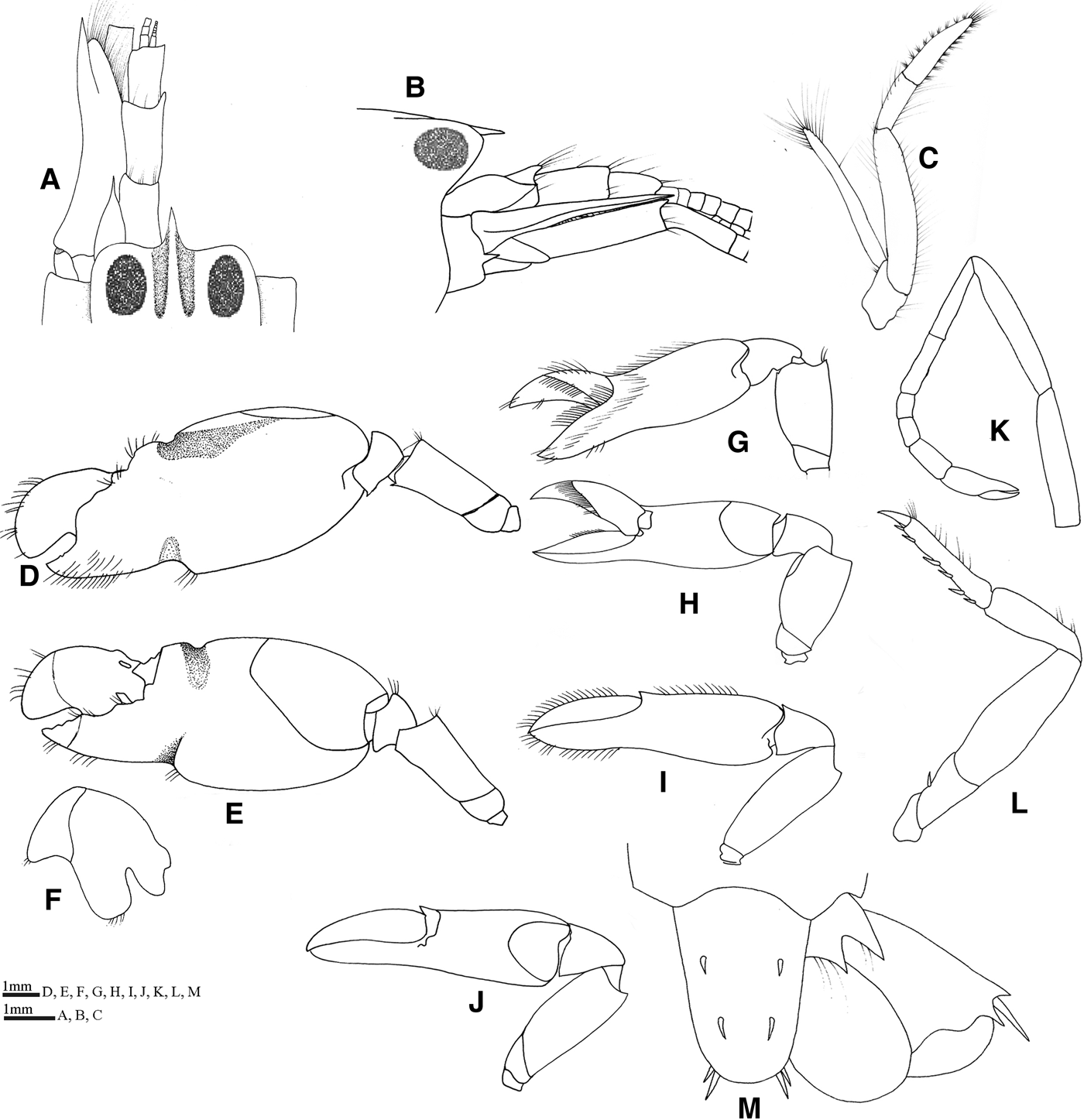
A. mohammadpouri sp. nov., male paratype. (A) frontal region in dorsal view and (B) lateral view; (C) third maxilliped in lateral view; (D) right major chela in lateral view and (E) mesial view; (F) dactylus showing plunger in lateral view (G) left minor chela of male in lateral view and (H) mesial view; (I) left minor chela of female in lateral view and (J) mesial view; (K) right second pereiopod in lateral view; (L) right third pereiopod in lateral view; (M) telson and uropods in dorsal view.

Type Locality: Abu-Musa Island, Persian Gulf, Iran.
Description
Medium-sized species of Alpheus (CL range 8–9.5 mm). Carapace smooth, not setose. Rostrum conical, slightly longer than broad at base, tip reaching to middle of first article of antennular peduncle; rostral carina marked, rounded dorsally, and reaches posterior to orbital hoods. Orbital hoods rounded and anterior margin unarmed, slightly concave near rostrum, no projections between rostrum and orbital hoods. Pterygostomial angle rounded, not protruding (Figure 4A & B). Cardiac notch well developed.
Antennular peduncle with second segment about 1.5 times as long as visible part of first and more than twice as long as third; stylocerites with sharp point extending end of first article; ventromesial carina with small and broadly triangular tooth. Antenna with stout basicerites bearing small and acute distoventral tooth; scaphocerite with concave lateral margin and well-developed blade, latter not over-reaching strong distolateral tooth; carpocerites remarkable and extending beyond scaphocerite (Figure 4A & B).
Mouthparts (Figure 4C) not dissected, typical for Alpheus in external view; third maxilliped slender, pediform; when extended markedly longer than antennular peduncle and carpocerite; antepenultimate article flattened ventromesially; penultimate and ultimate segment as illustrated, not species-specific; exopod equal to antepenultimate segment.
Major chela (Figure 4D–F) generally similar in both sexes, not significantly larger in males; ischium short, stout; merus relatively stout, about 2.6 as long as wide, distodorsal margin curved, distomesial with acute tooth; carpus short, cup-shaped, with broadly rounded distal lobes; dorsal groove of major chela almost abruptly rounded, not extending posteriorly on mesial face, dorsal shoulder rounded, not overhanging, ventral shoulder rounded, slightly protruding anteriorly (Figure 4E); dactylus longer than pollex, distally rounded, not twisted, with large stout plunger; adhesive discs well developed (Figure 4D–F).
Minor chela (Figure 4G–J) sexually dimorphic, more slender than major chela; ischium very short; merus stout, about 3.5 times as long as wide, distodorsal margin ending curved; distomesial without tooth, with broad dorsal lobe; carpus short, cup-shaped; palm almost equal to length of fingers; palm surface smooth, without any grooves and crests; fingers equal in length, crossing distally, covered with scattered long setae; dactylus almost flattened dorsally; pollex thicker than dactylus; opposing surface of fingers excavate.
Second pereiopod (Figure 4K) slender; merus longer than ischium; carpus with five joints, ratio of segments approximately equal to 3.5:2.5:1:1:2; chela simple, fingers slightly shorter than palm.
Third (Figure 4L) and fourth pereiopods generally similar, relatively slender; ischium with spine-like seta; merus around 4.5 times as long as wide; carpus about half as long as merus, without spine-like seta; propodus 1.2 times as long as carpus but shorter than merus, inferior margin with five spine-like setae and one distal pair, dorsolaterally with row of short setae; dactylus, simple, conical, about 1/4 of propodus length.
Telson (Figure 4M) almost subrectangular, tapering distally, about 2.2 times as long as proximal width, lateral margin slightly convex; dorsal surface with two pairs of postero-lateral spine-like setae, first pair at about mid-length part, second pair on about 3/4 telson length; each posterolateral angle with pair of spine-like setae, mesial about twice as long as lateral.
Uropod (Figure 4M) with bifid protopod, inner and outer lobe ending in acute tooth, exopod and endopod more or less equal in length, rounded distally; exopodal diaeresis sinuous.
Colour pattern: Based on living material, females and males show dimorphism in colour pattern. In females the carapace, abdomen, walking legs and uropods are dark brown with evenly scattered green chromatophores; major and minor chela brown mesially with white patches on mesial surface, finger tips of major chelae white; antennular and antennal peduncle transparent; margin of uropods and telson with transverse white band proximally (Figure 1E). Males with carapace surface dark brown; abdomen and walking legs semi-transparent with blue chromatophores; uropods and telson, dark blue with intense blue chromatophores, anterior margin of uropods and telson with transverse white band; major and minor chela brown mesially with light patches on mesial surface, fingertips of major chela light; antennular and antennal peduncle transparent (Figure 1F).
Habitat: This species was found in crevices of massive rocks and all specimens were collected in the same habitat as A. ankeri sp. nov.
Distribution: Presently only known from the Abu-Musa and Siri Islands, Persian Gulf, Iran.
Etymology: The species is named in honour of Alireza Mohammadpour for his encouragement and support of AD.
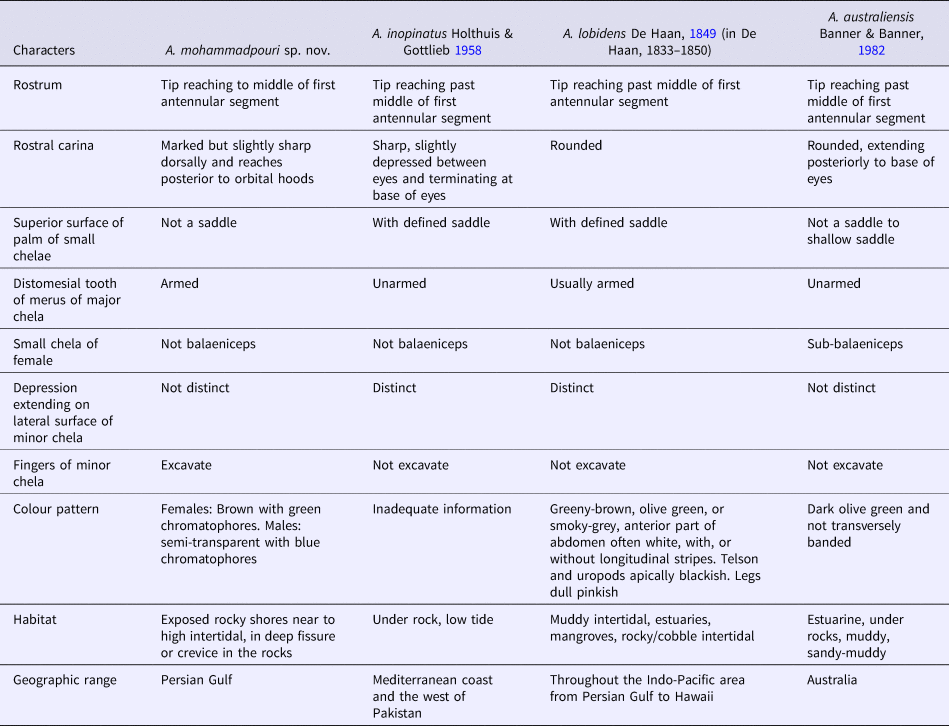
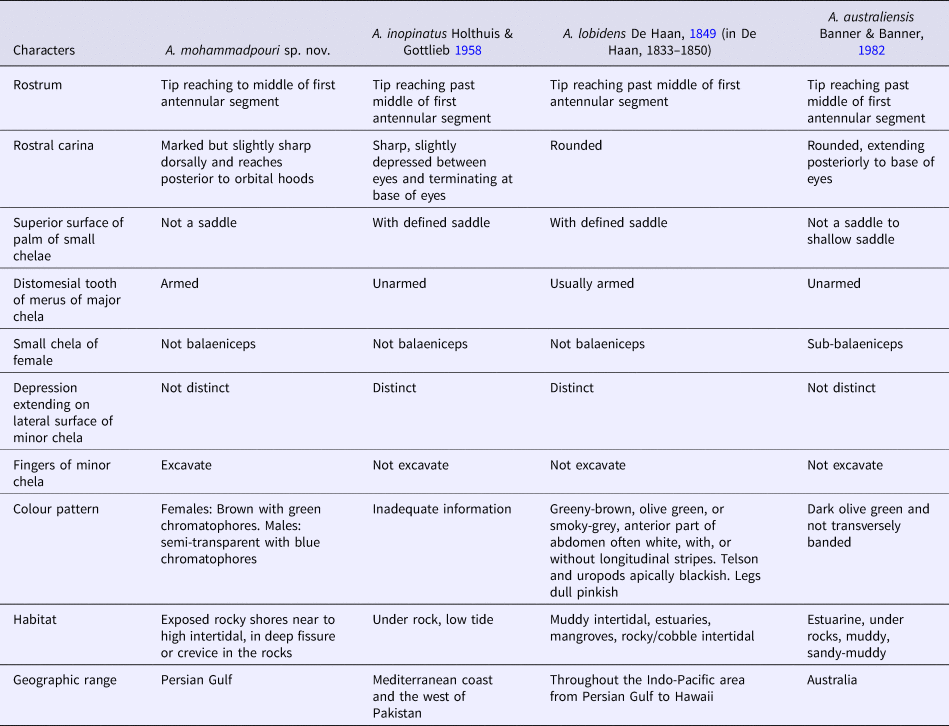
Remarks. The alcohol-preserved specimens of A. mohammadpouri sp. nov. which are now bleached show close similarity to A. inopinatus, A. lobidens and A. australiensis Banner & Banner, Reference Banner and Banner1982, more than any other species in the A. edwardsii group. But this new species is easily differentiated from these related species by its particular colour pattern, which is easily recognized in the field. But this is not the case when one works with preserved material only. The major morphological discriminating feature that separates A. mohammadpouri sp. nov. from A. inopinatus is the absence of sculpturing on the palm of the minor chela. In A. inopinatus, the superior surface of the palm is marked with a defined saddle and strong tooth flanking the dactylar articulation medially. While A. mohammadpouri sp. nov. shows no sculpturing on the palm of the minor chela. Alpheus australiensis is distinct from this new species by the presence of sub-balaeniceps in female individuals compared with females of the new species which lack balaeniceps. Another diagnostic character is the presence of a disto-mesial tooth on the merus of the major chela, while this is absent in A. australiensis. The new species is distinguished from A. lobidens using two main characteristics: (1) superior surface of the palm of the minor chela lacking saddle in A. mohammadpouri sp. nov, and (2) fingers of minor chela are clearly excavate in the new species (Table 2).
Morphological features for distinguishing Alpheus mohammadpouri sp. nov. from the closest species
Discussion
The genus Alpheus was divided by Coutière (Reference Coutière1905) into seven groups. These are A. macrocheles, A. sulcatus, A. obesomanus, A. diadema, A. brevirostris, A. crinitus, A. edwardsii. All of these are found in the Persian Gulf. In addition to 17 previously recorded species, there is evidence for 17 species of this genus and eight species of Synalpheus from the region (current authors and H. Ashrafi unpublished data). During an ongoing project on decapod diversity of the Persian Gulf and Gulf of Oman by the authors, the new species were found in Abu-Musa Island rocky habitat in an area of about 250 m2 and a few specimens in similar habitat in Siri Island. The three species described herein, belong to the A. edwardsii heterogeneous group which is defined mainly by (1) lack of orbital teeth, (2) presence of two grooves on the major chela (Banner & Banner, Reference Banner and Banner1982); (3) minor chela with balaeniceps only in males, (4) third legs with unarmed merus and simple dactylus; (5) rostral carina marked and slightly sharp dorsally and reaching posterior to orbital hoods and (6) ventro-mesial margin bearing an acute tooth terminally. In a study by Williams et al. (Reference Williams, Knowlton, Weigt and Jara2001), two unrelated clades of snapping shrimps based on the unique shape of the double-notched major chela were reported. In their study, clade 1 or clade E belong to the Alpheus edwardsii group. In members of this species group, the dorsal notch of the major chela extends posteriorly onto the mesial face (Anker & De Grave, Reference Anker and De Grave2009). The clade 2 or clade L of the Williams et al. (Reference Williams, Knowlton, Weigt and Jara2001) study belongs to Alpheus leviusculus group with a dorsal notch on the major chela which is abruptly rounded and not extended posteriorly on the mesial face (see Williams et al., Reference Williams, Knowlton, Weigt and Jara2001, Figure 1). Only four species of clade 2 were recorded from the Indo-west Pacific including A. leviusculus Dana, Reference Dana1852, A. parvirostris Dana, Reference Dana1852, A. maindroni Coutière, Reference Coutière1898 and A. bannerorum Bruce, Reference Bruce1987. In the present study A. ankeri sp. nov. and A. mohammadpouri sp. nov., bearing a particular dorsal notch, agree with clade 2 of Williams et al. (Reference Williams, Knowlton, Weigt and Jara2001). Apart from A. parvirostris, which is also found on coral branches, the other species, including the new species, are considered as rock-dwelling.
In summary, the Persian Gulf as a socio-economically important region in the Middle East is under-studied from an environmental and faunistic point of view. Apart from recent attempts to conduct some marine surveys in surrounding countries (Oman, Qatar, UAE, Saudi Arabia, Kuwait and Iraq), there is a huge gap in our knowledge from this region and there is a need for thorough biodiversity investigations. In the last decade, a series of crustacean collections has been conducted by the School of Biology, at the University of Tehran. This has resulted in higher records for Decapoda (more than 400 species) based on comparative studies, mostly on crabs (Naderloo, Reference Naderloo2017). Other reports concern high diversity of caridean shrimp (De Grave & Ashelby, Reference De Grave and Ashelby2011; Naderloo & Türkay, Reference Naderloo and Türkay2012). The need for such taxonomic studies is rising in the region. Recently, Ansari & Maghsoodlou (Reference Ansari and Maghsoodlou2016) studied the reproductive biology of a mis-identified species from the Gulf of Oman, Iran (wrongly referred to the Arabian Sea) as Alpheus cf. burukovskyi Anker & Pachelle, Reference Anker and Pachelle2015, which is a Pacific species in Panama. The material appears to belong to Alpheus sp., but no material was available for further examination. The Persian Gulf is currently facing many environmental constraints (Riegl & Purkis, Reference Riegl, Purkis, Riegl B and Dodge R2012) and there is an urgent need for evaluations of environmental conditions (Feary et al., Reference Feary, Burt, Bauman, Al-Hazeem, Abdel-Moati, Al-Khalifa, Anderson, Amos, Baker, Bartholomew, Bento, Cavalcante, Chen, Coles, Dab, Fowler, George, Grandcourt, Hill, John, Jones, Keshavmurthy, Moradi, Och Tapeh, Mostafavi, Naser, Pichon, Purkis, Riegl, Samimi-Namin, Sheppard, Vajed Samiei, Voolstra and Wiedenmann2013). Some recent examples of environmental problems include increased oil tanker traffic, spilled-oil pollution, and higher temperatures and salinity compared with nearby open waters. Therefore, there is a need for increased biodiversity monitoring and urgent evaluation of the conservation status of species in the region. Abu-Musa Island is located with several others, such as Kish and Siri Islands, and all are under threat of quick development for tourism and oil exploration. Abu-Musa Island shows very low habitat diversity being composed of only sand, rock and coral; high intertidal species diversity was observed in only one location, namely Qadir Park, in which a 250 m2 bedrock is dominated by a great diversity of different species, mostly crustaceans. This remote island has so far yielded 30 alpheid shrimps including members of the genera Alpheus, Synalpheus, Salmoneus, Arete and Athanas. This high α-diversity is remarkable in such a small locality and could represent many endemic sympatric species. Here, we refer to this as ‘narrow endemism’ in which each species occupies a microhabitat. The current study describes just three new Alpheus species from this island but unpublished data indicate a further 14 Alpheus and eight Synalpheus species from this island; mainly from the Qadir Park coast in the bedrock habitat with crevices. This high diversity demands more attention for the conservation of species in this region. Luckily, the island is currently protected from sampling and tourism activity but due to the short distances to other close islands with less protection, any conservation plans should include a larger area for protection. Further molecular taxonomic studies are planned to shed more light on the knowledge of biodiversity of alpheid shrimps of this region.
Acknowledgements
The Council of Research Affairs, University of Tehran is acknowledged for providing laboratory facilities and some financial support. The governor's office of Hormozgan Province and Abu-Musa Island and the Iranian Offshore Oil Company (IOOC) are acknowledged for providing free flights, accommodation and sampling permissions for this survey. The help of Professor Christopher Tudge, American University Washington, DC on several occasions, including English editing and useful comments on the manuscript is acknowledged. We also extend our special thanks to Messrs Hossein Ashrafi, Saeed Ebrahimnezhad and Rashed Abdollahi for their help in the field with sampling. Some photos were taken by Mr Soheil Shahbazi whose help is greatly acknowledged.
Financial support
The project is financially supported by Iran National Science Foundation (INSF) grant numbers 91058724 and 63669029 to AS and RN, respectively.