Introduction
Grassland multifunctionality
Within the Iowa landscape dominated by row-crops are scattered islands of grasslands, the intended home of ruminants, and often an unaccounted mélange of wild plants and animals. The tallgrass prairie once covered 140 million acres of North America, stretching from Indiana across Iowa to eastern Kansas, and south from Manitoba to Texas. More than 450 species of plants were supported through the cycle of climate, fire and animal grazing by buffalo and cattleReference Frisina and Mariani1. Site characteristics include gentle to steep slopes on soil with limited available phosphorus and organic matter. After breaking the native tallgrass prairie sod or removing savannah vegetation, early settlers seeded many of these lands to Kentucky bluegrass (Poa pratensis L.), tall fescue (Festuca arundicacea Schreb.) and, later, smooth bromegrass (Bromus inermis Leyss), for pasture and forage. Between 80 and 85% of Iowa was originally covered by tallgrass prairieReference Smith2, but today, less than 0.2% of the former prairie ecosystem remains in state preserves and numerous, undocumented and unprotected fragmentsReference Smith, Smith and Jacobs3.
In addition to high plant species richness, tallgrass prairies support diverse animal populationsReference Frisina and Mariani1, Reference West4. These grasslands are critical for bird abundance and richnessReference Ryan, Burger and Kurejeski5, native species perseveranceReference Rosburg, Glenn-Lewin, Smith and Jacobs6, and habitat for wildlife dependent on ungulate-grazed grass complexesReference Frisina and Mariani1. They also are promoted for soil conservation, water quality and wildlife habitat enhancement7–9. Because of the fragmentation and rarity of tallgrass prairie systems, some advocate that every remnant habitat be recognizedReference Jackson10, but conservation theory predicts that species within native habitat islands will lose genetic diversity due to small population sizes and the difficulties of re-colonizing distant remnants once a species has been reducedReference Primack11. Pasturelands, or ‘prairie pastures’, where native plants are incorporated in pasture systems, have been proposed to serve as corridors connecting native prairie remnants across the region.
Pasturelands occupied approximately 10% of Iowa's surface area and 14% of south central Marion County, Iowa, in 200212. Similarly, during the same period, across the US Corn Belt, 14.1 million acres of grassland pasture and range occupied roughly 9% of the 98.6 million acres of croplandReference Versterby13. Frequently located on acreage not suitable for higher-value crop production, these grasslands are often used for cattle and cow–calf operationsReference Cashman14. While row crop, fed cattle, poultry and swine sectors of the agricultural arena are marked by concentration, integration and industrializationReference Welsh15, the cow–calf sector of the industry that is dependent on grassland forage is dominated by small farmsReference Cashman14 that function independentlyReference Hinrichs and Welsh16. Small operations produce the majority of beef cattle in the USA, and control 74% of the land dedicated to beef cattle production, with three-quarters of the nation's beef cattle spending at least some portion of their life on a farm considered ‘small’ (130 to 2047 acres with 24–172 cows: USDA Small Beef Farm typology).
Researching grassland persistence and multifunctionality: project site and research questions
Few studies have examined the rationale behind continued use of grasslands in areas dominated by grain crop production and facing encroaching urbanization, as is occurring in Marion County, Iowa. A multidisciplinary project was undertaken in 2004–2005 in Marion County to (1) explore the socio-cultural aspects underpinning sustained grassland use in this increasingly urbanized county; and to (2) examine methods for maintaining multifunctionality and increasing biodiversity and sustainability in existing grasslands by incorporating native prairie grasses and forbs. Marion County was selected as the study site because it represented a county in transition, with many residents experiencing some pressure to sell their farmland for urban development due to its location within the Des Moines metropolitan area of 500,000 people. Despite this pressure, Marion County farmers had greater access to more diverse markets based on their proximity to a higher population base, compared to more rural counties in Iowa. We were particularly interested in determining how and why grass-based operations in Marion County continued despite significant structural and demographic urban pressure. In the companion project at the farm field level, we examined whether management practices mimicking native prairie systems could influence biodiversity within pastures, thereby contributing to ecosystem servicesReference Altieri17, Reference Sanderson, Skinner, Edwards, Tracy and Wedin18 supported by current Farm Bill provisions.
Marion County, Iowa, characteristics
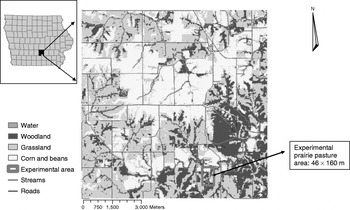
Marion County is located in south-central Iowa (Fig. 1) and represents a heterogeneous place with a broad array of farm types and influences on existing agricultural systems. Using the ‘USDA-ERS Farm Typology for a Diverse Agricultural Sector’Reference Hoppe, Perry and Banker19, we differentiated farm types into small family farms (sales <$250,000); limited-resource, retirement, residential/lifestyle, farming occupation/lower-sales, and farming occupation/higher sales. Factors influencing agricultural systems in Marion County include development pressureReference Rusk20; policy and market-driven pressure for expanded row crop productionReference Harl21, Reference Schertz and Doering22; land ownership and demographic changes related to land ownership, such as ‘acreages’ (country homes owned by urbanites) and absentee-owned hunting preservesReference Beem23; and the availability of off-farm income24.
Study site location and landscape characteristics. The experimental area within the study site was located in Indiana township of Marion County, Iowa, at R18W-T74N at NAD 1983 UTM Zone 15N with Transverse Mercator Projection. Land-use classification is derived from satellite imagery collected in May 2002 and May 2003. Data in raster format in 15 m2 cell size resolution. Data acquired from the Iowa DNR GIS library at http://www.igsb.uiowa.edu/./nrgislibx/. Map created by Karie Wiltshire in ArcMap 9 in October 2005.

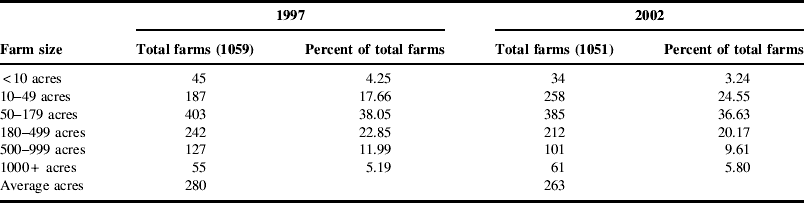
At the time of this study, approximately 60% of farm operators in Marion County claimed farming as their principal occupation12. Thirty-one percent of farm operators maintained cows and calving heifers12. Sixty-four percent of Marion County farms are less than 180 acres, following a bimodal distribution, with an increasing portion of farms between 10 and 50 acres, a decreasing portion of medium-sized farms (50 to 1000 acres), and a slight increase in larger farms (over 1000 acres) (Table 1). As part of the region's Combined Metropolitan and Micropolitan Statistical Area25, Marion County has a high degree of social and economic integration with the surrounding counties and Des Moines, as measured through commuting ties. Most of the county population of 32,766 residents25 is dispersed among two cities and seven smaller towns.
Farm size and distribution in 1997 and 2002 among Marion County, Iowa, farmsFootnote 1.
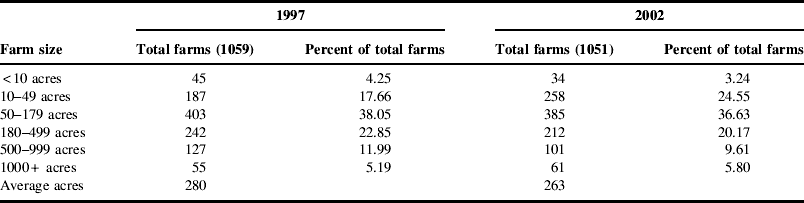
1 Data acquired from the National Agricultural Statistics Service, 2002.
Marion County is part of a broad plain into which the Des Moines and Skunk Rivers and other tributaries have created fertile valleys. Bottomlands associated with the waterways make up about 8% of the county, nearly level to gently undulating lands make up about 15%, and the remainder is gently rolling to very steep soils on uplandsReference Russell and Lockridge26. Although only 1% of the county population is employed in farmingReference Hanson, Artz and Imerman27, the 1051 farms account for 78% of the land surface12. The suitability of the land for row crops varies, with soils on upland ridges supporting intensive agricultural production, while the remainder is prone to erosionReference Mayer and Mensching28. However, landowner expectations for cash flow from croplands contribute to pressure on these marginal lands. Agricultural land use also competes with investment and hunting interests.
In a survey promoting the use of grass-based practices in Marion County, 84% of producer respondents stated that they would be willing to include forages in their cropping systems because this is a ‘more environmentally sound use of the land,’ and 32% indicated that they would be willing to change to more grass-based systems because it would decrease riskReference Hanson, Artz and Imerman27. As proposed in the socio-cultural study of this project, an understanding of the dimensions and dynamics of these decisions supporting multifunctional systems may contribute to the formulation of more effective agricultural policies that may lead to enhancing rural livelihoods and environmental protectionReference Dixon and Collinson29.
Socio-cultural aspects of grassland farmers
In preparing for the Marion County study, we found that, for part- and full-time small beef operations in mixed row-crop and cattle enterprises, managing cows reflects pluriactivity in which the farm plays a strategic role in the household incomeReference Jervell30, with a broad range of social, political and economic parameters mediating land-use decisions. Farming Systems Research (FSR)Reference Shaner, Philipp and Schmehl31, Reference Sutherland32 began with the observation that farmers do not manage cropping systems in isolation, and led researchers to describe cropping systems of interest as but one of many subsystems on a farm. In uncovering the processes used by small farmers whose objectives may be different from mainstream farmersReference Collinson and Collinson33, researchers can articulate other functions of the agricultural system, such as land conservation and maintenance of landscape structure, natural resources, biodiversity, which contribute to socio-economic viabilityReference Josling, Tweeten and Thompson34, Reference Maier35. Complementary to FSR is the embeddedness perspective, which holds that personal behavior is strongly associated with networks of interpersonal relations, counter to atomized actor explanations of such behaviorReference Granovetter36, and these social determinants of economic action often relate to the broader context of livelihood and lifestyle dimensionsReference Hinrichs37. Whereas FSR emphasizes how farms and farm families are members of complex, hierarchical institutional and social structures, embeddedness explores how individual relationships to these structures influence the socio-cultural relevance of economic actions. Production practices can also contribute to cultural identitiesReference Bell38–Reference Hatch40, informal exchangeReference Mingione41 and kinship tiesReference Richards and Creasy42. Non-economic motives of economic activities were found to include the work itself, household relations, and the impact on the surrounding community in an analysis by HinrichsReference Hinrichs37.
Materials and Methods
Over a 14-month period in 2004–2005, farmers from predominantly grass-based systems in Marion County, Iowa, were identified and asked to describe how and why their grass-based agricultural operations were sustained. Using embeddedness and FSR perspectives as a conceptual framework, we asked the following questions: (1) what do marginal land, grass-based farmers perceive as their motivation, incentives, and limitations; (2) how do infrastructural institutions and general social relationships influence the farmers; and (3) what internal household factors, and external biological, physical, and socioeconomic factors influence decisions, and how are these perceived in the light of risk? Inherent in the discussions on motivations and incentives was an exploration of the multifunctionality of their farmlands and cow–calf operations.
Methods for determining typological categories included a focus group, participant observations and interviews with farmers engaged in grass-based, livestock and mixed farming operations on marginal lands, to understand the system interactions with their livelihoods and lifestyles. The intention of this research was to generate portrayals of values and opinions using accurate and effective qualitative ethnographic research proceduresReference Chambers, Denzin and Lincoln43, Reference Scrimshaw, DeWalt and Pelto44. The United States Department of Agriculture-Natural Resources Conservation Services (USDA-NRCS) Knoxville (Marion County) office was an additional observation point. Serving as a participant–observerReference Neuman45, one member of the research team (K. Wiltshire) volunteered her services during the summers of 2004 and 2005 at the USDA-NRCS office and developed relationships of exchange and understanding with community members. Participation in agricultural events focusing on cow–calf management also served as bases of observation.
Observation sites and identification of participants
In developing the initial typology, Marion County agriculture professionals from Iowa State University Extension and the USDA-NRCS identified five individuals with cow–calf operation experience to assist in this effort. These individuals constituted the focus group, which was organized by the graduate student (K. Wiltshire), with assistance provided by Extension and NRCS, to help develop an initial typology of cow–calf operators in Marion County. Using participatory group facilitation methodsReference Allen and Blythe46, the typology was developed with the goal of grouping individuals on the basis of similarities for determining their respective group opportunities and constraintsReference Capecchi47, Reference Bailey48. An outcome of the typology development was an increase in governmental agency understanding of the main types of cow–calf operators in Marion County: key elements of their production systems; the amount of time available to commit to this type of operation; their motivations for continuing a cow–calf operation; and the levels of success they are experiencing in maintaining this type of livelihood in the face of urban pressure. Typologies can also be used to establish a framework for identifying potential areas of cooperation among group members, such as coordinating aggregation of cattle, transportation and marketing among cow–calf operators to cut transaction costs and increase sales. By representing a group, these cow–calf operators could foster greater equality with governmental and financial organizations, which could lead to income/livelihood enhancementReference Flora and Flora49.
After initial typology development and operationalization, the FSR procedure of ‘diagnosis’ described by SutherlandReference Sutherland32 was used to identify other farmer participants for the study to maximize differences between typology classes and to minimize sources of variation within themReference Collinson and Collinson33. The goal of the typology, however, was not to isolate participants into a permanent group, since typologies seek to only approximate groups or clustersReference Capecchi47, and, ideally, increase the probability that the specific group will react in a certain manner. Snowball and purposive samplingReference Neuman45, based on focus-group members’ suggestions, was employed to obtain in-depth interviews with a total of 21 farmers and nine agricultural industry employees from June 2004 to June 2005. Agricultural industry employees were interviewed strictly to facilitate further understanding of cow–calf operations in Marion County; the typology reflects only the categories developed with farmer participants. For initiating snowball sampling, each participant was asked for a referral to someone they felt would be willing to be interviewed. Two other farmers were identified at agricultural events and interviewed.
Qualitative data collection and analysis: data recording, organization and analysis
During the focus group and interviews, the interviewer identified herself as a graduate student conducting the analysis solely for educational purposes. To protect confidentiality, the identity of participants was not recorded. Each interview began by acquiring informed consent and explaining standard interviewing procedures, including permission to use an audio recording device. An Olympus® Digital Voice was used for all but two of the interviews. All records associating the particular discussion or interview with the participant's identity were destroyed after data entry. Audio-recorded interviews were transcribed with the assistance of an Olympus® Digital Wave Player (Olympus®, Center Valley, PA, USA) and Dragon Naturally Speaking 8.0 software (ScanSoft® Inc., Burlington, MA, USA). The transcription of the interviews was analyzed with grounded theory open coding and focused coding for themesReference Ryan, Bernard, Denzin and Lincoln50 using the Qualrus™ Intelligent Qualitative Analysis Program (Idea Works Inc., Columbia, MO, USA). In the transcription, ‘farmer’ referred to the primary decision-maker on the farm, although, as noted by HinrichsReference Hinrichs37, the ‘primary decision-maker’ is often a role allocated to an individual based on what type of decision is being made. While several household members often participated in an interview, each participant household is referred to as the ‘farmer’ for ease of analysis. The typology categories developed from the focus group were then further refined to reflect differences from interviews with the full group of participants.
Vignette case-study research
Sets of themes or concepts were identified throughout the analysis of focus group and interview content to determine linkages and relationships, following methods described by Miles and HubermanReference Miles and Huberman51. Correlations were qualitatively identified between themes and assigned typology. The themes were then incorporated into the summarizing typology classes to present results in a form of models of ethnographic collective case studiesReference Chambers, Denzin and Lincoln43, Reference Orum, Reagin, Sjober, Orum, Reagin and Sjober52, Reference Stake, Denzin and Lincoln53. Homogeneous and contrasting codes within themes among case members were compiled as generic ‘vignettes’ about the typology caseReference Finch54, including quotes from participants as exemplars of concepts, theories and negative casesReference Ryan, Bernard, Denzin and Lincoln50 in a narrative approachReference Becker, Ragin and Becker55. Triangulation, or the use of diverse methods for the acquisition of information about the people and scenario, such as the interviews, focus group and participant observation among several different social groups, aided external validityReference Neuman45.
Results and Discussion
Typology development: income relevance, livelihood system and values
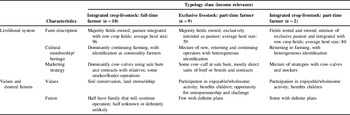
In determining the answer to the principal question: ‘What do marginal-land, grass-based farmers perceive as their motivation, encouragement, and limitations within their farming systems?’, several general tendencies emerged. Through the focus group and interview analysis, 36 codes were identified under 13 themes. Particular typology showed strong salience with the associated themes, demonstrating that typology class was an effective method for summarizing the data. Although heterogeneity among study participants’ responses was observed, the typology category, ‘income relevance’, had classes that cohesively grouped the most members. Following this segregation, each typology class was analyzed under the parameters of ‘livelihood system’, ‘values and desired futures’ and ‘integrating livelihood and values’ (Table 2). Analyzing cow–calf operations through the lens of income-relevance typology classes shed light on differences among operations, which resonates with recent farming systems research studies advocating the recognition of diverse socio-economic and biophysical influences on farming systemsReference Robotham and McArthur56, Reference Mishra, Ol-Osta and Steele57. All 21 farmer participants whose focus group and interview responses were utilized in the final typology development were placed in a specific typology class, based on similarities in income relevance, livelihood system and values. Participants verified their typology class after researchers completed the typology exercise.
Typology class characteristics of cow–calf operators developed from focus group, interviews and field observations in Marion County, Iowa, 2004–2005.

Integrated livestock/crop operation: full-time income source
The majority of participants in this study maintained integrated cattle (cow–calf, calf-to-finish, stockers or feeders) and grain operations as full-time income sources. Thirty percent of the participants in this typology class had spouses with off-farm jobs. Each of the farms depended on family members for labor and management, although several employed assistance and custom work. Most of the participants matched their cattle herd numbers to what they considered their land and labor base. None felt constrained by land limitations nor pursued land acquisitions to increase their herd sizes. Rather, they hoped to gain additional lands to avoid the negative perceptions of farming by recent ex-urban neighbors.
The full-time integrated operation participants were continuing a family farm, with most farming the original family homestead. Most identified themselves as full-time commodity farmers, and described membership in ‘conventional’ groups such as Farm Bureau, grain interest groups, the Iowa Cattlemen's Association, and local co-op boards, although one family engaged in full-time operations identified themselves with ‘alternative’ agriculture. Participants considered raising cattle, grains and hay in a complementary fashion utilizing crop rotations and manure distribution. The size of the operations managed by the integrated full-time class was highly variable, suggesting management of a mixture of rented and owned land, although most owned the majority of their pastureland. The range of herd sizes was 38–120 cows or 300 feeders, with an average of 96 head. The managed farmland size ranged from 200 to 4500 acres with an average of 1444 acres, and managed pastures ranged from 140 to 500 acres with an average of 288 acres. Forty percent of participants operated rotational grazing systems under a USDA Environmental Quality Incentive Program (EQIP) contract, although most others managed their pastures under a rotational grazing system not subject to third-party oversight.
Sixty percent of these participants primarily sold their grains and the remainder used some portion as feedstuffs while selling the balance. The majority of full-time farmer participants considered convenience, proximity and trust when choosing marketing strategies for their livestock, using the regional sale barn as their preferred marketing site. The remaining group used more complex marketing strategies, including the regional sale barn to sell ‘bottom-line’ cattle, access new buyers or sellers, or sell in different seasons. Despite the mixed attitudes, the sale barn was considered a dependable, competitive income source for the participants, with several returning to the sale barn after trying other venues. Several spoke about loyalty to the local sale barn:
I purposely try to patronize it to help keep them in business. All of our cattle go through there, and most of the cattle I buy come from there. It works well for my operation.
The need for convenience and trust also influenced a significant reliance on familial relationships to sell or contract calves and stockers to relatives for feeding.
Multifunctionality of pasture systems
While convenience influenced livestock marketing, pastureland use was mediated by its contribution to a sustained livelihood. Pastures were justified with a cost–benefit comparison to that of row-crops. Limiting factors included accessibility, incompatibility to machinery size, and need for terraces and drainage. As described by one member of the group:
I believe in full utilization of the land relative to soil constraints. If it's not suitable for farming, let's pasture it; if it's suitable for both, we still have some waterways and headlands that we're going to harvest for the livestock.
Some argue the land-use criterion employed by participants is what GlennaReference Glenna58 considers an ‘instrumental rationality’ in which farmers alter their land and techniques to improve productivity and efficiency while employing soil-saving techniques. Land-use perspectives, both on- and off-farm, were strongly associated with livelihood strategies for full-time integrated operations.
Perceived threats to livelihoods included residential zoning of surrounding land and complaints about odor, tractors and chemicals. Participants indicated plans to purchase surrounding farmland, or rent land from new residents. As one participant observed:
Many people who work with farmers just want their ground in row crop, so I was surprised when I learned that many I've worked with are quick to say they want it in hay. They are really concerned about the way the farm looks when people drive by.
These farmers often provide services such as snow plowing to new owners in the interest of maintaining amicable relations and preventing farming interruptions. Other farm operators explored new markets, including hay sales for new residents with horses, and beef sales.
Values and desired future
Assertiveness, in the form of opportunism within a changing social landscape and demand for farmland, was a strategy of several participants, but 40% of full-time farmers adhered to values and family contexts that prevented selling land. A family farm with a long agricultural heritage guarded their farm:
Everyone wants our land, but our family will sell nothing. It's so hard to get land, and we are really married to it. We're not the kind to sit and enjoy money from a land sale. This is everything, it is our life. It's so heartbreaking to watch farms get sold to investors around here.
Despite the uncertainty about farming, participants with children emphasized passing on values they associate with agriculture. Seventy percent of participants with children encouraged them to participate in government-sponsored agricultural youth groups, such as 4-H and FFA. Comments about farm-related skills, work ethic and independence were abundant among the full-time integrated typology participants, as were commitments to land conservation.
A strict economic motive was diluted by indicators of embeddedness as participants discussed their rationale for managing pasture and cattle. The social capital and inherited linkages that several experienced through family were pivotal to their current cattle operation. Other participants used their social capital for entrepreneurship, and partially justified their operation with that capital. Regarding their decision to sell beef to friends and neighbors, one couple explained, ‘We don't make much of a return on it; we just figure they deserve to eat good beef.’ Other participants associated cattle production with lifestyle dimensions they considered important:
I look at it as a way of life. It's a good place to raise children, you're constantly involved with nature, and you're outside everyday. These are things that city people pay to see.
Cultural and ethnic studies of full-time agricultural operations have observed similar decisions mediated by socio-cultural attributes rather than strict profit maximizationReference Flora and Stitz59, Reference Salamon60. Other studies have found that the path and success of entrepreneurs is derived from socio-cultural relationships, and that this social capital is critical to decision-making and persistenceReference Lauer61, Reference Portes and Sensenbrenner62.
Integrating livelihood and values
The livelihood of the full-time integrated operators is dependent on their crops and land-use strategies and reflected by their approach of matching soil and topographic characteristics to pastureland. Although a common response to a question defining characteristics of cattlemen was ‘independence,’ all of the full-time integrated operators in the study participated in government crop programs. They expressed frustration with government programs that lacked recommendations for their topography or climate, reinforcing a desire for institutional recognition of local knowledgeReference Kloppenburg63–Reference Ward and Munton65. Participants also voiced frustration about this void in extension programs and criticized government programs that encouraged plowing of erodible lands.
Exclusive cow–calf operation: part-time income source
Those participants who solely maintained cattle did so as part-time operators, with either full-time off-farm employment or as retirees. Approximately 25% of the participants in this group stated that labor availability constrained their operations and 25% stated land size restricted expansion. The heterogeneity of constraints affecting the participants is consistent with work by Lawrence and SchuknechtReference Lawrence and Schuknecht66 who found labor availability a variable constraint to farm management, and land as an occasional obstacle to profitable, optimum size operations. Although several of the operations were not located on family homesteads, the decision to maintain operations was closely associated with heritage or identity. Some participants were continuing their family traditions:
With the cows, you're taking care of the soil. My dad's mother grew up here, so it's been in the family forever. We're going to keep that ground, so we might as well take care of it.
Very few of the part-time cow–calf operations generated substantial income on which the operator or the family depended, although it was a valued supplement to several who identified themselves as ‘cattlemen’ or ‘graziers’. For these producers, managing a cow–calf operation provides a claim to the rural or country identityReference Bell38, Reference Hinrichs37. All participants in this group owned the majority of the land used for their cow–calf or grass operations. Farms ranged from 20 to 3200 acres with an average of 499 acres, managed pastures ranged from 20 to 1200 acres, with an average of 219 acres, and herd size ranged from 8 to 200 head, with an average of 59 cows.
Multifunctionality of pasture systems
Acreage owned by the exclusive livestock operators ranged from ‘high crop suitability’ to ‘highly erodible’ land. A livelihood strategy not dependent on cattle-related income influenced the capacity of this typology group to be flexible in land-use options. Some participants pasture the erodible ground and rent the remaining land, while others manage all land as pasture. Although the pasture and cattle management tactics were highly varied among this group, all but one managed their pastures as ‘whole fields’ in which the entire field is exclusively pasture (rather than being associated with nearby row-crops). This trend may be related to lack of other uses or labor limitations. Similar to integrated crop-livestock operators, most exclusive livestock operators manage their pastures under a rotational system, with 40% of this group participating in rotational grazing systems supported by USDA-EQIP programs.
The marketing strategies among exclusive part-time operators varied, often guided by experimentation. Sixty-six percent of the part-time operators engaged in some form of direct marketing, through sales of beef to neighbors, friends or clients, or through the sale of breeds and club calves. These participants associated their operations with challenges rewarded monetarily, or with the satisfaction of providing good products. The thrill of marketing innovative ideas and breeds motivated some:
The biggest reason we're in this business is because we enjoy the people and the satisfaction of raising cattle that other people want to buy for a premium.
The part-time exclusive participants managed their farms with intention. Living in, or protecting, the countryside while engaging in a particular lifestyle was their goal, and expressed concern about changes to the countryside. Depopulation associated with row-crop expansion and animal confinement operations concerned another. Others expressed concern about the future:
The demand from people who have money on the outside, like hunting or investment circles is stronger than from ag circles. That's a real challenge for us. Young people can't enter the cattle domain because land costs too much to rent.
Values and desired futures
Part-time exclusive cow–calf operations were motivated by the values embedded in the process of caring for cattle, as explained by one participant:
It just gets in your blood. It's the satisfaction you get looking at those calves and knowing that the management decisions were good, and when a sale comes up in the fall, getting the satisfaction of a good sale.
Such comments suggest that cow-calving is embedded in a rural culture, and it serves needs that are separate from, although not at odds with, livelihoodReference Hinrichs37. This embeddedness of cow-calving among part-time exclusive participants was a pervasive theme within this typology. The role of the cow–calf operation was as an ‘end use’ for the majority of participants who specifically value cattle as both a process and a product for the farming operation. Half the participants who associated the process of caring for and marketing cattle expressed a desire to benefit their children or society at large in non-economic ways, while the same percentage saw their livestock enterprise as fulfilling their personal desire for challenge, invention and entrepreneurship. ‘Stewardship’ of land, wildlife and natural resources, and ‘learning ethical issues and life lessons’ from cattle raising were also mentioned by several members of this group. Only one of the participants confirmed the continuity of their farm. Despite the uncertainty about farming, four participants with children emphasized passing on the values associated with agriculture and encouraged their children to participate in 4-H and FFA groups.
Integrating livelihood and values
Livelihood and lifestyle dimensions motivated exclusive cow–calf, part-time income participants to maintain their operations. They were able to manage cattle, allocate pastureland and market their products with flexibility and innovation, attributes made possible by additional means of income and because of values encouraging animal husbandry and land stewardship. Most distinguished themselves from row-crop farmers, and made decisions for land-use that were sometimes in reaction to previous row-crop use. Some expressed concern that current trends in row-crop or animal-confinement agriculture were degrading their quality of life in the countryside.
Integrated livestock/crop operation: part-time income source
The smallest group identified through the purposive sampling process maintained integrated cattle and grain operations as part-time income sources with spouses having off-farm jobs. Because of the small number of participants in this sample, only prominent trends derived from this group are described. This group managed a mixture of rented and owned farmland, averaging 633 acres, and an average of 395 acres of pastureland, with a mean herd size of 80 cows. Family members provided labor and management support. Pastures were managed in rotational systems, but they did not utilize USDA-EQIP contracts.
As suggested by the class title, many characteristics of this group were a blend of the exclusive part-time and the integrated full-time operator types. Each participant grew up on a farm, although each left and then returned to farming after becoming established in a professional field. One returned to the family farm homestead motivated to continue the family farm operation. Although they marketed their grains, they emphasized the cow–calf component on their farm, allocating more time and interest to it compared to the smaller corn and soybean component. They explain the cow–calf operation as such: ‘For us, it's a family thing. We like to do it, and it fits our schedules well.’ The cattle operation fits their livelihood because of compatible labor needs and an existing land base. Identity and preference for the countryside and the values associated with raising cattle reinforced their desire to return to the farm. The decision to maintain cropland for this operation was influenced by the existing allocation of land to row-crops as well as the skills and machinery available. The part-time integrated cow–calf and row-crop operators also stated that their operations serve purposes related to family, identity and enjoyment, similar to the embeddedness observed among the part-time exclusive cow–calf operators, but built on the integrated operation model that is attentive to efficiencies as observed in the full-time integrated operators.
Typology class comparison
Income relevance
While there was some heterogeneity within each typology class, the integrated full-time operation participants were overwhelmingly guided by livelihood strategies, which was consistent with work by CashmanReference Cashman14, who found that income reliance sculpted feasible management strategies among the small-farm cattlemen group. This class also identified themselves uniformly as commodity farmers. Within the other typology classes, the decision to maintain cattle was the most unifying characteristic among members of the part-time farmer groups, not income reliance. This heterogeneity could bear consequences when a single label, such as ‘commercial cow–calf operation’, is used to develop programs, which is salient with perspectives articulated by Bourdieu and WacquantReference Bourdieu and Wacquant67 and GlennaReference Glenna58 in which the logic of accumulation of capital and commodification of land is the dominant agricultural label. These distinct identities among the exclusive part-time class could also affect political empowerment, as suggested by FSRReference Flora, Francis and Collinson68.
Governmental support and marketing
All the full-time and part-time integrated operators used were aware of infrastructure, institutions and policies to facilitate their work, although several expressed concern about relevant design and implementation. The part-time exclusive cow–calf operators were less engaged in, and less aware of, government programs, although several were grateful for opportunities to participate in programs such as USDA-EQIP. Regarding marketing, the availability of a reliable, equitable marketing venue such as the sale barn appeared to be sustaining cow–calf operations in the region. Similarly, Cruise and LysonReference Cruise and Lyson69 and Schwarzweller and DavidsonReference Schwarzweller and Davidson70 noted that diverse structural components, such as educational systems, market competition and access to reliable sources of information, significantly contribute to community productivity of animal operations.
Multifunctionality of pasture systems
Pasture systems among full-time integrated cattle and grain crop operators were generally ‘integrated fields’ used for both row crop and cattle, and were dependent on the season and the crop rotation. The part-time operators tended to use fields exclusively for cattle. This difference suggests that part-time operators may be more willing candidates for long-term perennial vegetation projects and habitat development, such as the multifunctional prairie pasture system developed with a member of this group in a follow-up agroecological on-farm experimentReference Wiltshire, Delate, Flora and Wiedenhoeft71. Integrated operators may benefit from policies and practices rewarding the incorporation of soil quality-enhancing pastures and longer crop rotations through carbon sequestration credits proposed in federal regulations.
Rural viability
The future of the family farm was uncertain in all typology classes. Among all the participants, 33% were confident that their operation would not continue as such when they retired, which is consistent with findings by Lawrence and SchuknechtReference Lawrence and Schuknecht66, who determined that 42% of operations with more than 100 heads of cattle would not be passed down to family members. Only one of nine participants in the exclusive part-time class was confident of the continuation of the farm in the future, suggesting that those in this typology had a tendency to consider the operation as a lifestyle choice and as an identification of residence in the rural countrysideReference Hinrichs37.
Conclusions from the Socio-cultural Study
From this socio-cultural study of cow–calf operators in Marion County, Iowa, an agricultural area facing increasing pressure from urban development, it could be argued that many part-time exclusive cow–calf operator families are strongly motivated by a desire to maintain an agricultural heritage and imageReference Hinrichs37, while integrated crop-livestock operators are more influenced by economically driven instrumental rationaleReference Glenna58. The motivation to participate in, and otherwise maintain, labor- and knowledge-intense practices is embedded in complex socio-economic and socio-cultural systemsReference Hinrichs37 and supported by both household and structural support mechanismsReference Cruise and Lyson69. The integrated full-time operation was strongly influenced by livelihood-oriented parameters and matched livelihood needs with their land use and cattle operations, although participants were influenced by social relationships and values as they planned and executed their operations.
The importance of maintaining multifunctional farmlands and protecting biodiversity also was inherent in focus group and interview discussions. Multifunctionality recognizes that, while the primary role of agriculture is producing food and fiber, other functions, such as land conservation, maintenance of landscape structure, sustainable management of natural resources, biodiversity preservation, and contributions to the socio-economic viability of rural areasReference Josling, Tweeten and Thompson34, Reference Maier35, are also valuable—a sentiment expressed by many members of the cow–calf operator typology classes. The overall multifunctional profile of grass-based lands in Marion County, as described by study participants, included environmental attributes, such as preventing erosion by maintaining lands in pasture; economic benefits resulting from cow–calf sales; and social connections contributing to the stability of the rural community. Vignettes developed from this typology and interview process can be used to understand the human dimension underpinning the persistence of grass-based farms in this county, in order to create effective policies for farmland conservation and rural preservation. Policies in Japan, South Korea, Norway and Switzerland have supported the concept that small- to moderate-sized independent farms can help enhance the economic, environmental and social health of rural areas and preserve cultural heritageReference Brunstad, Gaasland and Vårdal72. As European Union polices have placed monetary value on the non-market benefits of agriculture, such as biodiversity preservation, current commodity-production policies in USA could be shifted for providing more environmental, social and economic benefitsReference Batie73, Reference Boody, Vondracek, Andow, Krinke, Westra, Zimmerman and Welle74, as Americans are increasingly recognizing the public benefits embedded in private agricultural systemsReference Kline and Wichelns75.
Biodiversity enhancement in agricultural systems can be achieved by incorporating native grasses and forbs into otherwise marginal rangeland or pasture, which falls within the mandate of the Conservation Stewardship Program (formerly the Conservation Security Program) (‘CSP’) as authorized in the latest US Farm Bill (Food, Conservation, and Energy Act of 2008). Government programs, such as the CSP and EQIP, can provide incentives for sustaining a farm landscape consisting of diverse, grass-based agricultural systems that support rural livelihoods and environmental quality. In the second phase of this project, a full-time cow–calf operator from the study group, operating in a direct-market scheme, demonstrated the potential for prairie pastures to enhance the biodiversity and sustainability of his grassland systemReference Wiltshire, Delate, Flora and Wiedenhoeft71. Additional research is required to determine the transferability of these results to other regions. In more rural counties, with less urban development pressure, land values would be lower, and off-farm employment opportunities would be more limited. Marketing opportunities would be greater in a peri-urban county, such as Marion County, Iowa, where higher rates of disposable income are available to support farmers marketing products with perceived environmental benefits.
Governmental support for the implementation of conservation-focused agricultural systems, such as prairie pastures, will lead to an increase in ecosystem services on working landsReference Foster, Kindscher, Houseman and Murphy76, while reducing inputs based on limited fossil-fuel resources. In order to address the educational needs expressed by study participants, Extension and federal environmental agencies are encouraged to provide relevant design and implementation recommendations in recognition of local knowledge related to farmland multifunctionality and sustainable land usage for integrated crop and livestock operations.