INTRODUCTION
Social cognition, defined as the mode of how we understand, perceive, and interpret our social world, is the umbrella term encompassing emotional recognition, processing of emotions, theory of mind, and social perception (Penn, Corrigan, Bentall, Racenstein, & Newman, Reference Penn, Corrigan, Bentall, Racenstein and Newman1997). Facial emotional recognition (FER), as a special domain of social cognition, is the capacity to interpret the emotions of others based on their facial expressions (Ekman, Reference Ekman1993) and is essential for proper communication and social functioning (Pinkham, Penn, Perkins, Graham, & Siegel, Reference Pinkham, Penn, Perkins, Graham and Siegel2007). Deficits in FER have been studied previously and associated with many different mental disorders such as depression (Bourke, Douglas, & Porter, Reference Bourke, Douglas and Porter2010), bipolar affective disorder (Bilderbeck, Atkinson, Geddes, Goodwin, & Harmer, Reference Bilderbeck, Atkinson, Geddes, Goodwin and Harmer2017), attention deficit/hyperactivity disorder (Razavi, Tehranidoost, Ghassemi, Purabassi, & Taymourtash, Reference Razavi, Tehranidoost, Ghassemi, Purabassi and Taymourtash2017), and schizophrenia (Chan, Li, Cheung, & Gong, Reference Chan, Li, Cheung and Gong2010; Daros, Ruocco, Reilly, Harris, & Sweeney, Reference Daros, Ruocco, Reilly, Harris and Sweeney2014; Hall et al., Reference Hall, Harris, Sprengelmeyer, Sprengelmeyer, Young, Santos and Lawrie2004; Kohler, Walker, Martin, Healey, & Moberg, Reference Kohler, Walker, Martin, Healey and Moberg2009; Savla, Vella, Armstrong, Penn, & Twamley, Reference Savla, Vella, Armstrong, Penn and Twamley2012).
In schizophrenia, deficits in FER seem to be present from the first episode of psychosis (Barkl, Lah, Harris, & Williams, Reference Barkl, Lah, Harris and Williams2014) as well as in patients with ultra-high risk of psychosis (Addington, Penn, Woods, Addington, & Perkins, Reference Addington, Penn, Woods, Addington and Perkins2008; Amminger et al., Reference Amminger, Schäfer, Papageorgiou, Klier, Schlögelhofer, Mossaheb and McGorry2011). Moreover, impairment in FER significantly distinguished patients at-risk of psychosis who later transitioned to schizophrenia from the ones who did not, having more predictive value than some general neurocognitive measures such as attention, vigilance and processing speed (Corcoran et al., Reference Corcoran, Keilp, Kayser, Klim, Butler, Bruder and Javitt2015).
Emotion-specific deficits in schizophrenia were found primarily in the recognition of negative emotions such as sadness, fear, and anger (Barkhof, de Sonneville, Meijer, & de Haan, Reference Barkhof, de Sonneville, Meijer and de Haan2015; Lee, Lee, Kweon, Lee, & Lee, Reference Lee, Lee, Kweon, Lee and Lee2010). However, the literature is rather inconsistent when it comes to the identification of deficits on the level of specific emotions, including FER of neutral or angry faces. Catalan et al. (Reference Catalan, de Artaza, Bustamante, Orgaz, Osa, Angosto and van Os2016) reported a significant difference between patients with first-episode psychosis (FEP) and healthy controls (HC) in recognizing angry faces, while Barkl’s meta-analysis showed no between-group mean differences in recognition of anger expressions in the FEP sample compared to HC (Barkl et al., Reference Barkl, Lah, Harris and Williams2014). Some of these discrepancies may arise from smaller sample sizes of the published studies or smaller sample sizes of studies included in the meta-analyses (for example, in the previously mentioned Barkl’s meta-analysis, study with the largest patient sample size had 50 FEP).
Additionally, incorrect recognition of specific emotions may also arise from patient psychopathology at the time of assessment of FER, which may subsequently influence results if this variable is not included in the analysis. For example, FER was found to be associated with negative symptoms of schizophrenia (Chan et al., Reference Chan, Li, Cheung and Gong2010) or with positive symptoms like delusions (Arguedas, Green, Langdon, & Coltheart, Reference Arguedas, Green, Langdon and Coltheart2006). Additionally, the association of impairment of FER of fear with aggressive behavior or other emotions with impulsiveness has been suggested (Antonius et al., Reference Antonius, Kline, Sinclair, White-Ajmani, Gianfagna, Malaspina and Trémeau2013; Krakowski et al., Reference Krakowski, De Sanctis, Foxe, Hoptman, Nolan, Kamiel and Czobor2016).
In this study, we sought to examine deficits in FER present in first-episode psychosis and after multiple episodes, their emotion-specific nature, and their relationship with psychopathology. To reduce the number of possible confounding factors typically found in samples of patients with schizophrenia, we recruited a large sample of patients, including a more homogenous subgroup of patients with first-episode psychosis (FEP). Therefore, the primary aim of our study was to compare FER between FEP, patients with multi-episode schizophrenia (SCH), and healthy controls (HC). Our secondary aims were to assess associations of FER with clinical features including psychopathology, depression, aggression and impulsiveness.
Finally, our tertiary, exploratory objective was to investigate possible associations of deficits in FER and quality of life as FER was found to be associated with various domains of quality of life, for example, community participation and social relationships (Hofer et al., Reference Hofer, Benecke, Edlinger, Huber, Kemmler, Rettenbacher and Fleischhacker2009; Poole, Tobias, & Vinogradov, Reference Poole, Tobias and Vinogradov2000) as well as with functioning (Hofer et al., Reference Hofer, Benecke, Edlinger, Huber, Kemmler, Rettenbacher and Fleischhacker2009). Thus, we tested hypotheses as follows: (1) FER deficits are present in FEP and SCH compared with healthy controls; (2) FER deficits are correlated with psychopathology.
METHODS
Participants and Protocol
We performed a cross-sectional study on the sample of 160 patients and 80 HC. Patients were recruited from two hospitals in Croatia, the Zagreb University Hospital Centre (ZUHC) and the University Hospital Vrapce (UHV), in the period from October 2015 until October 2017. Inclusion criteria for FEP were: no history of antipsychotic use before admission to hospital, first episode of psychosis and fulfillment of the criteria for psychotic episode (codes F23, F29) according to the criteria of International Classification of Disorders, 10th revision (ICD-10) (World Health Organization, 1992). Inclusion criteria for SCH were: two or more episodes of psychosis with illness duration of more than 5 years and fulfillment of criteria for schizophrenia spectrum disorders (F20) according to the criteria of ICD-10 (World Health Organization, 1992). Exclusion criteria for all three groups were: below 18 years of age, mental retardation, mental illness in childhood that can present with psychosis, neurological disorders, pregnancy and lactation, organic psychosis, the use of medications that can produce psychotic reactions, comorbid alcoholism or other addictions, use of drugs (except marijuana allowed for up to 3 times a year), psychiatric confinement, and legally incapacitated participants.
Patients were assessed during the acute phase of illness, up to the third week of treatment. Assessment included clinical rating of symptoms, self-measurement scales and assessment of FER. HC were recruited among healthcare professionals (nurses, psychologists), social workers who work in ZUHC and UHV, and medical students during their Psychiatry course at these two hospitals. All healthy participants had no personal or family history of psychiatric illnesses. HC were assessed for FER only.
The study protocol was approved by the Ethics Committee of the ZUHC and UHV. Researchers explained the study protocol to all participants taking part in the study and were at their disposal for additional questions. All participants signed an informed consent form before entering the study and were free to withdraw it at any time (none withdrew the consent). The study was performed in accordance with the World Medical Association Declaration of Helsinki 2013.
Primary Outcome: Assessment of FER in Study Participants
Percentage of correctly recognized facial emotional expressions assessed by the Penn Emotion Recognition Task, ER40 (Gur et al., Reference Gur, Sara, Hagendoorn, Marom, Hughett, Macy and Gur2002) was the primary outcome of the present study. The test was administered in its computerized implementation. Participants are shown 40 color photographs of male and female faces expressing emotions of happiness, sadness, anger, fear, and neutral. Each emotion was represented in eight photographs shown in random order, one photograph at a time. Participants had to mark the correct emotion on a separate sheet of paper, following the presentation of the picture on the screen. Instructions on how to perform the test as well as emotion labels were presented in Standard Croatian language.
Independent Variables
There are five independent variables, as follows.
(a) The Positive and Negative Syndrome Scale score (PANSS; Kay, Fiszbein, & Opfer, Reference Kay, Fiszbein and Opfer1987) was used to determine the severity of psychotic symptoms using 30 items divided in three symptom domains: positive (7 items), negative (7 items), and general (16 items), with higher scores representing higher levels of psychopathology.
(b) The Calgary Depression Scale for Schizophrenia (CDSS; Addington, Addington, & Schissel, Reference Addington, Addington and Schissel1990) is a nine-item instrument measuring depressive symptoms in people with schizophrenia. A score above 6 has 82% specificity and 85% sensitivity for predicting the presence of a major depressive episode (Addington, Addington, & Maticka-Tyndale, Reference Addington, Addington and Maticka-Tyndale1993).
(c) The Barratt Impulsiveness Scale-11 (BIS-11; Patton & Stanford, Reference Patton and Stanford1995) was used for assessment of impulsiveness. It is composed of 30 items divided into three factors: Attentional (8 items), Motor (11 items), and Non-planning (11 items). Higher scores show more impulsive behavior.
(d) The Aggression questionnaire (AQ; Buss & Perry, Reference Buss and Perry1992) measures aggression in adults across four factors: Physical Aggression (nine items), Verbal Aggression (five items), Anger (eight items), and Hostility (eight items), higher scores meaning higher aggression rates.
(e) The World Health Organization Quality of Life Assessment (WHOQOL-BREF; World Health Organization Group, 1998) measures the quality of life with 26 items divided into four domains: Physical health, Psychological, Social relationships, and Environment. The first two items were examined separately, one regarding participants’ overall perception of quality of life and other regarding their perception of their health. Higher scores indicate higher quality of life.
Statistical Analysis
Primary analysis of the differences in FER among FEP, SCH, and HC was performed using quantile regression. We presented the median percentage of correctly recognized facial emotional expressions with 95% CIs, adjusted for age and gender. Statistical significance was corrected for multiple testing by Sequential Holm-Bonferroni correction. Association of FER accuracy with the severity of symptoms, depression, aggression, and impulsiveness was analyzed using quantile regression. As the standardized measures of effect sizes, we calculated Koenker and Machado pseudo-coefficients of determination (R2). Association of FER accuracy with quality of life was analyzed with Kendall’s tau b coefficient accompanied with its 95% CI estimated from 1000 bootstrap samples. The level of statistical significance was set at two-tailed p < .05 and CIs were set at 95%. Statistical analysis was performed using NCSS 12 Statistical Software (2018) (NCSS, LLC. Kaysville, UT).
RESULTS
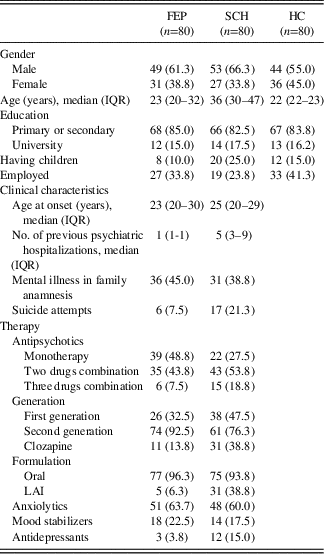
We assessed 226 patients for eligibility, of which 60 were excluded due to exclusion criteria, while 6 refused to participate. The final sample consisted of 80 participants who met inclusion criteria for FEP, 80 who met inclusion criteria for SCH, and 80 HC. The proportion of women was somewhat higher in the control group, while SCH had higher median age and proportion of unemployed participants (Table 1). Our three study groups were comparable regarding education. FEP and SCH were different regarding the number of previous psychiatric hospitalizations and suicide attempts. The SCH group was more often treated with combination therapy, the first generation antipsychotics, clozapine, long-acting injectable formulations, and antidepressants. The two patient groups were comparable regarding the treatment with anxiolytics and mood stabilizers.
Participants characteristics

Note. Data are presented as number (percentage) of participants if not stated otherwise.
FE P = patients with first-episode psychosis; SCH = patients with multi-episode schizophrenia; HC = healthy controls; IQR = interquartile range; LAI = long-acting injectable.
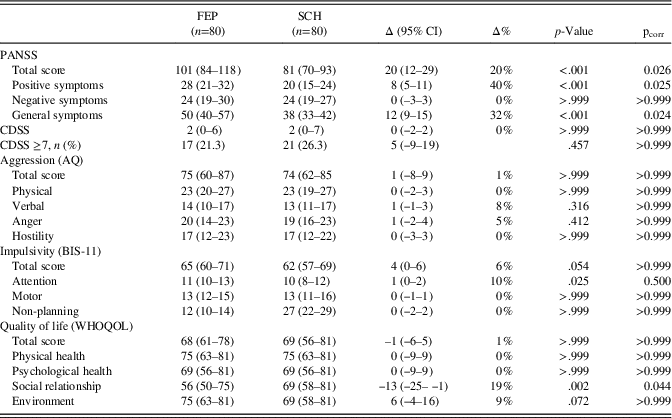
FEP had a significantly higher PANSS total score as well as positive and general symptoms PANSS scores in comparison with SCH, but we did not observe any differences in the severity of negative symptoms (Table 2). Two patient groups had similar results on the CDSS depression, AQ aggression, and BIS-11 impulsiveness scales. Quality of life was comparable between the two patient groups and the only significant difference was in better perceived quality of social relationships in the SCH group.
Participants clinical and psychological characteristics

Note. Data are presented as median (interquartile range) if not stated otherwise.
PANSS = Positive and Negative Syndrome Sale; CDSS = Calgary Depression Scale for Schizophrenia; AQ = Aggression Questionnaire; BIS-11 = Barratt Impulsiveness Scale-11; WHOQOL = World Health Organization Quality of Life Assessment; FEP = patients with first-episode psychosis; SCH = patients with multi-episode schizophrenia; Δ = absolute difference between two medians; 95% CI = Bonett-Price 95% confidence intervals of the absolute difference between two medians; Δ% = difference between two medians relative to the median in SCH group; p = two-tailed statistical significance of the difference between two medians calculated by quantile regression; pcorr = statistical significance corrected for multiple testing by sequential Holm-Bonferroni correction.
Differences in FER Between FEP and SCH
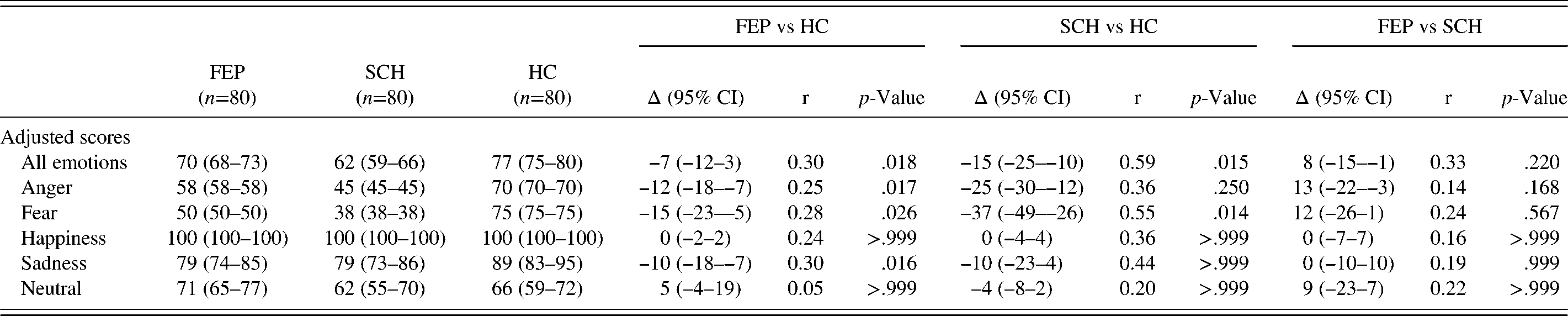
FEP and SCH correctly recognized a significantly lower percentage of facial emotional expressions of anger, fear and sadness than HC, after adjustment for age and gender and correction for multiple testing (Table 3). Faces presenting happiness and neutral emotional expressions were not significantly differently recognized among FEP, SCH, and HC. We did not observe significant differences in the percentage of correct recognition of any emotion between the two patient groups. On this particular sample level, the recognition of facial expressions was consistently better in the FEP than in the SCH group, but none of these differences were statistically significant.
Percentages of correctly recognized facial emotional expressions by Penn Emotion Recognition Task (ER40), adjusted for age and gender

Note. Data are presented as median percentage of correct answers (95% CI) adjusted for age and gender
FEP = patients with first-episode psychosis; SCH = patients with multi-episode schizophrenia; HC = healthy controls; Δ = difference between two medians; 95% C I = Bonett-Price 95% confidence intervals of the difference between two medians; r = standardized effect size; p = two-tailed statistical significance of the difference between two medians calculated by quantile regression and corrected for multiple testing by sequential Holm-Bonferroni correction.
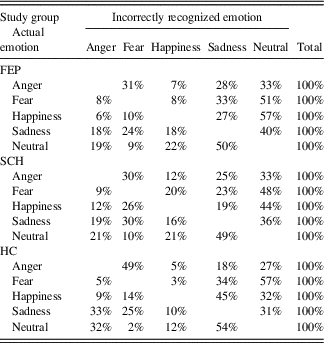
Results showing the incorrectly chosen emotions for our three groups are presented in Table 4. Results are presented as the percentage of incorrectly recognized emotions in each group. We found statistically significant differences in the distribution of incorrect responses among the three groups (HC, FEP, and SCH) using the chi squared test for four emotions (Anger: χ2 = 17.934, df = 6; Fear: χ2 = 51.663, df = 6; Happy: χ2 = 12.738, df = 6; Neutral: χ2 = 27.700, df = 6; each p < .05).
Incorrectly recognized emotions

Note. Data are presented as percentage out of all incorrectly recognized emotions presented in the row.
FEP = patients with first-episode psychosis; SCH = patients with multi-episode schizophrenia; HC = healthy controls.
Association of FER With Psychopathology and Depression
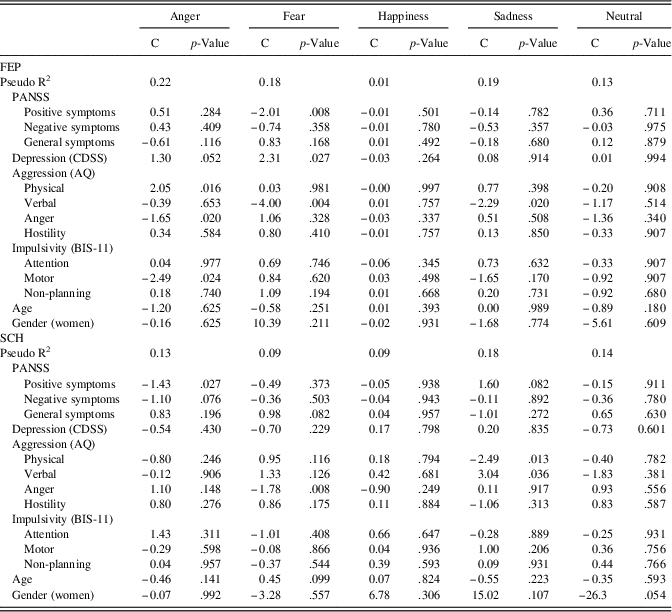
Correct recognition of anger in FEP was significantly, independently and positively correlated with the AQ physical aggression sub-scale and negatively with the AQ anger sub-scale and BIS-11 motor sub-scale (Table 5). In SCH, correct recognition of anger was significantly negatively correlated with the PANSS positive symptoms sub-scale. Correct recognition of fear in FEP was negatively correlated with the severity of positive symptoms and the AQ verbal aggression sub-scale and positively correlated with the severity of depression. In SCH, only the AQ anger sub-scale had significant negative correlation with the correct recognition of fear. Sadness was more often correctly recognized in FEP who had lower scores on the AQ verbal aggression sub-scale and by SCH who had lower scores on the AQ physical and higher scores on verbal aggression sub-scales. Correct recognition of happiness and neutral facial expressions was not associated with any psychopathology or psychological scales’ results.
Five quantile regressions of psychopathology, age, and gender to the percentage of correctly recognized emotions in FEP and SCH

Note. Data are presented as median (interquartile range) if not stated otherwise.
C = median regression coefficient; p = statistical significance of the coefficients; R2 = Koenker and Machado pseudo coefficient of determination; PANSS = Positive and Negative Syndrome Sale; CDSS = Calgary Depression Scale for Schizophrenia; AQ = Aggression Questionnaire; BIS-11 = Barratt Impulsiveness Scale-11; FEP = patients with first-episode psychosis; SCH = patients with multi-episode schizophrenia.
FER Association With the Quality of life
In the FEP sample, the social relationship WHOQOL sub-scale score was significantly correlated with the recognition of fear (Kendall’s tau b = 0.20; 95% CI [0.01–0.36]; p = .018). We did not find significant correlations of any other quality of life dimensions with the recognition of any emotion neither in FEP nor in SCH.
DISCUSSION
We conducted a study on a large sample of patients in the early stage of illness (first episode), SCH, and HC investigating the differences in FER of five emotions: happiness, sadness, fear, anger, and neutral as well as possible correlations of FER with different clinical features. We confirmed our first hypothesis and showed the significantly decreased FER in FEP and SCH compared with the healthy control group. Our second hypothesis was partially confirmed, as only deficits in FER of negative emotions were correlated with some clinical features.
The capability to correctly identify emotions significantly decreased from HC to FEP and SCH, with the worst results in the SCH group. This applied to all emotions, with the exception in recognition of happiness and neutral expressions where we found no significant difference between patients and HC. Concordant with our results, previous studies support the finding that there were no deficits in FER of positive emotions or that they were smaller than deficits in negative emotions (Barkhof et al., Reference Barkhof, de Sonneville, Meijer and de Haan2015; Barkl et al., Reference Barkl, Lah, Harris and Williams2014; Lee et al., Reference Lee, Lee, Kweon, Lee and Lee2010). Moreover, FER of positive emotions (happiness) seems to be “the easiest” compared with other emotions in all three groups. Likewise, when assessing the number of incorrect emotions that were chosen, the least common mistake in recognizing anger and sadness was happiness.
In general, the majority of previous studies were consistent in the finding that deficits of FER in negative emotions are present in patients at different stages of the illness (Barkl et al., Reference Barkl, Lah, Harris and Williams2014; Chan et al., Reference Chan, Li, Cheung and Gong2010; Comparelli et al., Reference Comparelli, Corigliano, De Carolis, Mancinelli, Trovini, Ottavi and Girardi2013; Lee et al., Reference Lee, Lee, Kweon, Lee and Lee2010). Thus, deficits of FER may persist in a trait-like manner, independent of acute illness or even across different psychotic disorders (for example, in patients with bipolar disorder with psychotic features, see Daros et al., Reference Daros, Ruocco, Reilly, Harris and Sweeney2014). However, this does not exclude the fact that different aspects of acute psychopathology may act as a modifier of FER. In that case, we could expect a mixture of different results on the associations of FER and negative emotions in the literature due to rather heterogeneous samples, especially when deficits in specific emotions are analyzed.
Indeed, as reported earlier, the literature is rather inconsistent when it comes to identifying deficits on the level of specific emotions. Catalan et al. (Reference Catalan, de Artaza, Bustamante, Orgaz, Osa, Angosto and van Os2016) reported a significant difference between FEP and HC in recognizing angry faces, which is in accordance with our results. On the other hand, Barkl et al. (Reference Barkl, Lah, Harris and Williams2014) found no group mean differences in recognition of anger expressions in the FEP sample compared with HC. In this study, we found that correct recognition of negative emotions was significantly, independently, and positively correlated with psychopathology in both patient groups, but more consistently in FEP.
In contrast, correct recognition of happiness and neutral facial expressions were not associated with any psychopathology or psychological scales results. This could indicate that the acute phase of the illness, as in our FEP sample and to a certain extent in SCH, may modify FER of negative, but not of positive emotions. The same was also suggested in the study by Daros et al. (Reference Daros, Ruocco, Reilly, Harris and Sweeney2014), where deficits of FER were found in patients with bipolar disorder and SCH during acute psychosis and after 7 weeks of treatment, but only deficits of FER of negative emotions in SCH were correlated with negative symptoms in the sub-acute phase (Daros et al., Reference Daros, Ruocco, Reilly, Harris and Sweeney2014).
Furthermore, in this study, we found that more positive psychotic symptoms, higher impulsiveness and aggression were accompanied by poorer FER of anger, fear and sadness, which was more pronounced in FEP. This may be a finding unique for FEP, who are more often characterized by higher impulsivity and aggressive behavior compared with SCH (Krakowski et al., Reference Krakowski, De Sanctis, Foxe, Hoptman, Nolan, Kamiel and Czobor2016). It is questionable whether there is a causal relationship between poor recognition of emotions and subsequent psychopathology or whether the relationship is inversed (Krakowski et al., Reference Krakowski, De Sanctis, Foxe, Hoptman, Nolan, Kamiel and Czobor2016).
Some of these correlations were also reported in the group of multi-episode patients, but only for some of the tests and less consistently then in FEP, which is in accordance with some previous reports (Chan et al., Reference Chan, Li, Cheung and Gong2010; Martin, Baudouin, Tiberghien, & Franck, Reference Martin, Baudouin, Tiberghien and Franck2005). This could perhaps be explained by the relative heterogeneity of the SCH sample, as we may assume a different degree of overall symptoms and functional impairment among patients in time, which may decrease the statistical strength of the associations. Therefore, we might hypothesize that a more homogenous sample such as FEP, with similar duration of illness, similar psychopathology specifics as well as less medication over time, may produce more reliable results. Moreover, as FER may be associated with neurocognition in schizophrenia (Mueser et al., Reference Mueser, Doonan, Penn, Blanchard, Bellack, Nishith and DeLeon1996; Ventura, Wood, Jimenez, & Hellemann, Reference Ventura, Wood, Jimenez and Hellemann2013), the different level of cognitive decline in our SCH group may influence their performance as an important and independent factor. Our SCH group consisted of chronic patients with multi-episodes of psychosis and illness duration of more than 5 years so it is possible that these individuals have severe neurocognitive impairment across all neurocognitive domains (Barder et al., Reference Barder, Sundet, Rund, Evensen, Haahr, ten Velden Hegelstad and Larsen2013; Gold, Reference Gold2004).
Results of assessment of FER for neutral faces were also heterogeneous. While we found no differences in correct FER for neutral faces between patients and controls, Catalan et al. (Reference Catalan, de Artaza, Bustamante, Orgaz, Osa, Angosto and van Os2016) found significant differences in recognizing neutral faces between FEP and HC. Interestingly, when assessing the incorrect identification of emotions, we found that HC group gives “more concrete” wrong answers (the most common mistake in recognizing anger was fear, in recognizing sadness was anger etc.; with the exception of fear where neutral was chosen), while both patient groups seemed to have less differentiated recognition as they most frequently incorrectly labeled the other four emotions (anger, fear, happiness, and sadness) as “neutral,” with more incorrect answers in the SCH than in the FEP group.
On the other hand, FEP and SCH both had higher numbers of the answers “happiness” and “fear” instead of “neutral,” compared with HC. This could be due to their overall impairment in emotion recognition that influences both their ability to correctly recognize emotions and their way of finding other possible solutions. For example, reasoning and problem solving are found to be strongly related to FER compared with other neurocognitive domains (Ventura et al., Reference Ventura, Wood, Jimenez and Hellemann2013).
The clinical value of this wrong attribution of neutral faces is unclear. However, in a study of aggression and identification of neutral faces, the authors suggested that the two were interconnected in SCH (Antonius et al., Reference Antonius, Kline, Sinclair, White-Ajmani, Gianfagna, Malaspina and Trémeau2013).
Finally, in the FEP group, correct identification of fear was correlated with better quality of social relationships, with a possible interpretation that patients with a better ability to recognize other people’s emotions have better social skills and are more satisfied with their relationships. Although we were not assessing our patients’ functionality, these results could be in line with previous studies that show lower levels of social functioning in patients with poorer emotional recognition performance (Bordon, O’Rourke, & Hutton, Reference Bordon, O’Rourke and Hutton2017; Irani, Seligman, Kamath, Kohler, & Gur, Reference Irani, Seligman, Kamath, Kohler and Gur2012; Pinkham et al., Reference Pinkham, Penn, Perkins, Graham and Siegel2007).
This study has several limitations. First, as we chose a consecutive sample of FEP and SCH and the convenient sample from the healthy population, the study has an increased risk of sample bias and lower probability of representativeness for the targeted populations. Second, as our HC group was chosen from the population of medical students and healthcare professionals, it is possible that it is not fully representative of the general population. Third, our sample cannot be treated as the representative for the entire Croatian population of FEP and SCH, although there is no ground for the assumption that FER is significantly different in different regions of the country. Fourth, we cannot exclude the effects of other factors not included in the study, such as overall neurocognitive decline in FER, as we did not include a test of non-emotional neurocognitive ability to establish specificity of the effect. Fifth, some of the measures used (for assessment of impulsiveness, aggression, and quality of life) were self-report questionnaires, the results of which could be affected by response bias. This is in concordance with previous literature. For example, Rosenman, Tennekoon, and Hill (Reference Rosenman, Tennekoon and Hill2011) reported response bias in self-report measurements as a well-known effect and in general possibly due to different reasons, for example, misunderstanding, exaggerating, or social-desirability bias. We can assume that acute phase of illness could also increase the bias, but it is not known to which extent.
CONCLUSIONS
We conducted a study on a large sample of patients in the early stage of illness (first episode), patients with multiple episodes of schizophrenia and HC, investigating the differences in recognition of five emotions. We confirmed that the capability to correctly identify negative emotions significantly decreased from HC to FEP and SCH, with the worst results in the SCH group. FER of negative emotions was negatively correlated with psychopathology, specifically positive psychotic symptoms, impulsivity and aggression, possibly indicating that FER may be variable in patients depending on the psychopathology, although the direction of this relationship is unclear.
These results indicate the presence of FER impairment from the beginning of the illness and its further deterioration during the course of illness, with more severe deficits in facial recognition of negative emotions. Second, the results also suggest that FER of anger and fear may depend on or contribute to clinical symptoms. Thus, assessment of FER should be included in the clinical assessment and treatment plan from the beginning of the illness, especially since studies have found positive results for treatment directed toward emotional processing (Bordon et al., Reference Bordon, O’Rourke and Hutton2017).
ACKNOWLEDGMENTS
This research was supported by the grant of the Croatian Science Foundation No UIP‐2014‐09‐1245 Biomarkers in schizophrenia-integration of complementary methods in longitudinal follow up of first episode psychosis patients. The funding source was not involvement in the collection, analysis and interpretation of data, in the writing of the report, nor in the decision to submit the article for publication. The authors declare no conflict of interest.