Implications
Crayfish is a delicious and healthy food item for human. An increasing market demand for this aquatic organism encourages development of techniques for artificial reproduction and farming of crayfish during recent decade. Here we studied the time interval between mating and egg laying in broodstock of two widespread freshwater crayfish species including signal and noble crayfish. Results of present study can directly be used by crayfish farmers for management of broodstocks across Europe and America. Also, this study provides basic information for biologists to further study of biology of reproduction in crayfish.
Introduction
The post-mating sperm storage is well known in a wide range of animals including vertebrates (Holt and Lloyd, Reference Holt2010; Holt, Reference Holt and Lloyd2011) and invertebrates (Bauer, Reference Bauer1986; Wolcott et al., Reference Wolcott, Wynne and Thomas2005; Niksirat et al., Reference Niksirat, Kouba and Kozák2014). Crayfish as members of decapod crustaceans make up a large group of invertebrates including three families, 33 genera, and over 640 known species (Crandall and Buhay, Reference Cossins2008). Crayfish male produces immotile spermatozoa (Tudge, Reference Tudge2009; Niksirat et al., Reference Niksirat, James, Andersson, Kouba and Kozák2013a and Reference Niksirat and Kouba2013b; Kouba et al., Reference Kouba, Niksirat and Bláha2015; Yazicioglu et al., Reference Yazicioglu, Hamr, Kozák, Kouba and Niksirat2016) that are packed into spermatophore and transferred to the female body surface in Astacidae and Parastacidae, or into the annulus ventralis which is known as a spermatophore storage segment in Cambaridae (Hamr, Reference Hamr2002), during mating. Crayfish male gametes undergo post-mating morphological and molecular changes that are necessary for them to acquire fertilization ability (Niksirat et al., Reference Niksirat, Kouba and Kozák2015a and Reference Niksirat, Vancová, Andersson, James, Kouba and Kozák2016; Niksirat and Kouba, Reference Niksirat, Kouba, Rodina and Kozák2016). Spermatozoa are released from spermatophore during fertilization and after fertilization eggs are attached to the body of female crayfish until hatching (Niksirat et al., Reference Niksirat, Kouba, Psenicka, Kuklina and Kozák2015b).
Noble crayfish Astacus astacus occurs in the open waters and it is widely distributed mainly in the northern and central Europe (Holdich et al., Reference Holdich, Reynolds, Souty-Grosset and Sibley2009). The signal crayfish Pacifastacus leniusculus is a North American species with a wide native range between the Pacific Ocean and Rocky Mountains (Taylor et al., Reference Taylor, Schuster, Cooper, Di Stephano, Eversole, Hamr, Hobbs, Robinson, Skelton and Thoma2007). Although, there are some reports regarding the timing of spawning in crayfish (Lewis, Reference Lewis2002), the duration of post-mating spermatophore storage is not fully investigated in crayfish, yet. Because of high market demand of crayfish, there is an increasing interest in crayfish culture (Skurdal and Taugbøl, Reference Skurdal and Taugbøl2002). Production of juveniles is an important step for development of sustainable crayfish farms. Knowledge such as the duration of post-mating spermatophore storage in relation with environmental factors (e.g. temperature and season) can facilitate management of crayfish broodstock with aim of juvenile production.
The goal of present study was to investigate the duration of post-mating spermatophore storage as well as the timing and temperature of spawning in the signal crayfish and the noble crayfish. The results of present study can provide basic data regarding the time interval between mating and the onset of egg laying and subsequent fertilization in two commercially and ecologically important crayfish species that can be used for the management of broodstock in farms within their native ranges and/or natural habitats.
Material and methods
Adult signal crayfish (Pacifastacus leniusculus Dana, 1852; n=142) and noble crayfish (Astacus astacus Linnaeus, 1758, n=72) were collected from the Babačka Brook (Sklené nad Oslavou, Czech Republic) and Kramata Reservoir (Hrabice, Czech Republic), respectively. The experiment was started on September 26, 2012. A total of 36 and 71 pairs of noble and signal crayfish were used for experiment, respectively. Each pair consisted of one male and one female. The pairs of crayfish were placed in plastic mesh boxes which were divided into four chambers to keep each pair separately. Plastic mesh boxes were placed in two 850 l outdoor tanks. Animals were fed during experiment. All animals were kept under the same natural temperature and photoperiod. Water temperature was recorded using data loggers (Minikin; Environmental Measuring Systems, Brno, Czech Republic). All pairs were checked for mating and egg laying twice a day by observing presence of spermatophore and eggs in the abdominal part of female, respectively.
Statistical analysis
The non-parametric Mann–Whitney test was carried out to compare the post-mating spermatophore storage duration as well as suitable temprature for the mating and egg laying between two studied species using SPSS statistical package version 16.0. For all statistical tests, P<0.05 was considered significant. Data are presented as the mean±SEM.
Results
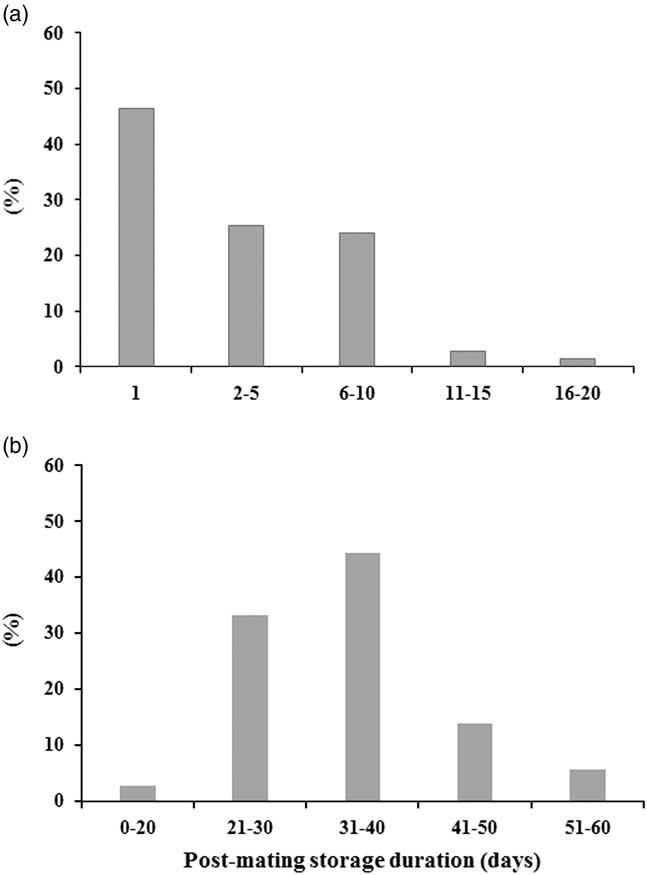
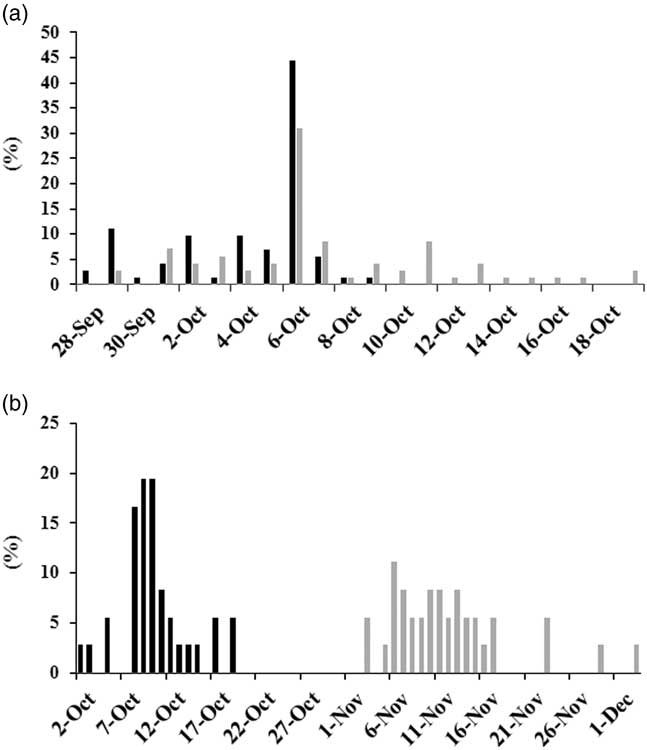
Results showed that the average duration of the post-mating spermatophore storage is significantly (P<0.05) longer in the noble crayfish (34.6±1.7 days, range: 19 to 60 days) than the signal crayfish (3.9±0.5 days, range: 1 to 18 days). The highest percentages of the post-mating spermatophore storage duration in the signal crayfish (46.5%) and the noble crayfish (44.5%) were 1 and 31 to 40 days, respectively (Figure 1a and b). The first and last matings and egg layings in the signal crayfish were observed on September 28, October 9, September 29 and October 19, respectively. The first mating in the noble crayfish occured on October 2. Mating in this species ended on 19th of the same month. However, first egg laying female was not observed before November 3. Egg laying terminated on December 3 in the noble crayfish. While there was an overlap in the mating and egg laying timings in the signal crayfish, these two reproductive processes were not observed at the same days in the noble crayfish and there was at least 2 weeks interval between the last mating and first egg laying individuals (Figure 2a and b).
Bars show classification of the post-mating spermatophore storage duration in the signal (a) and the noble crayfish (b).

Mating and egg laying dates in the signal (a) and the noble crayfish (b) during spawning season. Black and gray bars show mating and egg laying percentages, respectively.

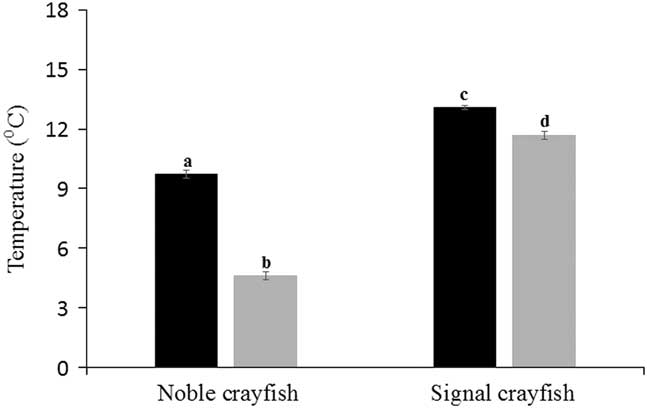
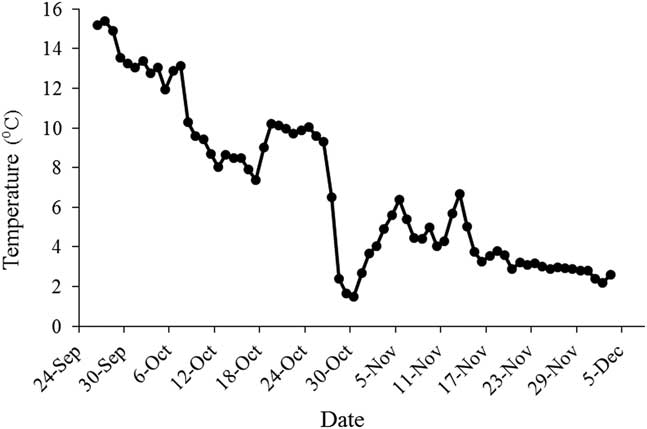
Average mating and egg laying temperatures were significantly (P<0.05) higher in the signal crayfish than the noble crayfish. The average temperatures for mating in the both species were significantly (P<0.05) higher than the temperatures that they utilized for egg laying (Figure 3). Temperature trend during experiment is shown in Figure 4.
Average water temperatures during mating and egg laying in the noble crayfish (36 pairs) and the signal crayfish (71 pairs). Values marked with different superscripts differ significantly from each other at P<0.05. Data of temperature are shown as mean±SEM. Black and gray bars show the mating and egg laying, respectively.

Water temperature during the experiment.

Discussion
Results of the present study showed that the female noble crayfish stores the post-mating spermatophores for longer periods compared with the signal crayfish. In addition, we managed to show that the signal crayfish preferes warmer waters for mating and laying of eggs in comparison with the noble crayfish. Buřič et al. (Reference Buřič, Kouba and Kozák2013) observed that the female spiny-cheek crayfish, Orconectes limosus, can successfully store spermatophore from their autumn mating for more than half a year. They stated that this trait allows the female to increase its chance for multiple successful matings and also finding the best mate.
Post-mating spermatophore storage has been reported in many other species of decapod crustaceans including crabs, shrimps and lobsters (Bauer, Reference Bauer1986; Moyano et al., Reference Moyano, Gavio and Cuartas2009). In some decapods such as clawed lobsters and some crabs with a long life-span, post-mating male gametes can be saved across consecutive molts by storage in some parts of the seminal receptacles of females that are not cast out during molting. This strategy allows post-mating spermatophores to be utilized successfully for next years for fertilization of eggs (Factor, Reference Factor1995; Becker et al., Reference Becker, Brandis and Storch2011). This strategy is well observed in the mated females Tanner crab, Chionoecetes bairdi, that produced 100% of fertilized eggs in the same year after mating but continued to produce 97% and 71% fertilized eggs in the next 2 years even without any contact by males (Paul, Reference Paul1984). Also, Jensen and Bentzen (Reference Jensen and Bentzen2012) reported that female Dungeness crab, Metacarcinus magister can fertilize eggs using stored sperm as old as 2.5 years. Female blue crab Callinectes sapidus that mates in summer and fall must store spermatophore for 7 to 11 months before using them in following summer for fertilization. This post-mating spermatophore storage strategy is very important for the blue crab because female mates only once during whole lifetime (Millikin and Williams, Reference Millikin and Williams1984; Hines et al., Reference Hines, Jivoff, Bushmann, Van Montfrans, Reed, Wolcott and Wolcot2003). Long-term post-mating spermatophore storage strategy by female decapods has an important role in the population biology and sustainable fishery, because it may compensate negative effects of fishing to some extent by allowing posthumous paternity to the largest males that are caught by fishing activities (Gosselin et al., Reference Gosselin, Sainte-Marie and Bernatchez2005; Sainte-Marie et al., Reference Sainte-Marie, Gosselin, Sevigny and Urbani2008; Taylor et al., Reference Taylor, Price and Wedell2014; Ellis et al., Reference Ellis, Hodgson, Andre, Sørdalen, Knutsen and Griffiths2015; Vogt, Reference Vogt2016).
In addition, it has been proved that decapod spermatozoa undergo some morphological and molecular modifications providing them fertilizing ability, also known as spermatozoon capacitation (Alfaro et al., Reference Alfaro, Ulate and Vargas2007). Vanichviriyakit et al. (Reference Vanichviriyakit, Kruevaisayawan, Weerachatyanukul, Tawipreeda, Withyachumnarnkul, Pratoomchat, Chavade and Sobhon2004) proved that an extensive molecular modification of the spermozoon including protein tyrosine phosphorylation takes place during post-mating storage in the female thelycum of giant tiger prawn Penaeus monodon. It takes 6 to 7 h for spermatophore of Pacific white shrimp Litopenaeus vannamei to be capacitated in the thelycum of female at 28°C. During post-mating interval, spermatozoa undergo a morphological change including further development of a region in the spermatozoon so called filamentous meshwork, located between the nucleus and the hemispherical cap (Alfaro et al., Reference Alfaro, Ulate and Vargas2007). In addition, observation of some biochemical changes confirm that capacitation of L. vannamei spermatozoa happens following 4 to 6 h of post-mating storage in thelycum of female at 28°C (Aungsuchawan et al., Reference Aungsuchawan, Browdy and Withyachumnarnkul2011). It is well-known that higher temperatures accelerate biological processes (Cossins, Reference Crandall and Buhay2012). Therefore, shorter post-mating spermatophore storage duration in the female signal crayfish could be attributed to higher water temperature compared with the noble crayfish that preferes colder temperatures and stores post-mating spermatophore for longer periods.
Post-mating spermatophore storage duration was poorly documented in decapods in general and crayfish in particular. Here we managed to demonstrate the patterns of spermatophore storage in relation with environmental factors such as temperature in broodstocks of two ecologically and economically important crayfish species that were kept under equal outdoor conditions. Our results can provide information for farmers to predict reproductive behaviors of studied crayfish species and therefore can facilitate broodstock management. For example, we have frequently observed that males eat eggs from female crayfish. If farmers are aware of the egg laying timings for those two species, they can separate mated females from males and transfer them from the mating to spawning facilities where females are allowed to incubate their fertilized eggs in safer conditions. To sum up, female noble crayfish stores post-mating spermatophores for longer periods compared with the signal crayfish. Also, signal crayfish mates and lays egg in temperatures that are significantly higher than noble crayfish with spawning season shorter in signal crayfish (September 28 to October 19) compared with noble crayfish (October 2 to December 3). The results of present study provide information contributing to the crayfish broodstock management in farms.
Acknowledgments
This project was supported by the Ministry of Education, Youth, and Sports of the Czech Republic CENAKVA (No. CZ.1.05/2.1.00/01.0024), CENAKVA II (No. LO1205 under the NPU I program) and the Grant Agency of the University of South Bohemia (017/2016/Z).