1. Strict and Loose Logics
A certain privileged relationship between music and mathematics is often remarked upon, and taken by many as a sort of first principle of analysis and creation. And while investigations into these relationships have doubtless proven fruitful for uncountable discoveries, the fact remains that human beings had been making music for time immemorial before the theorems of Pythagoras. The intersection of musical and mathematical certainties thus rests upon a prehistory of a different character. Perhaps with the Pythagoreans people finally felt that they ‘understood’ music, but then lack of this understanding had hitherto not impeded musical creation and meaning.
There were of course the social orders underlying the numerical orders, the ritual repetitions of doing what others were doing and had done, the order of tradition, and the institutionalisation of a local practice, much of which was imbued with the images and ‘backstory’ of local myths.
Beyond this we have only the exercise of imaginary origins, however well- or mis-informed with ethnographic knowledge, which is neither useless nor revelatory, but has its place as an aura and infinite ground, a kind of preliminary echo which inflects any reflection into ‘the musical’. Considering sound events to which we do have access (as opposed to dwelling on imaginary origins and deep historical pasts), we can discover a certain phenomenological wonder at the appearance of the auditory aspect. A specific pleasure is taken in the difference between what a thing sounds like and what a thing looks like. When we look at something, we are seeing it from the outside, and we wrap our concepts around it, installing it in a semiotic web, if not trapping it in layers of cultural constructs. But when an object sounds, it approaches us from the inside out, and sound is the perception of the interiority of things, as opposed to the surfaces of things, which we access through sight and touch.
When one hears violin music, one knows that the sounds are coming from a violin. When one hears a door slam, one knows that the sound came from the door. When one hears a computer-generated waveform, one may know that the sound came from a computer, or from electronic circuits, or from amplified speakers. But the sound does not issue from these sources in the same way that sound issues from a violin or a slammed door. There is a certain crisis in connotation, a failure of reference. The sound has the aura of pure artificiality. It enters awareness with a certain sharpness, with a vital lack of experiential baggage. It is of course the child of the history of trigonometry, but formulas do not resonate like images. And yet even this acoustic material can generate a field of images in the listener.
It is almost impossible not to convert the imageless into images, and attach associations even to what is without associational intent. But these automatic efforts are always incomplete. Furthermore, these images are not merely limited to the free play of thought or the autonomy of subconscious synaesthetic processes, but rather Western music is characterised in part by its partial existence as a graphic. The visual representation of sound waves and the graphic user interfaces used in their manipulation are a logical outgrowth of the technics of musical notation. In listening we are never far removed from the acoustical image.
To begin a reflection on acoustic images with a comment on the mathematical and notational is in part to situate this phenomenon in a realm apart from the calculative and rationalised, and also to note that this has been a recurrent theme in Western music, whether it was the opposition of programmatic to absolute music or the much later opposition of concrète to electronic–serialist compositional agendas. The importance of mentioning formal logics and calculi at the outset is to call attention the fact that associative–imagistic cognitive and metaphoric processes do in fact occur simultaneously, even in musics that are completely unconcerned with these aspects of listening experience, and in fact may even play important structural roles in such compositions (for example, much of Xenakis’ work owes as much to his mathematical formalism as it does to the poetic transformation of his own personal memories of war, violence and trauma). The acoustic image is also rhizomatic in that it instantiates a network or chain of associations which have aspects of semiotic play and culturally specific associations that can be ‘messy’ to disentangle.
2. Meaning and Experience
Nevertheless, it is possible to delineate certain phenomenological features of acoustic images that can be said to be intersubjective (i.e. if I describe my lived intuitive experiences of acoustic images, you may recognise something of your own experience). The complexity of acoustic images, having both cognitive (biologically ‘hardwired’) and semiotic (culturally constructed) aspects calls for a multiparametric approach that is sensitive in general to that delicate zone where interpretation meets experience. An acoustically representative moment of listening in a hermeneutic context can be found in Heidegger’s Being and Time:
Initially we never hear noises and complexes of sound, but the creaking wagon, the motorcycle. We hear the column on the march, the north wind, the woodpecker tapping, the crackling fire. (Heidegger Reference Heidegger1996: 193)
In this well-known passage, Heidegger situates perception as always occurring within the context of the pre-understood. It takes what Heidegger calls a ‘special effort’ to hear sounds in themselves, and not as attached to worldly things in everyday contexts. However, as anyone who has listened to modern – especially electro-acoustic – music can report, we can easily be presented with sounds for which we have no pre-understanding, and in fact no special effort is required on our part to hear noises as ‘complexes of sound’ for which a source or a thing may not readily come to mind. Certainly this is true of any compositional situation where one is interacting with acoustic technology – with a simple press of a real or virtual controller, sounds which utterly surprise us can come into our experience without being hermeneutically pre-understood. Understanding is not in and of itself something which can ‘contain’ all that is experienced, but in fact we may experience perceptions – in this case sounds – which can escape the hermeneutic–interpretive field. And yet that field is precisely what is invoked in any attention to acoustic images, namely the field of concepts, meanings and associations.
A phenomenology of the acoustic image is attuned to a visualist, or at least cross-modal, hybridisation and ‘contamination’ of sonic materials. Acousmatic approaches, such as Schaeffer’s phenomenology of sound objects, are explicitly anti-visualist in their orientations. The modernist penchant for defining the essence of a medium in strict contradistinction to other media and modalities in order to seek a purity of praxis is characteristic of a previous historical moment. Yet an explication of acoustic ‘images’ is not necessarily anathema or opposed to acousmatic sensibilities. We can note that the specific visualism rejected by Schaeffer was the visual-as-source-and-cause of the audible. The acoustic image, however, is an ‘internal’ image that is not necessarily attached to the ‘external’ visual of a sound’s source or material origin.
Acousmatic, adjective: referring to a sound that one hears without seeing the causes behind it. (Schaeffer Reference Schaeffer1966: 91, quoted in Kane Reference Kane2007: 3)
Often surprised, often uncertain, we discover that much of what we thought we were hearing, was in fact only seen and explained, by the context. (Schaeffer Reference Schaeffer1966: 93, quoted in Kane Reference Kane2007: 3–4)
What is vitiated from this phenomenological bracketing of the sound object from any cohabitation with the visual is the imaginal production of images which may be entirely free of and different in character from the visual–objective–causal context of a sound’s origin. This linkage of the acoustic image to source and causation (what we are here calling the external image) is also found in Bayle’s formulations:
In acousmatic music, one may recognize the sound sources, but one also notices that they are out of their usual context. In the acousmatic approach, the listener is expected to reconstruct an explanation for a series of sound events, even if this explanation is provisional. Like reading a detective story, one invents a scenario to find the chain of causality that explains the situation (Desantos, Roads and Bayle Reference Desantos, Roads and Bayle1997: 17).
In the following sections we will argue that the imagination of the acousmatic is not limited to the merely causal but is instantiated in a much richer network of relationships which can also be elucidated phenomenologically.
3. Descriptive Vectors
Under the subheadings below we will outline certain features which, from a phenomenological perspective (meaning from an attempt to describe the intuitions embedded in our lived experiences), are germane to the elucidation of acoustic images. As the particular order of these concepts is not important (since we are not trying to establish an essence or fundamental ‘structure’ to this phenomenon) we will try to capture some of that loose logic and associative quality by letting each heading below ‘float’ amongst the others, so the heading numbers are not intended to represent any kind of hierarchy.
3.1. A Heuristic of Image Space
In The Poetics of Music, Stravinsky borrows the ideas of the Russian philosopher Pierre Souvtchinsky to elucidate music as the structuring of similarity and contrast. Souvtchinsky had defined music as being of two kinds, ontological (based on similarities) and psychological (based on contrast):
Mr. Souvtchinsky thus presents us with two kinds of music: one which evolves parallel to the process of ontological time, embracing and penetrating it, inducing in the mind of the listener a feeling of euphoria and, so to speak, of ‘dynamic calm.’ The other kind runs ahead of, or counter to, this process. It is not self-contained in each momentary tonal unit. It dislocates the centers of attraction and gravity and sets itself up in the unstable; and this fact makes it particularly adaptable to the translation of the composer’s emotive impulses … .
Music that is based on ontological time is generally dominated by the principle of similarity. The music that adheres to psychological time likes to proceed by contrast. To these two principles which dominate the creative process correspond the fundamental concepts of variety and unity. (Stravinsky Reference Stravinsky2007: 31)
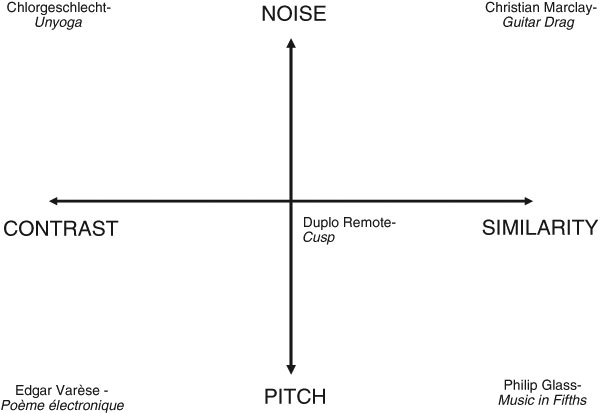
Similarity and contrast can be thus discussed as phenomenological manifestations of periodicity in that the similar may be viewed as periodic and the contrasting as aperiodic. These represent a ‘macro’ correspondence to the pitch/noise ‘micro’ feature of periodic and aperiodic waveforms, and together these two sets of oppositions can form a two-axis heuristic. On one continuum similarity and contrast represent the phenomenological manifestations of a/periodicity; on the other, noise and pitch represent the acoustic science of a/periodicity (see figure 1).
Two-dimensional heuristic of image space.

While scientific representations of periodicity (orbits, rotations, oscillations, heartbeats, breath, etc.) certainly ‘leak’ into any phenomenological assessment of periodic behaviours, it is important that the acoustic science remain distinct from phenomenological interpretations (the latter describes lived experience; the former is based on scientific method and mathematical modelling). For example, it is possible to acoustically generate an aperiodic waveform so as to exhibit little variety or contrast, and thus be phenomenologically periodic (e.g. monotonous noise).
The musical examples listed in figure 1 have been selected to be illustrative of this dual-periodic (pitch–noise, similar–contrasting) aspect to articulate the field out of which acoustic images emerge. The selected section of Philip Glass’s Music in Fifths is a series of whole tones repeatedly ascending from the first to the fifth and descending back to the first. The key feature of this example is the repetition of the same five pitches in a similar pattern; however, the progression is not always exactly the same and occasionally skips one, two or three notes while descending, which has the effect of breaking the similarity that is reinforced by its repetition, resulting in slight changes in timing, a sense of incomplete phrases, and interrupted cadence. Christian Marclay’s Guitar Drag exhibits guitar distortion and overdrive primarily in a single pitch consisting of a rich rhythm of repeated boiling pops and clicks that blend together into a noisy drone. Again the backdrop of the constancy of noise is broken by occasional variance in tonal colour, volume and rhythm attracting the attention of the listener without completely pulling the focus out of immersion in the drone. Unyoga, by the Chlorgeschlecht collective, is segmented into a variety of different short moments of noise. The segments alternate between moments of quiet, to clicks and pops over a high-pitched sine wave, to various loud chaotic moments of noise consisting sometimes of crunchy guitar chords based off a minor third or drones of guitar distortion or vocal screaming or rapid drum beats, or combinations of these overlapping. This piece elicits the noisy contrast, not just in the alternation between quiet and loud but also in the variety of different kinds of noise presented. The selected section of Edgar Varèse’s Poème électronique elaborates a variety of sound events of various pitches and glissandos covering a broad range of electronic timbres from single voice waveforms to rich gong sounds performed in varying lengths from short beeps and chirps to long single tones and cyclical sliding whistles. The contrast in the variety of tones in this sample challenges the ear to assemble a meaningful composition from pitched sounds which have been uncoupled from their traditional associations with each other. Occupying the centre of this heuristic space is a selection from Duplo Remote’s Cusp, a sample of glitch electronica offering the noisy buzzes, clicks and pops of electronic distortion in a consistent four-beat measure over a smooth electronic organ in a repeated first, fourth, fifth progression. A similarity reinforced by a repetition of cadence and pitch is contrasted by rhythmic irregular noise of distorted, broken beats.
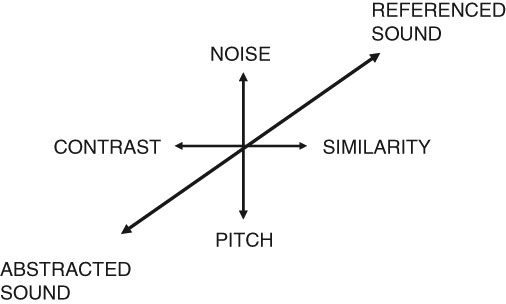
To these two axes we can add a third that is especially relevant to acoustic imagery, the referential–abstracted axis, which is shown in figure 2. While several of the above examples may also find themselves on this referential–abstracted axis, the start of Marko Peljihan’s performance work SPEKTR!, performed at ISEA 2008 in Singapore, exemplifies the extremes of this vector. This work begins with a long transition via crossfade from a familiar piano rag to a stream of rapid, randomly generated electronic tones at the highest register of piano performance. The rag, firmly rooted in a motif of past popular culture, is contrasted by pitched noise bordering on uncontrolled cacophony unfamiliar in sound and form. The sense one obtains while listening in these moments is of the piano music becoming abstracted into these other articulations of rhythm and timbre – whether this is in fact what is technically occurring isn’t relevant for our purposes, as we are here only describing the effect of an acoustic image.
Three-dimensional heuristic of acoustic image space.

This completes a Cartesian three-axis ‘space’ in which acoustic–temporal events can be said to occur. It is intended to work as a heuristic of general acoustic experience, describing a kind of ‘first impact’ sense of where we are at in any given composition of music and sound, as well as the space in which acoustic images unfold.
What is of particular interest in the Souvtchinsky–Stravinsky discussion of similarity and contrast is the connection of this duality to the other duality, ontological and psychological. A full discussion of Souvtchinsky’s work, and its relation to the philosophy of time more generally, is not possible here; however, we can note for our purposes that contrast can be a particular way to ‘psychologise’ sound (to move toward psychic rather than ‘real’ space) by noting that contrast – in both composed and real soundscapes – can itself be a moment of added significance. We can approach this via a thought experiment: imagine walking down the street – at the ontological level, vehicles are passing, key chains rattling in the pockets of pedestrians, some birds are chirping, a truck is backing up in an alley and beeping – then, suddenly, a car explodes, or a person screams – contrast here is the non-redundant, and is thus informationally richer (Snyder Reference Snyder2001: 237) than the palette of similar-redundant sounds that typically make up familiar spaces. Here we are invoking dramatic practices in relation to sound design that can connect thematically to this larger notion of the similar-ontological and contrastive-psychological.
3.2. Bodily thresholds
Removing the noise–pitch distinction from its usual moorings in acoustic, psycho-acoustic or information theories, there is a phenomenologically locative component to acoustic imagery which can be said to instantiate a sense of ‘inwardness’ and ‘outwardness’, or perhaps a sense of ‘from within’ and ‘from without’. In human speech, vowels are pitches and consonants are noises. Pitches made via our vocal apparatus involve the coordination of our lungs, diaphragm and vocal chords, producing a vibration in our chest and throat that is more endogenous than the noise-consonant interruptions of airflow produced by our mouth (Ladefoged Reference Ladefoged2005: 32–68). Consonants are orificial, produced at the threshold of our body with the surrounding environment, and consequently have a more exogenous feel to them. In the composition of sounds, it will often be found that pitched elements have a more ‘penetrating’ quality, and not simply in terms of affects produced by melody (compared to pitches, noise has a much harder time of, say, moving us to tears than a sad melody) (Pashler Reference Pashler1998: 75–118). This phenomenological sense of pitch-inside and noise-outside can play an important role in the poetics of compositions which combine both kinds of acoustic material to a high degree.
Reinforcing these inside/outside distinctions are the environmental contexts in which we are enmeshed, in which the world presents itself as predominately composed of background noises (wind, waves, stream trickles, leaves rustling, traffic) against which various species send forth their pitched calls in order to distinguish themselves from this background (which of course is also composed of other signalling life) and to communicate (Rhodes Reference Rhodes2002: 21–6). The sense again is of pitches emanating from an interiority, while noises feel like external space and world. To test this yourself, hum a bit, and then click your tongue against the back of your teeth. This threshold image articulated by noise and pitch is not dependent solely on our production of sound, but also occurs in listening to composed works.
3.3. ‘Abstraction’
The very term ‘abstract’ can be problematic if by it we simply mean something like ‘nonrepresentational’, as abstract sounds can of course be particularly rich in connotations (though use of this term in opposition to referentiality in general can be useful, as we saw above). If we go a little deeper into these distinctions, we might say that the difference between an abstract and a representational sound is the difference between a sound which seems to have a source or to have been produced by some known thing (the referent–representation), while a sound that is abstract seems to generate its source. In other words, rather than being produced by its source, the abstract produces its source(s), which emerge in a play of tangents and possibilities of suggestiveness (Gaver Reference Gaver1993). A kind of ‘relational magnetism’ occurs if for no other reason than that everything can be said to share some quality with some other thing (‘everything through everything else’ as Heraclitus wrote). In the field of abstraction we can identify two major modalities that yield particularly rich associations: formal and material abstraction.
Formal abstraction plays upon the sense of things as having tendencies, while material abstraction is based on the intuitive sense of substance or ‘stuffness’. To draw a parallel with graphic design, the DVD title page of Gentlemen Prefer Blondes features vertical, rectilinear bars arrayed in two-tone yellow, which plays off that aspect of hair which has something in common with lines and columns – this would be an example of formal abstraction, as there is no sense at all of the material feel of hair but only its reduction to the qualities of linearity and multiplicity. Sounds ‘rising’ in pitch, for instance, can suggest many other things ‘rising’ (in fact, this common term is already a form of metaphoric hermeneutics, as there is no rising occurring at all but only an increase in waveform cycles). Formally, since there are many things capable of rising (balloons, flowers, birds, volcanoes, space ships, children thrown into the air, balls hurled in sports, etc.), the suggestiveness of such sounds are materially neutral and thus can be designated as formal instead.
Material abstraction occurs when a sound possesses qualities that immediately suggest physicality of some kind. Ruth Anderson’s I Come Out of Your Sleep, for example, features sounds that have had their breathiness moved into a zone freed from poetic speech, resembling snoring and moving into the ‘airy’ in general. Much sampled music relies for its poetic effects on some material tie to an original recording in order to imbue the composition with a tangible aura of some specific substance, even though its processing may take it very far from its original referent, in order to explore neighbouring, and material, territories. Alternately, music which is electronically or mathematically generated may accumulate its ‘bleeps and blurps’ with enough event density that it begins to take on qualities of boiling or roiling, or perhaps rapid-fire bursts of bullet-like and pointillist bombardments (Wishart Reference Wishart1994). In a sense, formal abstractions can morph into material abstractions if the sense of tendencies produce strong material associations and definite images emerge in one’s listening experience (for often it is difficult to intuitively disentangle a substance from its typical behaviour, as in, for example, a twanging rubber band).
3.4. Holonic fields
A common feature of parts and wholes arrayed in living systems is that there are dynamic tensions of autonomy and integration. A part of something may at times seem to want to ‘wiggle itself free’ of its embedded context, while at other times it may settle nicely into the surrounding flux and flow. In literature, for example, one is always coming across critical commentary of the sort, ‘Self vs. Society’, or ‘Society vs. Nature’, and so on. These static and often over-used oppositional constructs take on a more subtle dynamism when expressed in terms of complex systems. The term ‘holon’ has been used to name this dual quality of systemic entanglement: the ways in which parts are wholes and wholes are parts, and the ways in which elements of systems – themselves parts of larger systems – possess dual qualities of self-assertion and field-integration. Arthur Koestler described the holon in these terms:
In the growing embryo, successive generations of cells branch out into diversified tissues, which eventually become integrated into organs. Every organ has the dual character of being both a subordinate part and at the same time an autonomous whole – which will continue to function even if transplanted into another host. The individual self is an organic whole, but at the same time a part of his family or tribe. Each social group has again the characteristics of a coherent whole but also of a dependent part within the community or nation. Parts and wholes in an absolute sense do not exist anywhere. The living body and the body social are not assemblies of elementary bits; they are multi-leveled, hierarchically organized systems of sub-wholes containing sub-wholes of a lower order, like Chinese boxes. These sub-wholes, or ‘holons’ as I have proposed to call them, are Janus-faced entities which display both the independent properties of wholes and the dependent properties of parts.
… Thus the self-assertive tendency of the holon has its counterpart in the integrative tendency to function as part of the larger whole. (Koestler Reference Koestler1973: 111–12)
Acoustic images have holonic qualities. They can seem to suddenly appear in the midst of listening, and then disappear when, in a sense, the metaphor can no longer be carried (as when the sounds change to such an extent that the suggested image is no longer tenable). Furthermore, every moment in a composition presents the holonic ‘drama’ in that we are given either elements that are integrated with each other, or those which strain against each other, or some combination thereof (Truax Reference Truax1999). This sense of what’s happening in the holonic field yields much of our sense of whether a certain element is out of place or in place, sticks out like a sore thumb or not, or whether it’s poignant to stick out at this particular moment but not at another (Schafer Reference Schafer1994). Acoustic images emerge and fade out of this holonic play of part-wholes, either struggling against their context – if only momentarily – or surrendering entirely to the whole (as in, say, a drone).
3.5. The body analogue
A transformative event happened to music with the advent of electronic music – music ceased to carry within itself a representation of the body. The early proponents of music electronics specifically praised the ability of the new music machines to transcend or exceed human limitations. Machines would be able to play notes faster, tirelessly, perfectly in time with the score, and achieve pitches and timbres impossible to attain through the efforts of vocal and manual dexterity and virtuosity; music could be louder than ever before, projected through space at greater distances through wires or simply through sheer volume. A contemporary extension of Marinetti’s bruitism, which sought to escape the bounds of traditional music instrumentation by simulating mechanistic process, electronic instrumentation escapes bodily manipulation of the instruments altogether (Kahn Reference Kahn2001). While it had hitherto perhaps been possible to write such music – one can imagine a complexity of musical notation that also exceeds the same limits of human playability – electronic composition brought into acoustic space a new poetics of music, a poetics of freedom delimited in part by redefining the human body as a creative confine. An important aspect of the acoustic image of such music is that the body is simply not there as part of the image. A composition for a traditional acoustic instrument bears with it the image of the musician’s body, playing within the limits of human physiognomy, and we acknowledge as much when we sympathetically hum or tap along: in this way our body participates in the body-image instantiated by the music. Computer or machine musics, by contrast, present no such body image to participate along with – our body is left outside the field of listening and elsewhere, as perhaps the rhythms are too fast, the pitches too high, the timbres utterly immaterial and so forth. On the other hand, when one uses computational or electronic means to produce music the parameters of which are within the limits of human playability and bodily participation, there is a noticeable affective shift as the body reappears as something that can tap and/or hum along (as in, for example, Laurie Spiegel’s Appalachian Grove I). Technologies can produce or erase this body image, and have perhaps contributed much to an expanded sense of what we can call the imago mundi, the worldliness of sounds and the transcendence of the (limited, and perhaps entirely too subjective and egoistic at times) body analogue.
3.6. Narrativity
Sounds can be interpreted or experienced as characters in a story – their envelopes and timbres either cohering or transforming, giving us either Aristotle’s ‘consistent character’ or a very transformative–developing persona. These character-sounds with their traits and qualities might be enmeshed in a storyworld, a surrounding context which is the background to their foregrounded movements and transpirings. While much can be said about acoustic images in terms of implied or suggested narratives, we would like to focus on one particular aspect and a philosophical elucidation, namely the appearance of conflict, which is often said to be the whole point of a story (Meelberg Reference Meelberg2006). In Art as Experience John Dewey defined experience as the rhythmic pulsings of life engaged in a constant falling in and out of equilibrium with its environment:
There are two sorts of possible worlds in which esthetic experience would not occur. In a world of mere flux, change would not be cumulative; it would not move toward a close. Stability and rest would have no being. Equally is it true, however, that a world that is finished, ended, would have no traits of suspense and crisis, and would offer no opportunity for resolution. Where everything is already complete, there is no fulfillment. We envisage with pleasure Nirvana and a uniform heavenly bliss only because they are projected upon the background of our present world of stress and conflict. Because the actual world, that in which we live, is a combination of movement and culmination, of breaks and re-unions, the experience of a living creature is capable of esthetic quality. The live being recurrently loses and reestablishes equilibrium with his surroundings. (Dewey Reference Dewey1980: 16)
David Mamet has identified three questions which all dramas must answer: ‘Who wants what from whom? What happens when they don’t get it? Why now?’ In other words, a story that goes as follows: ‘A child cried when it saw the ice cream. The mother bought the ice cream and gave it to the baby. The baby stopped crying.’ simply isn’t interesting as a story, because stories tell us something about the fact that desires are often frustrated by reality, and that the nature of experience itself is to undergo constant rhythms of desire, frustration, satiation and equilibrium. Acoustic images often play off this underlying dramatic feature of life and present us with dramatic moments and cessations, often called simply tension and resolution, but underlying this is an image of the dynamics of existence as we’ve experienced it since birth.
3.7. Rorschachian synaesthetes (or, it’s just you)
Anyone who’s ever taught electroacoustic music has come across the absolutely authentic and arbitrary reactions of minds newly exposed to an expanded field of sonic possibilities. The final aspect of acoustic images we would like to touch on is this entirely free play (though it’s a freedom of a sort that might occur in multiple heads simultaneously) of free association and imaginal reflexology. In this context it might be good to recall the scene in Thomas Pynchon’s The Crying of Lot 49, where Stockhausen is rocking the house:
The Scope proved to be a haunt for electronics assembly people from Yoyodyne. The green neon sign outside ingeniously depicted the face of an oscilloscope tube, over which flowed an ever-changing dance of Lissajous figures. Today seemed to be payday, and everyone inside to be drunk already. Glared at all the way, Oedipa and Metzger found a table in back. A wizened bartender wearing shades materialized and Metzger ordered bourbon. Oedipa, checking the bar, grew nervous. There was this je ne sais quoi about the Scope crowd: they all wore glasses and stared at you, silent. Except for a couple-three nearer the door, who were engaged in a nose-picking contest, seeing how far they could flick it across the room.
A sudden chorus of whoops and yibbles burst from a kind of juke box at the far end of the room. Everybody quit talking. The bartender tiptoed back, with the drinks.
‘What’s happening?’ Oedipa whispered.
‘That’s by Stockhausen,’ the hip graybeard informed her, ‘the early crowd tends to dig your Radio Cologne sound. Later on we really swing. We’re the only bar in the area, you know, has a strictly electronic music policy. Come on around Saturdays, starting midnight we have your Sinewave Session, that’s a live get-together, fellas come in just to jam from all over the state, San Jose, Santa Barbara, San Diego.
‘Live?’ Metzger said, ‘electronic music, live?’
‘They put it on the tape, here, live, fella. We got a whole back room full of your audio oscillators, gunshot machines, contact mikes, everything man. That’s for if you didn’t bring your ax, see, but you got the feeling and you want to swing with the rest of the cats, there’s always something available.’ (Pynchon Reference Pynchon2006: 34)
While this kind of music has most often been characterised as ‘bleeps and blurps’ (in fact, we did so earlier), Pynchon here gives us ‘whoops and yibbles’ as the onomatopoetic descriptive alternative. In terms of aspects of the acoustic image outlined here, the most salient is perhaps the commentary on what we called the body analogue, as in this scene machine music is directly juxtaposed to its analogue–live–instrumentalist counterpart. We can take ‘whoops and yibbles’ to be modes of either material or formal abstraction, depending on whether these sounds attach themselves to acts (such as ‘nibbling’ or ‘whooping it up’) or material qualities (such as ‘dribbling’) or similar associations that a reader may imaginally hear. While electronic music may ordinarily be out of place in a hipster bar, a kind of rogue element thrust from its appropriate context, the fictional Scope is in fact the holonic–integrative context for this Stockhausen work, while at the same time serving as an integral component of the storyworld of this scene. The word play utilised by Pynchon invokes a field of imaginary sounds in much the same way that sounds might invoke a field of imaginary objects or actions. Which is to say, your guess as to what Stockhausen work Pynchon is referring to is as good as ours.
4. Conclusion
In this paper we have tried to sketch the outlines of a phenomenological approach to describing a highly subjective and transient phenomenon, the imagistic qualities of acoustic events. It is necessarily – as all phenomenological approaches may be – a beginning (Husserl indeed thought his method was a way of perpetually starting anew), and it of course has taken its main features from our own store of experience and intuitions, which have additionally been articulated in a semiotic field. The aim has been to give something of a sense of that threshold in which what is experienced is just captured in a form of meaning even as it immediately eludes it, as so often happens in music. We have borrowed from related philosophical fields (pragmatism, hermeneutics, empiricism, poetics) insights that are in many ways phenomenological in character, in that they ‘ring true’ with the intuitive structures of our experience, and can thus be brought to bear on our subject. We started by setting this discussion against formal–mathematical representations, in order to distinguish this approach from pre-existing models (calculation, notation, visual representation) and focus on the lived experience of acoustic images, whether these occur while we are listening or composing. Contemporary techniques have given us a creative space in which an infinite variety of sounds can be used, and acoustic images are perhaps responsible for much of what makes such works listenable in that they provide anchors of meaning and focal points for associations. While this paper has not dwelled on specific kinds of music and sound works, these imagistic associations are perhaps particularly acute and necessary for works where timbral transformations take compositional priority over and against logics of temporal-octave division. A comment of Boulez’s is particularly salient in this context:
[T]imbre uses constituted wholes – instruments or the voice – whose relationships are highly complex and irreducible to simple numerical proportions. Therefore, in general, reasoning must proceed by analogy. (Boulez Reference Boulez1971: 59)
Acoustic images are also just such ‘constituted wholes’ in that an image partakes of gestalt qualities such as ‘edginess’ and ‘figure-ground’ properties. Also, they are very much a part of the analogic dimensions of acoustic experience (as opposed to the ‘digital’ codifications of notation, visual representation or mathematic modelling), and are a part of how we ‘proceed by analogy’ when listening or composing. Boulez does call this sense of analogy a form of ‘reasoning’ (where we might be tempted to restrict the notion of reasoning to more analytic, formal or quantitative relationships when the subject is the musical in general). Images have their rationale as well, and these can relate to such things as the experience of our bodies or that of our machines, or the behaviour of things generally, or the drama inherent in the ebb and flow and frustration of our needs and desires, or the manner in which identifiable outlines cohere or disperse in our perceptual fields, or the infinite ways that one thing can be like something else, and of course the play of differences of which any system must be articulated.
Just as things occur, exist, break down into their parts, objects in time, in space, and so on. All is as water runs, flames consume themselves, flowers close or clouds pass etc.
These are universal paradigms. (Bayle Reference Bayle2007: 249)
The parameters of associative processes occurring in listening outlined here can help to explain the motivations constitutive of the final form a composition may take, as well as much of the ‘meaning’ it might have for us in listening to it, for our compositions are just as much a part of the world as we are.