Introduction
No-till crop production has become a standard practice for many soybean growers in the Mid-Atlantic region of the United States (Delaware, Maryland, New Jersey, Pennsylvania, and Virginia). In 2012, approximately 70% of planted soybean hectares in the Mid-Atlantic region and southern coastal plains (North Carolina, South Carolina, and Georgia) were planted no-till, compared with the U.S. average of approximately 40% (USDA 2014; Wade et al. Reference Wade, Claassem and Wallander2015). No-till production offers many economic and soil benefits. For example, no-till results in lower labor and machinery costs and improved soil health through reduced soil erosion, reduced runoff, and retained soil moisture (Uri Reference Uri2000). However, no-till production relies on herbicide applications for control of both winter and summer annual weeds.
Winter annual weeds can emerge in the fall or early spring and interfere with planting, compete with the emerging crop, and serve as alternate hosts for crop pests (Monnig and Bradley Reference Monnig and Bradley2007; Venkaresh et al. Reference Venkaresh, Harrison and Reidel2000). Emergence of summer annual weeds can occur before soybean planting and may continue for weeks after planting. If not controlled, weed competition can result in significant yield loss (Fickett et al. Reference Fickett, Boerboom and Stoltenberg2013; Gharde et al. Reference Gharde, Singh, Dubey and Gupta2014). Weed competition studies in soybean demonstrate the need for control several weeks after planting (Agostinetto et al. Reference Agostinetto, Fontana, Vargas, Perboni, Polidoro and Silva2014; Hager et al. Reference Hager, Wax, Stoller and Bollero2002; Halford et al. Reference Halford, Hamill, Zhang and Doucet2001; Van Acker et al. Reference Van Acker, Swanton and Weise1993). However, weed competition can be more severe if weeds are present at planting (VanGessel et al. Reference VanGessel, Ayeni and Majek2001).
Fall herbicide applications can benefit growers by targeting winter annual weeds when they are small and actively growing (Hasty et al. Reference Hasty, Sprague and Hager2004; Monnig and Bradley Reference Monnig and Bradley2007). The use of residual herbicides in the fall can be effective in controlling several winter annual weed species, but control of weeds that can emerge in both fall and early spring, such as horseweed (Erigeron canadensis L.) (Buhler and Owen Reference Buhler and Owen1997), has been inconsistent (Hasty et al. Reference Hasty, Sprague and Hager2004; Monnig and Bradley Reference Monnig and Bradley2007). Herbicide applications made early in the spring can be effective in controlling these late-emerging winter annual weeds (Davis et al. Reference Davis, Kruger, Young and Johnson2010; Hasty et al. Reference Hasty, Sprague and Hager2004; Monnig and Bradley Reference Monnig and Bradley2007). However, soybean is planted in late spring, and if a herbicide application is made within 1 to 2 wk before planting, control of horseweed and other winter annual weeds may not be adequate due to weed size and growth stage (Monnig and Bradley Reference Monnig and Bradley2007). Likewise, earlier application timings may not control a large percentage of summer annual weeds, because they have not yet emerged (Jha and Norsworthy Reference Jha and Norsworthy2009; Myers et al. Reference Myers, Curran, VanGessel, Calvin, Mortensen, Majek, Karsten and Roth2004). In an attempt to reduce the number of herbicide applications, most no-till soybean growers include residual herbicides when they apply their nonselective herbicides, whether the application is made in the early spring or just before planting. For species with a prolonged germination period, such as Palmer amaranth or large crabgrass, a POST application is often needed for full-season weed control.
Preplant applications of glyphosate and 2,4-D have been a standard for no-till soybean growers in the Mid-Atlantic region. However, glyphosate plus 2,4-D does not provide residual weed control. The inclusion of herbicides that provide residual control with preplant glyphosate applications has been shown to provide a longer period of weed control in soybean (Byker et al. Reference Byker, Soltani, Robinson, Tardiff, Lawton and Sikkema2013; Monnig and Bradley Reference Monnig and Bradley2007). Some of the residual herbicides can also provide some control of emerged weeds. Likewise, POST applications of glyphosate and a residual herbicide can provide extended weed control into the cropping season (Whitaker et al. Reference Whitaker, York, Jordan and Culpepper2010).
Further complicating weed management is the presence of herbicide-resistant weeds that limit herbicide options. Glyphosate-resistant horseweed has been a significant problem since the early 2000s (Scott and VanGessel Reference Scott and VanGessel2007; VanGessel Reference VanGessel2001), and more recently glyphosate-resistant Palmer amaranth has been increasing in this region (Bravo et al. Reference Bravo, Leon, Ferrell and Mulvaney2017; Webster and Nichols Reference Webster and Nichols2012). Weed biotypes resistant to multiple herbicide mechanisms of action reduce herbicide options. Multiple resistance to glyphosate and acetolactate synthase–inhibiting herbicides has also been reported in Palmer amaranth (Kupper et al. Reference Kupper, Borgato, Patterson and Netto2017; Sosnoskie et al. Reference Sosnoskie, Kichler, Wallace and Culpepper2011) and horseweed (Kruger et al. Reference Kruger, Davis, Weller and Stachler2009), as well as protoporphyrinogen oxidase–inhibitor resistance in Palmer amaranth (Salas et al. Reference Salas, Burgos, Tranel, Singh, Glasgow, Scott and Nichols2016; Schwartz-Lazaro et al. Reference Schwartz-Lazaro, Norsworthy, Scott and Barber2017). Therefore, fields infested with these biotypes need additional herbicide applications to control resistant biotypes, and in some cases, application of herbicides such as 2,4-D can alter application timings due to required interval between application and soybean planting.
Several studies have evaluated the effects of either fall or spring residual herbicide applications on winter and summer annual weeds (Davis et al. Reference Davis, Kruger, Young and Johnson2010; Hasty et al. Reference Hasty, Sprague and Hager2004; Monnig and Bradley Reference Monnig and Bradley2007; Owen et al. Reference Owen, Steckel, Koger, Main and Mueller2009). However, few published studies have evaluated fall followed by spring applications as part of a full-season program to manage both winter and summer annual weeds. The objective of this study was to compare various preplant herbicide application timings for full-season weed control in no-till soybean. These included fall, fall followed by spring, and spring-only application timings. The benefit of residual herbicides with fall and spring application timings was investigated. This study was not designed to test all potential herbicides, but rather to evaluate different approaches for weed control.
Materials and Methods
Trials were conducted over three growing seasons and were initiated in the fall of 2013, 2014, and 2015 at the University of Delaware Carvel Research and Education Center in Georgetown, DE (38.64° N, 75.46° W). The soil type was a Rosedale loamy sand (loamy, siliceous, semiactive, mesic Arenic Hapludults), 81% sand, 12% silt, and 7% clay, with pH values of 6.1, 5.4, and 5.6 and organic matter of 1.8%, 1.4%, and 1.1% in 2014, 2015, and 2016, respectively.
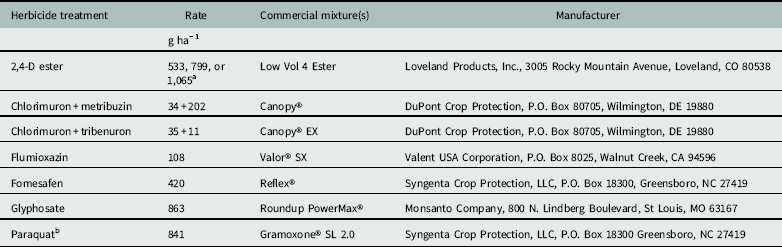
The study was a randomized complete block design with a factorial arrangement of fall treatments and spring herbicide application timing as the main effects, with three replications per treatment. Fall treatments included glyphosate plus 2,4-D applied alone (referred to as fall with no residual), applied with a prepackaged mixture of chlorimuron plus tribenuron (referred to as fall chlorimuron plus tribenuron), or applied with flumioxazin (referred to as fall flumioxazin), and no fall treatment (Table 1). The residual herbicide treatments of chlorimuron plus tribenuron and flumioxazin were chosen because they represent two different herbicide mechanisms of action, have different soil half-lives, and have provided satisfactory weed control in trials conducted at the University of Delaware (Curran et al. Reference Curran, Lingenfelter, Johnson, VanGessel, Vollmer, Schultz, Cahoon, Flessner, Hines and Chandran2018; Shaner Reference Shaner2014).
Herbicide treatments and rates applied as commercial formulations used in field studies in Delaware in 2013, 2014, 2015, and 2016.

a 2,4-D rates were 1,065 g ae ha−1 when applied 4 wk before planting, 799 g ae ha−1 when applied in the fall, and 533 g ae ha−1 when applied 1 to 2 wk before planting.
b Treatment included crop oil concentrate and urea ammonium nitrate at 1.25% and 2.5% v/v, respectively.
Spring herbicide application timings included applications 4 wk before planting (referred to as early-spring), 1 to 2 wk before planting (referred to as late-spring), or as sequential applications made 4 wk before planting and at planting (referred to as sequential-spring), and a no spring treatment (Table 1). Early- and late-spring herbicide treatments included glyphosate plus 2,4-D plus a prepackaged mixture of chlorimuron plus metribuzin. The sequential-spring treatment included glyphosate plus 2,4-D at 4 wk before planting followed by paraquat plus chlorimuron plus metribuzin applied at planting. The premix of chlorimuron plus metribuzin was selected based on its consistent weed control in University of Delaware trials and widespread use in the region.
Fall applications were made on December 2, 2013, December 15, 2014, and November 16, 2015. Early-spring applications were made on May 2, 2014, April 13, 2015, and April 21, 2016. Late-spring applications were made 2 to 3 wk later (May 20, 2014, April 24, 2015, and May 9, 2016). Soybeans were planted May 29, 2014, May 7, 2015, and May 19, 2016, and PRE applications were made within 24 h of planting. Soybean cultivar ‘39RY43’ (Dyna-Gro, 2775 Giant Road, Richmond, CA 94806), ‘P94Y23’ (Pioneer Hi-Bred International, P.O. Box 1000, Johnston, IA 50131), and ‘S43YR95’ (Dyna-Gro) were planted in 2014, 2015, and 2016, respectively, and seeded at a rate of 444,600 seeds ha−1.
The entire study was treated with glyphosate plus fomesafen as a broadcast application at 6 wk after planting (WAP) (Table 1). Preplant treatments that did not provide adequate early-season weed control would result in larger plants that would not be adequately controlled with glyphosate plus fomesafen. This provided an opportunity to evaluate how the preplant treatments responded to a full-season approach to weed management. Glyphosate plus fomesafen was used because it is the most common POST herbicide combination for Palmer amaranth control in the Mid-Atlantic region.
Individual plots were 7.6-m long and 3-m wide with seven rows, 38 cm apart. Herbicides were applied using a tractor-mounted sprayer with a spray volume of 187 L ha−1 at 4.8 kPa and 11002 Greenleaf AirMix® spray nozzles (Greenleaf Technologies, P.O. Box 1767, Covington, LA 70434) with a pressure of 276 kPa.
Weed control was visually evaluated on a 0 to 100 scale, with 0 being no control and 100 being complete control, at 0, 4, and 9 WAP in 2014 and 1, 4, and 9 WAP in 2015 and 2016. Soybean was harvested at physiological maturity, and yields were adjusted to 13% moisture.
Data were subjected to ANOVA with the Fit Mixed procedure in JMP Pro v. 14 (SAS Institute, SAS Campus Drive, Building T, Cary, NC 27513), with year, fall treatment, and spring treatment as fixed effects. Replications and replications nested within year were treated as random effects. Fixed effects and interactions were tested using Fisher’s LSD test at P=0.05. If no interactions were observed, data were combined over fixed effects or years.
Results and Discussion
Winter Annual Weeds
Each year of the study, adequate fall precipitation occurred to incorporate fall-applied residual herbicides. Winter annual weed density and distribution was not consistent across study sites. In 2 out of 3 yr, field pansy (Viola bicolor Pursh), knawel (Scleranthus annuus L.), and horseweed were rated by species. The remaining winter annual weeds were grouped together and evaluated as other winter annual weeds. These included cutleaf evening-primrose (Oenothera laciniata Hill), henbit (Lamium amplexicaule L.), mouseear chickweed [Crastium fontanum ssp. vulgare (Hart) Greuter & Burdet], and redstem filaree [Erodium cicutarium (L.) L’her. ex Ait.].
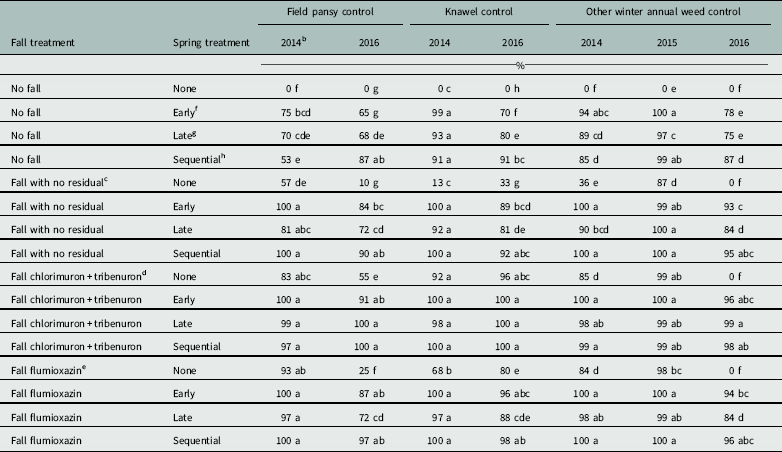
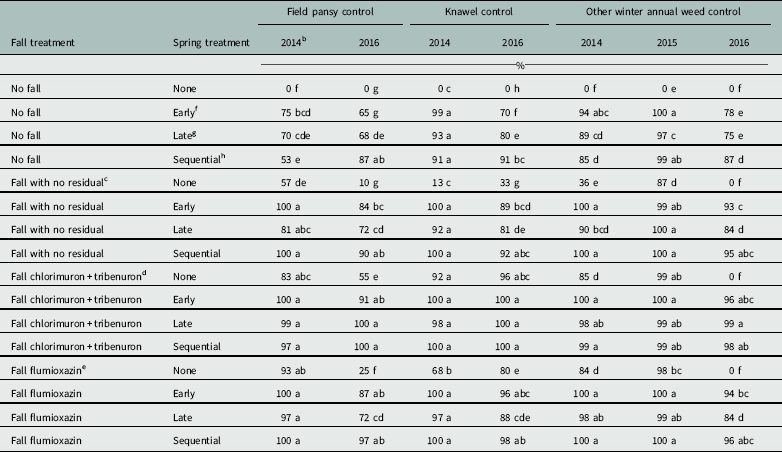
Effectiveness of fall residual treatments alone varied by weed species and year and did not provide consistent, acceptable weed control when rated at 0 or 1 WAP (Table 2). For instance, knawel control was at least 92% with fall chlorimuron plus tribenuron alone in 2014 and 2016, but the same treatment provided 83% and 55% field pansy control in 2014 and 2016, respectively. Also, this treatment ranged from 0% to 99% control of other winter annual weeds over a 3-yr period. Furthermore, a single application in the spring (early or late) did not always provide greater than 70% control of the winter annual weeds present.
Field pansy, knawel, and other winter annual weed control with fall and spring herbicide applications in Delaware when rated at 0 or 1 wk after planting.Footnote a
a Data in same column followed by the same letter are not significantly different from one another (P=0.05, LSD).
b At-planting portion of the sequential application not applied at time of rating.
c Fall with no residual: glyphosate 863 g ae ha−1+2,4-D 799 g ae ha−1.
d Fall chlorimuron+tribenuron: glyphosate 863 g ae ha−1+2,4-D 799 g ae ha−1+chlorimuron 35 g ai ha−1+tribenuron 11 g ai ha−1.
e Fall flumioxazin: glyphosate 863 g ae ha−1+2,4-D 799 g ae ha−1+flumioxazin 108 g ai ha−1.
f Early: glyphosate 863 g ae ha−1+2,4-D 1,065 g ae ha−1+chlorimuron 34 g ha−1+metribuzin 202 g ai ha−1 applied 4 wk before planting.
g Late: glyphosate 863 g ae ha−1+2,4-D 533 g ae ha−1+chlorimuron 34 g ha−1+metribuzin 202 g ha−1 applied 1 to 2 wk before planting.
h Sequential: glyphosate 863 g ha−1+2,4-D 1,065 g ha−1 4 wk before planting followed by paraquat 841 g ha−1+chlorimuron 34 g ha−1+metribuzin 202 g ha−1+crop oil concentrate 1.25% v/v+urea ammonium nitrate 2.5% v/v applied at planting.
In 2014, field pansy control ranged from 81% to 100% with fall chlorimuron plus tribenuron or fall flumioxazin alone or when a fall treatment was followed by a spring application (Table 2). However, in 2016, fall chlorimuron plus tribenuron and fall flumioxazin alone provided 55% and 25% control, respectively. Therefore, two herbicide applications were needed to provide the greatest control in 2016. The greatest control was achieved with fall chlorimuron plus tribenuron followed by a spring application or fall flumioxazin followed by an early- or sequential-spring treatment. In addition, fall with no residual or no fall treatment required a sequential-spring treatment. It should be noted that field pansy ratings in 2014 were made before the second application of the sequential-spring treatment. Therefore, only the glyphosate plus 2,4-D portion of the treatment had been applied.
In 2014, all herbicide treatments, except fall flumioxazin alone or fall with no residual alone, provided 91% or greater knawel control (Table 2). In 2016, the only single-application treatment to provide the greatest knawel control was fall chlorimuron plus tribenuron alone. Fall flumioxazin followed by early- or sequential-spring treatments and no fall treatment followed by sequential-spring treatments also provided the greatest level of control. In addition, the sequential-spring treatment alone and fall with no residual followed by an early-spring treatment provided 91% and 89% control, respectively. In 2014, the high knawel density (160 plants m−2) led to intraspecific competition that resulted in many shorter, smaller plants (≤6 cm) that were more susceptible to glyphosate plus 2,4-D applications. In contrast, a lower weed density in 2016 (50 plants m−2), reduced plant to plant competition and allowed weeds to reach heights up to 13 cm at time of spring application. This resulted in less effective control with the single application of the early- and late-spring treatments alone.
Due to lack of uniform distribution and low densities, all other winter annual weeds were rated together. In 2014, the early-spring treatment alone was the only single-herbicide application to provide at least 94% control of other annual weeds (Table 2). Similar levels of control were achieved with a fall-residual application followed by a spring application or fall with no residual followed by either early- or sequential-spring treatments. While there were significant differences, all treatments with a spring application provided at least 85% control. In 2015, all treatments, except for fall with no residual alone, provided 97% or greater control, although there were significant differences. In 2016, fall treatments alone provided no control. Fall chlorimuron plus tribenuron with a spring application provided 96% to 98% control. Fall flumioxazin or fall with no residual needed either an early-spring application or sequential-spring applications to provide similar control.
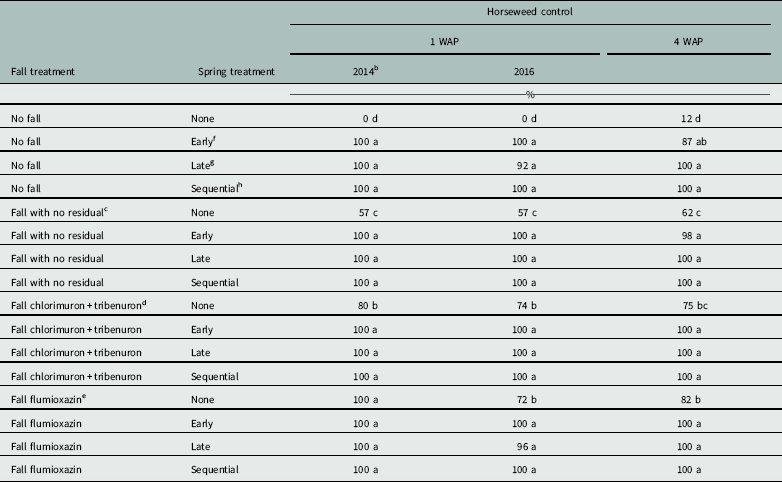
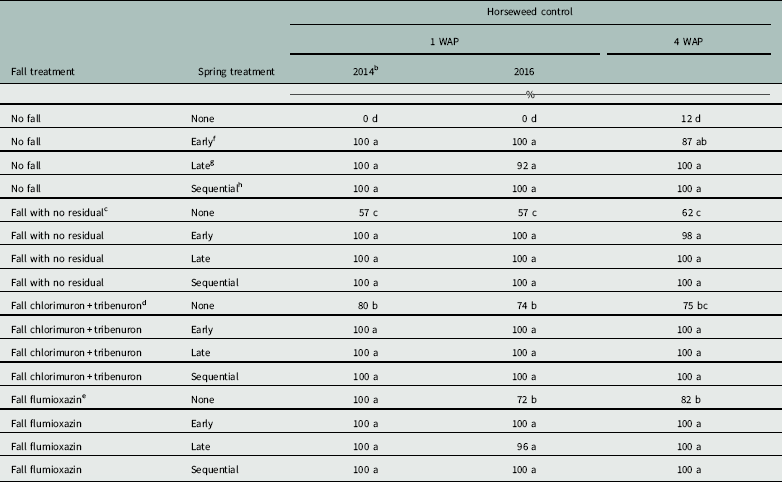
Horseweed was present in the study area in 2014 and 2016. In 2014, horseweed control was 100% for all treatments that included a spring application, regardless of application timing when rated at 0 or 1 WAP (Table 3). Fall flumioxazin with no spring treatment also provided 100% control. In 2016, spring applications were needed to provide at least 92% control, while fall-applied herbicides alone provided 57% to 74% control. Similarly, Davis et al. (Reference Davis, Kruger, Young and Johnson2010) reported better horseweed control with spring applications compared with fall applications.
Horseweed control rated at 0 or 1 and 4 wk after planting (WAP) with fall and spring herbicide treatments.Footnote a
a Data in the same column followed by the same letter are not significantly different from one another (P=0.05, LSD).
b Horseweed rated at planting in 2014. At-planting portion of the sequential application not applied at time of rating.
c Fall with no residual: glyphosate 863 g ae ha−1+2,4-D 799 g ae ha−1.
d Fall chlorimuron+tribenuron: glyphosate 863 g ae ha−1+2,4-D 799 g ae ha−1+chlorimuron 35 g ha−1+tribenuron 11 g ha−1.
e Fall flumioxazin: glyphosate 863 g ae ha−1+2,4-D 799 g ae ha−1+flumioxazin 108 g ha−1.
f Early: glyphosate 863 g ae ha−1+2,4-D 1,065 g ae ha−1+chlorimuron 34 g ha−1+metribuzin 202 g ha−1 applied 4 wk before planting.
g Late: glyphosate 863 g ae ha−1+2,4-D 533 g ae ha−1+chlorimuron 34 g ha−1+metribuzin 202 g ha−1 applied 1 to 2 wk before planting.
h Sequential: glyphosate 863 g ae ha−1+2,4-D 1,065 g ae ha−1 4 wk before planting followed by paraquat 841 g ha−1+chlorimuron 34 g ha−1+metribuzin 202 g ha−1+crop oil concentrate 1.25% v/v+urea ammonium nitrate 2.5% v/v applied at planting.
Horseweed control at 4 WAP followed the same trends, with all fall treatments requiring a spring application to provide excellent control or greater (Table 3). The other departure from the 0 or 1 WAP ratings was the early-spring treatment with no fall application, which provided 87% control, while the other treatments were ≥98%.
Fall followed by spring applications were needed to control the majority of winter annual weeds, as fall-only treatments did not provide consistent control of spring-emerging weeds. However, fall-residual herbicide treatments seemed to have more benefit when the applications were made in December (2014 and 2015) rather than in mid-November (2016). The fall-applied residual herbicides in this study often lack sufficient residual activity to control spring-emerging weeds. Soil half-lives for flumioxazin under field conditions can range from 1 to 4 wk (Alister et al. 2008; Mueller et al. Reference Mueller, Boswell, Mueller and Steckel2014); for chlorimuron, 1 to 4 wk (Gaynor et al. Reference Gaynor, MacTavish, Edwards, Rhodes and Huston1997; Vencill and Banks Reference Vencill and Banks1994); and for tribenuron, up to 1 wk (Dong et al. Reference Dong, Qian and Hu2015; Mehdizadeh et al. Reference Mehdizadeh, Alebrahim and Roushani2017). In addition, the 2016 season had warmer winter temperatures and more rainfall, which may have contributed to better weed growth and ultimately lower control ratings close to planting. The average maximum daily temperature in late fall though early spring of 2014 and 2015 was 9 C, but 13 C in 2016, with temperatures reaching as high as 16 C in December 2015 and April and March of 2016 (unpublished data). Furthermore, 60 cm of rain accumulated from the time the fall application was made in 2016 to the time the treatments were rated at 0 or 1 WAP, but less than 47 cm accumulated during the same time in 2014 and 2015 (unpublished data). This led to both increased herbicide dissipation and greater weed growth in 2016, resulting in lower control of other winter annual weeds.
Summer Annual Weeds
Palmer amaranth control was best when residual herbicide applications were made within 1 to 2 wk of soybean planting as late- or sequential-spring treatments. The main effect of spring treatment was significant when Palmer amaranth control was rated at 4 and 9 WAP; therefore, data were combined over fall treatment and years. Because Palmer amaranth emerges in early May (Jha and Norsworthy Reference Jha and Norsworthy2009), fall treatments were not expected to provide residual control.
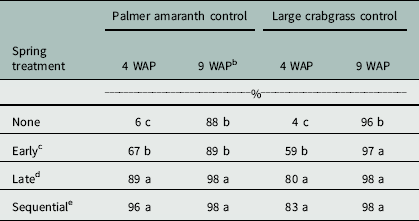
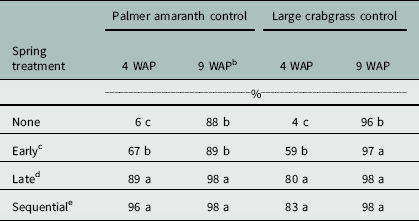
Dissipation of the residual herbicides chlorimuron and metribuzin led to poorer control with early-spring compared with late- and sequential-spring treatments when rated at 4 WAP (Table 4). Late- or sequential-spring treatments provided at least 89% Palmer amaranth control at 4 WAP, whereas the early-spring treatment provided 67% control (Table 4). As previously stated, chlorimuron has a half-life of approximately 4 wk, and the half-life of metribuzin is approximately 4 to 9 wk (Shaner Reference Shaner2014). The amount of time between the application of chlorimuron plus metribuzin in the early-, late-, and sequential-spring treatments was 9, 6, and 4 wk, respectively, before Palmer amaranth was rated at 4 WAP. Therefore, control declined with the early-spring treatment. Similarly, Whitaker et al. (Reference Whitaker, York, Jordan and Culpepper2010) reported that metribuzin plus chlorimuron controlled Palmer amaranth 87% within 3 wk of application, but control declined to 77% within 7 wk of application.
Palmer amaranth and large crabgrass control at 4 and 9 wk after planting (WAP).Footnote a
a Data averaged over fall treatments and year. Data in the same column followed by the same letter are not significantly different from one another (P=0.05, LSD).
b Ratings at 9 WAP reflect POST application of glyphosate 863 g ae ha−1+fomesafen 420 g ha−1 6 WAP.
c Early: glyphosate 863 g ae ha−1+2,4-D 1,065 g ae ha−1+chlorimuron 34 g ha−1+metribuzin 202 g ha−1 applied 4 wk before planting.
d Late: glyphosate 863 g ae ha−1+2,4-D 533 g ae ha−1+chlorimuron 34 g ha−1+metribuzin 202 g ha−1 applied 1 to 2 wk before planting.
e Sequential: glyphosate 863 g ae ha−1+2,4-D 1,065 g ae ha−1 4 wk before planting followed by paraquat 841 g ha−1+chlorimuron 34 g ha−1+metribuzin 202 g ha−1+crop oil concentrate 1.25% v/v+urea ammonium nitrate 2.5% v/v applied at planting.
Following an application of glyphosate plus fomesafen at 6 WAP, late- and sequential-spring treatments controlled Palmer amaranth 98%, whereas the no spring and early-spring treatments provided 88% and 89% control at 9 WAP, respectively (Table 4). This difference in control can be attributed to weed size at the timing of the glyphosate plus fomesafen application. The population of Palmer amaranth was glyphosate-resistant, thus fomesafen provided the control. Effective control of Palmer amaranth with fomesafen POST depends on effective herbicide coverage, with optimum Palmer amaranth size for control being 10-cm tall or less (Anonymous 2018). Palmer amaranth in plots receiving no spring or the early-spring treatment ranged from 10 to 38 cm in height and was not effectively controlled by the glyphosate plus fomesafen application.
Control of large crabgrass was also greater when herbicide applications were made within 2 wk of planting. The main effect of spring treatment was significant when large crabgrass control was rated at 4 and 9 WAP. Late- and sequential-spring treatments controlled large crabgrass at least 80% at 4 WAP, but the early-spring treatment provided 59% control (Table 4). These results are similar to those with Palmer amaranth control, as residual control with early-spring applications dissipated before evaluation at 4 WAP. At 9 WAP, large crabgrass control was 96% to 98% with all treatments (Table 4). Glyphosate has been shown to be effective in controlling large crabgrass, and the glyphosate plus fomesafen application was able to improve control later in the season, even in treatments without an effective PRE herbicide application.
Soybean Yield
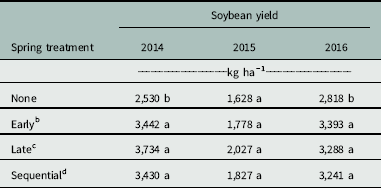
There was a significant year by spring treatment interaction for soybean yield. In 2014 and 2016, yields were greater when a spring treatment was applied (Table 5). There were no treatment differences in 2015. Yields were lower in 2015 compared with 2014 and 2016 (Table 5). Lower yields in 2015 were the result of moisture stress during late vegetative growth. Rainfall totals for July of 2015 (8 cm) were approximately half the monthly total in 2014 (16 cm) and 2016 (15 cm). In addition, the site was watered using supplemental irrigation in 2016, but not in 2014 and 2015. In 2014 and 2015, soybean stands were often poor in plots with no spring treatment due to moisture stress and competition with winter annual weeds.
Soybean yields for 2014, 2015, and 2016 in Delaware averaged over fall treatments.Footnote a
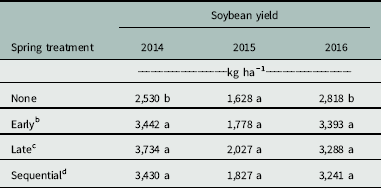
a Data in the same column followed by the same letter are not significantly different from one another (P=0.05, LSD).
b Early: glyphosate 863 g ae ha−1+2,4-D 1,065 g ae ha−1+chlorimuron 34 g ha−1+metribuzin 202 g ha−1 applied 4 wk before planting.
c Late: glyphosate 863 g ae ha−1+2,4-D 533 g ae ha−1+chlorimuron 34 g ha−1+metribuzin 202 g ha−1 applied 1 to 2 wk before planting.
d Sequential: glyphosate 863 g ae ha−1+2,4-D 1,065 g ae ha−1 4 wk before planting followed by paraquat 841 g ha−1+chlorimuron 34 g ha−1+metribuzin 202 g ha−1+crop oil concentrate 1.25% v/v+urea ammonium nitrate 2.5% v/v applied at planting.
Previous studies examining the effect of application timing have mostly evaluated herbicides applied in the fall or spring, but not sequentially. Our results are consistent with Hasty et al. (Reference Hasty, Sprague and Hager2004), in that fall residual herbicides were better at controlling later-emerging winter annual weeds compared with a fall application with no residual treatment. However, the inclusion of a spring treatment provided better winter annual weed control than fall treatments alone. When preceded by a fall herbicide treatment, early- and sequential-spring applications were consistently more effective than late applications in controlling winter annual weeds. However, late- and sequential-spring treatments were needed for greater Palmer amaranth and large crabgrass control. Our results also demonstrated that a spring treatment was needed for the highest level of horseweed control, as control with fall-only residual treatments was variable at 0 or 1 WAP.
Current best management practices for control of Palmer amaranth and other weeds known to be herbicide resistant recommend planting into weed-free fields, keeping fields as weed-free as possible, and applying herbicides at the recommended weed size (Norsworthy et al. Reference Norsworthy, Ward, Shaw, Llewellyn, Nichols, Webster, Bradley, Frisvold, Powles, Burgos, Witt and Barrett2012). Our results are consistent with previous studies in showing fall herbicides alone did not provide adequate winter annual weed control at soybean planting (Davis et al. Reference Davis, Kruger, Young and Johnson2010; Monnig and Bradley Reference Monnig and Bradley2007). Also, a single spring application of glyphosate plus 2,4-D plus chlorimuron plus metribuzin did not provide consistent control of a diverse weed population. Therefore, two herbicide applications, fall followed by spring or sequential-spring applications were needed to provide a weed-free seedbed each year. Growers often try to minimize the number of herbicide applications by including a residual herbicide with the nonselective preplant application. Residual herbicide applications made 4 wk before planting were not as effective in controlling Palmer amaranth and large crabgrass as those made closer to planting. This corroborates results from others that have shown better Palmer amaranth control is achieved with timely applications of an effective PRE herbicide followed by effective POST residual herbicides (Bell et al. Reference Bell, Norsworthy, Scott and Popp2015; Whitaker et al. Reference Whitaker, York, Jordan and Culpepper2010). When designing a herbicide program, it is important to target both winter and summer annual weeds at timings that produce optimal control. Herbicide applications need to be made several weeks before soybean planting to provide effective control of winter annual weeds at planting; however, a second application that includes a residual herbicide will need to be made for summer annual weeds with a prolonged germination period.
Acknowledgments
The authors would like to thank the Delaware Soybean Board for funding this research. No conflicts of interest have been declared.