Introduction
Neurological soft signs (NSS) refer to subtle neurological abnormalities manifested in the form of motor coordination, complex motor sequencing, sensory integration and disinhibition (Heinrichs & Buchanan, Reference Heinrichs and Buchanan1988; Chen et al. Reference Chen, Shapleske, Luque, McKenna, Hodges, Calloway, Hymas, Dening and Berrios1995). NSS have been considered ‘target features’ (Tsuang & Faraone, Reference Tsuang and Faraone1999) and possible endophenotypes of schizophrenia (Chan & Gottesman, Reference Chan and Gottesman2008). Patients with schizophrenia and their non-psychotic first-degree relatives have significantly higher prevalence of NSS than healthy controls (Chan et al. Reference Chan, Xu, Heinrichs, Yu and Gong2010c , Reference Chan, Xu, Heinrichs, Yu and Wang d ).
However, to qualify as an endophenotype, a marker must be associated with the illness, heritable, state-independent, demonstrate co-segregation and familial association, and be reliable and valid (Gottesman & Gould, Reference Gottesman and Gould2003; Gourion et al. Reference Gourion, Goldberger, Bourdel, Bayle, Millet, Olie and Krebs2003; Chan & Gottesman, Reference Chan and Gottesman2008). There is ample evidence in the extant literature to suggest that NSS fulfill many of the criteria of endophenotypes for schizophrenia (Chan & Gottesman, Reference Chan and Gottesman2008; Chan et al. Reference Chan, Xu, Heinrichs, Yu and Gong2010c , Reference Chan, Xu, Heinrichs, Yu and Wang d ). For example, NSS have been shown to be associated with schizophrenia (Chan et al. Reference Chan, Xu, Heinrichs, Yu and Wang2010 d), to be state-independent (Chan et al. Reference Chan, Wang, Zhao, Yan, Xu, Gong and Manschreck2010b , Reference Chan, Xu, Heinrichs, Yu and Wang d ), to be familially associated and co-segregate (Chan et al. Reference Chan, Xu, Heinrichs, Yu and Gong2010 c), and to be reliable and valid (Chen et al. Reference Chen, Shapleske, Luque, McKenna, Hodges, Calloway, Hymas, Dening and Berrios1995). However, the heritability of NSS needs to be further examined and validated. Greenwood et al. (Reference Greenwood, Swerdlow, Gur, Cadenhead, Calkins, Dobie, Freedman, Green, Gur, Lazzeroni, Nuechterlein, Olincy, Radant, Ray, Schork, Seidman, Siever, Silverman, Stone, Sugar, Tsuang, Tsuang, Turetsky, Light and Braff2013) reported the results of the first phase of the Consortium on the Genetics of Schizophrenia (COGS-1) and found that the 12 potential endophenotypes included in the COGS-1 exhibited comparable levels of heritability, ranging from 31 to 44%. Seidman et al. (Reference Seidman, Hellemann, Nuecherlein, Greenwood, Braff, Cadenhead, Calkins, Freedman, Gur, Gur, Lazzeroni, Light, Olincy, Radant, Siever, Silverman, Sprock, Stone, Sugar, Swerdlow, Tsuang, Tsuang, Turesky and Green2015) showed that the 12 potential cognitive endophenotypes could be classified into five distinct factor scores with heritability ranging from 22 to 39%. However, the COGS-1 potential endophenotypes do not include NSS and the heritability of NSS is not known. Only one study has examined the heritability of NSS. Based on the data from 96 participants from eight extended families with schizophrenia, Sanders et al. (Reference Sanders, Joo, Almasy, Wood, Keshavan, Pogue-Gelle, Gur, Gur and Nimponkar2006) demonstrated high heritability of NSS items, e.g. audio-visual integration (h 2 = 0.79), fist-ring (right hand completion time h 2 = 0.53, left hand completion time h 2 = 0.70), alternation fist-palm (completion time h 2 = 0.77), and rapid alternating movements (right hand completion time h 2 = 0.99, left hand completion time h 2 = 1). These findings suggest that motor coordination items may be highly heritable. However, a more direct way to calculate heritability is to make use of the twin design. Although a twin study has been conducted to calculate the correlation of NSS between monozygotic (MZ) twins and dizygotic (DZ) twins (Picchioni et al. Reference Picchioni, Toulopoulou, Landau, Davies, Ribchester and Murray2006), no twin study has been conducted to estimate the heritability of NSS. Moreover, there are also potential ethnic variations in NSS prevalence in non-Caucasian populations (Gureje, Reference Gureje1988; Chen & Chan, Reference Chen and Chan2003). For example, Chen & Chan (Reference Chen and Chan2003) have reported a trend for healthy Caucasian participants to have higher levels of sensory integration signs than their Chinese counterparts.
The present study used a healthy twin design to examine the heritability of NSS in the Han Chinese population. We also examined the familiality of NSS in patients with schizophrenia and their non-psychotic first-degree relatives. We hypothesized that NSS would demonstrate a high heritability in healthy twins. We further hypothesized that high familiality would be demonstrated in patients with schizophrenia and their non-psychotic first-degree relatives for NSS.
Method
Participants
A total of 267 pairs of MZ twins and 127 pairs of DZ twins were recruited from the twin pools of the Institute of Psychology, Chinese Academy of Science and Sun Yat-sen University. People with a history of psychiatric disorder, head trauma, cerebral organic diseases and substance abuse were excluded.
In addition, 75 patients with schizophrenia and 75 non-psychotic first-degree relatives were recruited from the Peking University Sixth Hospital, the Beijing Huilongguan Hospital and the Castle Peak Hospital. All patients met the diagnostic criteria of schizophrenia according to the Diagnostic and Statistical Manual of Mental Disorders, fourth edition (DSM-IV) (American Psychiatric Association, 2000). Exclusion criteria included: co-morbid diagnosis of major depressive disorder; substance dependence in the past 6 months; substance abuse in the past month; an intelligence quotient (IQ) of less than 70; and a history of head injury or neurological disorder. The inclusion and exclusion criteria for the non-psychotic first-degree relatives were the same as those of the healthy twins. The IQ of each participant was estimated by the abbreviated Chinese version of the Wechsler Adult Intelligence Scale (Gong, Reference Gong1992).
Demographics of the participants are shown in Table 1. Taking the significant age difference between patients with schizophrenia and their first-degree relatives into consideration, the first-degree relatives were further divided into the sibling group with 49 siblings and the parent group with 26 parents.
Demographics of healthy twins, schizophrenia patients and their first-degree relatives

MZ, Monozygotic twin; DZ, dizygotic twins of the same sex; SCZ, schizophrenia patients; REL, first-degree relatives of schizophrenia patients; SCZ-SIB, schizophrenia patients in sibling group; SIB, siblings of schizophrenia patients; SCZ-PAR, schizophrenia patients in parent group; PAR, parents of schizophrenia patients.
Mean value was significantly different from that of the SCZ group: * p < 0.05, ** p < 0.01.
The study was approved by the ethics committees of the Institute of Psychology, Chinese Academy of Sciences, the Peking University Sixth Hospital, Beijing Huilongguan Hospital, and the New Territories West Cluster of the Hong Kong Hospital Authority. All participants gave written informed consent before the commencement of the study.
NSS measures
NSS were evaluated with the abridged version of the Cambridge Neurological Inventory (CNI) (Chan et al. Reference Chan, Wang, Wang, Chen, Manschreck, Li, Yu and Gong2009), which was designed to measure NSS in terms of motor coordination (e.g. finger tapping and opposition), sensory integration (e.g. left–right orientation and extinction) and disinhibition (e.g. saccade blink and mirroring behaviour). All items were rated on a dichotomized category (0 for absence and 1 for presence) by a trained experimenter who was blind to the participants’ status. Item scores were summed up to subscale scores for motor coordination, sensory integration, disinhibition, and a total score of NSS. A higher score indicates a higher level of neurological abnormalities. The inter-rater reliability values for the subscale and full-scale scores were all above 0.85 (Chan et al. Reference Chan, Wang, Wang, Chen, Manschreck, Li, Yu and Gong2009).
Data analysis
The classical method and structure equation model were applied to calculate the heritability of each NSS item, subscale scores and total score of the CNI. According to the classical equation h 2 = 2 (r MZ − r DZ) by Falconer (Hartl & Clark, Reference Hartl and Clark2007), we calculated classical heritability based on the intraclass correlation coefficients (ICCs) of MZ and DZ twins on the CNI. The ACE model was also used to calculate the heritability of NSS (Neale & Maes, Reference Neale and Maes2004). In the ACE model, A refers to the additive genetics, C refers to the common environment and E refers to the random environment. Since the C factor and the non-additive genetics (D) cannot be estimated simultaneously and the twins included in this study were all non-adopted, the D factor was dropped. The submodels AE and CE were compared with the ACE model. If the χ2 of submodel AE or CE was not significantly different from that of the full ACE model, then the parsimonious AE or CE model was preferred. Heritability a 2 was counted as the proportion of the effect from factor A.
For the familiality estimation, analyses of covariance (ANCOVAs) controlling for the number of years of education, age and IQ were conducted between patients with schizophrenia and their first-degree relatives, and subgroup analyses between patients with schizophrenia and their siblings and their parents, respectively, on the subscale and the total scores of the CNI. Finally, Spearman rank correlation was calculated between patients with schizophrenia and their first-degree relatives in subscale and total scores of the CNI. Bonferroni correction was applied to correct for multiple comparisons.
All the analyses were conducted with SPSS 18.0 (USA) except the heritability calculation based on the ACE model, which was conducted with the Mx package (Neale et al. Reference Neale, Boker, Xie and Maes2003).
Results
Heritability
The ICC among the MZ twins was higher than the ICC among the DZ twins in the subscale and the total scores of the CNI. The classical heritability of the total CNI score, the motor coordination and the disinhibition subscales was around 0.3 and for the sensory integration subscale was 0.51 (Table 2). The NSS scores in MZ twins and DZ twins are presented in online Supplementary Fig. S1.
Intraclass correlation coefficients of MZ and DZ and heritability of CNI and subscales

MZ, Monozygotic twins; DZ, dizygotic twins; CNI, Cambridge Neurological Inventory; a 2, additive genetic effect; CI, confidence interval; c 2, common environment effect; e 2, random environment effect; df, degrees of freedom; AIC, Akaike's information criterion; RMSEA, root mean square error of approximation.
The ACE model showed that the heritability of the total CNI score and the disinhibition subscale was not significant, while the heritability of the motor coordination subscale (a 2 = 0.57, p < 0.001) and the heritability of the sensory integration subscale (a 2 = 0.21, p = 0.001) were significant (Table 2).
Familiality
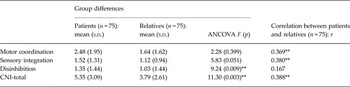
Significant group differences between patients with schizophrenia and their first-degree relatives on the disinhibition subscale (p = 0.009) and the total CNI score (p = 0.003) were observed. However, scores on the motor coordination (p = 0.399) and the sensory integration subscales of people with schizophrenia did not distinguish them from their first-degree relatives (p = 0.051) (Table 3). When the first-degree relatives were divided into parents and siblings, patients with schizophrenia could be distinguished from their corresponding siblings by the total CNI score (p = 0.034), whereas they could be distinguished from their corresponding parents by the sensory integration subscale score (p = 0.022) and the total CNI score (p = 0.022) (online Supplementary Table S1).The effects of the covariates age and IQ were both significant.
Group differences and correlations between schizophrenia patients and their first-degree relatives in CNI a

CNI, Cambridge Neurological Inventory; s.d., standard deviation; ANCOVA, analysis of covariance.
a Age, education years and intelligence quotient were controlled.
** p < 0.01.
Patients with schizophrenia showed significant correlation with their first-degree relatives on the total CNI score (r = 0.388, p = 0.001), the motor coordination subscale score (r = 0.369, p = 0.001) and the sensory integration subscale score (r = 0.380, p = 0.029), while correlation with the disinhibition subscale score was not significant (r = 0.167, p = 0.152) (Table 3). In addition, the correlation between patients with schizophrenia and their parents and the correlation between patients with schizophrenia and their siblings showed a similar pattern (online Supplementary Table S1).
Discussion
In the present study, we found a modest to moderate heritability for NSS in a group of Chinese healthy twins. Although patients with schizophrenia scored higher than their non-psychotic first-degree relatives on the CNI, both groups showed high correlation with each other on the total score and several subscales, suggesting possible familiality of NSS in patients with schizophrenia. These results are consistent with our a priori hypothesis that NSS are highly heritable and show familial association.
The motor coordination and the sensory integration subscales showed high heritability estimates based on both the classical heritability equation and the genetic model analysis. These results are similar to the heritability estimates of NSS in schizophrenia families (Sanders et al. Reference Sanders, Joo, Almasy, Wood, Keshavan, Pogue-Gelle, Gur, Gur and Nimponkar2006). However, a more detailed rating system was adopted in the earlier study, rather than the yes/no system adopted in our study, which may partly explain the higher heritability estimates previously found. Furthermore, we found that the correlation of NSS among the healthy MZ twins showed a similar pattern to results from studies using MZ twins with schizophrenia. Picchioni et al. (Reference Picchioni, Toulopoulou, Landau, Davies, Ribchester and Murray2006) found that the correlation coefficient of NSS among MZ twins in which one was diagnosed with schizophrenia was 0.523, while the correlation among healthy MZ control twins was 0.657. This latter correlation is consistent with the NSS total score correlation of 0.673 that we found among MZ twins. However, the correlation among DZ twins in their study was not significant while we found a correlation coefficient of 0.542. This may be related to the small number of DZ twins (12 pairs) in their study. It should be noted that the total CNI score did not show any additive genetic component even though both the motor coordination and the sensory integration subscale scores did. Further studies are needed to explore the reason for this pattern.
Similar significant correlations of the NSS subscale and total scores were demonstrated between patients with schizophrenia and their first-degree relatives, regardless of whether the comparison was made between patient–sibling pairs or patient–parent pairs in the present study. These high correlations were consistent with previous studies in Caucasian clinical samples (Ismail et al. Reference Ismail, Cantor-Graae, Cardenal and McNeil1998; Yazici et al. Reference Yazici, Demir, Yazici and Gogus2002; Compton et al. Reference Compton, Bollini, Mack, Kryda, Rutland, Weiss, Bercu, Esterberg and Walker2007). The disinhibition subscale appears to be relatively less sensitive and specific in our sample. In addition, when age and IQ were included as covariates, the effects of IQ and age were both significant, suggesting the influence of age and IQ on NSS. This also lends support to the results of our previous meta-analysis in which age was shown to be a significant mediator of NSS (Chan et al. Reference Chan, Xu, Heinrichs, Yu and Gong2010 c).
It is noteworthy that the heritability estimates of NSS we found in our healthy twins sample and the patient–relative pairs sample were comparable with those reported by the COGS-1 potential endophenotypes (31–44%) (Greenwood et al. Reference Greenwood, Swerdlow, Gur, Cadenhead, Calkins, Dobie, Freedman, Green, Gur, Lazzeroni, Nuechterlein, Olincy, Radant, Ray, Schork, Seidman, Siever, Silverman, Stone, Sugar, Tsuang, Tsuang, Turetsky, Light and Braff2013) and higher than those reported by Seidman et al. (22–39%) (Seidman et al. Reference Seidman, Hellemann, Nuecherlein, Greenwood, Braff, Cadenhead, Calkins, Freedman, Gur, Gur, Lazzeroni, Light, Olincy, Radant, Siever, Silverman, Sprock, Stone, Sugar, Swerdlow, Tsuang, Tsuang, Turesky and Green2015). Specifically, the heritability was 29% for pre-pulse inhibition, 20% for P50 suppression, 36% for anti-saccade task, 34% for degraded-stimulus Continuous Performance Test, 26% for California Verbal Learning Test, 34% for Letter-Number Span, 25% for abstraction and mental flexibility, 30% for face memory, 34% for spatial memory, 52% for spatial processing, 38% for sensorimotor dexterity, and 16% for emotion recognition (Greenwood et al. Reference Greenwood, Swerdlow, Gur, Cadenhead, Calkins, Dobie, Freedman, Green, Gur, Lazzeroni, Nuechterlein, Olincy, Radant, Ray, Schork, Seidman, Siever, Silverman, Stone, Sugar, Tsuang, Tsuang, Turetsky, Light and Braff2013). Chan et al. (Reference Chan, Wang, Wang, Chen, Manschreck, Li, Yu and Gong2009) suggested that NSS were associated with executive attention, verbal memory and visual memory. Thus, it is reasonable to suggest that NSS show comparable heritability to the COGS-1 potential cognitive endophenotypes. However, COGS-1 (Swerdlow et al. Reference Swerdlow, Gur and Braff2015) does not include NSS items in its assessment regimen. One related item is ‘anti-saccade’, which may be construed a disinhibition sign. Given the low heritability of disinhibition signs we found in our sample, other NSS should be incorporated into the assessment regimen for future study. One possible reason for why NSS are not incorporated in the formal assessment regimen in the past may be the perceived ‘soft’ nature of NSS. However, recent studies have provided strong evidence that NSS are not ‘soft’ in that they relate to brain structural and functional networks (Zhao et al. Reference Zhao, Li, Huang, Yan, Dazzan, Pantelis, Cheung, Lui and Chan2014). Indeed, items such as the ‘Fist-Edge-Palm’ sign, which has strong theoretical association with frontal lobe functions (Luria, Reference Luria1966), has specific functional connectivity linking the right inferior prefrontal cortex and the right middle prefrontal cortex in healthy volunteers (Rao et al. Reference Rao, Di, Chan, Ding, Ye and Gao2008), and may capture similar higher cortical functions in patients with schizophrenia (Chan et al. Reference Chan, Wang, Wang, Chen, Manschreck, Li, Yu and Gong2009). Given the brevity (10 min), sensitivity and specificity (Chan et al. Reference Chan, Wang, Wang, Chen, Manschreck, Li, Yu and Gong2009; Zhao et al. Reference Zhao, Ma, Lui, Liu, Xu, Yu, Tan, Wang, Qu, Wang, Huang, Cheung, Dazzan and Chan2013) of the CNI, as well as the strong neural underpinnings of NSS (Chan & Gottesman, Reference Chan and Gottesman2008; Rao et al. Reference Rao, Di, Chan, Ding, Ye and Gao2008; Zhao et al. Reference Zhao, Li, Huang, Yan, Dazzan, Pantelis, Cheung, Lui and Chan2014), it may be worthwhile to include at least some NSS items in the endophenotype assessment regimen for schizophrenia (Chan et al. Reference Chan, Gottesman, Ge and Sham2010a ).
This study has several limitations. First, we only recruited healthy twins. The rating system adopted was based on a yes/no dichotomized scoring system that may fail to describe the distribution of NSS. According to the threshold model proposed by Falconer (Reference Falconer1973), however, clinical twins and healthy twins could be regarded as a distribution of liability to schizophrenia in which patients with schizophrenia exceed the threshold (Rijsdijk et al. Reference Rijsdijk, Van Haren, Picchioni, McDonald, Toulopoulou, Pol, Kahn, Murray and Sham2005). Hence the exploration of NSS among healthy twins could also produce useful information on its heritability. Future study should extend the examination of the heritability of NSS in clinical twin samples in the Chinese context. Second, although the age difference between the healthy twins cohorts and the patient cohort may not bias the results, it made comparison between the two cohorts difficult, especially since there is some evidence to suggest that NSS exhibit age-related differences in the healthy population (R.C.K. Chan et al. unpublished observations). Third, it should be noted that the heritability of NSS and other potential endophenotypes is lower than the diagnosis of schizophrenia itself (around 80%) (Keller & Miller, Reference Keller and Miller2006).
In conclusion, NSS show moderate but significant heritability as assessed by the abridged version of the CNI, especially the motor coordination subscale in healthy twins. Our results suggest that NSS may be heritable and thus a potentially informative endophenotype.
Supplementary material
For supplementary material accompanying this paper visit http://dx.doi.org/10.1017/S0033291715001580
Acknowledgements
This study was supported by grants from the Outstanding Young Investigator Award of the National Science Fund China (81088001), the Key Laboratory of Mental Health and the Knowledge Innovation Project of the Chinese Academy of Sciences (KSCX2-EW-J-8), a grant from the initiation fund of the CAS/SAFEA International Partnership Programme for Creative Research Team (Y2CX131003), and a grant from the Beijing Training Project For The Leading Talents in S & T (Z151100000315020). These funding agents had no further role in the study design; in the collection, analysis and interpretation of the data; in the writing of the manuscript; and in the decision to submit the paper for publication.
Declaration of Interest
None.