Introduction
Major depressive disorder (MDD) is one of the most common psychiatric disorders. The Centers for Disease Control has reported that on a national survey 9.1% of respondents met the criteria for current depression (significant symptoms for at least 2 weeks before the survey), including 4.1% who met the criteria for MDD.1 MDD is associated with significant economic burden and morbidity, and is expected to represent the leading cause of disability worldwide by 2030.2 According to the Diagnostic and Statistical Manual of Mental Disorders, Fifth Edition (DSM-5), in order to meet criteria for MDD, one would have to exhibit either depressed mood or anhedonia and 4 additional symptoms, including difficulty with sleep, appetite disturbances, fatigue or low energy, low self-esteem or inappropriate guilt, psychomotor retardation or agitation, cognitive impairment, or suicidal ideation, and report significant distress or impairment in functioning. However, as reflected in the latest edition of the DSM (DSM-5), additional symptoms are often present among individuals with MDD. Specifically, the DSM-5 added a new MDD specifier, “with anxious distress,” indicating the presence of anxiety symptoms.Reference Uher, Payne and Pavlova3 This revision in the DSM-5 classification results from numerous studies showing that anxiety symptoms are often present among MDD patients, and that the co-occurrence of MDD and anxiety disorders has been observed in many settings.Reference Stein, Kirk, Prablin, Grott and Terepa4–Reference Kendler, Prescott, Myers and Neale7 Throughout paper, please condense more than two sequential reference numbers with an en dash (ie, 4–7, but 4,5). Moreover, additional anxiety symptoms that are not included in the “anxious distress” specifier are also common among patients with MDD, such as irritability. We previously observed that among 2307 outpatients who enrolled in the Sequenced Treatment Alternatives to Relieve Depression Study (STAR*D) on nonpsychotic major depression, significant irritability was present in 46% of the participants.Reference Perlis, Fava and Trivedi8 Similarly, several authors have described the presence of discrete anger attacks among individuals with MDD.Reference Fava, Nierenberg and Quitkin9, Reference Sayar, Guzelhan and Solmaz10
Assessing the presence of anxiety symptoms among MDD patients is critical, as it has been associated with greater depression severity, slower remission and lower likelihood of remission on antidepressants, and increased suicidality.Reference Fava, Alpert and Carmin11–Reference Nock, Hwang, Sampson and Kessler13 A recent review has also outlined neurobiological differences between MDD with and without anxiety symptoms,Reference Ionescu, Niciu, Mathews, Richards and Zarate14 which may influence prognosis and treatment. However, current assessment measures of depression either do not assess anxiety symptoms or assess them in a limited fashion.Reference Lecrubier15 Measures that capture the common clinical features of MDD, as well as anxiety symptoms, may aid in the identification of patients who will require more tailored or intensive treatment strategies and may also contribute to studies on the pathophysiology of depressive disorders and the development of targeted new treatments. Finally, they may better capture improvement or worsening of symptoms and therefore treatment response. An instrument that assesses all the features of MDD is critical, as it will lead to improved treatment and outcome.
In light of the limitations of current depression measures, our group developed a more comprehensive scale for the assessment of MDD, the Symptoms of Depression Questionnaire (SDQ), which includes features that are often not assessed, such as irritability, anger attacks, and anxiety symptoms. Here we present its preliminary validation information.
Methods
Participants
The analyses reported below were conducted using 2 separate samples.
Sample 1 included 335 college students who were administered study questionnaires in the context of mental health screening conducted as part of a larger project on suicide prevention. This was a convenience sample of primarily female (62%) and Caucasian (78%) college students, with a mean age of 19.5 years (standard deviation [SD] 1.7 years). We used this sample to conduct the factor analysis and to examine concurrent validity.
Sample 2 included 11 individuals enrolled in a study examining the effectiveness of open-label placebo. Briefly, this sample included 5 (45.6%) males and 6 (54.4%) females. Participants were on average 38.8 years old (SD 12.5). We used this sample to examine test–retest reliability of the SDQ.
Procedures
Sample 1
Data were collected at one mid-size Boston college. For a detailed description of recruitment procedures, please see Guidi et al.Reference Guidi, Pender and Schwartz16 Briefly, during an on-campus mental health screening study, staff explained to interested students the details and aims of the project and provided a consent form approved by the Partners Human Research Committee (IRB) and college IRB along with a packet of screening questionnaires. The screening packet included several measures about mental health symptoms. For the current study, we considered information collected by the SDQ, the Beck Depression Inventory,Reference Beck, Ward, Mendelson, Mock and Erbaugh17 the Beck Anxiety Inventory,Reference Beck, Epstein, Brown and Steer18 and the Suicide Behavior Questionnaire–Revised (SBQ-R).Reference Osman, Bagge, Gutierrez, Konick, Kopper and Barrios19
Sample 2
Participants in Sample 2 were enrolled in a randomized, controlled, pilot study to assess feasibility and effectiveness of an open-label placebo treatment for subjects with MDD. Eligible subjects were randomly assigned to 4 weeks of open-label placebo or to 2 weeks of wait-list/no-treatment followed by 4 weeks of open-label placebo. Following informed consent, subjects underwent a screening visit to determine eligibility. Participants randomized to the immediate treatment group were given the placebo pills after the screen visit. Patients randomized to the wait-list group were given the placebo pills 2 weeks after the screen visit. The SDQ was administered at the screening visit and afterward every 2 weeks for the duration of the study.
Measures
Symptoms of Depression Questionnaire (SDQ)
The SDQ is a 44-item, self-report scale designed to measure the severity of symptoms across several subtypes of depression. As such, the SDQ includes items that inquire about an extensive number of depressive symptoms. Items reflect a broad and heterogeneous collection of depression-related symptom features. Moreover, it includes several items that inquire about anxiety symptoms often present among depressed patients. The scale was developed by 2 of the authors (R.S. and M.F.) who chose the items on the basis of the most current knowledge of depressive symptoms and MDD subtypes. The 43 SDQ items are rated on a 6-point scale. Each item is rated based on a subject’s perception of what is normal for the individual (score = 2), what is better than normal (score = 1), and what is worse than normal (scores=3–6).
Beck Depression Inventory (BDI)Reference Beck, Ward, Mendelson, Mock and Erbaugh17
The BDI is a 21-item, self-report scale designed to measure the severity of depressive symptoms. The scale has been extensively used in depression research and has demonstrated solid reliability and construct validity.Reference Beck, Steer and Garbin20 In the present study, the BDI had an internal consistency (coefficient α) of .90.
Beck Anxiety Inventory (BAI)Reference Beck, Epstein, Brown and Steer18
The BAI is a 21-item, self-report measure of anxiety symptom severity. The BAI is considered the gold standard self-report anxiety measure and has been widely used in anxiety research. The BAI has been shown to have strong psychometric properties,Reference Kabacoff, Segal, Hersen and Van Hasselt21 and in the present study, the BAI had an internal consistency (coefficient α) of .92.
The Suicide Behavior Questionnaire–Revised (SBQ-R)Reference Kabacoff, Segal, Hersen and Van Hasselt21
The SBQ-R is a brief, 4-item measure of suicidal ideation, desire, and behaviors. The scale is widely used as a screening measure for suicide risk and as a measure of suicide severity. In the present study, the SBQ-R had an internal consistency (coefficient α) of .84 despite having only 4 items.Reference O’Connor22
Results
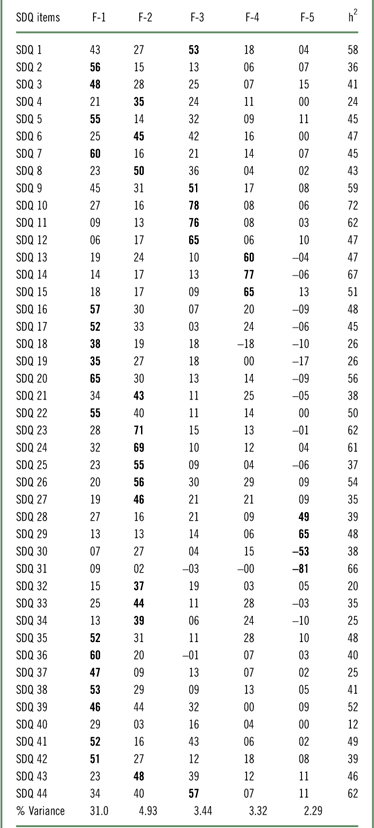
Factor Structure of SDQ (Table 1)
A principal axis factor analysis (PAF) was employed to determine the internal structure of the 43 SDQ items. Prior to conducting the PAF, a parallel analysis (PA) was undertaken to help determine the number of meaningful factors that could be extracted from the PAF.Reference O’Connor22, Reference Watkins23 The first 6 random eigenvalues generated by the PA were 1.83, 1.72, 1.66, 1.60, 1.55, and 1.50, while the first 6 real eigenvalues generated by the PAF were 14.17, 2.64, 2.05, 1.96, 1.55, and 1.46. Although the sixth eigenvalue generated by the PAF was greater than 1, it was also lower than the one generated by the PA, suggesting that 5 meaningful factors were present in the SDQ matrix. The 5 factors were extracted and varimax rotated to improve interpretability. These 5 factors contained meaningful (.35 or greater) loadings for 43 of the 44 items. Table 1 shows the factor loadings for the SDQ items. While a number of multiple loadings were observed, only 8 SDQ items failed to achieve a clear primary loading (primary factor loading of ≥.35 and ≥.10 greater than its secondary loading) on a factor. Each SDQ item was assigned to a subscale based on its strongest factor loading.
As Table 1 shows, the first factor was marked by SDQ item 20 (“How has your energy been over the past months?”) and item 7 (“How has your motivation/interest/enthusiasm been over the past month?”). This factor appears to tap a dimension of lassitude, mood, and cognitive and social functioning. The second factor was marked by item 23 (“How agitated have you felt over the past month?”) and item 24 (“How irritable have you felt over the past month?”). This factor appears to capture anxiety, agitation, irritability, and anger. The third factor was marked by item 10 (“How has your outlook on life been over the past month?”), which measures the extent to which one wishes to be dead, and by item 11 (“How has your outlook on suicide been over the last month?”), which measures the extent to which one wishes to kill oneself. Therefore, it appears that factor 3 assesses suicidal ideation. The fourth factor was marked by item 14 (“How has your ability to fall asleep been over the past month?”), which assesses disruptions in sleep quality. The fifth factor was marked by item 31 (“Have you gained weight over the last month?”), which seems to capture changes in appetite and weight. Only one item, item 40 (“How has your sexual functioning been over the last month?”), failed to load (≥.35) onto a factor. This item had its highest loading (.298) and strongest correlation to factor 1, and was therefore assigned to that factor.
SDQ item factor structure with varimax rotation

N=313. Factor loadings and commonalities (h2) are presented without decimal points. Primary item loadings are presented in bold.
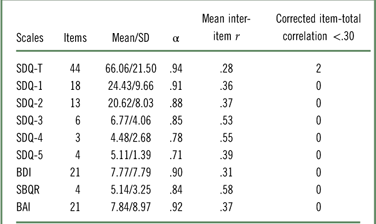
Item level analysis of the SDQ Full Scale and Subscales
Sample size (Ns) range from 308 to 325.
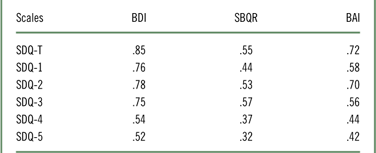
SDQ Full Scale and Subscales concurrent validity correlations
SDQ-T refers to the total score of the SDQ. SDQ-1 is the first subscale of the SDQ and includes items related to lassitude, mood, and cognitive functioning. SDQ-2 includes items related to anxiety, agitation, irritability, and anger. SDQ-3 includes items related to suicidal ideation. SDQ-4 assesses disruptions in sleep quality. SDQ-5 includes items on changes in appetite and weight.
Sample size (Ns) range from 308 to 325. All correlations are statically significant at p <.001.
Scale and Item Level Analyses
Table 2 presents the basic scale and item-level analyses for the SDQ Full Scale and subscales along with the properties of the concurrent validity measures (BDI, BAI, and SBQ-R). The SDQ Full Scale had excellent internal consistency (.94), low mean inter-item correlation, and only 2 items with adjusted item-to-scale correlations below the boundary of .30.Reference Nunnally and Bornstein24 The SDQ subscales 1, 2, and 3 showed good internal consistency (.85–.91), while the SDQ subscales 4 and 5 had internal consistencies that were slightly below the acceptable level of .80 (.78 and .71, respectively), as recommended by Nunnally and Bornstein.Reference Nunnally and Bornstein24 The lower internal consistency of these 2 subscales likely results from the limited number of items assigned to each scale (3 and 4 items, respectively).
Concurrent Validity
Correlation analyses were used to evaluate the concurrent validity of the SDQ Full scale and subscales (Table 3). Correlations were obtained to examine the relationships of the SDQ Full Scale and subscales with the BDI, BAI, and SBQ-R. The SDQ Full Scale had strong significant correlations with all the concurrent validity scales, but was most strongly associated with depression, as measured by the BDI (.85). The SDQ Subscales were all strongly correlated with depression (BDI), but also revealed a meaningful pattern of secondary correlations. For example, SDQ Subscale 2 (anxiety, agitation, irritability, and anger) had the highest correlations with anxiety (BAI, .70), and SDQ Subscale 3 (suicide, self-harm, and worthlessness) had a high correlation with depression (.75) and suicide (SBQ-R, .57) and lower correlation with anxiety (.56).
While the SDQ is not intended to be used as a diagnostic tool, it might be helpful for clinicians and researchers to have an indication of depressive symptoms severity associated with SDQ score ranges. Thus, we determined the percentile equivalent SDQ scores for common BDI score depression benchmarks. Specifically, a BDI-I of 0–9 indicates no or minimal depression, 10–18 indicates mild depression, 19–29 indicates moderate depression, and 30–63 indicates severe depression. In the present sample, a BDI score of 9 fell at the 75th percentile, and the corresponding SDQ score was a 79; likewise the BDI score of 19 fell at the 91st percentile, and the corresponding SDQ score was 105; last, a BDI score of 29 fell at the 98th percentile of the sample, and the corresponding SDQ score was a 133. Using these SDQ scores (79, 105, and 133) and ranges, clinicians and researchers can estimate mild, moderate, and extreme depressive severity. However, these scores have not been replicated in other samples, and therefore should be considered preliminary at best.
Test–Retest Reliability
Test–retest reliability was conducted on data from Sample 2, which included 11 subjects who completed the SDQ approximately 2 weeks apart. Given the limited sample size, we restricted the test–retest analyses to the SDQ Full Scale. For these subjects, the test–retest reliability for the SDQ Full Scale was .80 (P<.01).
Discussion
This study examined the validity and reliability of a novel scale, the SDQ, which was developed to more fully capture the heterogeneity of symptom presentations of depressive disorders than current, widely used scales for MDD. The SDQ Full Scale had excellent internal consistency, low mean inter-item correlation, and good temporal stability. Moreover, the SDQ includes 5 meaningful factors, each with adequate reliability and concurrent validity. SDQ factors 1, 3, 4, and 5 assess psychological and physiological symptoms that are typically included in measures of depression. Factor 1 measures common dimensions of depressive symptoms including lassitude, energy, mood, and cognitive, and social functioning (subscale 1). Factor 3 includes items on outlook on life, pessimism, suicide, self-harm, and worthlessness (subscale 3). The validity of these 2 factors is supported by their strong correlation with the BDI. Moreover, subscale 3, which captures suicide ideation and worthlessness, had a high association with a specific measure of suicide. Factors 4 and 5 measure physiological features of depression, namely sleep difficulties and changes in appetite/weight, respectively. Given that these 2 factors focus on specific aspects of depression, they had a lower, though still significant, correlation with the total score of the BDI. The most innovative aspect of SDQ is its inclusion of a factor that measures anxiety, agitation, irritability, and anger. Our findings indicate that subscale 2 has strong reliability, and a review of its items suggests that it also has good construct (face) validity. Moreover, concurrent validity was supported by the fact that SDQ factor 2 was the SDQ subscale with the highest correlation with the BAI.
One of the strengths of the SDQ is that it includes several items that assess anxiety symptoms, which are often present among depressed patients. To date, in order to evaluate anxiety symptoms among depressed patients, some clinicians would administer a measure of depressive symptoms as well as a separate measure of anxiety. However, the administration of 2 separate measures does not allow accurate determination of a patient’s response to treatment. For example, it would be difficult to determine whether a person is responding to treatment in the case where the depression measure would indicate improvement while the anxiety measure would indicate worsening.
Thus, the administration of 1 measure that assesses depressive symptoms as well as anxiety symptoms would best guide treatment. Although scales of depression that include items measuring anxiety and tension exist, the number of items addressing these areas is low, and the scales tend to omit other important features of depression. For example, the Hamilton Depression Rating Scale (HAM-D)Reference Hamilton25 is a 17-item scale that includes only 3 items measuring anxiety, and it does not inquire separately about other important aspects of depression that are included in the SDQ, such as hypersensitivity to criticism and irritability. Similarly, the Quick Inventory of Depressive Symptomatology (QIDS),Reference Rush, Trivedi and Ibrahim26 another very common 16-item measure of depression, includes only Diagnostic and Statistical Manual of Mental Disorders, Fourth Edition (DSM-IV) symptoms of depression. To our knowledge, the SDQ is the most comprehensive measure of depression available, as it includes items on depression as well as on anxiety and irritability. Given that anxious depression features are associated with greater severity of illnessReference Sayar, Guzelhan and Solmaz10, Reference Sherbourne and Wells27 and lower response and remission rates to standard treatments,Reference Fava, Alpert and Carmin11 and that depression with irritability and anger attacks is characterized by distinctive psychological and neurobiological features,Reference Nock, Hwang, Sampson and Kessler13 the SDQ and its subscales may provide a more complete characterization of depressed patients along clinically and biologically meaningful dimensions. Thus, the SDQ provides information on symptom severity on a more comprehensive level than previous scales and may be able to better inform treatment.
A limitation of the study is that the measure was developed primarily on the bases of a theoretical conceptualization of what symptoms constitute depression. The SDQ was not developed based on a method of identification of relevant items. Moreover, items were developed by 2 of the authors on the bases of their extensive clinical and research knowledge. Patients were not consulted on the level of comprehension of the items. However, many items include clarification in parentheses of terms that respondents may not be familiar with (items 3, 8, and 10), and the options of answers provide further clarification. Nonetheless, future studies are needed to further evaluate the level of understanding of the items and their content validity. An additional limitation is the fact that the factor analysis was conducted among young, generally healthy, college students with low levels of depressive symptoms. Future studies are needed to determine whether our results are generalizable to diverse, clinical populations. Despite these limitations, the SDQ appears to have face validity, concurrent validity, and high reliability.
Conclusion
In summary, we found that the SDQ is a valid measure of depression. It encompasses 5 subscales, with good convergent validity, as shown by a high correlation with other measures of depression, anxiety, and suicide ideation. Given that symptoms of anxiety and anger are common among depressed patients, the SDQ represents a valid and novel measure that assesses a more complete spectrum of physical and cognitive depressive symptoms than previous scales, and will be a valuable new tool in efforts to better characterize depression and identify and administer more targeted interventions.
Disclosures
Paola Pedrelli, Mark A. Blais, Jonathan E. Alpert, and Rosemary S. W. Walker do not have anything to disclose. Richard C. Shelton has the following disclosures: Bristol-Myers Squibb, Co., consultant, consulting fees; Cerecor, Inc., consultant, research support; Janssen Pharmaceutica, consultant, research support; Naurex, Inc., consultant, research support; Pamlab, Inc., consultant, consulting fees; Ridge Diagnostics, consultant, consulting fees; Shire Pic, consultant, consulting fees; Takada Pharmaceuticals, consultant, research support; Cerecor, Inc., consultant, research support; Novartis Pharmaceuticals, research, grant; Otsuka America, research, grant. Maurizio S. Fava has the following disclosures: Research support: Abbott Laboratories, Alkermes, Inc.; American Cyanamid; Aspect Medical Systems; AstraZeneca; BioResearch; BrainCells Inc.; Bristol-Myers Squibb; CeNeRx BioPharma; Cephalon; Clintara, LLC; Covance; Covidien; Eli Lilly and Company; EnVivo Pharmaceuticals, Inc.; Euthymics Bioscience, Inc.; Forest Pharmaceuticals, Inc.; Ganeden Biotech, Inc.; GlaxoSmithKline; Harvard Clinical Research Institute; Hoffman-LaRoche; Icon Clinical Research; i3 Innovus/Ingenix; Janssen R&D, LLC; Jed Foundation; Johnson & Johnson Pharmaceutical Research & Development; Lichtwer Pharma GmbH; Lorex Pharmaceuticals; MedAvante; National Alliance for Research on Schizophrenia & Depression (NARSAD); National Institute of Drug Abuse (NIDA); National Institute of Mental Health (NIMH); Neuralstem, Inc.; Novartis AG; Organon Pharmaceuticals; PamLab, LLC; Pfizer Inc.; Pharmacia-Upjohn, Pharmaceutical Research Associates, Inc.; Pharmavite® LLC; PharmoRx Therapeutics; Photothera; Roche Pharmaceuticals; RCT Logic, Inc.; (formerly Clinical Trials Solutions, LLC); Sanofi-Aventis US LLC; Shire; Solvay Pharmaceuticals, Inc., Synthelabo; Wyeth-Ayerst Laboratories. Advisory/consulting: Abbott Laboratories; Affectis Pharmaceuticals AG; Alkermes, Inc.; Amarin Pharma Inc.; Aspect Medical Systems; AstraZeneca; Auspex Pharmaceuticals; Bayer AG; Best Practice Project Management, Inc.; BioMarin Pharmaceuticals, Inc.; Biovail Corporation; BrainCells Inc.; Bristol-Myers Squibb; CeNeRx BioPharma; Cephalon, Inc.; Cerecor; CNS Response, Inc.; Compellis Pharmaceuticals; Cypress Pharmaceutical, Inc.; DiagnoSearch Life Sciences (P) Ltd.; Dianippon Sumitomo Pharma Co. Inc.; Dove Pharmaceuticals, Inc.; Edgemont Pharmaceuticals, Inc; Eisai Inc.; Eli Lilly and Company; EnVivo Pharmaceuticals, Inc.; ePharmaSolutions; EPIX Pharmaceuticals, Inc.; Euthymics Bioscience, Inc.; Fabre-Kramer Pharmaceuticals, Inc.; Forest Pharmaceuticals; GenOmind, LLC; GlaxoSmithKline; Grunenthal GmbH; i3 Innovus/Ingenis; Janssen Pharmaceutica; Jazz Pharmaceuticals, Inc.; Johnson & Johnson Pharmaceutical Research and Development, LLC; Knoll Pharmaceuticals Corp.; Labopharm Inc.; Lorex Pharmaceuticals; Lundbeck Inc.; MedAvante, Inc.; Merck & Co., Inc.; MSI Methylation Sciences, Inc.; Naurex, Inc.; Neuralstem, Inc.; Neuronetics, Inc.; NextWave Pharmaceuticals; Novartis AG; Nutrition 21; Orexigen Therapeutics, Inc.; Organon Pharmaceuticals; Otsuka Pharmaceuticals; Pamlab, LLC.; Pfizer Inc.; PharmaStar; Pharmavite® LLC.; PharmoRx Therapeutics; Precision Human Biolaboratory; Prexa Pharmaceuticals, Inc.; Puretech Ventures; PsychGenics; Psylin Neurosciences, Inc.; Ridge Diagnostics, Inc.; Roche; Sanofi-Aventis US LLC.; Sepracor Inc.; Servier Pharmaceuticals, Inc.; Somerset Pharmaceuticals, Inc.; Sunovion Pharmaceuticals; Supernus Pharmaceuticals, Inc.; Synthelabo; Takeda Pharmaceutical Company Limited; Tal Medical, Inc.; Tetragenenx Pharmaceuticals, Inc.; TransForm Pharmaceuticals, Inc.; Transcept Pharmaceuticals, Inc.; Vanda Pharmaceuticals, Inc. Speaking/publishing: Adamed, Co.; Advanced Meeting Partners; American Psychiatric Association; American Society of Clinical Psychopharmacology; AstraZeneca; Bevoir Media Group; Boehringer Ingelheim GmbH; Bristol-Myers Squibb; Cephalon, Inc.; CME Institute/Physicians Postgraduate Press, Inc., Eli Lilly and Company; Forest Pharmaceuticals, Inc.; GlaxoSmithKline; Imedex, LLC; Imedex, LLC; MGH Psychiatry Academy/Primedia; MGH Psychiatry Academy/Reed Elsevier, Novartis AG; Organon Pharmaceuticals; Pfizer Inc.; PharmaStar, United BioSource, Corp.; Wyeth-Ayerst Laboratories. Equity holdings: Compellis; PsyBrain, Inc. Royalty/patent, other income: Patent for Sequential Parallel Comparison Design (SPCD), which is licensed by MGH to RCT Logic, LLC; and patent application for a combination of ketamine plus scopolamine in major depressive disorder (MDD). Copyright for the MGH Cognitive & Physical Functioning Questionnaire (CPFQ), Sexual Functioning Inventory (SFI), Antidepressant Treatment Response Questionnaire (ATRQ), Discontinuation-Emergent Signs & Symptoms (DESS), and SAFER; Lippincott, Williams & Wilkins; Wolkers Kluwer; World Scientific Publishing Co. Pte. Ltd.
Appendix 1
Name or ID #:________________________________ Date: ______________________
MM DD YYYY
SYMPTOMS OF DEPRESSION QUESTIONNAIRE (SDQ)
Please answer all questions by circling the correct answer or the answer which seems the most appropriate to you.
Instructions: Please read each item and circle the number above the statement that you think applies to you. Some questions use the words “minimally,” “moderately,” “markedly,” and “extremely.” Minimally means that this item happens to you only rarely or that it is mild when it happens. Moderately means that this item bothers you some of the time but that it does not interfere with your life in any way. Markedly means that this item bothers you quite a bit and that it causes you some problems in your life. That is, it interferes with your ability to do certain things that are important to you such as working, taking care of your family, or enjoying time with friends. Extremely means that this problem troubles you a lot and that it interferes with your ability to do a lot of things.
1) How has your mood been over the past month?
1 2 3 4 5 6
better normal minimally moderately markedly extremely
than normal sad sad sad sad
2) How responsive has your mood been over the past month?
1 2 3 4 5 6
more normal minimally moderately markedly extremely
than usual flat flat flat flat
3) How has your affect (or how you display your mood to the external world) been over the past month?
1 2 3 4 5 6
better normal minimally moderately markedly extremely
than normal sad sad sad sad
4) How prone to tears have you been over the past month?
1 2 3 4 5 6
less normal minimally moderately markedly extremely
than usual tearful tearful tearful tearful
5) How reactive have you been to positive things/events over the past month?
1 2 3 4 5 6
more normal minimally moderately markedly not reactive
than usual less reactive less reactive less reactive at all
6) How reactive have you been to negative things/events over the past month?
1 2 3 4 5 6
less normal minimally moderately markedly extremely
than usual more reactive more reactive more reactive reactive
7) How has your motivation/interest/enthusiasm been over the past month?
1 2 3 4 5 6
greater normal minimally moderately markedly totally
than normal diminished diminished diminished absent
8) How sensitive (e.g., thin-skinned) have you been to rejection/criticism over the past month?
1 2 3 4 5 6
less normal minimally moderately markedly extremely
than usual more reactive more reactive more reactive reactive
9) How optimistic have you been over the past month?
1 2 3 4 5 6
More optimistic normal minimally moderately markedly extremely
than usual pessimistic pessimistic pessimistic pessimistic
10) How has your outlook on life been over the past month?
1 2 3 4 5 6
more positive normal; minimally moderately markedly extremely
than usual happy wishing to wishing to wishing to wishing to
to be alive be dead be dead be dead be dead
11) How has your outlook on suicide been over the past month?
1 2 3 4 5 6
more against normally minimally moderately markedly extremely
it than usual not thinking wishing to wishing to wishing to wishing to
about it kill yourself kill yourself kill yourself kill yourself
12) How has your outlook on harming your body been over the past month?
1 2 3 4 5 6
more against normally minimally moderately markedly extremely
it than usual not thinking wishing to wishing to wishing to wishing to
about it harm yourself harm yourself harm yourself harm yourself
13) How has your ability to fall asleep been over the past month?
1 2 3 4 5 6
easier normal minimally moderately markedly totally
than normal diminished diminished diminished absent
14) How has your ability to stay asleep in the middle of the night been over the past month?
1 2 3 4 5 6
easier normal minimally moderately markedly totally
than normal diminished diminished diminished absent
15) How has your ability to stay asleep around the time before waking up been over the past month?
1 2 3 4 5 6
easier normal minimally moderately markedly totally
than normal diminished diminished diminished absent
16) How has your wakefulness/alertness been over the past month?
1 2 3 4 5 6
more normal minimally moderately markedly totally
than normal diminished diminished diminished absent
17) How sleepy during the day have you been over the past month?
1 2 3 4 5 6
less not at all minimally moderately markedly extremely
than normal sleepy sleepy sleepy sleepy
18) How much have you been oversleeping at night over the past month?
1 2 3 4 5 6
less not at all minimally moderately markedly extremely
than normal increased increased increased increased
19) How much have you been oversleeping during the day over the past month?
1 2 3 4 5 6
less normal minimally moderately markedly extremely
than normal increased increased increased increased
20) How has your energy been over the past month?
1 2 3 4 5 6
greater normal minimally moderately markedly totally
than normal diminished diminished diminished absent
21) How heavy (in arms or legs) have you felt over the past month?
1 2 3 4 5 6
less not at all minimally moderately markedly extremely
than normal heavy heavy heavy heavy
22) How slowed down have you felt over the past month?
1 2 3 4 5 6
less not at all minimally moderately markedly extremely
than normal slowed down slowed down slowed down slowed down
23) How agitated have you felt over the past month?
1 2 3 4 5 6
less not at all minimally moderately markedly extremely
than normal agitated agitated agitated agitated
24) How irritable have you been over the past month?
1 2 3 4 5 6
less not at all minimally moderately markedly extremely
than normal irritable irritable irritable irritable
25) Have you had anger attacks (suddenly feeling very angry and like exploding with anger) over the past month?
1 2 3 4 5 6
never almost never rarely sometimes frequently all the time
26) How anxious/worried have you felt over the past month?
1 2 3 4 5 6
less not at all minimally moderately markedly extremely
than normal anxious anxious anxious anxious
27) Have you had panic attacks over the past month?
1 2 3 4 5 6
felt calmer not at all rarely sometimes frequently all the time
than normal
28) How has your appetite been over the past month?
1 2 3 4 5 6
greater normal minimally moderately markedly totally
than normal diminished diminished diminished absent
29) Have you lost weight over the past month?
1 2 3 4 5 6
gained not at all minimally mildly moderately markedly
some weight
30) Has your appetite been excessive over the past month?
1 2 3 4 5 6
less not at all rarely sometimes frequently all the time
31) Have you gained weight over the past month?
1 2 3 4 5 6
lost not at all minimally mildly moderately markedly
some weight
32) Have you had tachycardia/palpitations over the past month?
1 2 3 4 5 6
my heart rate not at all rarely sometimes frequently all the time
felt slower than
usual
33) Have you had pains or aches over the past month?
1 2 3 4 5 6
fewer aches not at all rarely sometimes frequently all the time
and pains
than usual
34) Have you had gastrointestinal (stomach or bowel) symptoms over the past month?
1 2 3 4 5 6
fewer symptoms not at all rarely sometimes frequently all the time
than usual
35) How has your ability to focus/sustain attention been over the past month?
1 2 3 4 5 6
greater normal minimally moderately markedly totally
than normal diminished diminished diminished absent
36) How has your ability to remember/recall information been over the past month?
1 2 3 4 5 6
greater normal minimally moderately markedly totally
than normal diminished diminished diminished absent
37) How has your ability to find words been over the past month?
1 2 3 4 5 6
greater normal minimally moderately markedly totally
than normal diminished diminished diminished absent
38) How has your sharpness/mental acuity been over the past month?
1 2 3 4 5 6
greater normal minimally moderately markedly totally
than normal diminished diminished diminished absent
39) How has your ability to make decisions been over the past month?
1 2 3 4 5 6
greater normal minimally moderately markedly totally
than normal diminished diminished diminished absent
40) How has your sexual functioning been over the past month?
1 2 3 4 5 6
better normal minimally moderately markedly totally
than normal diminished diminished diminished absent
41) How has your social functioning been over the past month?
1 2 3 4 5 6
better normal minimally moderately markedly totally
than normal diminished diminished diminished absent
42) How has your ability to work/study/function at home been over the past month?
1 2 3 4 5 6
better normal minimally moderately markedly totally
than normal diminished diminished diminished absent
43) How guilty have you felt over the past month?
1 2 3 4 5 6
less not at all minimally moderately markedly extremely
than normal guilty guilty guilty guilty
44) How worthless have you felt over the past month?
1 2 3 4 5 6
less not at all minimally moderately markedly extremely
than normal worthless worthless worthless worthless
Copyright: Massachusetts General Hospital and Vanderbilt University (Drs. Maurizio Fava and Richard Shelton).