

Introduction
Over the past decade, European states have faced overlapping crises that have reshaped their external environment. Geopolitical fragmentation, conflicts on Europe's borders, and instability across the wider Mediterranean have created sustained pressure to adapt foreign policy. Yet shocks do not automatically generate political or institutional transformation. Instead, they activate differentiated processes of politicisation and depoliticisation that determine whether policy change becomes visible and contested or insulated from scrutiny (Coticchia and Moschella, Reference Coticchia and Moschella2026).
This article explores how different regime type influences the politicisation and depoliticisation of intervention behaviour in intrastate conflicts. More specifically, it explicates why, when faced with comparable regional crises and strategic incentives, democratic and hybrid-authoritarian states select different repertoires of external support. This question is both timely and important. Existing research demonstrates that external actors often influence the genesis, trajectories, and outcomes of civil wars by providing, among other forms of support, arms, training, funding, logistics, intelligence, diplomatic support, and direct military assistance. However, less attention has been paid to how domestic regime characteristics affect the political feasibility, visibility and timing of these interventions. Therefore, the puzzle is not simply whether democracies and non-democracies behave differently abroad. Instead, it is how regime type structures the range of intervention tools that governments can deploy, justify, conceal, or suspend when conflicts become politically sensitive (Hermann, Reference Hermann1990; Böller and Wenzelburger, Reference Böller and Wenzelburger2024). Put differently, we are interested in how intervention behaviour itself becomes politicised or depoliticised.
In this article, politicisation refers to the process through which foreign policy choices become publicly visible and subject to domestic contestation, whereas depoliticisation encompasses strategies that shield external action by framing it as technical, indirect, or institutionally mediated (Coticchia and Moschella, Reference Coticchia and Moschella2026). External interventions are a particularly revealing site to observe these dynamics: contemporary involvement often relies on training missions, logistical support, armed drones, private contractors, and covert assistance, modalities that vary sharply in visibility and political exposure.
We argue that regime type drives these divergent trajectories of politicisation and depoliticisation. Democratic states, facing higher domestic audience costs and reputational constraints (Fearon, Reference Fearon1997), tend to manage foreign policy change by favouring indirect, low-visibility, norm-bound, and institutionally mediated interventions; or by suspending cooperation as political and reputational costs rise. Hybrid-authoritarian states, operating under lower domestic constraints and greater tolerance for escalation, can deploy politicised or selectively depoliticised instruments that reshape conflict dynamics while limiting domestic accountability. Our dependent variable is intervention behaviour, the range of external support options chosen by each state in different conflict environments.
Empirically, we analyse external interventions in the intrastate conflicts in Libya, Ethiopia, and Somalia, comparing the intervention repertoires of two democratic states (Italy and France) and two hybrid-authoritarian states (Türkiye and the United Arab Emirates). Through a structured comparison, we trace how intervention repertoires shift across conflict environments, treating both direct intervention and strategic non-intervention (including suspension and withdrawal) as meaningful outcomes. In doing so, the article makes three contributions. First, it shifts the analysis of external intervention from the question of whether states intervene to the question of how different intervention modalities become politically feasible. Second, it connects the literature on regime type and audience costs with the study of external support in civil wars. Third, it shows that intervention repertoires are sequential: restraint or suspension by democracies can create openings for more escalation-tolerant actors to expand their role.
The article proceeds as follows. The first section reviews the intervention literature and develops the modality framework. Part two outlines the analytical framework and research design. The third through fifth sections analyse interventions in Libya, Ethiopia, and Somalia. The penultimate part compares findings across cases, and the final section concludes the article.
External support in intrastate conflicts
Civil wars are often understood as domestic struggles, yet they are rarely contained entirely within the boundaries of the state. External states increasingly shape intrastate wars through arms transfers, funding, basing, and political backing (Salehyan et al., Reference Salehyan, Gleditsch and Cunningham2011; Paliwal and Staniland, Reference Paliwal and Staniland2023). Such third-party support introduces new actors, interests, and forms of influence that complicate trajectories of violence, settlement, and post-conflict governance (Regan, Reference Regan2000; Toukan, Reference Toukan2019; Rickard, Reference Rickard2022). For this reason, intrastate conflicts are useful sites for examining not only whether external actors intervene, but also how they select, justify and manage politically different forms of involvement.
The literature on third-party support and civil wars has shifted over the years, moving from earlier emphases on geopolitical, ideological, and material incentives (Findley and Teo, Reference Findley and Teo2006) to alliance ties, identity connections, regional security externalities, and rivalries among external powers (Kathman, Reference Kathman2011; Koga, Reference Koga2011; Aydin and Regan, Reference Aydin and Regan2012; Maoz and San- Akça, Reference Maoz and San- Akça2012). In addition, findings have demonstrated the need to disaggregate the forms of external support because different modalities have distinct effects on conflict dynamics (Sawyer et al., Reference Sawyer, Cunningham and Reed2017). This marks a significant shift from explaining why states intervene to explaining how they intervene: The latter places modalities, rather than mere presence/absence of intervention, at the centre of causal explanation. This is central to our argument. Although existing studies have significantly advanced our understanding of the drivers and consequences of external support, less attention has been given to the domestic political conditions that make specific intervention modalities politically feasible. In other words, while the literature tells us a great deal about why states support conflict parties, it says little about why some governments rely on visible, coercive or deniable instruments, while others favour indirect, multilateral or easily justifiable forms of support. This article attempts to address this gap by linking regime type to the visibility, contestability, and timing of intervention strategies.
Typologies of external support
To address this complexity, the Uppsala Conflict Data Program (UCDP) developed the External Support Dataset (ESD), which categorises ten distinct modalities (letters a–j) of external support (Högbladh et al., Reference Högbladh, Pettersson and Themnér2011). These range from direct troop deployments to economic, logistical, intelligence, and other forms of assistance. Contemporary intrastate conflicts, however, increasingly feature hybrid forms of support, such as the financing and deployment of private military companies (PMCs) and mercenaries. We draw on this typology to specify how support varies in visibility and political exposure (see Supplementary Appendix 1).
The UCDP-ESD typology is not simply used as a descriptive coding device; rather it enables us to compare the political costs of different support modalities. Direct troop deployments, armed drones, proxy forces, covert logistics, financial assistance, training missions, and diplomatic backing do not subject governments to equal levels of public scrutiny. Some instruments are highly visible and potentially politicising, while others can be framed as technical, humanitarian, multilateral or routine. This distinction is crucial for understanding how external intervention becomes politicised or depoliticised in practice.
Regime type and external support
The literature on the consequences and drivers of external intervention is extensive, yet comparatively less attention has been given to how regime type shapes not only the likelihood but also the form of external support states provide (Mumford, Reference Mumford2013; Tholens, Reference Tholens2021; Sakstrup and Tolstrup, Reference Sakstrup and Tolstrup2022). Democracies face electoral accountability, reputational sensitivity, and media scrutiny (Gelpi et al., Reference Gelpi, Feaver and Reifler2009), whereas authoritarian and hybrid regimes possess greater operational latitude abroad (Levitsky and Way, Reference Levitsky and Way2010; Weeks, Reference Weeks2018). Recent work highlights how non-democratic states increasingly employ coercive and hybrid practices outside traditional multilateral constraints (Karlsrud, Reference Karlsrud2019; Karlsrud and Reykers, Reference Karlsrud and Reykers2020). This, in turn, underscores the need to disaggregate support modalities rather than treat intervention as a single act category.
Analytical framework and research design
The wider Mediterranean as analytical space
This study adopts the concept of the “wider Mediterranean” as an analytical framework to examine the foreign policy strategies of Italy, France, Türkiye, and the UAE. Initially rooted in Italian policy debates and later developed in critical geopolitics (Di Peri, Reference Di Peri2021), the wider Mediterranean transcends the conventional Mediterranean basin and encompasses North Africa, the Sahel, the Red Sea, and the Horn of Africa. Recent studies have conceptualised this enlarged Mediterranean as a strategic space shaped by overlapping security dynamics, middle-power activism, and post-crisis realignments (Coticchia and Mazziotti di Celso, Reference Coticchia and Mazziotti Di Celso2025; Raineri and Baldaro, Reference Raineri and Baldaro2025). Accordingly, the wider Mediterranean serves as both a geographic scope and a strategic field in which democratic and hybrid-authoritarian states operate to shape African intrastate conflicts.
We do not simply employ the concept of the wider Mediterranean as a geographical label; rather, we treat it as a relational security space. This concept is analytically useful because the conflicts examined here are connected by overlapping routes of military projection, migration governance, energy security, port infrastructure, maritime competition, and regional power rivalry. Libya, Ethiopia, and Somalia are therefore not considered individual conflict zones, but locations within a wider arena of intervention where European, Turkish, and Gulf actors compete for influence by providing various forms of external support. Despite its geographic distance from the Mediterranean littoral, the UAE functions as a Mediterranean actor due to its sustained military presence, commercial investments, and diplomatic activism stretching from Greece to Egypt to Libya and Ethiopia (Schumacher, Reference Schumacher2018; Ribé, Reference Ribé2021).
The unit of analysis is the intervention repertoire adopted by each external actor within each conflict setting. Therefore, the empirical cases are not only the civil wars in Libya, Ethiopia, and Somalia, but also the actor-conflict dyads through which Italy, France, Türkiye, and the UAE selected, adjusted, suspended, or escalated specific forms of support. This allows us to compare intervention behaviour across regime types while controlling for a shared regional arena of strategic competition.
Theoretical assumptions and causal mechanisms
Building on the literature on regime type and audience costs (Gelpi et al., Reference Gelpi, Feaver and Reifler2009; Sakstrup and Tolstrup, Reference Sakstrup and Tolstrup2022), we outline three assumptions linking domestic regime characteristics to the selection, visibility, and sequencing of external intervention repertoires. These assumptions guide the comparative analysis and are traced across cases (see Supplementary Appendix 2).
Assumption 1 (Modality constraint and depoliticisation): Democratic states are more likely to manage intervention through depoliticised forms of support (Schultz, Reference Schultz1999). Electoral accountability, media scrutiny, and institutional veto points increase domestic political costs, incentivising executives to favour indirect, low-visibility, and norm-bound instruments, including training missions, capacity building, intelligence sharing, diplomatic sponsorship, and multilateral frameworks.Footnote 1 Such modalities reduce public contestation by presenting intervention as technical, legal, humanitarian, or internationally mandated. This does not mean democracies cannot use force or pursue strategic interests abroad. Rather, intervention becomes more politically constrained when civilian casualties, escalation, or reputational damage become significant issues.
Assumption 2 (Escalation tolerance and politicised intervention): Hybrid-authoritarian states display greater tolerance for escalation and political risk due to lower domestic audience costs and fewer institutional constraints (Weeks, Reference Weeks2018). This enables more overt, coercive, or hybrid intervention tools, including armed drones, proxy forces, private military contractors, and covert logistics. These instruments either politicise foreign policy through overt military engagement or allow selective depoliticisation through deniability and opacity. Hybrid-authoritarian actors may openly politicise intervention to serve domestic legitimisation, nationalist mobilisation, or status claims, while simultaneously shielding specific instruments from scrutiny. Their advantage lies in their ability to combine visibility and concealment more flexibly.
Assumption 3 (Substitution and sequencing of the intervention space): When democratic states restrict or suspend intervention due to rising domestic or reputational costs, permissive conditions may emerge for other actors to expand their engagement. Research on intervention diffusion and proxy warfare suggests that external involvement in civil wars is relational and sequential, with less constrained actors exploiting political or operational vacuums left by more restrained states (Salehyan et al., Reference Salehyan, Gleditsch and Cunningham2011; Mumford, Reference Mumford2013). Thus, foreign policy change unfolds sequentially: restraint by democracies can enable escalation by less constrained actors.
Research design, cases, and data
The article uses a qualitative, comparative research design to examine how regime type affects the politicisation and depoliticisation of intervention behaviour. The empirical strategy is process-oriented rather than hypothesis-testing and reconstructs sequences of intervention, escalation, suspension, and withdrawal (Bennett and Elman, Reference Bennett and Elman2007; Van Meegdenburg, Reference Van Meegdenburg, Mello and Ostermann2023), treating strategic non-intervention as a meaningful outcome.
In order to align our terminology with that used in comparative politics scholarship, we use the term “hybrid-authoritarian states” rather than “less democratic states.” This label encompasses regimes that combine limited electoral or institutional features with substantial executive discretion, inadequate checks and balances, and limited public accountability in foreign and security policy (Schmid, Reference Schmid2025). In empirical terms, this category is supported by democracy datasets such as V-Dem, the latest version of which includes indicators and indices designed to capture the various dimensions of democratic and authoritarian rule. This distinction is not intended to be rigid, but rather to provide a functional classification based on the domestic constraints that shape foreign policy decision-making.
Case selection follows a most-similar logic with variation in domestic political constraints. France and Italy are treated as consolidated democracies characterised by electoral competition, plural media systems, and greater reputational exposure. By contrast, Türkiye and the UAE exhibited substantially lower levels of such constraints. Although Türkiye formally retains electoral institutions, democratic backsliding and executive centralisation since the mid-2010s have reduced accountability costs and legislative oversight, rendering its foreign policy behaviour more akin to that of hybrid-authoritarian regimes (Gümrükçü, Reference Gümrükçü2022). In contrast, the UAE represents a more clearly authoritarian case in the foreign and security sphere, which is the preserve of the ruling royal president, currently Mohamed bin Zayed al Nahyan (Yates, Reference Yates2020; Koch, Reference Koch2025). Grouping Türkiye and the UAE together does not imply identical regime characteristics but reflects their shared feature of lower domestic constraints on intervention decisions.
The analysis focuses on three intrastate conflicts in the wider Mediterranean region: Libya (2014–2020), Ethiopia (2020–2022), and Somalia (2012–present). The cases were selected because they occurred during periods of heightened uncertainty, involve both democratic and hybrid-authoritarian interveners (see Figure 1), and vary in conflict dynamics, ranging from rapid escalation in Libya and Ethiopia to chronic instability in Somalia. The unit of analysis is the actor-conflict dyad, allowing comparison across both conflicts and interveners. Intervention and non-intervention are treated as analytically relevant outcomes.
Interveners and conflict cases in the wider Mediterranean. Authors’ composite map created with mapchart.Net.

Figure 1 Long description
Thematic political map centered on Africa with parts of Europe and Asia shown, with north at top. Country borders and country names are labeled across the map. Legend categories shown: African countries in conflict, Libya, Ethiopia, Somalia. Democratic states, Italy, France. Hybrid-authoritarian states, Turkiye, United Arab Emirates, UAE. The conflict category is applied to Libya in North Africa, Ethiopia in the Horn of Africa region and Somalia on the Horn of Africa coastline. The democratic intervener category is applied to Italy in southern Europe and France in western Europe. The less democratic intervener category is applied to Turkiye at the junction of southeastern Europe and western Asia and to the United Arab Emirates on the Arabian Peninsula near the Persian Gulf.
The article draws on a combination of primary and secondary sources for its empirical analysis, including the UCDP-ESD, UN Panel of Experts reports, official statements, open-source intelligence, and existing academic literature. These materials are supplemented by repeated field observations conducted by the authors going back fifteen years, for this and related research projects, in Ethiopia and Somalia as well as Türkiye, Italy, France, and the UAE. Rather than employing formal content analysis, the sources were analysed through qualitative triangulation. For each actor-conflict dyad, support modalities were identified and coded according to the UCDP–ESD categories, and changes in intervention repertoires were traced over time.
The field observations should be considered contextual and interpretive evidence rather than a standalone data source. Although they were not conducted uniformly across all case countries or according to a formal ethnographic protocol, they informed our understanding of intervention practices, elite narratives, and local perceptions of external involvement. They also provided background knowledge that helped interpret documentary sources, identify relevant actors and narratives, and assess the plausibility of reconstructed intervention sequences. We therefore use them for contextualisation and triangulation rather than as the primary basis for empirical claims.
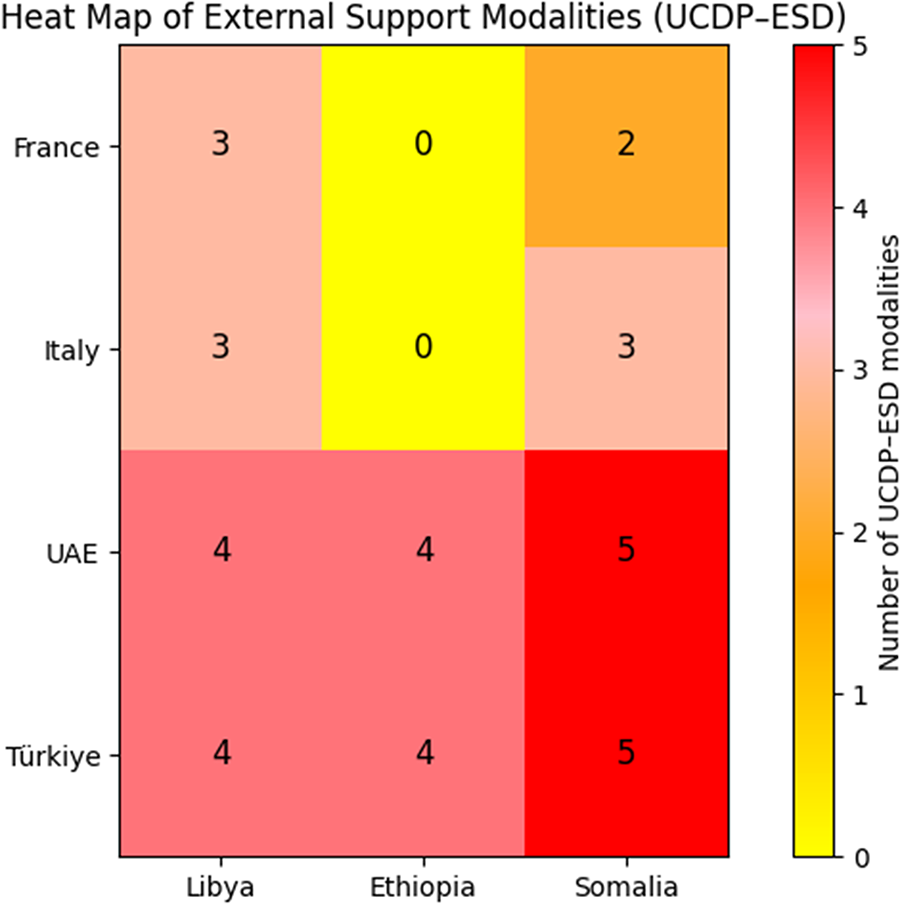
Based on the data collected for the article, we applied the UCDP–ESD modalities listed in Supplementary Appendix 1 to the four interveners across cases (see Supplementary Appendix 3; Figure 2). The three cases are explicated below.
Heat map of external support modalities across cases (UCDP–ESD coding). Cells indicate the number of distinct external support modalities employed by each actor in each conflict; conservative coding excludes disputed or publicly denied modalities.

Case study I: Libya (2014–2020)
Conflict overview and strategic relevance
The Libyan intrastate conflict that emerged after the overthrow and subsequent death of long-time ruler Muammar Gaddafi in 2011, transformed into a complex proxy war involving multiple actors. By 2017, Libya's polity had effectively fractured into two main factions. On one side was the Government of National Accord (GNA), recognised by the UN and based in the capital city of Tripoli. Opposing them was the Libyan National Army (LNA), led by General Khalifa Haftar, which primarily operated from the eastern part of the country in and around Benghazi and Tobruk. It received substantial military support from the UAE, Egypt, and Russia (including Wagner Group contractors), and informal diplomatic support from France (Guzansky and Marshall, Reference Guzansky and Marshall2023). At the same time, the GNA relied mainly on diplomatic backing from Italy and the UN until Türkiye intervened decisively in early 2020 (Rossiter and Cannon, Reference Rossiter and Cannon2024).
The conflict quickly acquired geopolitical significance because of Libya's proximity to Europe, its role in migration pathways, its energy reserves, and its strategic location within the Mediterranean region (Corrao and Redaelli, Reference Corrao and Redaelli2021). External involvement intensified after Haftar launched his offensive against Tripoli in April 2019. Libya therefore provides a high-intensity conflict setting in which actors faced similar strategic incentives but adopted very different intervention repertoires.
Democratic states
France
France's approach to Libya's intrastate conflict has been shaped by strategic priorities: addressing insecurity in the Sahel region and curbing irregular migration across the Mediterranean. While Paris officially acknowledged the GNA, it began to cultivate covert relations with Khalifa Haftar after 2011, perceiving him as a dependable, anti-Islamist figure capable of bringing stability to eastern Libya. From 2016 to 2018, France deployed its special forces in support roles (Stephen and Willsher, Reference Stephen and Wilsher2016). French-purchased Javelin missiles were later discovered at an LNA base in Gharyan, but this represents the sole ambiguous case sometimes interpreted as indirect lethal support, and Paris publicly denied any transfer (Schmitt and Walsh, Reference Schmitt and Walsh2019; Mezran and Fasanotti, Reference Mezran and Fasanotti2020).
Employing the UCDP typology, French involvement essentially took the form of logistical assistance (e), military advising (f), intelligence cooperation (h), and political backing rather than overt weapons transfers or combat support, which is consistent with democratic constraints on visible military escalation. As rivalry with Türkiye intensified in the eastern Mediterranean, France's support for Haftar acquired an additional balancing dimension shared with Egypt, the UAE, and Greece (Reuters, 2020). However, France did not deploy drones, mercenaries, or direct firepower, in contrast with the actions of hybrid-authoritarian interveners.
Italy
Italy's engagement in Libya has been shaped by its historical connections, reliance on ENI energy assets, and concerns about migration and terrorism (Ceccorulli and Coticchia, Reference Ceccorulli and Coticchia2020). Unlike France, Italy supported the GNA and, working through EU and UN channels, prioritised institutional stabilisation rather than battlefield shaping (Ilardo, Reference Ilardo2018). Rome invested heavily in training and financing the Libyan Coast Guard – spending €32.6 million between 2017 and 2021 (MSF, 2022) – and maintained a limited military presence focused on medical, security, and logistical assistance. Italy repeatedly criticised French unilateralism while refraining from lethal support, which ultimately constrained its influence once Türkiye escalated militarily in 2020 (Kardaş, Reference Kardaş2020). In UCDP–ESD terms, Italy's intervention corresponded primarily to material/logistics support (e), training/expertise (f), and financial support (g). Italy's approach was therefore more institutionalised and multilateral than coercive. This stance reflected a preference for instruments that could be publicly justified through stabilisation, migration management and European or UN-backed frameworks.
Hybrid-authoritarian states
United Arab Emirates
The UAE emerged as the primary and most significant provider of military assistance to Khalifa Haftar and the LNA. Initiating this support in 2014, the UAE played a crucial role by supplying financial resources (g) and advanced weaponry. This third-party support included sophisticated drones (d) for surveillance and combat, heavily armoured vehicles (e) and comprehensive air-defence systems to protect LNA assets from aerial threats. Additionally, the UAE facilitated the recruitment of mercenaries (i) – many of them from Sudan – that further bolstered Haftar's military capabilities and enhanced the LNA's battlefield effectiveness (Bakir, Reference Bakir2020). Emirati-purchased, Chinese-made Wing Loong II drones carried out lethal strikes, and the UAE reportedly constructed and maintained the al-Khadim airbase in eastern Libya (Delalande, Reference Delalande2017). This support provided the LNA with air superiority until Türkiye intervened (Rossiter and Cannon, Reference Rossiter and Cannon2022). Additionally, the UAE reportedly violated the UN arms embargo, relying on parallel logistics routes via Egypt, including airlifts and cross-border land shipments (UN Panel of Experts, 2020).
Türkiye
In January 2020. Türkiye transitioned from offering diplomatic backing to the GNA to launching a comprehensive military intervention in Libya. This change was prompted by the LNA's advances towards Tripoli and escalating tensions over Eastern Mediterranean maritime disputes (Shay, Reference Shay2019). Türkiye deployed Bayraktar TB2 drones (d), military advisers and electronic warfare systems (e, f), and Syrian proxy fighters via SADAT (i), a private military consultancy that aligns with Turkish state policy (Costantini and Donelli, Reference Costantini and Donelli2022). In 2019, the initial losses of Turkish drones led to a swift technological shift, with the introduction of relay masts designed to extend their operational range and Turkish drone operators from Baykar Makina, the drones’ manufacturer (Calcara et al., Reference Calcara, Gilli, Gilli, Marchetti and Zaccagnini2022). By May 2020, Turkish-backed forces had successfully dismantled the LNA's air defences, taken control of the al-Watiya airbase, and turned the tide against Haftar's offensive (Rossiter and Cannon, Reference Rossiter and Cannon2022). This power shift prompted negotiations facilitated by the UN. Thus, Türkiye emerged as the most influential external actor in Libya, displacing both Italy (diplomatically) and the UAE (militarily). During the period under consideration, decision-making on foreign policy in Türkiye was highly centralised within the executive, with limited parliamentary scrutiny or sustained public debate on external military operations (Donelli, Reference Donelli2020). This institutional configuration reduced domestic audience costs and reinforced the effects of the regime type identified in this article.
Case-level findings: Libya
Libya illustrates distinct intervention repertoires under similar strategic incentives. France and Italy remained engaged but relied primarily on indirect, institutionally mediated forms of support, whereas Türkiye and the UAE employed coercive and hybrid instruments, including drones, proxy forces, military advisers, and covert logistics. These directly altered battlefield dynamics. Democratic actors refrained from coercive escalation, creating space for hybrid-authoritarian actors to expand their role and reshape the balance of power. Libya therefore illustrates a rapid substitution dynamic in which regime type influenced not only the form of intervention, but also its timing and strategic consequences.
Case study II: Ethiopia (2020–2022)
Conflict overview and strategic relevance
The Ethiopian civil war began in November 2020 when a political confrontation between Ethiopia's federal government led by Prime Minister Abiy Ahmed and the Tigray People's Liberation Front (TPLF) escalated into an armed conflict. Initially confined to Tigray, the war expanded in mid-2021 when the Tigray Defense Forces (TDF) advanced into neighbouring regions and came within 60 km of the capital, Addis Ababa (Gebre-Medhin, Reference Gebre-Medhin2025). The conflict took a new turn in late 2021, when the Ethiopian National Defense Force (ENDF), bolstered by foreign-supplied drones and air support, regained control of territory by conducting a series of targeted airstrikes on areas held by the TDF, including the city of Mekelle.
Like Libya, Ethiopia enables comparison between democratic and hybrid-authoritarian interveners operating under similar strategic incentives but different domestic constraints. Unlike Libya, however, democratic actors suspended or withheld military cooperation as reputational and humanitarian costs increased, making Ethiopia a particularly useful case for examining non-intervention and suspension as forms of intervention behaviour.
Democratic states
France
Prior to the war, France was among Ethiopia's most important security partners. During President Emmanuel Macron's 2019 visit to Addis Ababa, the two countries signed a comprehensive defence cooperation agreement. This agreement included military training, assistance in rebuilding Ethiopia's navy, and a framework for arms transfers. It also included a “shopping list” that reportedly requested fighter aircraft, helicopters, unmanned aerial vehicles (UAVs), and electronic warfare systems (Irish, Reference Irish2019). However, once the conflict escalated and reports of atrocities mounted, France suspended all military cooperation in August 2021. Paris decided not to deliver any of the equipment requested. Instead, France shifted its support to dialogue efforts and redirected its training towards actors involved in potential political transition processes rather than the ENDF. In UCDP–ESD terms, France provided no coercive modalities (0), consistent with democratic constraint and suspension behaviour once reputational risk rose.
Italy
Italy adopted an even more cautious stance. In 2019, a bilateral defence cooperation agreement was signed, aimed at enhancing training, procurement, and defence research. However, it did not come into effect until the Italian Parliament approved it in 2020, just ahead of the outbreak of war. In 2021, allegations of civilian abuses perpetrated by the ENDF surfaced , and parliamentary pressure led Defence Minister Lorenzo Guerini to suspend the agreement in February 2022 (Mistretta, Reference Mistretta2025). The criticism came not from the general public, but rather from specific political constituencies, including representatives of the Five Star Movement and Tigrayan diaspora activists. In UCDP–ESD terms, Italy also provided no coercive modalities (0), reflecting the same pattern of democratic constraint.
Hybrid-authoritarian states
United Arab Emirates
The UAE emerged as a key military backer and financial supporter of the Abiy government during the conflict. In late 2021, as federal forces were losing ground to the TPLF, the UAE reportedly deployed at least six Chinese-made, Wing Loong I/II armed drones (d) and their operators from its base in Assab, Eritrea (Mitzer and Oliemans, Reference S and J2021). Additional reporting suggested the existence of an Emirati air bridge supplying weapons (d), surveillance technology, and covert airlift logistics (e) directly to Ethiopian forces. Some reporting indicates additional forms of support that cannot be fully identified (j).
The UAE's involvement was facilitated by its close political relationship with Abiy, whom Abu Dhabi supported during his rise to power in 2018 (Maasho, Reference Maasho2018). Although the UAE engaged in limited diplomatic messaging and later signalled support for ceasefire negotiations, its primary mode of intervention was direct and high-impact military. In UCDP–ESD coding terms, UAE intervention maps to (d) weapons, (e) material/logistics, (g) funding/economic support, and (j) additional unidentified forms of support.
Türkiye
Türkiye's relationship with Ethiopia evolved from commercial ties to a political and military partnership. By 2020, Turkish investments in Ethiopia had exceeded $2.5 billion, establishing Türkiye as the country's second-largest foreign investor after China. As European defence cooperation with Ethiopia crumbled after the onset of the Tigray War, Ankara seized the opportunity. In August 2021, Abiy Ahmed visited Ankara and signed a military framework agreement that included the sale of defence equipment (d). The agreement also included officer training and advisory support (f) and required logistics sustainment (e). Turkish-made Bayraktar TB2 drones were delivered to Ethiopia by the end of 2021. Reports indicate that the TB2s were used in airstrikes on northern regions during late 2021 and early 2022.
Case-level findings: Ethiopia
Ethiopia illustrates democratic depoliticisation through suspension. Prior to the war, both France and Italy envisaged expanded defence cooperation with Ethiopia. However, reports of atrocities and humanitarian abuses made continued military engagement politically and reputationally costly, prompting restraint and a shift towards diplomatic engagement. In this sense, non-intervention constituted an active form of intervention behaviour rather than a residual category.
Türkiye and the UAE followed a different trajectory. Both expanded their involvement through armed drones, logistics, defence agreements, and military support that proved militarily consequential. Ethiopia therefore provides the clearest example of substitution through suspension: as democratic actors reduced or suspended cooperation, hybrid-authoritarian states filled the resulting space with coercive and technology-enabled forms of support, expanding both their influence and the range of intervention available to the Ethiopian government.
Case study III: Somalia (2012–present)
Conflict overview and strategic relevance
Somalia remains one of the longest-running intrastate conflicts in Africa. Following state collapse in 1991, the establishment of the Federal Government of Somalia (FGS) in 2012 restored only partial authority in and around Mogadishu, making the post-2012 period the relevant phase for analysis. Despite the presence of the FGS, clan rivalries, insurgent rule, and al-Shabaab continued to erode governance capacity. Due to its location on the Red Sea–Gulf of Aden corridor, Somalia is deeply embedded in the wider Mediterranean security space.
Unlike Libya and Ethiopia, Somalia represents a protracted, low-intensity conflict environment characterised by chronic instability rather than sharp battlefield turning points. This setting allows us to examine how external actors accumulate influence gradually through training, infrastructure, logistics, and political relationships.
Democratic states
France
France's engagement in Somalia has been limited and selective. It has focused on maritime security, counterterrorism, and regional naval operations (e.g. from the Djibouti base). Although French interests in the Red Sea route and Sahel security overlap in Somalia, France has avoided sustained military intervention on Somali territory. Instead, it has operated largely through multilateral initiatives, emphasising intelligence and training assistance. More recently, Paris has also cultivated closer diplomatic and economic ties with Somaliland, reflecting a strategy of limited, selective influence consistent with democratic accountability pressures. In UCDP–ESD terms: (f) training/expertise and (h) intelligence.
Italy
Rather than direct military engagement, Italy's intervention in Somalia is marked by institutional support and capacity-building efforts, including in the security sector. Leveraging historical ties from colonial times and recent concerns about migration and regional stability, Italy has made significant contributions to the EU Training Mission in Somalia (EUTM Somalia) and maritime security operations, including anti-piracy efforts. Italy has taken a proactive role in bolstering the capabilities of the Somali Coast Guard through EU-framed training and financial assistance, and it has also supported the training of Somali police units. These efforts are embedded in EU frameworks and emphasise institutional capacity rather than battlefield shaping; in UCDP–ESD terms, Italy corresponds to (e) material/logistics, (f) training, and (g) funding.
Hybrid-authoritarian states
United Arab Emirates
The UAE's engagement in the Horn of Africa has been tactical, transactional, and forms part of its wider engagement with the region. In Somalia, Abu Dhabi has provided training and other support to military and police forces in Mogadishu as well as the autonomous region of Puntland, where it has also invested in the brown water port of Bosaso. It has also invested heavily (via Dubai's DP World ports operator) in the de facto independent Republic of Somaliland at the port of Berbera (Cannon & Rossiter, Reference Cannon and Rossiter2017). This support has occurred outside of the established political frameworks offered by the FGS in Mogadishu. By doing so, Abu Dhabi has strengthened its influence in these regions while attempting to maintain good relations with Mogadishu. In 2018, the UAE signed a port and military access agreement with Somaliland, allowing the option of building a naval dock, as well as a logistics hub at the Berbera airport. In 2024, Ethiopia and Somaliland concluded a Memorandum of Understanding on defence, strengthening the strategic alignment among the UAE, Somaliland, and Ethiopia and expanding the interventionist space of Gulf-Horn actors. The UAE employs substantial investments in infrastructure and logistics. It also reportedly played a major role in the election of Somalia's president, Hassan Sheikh Mohamud, in 2022 (Milliken, Reference Milliken2024). Over more than a decade, the UAE's support in Somalia corresponds, in UCDP–ESD terms to (d) weapons, (e) material/logistics, (g) funding/economic support, (i) other forms (including political brokerage/PMC-linked support), and (j) additional unidentified support.
Türkiye
Türkiye has expanded its presence in Somalia from economic engagement to a military and strategic footprint. Since 2011, Türkiye has become increasingly embedded in Somalia's body politic, and the country leads Ankara's overall sub-Saharan Africa strategy. In 2017, Türkiye established a military training facility in Mogadishu and initiated large-scale training for Somali National Army units (Cannon & Rossiter, Reference Rossiter and Cannon2019). In addition to providing training, Türkiye has actively engaged in arms sales to Somalia, further solidifying its military partnership (Cannon, Reference Cannon2024; Donelli, Reference Donelli2024). Defence cooperation has included armoured vehicles and UAVs for reconnaissance and surveillance, aligning military support with Ankara's broader influence strategy. In UCDP–ESD coding terms, Türkiye’s Somalia involvement includes (d) weapons, (e) material/logistics support, (f) training/expertise, (i) other forms (basing/advisory structures), and (j) unidentified modalities.
Case-level findings: Somalia
Somalia demonstrates that regime-type effects extend beyond periods of rapid escalation. Unlike Libya and Ethiopia, external influence accumulated gradually within a protracted conflict environment. France and Italy remained engaged through low-visibility, institutionally embedded forms of support centred on maritime security, training, and capacity building. Their interventions were sustained but narrow, technocratic, and politically low risk.
Türkiye and the UAE adopted broader and more cumulative repertoires. Through military training, arms transfers, logistics, infrastructure investment, port access, and political partnerships, both actors expanded their influence over time. Although these instruments did not produce the immediate battlefield effects observed in Libya or Ethiopia, they gradually reshaped patterns of external influence in Somalia and the Horn of Africa.
Somalia therefore illustrates substitution through gradual entrenchment. Democratic actors remained present through limited multilateral engagement, whereas hybrid-authoritarian actors accumulated more extensive and politically embedded forms of influence. The case demonstrates that regime type shapes not only escalation during crises but also the long-term accumulation of influence in chronic conflict settings.
Comparative implications: regime type and intervention repertoires
This section compares findings from Libya, Ethiopia and Somalia to identify the comparative implications that emerge from the case studies. Regime type influences intervention behaviour through three interconnected dimensions: the political feasibility of support modalities, the politicisation or depoliticisation of intervention, and the timing of intervention expansion and substitution.
Democratic depoliticisation and modality constraint
In all three cases, democratic states limited their intervention behaviour to comparatively depoliticised approaches. This pattern reflects the first mechanism identified in the article, whereby domestic audience costs, media scrutiny and reputational exposure restrict the range of politically viable instruments available to democratic state leaders. Rather than escalating to highly visible or coercive tools, France and Italy generally favoured indirect, low-visibility and institutionally mediated approaches that shielded external action from domestic contestation.
In Libya, France and Italy maintained an active presence while avoiding overt coercive escalation. France provided Haftar with political ambiguity, intelligence cooperation and limited support, while Italy backed the GNA with training, logistical assistance, migration governance and participation in multilateral stabilisation frameworks.
In Ethiopia, democratic depoliticisation took the form of suspension and restraint. As reports of atrocities and humanitarian crises increased, France and Italy froze or withheld military cooperation, shifting towards diplomatic and humanitarian engagement.
In Somalia, depoliticisation occurred through routine and institutional embedding. France and Italy maintained a presence, but their involvement was channelled through maritime security, EU missions, capacity building and police or coast guard training.
The comparison shows that democratic depoliticisation does not take a single form. It can involve indirect engagement, as in Libya; suspension or non-intervention, as in Ethiopia; or a routinised institutional presence, as in Somalia. These forms are not characterised by passivity, but rather by the selection of instruments that reduce visibility, limit contestation and preserve public justifiability.
Hybrid-authoritarian escalation and flexible visibility
Both Türkiye and the UAE displayed greater tolerance for coercive, hybrid and selectively visible intervention tools. This pattern reflects the second mechanism identified in the article, whereby lower domestic audience costs, weaker institutional oversight and more limited public contestation broaden the range of instruments that are politically feasible. Across the three cases, hybrid-authoritarian actors were more willing and able to rely on armed drones, proxy forces, military advisers, covert logistics, port infrastructure, bilateral security arrangements and political brokerage.
In Libya, this produced rapid and visible effects on the battlefield. Although Turkish and Emirati support was directed at opposing sides, both relied on coercive and hybrid tools that directly reshaped the balance of power.
In Ethiopia, meanwhile, Türkiye and the UAE expanded their influence through the use of drones, military agreements, logistics and financial or material support, at a time when European actors were becoming increasingly constrained.
In Somalia, these same actors accumulated influence more gradually through training facilities, arms provision, infrastructure development, port access and security partnerships.
These cases demonstrate that hybrid-authoritarian intervention is not necessarily more visible or militarised. Rather, it is characterised by flexible visibility. Some instruments are openly politicised and used to signal regional status, strategic autonomy or military effectiveness. Others remain depoliticised by means of opacity, deniability or bilateral arrangements that reduce external scrutiny. This flexibility enables hybrid-authoritarian actors to combine escalation with insulation from accountability.
Three forms of substitution
The comparative analysis also highlights a recurring dynamic of substitution and sequencing. Intervention spaces are not static. When democratic actors limit escalation, suspend cooperation, or confine themselves to narrow institutional roles, other actors may expand into the resulting space. However, the form of substitution varies across conflict environments.
In Libya, substitution occurred through rapid escalation. France and Italy remained politically bounded and avoided overt coercive intervention, while Türkiye and the UAE expanded through drones, proxy forces, military advisers, and covert logistics. The result was a rapid redistribution of influence on the battlefield.
In Ethiopia, substitution occurred through suspension. As reputational and humanitarian costs increased, France and Italy withheld or suspended defence cooperation. Meanwhile, Türkiye and the UAE filled the void by providing the Ethiopian federal government with drones, military agreements, logistics and support. In this context, the absence of intervention by democratic actors enabled hybrid-authoritarian expansion.
In Somalia, substitution occurred gradually and was entrenched. Democratic actors did not withdraw, but remained within narrow, multilateral and technocratic repertoires. Meanwhile, Türkiye and the UAE exploited the protracted conflict environment to establish broader forms of influence by providing infrastructure, training, bases, port access, arms and political brokerage.
This comparison suggests that not only does regime type shape the instruments that states use, but it also shapes the temporal pattern of intervention. Rather than simply intervening more, hybrid-authoritarian actors often intervene differently, faster or more cumulatively, depending on the conflict environment and the opportunities created by democratic restraint.
Scope conditions and limits of the argument
The findings should not be interpreted as suggesting that regime type alone determines intervention behaviour. Strategic interests, military capacity, defence-industrial resources, alliance structures, geography and bilateral ties also play a role. France, Italy, Türkiye, and the UAE differ in terms of not only regime type, but also power status, regional ambitions, military capabilities and available technologies. Therefore, the argument advanced here is more specific: regime type shapes how these interests and capabilities are managed politically, which instruments are easier to justify, and which forms of intervention can be sustained under conditions of scrutiny or escalation. Nor does the argument imply that democracies never use force, nor that hybrid-authoritarian actors always escalate. Rather, the comparison demonstrates that similar strategic environments result in different intervention repertoires because domestic constraints influence the political costs associated with particular methods. Therefore, regime type is best understood as a permissive and constraining condition rather than a deterministic explanation.
Taken together, these conditions qualify but do not undermine the broader argument advanced in this article. The three cases suggest that intervention repertoires are shaped by the interaction between external crises and domestic political constraints. Democratic states tend to manage interventions using depoliticised approaches that reduce visibility and contestation. In contrast, hybrid-authoritarian actors can combine politicised escalation with selective opacity. The main comparative implication is that intervention behaviour is both relational and sequential. The restraint, suspension, or routinisation of democratic involvement can create opportunities for hybrid-authoritarian actors to increase their influence by employing more coercive, flexible, or cumulative strategies.
Conclusion
This article examined how regime type influences intervention behaviour in intrastate conflicts. Comparing democratic states (Italy and France) and hybrid-authoritarian states (Türkiye and the UAE) across conflicts in Libya, Ethiopia and Somalia, it showed that regime type shapes not only whether states intervene, but also how they select, justify, suspend, conceal, and escalate particular forms of external support. Similar strategic environments do not necessarily produce similar intervention repertoires because external action is filtered through domestic constraints, audience costs, reputational exposure, and executive discretion.
The comparison revealed three forms of substitution. In Libya, substitution occurred through rapid escalation; in Ethiopia, through suspension; and in Somalia, through gradual entrenchment. These patterns demonstrate that intervention behaviour is relational and sequential. Democratic actors tend to rely on politically defensible, low-visibility forms of engagement, whereas hybrid-authoritarian actors possess greater flexibility to combine overt political signalling with operational opacity.
By integrating regime type with the politicisation-depoliticisation framework, the article makes three contributions. First, it shifts attention from the presence or absence of intervention to intervention repertoires. Second, it links research on external support in civil wars to debates on audience costs, accountability and regime type. Third, it shows that intervention spaces evolve sequentially, such that democratic restraint, suspension or routinised engagement may create opportunities for other actors to expand their influence.
The argument is not deterministic. Strategic interests, capabilities, and geographical proximity also matter. Rather, regime type shapes how these factors become politically actionable and which instruments can be sustained over time. Future research should assess whether these mechanisms extend beyond the wider Mediterranean and examine how technological change, arms transfers and alliance politics interact with regime type to influence intervention repertoires. Overall, the article demonstrates that regime type continues to matter because it structures the political management of visibility, contestation, and escalation in contemporary intervention politics.
Funding statement
This research received no specific grant from any public or private funding agency.
Data availability statement
This study draws on publicly available sources and the UCDP External Support Dataset (UCDP–ESD). The authors’ case classifications were developed through qualitative triangulation of the sources described in the article and do not constitute a standalone dataset.
Supplementary material
The supplementary material for this article can be found at https://doi.org/10.1017/ipo.2026.10098.
Acknowledgements
The authors gratefully acknowledge the help and expertise of Ghebrebrhan Weldit Gebrehans for his assistance with the figures.
Competing interests
The authors declare none.
Author contribution
F.D.: Conceptualisation, Data curation, Formal analysis, Investigation, Methodology, Supervision, Validation, Writing – original draft, Writing – review and editing. B.J.C.: Conceptualisation, Data curation, Formal analysis, Investigation, Methodology, Project administration, Validation, Visualisation, Writing – original draft, Writing – review and editing.



 Open access

