




No CrossRef data available.
Conditioning the Effects of Aid: Cold War Politics, Donor Credibility, and Democracy in Africa
Published online by Cambridge University Press: 19 May 2004
Abstract
The effect of foreign aid on regime type in recipient countries remains widely debated. In this research note, I argue that a recent focus on “moral hazard” has distracted attention from another mechanism linking foreign aid to domestic political institutions. During the Cold War, donors' geopolitical objectives diminished the credibility of threats to condition aid on the adoption of democratic reforms. The demise of the Soviet Union and the end of the Cold War, on the other hand, enhanced the effectiveness of Western aid conditionality. I reanalyze an important recent study and demonstrate that the small positive effect of foreign aid on democracy in sub-Saharan African countries between 1975 and 1997 is limited to the post–Cold War period. This new empirical evidence underscores the importance of geopolitical context in conditioning the causal impact of development assistance, and the evidence confirms that the end of the Cold War marked a watershed in the politics of foreign aid in Africa.I would like to thank Henry Brady, Jennifer Bussell, Ruth Berins Collier, David Collier, Robert Powell, Jason Seawright, Beth Simmons, Laura Stoker, and two anonymous reviewers for their comments. I am also grateful to Arthur Goldsmith for sharing his data. Any errors are my own.
Information
- Type
- Research Article
- Information
- Copyright
- © 2004 The IO Foundation and Cambridge University Press
What is the impact of foreign aid on democracy and regime type in recipient countries? This question has become an important research topic with significant policy implications, yet the effect of aid on local political institutions remains widely debated. While some analysts suggest that aid “conditionality” may further the adoption of democratic reforms in recipient countries,1
others claim that aid creates a “moral hazard”2The concept of moral hazard was first developed in the context of economic analyses of insurance. In this framework, the problem of moral hazard occurs not only because insured agents exercise power over the probability or risk of the bad outcome against which they are insured, but also because the insurance company has a limited ability to monitor the agents' actions because of informational asymmetries.
See Bräutigam 2000; Devarajan et al. 2001; Killick 1998; Maren 1997; and Moore 1998.
Recent attempts to evaluate the empirical record have produced a growing body of evidence that is, unfortunately, inconclusive.5
For recent arguments, see Abrahamsen 2000; Bräutigam 2000; Devarajan et al. 2001; Easterly 2001; Hook 1998; Lancaster 1999; Maren 1997; and Moore 1998.
If this argument is correct, one should expect the causal impact of aid on democracy to diverge in the Cold War and post–Cold War periods. While many qualitative studies have suggested that the end of the Cold War marked a watershed in the politics of aid in Africa, statistical studies have failed to account for this potential source of heterogeneity in cross-section time-series analyses. In what follows below, I reanalyze an important recent study,6
which found a positive, statistically significant relationship between official development assistance (ODA) from Western countries and the level of democracy in forty-eight sub-Saharan African countries between 1975 and 1997. Using data obtained from the author of that study, I divide the cases into two time periods and then add to the regression model a new dichotomous control variable to reflect whether recipient countries had a client relationship with the former Soviet Union. I find that, in the period from 1975 to 1986, no statistically significant relationship emerges between ODA and democracy.7In Goldsmith's 2001 study, the dependent variable is alternately described as “good governance,” “due process,” “rule of law,” “state capacity,” “political freedom,” and “democracy.” In this article, I stick to the terms “democracy” and “regime type” and operationalize this dependent variable using scores on the scale developed by Freedom House. Although democracy remains a contested concept, the Freedom House index is widely accepted as one of the best empirical indicators of political democracy. See Diamond 1999, 12.
These findings raise several empirical and theoretical issues for debates about the impact of foreign aid. In the following section, I derive the logic of the theoretical argument. Because there is no a priori reason to expect the allegedly “perverse” effects of aid to strengthen or weaken over time, the “moral hazard” or “perversity” thesis makes no prediction about divergence in the relationship between aid and regime type across historical periods. In contrast, the causal mechanism I highlight here suggests that the impact of Western aid on democracy in Africa should vary systematically between the Cold War and post–Cold War eras. This logic therefore provides an initial way to distinguish empirically the “moral hazard” and the “credible commitment” mechanisms. In the subsequent section, I present statistical evidence that the positive relationship between aid and democracy in Africa is limited to the post–Cold War period, lending support to the “credible commitment” story and underscoring the importance of global geopolitical context in conditioning the impact of aid.
Foreign Aid, Democracy, and the Credibility of Aid Conditionality
Why might one expect the causal relationship between foreign aid and regime type to diverge in the Cold War and post–Cold War periods? The essence of the difficulty of using aid to promote democracy may lie not so much in an informational asymmetry between donors and aid recipients, as the “moral hazard” argument made by many prominent critics of aid would suggest,8
For example, Easterly 2002. See also the references in note 3.
The end of the Cold War could make threats to withhold development assistance to African states more credible, and therefore more effective, in two ways. First, the diminished geostrategic importance of African clients in the post–Cold War period would imply that the loss of such clients would impose a negligible geopolitical cost on powerful donors. Second, the dissolution of the Soviet Union may not only have removed a geopolitical threat to the West but may have vindicated the liberal values of Western donors, lending them a sense of the possibility of democratization all over the world. Thus the perceived benefit of promoting democracy in Sub-Saharan Africa rose even as the cost of losing African clients declined dramatically. African leaders lost significant leverage with which to resist aid conditionality, because only one donor (or group of donors) offered aid to them in the post–Cold War period. No longer able to take refuge in balance-of-power politics, recalcitrant African states could be more effectively pressed to undertake the democratizing reforms that Western donors had de-emphasized during the Cold War. Proponents and opponents of the “perversity thesis” of foreign aid alike provide no reason to expect the influence of the putative “moral hazard” to increase or decrease over time. In contrast, the clear prediction of the credible commitment story is that aid conditionality should become more effective in the post–Cold War period. One should therefore expect a positive relationship between aid and democracy in the post–Cold War period.
This causal mechanism and its empirical prediction are supported by the qualitative evidence offered by previous studies of democratic reform in Sub-Saharan Africa. For example, Claude Ake has described a “legacy of indifference” to democracy among Africa's political leaders, a legacy rooted in both the continent's colonial past and the attitudes of many African politicians after independence.9
Faced with challenges to their newfound political power, postindependence elites opted for a unifying developmental ideology that sought to repress internal dissent. Importantly, however, this ideology found obliging complicity from Western countries that were most concerned with the grand strategies of Cold War politics. Rather than press for democratization, Ake argues that Western powers “ignored human rights violations and sought clients wherever they could.”10Ibid., 63–64.
Consistent with my claim that threats to withhold aid became more credible as the importance of retaining African clients diminished, however, Ake points to the significance of Africa's greatly diminished strategic importance for the adoption of democratic reforms in the post–Cold War period:
The marginalization of Africa has given the West more latitude to conduct its relations with Africa in a principled way. In the past, the West adopted a posture of indifference to issues of human rights and democracy in Africa in order to avoid jeopardizing its economic and strategic interests and to facilitate its obsessive search for allies against communism. Now that these concerns have diminished, the West finds itself free to bring its African policies into greater harmony with its democratic principles.11
Ibid., 64.
The failure to tie aid to democratic reforms during the Cold War period, therefore, stemmed from the geostrategic priorities of donors. On a more fundamental level, however, the greater “latitude” of the West to demand democratic reforms in the post–Cold War period may have its source in the credible commitment issue. Once competition with the Soviet Union for African clients had receded, Western donors could much more credibly threaten to withdraw aid if democratic reforms were not enacted by recipient states.
If the argument advanced above is correct, one should expect to see the relationship of aid to regime type in Sub-Saharan Africa to be characterized by temporal discontinuity. Previous quantitative studies of the relationship between foreign aid and democracy have failed to take this source of heterogeneity into account, instead assuming that parameter coefficients are constant over the two periods. In the following section, I provide empirical evidence in support of the alternate hypothesis that a structural shift in the effect of aid on democracy occurred with the end of the Cold War.
The Empirical Evidence: Effects of the Cold War on Aid and Democracy
In an important recent analysis of the impact of foreign aid on regime type in sub-Saharan Africa, Goldsmith presents statistical evidence that the principled intentions of foreign donors have, on average, been a “minor net plus” for the cause of democracy in sub-Saharan Africa.12
Goldsmith 2001, 124.
ODA comprises bilateral loans and grants from Development Assistance Committee (DAC) members, multilateral organizations to which those members contribute, and certain Arab countries, but it does not include Soviet economic credits to sub-Saharan Africa. The DAC member countries of the OECD are Australia, Austria, Belgium, Canada, Denmark, Finland, France, Germany, Greece, Ireland, Italy, Japan, Luxembourg, Netherlands, New Zealand, Norway, Portugal, Spain, Sweden, Switzerland, United Kingdom, and United States. ODA includes program, project or food aid, emergency assistance, and peacekeeping assistance or technical cooperation, including loans with a grant element of more than 25 percent. World Bank 1999, 286.
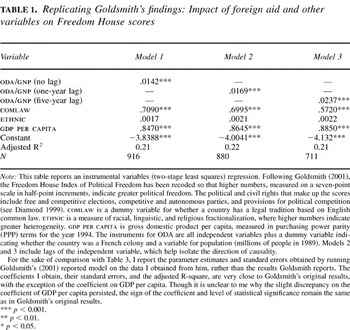
Goldsmith 2001 instruments the ODA variable with a population variable and a dummy variable for having been a French colony, along with the other independent variables in the model, and uses a two-stage least squares (2SLS) model to correct for possible endogeneity. I conducted a Durbin-Wu-Hausman test and found that the coefficient of the residual from the OLS regression of ODA on all other variables in the implied system of equations was not statistically significant, suggesting that the instrumental variable 2SLS setup may be unnecessary (that is, ordinary least squares estimates may be consistent). Nonetheless, for ease of comparison with Goldsmith's results, in all the tables in this article, I have reported the results of instrumental variable (2SLS) models. As a robustness check I ran the analyses with ordinary least squares (OLS) estimators, and the results were substantially the same as those reported. For more on the Durbin-Wu-Hausman test, see 〈http://www.stata.com/support/faqs/stat/endogeneity.html〉. Accessed 29 December 2003.
Goldsmith 2001, 124.
Replicating Goldsmith's findings: Impact of foreign aid and other variables on Freedom House scores

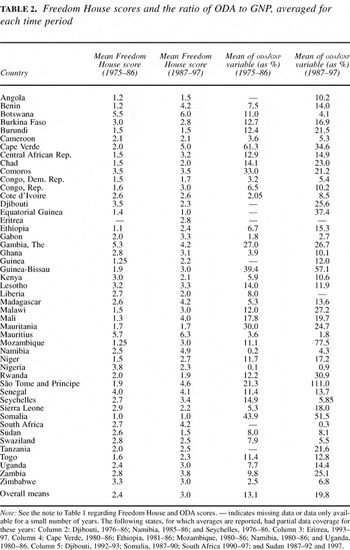
If the theoretical argument suggested in the previous section is correct, however, the positive effect of ODA on the Freedom House scores should be limited to the post–Cold War period. A look at some descriptive statistics in Table 2 suggests interesting contrasts between the periods from 1975–86 and 1987–97. Because this periodization of the data plays an important role in the multivariate analysis that follows, a few words of explanation of the break between 1986 and 1987 in Table 2 are in order. My goal was to divide the sample into Cold War and post–Cold War periods, so 1986–87 might seem like a less natural dividing point for the data than, say, 1991, the year of the dissolution of the Soviet Union. However, in the context of Cold War battles for clients in Africa, the latter date is misleading. Heavy Soviet engagement in Africa had already waned by the mid-1980s, with the emergence of a “new thinking” in Soviet foreign policy associated with Mikhail Gorbachev, Eduard Shevardnadze, and others, and the Soviet elite had distanced itself from Leonid Brezhnev's foreign policy doctrines. This elite no longer proclaimed, as it once did, the existence of what George Breslauer has termed “an irreconcilable struggle between imperialism and socialism for the allegiance of Third World peoples.”16
Breslauer 1992, 196.
Ake 1996. See note 11.
Freedom House scores and the ratio of ODA to GNP, averaged for each time period

Table 2 reports mean values of Freedom House scores and the ratio of ODA to GNP for each country case during each of the periods. The general trend does not contradict the assertion of a linear relationship between Freedom House scores and ODA. In the earlier period, Freedom House scores for all cases ranged around an overall mean of 2.4 on a scale of 1 to 7 (the data was recoded from the normal Freedom House index so that higher scores indicate greater political and civil rights), while in the later period the overall mean has increased significantly, from 2.4 to 3.0. As for the relationship of ODA to GNP (which is expressed in Table 2 as a percentage rather than a ratio), between 1975 and 1986, the cases fluctuated around an overall mean of 13.1, while in the later period between 1987 and 1997, the cases varied around the mean of 19.8. This aggregate impression may, however, mask distinct trends among subgroups of cases. In the first period, the countries that received the lowest scores on the Freedom House variable included the socialist-oriented states allied during the Cold War with the Soviet Union, in particular Ethiopia, Mozambique, and Tanzania. In the later period, however, the increase of the ODA/GNP ratio in countries that had received little or no ODA (that is, aid from the rich, largely Western members of the Development Assistance Committee of the Organization for Economic Cooperation and Development (OECD) during the earlier period is striking. Note for example the case of Tanzania, where ODA went from zero to 22 percent of GNP, or Mozambique, where it went from 11 to 78 percent.19
Obviously the ratio of ODA/GNP is affected by changes in the denominator as well as in the numerator. Nonetheless, the dramatic growth of this ratio in such cases clearly owes to a rise in the absolute amounts of ODA rather than to a precipitous decline in national income.
These descriptive statistics, along with the theoretical argument advanced in the previous section, suggest that the positive, statistically significant effect of foreign aid on democratization that Goldsmith finds may be highly period-dependent. In his analysis, Goldsmith notes that since 1989 “eighteen African countries (have) moved up at least one category in the Freedom House ratings.”20
Goldsmith 2001, 131.
Ibid., 140.
Ibid., 136.
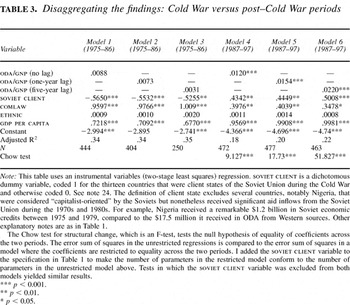
Aid, therefore, may have a positive impact on democracy only in the later period. To test the argument, in Table 3, I again ran the regression described in Table 1, dividing the sample observations into the two periods presented in Table 2. Moreover, I added to the earlier model a dichotomous dummy variable measuring whether a country was a client state of the Soviet Union during the Cold War.23
The results reported in Table 3 are robust to the exclusion of the soviet client dummy variable, that is, the sign and statistical significance of the estimated coefficients of the independent variables in the restricted model, which I do not report to save space, are largely identical to those in Table 3.
The countries are Angola, Benin, Cape Verde, Congo, Ethiopia, Guinea, Guinea-Bissau, Madagascar, Mozambique, Seychelles, and Tanzania (“revolutionary democracies”); and Mali and Zambia (“socialist-oriented states”). Guinea became a “capitalist-oriented” country from the Soviet standpoint in 1984, but I include it as a Cold War client state of the Soviet Union, because the categorization covered most of the first period in my analysis. Somalia, on the other hand, was a “revolutionary democracy” (and thus in favor with the Soviet Union) before 1977, but the Soviets categorized it as “capitalist-oriented” after that year; accordingly, it is coded as a 0 in the dichotomous scheme used here. For data and the sources of these categories, see Albright 1991, 38–39.
As reported in World Bank 1999. See note 13 on the components of ODA.
Because of severe missing data, it was not possible to incorporate the actual amounts of Soviet aid into the analysis.
Disaggregating the findings: Cold War versus post–Cold War periods

Between 1975 and 1986, no statistically significant effect of ODA on the dependent variable emerges for any of the three models. By contrast, the coefficient on ODA in the 1987–97 period is positive and statistically significant at the .001 level in each of the three models. A Chow test for structural change strongly rejects the null hypothesis that coefficients are equal in the two periods. Furthermore, the results are robust to a variety of departures from ordinary least square (OLS) assumptions about the error term.27
For example, readers may be skeptical of the least squares sphericality assumptions (nonautocorrelation and homoscedasticity). Using pairwise inclusion of cases to take account of the slightly unbalanced panel, I estimated the model with panel-corrected standard errors (see Beck and Katz 1995), which correct for panel heteroscedasticity and contemporaneous correlation of the errors. For purposes of comparability with Table 1 and Goldsmith's 2001 results, I report the 2SLS results using uncorrected standard errors in Table 3. However, the sign and statistical significance of the coefficients when panel-corrected standard errors are used are identical to those reported in Table 3. The full set of results are available from the author on request.
What inferences can one draw from these results? First, they lend support to the hypothesis that the impact of aid on regime type varies between the Cold War and post–Cold War periods. The strong association between the ODA variable and Freedom House scores around the beginning of the 1990s is apparently driving the statistically significant, positive impact of ODA on democracy that was reported in Table 1 for the entire period from 1975–97. For purposes of this article, the most important point is that ODA stemming from Western countries and certain Arab countries fails to have a statistically significant impact on political freedoms in sub-Saharan Africa from 1975 to 1986. The positive and statistically significant association of the same variables between 1987 and 1997 suggests that the time period clearly matters.
Second, the sign of the coefficients on the soviet client dummy variable are notable. In the earlier period, the estimates for this variable are negative and statistically significant in all three of the models, while in the later period they are statistically significant and positively signed. The negative sign in the earlier period may suggest the importance of the unmeasured Soviet aid to such states and certainly is consistent with the theoretical argument I have made above. Just as interesting, however, is the finding that having been a Soviet client state during the Cold War was statistically significantly and positively associated with democratization in the post–Cold War period. This is consistent with the argument that the end of the Cold War precipitated a particularly marked shift among formerly Soviet client states and suggests that previous cross-sectional time-series studies of the impact of aid on democracy in Africa have failed to account for this source of heterogeneity in sample periods.
The evidence in Table 3, therefore, supports the claim that the ability of Western lenders to condition aid on the adoption of reforms increased with the demise of the Soviet Union. Previous studies have also noted that the end of the Cold War provided an incentive for international donors to move more vigorously to sanction antidemocratic practices than they had during the Cold War. As Bratton and Van de Walle explained in their definitive study of regime transitions in contemporary Africa, “In the post–Cold War world, Western diplomacy is generally intolerant of military intervention in new democracies. Thus, the 1993 coup in Burundi was greeted by the suspension of most foreign aid, as was the decision by the Nigerian military to annul the 1993 elections won by Moshood Abiola.”28
It is certainly the case that some threats to apply sanctions have not been followed through in the post–Cold War period and that there have been important inconsistencies of application. A complex mix of “carrots” and “sticks” has been applied, as in the case of Daniel Arap Moi's Kenya,29 and some undemocratic practices have gone unsanctioned, to the chagrin of many critics of international donor organizations. Nonetheless, Goldsmith's assertion that aid may be a “minor net plus”30Ibid., 124.
The results are also consistent with country-level claims that the demise of the Soviet Union produced a particularly dramatic shift among formerly Marxist-Leninist countries. For example, Bratton and Van de Walle observe that “the greatest gains in political liberalization (between 1988 and 1992) were made by governments that started from a very low base of rights observance and that abandoned an ideological commitment to Marxism-Leninism (e.g., Bénin, Cape Verde, Congo, Ethiopia, Mozambique, and Angola).”31
Bratton and van de Walle 1997, 160; see also Herbst 1990.
Allen 1992, cited in Bratton and van de Walle 1997.
Ibid., 434.
Ibid., 438. It should nonetheless be noted that although French President François Mitterand was widely given credit for promoting aid conditionality for Africa at the La Baule Franco-American Summit in 1991, French policies have been criticized for their inconsistency. Bratton and van de Walle 1997, 241, note that “Democratic Bénin actually saw its French aid decline in the year following its transition, whereas recalcitrant authoritarian regimes in Togo, Cameroon, and Zaire all benefited from French aid increases during the same period.”
Some skeptics could justifiably argue that the empirical models do not completely specify the covariates of democracy in sub-Saharan Africa. The amount of variance explained (as reflected in the R-squared statistic) is fairly low for a time-series cross-section model and substantially lower during the later period than the earlier, suggesting perhaps an important role for un-modeled factors during the later period. A more complete predictive model might include a measure of dependence on natural resource endowments (which should be negatively associated with democracy according to the “resource curse” literature36
See Ross 2001.
See also note 14. Little scholarship has suggested that aid allocation in Africa (at least until recently) has been driven by the natural resource endowments of recipients. As for internal democracy movements, much of the existing literature has stressed the extent to which the culmination of domestic democracy movements, though contemporaneous with the end of the Cold War, was independent of it. Ake 1996, for example, points out that internal struggles for democratization in a number of sub-Saharan African countries independently came to fruition just as the ideological struggle of East and West in the Third World came to an end. See also Bratton and van de Walle 1997.
Conclusion: Foreign Aid and Democracy Reconsidered
The findings I present in this research note make two contributions to the debate concerning the effectiveness of foreign aid conditionality. First, the analysis suggests that the causal impact of aid on regime type may be historically contingent in ways not appreciated by previous research. The relationship between foreign aid and democracy in sub-Saharan Africa appears to be highly conditioned by the distinction between the Cold War and post–Cold War periods. Earlier empirical research, therefore, may have reported misleading averages that in fact masked temporally defined shifts in causal patterns across subgroups of cases.
Secondly, the causal mechanism to which I have pointed to explain this divergence is quite distinct from the increasingly popular “moral hazard” or “perversity” theory of aid. Whether the latter theory is correct or incorrect, it clearly makes no prediction about temporal variation in the effect of aid on democracy. In other words, there is no a priori reason to expect the allegedly “perverse” effect of aid on democracy to strengthen or weaken over time. The predictions of my credible commitment story, on the other hand, contain an important temporal dimension, because the disappearance of the geostrategic threat from the Soviet Union may have made threats from Western donors to withdraw aid much more credible. The empirical results I present in this article are consistent with the predictions of the credible commitment story but not with the “perversity thesis.” The results therefore suggest that further theoretical attention should be focused on the issue of credible commitment in the allocation of foreign aid.
These empirical and theoretical points justify increased attention as well to the geopolitics of aid provision in future research. In contrast to recent arguments advanced by some of foreign aid's critics, the likelihood that aid may effectively promote democracy will in fact increase when the role of strategic or geopolitical factors in allocating aid diminishes. Former World Bank economist William Easterly recently launched a scathing criticism of donor organizations, entitled “The Cartel of Good Intentions” in which he states:
among the most popular concepts the aid community has recently discovered is “selectivity”—the principle that aid will only work in countries with good economic policies and efficient, squeaky-clean institutions. The moment of aid donors' conversion on this point supposedly came with the end of the Cold War, but in truth, selectivity (and other “new” ideas) has been a recurrent aid theme over the last 40 years…. Unfortunately, evidence of a true conversion on selectivity remains mixed.38
In fact, the suggestion that aid conditionality is a recycled notion may be irrelevant. What may matter is not whether donor “selectivity” is a new idea, or whether aid will only “work” in countries with institutions that are already “squeaky-clean.” Instead, a crucial factor may be whether the threats of international donors to withdraw aid if democratic reforms are not adopted can be made credible and therefore effective. The theory and evidence presented above suggest that conditioning aid on levels of democracy in recipient countries may only be credible under certain global geostrategic circumstances—for example, those provided in Africa by the end of the Cold War. The empirical evidence presented above should provide a small measure of encouragement to the proponents of foreign aid. At the same time, for those concerned with promoting democracy in Africa, there is no guarantee that the propitious conditions posed by the end of the Cold War will persist. U.S. policymakers have recently begun point out the strategic nature of West and Central African oil reserves, implying that geopolitical criteria could play an important role in pending aid allocation decisions.39
See, for example, James Dao, “In Quietly Courting Africa, U.S. Likes Dowry,” New York Times, 19 September 2002, A1.
References
REFERENCES
Abrahamsen, Rita.
2000.
Disciplining Democracy: Development Discourse and Good Governance
in Africa.
London:
Zed Books.
Ake, Claude.
1996.
Rethinking African Democracy. In
The Global Resurgence of Democracy,
2d ed., edited by
Larry Diamond and
Marc F. Plattner,
63–75.
Baltimore, Md.:
Johns Hopkins University Press.
Albright, David E.
1991.
Soviet Economic Development and the Third World.
Soviet Studies
43 (1):27–59.Google Scholar
Allen, Chris.
1992.
“Goodbye to All That”: The Short and Sad Story of
Socialism in Benin.
Journal of Communist Studies
8 (2):63–81.Google Scholar
Beck, Nathaniel, and
Jonathan N. Katz.
1995.
“What to Do (and Not to Do) with Time-Series Cross-Sectional
Data.”
American Political Science Review
89 (3):634–47.Google Scholar
Bratton, Michael, and
Nicolas van de Walle.
1997.
Democratic Experiments in Africa: Regime Transitions in Comparative
Perspective.
Cambridge:
Cambridge University Press.
Bräutigam, Deborah.
2000.
Aid Dependence and Governance.
Stockholm:
Almquist and Wiksell International.
Breslauer, George W.
1992.
Explaining Soviet Policy Changes: Politics, Ideology, and
Learning. In
Soviet Policy in Africa: From the Old to the New Thinking, edited by
George W. Breslauer,
196–216.
Berkeley:
Center for Slavic and East European Studies, University of
California, and the Berkeley-Stanford Program in Soviet Studies.
Devarajan, Shantayanan,
David R. Dollar, and
Torgny Holmgren, eds.
2001.
Aid and Reform in Africa: Lessons from Ten Case Studies.
Washington, D.C.:
World Bank.
Diamond, Larry.
1999.
Developing Democracy: Toward Consolidation.
Baltimore, Md.:
Johns Hopkins University Press.
Easterly, William.
2001.
The Elusive Quest for Growth: Economists' Adventures and
Misadventures in the Tropics.
Cambridge, Mass.:
MIT Press.
Easterly, William.
2002.
The Cartel of Good Intentions.
Foreign Policy 131
(July/August):40–44.Google Scholar
Goldsmith, Arthur A.
2001.
Foreign Aid and Statehood in Africa.
International Organization
55 (1):123–48.Google Scholar
Herbst, Jeffrey.
1990.
Third World Communism in Crisis: The Fall of Afro-Marxism.
Journal of Democracy
1 (3):92–101.Google Scholar
Hook, Steven W.
1998.
“Building Democracy” through Foreign Aid: The
Limitations of United States Political Conditionalities,
1992–1996.
Democratization
5 (3):156–80.Google Scholar
Killick, Tony,
Ramani Gunatilaka, and
Ana Marr.
1998.
Aid and the Political Economy of Policy Change.
London:
Routledge.
Lancaster, Carol.
1999.
Aid to Africa: So Much to Do, So Little Done.
Chicago:
University of Chicago Press.
Maren, Michael.
1997.
Road to Hell: The Ravaging Effects of Foreign Aid and International
Charity.
New York:
Free Press.
Moore, Mick.
1998.
Death Without Taxes: Democracy, State Capacity, and Aid Dependence
in the Fourth World. In
The Democratic Developmental State: Politics and Institutional
Design, edited by
Mark Robinson and
Gordon White,
84–121.
Oxford:
Oxford University Press.
Nwajiaku, Kathryn.
1994.
The National Conferences in Benin and Togo Revisited.
Journal of Modern African Studies
32 (3):429–47.Google Scholar
World Bank.
1999.
Entering the 21st Century: World Development Report 1999/2000.
Washington, D.C.:
World Bank.
Replicating Goldsmith's findings: Impact of foreign aid and other variables on Freedom House scores
Freedom House scores and the ratio of ODA to GNP, averaged for each time period
Disaggregating the findings: Cold War versus post–Cold War periods
 You have
Access
- 280
- Cited by