Non-technical Summary
A decapod crustacean faunule is described from sedimentary rocks of the Tomášovce Member (Borové Formation) of northern Slovakia (Western Carpathians). Its age is approximately 34 million years old. The fossil specimens were collected at the Ďurkovec quarry in the Spišská Nová Ves district. This material is identified as belonging to four species: Ctenocheles sp. indet., Amphoranina hazslinszkyi new combination, Calappilia tridentata, and Coeloma vigil. Many specimens are preserved as complete individuals, suggesting rapid burial and minimal subsequent transport. The decapods inhabited a shallow marine environment with the depth likely not exceeding 100 meters.
Introduction
Decapod crustaceans from the Eocene strata of eastern Slovakia are poorly known. The first report was that by Reuss (Reference Reuss1859), describing one crab taxon (Ranina hazslinszkyi Reuss, Reference Reuss1859) based on a single specimen collected from the vicinity of Spišská Nová Ves. The locality can be identified as the Ďurkovec quarry with a long history of quarrying. In the quarry, highly fossiliferous calcareous sandstones and siltstones of the Borové Formation are exposed. Decapod crustaceans represent ~5% of all macrofossils, and some 10% of all macrofaunal remains found at the Ďurkovec quarry (Hyžný and Zágoršek, Reference Hyžný and Zágoršek2012). A preliminary report on the crab faunule was presented by Hyžný (Reference Hyžný, Garassino, Feldmann and Teruzzi2007); an updated list of taxa occurring there was given by Hyžný (Reference Hyžný2011). Hyžný and Zágoršek (Reference Hyžný and Zágoršek2012) reported on a bryozoan-decapod association and depicted several specimens of Coeloma vigil A. Milne-Edwards, Reference Milne-Edwards1865. A brief summary (in Slovak language) of the crab assemblage, at that time consisting of three species, was given by Hyžný et al. (Reference Hyžný, Krempaská and Heteš2018). Reassignment of R. hazslinszkyi to Amphoranina Nyborg et al., Reference Nyborg, Pasini, Garassino, van Bakel, Vega and Nyborg2020, presented herein represents the first occurrence of this genus in Europe, whereas it was previously restricted to North America (Nyborg et al., Reference Nyborg, Pasini, Garassino, van Bakel, Vega and Nyborg2020). The aims of the present contribution are threefold: (1) to taxonomically evaluate the decapods from the Ďurkovec quarry; (2) to discuss the preservation and taphonomy of respective decapod association; and (3) to present a reconstruction of the paleoenvironment inhabited by studied decapod taxa.
Geologic setting
The Borové Formation is part of the Podtatranská (Subtatric) Group, which is composed of sedimentary rocks of Paleogene age. The Borové Formation is a typical transgressive formation with occurrences of marine fauna, mostly bivalves and gastropods. Lithologically, it consists of breccias, conglomerates, sandstones, limestones, and rarely, also claystones (Gross et al., Reference Gross, Köhler and Samuel1984; Gross, Reference Gross2008). There are a few regional lithostratigraphic units of the Borové Formation in the Hornád Basin, eastern Slovakia: the Hornád Member, the Chrasť Member, and the Tomášovce Member (Gross et al., Reference Gross, Buček, Ďurkovič, Filo and Maglay1999). The last represents the uppermost member of the Borové Formation occurring in the Hornádska and Šarišská vrchovina uplands and indirectly dated to the latest Priabonian stage (Filo and Siráňová, Reference Filo and Siráňová1996; Gross, Reference Gross2008). The Tomášovce Member represents an up to 150 m thick complex, composed of alternating fine-grained sandstones and siltstones with pyrite concretions and rare intercalations of medium-grained carbonate arenites and fine-grained petromict conglomerates (Filo and Siráňová, Reference Filo and Siráňová1996; Gross, Reference Gross2008). The fossil content includes a tropical flora (predominantly angiosperm plants) and neritic macrofauna dominated by bivalves (Filo and Siráňová, Reference Filo and Siráňová1996; Krempaská, Reference Krempaská1998). Other faunal components include bryozoans, echinoids, decapod crustaceans, and shark teeth (Filo and Siráňová, Reference Filo and Siráňová1996; Krempaská, Reference Krempaská1998; Holec et al., Reference Holec, Krempaská and Pomorský2005; Hyžný, Reference Hyžný, Garassino, Feldmann and Teruzzi2007; Hyžný and Zágoršek, Reference Hyžný and Zágoršek2012; Hyžný et al., Reference Hyžný, Krempaská and Heteš2018). The trace fossil association consists mostly of the ichnogenera Planolites Nicholson, Reference Nicholson1873; Scolicia Quatrefages, Reference Quatrefages1849; and Thalassinoides Ehrenberg, Reference Ehrenberg1944; perpendicular burrows of unknown affinities have also been identified (Hyžný and Zágoršek, Reference Hyžný and Zágoršek2012).
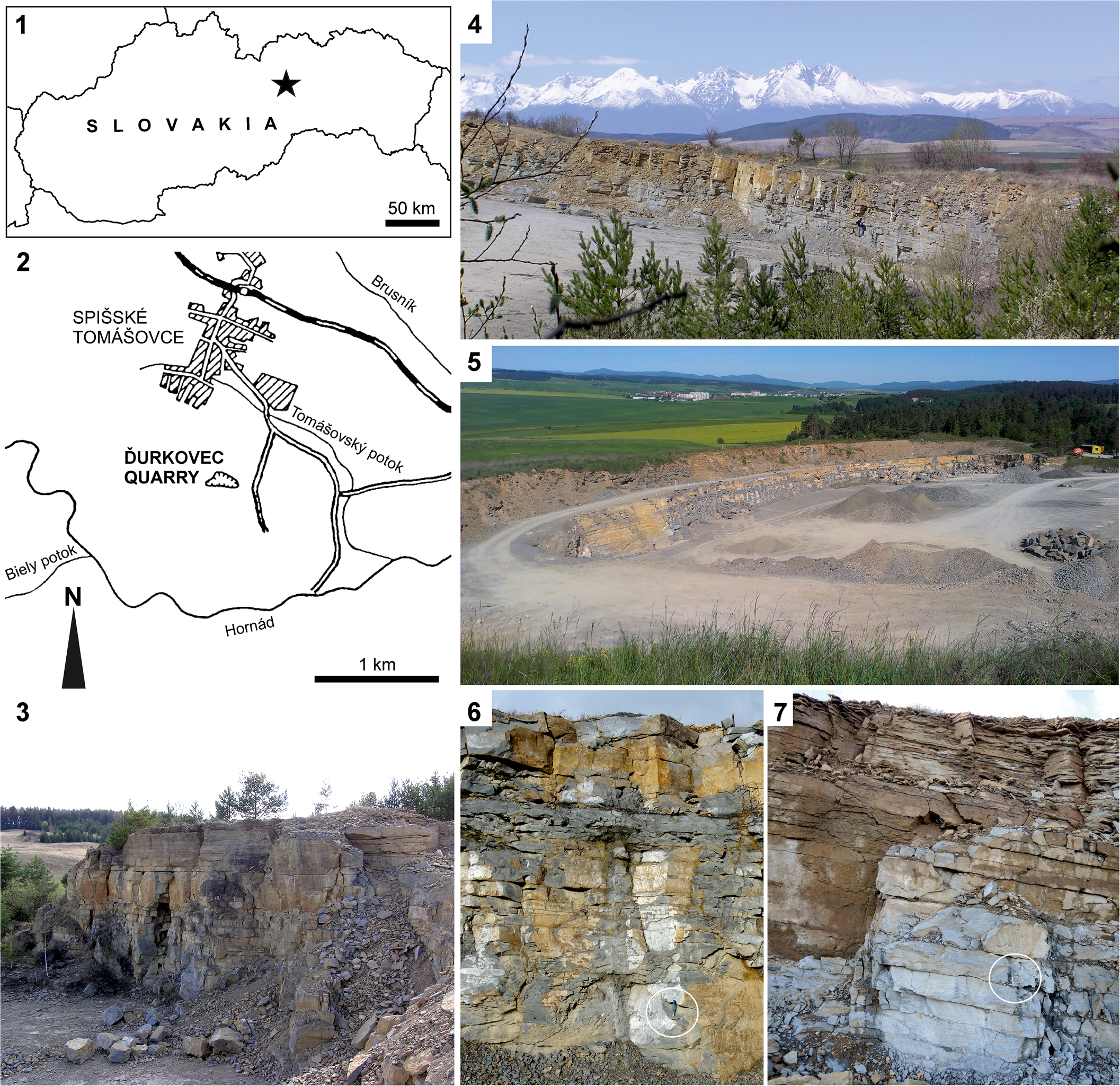
The stratotype of the Tomášovce Member established by Filo and Siráňová (Reference Filo and Siráňová1996) was situated in the Ďurkovec quarry (Fig. 1), 1 km south from the village of Spišské Tomášovce in the Spišská Nová Ves district (GPS location: 48°57′0.21″N, 20°28′21.74″E). In the quarry, alternating fine-grained sandstones and siltstones, with pyrite concretions and scarce intercalations of medium-grained calcareous arenites and fine-grained petromict conglomerates, are exposed (Filo and Siráňová, Reference Filo and Siráňová1996). In the nineteenth century, the Ďurkovec quarry was opened for sandstone extraction and its two levels are still active. Because of rapid progress of quarrying, the stratotype section (~10 m sequence) as defined by Filo and Siráňová (Reference Filo and Siráňová1996) is no longer present. A reference section, correlated with the topmost 3 m of the original stratotype section of Filo and Siráňová (Reference Filo and Siráňová1996, fig. 5), and consisting of an ~4.5 m sequence of alternating fine-grained calcareous sandstones and siltstones (Hyžný and Zágoršek, Reference Hyžný and Zágoršek2012, fig. 2) was established in 2009. Due to continuous quarrying in 2011, the correlation section was destroyed completely. Nevertheless, the fossiliferous layers are still exposed and accessible for collecting.
The Ďurkovec quarry, the stratotype locality of the Tomášovce Member (Borové Formation): (1) geographic location (star) within Slovakia; (2) location of the Ďurkovec quarry, 1 km south of Spišské Tomášovce; (3) stratotypic section as of 2004; (4) the quarry from the southeast as of 2002; (5) the quarry from the southwest as of 2017; (6) massively bedded calcareous sandstones corresponding to the lower part of the stratotype section; (7) layers of sandstone and siltstone corresponding to the upper part of the stratotype section. Note the geologic hammer for scale in the white circles. Photos by Z. Krempaská (3–5), M. Hyžný (6, 7).

Materials and methods
The Ďurkovec quarry has been thoroughly studied since the 1960s. Since 1988, staff from the Museum of Spiš in Spišská Nová Ves has performed continuous research there, which yielded a rich fossil collection, including decapod crustaceans that represent ~10% of all macrofaunal remains (Hyžný and Zágoršek, Reference Hyžný and Zágoršek2012). Donations from private collectors also contributed to the collection content. Due to collecting efforts of the senior author (MH) in 1998–2009 and further collecting of the junior author (AH) in 2014–2017, the number of available decapod specimens increased significantly. As a result, the present study is based on nearly 100 decapod specimens collected within three decades of research.
Decapod specimens are often preserved fully articulated. Isolated carapaces and/or chelae are also present. Usually, the cuticular surfaces are preserved so that the ornamentation of the outer cuticle layers can be identified.
Because of the overall hardness of the substratum, the fossil specimens were prepared using a fine pneumatic needle. To enhance greater contrast, some specimens were coated with ammonium chloride prior to photography. The presented synonymy lists in the systematic section are nonexhaustive, only including the most relevant works.
Repositories and institutional abbreviations
Figured and other specimens examined during this study are deposited in the following institutions: Department of Geology and Paleontology, Faculty of Natural Sciences, Comenius University (KGP-MH), Bratislava, Slovakia; Museum of Spiš (MS), Spišská Nová Ves, Slovakia; Department of Paleontology and Geology, Hungarian Natural History Museum (HNHM), Budapest, Hungary; and Muséum National d'Histoire Naturelle (MNHN), Paris, France.
Systematic paleontology
Order Decapoda Latreille, Reference Latreille1802
Infraoder Axiidea de Saint Laurent, Reference Saint Laurent1979
Family Ctenochelidae Manning and Felder, Reference Manning and Felder1991
Genus Ctenocheles Kishinouye, Reference Kishinouye1926
Type species
Ctenocheles balssi Kishinouye, Reference Kishinouye1926.
Description
Manus subtrapezoid in outline, tallest proximally, with upper and lower margins converging distally; fixed finger slender, downturned, ~2× longer than manus, armed with needle-like teeth.
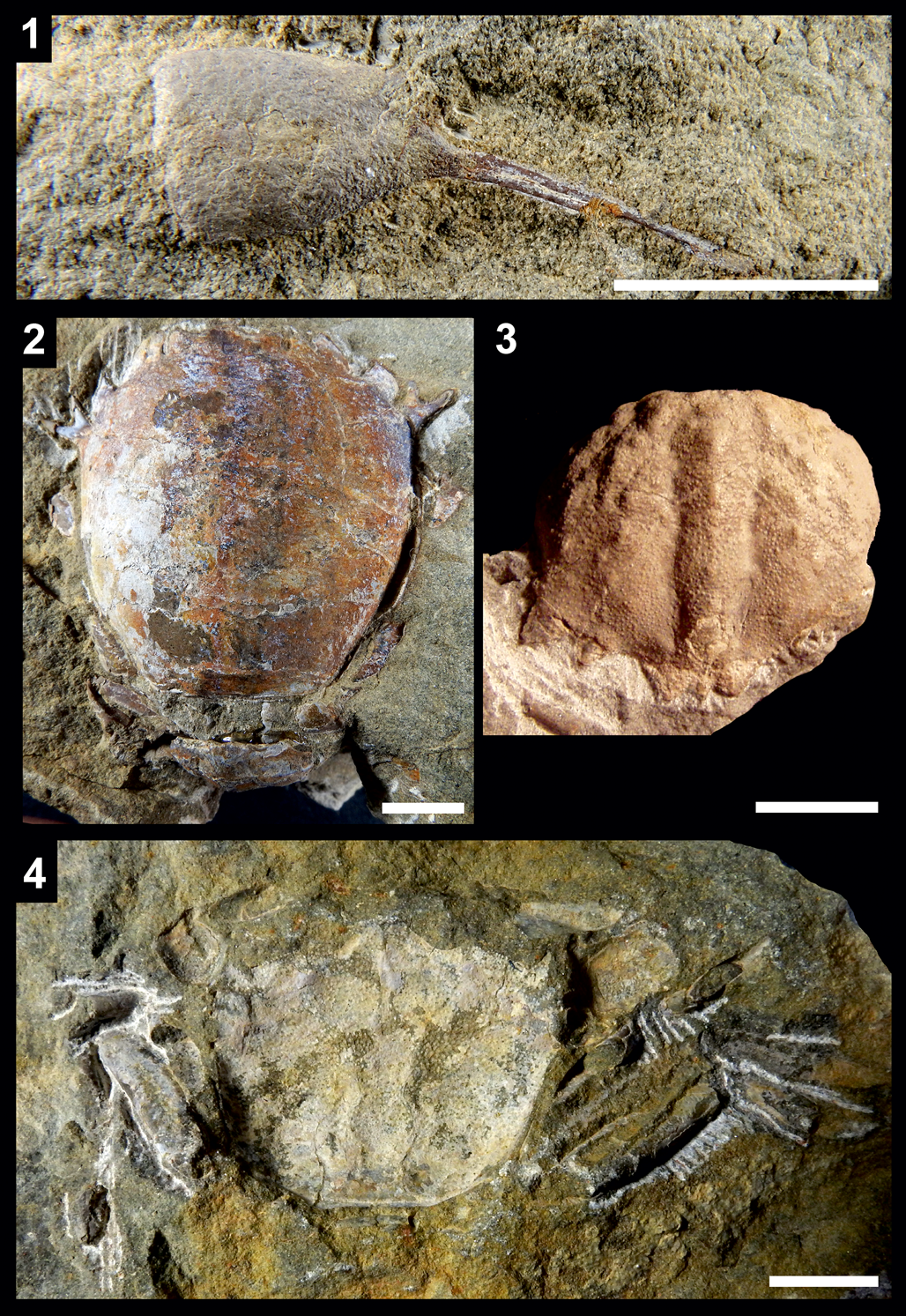
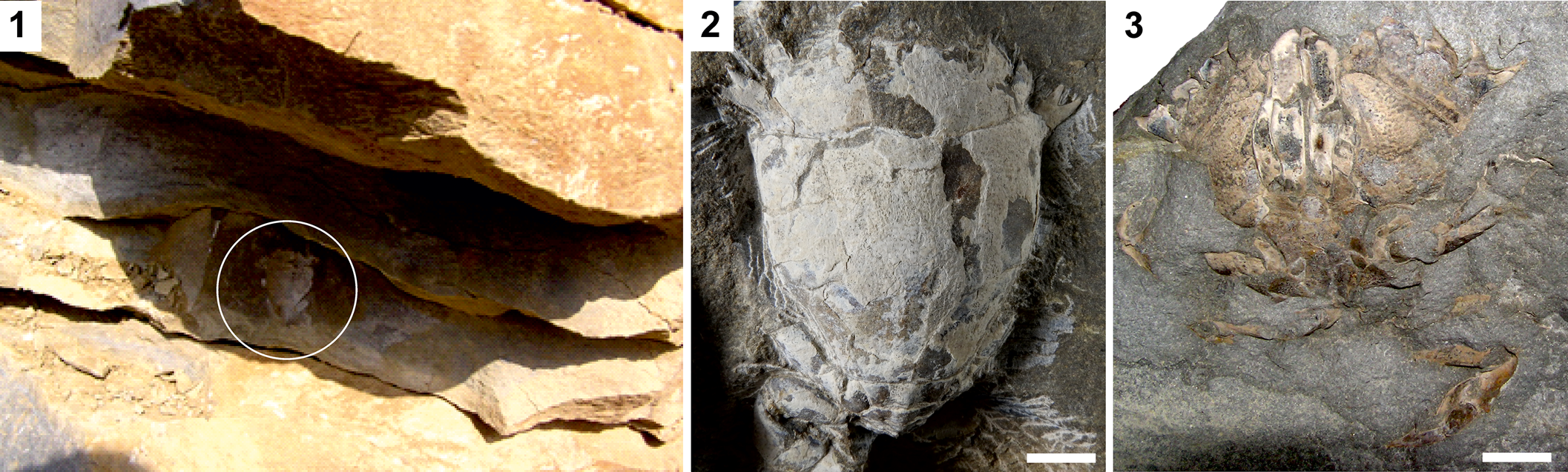
Decapod crustacean faunule from the Ďurkovec quarry (Tomášovce Member, Priabonian): (1) Ctenocheles sp. indet., KGP-MH DU-068; (2) Amphoranina hazslinszkyi (Reuss, Reference Reuss1859), neotype, MS P 2018/21; (3) Calappilia tridentata (Beurlen, Reference Beurlen1939), MS P99/99; (4) Coeloma vigil A. Milne-Edwards, Reference Milne-Edwards1865, MS P2017/6533. Scale bars = 10 mm. Photos by M. Hyžný.

Material
Isolated right propodus, KGP-MH DU-068.
Remarks
The specimen represents the remains of a major claw (pereiopod 1) of a burrowing shrimp, and based on overall morphology, it can be assigned to Ctenocheles (for more details, a reference is made for Hyžný and Dulai, Reference Hyžný and Dulai2014). The manus of the studied specimen is robust and nearly subtrapezoid in outline. In this respect, it is morphologically close to the extant congener Ctenocheles maorianus Powell, Reference Powell1949. The fixed finger is only poorly preserved, and its dentition cannot be discerned. Due to the fragmentary nature of the specimen, an assignment on the species level is impossible and therefore the material is treated in open nomenclature.
Infraorder Brachyura Latreille, Reference Latreille1802
Superfamily Raninoidea De Haan, Reference De Haan and Siebold1839
Family Raninidae De Haan, Reference De Haan and Siebold1839
Genus Amphoranina Nyborg et al., Reference Nyborg, Pasini, Garassino, van Bakel, Vega and Nyborg2020
Type species
Amphoranina blandi Nyborg et al., Reference Nyborg, Pasini, Garassino, van Bakel, Vega and Nyborg2020.
Amphoranina hazslinszkyi (Reuss, Reference Reuss1859) new combination
Figures 2.2, 3, 5
- Reference Reuss1859
Ranina Haszlinszkyi [sic] Reuss, p. 22, pl. 4, figs. 4, 5 (as R. Haszlinskyi [sic]).
- Reference Glaessner and Pompeckj1929
Ranina (Ranina) Haszlinszkyi [sic]; Glaessner, p. 362.
- Reference Lőrenthey and Beurlen1929
Hela Hazslinszkyi; Lőrenthey and Beurlen, p. 109, pl. 4, fig. 13.
- Reference Hyžný, Garassino, Feldmann and Teruzzi2007
Ranina (Ranina) speciosa; Hyžný, p. 59.
- Reference Hyžný, Garassino, Feldmann and Teruzzi2007
Ranina sp.; Hyžný, p. 59, fig. 1A–C.
- Reference Schweitzer, Feldmann, Garassino, Karasawa and Schweigert2010
Ranina haszlinskyi [sic]; Schweitzer et al., p. 74.
- Reference Hyžný2011
Ranina hazslinszkyi; Hyžný, p. 166, table 1.
- Reference Hyžný2011
Ranina sp.; Hyžný, p. 166, table 1.
- Reference Hyžný and Zágoršek2012
Ranina sp.; Hyžný and Zágoršek, p. 19.
- Reference Pasini and Garassino2017
?Ranina haszlinskyi [sic]; Pasini and Garassino, p. 52, fig. 7.
- Reference Hyžný, Krempaská and Heteš2018
Ranina hazslinszkyi; Hyžný et al., p. 338, figs. 2A, 3A–E, 4C.
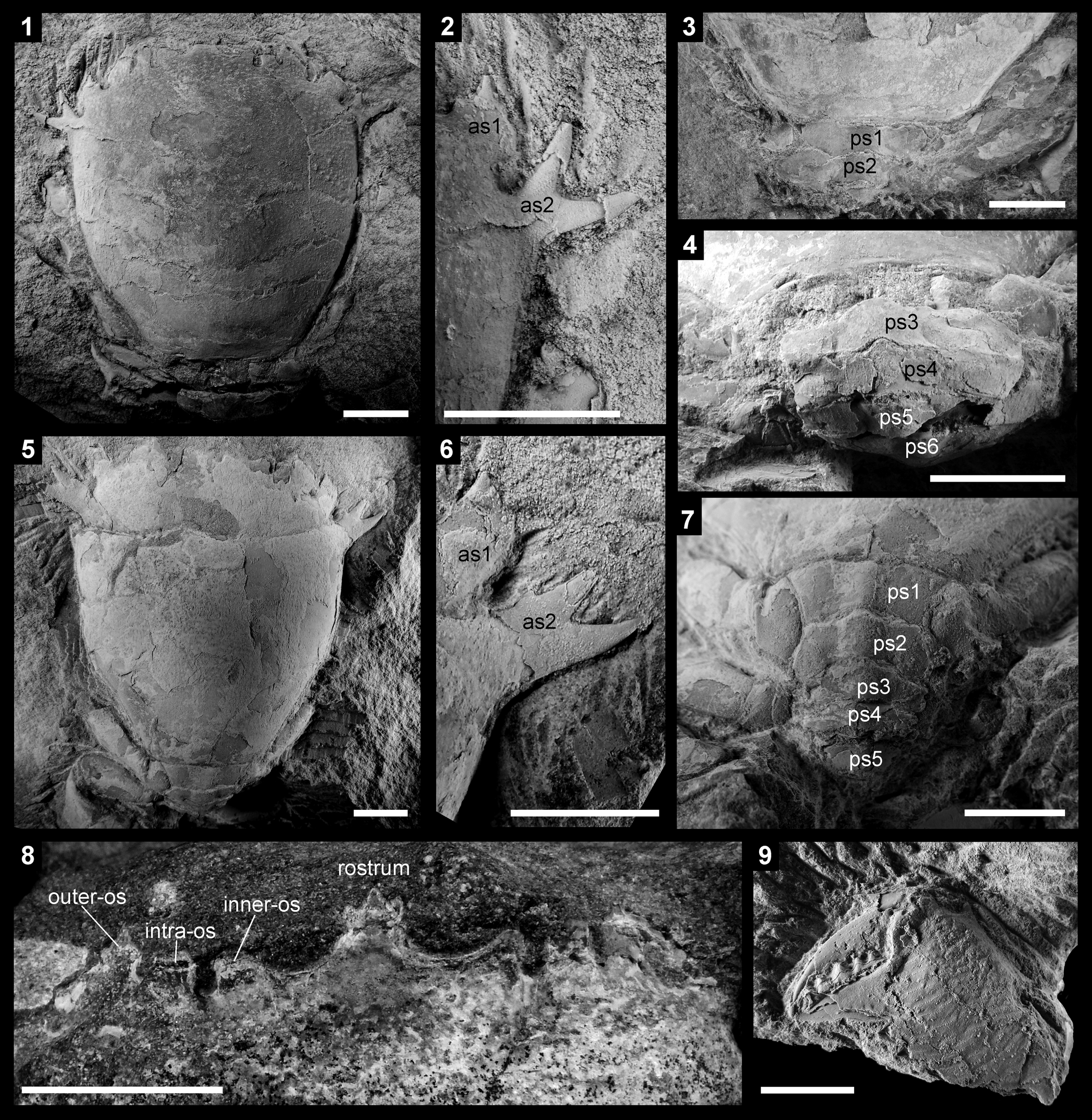
Amphoranina hazslinszkyi (Reuss, Reference Reuss1859) from the Tomášovce Member, Priabonian: (1–4) female, MS P2018/21: (1) dorsal view; (2) anterolateral spines on the left side (mirror image); (3, 4) pleon; (5–7) male, MS P2018/20: (5) dorsal view; (6) anterolateral spines on the right side; (7) pleon; (8) orbitofrontal margin with trifid rostrum, MS P2018/03; (9) left cheliped, KGP-MH DU-074. All specimens except (8) dusted with ammonium chloride prior to photography. as = anterolateral spine; os = orbital spine; ps = pleonal somite. Scale bars = 10 mm. Photos by A. Heteš (1–7, 9), M. Hyžný (8).

Type specimens
The species was described as Ranina hazslinszkyi based on a single specimen originating from gray fine-grained carbonatic sandstone exposed at ‘Iglo bei Eperies’ (Reuss, Reference Reuss1959, p. 22). ‘Iglo’ is one of the historic names given to modern Spišská Nová Ves, whereas ‘Eperies’ is nowadays the town of Prešov. The only known outcrop with gray carbonatic sandstones is the Ďurkovec quarry at Spišské Tomášovce in the Spišská Nová Ves district. The quarry itself has a long history going back to the nineteenth century. Thus, Ďurkovec is identified as the type locality of R. hazslinszkyi. It is of note that the specimen was donated by Friedrich Hazslinszky together with the second specimen of unknown affinities coming from Radács (nowadays Radatice; ~50 km east of Spišské Tomišovce). Although the type locality of R. hazslinszkyi was clearly stated both by Reuss (Reference Reuss1859, p. 22) and Hazslinszky (Reference Hazslinszky1859, p. 6), the monograph by Lőrenthey and Beurlen (Reference Lőrenthey and Beurlen1929, p. 110) mentioned it erroneously as Radács. This error was uncritically repeated by Hyžný (Reference Hyžný2011, p. 166, table 1) and Pasini and Garassino (Reference Pasini and Garassino2017, p. 52).
Hyžný (Reference Hyžný2011) indicated that the repository of the holotype as unknown. The specimen is considered lost, prompting the selection of a neotype. That opportunity is taken here, and the specimen MS P 2018/21 (Figs 2.2, 3.1–3.4) is selected as the neotype of Amphoranina hazslinszkyi.
Diagnosis
Carapace ovate in outline; dorsal regions indistinct; outer surface ornamentation consisting of subparallel coarse spinules directed anteriorly; rostrum trifid; inner-orbital spine rounded; intraorbital spine subsquare; outer-orbital spine subrectangular with serrated anterior margin; first anterolateral spine broad at base and with pointed tip with small spinule positioned medially; second anterolateral spine bifid or trifid (with additional medial spinule) with outermost spinule directed outward.
Description
Carapace ovate in outline, longer than wide, with maximum width at second anterolateral spine; dorsal regions indistinct; outer surface ornamentation consisting of subparallel coarse spinules directed anteriorly, not arranged in distinct transverse rims. Orbitofrontal margin 65–70% of maximum width (without spinules of anterolateral spines); rostrum trifid; orbital margins with two deep fissures; inner-orbital spine rounded; intraorbital spine subsquare; outer-orbital spine subrectangular with serrated anterior margin; anterolateral margin with two spines, both positioned oblique to carapace midline; first anterolateral spine broad at base with pointed tip with small spinule positioned medially; second anterolateral spine bifid with or without additional medial spinule; outermost spinule of second anterolateral spine directed outward; posterolateral margins slightly convex, rimmed; posterior margin 40–45% of maximum carapace width. Pleonal somites subtrapezoidal to subrectangular in outline, slightly raised medially; pleonal somite 1 narrowing posteriorly; male pleonal somite 2 approximately as wide as pleonal somite 1; female pleonal somite 2 wider than pleonal somite 1; male pleonal somites 3–6 narrower than pleonal somite 1 and narrowing progressively; female pleonal somites 3–6 wider than or as wide as pleonal somite 1. Chelipeds (pereiopods 1) homochelous, homodontous, with fingers deflexed; merus subovoid in outline, with outer surface with three transverse bands; carpus subtrapezoid in outline, with upper margin with spine positioned distally; manus subrectangular with rounded proximolower margin, lower margin with five oblique spines, upper margin with single spine pointing distally; fixed finger deflexed, triangular in outline, with six blunt teeth; dactylus slightly curved, with six blunt teeth, upper margin with long spine positioned proximally and pointing distally.
Materials
29 specimens (MS P 2017/6515–6520, 2018/01–16, 2018/18–24) plus 34 specimens (KGP-MH DU-001–032, DU-072, DU-074).
Remarks
Reuss (Reference Reuss1859) described a new species in honor of the collector of the specimen, Friedrich Hazslinszky. Unfortunately, the name of Hazslinszky was spelled incorrectly by Reuss (Reference Reuss1859, p. 22, pl. 4, figs. 4, 5) in the specific epithet as “Haszlinszkyi” and “Haszlinskyi”; typos were also used in several subsequent publications (see the abbreviated synonymy list above).
The collection forming the basis of this study also includes individuals with well-preserved anterolateral spines, which were not preserved on the original material collected by Hazslinszky (and depicted by Reuss, Reference Reuss1859, pl. 4, fig. 4B). This caused initial confusion in the determination of crab specimens from the Ďurkovec quarry. In his previous work, Hyžný (Reference Hyžný, Garassino, Feldmann and Teruzzi2007) mentioned two species of the genus Ranina Lamarck, Reference Lamarck1801, i.e., R. speciosa (von Münster, Reference Münster1840) and R. sp. indet., from the Ďurkovec quarry, believing that the variability of anterolateral spines preserved on the material is taxonomically significant. Later, Hyžný (Reference Hyžný2011) reported the presence of only one species (treated in open nomenclature), whereas the affinity with R. speciosa was excluded due to differences in the morphology of anterolateral spines. The opinion presented herein is that the specimens collected from the Ďurkovec quarry represent the same species as that described by Reuss (Reference Reuss1859). This assumption was based on the conformity between the published figures and the newly collected material as well as the identification of the Ďurkovec quarry as the type locality of R. hazslinszkyi.
Based on the incompleteness of the figured specimen by Reuss (Reference Reuss1859), the assignment of the species to the genus Ranina was doubted by Pasini and Garassino (Reference Pasini and Garassino2017). Newly collected material allows the reassignment of the species to the genus Amphoranina. Until recently, two species were known, A. blandi and A. multispinata Nyborg et al., Reference Nyborg, Pasini, Garassino, van Bakel, Vega and Nyborg2020, both from Paleogene deposits of North America (Nyborg et al., Reference Nyborg, Pasini, Garassino, van Bakel, Vega and Nyborg2020). The reassignment of Ranina hazslinszkyi to Amphoranina is based on shared diagnostic characters, including the trifid rostrum, the frontally directed first anterolateral spine, and the second anterolateral spine being bifid with or without accessorial spinule. Amphoranina hazslinszkyi differs from its congeners in several characters: the first anterolateral spine has a small spinule positioned medially and the outermost spinule of the second anterolateral spine is directed outward (to the side). In other species, the first anterolateral spine is single and the outermost spinule of the second anterolateral spine is directed more-or-less to the front (Nyborg et al., Reference Nyborg, Pasini, Garassino, van Bakel, Vega and Nyborg2020, fig. 7). Otherwise, the outline of the first anterolateral spine of A. hazslinszkyi is much closer to that of A. multispinata than to that of A. blandi.
Several individuals of Amphoranina hazslinszkyi possess well-preserved pleons allowing identification of sexual dimorphism (see also Feldmann and Schweitzer, Reference Feldmann and Schweitzer2007, for other raninoids). Moreover, variation in the nature of the second anterolateral spine (i.e., with or without an accessorial spinule) seems to be related to sexual dimorphism; the presence of a trifid spine (with accessorial spinule) was identified on a male specimen, whereas a bifid spine (without accessorial spinule) was present on a female specimen. Nevertheless, correlation of this type of variation with sexual dimorphism needs to be confirmed on a larger amount of material.
Superfamily Calappoidea De Haan, Reference De Haan and Siebold1833
Family Calappidae De Haan, Reference De Haan and Siebold1833
Genus Calappilia A. Milne-Edwards in de Bouillé, Reference Milne-Edwards and Bouillé1873
Type species
Calappilia verrucosa A. Milne-Edwards in de Bouillé, Reference Milne-Edwards and Bouillé1873.
Calappilia tridentata (Beurlen, Reference Beurlen1939)
Figure 2.3
- Reference Beurlen1939
Calappa tridentata Beurlen, p. 150, text-fig. 5, pl. 7, figs. 8–10.
- Reference Hyžný, Garassino, Feldmann and Teruzzi2007
Calappilia sp.; Hyžný, p. 59, fig. 1F.
- Reference Schweitzer, Feldmann, Garassino, Karasawa and Schweigert2010
Calappilia tridentata; Schweitzer et al., p. 84.
- Reference Hyžný2011
Calappilia tridentata; Hyžný, p. 166, fig. 1D.
- Reference Busulini, Beschin, Tessier, Fraaije, Hyžný, Jagt, Krobicki and Van Bakel2014
Calappilia tridentata; Busulini et al., p. 204, pl. 3, fig. 8.
Type specimens
Syntypes, HNHM.M.59.4676, 59.4679, 59.4681, and 60.758.
Diagnosis
See Busulini et al. (Reference Busulini, Beschin, Tessier, Fraaije, Hyžný, Jagt, Krobicki and Van Bakel2014, p. 204).
Description
Carapace subcircular in outline; front narrow; orbits small; anterolateral margins rounded anteriorly, granular; posterolateral margins with two broad spines converging posteriorly (first spine larger than second one); posterior margin with three broad subequal spines. Carapace regions poorly defined except in axial regions; gastrocardiac region defined by deep longitudinal grooves; carapace with large round tubercles arranged in longitudinal rows, tubercles more strongly developed on anterior half of carapace; carapace surface uniformly granular.
Material
Isolated carapace preserved in dorsal aspect (MS P 99/99/1–3).
Remarks
The only isolated carapace attributable to Calappilia tridentata was treated in open nomenclature (Calappilia sp. indet.) by Hyžný (Reference Hyžný, Garassino, Feldmann and Teruzzi2007). The species was revised in the work of Busulini et al. (Reference Busulini, Beschin, Tessier, Fraaije, Hyžný, Jagt, Krobicki and Van Bakel2014).
Superfamily Portunoidea Rafinesque, Reference Rafinesque1815
Family Polybiidae Ortmann, Reference Ortmann1893
Genus Coeloma A. Milne-Edwards, Reference Milne-Edwards1865
Type species
Coeloma vigil A. Milne-Edwards, Reference Milne-Edwards1865.
Coeloma vigil A. Milne-Edwards, Reference Milne-Edwards1865
Figures 2.4, 4
- Reference Milne-Edwards1865
Coeloma vigil A. Milne-Edwards, p. 324, pl. 12, figs. 1–3.
- Reference De Angeli and Garassino2006
Coeloma vigil; De Angeli and Garassino, p. 56 [cum. syn.].
- Reference Hyžný, Garassino, Feldmann and Teruzzi2007
Coeloma (Coeloma) vigil; Hyžný, p. 59, figs. 1D, E.
- Reference Hyžný, Garassino, Feldmann and Teruzzi2007
?Portunites sp.; Hyžný, p. 59.
- Reference Jagt, van Bakel and Fraaije2010
Coeloma vigil; Jagt et al., table 1.
- Reference Schweitzer, Feldmann, Garassino, Karasawa and Schweigert2010
Coeloma vigil; Schweitzer et al., p. 137.
- Reference Hyžný2011
Coeloma vigil; Hyžný, fig. 1B, table 1.
- Reference Hyžný and Zágoršek2012
Coeloma vigil; Hyžný and Zágoršek, p. 19, text-fig. 3.
- Reference Hyžný and Zorn2020
Coeloma vigil; Hyžný and Zorn, p. 39, pl. 22, figs. 8, 9.
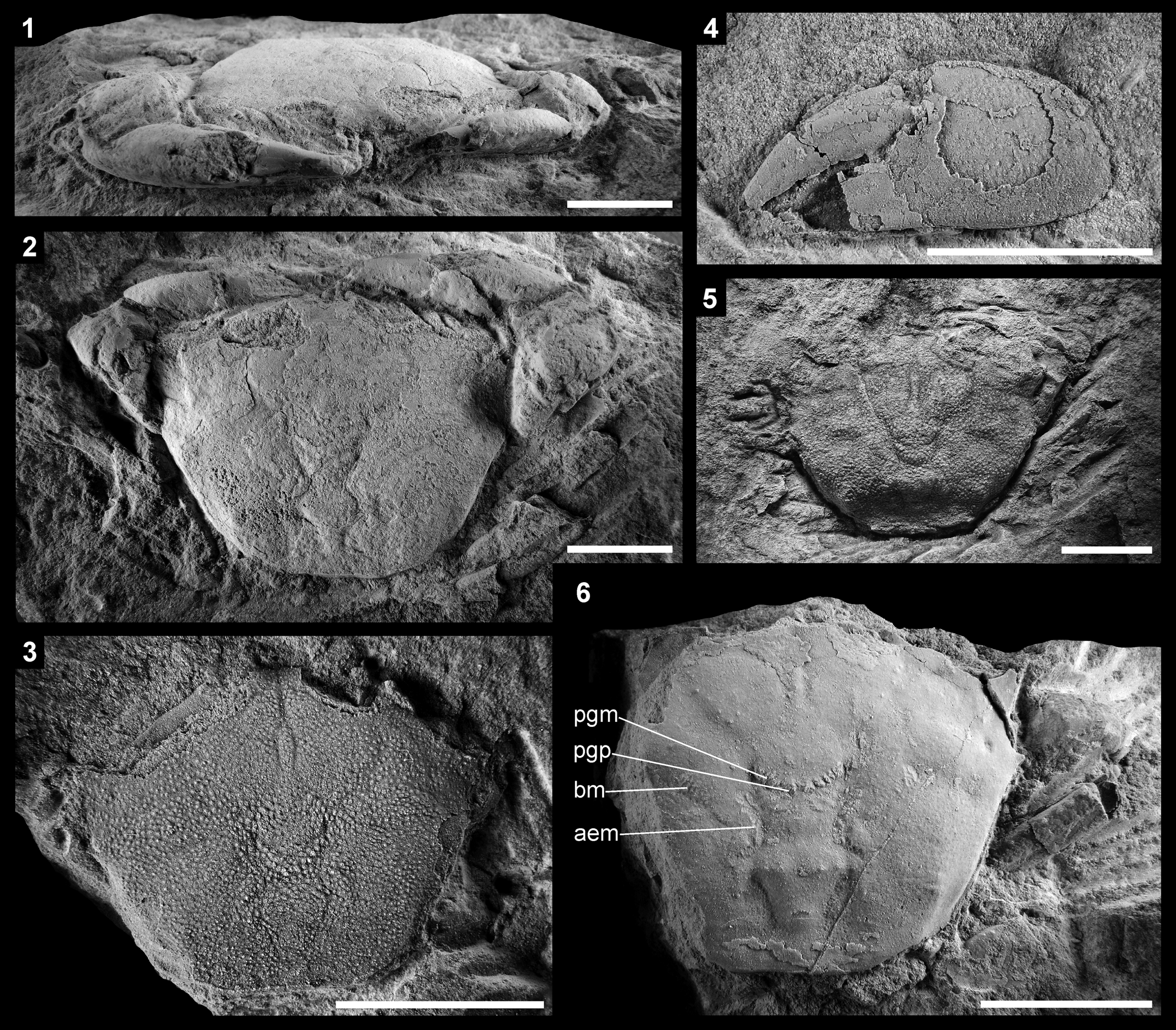
Coeloma vigil A. Milne-Edwards, Reference Milne-Edwards1865 from the Tomášovce Member, Priabonian: (1, 2) near-complete individual showing asymmetrical chelae, KGP-MH DU-067: (1) frontal view; (2) dorsal view; (3) isolated carapace with well-preserved cuticular surfaces, MS P 2017/6539; (4) isolated left chela, MS P 2017/6540; (5) carapace with associated partially-preserved legs, MS P 2017/6532; (6) internal cast (carapace without cuticle) showing muscle scars, MS P 2017/6524. aem = attractor epimeralis muscles; bm = branchial muscles; pgm = posterior gastric muscles; pgp = posterior gastric pits for stomach muscle. All specimens dusted with ammonium chloride prior to photography. Scale bars = 10 mm. Photos by M. Hyžný (1–4, 6), A. Heteš (5).

Type material
Holotype, MNHN R03822.
Diagnosis
See Schweitzer et al. (Reference Schweitzer, Feldmann and Karasawa2021, p. 7).
Description
Carapace subhexagonal in outline, wider than long, widest at one-third of maximum carapace length from the front; width of orbitofrontal margin equaling ~90% of maximum carapace width; front narrow, with four blunt spines including inner orbital spines (directed anterolaterally); orbits very wide; orbital rim beaded; upper orbital margin biconcave with two fissures; outer orbital spine directed forward; anterolateral margin short, with three spines (excluding outer orbital spine); posterolateral margins straight, converging posteriorly; posterolateral re-entrants shallow; posterior margin slightly sinuous, rimmed. Carapace surface uniformly granular; regions well developed; grooves moderately deep; mesogastric region with long anterior process; urogastric and metagastric regions well delineated by grooves; cardiac region with two elevations positioned transversely. Chelipeds heterochelous; manus subtrapezoid in outline, with upper margin convex, lower margin straight; fingers with longitudinal grooves; major claw (crusher) fingers with blunt teeth and dactylus with knobstick molariform tooth; minor claw (cutter) dactylus and fixed finger with uniform conical teeth.
Materials
28 specimens (MS P 37/2000, 23/2002, 2018/17, 44/2000/1,2, 2017/6521–6544) plus 1 specimen (KGP-MH DU-067).
Remarks
From the Tomášovce Member exposed in the Ďurkovec quarry, Hyžný (Reference Hyžný, Garassino, Feldmann and Teruzzi2007) mentioned the presence of several crab taxa, including Coeloma vigil and ?Portunites sp. After a thorough revision of the material, it can be stated that all of the specimens provisionally included in the two latter species belong to only one of them, Coeloma vigil. The apparent differences causing the initial confusion are related to the mode of preservation, i.e., whether the cuticular surfaces were preserved in their entirety or not. If the cuticle is intact, its surface is granular (Fig. 4.3) whereas in specimens without the cuticle, the surface is smooth except for the muscle scars (Fig. 4.6; see Klompmaker et al., Reference Klompmaker, Hyžný, Portell, Jauvion, Charbonnier, Fussell, Klier, Tejera and Jakobsen2019, for more details on muscle scars in decapods). At the Ďurkovec quarry, the best-preserved individuals of Coeloma vigil (including the eye stalks: Hyžný and Zágoršek, Reference Hyžný and Zágoršek2012, text-fig. 3) can be found predominantly in siltstones, whereas those in calcareous sandstones are less well preserved.
Discussion
Preservation and taphonomy
At the Ďurkovec quarry, the decapod assemblage is dominated by two species, Amphoranina hazslinszkyi (N = 63) and Coeloma vigil (N = 29), whereas another two taxa, Ctenocheles sp. and Calappilia tridentata, are known each from a single specimen. Crabs often are preserved intact with all appendages, including chelipeds and eye stalks (Hyžný and Zágoršek, Reference Hyžný and Zágoršek2012, text-fig. 3); this can be observed in both dominant species. This type of preservation is not so frequent in the fossil record, because decapod exoskeletons, of both molts and corpses, tend to disintegrate rapidly (Plotnick, Reference Plotnick1986; Plotnick et al., Reference Plotnick, Baumiller and Wetmore1988; Mutel et al., Reference Mutel, Waugh, Feldmann and Parsons-Hubbard2008; Klompmaker et al., Reference Klompmaker, Portell and Frick2017). At the Ďurkovec quarry, complete individuals of A. hazslinszkyi often are preserved in a perpendicular position relative to the bedding and some of them were found directly in the quarry wall (Hyžný, Reference Hyžný, Garassino, Feldmann and Teruzzi2007, fig. 1A; Fig. 5.1, 5.2). Nowadays, raninid crabs spend much of their time buried in the substrate, with only eyes and antennules protruding from the sediment (Skinner and Hill, Reference Skinner and Hill1986, p. 462). The same behavior can be postulated for A. hazslinszkyi; complete individuals preserved perpendicular to the bedding are interpreted as animals that were covered by large amounts of sediment while being buried in the substrate, causing their death. Some individuals of A. hazslinszkyi show signs of the escape position (Fig. 5.3), i.e., with chelipeds and walking legs spread out in an attempt to escape from enclosing sediment (Schäfer, Reference Schäfer1951; Bishop, Reference Bishop1986). Interestingly, specimens of Coeloma vigil were not preserved in the escape position, and when covered with sediment, they probably represented corpses or molts. This could also suggest that the escape capabilities of the much more mobile Coeloma vigil were higher than those of A. hazslinszkyi buried in the substrate. In any case, the buried decapod specimens have not been subsequently physically disturbed by bioturbation, suggesting a higher rate of sedimentation. Nevertheless, trace fossils are known from the studied section of the Ďurkovec quarry. Besides other ichnotaxa, also the presence of Thalassinoides has been noted (Hyžný and Zágoršek, Reference Hyžný and Zágoršek2012). This ichnogenus is commonly considered as being produced by decapod crustaceans, especially burrowing shrimps (Bromley and Frey, Reference Bromley and Frey1974; Gingras et al., Reference Gingras, Dashtgard, MacEachern and Pemberton2008). No clear relationship between the trace fossils and decapod crustaceans was postulated by Hyžný (Reference Hyžný, Garassino, Feldmann and Teruzzi2007). In the meantime, a single specimen of Ctenocheles sp. indet. was collected at the Ďurkovec quarry, suggesting that the respective trace fossils are remains of the burrow system produced by ctenochelid burrowing shrimps or a yet to be found other axiidean. In highly bioturbated horizons, decapod crustacean body fossils are rare or not present (Hyžný and Zágoršek, Reference Hyžný and Zágoršek2012, text-fig. 2); these horizons are usually bound to the upper part of the layers within the studied section.
Amphoranina hazslinszkyi (Reuss, Reference Reuss1859) from the Tomášovce Member, Priabonian: (1) complete individual preserved perpendicular to the bedding planes; (2) same as (1) after extraction from the quarry wall, MS P2018/20; (3) individual MS P2018/23 in supposed escape position (see text for more details). Scale bar = 10 mm. Photos by Z. Krempaská (1), M. Hyžný (2, 3).

Paleoenvironment
The determined faunal assemblages from the Ďurkovec quarry are characteristic of a shallow, neritic, marine environment with the prevalence of euryhaline forms and accessory littoral elements (Filo and Siráňová, Reference Filo and Siráňová1996; Hyžný and Zágoršek, Reference Hyžný and Zágoršek2012). Changes in lithology (from massive sandstones to siltstones) and thickness of bedding (from thick to thinner layers) throughout the stratotype section suggest a continuous decrease of the sedimentation rate in the uppermost part of the section. Although Filo and Siráňová (Reference Filo and Siráňová1996) roughly estimated the depth of the marine setting as ~200 m, Hyžný and Zágoršek (Reference Hyžný and Zágoršek2012) suggested it to be no more than 100 m; the latter estimate was based on the presence of bryozoan genera. The occurrence of large fragments of the bryozoan colonies and even near-complete colonies of free-living bryozoans indicate the absence or only very short postmortem transport and rather rapid burial (Hyžný and Zágoršek, Reference Hyžný and Zágoršek2012), which is in agreement with the mode of preservation of decapod crustaceans as discussed above. The environment during the sedimentation of layers with large bryozoans (the upper part of the stratotypic section) was very shallow with permanent water currents (Hyžný and Zágoršek, Reference Hyžný and Zágoršek2012).
Conclusions
Several decades of collecting at the Ďurkovec quarry (northern Slovakia, Spišská Nová Ves district), the stratotype locality of the Tomášovce Member, Borové Formation (Priabonian), yielded four decapod species, including an axiidean shrimp Ctenocheles sp. (Ctenochelidae), and three brachyuran crabs Amphoranina hazslinszkyi new comb. (Raninidae), Calappilia tridentata (Calappidae), and Coeloma vigil (Polybiidae). Amphoranina hazslinszkyi represents the first occurrence of this genus in Europe. The studied decapod faunule was represented by a collection of nearly 100 specimens and was dominated by A. hazslinszkyi and Coeloma vigil, many of which were preserved as complete individuals, suggesting rapid burial and minimal to no postmortem transport. Specimens of A. hazslinszkyi, preserved perpendicular to the bedding planes are interpreted as being covered by a large amount of sediment while buried in the substrate, causing death of the animals. The presence of trace fossils Thalassinoides are linked with the burrowing shrimp Ctenocheles sp. The decapod faunule inhabited shallow marine environment with the depth likely not exceeding 100 meters.
Acknowledgments
R.M. Feldmann (deceased), R.H.B. Fraaije (Oertijdmuseum, Boxtel), and C.E. Schweitzer (Kent State University) are thanked for encouragement during the initial phases of the research. A. Harničár (Veľký Slavkov, Slovakia) donated some specimens. Z. Krempaská (MS) provided access to the material deposited in MS and provided photos of the Ďurkovec quarry from her archive. The manuscript benefitted from constructive criticism by reviewers F.A. Ferratges (Instituto Geológico y Minero de España, Madrid) and C.E. Schweitzer, and the guest editor A.A. Klompmaker (Alabama Museum of Natural History). The research has been supported by the Slovak Research and Development Agency under contracts no. APVV-20-0079 and APVV-22-0523.
Competing interests
The authors declare none.