


%20--%3e%3c!DOCTYPE%20svg%20PUBLIC%20'-//W3C//DTD%20SVG%201.0//EN'%20'http://www.w3.org/TR/2001/REC-SVG-20010904/DTD/svg10.dtd'%3e%3csvg%20version='1.0'%20id='Layer_1'%20xmlns='http://www.w3.org/2000/svg'%20xmlns:xlink='http://www.w3.org/1999/xlink'%20x='0px'%20y='0px'%20width='64px'%20height='64px'%20viewBox='5.5%20-3.5%2064%2064'%20enable-background='new%205.5%20-3.5%2064%2064'%20xml:space='preserve'%3e%3cg%3e%3ccircle%20fill='%23FFFFFF'%20fill-opacity='0'%20cx='37.785'%20cy='28.501'%20r='28.836'/%3e%3cpath%20fill='%23595959'%20d='M37.441-3.5c8.951,0,16.572,3.125,22.857,9.372c3.008,3.009,5.295,6.448,6.857,10.314%20c1.561,3.867,2.344,7.971,2.344,12.314c0,4.381-0.773,8.486-2.314,12.313c-1.543,3.828-3.82,7.21-6.828,10.143%20c-3.123,3.085-6.666,5.448-10.629,7.086c-3.961,1.638-8.057,2.457-12.285,2.457s-8.276-0.808-12.143-2.429%20c-3.866-1.618-7.333-3.961-10.4-7.027c-3.067-3.066-5.4-6.524-7-10.372S5.5,32.767,5.5,28.5c0-4.229,0.809-8.295,2.428-12.2%20c1.619-3.905,3.972-7.4,7.057-10.486C21.08-0.394,28.565-3.5,37.441-3.5z%20M37.557,2.272c-7.314,0-13.467,2.553-18.458,7.657%20c-2.515,2.553-4.448,5.419-5.8,8.6c-1.354,3.181-2.029,6.505-2.029,9.972c0,3.429,0.675,6.734,2.029,9.913%20c1.353,3.183,3.285,6.021,5.8,8.516c2.514,2.496,5.351,4.399,8.515,5.715c3.161,1.314,6.476,1.971,9.943,1.971%20c3.428,0,6.75-0.665,9.973-1.999c3.219-1.335,6.121-3.257,8.713-5.771c4.99-4.876,7.484-10.99,7.484-18.344%20c0-3.543-0.648-6.895-1.943-10.057c-1.293-3.162-3.18-5.98-5.654-8.458C50.984,4.844,44.795,2.272,37.557,2.272z%20M37.156,23.187%20l-4.287,2.229c-0.458-0.951-1.019-1.619-1.685-2c-0.667-0.38-1.286-0.571-1.858-0.571c-2.856,0-4.286,1.885-4.286,5.657%20c0,1.714,0.362,3.084,1.085,4.113c0.724,1.029,1.791,1.544,3.201,1.544c1.867,0,3.181-0.915,3.944-2.743l3.942,2%20c-0.838,1.563-2,2.791-3.486,3.686c-1.484,0.896-3.123,1.343-4.914,1.343c-2.857,0-5.163-0.875-6.915-2.629%20c-1.752-1.752-2.628-4.19-2.628-7.313c0-3.048,0.886-5.466,2.657-7.257c1.771-1.79,4.009-2.686,6.715-2.686%20C32.604,18.558,35.441,20.101,37.156,23.187z%20M55.613,23.187l-4.229,2.229c-0.457-0.951-1.02-1.619-1.686-2%20c-0.668-0.38-1.307-0.571-1.914-0.571c-2.857,0-4.287,1.885-4.287,5.657c0,1.714,0.363,3.084,1.086,4.113%20c0.723,1.029,1.789,1.544,3.201,1.544c1.865,0,3.18-0.915,3.941-2.743l4,2c-0.875,1.563-2.057,2.791-3.541,3.686%20c-1.486,0.896-3.105,1.343-4.857,1.343c-2.896,0-5.209-0.875-6.941-2.629c-1.736-1.752-2.602-4.19-2.602-7.313%20c0-3.048,0.885-5.466,2.658-7.257c1.77-1.79,4.008-2.686,6.713-2.686C51.117,18.558,53.938,20.101,55.613,23.187z'/%3e%3c/g%3e%3c/svg%3e)
%20--%3e%3c!DOCTYPE%20svg%20PUBLIC%20'-//W3C//DTD%20SVG%201.0//EN'%20'http://www.w3.org/TR/2001/REC-SVG-20010904/DTD/svg10.dtd'%3e%3csvg%20version='1.0'%20id='Layer_1'%20xmlns='http://www.w3.org/2000/svg'%20xmlns:xlink='http://www.w3.org/1999/xlink'%20x='0px'%20y='0px'%20width='64px'%20height='64px'%20viewBox='5.5%20-3.5%2064%2064'%20enable-background='new%205.5%20-3.5%2064%2064'%20xml:space='preserve'%3e%3cg%3e%3ccircle%20fill='%23FFFFFF'%20fill-opacity='0'%20cx='37.637'%20cy='28.806'%20r='28.276'/%3e%3cg%3e%3cpath%20fill='%23595959'%20d='M37.443-3.5c8.988,0,16.57,3.085,22.742,9.257C66.393,11.967,69.5,19.548,69.5,28.5c0,8.991-3.049,16.476-9.145,22.456%20C53.879,57.319,46.242,60.5,37.443,60.5c-8.649,0-16.153-3.144-22.514-9.43C8.644,44.784,5.5,37.262,5.5,28.5%20c0-8.761,3.144-16.342,9.429-22.742C21.101-0.415,28.604-3.5,37.443-3.5z%20M37.557,2.272c-7.276,0-13.428,2.553-18.457,7.657%20c-5.22,5.334-7.829,11.525-7.829,18.572c0,7.086,2.59,13.22,7.77,18.398c5.181,5.182,11.352,7.771,18.514,7.771%20c7.123,0,13.334-2.607,18.629-7.828c5.029-4.838,7.543-10.952,7.543-18.343c0-7.276-2.553-13.465-7.656-18.571%20C50.967,4.824,44.795,2.272,37.557,2.272z%20M46.129,20.557v13.085h-3.656v15.542h-9.944V33.643h-3.656V20.557%20c0-0.572,0.2-1.057,0.599-1.457c0.401-0.399,0.887-0.6,1.457-0.6h13.144c0.533,0,1.01,0.2,1.428,0.6%20C45.918,19.5,46.129,19.986,46.129,20.557z%20M33.042,12.329c0-3.008,1.485-4.514,4.458-4.514s4.457,1.504,4.457,4.514%20c0,2.971-1.486,4.457-4.457,4.457S33.042,15.3,33.042,12.329z'/%3e%3c/g%3e%3c/g%3e%3c/svg%3e)
%20--%3e%3c!DOCTYPE%20svg%20PUBLIC%20'-//W3C//DTD%20SVG%201.0//EN'%20'http://www.w3.org/TR/2001/REC-SVG-20010904/DTD/svg10.dtd'%3e%3csvg%20version='1.0'%20id='Layer_1'%20xmlns='http://www.w3.org/2000/svg'%20xmlns:xlink='http://www.w3.org/1999/xlink'%20x='0px'%20y='0px'%20width='64px'%20height='64px'%20viewBox='5.5%20-3.5%2064%2064'%20enable-background='new%205.5%20-3.5%2064%2064'%20xml:space='preserve'%3e%3cg%3e%3ccircle%20fill='%23FFFFFF'%20fill-opacity='0'%20cx='36.924'%20cy='28.403'%20r='28.895'/%3e%3cpath%20fill='%23595959'%20d='M37.442-3.5c8.99,0,16.571,3.085,22.743,9.256C66.393,11.928,69.5,19.509,69.5,28.5c0,8.992-3.048,16.476-9.145,22.458%20C53.88,57.32,46.241,60.5,37.442,60.5c-8.686,0-16.19-3.162-22.513-9.485C8.644,44.728,5.5,37.225,5.5,28.5%20c0-8.762,3.144-16.343,9.429-22.743C21.1-0.414,28.604-3.5,37.442-3.5z%20M12.7,19.872c-0.952,2.628-1.429,5.505-1.429,8.629%20c0,7.086,2.59,13.22,7.77,18.4c5.219,5.144,11.391,7.715,18.514,7.715c7.201,0,13.409-2.608,18.63-7.829%20c1.867-1.79,3.332-3.657,4.398-5.602l-12.056-5.371c-0.421,2.02-1.439,3.667-3.057,4.942c-1.622,1.276-3.535,2.011-5.744,2.2%20v4.915h-3.714v-4.915c-3.543-0.036-6.782-1.312-9.714-3.827l4.4-4.457c2.094,1.942,4.476,2.913,7.143,2.913%20c1.104,0,2.048-0.246,2.83-0.743c0.78-0.494,1.172-1.312,1.172-2.457c0-0.801-0.287-1.448-0.858-1.943l-3.085-1.315l-3.771-1.715%20l-5.086-2.229L12.7,19.872z%20M37.557,2.214c-7.276,0-13.428,2.571-18.457,7.714c-1.258,1.258-2.439,2.686-3.543,4.287L27.786,19.7%20c0.533-1.676,1.542-3.019,3.029-4.028c1.484-1.009,3.218-1.571,5.2-1.686V9.071h3.715v4.915c2.934,0.153,5.6,1.143,8,2.971%20l-4.172,4.286c-1.793-1.257-3.619-1.885-5.486-1.885c-0.991,0-1.876,0.191-2.656,0.571c-0.781,0.381-1.172,1.029-1.172,1.943%20c0,0.267,0.095,0.533,0.285,0.8l4.057,1.83l2.8,1.257l5.144,2.285l16.397,7.314c0.535-2.248,0.801-4.533,0.801-6.857%20c0-7.353-2.552-13.543-7.656-18.573C51.005,4.785,44.831,2.214,37.557,2.214z'/%3e%3c/g%3e%3c/svg%3e)
%20--%3e%3c!DOCTYPE%20svg%20PUBLIC%20'-//W3C//DTD%20SVG%201.1//EN'%20'http://www.w3.org/Graphics/SVG/1.1/DTD/svg11.dtd'%3e%3csvg%20version='1.1'%20id='Layer_1'%20xmlns='http://www.w3.org/2000/svg'%20xmlns:xlink='http://www.w3.org/1999/xlink'%20x='0px'%20y='0px'%20width='64.000977px'%20height='64px'%20viewBox='0%200%2064.000977%2064'%20enable-background='new%200%200%2064.000977%2064'%20xml:space='preserve'%3e%3cg%3e%3ccircle%20fill='%23FFFFFF'%20fill-opacity='0'%20cx='32.064453'%20cy='31.788086'%20r='29.012695'/%3e%3cg%3e%3cpath%20fill='%23595959'%20d='M31.943848,0C40.896484,0,48.476562,3.105469,54.6875,9.314453C60.894531,15.486328,64.000977,23.045898,64.000977,32%20s-3.048828,16.457031-9.145508,22.513672C48.417969,60.837891,40.779297,64,31.942871,64%20c-8.648926,0-16.152832-3.142578-22.513672-9.429688C3.144043,48.286133,0,40.761719,0,32.000977%20c0-8.723633,3.144043-16.285156,9.429199-22.68457C15.640137,3.105469,23.14502,0,31.943848,0z%20M32.060547,5.771484%20c-7.275391,0-13.429688,2.570312-18.458496,7.714844C8.381836,18.783203,5.772949,24.954102,5.772949,32%20c0,7.125,2.589844,13.256836,7.77002,18.400391c5.181152,5.181641,11.352051,7.770508,18.515625,7.770508%20c7.123047,0,13.332031-2.608398,18.626953-7.828125C55.713867,45.466797,58.228516,39.353516,58.228516,32%20c0-7.3125-2.553711-13.484375-7.65625-18.513672C45.504883,8.341797,39.333984,5.771484,32.060547,5.771484z%20M44.117188,24.456055%20v5.485352H20.859863v-5.485352H44.117188z%20M44.117188,34.743164v5.481445H20.859863v-5.481445H44.117188z'/%3e%3c/g%3e%3c/g%3e%3c/svg%3e)
Introduction
Antibiotic resistance is a major public health concern worldwide, mainly driven by inappropriate antibiotic prescription and use in healthcare facilities. Reference Iskandar, Molinier and Hallit1,2 A global study found a 16% increase in antibiotic consumption between 2016 and 2023, Reference Klein, Impalli and Poleon3 potentially leading to increased healthcare costs, greater resistance to multidrug-resistant bacteria, and poorer patient outcomes. Low-middle-income countries (LMICs) are particularly prone to antibiotic resistance due to large population and infectious disease burden, ease of access to antibiotics,Reference Hamers and van Doorn 4 scant antibiotic stewardship programs, and limited access to proper diagnostics and specialists. Reference Sulis, Sayood and Gandra5 A 2020 meta-analysis estimated that 52% of outpatient primary care visits in LMICs resulted in an antibiotic prescription, with a high proportion being inappropriate.Reference Sulis, Adam and Nafade 6 Competence in diagnosing infections and using antimicrobials appropriately cannot improve when access to training opportunities is limited.Reference Otaigbe and Elikwu 7
As technology evolves in healthcare and access to mobile phones by patients and physicians increases, mobile health (mHealth) becomes a promising option for augmenting antibiotic stewardship efforts. Reference Charani, Gharbi and Moore8,Reference Peiffer-Smadja, Poda and Ouedraogo9 Use of clinical decision-support systems (CDSS) has been shown to reduce antibiotic prescribing by 34%, Reference Boonacker, Hoes, Dikhoff, Schilder and Rovers10 consistent improvements in prescribing appropriateness, fewer errors, Reference Miranda-Barros, Pilco-Bonilla and Guaman-Lozada11 and a significant increase (7%–74%) in adherence to guidelines. Reference Yoon, Ritchie and Duffy12,Reference Tuon, Gasparetto, Wollmann and Moraes13 However, to comprehensively analyze the influence of antimicrobial stewardship (AMS) apps on antimicrobial prescribing, further research is required.Reference Helou, Foudraine and Catho 14
There are limited studies on the impact of mHealth technology on antibiotic stewardship efforts in resource-constrained settings.15,16 This study aimed to develop and implement ComBact, an mHealth-based CDSS, and examine physicians’ perceptions of its usability, clinical utility and system-level usability metrics at a tertiary-care hospital in Pakistan.
Methods
Study setting and participants
This study was conducted at Aga Khan University Hospital (AKUH), a tertiary-care academic medical center located in Karachi, Pakistan between January 2023 and June 2025. All physician prescribers (both in patient and outpatient) from the Section of Internal Medicine in Department of Medicine were invited to participate in this study. Nurse practitioners and pharmacists were excluded from this study.
Study design
This study employed a convergent parallel mixed-methods design. Qualitative component comprised of focus group discussions (FGDs) to capture in-depth user experiences, perceptions of usability of the mobile application, and its influence on their antibiotic prescribing practices. Quantitative analysis to characterize patterns of engagement comprised of application usage data, including frequency of access, feature utilization, and session duration. Following independent analysis, results from both study components were integrated.
Clinical algorithm-based CDSS development
The CDSS was developed by translating structured, evidence-based clinical algorithms into a digital platform tailored to the local context. Disease-specific algorithms for certain common infectious syndromes including skin and soft tissue infections, acute watery diarrhea (in immunocompetent), upper respiratory tract infections, urinary tract infection, acute undifferentiated fever (uncomplicated) (Typhoid fever), and complicated and uncomplicated Malaria, were incorporated, integrating clinical features with diagnostics (eg, C-reactive protein and cultures) to guide antibiotic decisions. These were aligned with institutional guidelines and refined using local antibiogram and antimicrobial resistance data. A multidisciplinary team, including infectious diseases specialists, internists, an AMS committee representative, and health informatics professionals, contributed to algorithm development, ensuring clinical validity, contextual relevance, and usability. The selected conditions were prioritized due to their high burden, frequent antibiotic misuse, and diagnostic uncertainty.
Development of mHealth application “ComBact”
The ComBact mHealth application was developed using a structured Software Development Life Cycle, including planning, design, development, testing, deployment, and maintenance (Figure 1). Requirements were defined through stakeholder consultations and workflow mapping. The interface replicated real-world inpatient and outpatient workflows with emphasis on usability and user experience and was built as a progressive web application using Angular and hosted on Google Firebase. The system used Google Firestore and BigQuery for reliable performance and data management. Core features included secure authentication, clinical assessment, treatment recommendation modules, and an AI-enabled server providing syndrome-based recommendations (Figure 2). Iterative testing ensured usability, reliability, and compliance before deployment across web and mobile platforms (Supplementary File 1).
ComBact application’s user interface.

Sequence diagram for ComBact.

Implementation of mobile application
Internal medicine physicians were informed through emails and meetings, and provided free access to the application via web-based deployment. The application supported Android, iOS, PC, and web platforms without requiring app store installation. Study team members provided onboarding and technical assistance. Participants accessed the intervention for 6–12 months.
Data collection
Data collection comprised two complementary components:
-
FGDs: After at least 6 months to 1 year of application use, participants who met the eligibility criteria that is, those who had engaged in using the ComBact mobile application at least 3 times during the period, were invited to participate in FGDs to explore collective perceptions of the application’s usability, relevance to clinical workflow, perceived benefits and limitations, and suggestions for enhancement. Focus group guide was developed based on literature review and refined through pilot testing with clinicians (Supplementary File 1). These clinicians were subsequently removed from analysis. Discussions were moderated by experienced research faculty and conducted in English or Urdu according to participant preference, audio-recorded with informed consent. The interview was conducted at a learning venue in AKUH, lasting 30–40 minutes. The researcher used open-ended questions to elicit the physicians’ experiences. The audio recordings were then transcribed verbatim, translated into English and were subsequently reviewed against the original recordings to ensure accuracy and analyzed inductively using Braun and Clarke’s thematic framework. Both the audio recordings and the transcription were kept in a secure, password-protected folder with access limited to the research team.
-
Descriptive Usage Data: Engagement metrics were analyzed using principles from the AMUsED framework(17), which provides a structured approach for quantifying usage and exposure in digital interventions. Key metrics including session duration, total time in app, and sessions per user were calculated to assess user engagement. All reported “average” values represent the mean (arithmetic average), consistent with standard reporting practices for digital exposure metrics.
Qualitative analysis
All FGDs were transcribed verbatim and imported into NVivo (version 15.0, QSR International) for analysis following completion of data collection, which was continued until thematic saturation was achieved. Transcripts were coded independently by two members of the research team, including a trained qualitative researcher, to enhance analytical rigor. Coding was conducted iteratively, with initial transcripts used to develop a preliminary codebook that was refined as subsequent transcripts were analyzed. To ensure data familiarization, transcripts were read and re-read over a two-week period, and reflective field notes were triangulated with transcript data to support interpretation and coherence. The coded data were then reviewed by additional research team members (n = 3) to ensure consistency and reliability. An inductive thematic analysis was conducted using Braun and Clarke’s six-step framework. Emerging themes and sub-themes were iteratively developed, reviewed, and refined through discussions among the principal investigator and another co-investigator, with arbitration by a third investigator where needed to enhance credibility. The final thematic framework was agreed upon by consensus, and member checking was conducted with a subset of participating physicians further to ensure the trustworthiness and validity of the findings.
Quantitative analysis
Descriptive statistics were generated to characterize patterns of application engagement among study participants. Usage metrics extracted from the application backend included: number of logins per user, cumulative time spent on the app, frequency of feature usage, and temporal trends in access (eg, use by time of day). These metrics were summarized using means for continuous variables and counts with percentages for categorical usage categories. Following independent analysis of quantitative and qualitative data, findings were integrated using a joint display approach. Quantitative usage metrics were aligned with qualitative themes, illustrative quotations, and corresponding inferences to enable inferences across data sources.
Ethical considerations
Ethical approval was obtained from the Aga Khan University ethics review committee prior to the commencement of the study (ERC Reference number: 5487). All physicians were approached via email and electronic informed consent was obtained.
Results
Qualitative results
A total of two FGDs were conducted for this study. The first focus group comprised internal medicine consultants, while the second included resident physicians. Altogether, 15 participants took part, with a median age of 31 years (IQR: 27–34 yr). This included four consultants (senior attending-level physicians), three instructors (early-career faculty), and eight residents (postgraduate trainees). Among the residents, there were two first-year, two second-year, one third-year, one fourth-year, and two chief residents who had completed their four-year internal medicine residency at the institute. The instructors had a minimum of 3.5 years of clinical experience, while the consultants had a median of 4 years of experience (IQR: 3–7.5 yr). We identified five interrelated themes that describe physicians’ experiences with the CDSS. Each theme reflects not only what participants reported, but how they interpreted the app’s role within their clinical workflow (Table 1).
Summarized qualitative findings; themes, sub-themes and physician’s illustrative quotations

Table 1. Long description
The table presents a detailed summary of qualitative findings from focus group discussions (FGDs) with physicians about their experiences with a Clinical Decision Support System (CDSS). It includes five themes, each with sub-themes and illustrative quotations from physicians. The themes are Outpatient-Focused Utility, Workflow Efficiency Versus Technical Barriers, Need for Integrated Decision Support, Gaps in Clinical Scope and Usability, and Recommendations for Enhancing Functionality and Use. Each theme and sub-theme is described with specific quotes from physicians, highlighting their views and experiences. The table is organized into columns labeled Themes, Sub-themes, and Physician’s Views, with rows detailing the specific themes, sub-themes, and corresponding quotations.
Theme 1: outpatient-focused clinical utility
Physicians consistently perceived the CDSS as a clinically useful tool for managing common, stable outpatient conditions. The app’s structured, algorithm-driven approach supported standardized assessment and treatment, reinforcing adherence to guideline-based care. Participants valued the ability to quickly access antibiotic recommendations tailored to specific clinical scenarios, which reduced cognitive burden during consultations. Physicians highlighted that while the app was well-suited for outpatient settings, its applicability diminished in high-acuity environments such as intensive care units. In these settings, clinical complexity, patient instability, and the need for individualized decision-making limited reliance on algorithm-based guidance.
Theme 2: workflow efficiency versus technical barriers
Physicians described the app’s interface as simple, easy to use, and logically sequenced. They reported that the app’s stepwise antibiotic selection contributed to more time-efficient clinical management. The ability to arrive at treatment decisions quickly was seen as a major advantage, particularly in time-constrained outpatient settings.
Physicians shared several user interface challenges. Issues such as delays in loading, repeated clicks, navigation breakdowns, and system interruptions disrupted clinical workflow and reduced usability. These barriers not only affected efficiency but also undermined user confidence in the tool.
Theme 3: need for integrated decision support
Physicians emphasized the need for an all-purpose mobile application featuring updated guidelines and authenticated information on antibiotic indications and dosages. They expressed that even a subpar interface would be acceptable if the application provided necessary information to guide clinical decision-making. Physicians emphasized that current practice often involves consulting multiple resources, which is time-consuming and fragmented. In this context, the CDSS was valued for its potential to consolidate clinical guidance into one accessible tool.
Importantly, participants expressed a preference for systems that go beyond static guideline presentation to actively support clinical reasoning. The ability to input patient-specific information and receive tailored diagnostic and therapeutic recommendations was seen as particularly beneficial.
Theme 4: gaps in clinical scope and adaptability
A key concern was the limited coverage of clinical conditions, particularly common or complex infections encountered in routine practice. This restricted the app’s usefulness and, in some cases, forced clinicians to rely on external resources. Additionally, the CDSS lacked adaptability to more complex patient scenarios, such as those involving comorbidities, immunocompromised states, organ dysfunction, or clinical deterioration. Participants also noted limitations in antibiotic selection logic, including insufficient alternatives for allergies, lack of escalation pathways, and over-reliance on single parameters (eg, CRP) in decision-making. These findings suggest that while algorithm-based systems can standardize care, their effectiveness depends on their ability to accommodate clinical variability and uncertainty.
Theme 5: recommendations for enhancing functionality and relevance
Based on their user experiences, physicians provided recommendations to enhance the app’s clinical content and functionality. Physicians emphasized the need to incorporate adjustments for chronic medical conditions like kidney and liver disease to provide dose-adjusted medications. They also stressed that the app’s core model should include features to counter antibiotic resistance, essential clinical calculations, and updated knowledge of diseases and current trends. The need for authentication via references was also relayed to ensure a comprehensive understanding of the disease management suggested.
Quantitative results
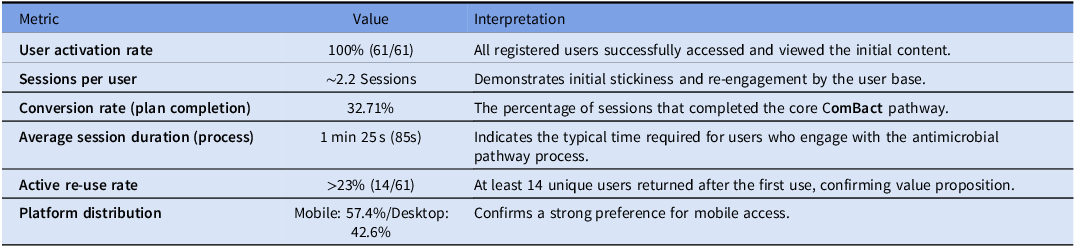
A total of 61 users registered for the app, and all of them accessed the app to view the dashboard and its information. There were 134 sessions conducted within the application, with each session being viewed an average of 1.23 times. This indicates that some users revisited the app process twice. User activation was 100% indicating frictionless onboarding and effective first-use dashboard. Session density was 2.2 sessions per user from 134 sessions and average session duration was 1 m 25 s (85s). Landing page dwell time was 18s and plan completion rate was 32.71% (Table 2).
Key performance indicators (KPI) summary

Table 2. Long description
A table with three columns labeled Metric, Value, and Interpretation, and six rows detailing various performance indicators. Row 1: Metric, User activation rate; Value, 100 percent (61/61); Interpretation, All registered users successfully accessed and viewed the initial content. Row 2: Metric, Sessions per user; Value, approximately 2.2 Sessions; Interpretation, Demonstrates initial stickiness and re-engagement by the user base. Row 3: Metric, Conversion rate (plan completion); Value, 32.71 percent; Interpretation, The percentage of sessions that completed the core ComBact pathway. Row 4: Metric, Average session duration (process); Value, 1 minute 25 seconds (85 seconds); Interpretation, Indicates the typical time required for users who engage with the antimicrobial pathway process. Row 5: Metric, Active re-use rate; Value, greater than 23 percent (14/61); Interpretation, At least 14 unique users returned after the first use, confirming value proposition. Row 6: Metric, Platform distribution; Value, Mobile: 57.4 percent, Desktop: 42.6 percent; Interpretation, Confirms a strong preference for mobile access.
Discussion
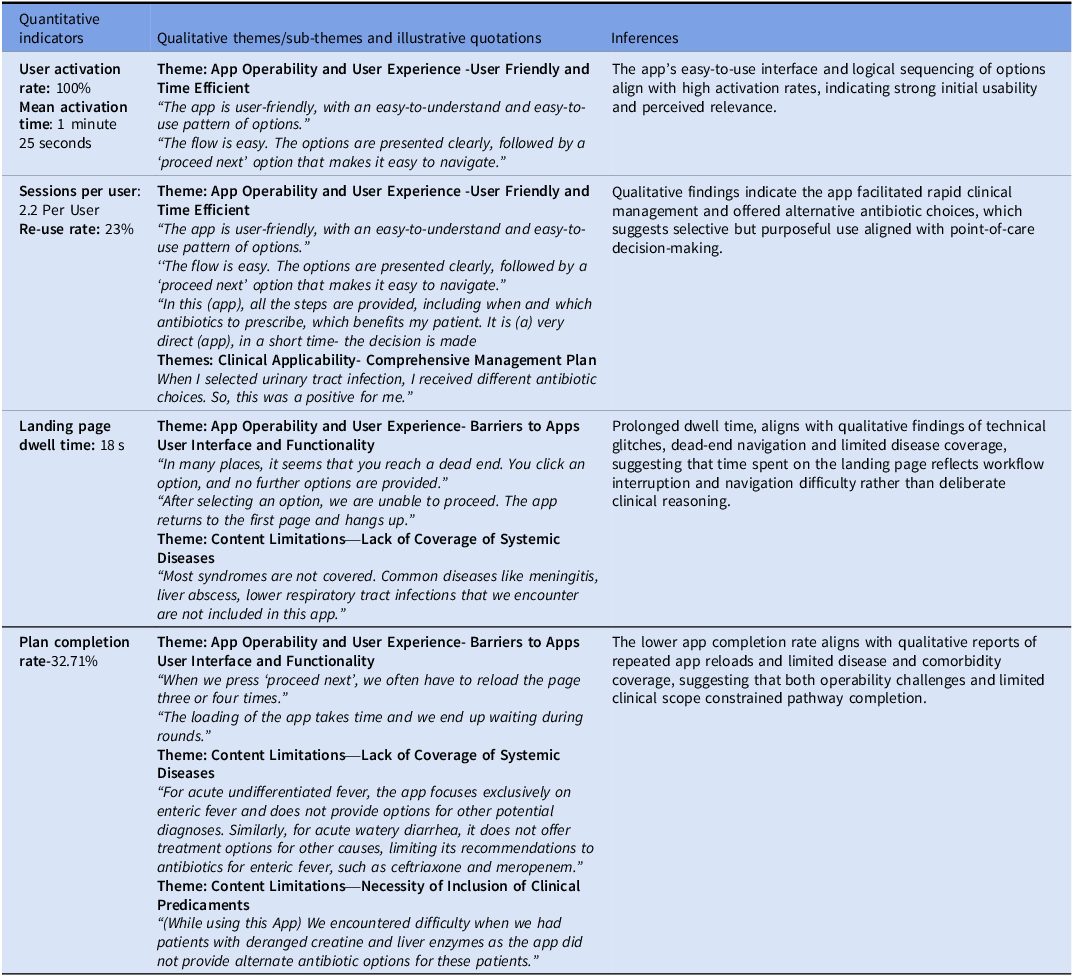
This mixed-methods study evaluated physicians’ experiences of the “ComBact” antibiotic stewardship app in a Pakistani tertiary hospital. Physicians found it intuitive, efficient, and clinically useful, but noted limitations in complex cases, technical performance, and critical-care integration. Analytics highlighted needs for workflow optimization, mobile testing, improved landing-page efficiency, and re-engagement strategies. The integration of quantitative usage metrics with qualitative themes and sub-themes provides a nuanced understanding of the app’s engagement, usability, and adoption patterns (Table 3). High user activation rates aligned with qualitative themes of app operability and user interface, suggesting initial usability and efficient clinical decision-making. This matched meaningful usage, reflected by session frequency and re-use rates. In contrast, prolonged page dwell aligned with workflow interruptions, navigation difficulties, and technical glitches, indicating usability friction. Low plan completion rates reflected limited disease coverage and insufficient comorbidity accommodation, constraining decision pathways within the app.
Joint display integrating quantitative indicators, qualitative themes, sub-themes, illustrative quotations and their corresponding inferences

Table 3. Long description
The table is divided into four main columns: Quantitative indicators, Qualitative themes/sub-themes and illustrative quotations, Inferences, and ALERT. It has multiple rows, each representing different aspects of the study. Row 1: User activation rate is 100 percent, mean activation time is 1 minute 25 seconds. Qualitative themes include App Operability and User Experience - User Friendly and Time Efficient. Illustrative quotations mention the app’s user-friendly interface and easy navigation. Inferences highlight the app’s strong initial usability and perceived relevance. Row 2: Sessions per user is 2.2 Per User, re-use rate is 23 percent. Qualitative themes again include App Operability and User Experience - User Friendly and Time Efficient, and Clinical Applicability - Comprehensive Management Plan. Illustrative quotations discuss the app’s ease of use and benefits in clinical decision-making. Inferences note the app’s facilitation of rapid clinical management. Row 3: Landing page dwell time is 18 seconds. Qualitative themes include App Operability and User Experience - Barriers to Apps User Interface and Functionality, and Content Limitations - Lack of Coverage of Systemic Diseases. Illustrative quotations mention dead-end navigation and limited disease coverage. Inferences suggest workflow interruptions and navigation difficulties. Row 4: Plan completion rate is 32.71 percent. Qualitative themes include App Operability and User Experience - Barriers to Apps User Interface and Functionality, and Content Limitations - Lack of Coverage of Systemic Diseases and Necessity of Inclusion of Clinical Predicaments. Illustrative quotations discuss app reloading issues and limited treatment options. Inferences highlight operability challenges and limited clinical scope.
A study from Italy explored 27 applications from 115 applications for appropriateness of content on antimicrobial prescribing to facilitate healthcare professionals and found that none of them fulfilled the criteria for having the required features which could be implemented highlighting the need for significant improvement in the development of mobile applications to assist prescribers, considering the local context. Reference Russo, Petrazzuolo and Trivisani18 The utility and impact of mobile CDSS to enhance antimicrobial stewardship efforts is largely unexplored in LMICs though there have been studies that have emphasized its potential in these settings. Reference Peiffer-Smadja, Poda and Ouedraogo19 Currently, there is no mobile application from Pakistan that focuses on antimicrobial prescribing and antimicrobial stewardship though Pakistan ranks third amongst LMICs in human antimicrobial consumption. Reference Mustafa, Niazi, Lakdawala and Mirza20 Hence, in contrast to those studies conducted in high-resource settings, our study extends the evidence by documenting implementation feasibility and user perceptions in a South Asian tertiary-care hospital.
Our qualitative findings highlight the significance of end-user acceptability, workflow fit, and context as crucial enablers in the analysis. Participants in our study valued ComBact’s simplicity, logical flow, and time efficiency, echoing findings from Peiffer-Smadja et al., who found that usability and workflow alignment were key to adoption of CDSS in West African primary care settings. Reference Peiffer-Smadja, Poda and Ouedraogo19 Physicians also recognized the benefit of having an authentic, single-source reference for antibiotic guidance, especially since access to subscription-based platforms (eg, UpToDate, Sanford Guide) is limited. Nonetheless, users voiced concern about the insufficient content coverage, particularly for complex infections, immunocompromised patients, patients in critical care settings and illnesses. In a systematic assessment of stewardship applications, Helou et al concluded that most lacked adaptation for specific populations and pathogens. Reference Helou, Foudraine and Catho14 These critiques are similar.
Analysis of in-app user behavior revealed several key engagement patterns that help explain where friction occurs in the physician workflow and how the tool might be optimized. Notably, there was a substantial drop-off (67%), indicating a critical point where many users disengaged before completing guideline-based recommendations. This suggests potential usability bottlenecks, such as unclear navigation, excessive cognitive load, or complex input requirements. Targeted optimization strategies, including progress indicators, simplified input fields, and contextual guidance, may improve completion rates and streamline clinician experience. With mobile devices accounting for 57.4% of app access, mobile-specific usability emerged as another area requiring attention. The observed session density (2.2 sessions per user over one year) suggests modest but repeat engagement with the CDSS. While some users returned beyond initial use, the overall frequency remains low for a tool intended to support routine clinical decision-making. In health informatics, sessions per user serve as a proxy for sustained engagement and workflow integration; therefore, this finding likely reflects limited habitual adoption. Several factors may explain this pattern. First, the CDSS was designed for specific clinical scenarios rather than continuous use across all patient encounters, limiting expected use frequency. Second, qualitative findings suggest that technical barriers and limited clinical scope may have reduced repeated use. Third, digital tools must compete with established practices and time constraints in busy clinical environments, which may hinder consistent engagement. Low session frequency is not uncommon in mHealth interventions unless they are closely integrated into workflows or supported by reinforcement strategies. This highlights the need for enhanced integration, broader clinical applicability, and improved usability. Future iterations should incorporate workflow integration, performance optimization, and expanded clinical content to improve longitudinal engagement. Engagement metrics were summarized using mean values, which estimate overall user exposure. Although median values may provide additional insight into typical usage patterns, they were not available in the analytics data set. Nevertheless, mean values remain consistent with standard reporting approaches and are sufficient to characterize overall engagement trends in this study.
To our knowledge, this is the first study in Pakistan to describe the co-development and qualitative evaluation of a stewardship mHealth app among practicing physicians. Using FGDs, app usage data, and physician feedback, this mixed-methods study provided a comprehensive assessment of user experience and feasibility, with findings from a real-world tertiary-care hospital in Pakistan offering valuable insights for LMIC settings where evidence remains limited. The study has several limitations, including potential volunteer bias due to self-selected participants who may have been more digitally inclined. Additionally, its conduct within a single tertiary-care institution may limit generalizability to other settings, and longer-term acceptability and sustained use were not evaluated. Although the clinical algorithms underwent iterative expert review and consensus-based validation before implementation, representing standard early-stage content validation approaches used in CDSS development, formal validation through clinical outcome studies was not performed. From a health informatics perspective, early evaluations of mHealth tools often rely on usage and usability metrics rather than clinical end points, and engagement measures primarily reflect interaction rather than effectiveness. Accordingly, the CDSS is intended as a decision-support adjunct, not a replacement for clinical judgment. Future work should focus on prospective validation of prescribing outcomes, safety, and patient-level impact.
Overall, the ComBact mHealth app was perceived as a user-friendly and effective clinical decision support tool for antibiotic stewardship, demonstrating promise in LMIC settings and warranting further evaluation of its clinical and economic impact.
Supplementary material
The supplementary material for this article can be found at https://doi.org/10.1017/ash.2026.10790.
Acknowledgements
We acknowledge the clinicians who participated in the FGDs and provided feedback on the ComBact application. Technical support for application development and maintenance was provided by the Aga Khan Development Network AKDN Digital Health Resource Center, Aga Khan University.
Financial support
This work was supported by The Society for Healthcare Epidemiology of America Education and Research Foundation (SHEA Foundation)
Competing interests
All authors report no conflicts of interest relevant to this article.
Use of artificial intelligence (statement if any)
ChatGPT (OpenAI, GPT-5.3) was used to support language refinement (grammar and syntax) only. The authors take full responsibility for the content, interpretation, and scientific accuracy.




 Open access

