Introduction
Porifera is the oldest metazoan group still extant on our planet and one of the most abundant groups of animals. These organisms are key members of shallow- and deep-water benthic ecosystems, occupying all aquatic environments, from marine to freshwater, tropical, temperate and polar areas (Sarà & Vacelet, Reference Sarà, Vacelet and Grassé1973; Van Soest et al., Reference Van Soest, Boury-Esnault, Vacelet, Dohrmann, Erpenbeck, De Voogd, Santodomingo, Vanhoorne, Kelly and Hooper2012). There are more than 8500 species (according to World Porifera Database; Van Soest et al., Reference Van Soest, Boury-Esnault, Hooper, Rützler, de Voogd, Alvarez, Hajdu, Pisera, Manconi, Schönberg, Klautau, Picton, Kelly, Vacelet, Dohrmann, Díaz, Cárdenas, Carballo, Ríos and Downey2017) of Porifera accepted and an additional 2300–3000 species already identified but undescribed (Appeltans et al., Reference Appeltans, Ahyong, Anderson, Angel, Artois, Bailly, Bamber, Barber, Bartsch, Berta, Błażewicz-Paszkowycz, Bock, Boxshall, Boyko, Brandão, Bray, Bruce, Cairns, Chan, Cheng, Collins, Cribb, Curini-Galletti, Dahdouh-Guebas, Davie, Dawson, De Clerck, Decock, De Grave, de Voogd, Domning, Emig, Erséus, Eschmeyer, Fauchald, Fautin, Feist, Fransen, Furuya, Garcia-Alvarez, Gerken, Gibson, Gittenberger, Gofas, Gómez-Daglio, Gordon, Guiry, Hernandez, Hoeksema, Hopcroft, Jaume, Kirk, Koedam, Koenemann, Kolb, Kristensen, Kroh, Lambert, Lazarus, Lemaitre, Longshaw, Lowry, Macpherson, Madin, Mah, Mapstone, McLaughlin, Mees, Meland, Messing, Mills, Molodtsova, Mooi, Neuhaus, Ng, Nielsen, Norenburg, Opresko, Osawa, Paulay, Perrin, Pilger, Poore, Pugh, Read, Reimer, Rius, Rocha, Saiz-Salinas, Scarabino, Schierwater, Schmidt-Rhaesa, Schnabel, Schotte, Schuchert, Schwabe, Segers, Self-Sullivan, Shenkar, Siegel, Sterrer, Stöhr, Swalla, Tasker, Thuesen, Timm, Todaro, Turon, Tyler, Uetz, van der Land, Vanhoorne, van Ofwegen, van Soest, Vanaverbeke, Walker-Smith, Walter, Warren, Williams, Wilson and Costello2012). The Class Demospongiae comprises 83% of all living sponges (Van Soest et al., Reference Van Soest, Boury-Esnault, Vacelet, Dohrmann, Erpenbeck, De Voogd, Santodomingo, Vanhoorne, Kelly and Hooper2012; Morrow & Cárdenas, Reference Morrow and Cárdenas2015). Sponges play crucial steps in the cycle of dissolved nutrients and organic matter in marine environments (Bell, Reference Bell2008; Maldonado et al., Reference Maldonado, Ribes and van Duyl2012), and are a vast source of compounds with biotechnological applications (Leal et al., Reference Leal, Puga, Serôdio, Gomes and Calado2012).
Economically, Porifera are also of major importance due to the extensive production of secondary metabolites, either by their own chemistry or that of their symbionts. Cyanobacteria, a common sponge symbiont, and known for their active secondary metabolism, have already been reported in intertidal sponges from this geographic location (Alex et al., Reference Alex, Vasconcelos, Tamagnini, Santos and Antunes2012, Reference Alex, Silva, Vasconcelos and Antunes2013; Alex & Antunes, Reference Alex and Antunes2015; Regueiras et al., Reference Regueiras, Alex, Pereira, Costa, Antunes and Vasconcelos2017). New secondary metabolites from Porifera, all from Demospongiae, are among the most promising to use for pharmaceutical applications (Leal et al., Reference Leal, Puga, Serôdio, Gomes and Calado2012). Intertidal sponges can also be used as bioindicators for water quality monitoring (Cebrian et al., Reference Cebrian, Uriz and Turon2007; Mahaut et al., Reference Mahaut, Basuyaux, Baudinière, Chataignier, Pain and Caplat2013).
Hooper & van Soest (Reference Hooper and van Soest2002) published a revised book on sponge classification, improving our knowledge of sponge biodiversity. This classification relies greatly on spicules morphology and their arrangement in sponge tissue (Morrow et al., Reference Morrow, Redmond, Picton, Thacker, Collins, Maggs, Sigwart and Allcock2013). The problem with this classification is that sponges are invertebrates with a high degree of ecophenotypic plasticity, influenced by parameters such as light, sedimentation, substratum type and orientation, and water-flow regime (Bell & Barnes, Reference Bell and Barnes2000; Erpenbeck et al., Reference Erpenbeck, Hooper and Wörheide2006, Reference Erpenbeck, Voigt, Al-Aidaroos, Berumen, Büttner, Catania, Guirguis, Paulay, Schätzle and Wörheide2016; Van Soest et al., Reference Van Soest, Boury-Esnault, Vacelet, Dohrmann, Erpenbeck, De Voogd, Santodomingo, Vanhoorne, Kelly and Hooper2012). Also, many of these morphological characters can be non-homologous, resulting in unresolved and ambiguous classification (Boury-Esnault, Reference Boury-Esnault2006). Problems related to identification resulted in disregarding sponges in large-scale surveys. In order to overcome this issue, molecular characters are being used as an aid for resolving these limitations (Wörheide et al., Reference Wörheide, Solé-Cava and Hooper2005, Reference Wörheide, Erpenbeck, Menke, Custódio, Lobo-Hajdu, Hajdu and Muricy2007; Cárdenas et al., Reference Cárdenas, Menegola, Rapp and Diaz2009, Reference Cárdenas, Pérez and Boury-Esnault2012; Pöppe et al., Reference Pöppe, Sutcliffe, Hooper, Wörheide and Erpenbeck2010; Vargas et al., Reference Vargas, Schuster, Sacher, Büttner, Schätzle, Läuchli, Hall, Hooper, Erpenbeck and Wörheide2012; Boury-Esnault et al., Reference Boury-Esnault, Lavrov, Ruiz and Pérez2013). Although phylogenetic studies have shown that the four Porifera classes are monophyletic, many major clades of sponges appear to be paraphyletic, leading to a revision of traditional sponge classification (Cárdenas et al., Reference Cárdenas, Pérez and Boury-Esnault2012; Hill et al., Reference Hill, Hill, Lopez, Peterson, Pomponi, Diaz, Thacker, Adamska, Boury-Esnault, Cárdenas, Chaves-Fonnegra, Danka, De Laine, Formica, Hajdu, Lobo-Hajdu, Klontz, Morrow, Patel, Picton, Pisani, Pohlmann, Redmond, Reed, Richey, Riesgo, Rubin, Russell, Rützler, Sperling, di Stefano, Tarver and Collins2013; Thacker et al., Reference Thacker, Hill, Hill, Redmond, Collins, Morrow, Spicer, Carmack, Zappe, Pohlmann, Hall, Diaz and Bangalore2013; Morrow & Cárdenas, Reference Morrow and Cárdenas2015; Alvizu et al., Reference Alvizu, Eilertsen, Xavier and Rapp2018).
In sponge phylogenetic studies, many different molecular markers have been used, both nuclear and mitochondrial. A 5′ partition of the mitochondrial cytochrome oxidase subunit 1 (CO1) (Folmer et al., Reference Folmer, Black, Hoeh, Lutz and Vrijenhoek1994) is among the most popular markers, being used for the ‘barcoding of life’ initiative. The Sponge Barcoding Project (Wörheide et al., Reference Wörheide, Erpenbeck, Menke, Custódio, Lobo-Hajdu, Hajdu and Muricy2007) was the first one on any non-bilateral taxon, aiming to cover all sponge taxa using primarily the 5′ partition of the CO1 marker.
The western coast of Portugal extends for more than 600 km and has some particular biogeographic circumstances (Boaventura et al., Reference Boaventura, Ré, da Fonseca and Hawkins2002), being one of the warmest European countries, with climatic influences from the Atlantic Ocean and Mediterranean Sea (Kottek et al., Reference Kottek, Grieser, Beck, Rudolf and Rubel2006). As a result, biodiversity is a mixture of the one present in the North-eastern Atlantic and the Mediterranean (Boaventura et al., Reference Boaventura, Ré, da Fonseca and Hawkins2002). Although sponges can be dominant members of some communities and play important roles in a variety of ecosystem functions (Rützler, Reference Rützler2012; Wulff, Reference Wulff2012), our knowledge of the intertidal and subtidal marine sponges in western Portugal derives especially from the works of Hanitsch (Reference Hanitsch1895), Lévi & Vacelet (Reference Lévi and Vacelet1958), Saldanha (Reference Saldanha1974), Lopes (Reference Lopes1989) and Pereira (Reference Pereira2007). In recent years, and due to difficulties in sponge identification, most intertidal diversity studies performed in this area (e.g. Monteiro Marques et al., Reference Monteiro Marques, Reis, Calvario, Marques, Melo and Santos1982; Boaventura et al., Reference Boaventura, Ré, da Fonseca and Hawkins2002; Pereira et al., Reference Pereira, Lima, Queiroz, Ribeiro and Santos2006) neglected the phylum Porifera, and improving our understanding of their biodiversity can be essential for habitat protection.
The aim of the present study is to characterize sponge diversity from the western coast of Portugal (NE Atlantic) using both morphological and molecular characters.
Materials and methods
Study site
Sampling locations were selected along the entire western coast of Portugal (Figure 1). All beaches had a combination of sand and rocks. Only rocky shore locations were selected as sponges are sessile animals that settle on hard surfaces. Figure 1A–C show three different sampling locations. Sampling periods were restricted to a few hours because of tidal regimes. To gain access to the largest possible intertidal area, sampling was always scheduled during spring tide (0.5 m below the mean sea level).
Sampling locations in Portugal: (1) Viana do Castelo, (2) Esposende, (3) Apúlia, (4) Angeiras, (5) Memória, (6) Aguda, (7) Buarcos, (8) S. João do Estoril, (9) Porto Côvo, (10) Vila Nova de Milfontes, (11) Almograve, (12) Monte Clérigos. Pictures (a), (b) and (c) illustrate three of the sampling locations: Esposende (a), Memória (b) and Porto Côvo (c).

Sampling took place between September 2010 and August 2013 in Portugal (North-east Atlantic). Collected sponges inhabit the rocky intertidal region and were predominant in sheltered areas, protected from the strong sun and tide, often lying at the base of the rocks.
Sponge samples were collected from 12 different intertidal sites (Figure 1). Table 1 summarizes the information about the sampling locations (geographic coordinates, number of sampling trips and number of specimens collected). A total of 31 collection trips were made and 170 sponges sampled. Sponges were on rock overhangs, and were collected through wading and with the help of a knife. After collection, sponges were immediately carried to the laboratory and processing usually began within 1 h after collection (up to maximum of 28 h after collection).
Summary of sampling locations: latitude, longitude, number of sampling trips and number of specimens collected

To maximize the diversity of the sponges analysed we covered, as much as possible, all the rocky areas of each beach.
Samples were photographed and preserved in 96% ethanol both for molecular analysis and morphological identification.
Sponge identification
Sponges were identified based on shape, consistency, texture, colour, habitat and spicules morphology, dimensions and arrangement. All sponge species collected were identified according to Lopes (Reference Lopes1989), Hooper & van Soest (Reference Hooper and van Soest2002) and Van Soest et al. (Reference Van Soest, Boury-Esnault, Hooper, Rützler, de Voogd, Alvarez, Hajdu, Pisera, Manconi, Schönberg, Klautau, Picton, Kelly, Vacelet, Dohrmann, Díaz, Cárdenas, Carballo, Ríos and Downey2017). Spicules temporary preparations and permanent slides of sponges cross sections were made according to the methods described by Lopes (Reference Lopes1995). Preparations were analysed under optical microscopy (Olympus BX41 microscope; Olympus Europe). Spicules were photographed and measured using CellB (Olympus Europe) software. Permanent slides were only made for one specimen of each identified species.
All collected specimens and permanent slides are deposited at BBE (Blue Biotechnology and Ecotoxicology) laboratory, CIIMAR-UP (Interdisciplinary Centre of Marine and Environmental Research – University of Porto).
Molecular analyses
DNA extraction
Total genomic DNA was extracted from sponge tissue (choanosomal tissue) using a commercially available Purelink™ Genomic DNA mini Kit (Invitrogen, San Diego, CA) and stored at −20°C until further analysis. gDNA integrity was checked by agarose gel electrophoresis with GelRed™ (Biotium) staining.
PCR and sequencing of demosponge specimens
PCR amplification was done only for sponges belonging to the Class Demospongiae, using a fragment located at the 5′ site of the mitochondrial cytochrome oxidase subunit 1 (CO1). Primers used were designed by Meyer et al. (Reference Meyer, Geller and Paulay2005) (dgLCO1490: 5′-GGTCAACAAATCATAAAGAYATYGG-3′; dgHCO2198: 5′-TAAACTTCAGGGTGACCAAARAAYCA-3′) and based on the ones described by Folmer et al. (Reference Folmer, Black, Hoeh, Lutz and Vrijenhoek1994). PCR conditions employed were as follows: initial denaturation at 94°C for 2 min, followed by 35 cycles of denaturation at 94°C for 40 s, annealing at 50°C for 40 s and extension at 72°C for 1 min and a final extension step at 72°C for 10 min. When necessary, amplification was done using primer forward from Meyer et al. (Reference Meyer, Geller and Paulay2005), combined with the reverse from Xavier et al. (Reference Xavier, Rachello-Dolmen, Parra-Velandia, Schönberg, Breeuwer and van Soest2010) (PorCOI12rev: 5′-ACTGCCCCCATNGATAAAACAT-3′). This reverse primer amplifies an alternative partition of the CO1 gene that overlaps ~60 bp with Folmer's 3′ partition and includes Erpenbeck's ‘I3-M11’ (Erpenbeck et al., Reference Erpenbeck, Hooper and Wörheide2006), a partition known to be more informative in cases of shorter divergence times. The incorporation of the primer designed by Xavier et al. (Reference Xavier, Rachello-Dolmen, Parra-Velandia, Schönberg, Breeuwer and van Soest2010), showed to be more sponge specific, helping overcome problems related with amplification of non-target DNA. The following protocol was used: initial denaturation at 95°C for 3 min, followed by 35 cycles of denaturation at 94°C for 40 s, annealing at 54°C for 45 s and extension at 72°C for 90 s and a final extension step at 72°C for 10 min. Between 5–10 ng of DNA were used for the PCR amplification. All PCR reactions were prepared in a 50 µl volume using Supreme NZYTaq 2x Green MasterMix (NZYTech, Lisboa, Portugal). Thermal cycling was carried out using Biometra T-Professional standard thermocycler (Biometra, Göttingen, Germany). PCR products were separated by 1.5% (w/v) agarose gel in 1× TAE buffer (Invitrogen, San Diego, CA, USA). The gels were stained with GelRed™ (Biotium, Fremont, CA, USA) and photographed under UV transillumination. For DNA sequencing each amplified product was purified using an Invitrogen PureLink™QuickGel Extraction and PCR Purification Combo Kit (Invitrogen, San Diego, CA, USA) according to the manufacturer's protocol followed by direct sequencing of the amplicons in both directions (GATC Biotech, Cologne, Germany).
Phylogenetic analysis
The sequences obtained were inspected, edited and aligned using Geneious® v9.1.5 software (Kearse et al., Reference Kearse, Moir, Wilson, Stones-Havas, Cheung, Sturrock, Buxton, Cooper, Markowitz, Duran, Thierer, Ashton, Mentjies and Drummond2012). The final sequences were used for a similarity search using BLAST and the NCBI nucleotide database (http://www.ncbi.nlm.nih.gov/BLAST) in order to complement sponge morphological identification. The nucleotide sequences were aligned with Muscle (Edgar, Reference Edgar2004). The unedited aligned file is provided in supplementary material (S1). Alignments were manually inspected and curated using BioEdit (Hall, Reference Hall1999). Maximum-likelihood (ML) phylogenetic trees (Felsenstein, Reference Felsenstein1981) were constructed in PhyML (Guindon & Gascuel, Reference Guindon and Gascuel2003); with 100 bootstrap replicates using nearest-neighbour interchanges (NNIs) tree search criteria. The best fit evolutionary model TrN + I + G under Akaike Information Criterion with correction (AICc) implemented in MrAIC v1.4.6 (Nylander, Reference Nylander2004) was selected for ML analysis. As the point of the phylogenetic analysis was not to make any evolutionary inference, focusing on sponge diversity rather than evolutionary relationships, an unrooted tree was used.
All sequences were submitted to the GenBank database (accession numbers KY492518–KY492600).
Results
A total of seven specimens (five species) were identified as belonging to the class Calcarea and 163 specimens (26 species) to the class Demospongiae. Although sampling locations were distributed along all the western coast of Portugal, due to proximity to our laboratory, most samplings were made on the north-western coast, mainly at Memória beach. Among Demospongiae, all species identified belonged to the subclasses Heteroscleromorpha, Keratosa and Verongimorpha. Table 2 shows the distribution of the identified species across the study area. All calcarean sponges were only present in one or two different locations, especially on the south-western coast. For Demosponges, only six different species were present in at least three different locations. Hymeniacidon perlevis, Ophlitaspongia papilla, Clathria sp. and Ircinia variabilis were the only sponges belonging to the class Demospongiae identified in the southern locations. Hymeniacidon perlevis was the most prevalent sponge along the sampled area, identified in 11 of the 12 sampling locations. Memória beach had the highest diversity of sponges (25 species) with 15 species only here identified.
Sponges collected from the western coast of Portugal. Sponges are divided in accordance to Class (Calcarea and Demospongiae) and their geographic locations are identified

Last column shows species distribution in accordance with the information provided by the World Porifera Database (Van Soest et al., Reference Van Soest, Boury-Esnault, Hooper, Rützler, de Voogd, Alvarez, Hajdu, Pisera, Manconi, Schönberg, Klautau, Picton, Kelly, Vacelet, Dohrmann, Díaz, Cárdenas, Carballo, Ríos and Downey2017) for the North-Eastern Atlantic (NEA), Mediterranean (MED) or Atlanto-Mediterranean (ATL-MED) distribution.
The last column of Table 2 shows the known distribution of the identified sponges, made in accordance to the information available at World Porifera Database (Van Soest et al., Reference Van Soest, Boury-Esnault, Hooper, Rützler, de Voogd, Alvarez, Hajdu, Pisera, Manconi, Schönberg, Klautau, Picton, Kelly, Vacelet, Dohrmann, Díaz, Cárdenas, Carballo, Ríos and Downey2017) and based on the Marine Ecoregions of the World (Spalding et al., Reference Spalding, Fox, Allen, Davidson, Ferda, Finlayson, Halpern, Jorge, Lombana, Lourie, Martin, McManus, Molnar, Recchia and Robertson2007). From this information, it is possible to see that all species here identified have already been described in the North-east Atlantic or the Atlanto-Mediterranean region.
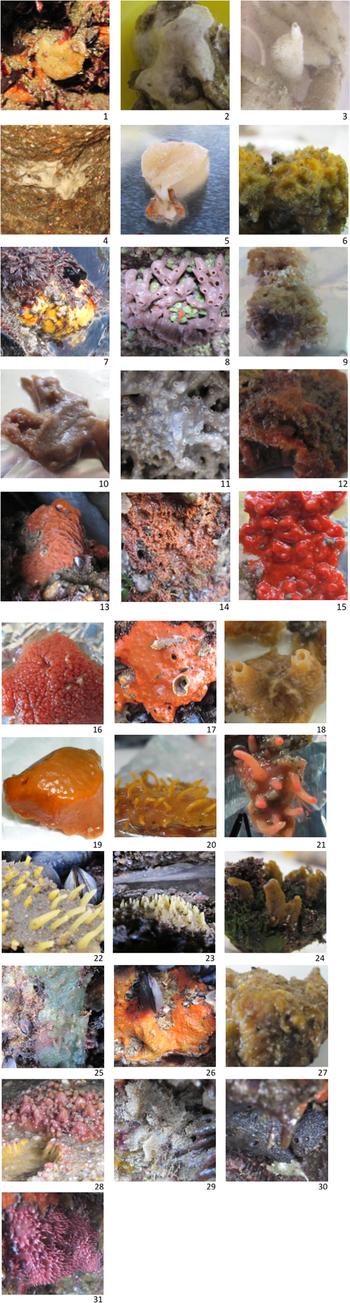
Figure 2 shows photos of the 31 identified sponge species. This identification is based on the morphological characters (Table S2 in supplementary material shows information on morphological identification of the demosponges, as spicules diversity and their measurements) and, when sequences obtained, further confirmed by molecular analyses (Table S3 in supplementary material shows data from the sequenced demosponges specimens and similarities with other CO1 sequences available at the nucleotide database at NCBI).
Photographs of identified sponges: 1. Grantia compressa, 2. Leucandra gossei, 3. Sycon ciliatum, 4. Clathrina coriacea, 5. Clathrina blanca, 6. Stelligera rigida, 7. Cliona celata, 8. Haliclona sp.1, 9. Haliclona sp.2, 10. Haliclona (Rhizoniera) rosea, 11. Haliclona (Haliclona) simulans, 12. Crella (Yvesia) rosea, 13. Amphilectus fucorum, 14. Phorbas plumosus, 15. Antho (Antho) granditoxa, 16. Clathria sp., 17. Ophlitaspongia papilla, 18. Myxilla (Myxilla) rosacea, 19. Tedania (Tedania) pilarriosae, 20. Polymastia sp.1, 21. Polymastia sp.2, 22. Polymastia agglutinans, 23. Polymastia penicillus, 24. Halichondria (Halichondria) panicea, 25. Halichondria sp., 26. Hymeniacidon perlevis, 27. Aaptos aaptos, 28. Aaptos papillata, 29. Dysidea fragilis, 30. Ircinia variabilis, 31. Aplysilla rosea.

From the 163 demosponges collected, we were only able to retrieve high quality sponge DNA for 83 of them. Sequences ranged from 278 bp to 1084 bp, representing 18 species across 14 genera and 10 families. From the remaining specimens, obtained sequences had poor quality or amplified DNA from other small invertebrates or marine algae, and were discarded. Molecular analysis was carried out to apply an integrative taxonomic approach, complementing the morphological identification (see Table S2 in supplementary material). Molecular analysis allowed comparison of obtained sequences with those available at the GenBank nucleotide database (NCBI) (Table S3).
The phylogenetic tree (Figure 3) revealed a well-supported topology, by Maximum likelihood tree-reconstruction approach, clearly separating different sponge genera. All sequences obtained belong to the subclass Heteroscleromorpha and there is a clear distinction between the different orders. At the orders level, phylogenetic analysis (Figure 3) showed to be monophyletic, with high bootstrap support values for orders Suberitida and Poecilosclerida and moderate support values for other orders. Specimens from the genera Hymeniacidon, Halichondria and Aaptos, belonging to the order Suberitida, formed a distinctive clade. In this clade it is also possible to distinguish between different families (Hymeniacidon and Halichondria belong to the family Halichondriidae and Aaptos belongs to the family Suberitidae) and different genera. Also, the genera Tedania, Hymedesmia, Myxilla, Phorbas, Antho, Clathria, Ophlitaspongia and Amphilectus all belong to the order Poecilosclerida and form a distinctive clade. At the family level, cladistic separations are also in most cases possible to differentiate.
Maximum likelihood (ML) phylogenetic tree based on the CO1 fragment (concatenation of both the Folmer's and the I3-M11 fragments of the gene CO1) of the sequences from Demospongiae. GenBank accession numbers are given in parentheses. The tree is unrooted. ML bootstrap support values are represented at the nodes. Only bootstrap values greater than 50% are given. The scale bar at the bottom represents 2% sequence divergence. On the right end of the tree information about sponge orders are given.

Here, we present a list of all intertidal demosponges reported to date in the western coast of Portugal. This checklist comprises information from the works of Hanitsch (Reference Hanitsch1895), Lévi & Vacelet (Reference Lévi and Vacelet1958), Saldanha (Reference Saldanha1974), Lopes (Reference Lopes1989), Pereira (Reference Pereira2007) and Costa et al. (Reference Costa, Costa-Rodrigues, Fernandes, Barros, Vasconcelos and Martins2012). Lopes (Reference Lopes1989) already made a compilation of the intertidal sponge diversity, which was used as a basis for our list, with all data checked and complemented with more recent published information.
List of intertidal sponges from the western coast of Portugal
Species with an asterisk (*) correspond to the ones found in the present work. After the name of the species, the reference for the first record for the western coast of Portugal is given. For demosponges, the classification system followed was according to Morrow & Cárdenas (Reference Morrow and Cárdenas2015).
Class CALCAREA Bowerbank, 1862
Subclass CALCARONEA Bidder, 1898
Order LEUCOSOLENIDA Hartman, 1958
Family GRANTIIDAE Dendy, 1893
Genus Grantia Fleming, 1828
*Grantia compressa (Fabricius, 1780) (Pereira, Reference Pereira2007)
Genus Leucandra Haeckel, 1872
*Leucandra gossei (Bowerbank, 1862) (Saldanha, Reference Saldanha1974)
Family SYCETTIDAE Dendy, 1893
Genus Sycon Risso, 1827
*Sycon ciliatum (Fabricius, 1780) (Saldanha, Reference Saldanha1974)
Subclass CALCINEA Bidder, 1898
Order CLATHRINIDA Hartman, 1958
Family CLATHRINIDAE Minchin, 1900
Genus Clathrina Gray, 1867
*Clathrina coriacea (Montagu, 1814) (Hanitsch, Reference Hanitsch1895)
*Clathrina blanca (Miklucho-Maclay, 1868) (Pereira, Reference Pereira2007)
Class DEMOSPONGIAE Sollas, 1885
Subclass HETEROSCLEROMORPHA Cárdenas, Pérez & Boury-Esnault, 2012
Order AXINELLIDA Lévi, 1953
Family RASPAILIIDAE Nardo, 1833
Genus Eurypon Gray, 1867
Eurypon clavatum (Bowerbank, 1866) (Lopes, Reference Lopes1989)
Eurypon coronula (Bowerbank, 1874) (Lopes, Reference Lopes1989)
Family STELLIGERIDAE Lendenfeld, 1898
Genus Stelligera Gray, 1867
*Stelligera rigida (Montagu, 1814) (Lopes, Reference Lopes1989)
Order BUBARIDA Morrow & Cárdenas, 2015
Family DICTYONELLIDAE van Soest, Diaz & Pomponi, 1990
Genus Tethyspira Topsent, 1890
Tethyspira spinosa (Bowerbank, 1874) (Lopes, Reference Lopes1989)
Order CLIONAIDA Morrow & Cárdenas, 2015
Family CLIONAIDAE d'Orbigny, 1851
Genus Cliona Grant, 1826
*Cliona celata Grant, 1826 (Saldanha, Reference Saldanha1974)
Cliona viridis (Schmidt, 1862) (Saldanha, Reference Saldanha1974)
Genus Pione Gray, 1867
Pione vastifica (Hancock, 1849) (Saldanha, Reference Saldanha1974)
Order HAPLOSCLERIDA Topsent, 1928
Family CHALINIDAE Gray, 1867
Genus Haliclona Grant, 1841
*Haliclona sp.1
*Haliclona sp.2
*Haliclona (Rhizoniera) rosea (Bowerbank, 1866)
*Haliclona (Haliclona) simulans (Johnston, 1842)
Order POECILOSCLERIDA Topsent, 1928
Family COELOSPHAERIDAE Dendy, 1922
Genus Lissodendoryx Topsent, 1892
Lissodendoryx (Lissodendoryx) isodictyalis (Carter, 1882) (Saldanha, Reference Saldanha1974)
Family CRELLIDAE Dendy, 1922
Genus Crella Gray, 1867
*Crella (Yvesia) rosea (Topsent, 1892)
Family ESPERIOPSIDAE Hentschel, 1923
Genus Amphilectus Vosmaer, 1880
*Amphilectus fucorum (Esper, 1794) (Lopes, Reference Lopes1989)
Family HYMEDESMIIDAE Topsent, 1928
Genus Hymedesmia Bowerbank, 1864
Hymedesmia (Hymedesmia) jecusculum (Bowerbank, 1866)
Hymedesmia (Hymedesmia) pansa Bowerbank, 1882 (Lopes, Reference Lopes1989)
Hymedesmia (Stylopus) coriacea (Fristedt, 1885) (Lopes, Reference Lopes1989)
Genus Phorbas Duchassaing & Michelotti, 1864
Phorbas dives (Topsent, 1891) (Lopes, Reference Lopes1989)
Phorbas fictitious (Bowerbank, 1866) (Saldanha, Reference Saldanha1974)
*Phorbas plumosus (Montagu, 1814) (Lopes, Reference Lopes1989)
Family MICROCIONIDAE Carter, 1875
Genus Antho Gray, 1867
*Antho (Antho) granditoxa Picton & Goodwin, 2007
Antho (Antho) involvens (Schmidt, 1864) (Lopes, Reference Lopes1989)
Genus Clathria Schmidt, 1862
Clathria (Clathria) coralloides (Scopoli, 1772) (Lopes, Reference Lopes1989)
Clathria (Clathria) toxistricta Topsent, 1925 (Pereira, Reference Pereira2007)
Clathria (Microciona) atrasanguinea (Bowerbank, 1862) (Lopes, Reference Lopes1989)
Clathria (Microciona) strepsitoxa (Hope, 1889) (Lopes, Reference Lopes1989)
*Clathria sp.
Genus Ophlitaspongia Bowerbank, 1866
*Ophlitaspongia papilla Bowerbank, 1866 (Costa, Reference Costa2012)
Family MYCALIDAE Lundbeck, 1905
Genus Mycale Gray, 1867
Mycale (Aegogropila) contarenii (Lieberkühn, 1859) (Lopes, Reference Lopes1989)
Mycale (Carmia) macilenta (Bowerbank, 1866) (Lopes, Reference Lopes1989)
Mycale (Carmia) minima (Waller, 1880) (Lopes, Reference Lopes1989)
Family MYXILLIDAE Dendy, 1922
Genus Myxilla Schmidt, 1862
*Myxilla (Myxilla) rosacea (Lieberkühn, 1859) (Hanitsch, Reference Hanitsch1895)
Family TEDANIIDAE Ridley & Dendy, 1886
Genus Tedania Gray, 1867
Tedania (Tedania) anhelans (Vio in Olivi, 1792) (Saldanha, Reference Saldanha1974)
*Tedania (Tedania) pilarriosae Cristobo, 2002
Order POLYMASTIIDA Morrow & Cárdenas, 2015
Family POLYMASTIIDAE Gray, 1867
Genus Polymastia Bowerbank, 1862
*Polymastia sp.1
*Polymastia sp.2
*Polymastia agglutinans Ridley & Dendy, 1886
*Polymastia penicillus (Montagu, 1814) (Saldanha, Reference Saldanha1974)
Order SUBERITIDA Chombard & Boury-Esnault, 1999
Family HALICHONDRIIDAE Gray, 1867
Genus Halichondria Fleming, 1828
*Halichondria sp.
*Halichondria (Halichondria) panicea (Pallas, 1766) (Carter, Reference Carter1876)
Genus Hymeniacidon Bowerbank, 1858
*Hymeniacidon perlevis (Montagu, 1814) (Hanitsch, Reference Hanitsch1895)
Family SUBERITIDAE Schmidt, 1870
Genus Aaptos Gray, 1867
*Aaptos aaptos (Schmidt, 1864)
*Aaptos papillata (Keller, 1880) (Lopes, Reference Lopes1989)
Genus Protosuberites Swartschewsky, 1905
Protosuberites epithyum (Lamark, 1815) (Lopes, Reference Lopes1989)
Genus Pseudosuberites Topsent, 1896
Pseudosuberites mollis Topsent, 1925 (Lopes, Reference Lopes1989)
Genus Suberites Nardo, 1833
Suberites carnosus (Johnston, 1842) (Lopes, Reference Lopes1989)
Genus Terpios Duchassaing & Michelotti, 1864
Terpios fugax Duchassaing & Michelotti, 1864 (Lopes, Reference Lopes1989)
Order TETHYIDA Morrow & Cárdenas, 2015
Family HEMIASTERELLIDAE Lendenfeld, 1889
Genus Adreus Gray, 1867
Adreus fascicularis (Bowerbank, 1866) (Lopes, Reference Lopes1989)
Family TETHYIDAE Gray, 1848
Genus Tethya Lamark, 1815
Tethya aurantium (Pallas, 1766) (Hanitsch, Reference Hanitsch1895)
Family TIMEIDAE Topsent, 1928
Genus Timea Gray, 1867
Timea mixta (Topsent, 1896) (Lopes, Reference Lopes1989)
Order TETRACTINELLIDA Marshall, 1876
Family ANCORINIDAE Schmidt, 1870
Genus Stelleta Schmidt, 1862
Stelletta anancora (Sollas, 1886) (Lopes, Reference Lopes1989)
Stelletta hispida (Buccich, 1886) (Saldanha, Reference Saldanha1974)
Family GEODIIDAE Gray, 1867
Genus Erylus Gray, 1867
Erylus discophorus (Schmidt, 1862) (Saldanha, Reference Saldanha1974)
Genus Geodia Lamark, 1817
Geodia cydonium (Linnaeus, 1767) (Saldanha, Reference Saldanha1974)
Order TRACHYCLADIDA Morrow & Cárdenas, 2015
Family TRACHYCLADIDAE Hallmann, 1917
Genus Trachycladus Carter, 1879
Trachycladus minax Topsent, 1888 (Lopes, Reference Lopes1989)
Subclass KERATOSA Grant, 1861
Order DICTYOCERATIDA Minchin, 1900
Family DYSIDEIDAE Gray, 1867
Genus Dysidea Johnston, 1842
*Dysidea fragilis (Montagu, 1814) (Pérès, Reference Pérès1959)
Family IRCINIIDAE Gray, 1867
Genus Ircinia Nardo, 1833
*Ircinia variabilis (Schmidt, 1862) (Hanitsch, Reference Hanitsch1895)
Genus Sarcotragus Schmidt, 1862
Sarcotragus spinosulus Schmidt, 1862 (Lopes & Boury-Esnault, Reference Lopes and Boury-Esnault1981)
Sarcotragus fasciculatus (Pallas, 1766) (Saldanha, Reference Saldanha1974)
Family SPONGIIDAE Gray, 1867
Genus Spongia Linnaeus, 1759
Spongia (Spongia) officinalis Linnaeus, 1759 (Lopes & Boury-Esnault, Reference Lopes and Boury-Esnault1981)
Family THORECTIDAE Bergquist, 1978
Genus Scalarispongia Cook & Bergquist, 2000
Scalarispongia scalaris (Schmidt, 1862) (Lopes & Boury-Esnault, Reference Lopes and Boury-Esnault1981)
Order DENDROCERATIDA Minchin, 1900
Family DARWINELLIDAE Merejkowsky, 1879
Genus Aplysilla Schulze, 1878
*Aplysilla rosea (Barrois, 1876) (Lopes, Reference Lopes1989)
Subclass VERONGIMORPHA Erpenbeck, Sutcliffe, De Cook, Dietzel, Maldonado, van Soest, Hooper & Wörheide, 2012
Order CHONDRILLIDA Redmond, Morrow, Thacker, Diaz, Boury-Esnault, Cárdenas, Hajdu, Lobo-Hajdu, Picton, Pomponi, Kayal & Colins, 2013
Family CHONDRILLIDAE Gray, 1872
Genus Thymosia Topsent, 1895
Thymosia guernei Topsent, 1895 (Lopes, Reference Lopes1989)
Order VERONGIIDA Bergquist, 1978
Family APLYSINIDAE Carter, 1875
Genus Aplysina Nardo, 1834
Aplysina aerophoba (Nardo, 1833) (Lopes, Reference Lopes1989)
Discussion
Most sponge diversity studies focus on subtidal sponges (Carter, Reference Carter1876; Topsent, Reference Topsent1928; Lévi & Vacelet, Reference Lévi and Vacelet1958; Saldanha, Reference Saldanha1974; Lopes & Boury-Esnault, Reference Lopes and Boury-Esnault1981; Naveiro, Reference Naveiro2002; Pereira, Reference Pereira2007; Pires, Reference Pires2007) and most intertidal diversity studies from this geographic area completely neglect the existence of sponges (e.g. Monteiro Marques et al., Reference Monteiro Marques, Reis, Calvario, Marques, Melo and Santos1982; Boaventura et al., Reference Boaventura, Ré, da Fonseca and Hawkins2002; Pereira et al., Reference Pereira, Lima, Queiroz, Ribeiro and Santos2006). In Atlantic shores, sponges have been recognized as important members of the ecosystem, both in terms of biomass and species richness, playing significant roles in ecosystem functioning (Xavier & van Soest, Reference Xavier and van Soest2012) due to being filter feeders.
The present study shows for the first time an updated list of intertidal sponges from the western coast of Portugal. Identified sponges from the present work belong to the classes Calcarea (five species) and Demospongiae (26 species). For the first time, calcarean sponges from the intertidal areas in this geographic location are described. So far, to our knowledge, there was no information on intertidal diversity of calcarean sponges (Hanitsch, Reference Hanitsch1895; Saldanha, Reference Saldanha1974; Lopes, Reference Lopes1989; Pereira, Reference Pereira2007). Combining all information available for the class Demospongiae, the intertidal area of the western coast of Portugal has 64 different species described. Figure 4 summarizes the information present in the list presented above.
Graphical distribution of number of species present in each order of the Class Demospongiae described in the intertidal area of the western coast of Portugal. In each order, information about its subclass is provided: ● Heteroscleromorpha; ► Keratosa; ■ Verongimorpha.

Most identified species belong to the class Heteroscleromorpha, within 10 orders, 22 families and 31 genera.
Praia da Memória, in the northern part of Portugal, seems to harbour the highest diversity of demosponges. Although the level of diversity of this place was clear when compared with other locations, Memória comprised more than 50% of all sampling trips, which can explain the discrepancies in diversity. Sponges belonging to the class Calcarea showed to be more dominant on the southern intertidal area of Portugal.
From the 26 species of Demospongiae here identified, 12 are described for the first time in the intertidal area and 11 for the first time on the western coast of Portugal. As shown in Table 2, all described sponges have already been reported in the North-east Atlantic and/or Mediterranean Sea. This information is available online at the World Porifera Database (Van Soest et al., Reference Van Soest, Boury-Esnault, Hooper, Rützler, de Voogd, Alvarez, Hajdu, Pisera, Manconi, Schönberg, Klautau, Picton, Kelly, Vacelet, Dohrmann, Díaz, Cárdenas, Carballo, Ríos and Downey2017). Xavier & Van Soest (Reference Xavier and van Soest2012) analysed diversity patterns of the North-east Atlantic and Mediterranean shallow water sponges, being able to identify 135 species just on the western Iberian Peninsula. These finding emphasize the need for a much deeper study of sponge diversity along the Portuguese coast, as the diversity may still be underestimated.
Hymeniacidon perlevis seems to be almost ubiquitous to all sample locations. Alex et al. (Reference Alex, Vasconcelos, Tamagnini, Santos and Antunes2012) have already reported, for the same studied area, genetic richness between different H. perlevis specimens in such a small distance (~500 km). Mahaut et al. (Reference Mahaut, Basuyaux, Baudinière, Chataignier, Pain and Caplat2013) used H. perlevis as a bioindicator and reported it to have a higher accumulation capacity of contaminants than the mussel Mytilus edulis Linnaeus. As this sponge inhabits almost all the western coast of Portugal, it can be used for water pollution studies in the future. These findings show the importance of the study of sponges, and knowing their diversity is the first step for every other study.
Plasticity in sponge morphology is very common, which makes sponge identification a challenge. Barnes & Bell (Reference Barnes and Bell2002) found differences in sponge morphology within the same species with varying depth.
To overcome this issue, many studies have been focusing on molecular data. CO1 has been the most popular marker, as it can help in taxonomy (Pöppe et al., Reference Pöppe, Sutcliffe, Hooper, Wörheide and Erpenbeck2010). As it has been the marker chosen for the barcoding of life and the sponge barcoding project, there is more information on public databases for this marker than for any other.
In our study, the use of CO1 helped to distinguish most of our sponges at the genus level. Although there are some limitations in the use of the gene CO1 for Porifera phylogeny resolution, as pointed out by Cárdenas et al. (Reference Cárdenas, Pérez and Boury-Esnault2012), this marker has been successfully used for the Porifera Barcoding project (Wörheide et al., Reference Wörheide, Erpenbeck, Menke, Custódio, Lobo-Hajdu, Hajdu and Muricy2007; Vargas et al., Reference Vargas, Schuster, Sacher, Büttner, Schätzle, Läuchli, Hall, Hooper, Erpenbeck and Wörheide2012), allowing in the majority of cases differentiation between different species. As demonstrated here, CO1 was previously shown to have a good resolution at the family level (Erpenbeck et al., Reference Erpenbeck, Breeuwer, van der Velde and van Soest2002, Reference Erpenbeck, Voigt, Al-Aidaroos, Berumen, Büttner, Catania, Guirguis, Paulay, Schätzle and Wörheide2016) and in some cases to the genus level (Erpenbeck et al., Reference Erpenbeck, Hooper and Wörheide2006).
We were not able to retrieve DNA for all Demospongiae. Extracting DNA from sponge tissue can have its challenges, as it is known that some taxa require specialized protocols (Erpenbeck et al., Reference Erpenbeck, Voigt, Al-Aidaroos, Berumen, Büttner, Catania, Guirguis, Paulay, Schätzle and Wörheide2016) and some compounds can be present that can inhibit PCR reaction (Vargas et al., Reference Vargas, Schuster, Sacher, Büttner, Schätzle, Läuchli, Hall, Hooper, Erpenbeck and Wörheide2012). Also, the use of CO1 can result in co-amplification and/or specific amplification of non-target organisms (Vargas et al., Reference Vargas, Schuster, Sacher, Büttner, Schätzle, Läuchli, Hall, Hooper, Erpenbeck and Wörheide2012). According to Vargas et al. (Reference Vargas, Schuster, Sacher, Büttner, Schätzle, Läuchli, Hall, Hooper, Erpenbeck and Wörheide2012) it is easier to amplify DNA in some Porifera families than others. Fifty-five per cent of our samples showed poor DNA quality and/or amplification of DNA from non-target organisms. Vargas et al. (Reference Vargas, Schuster, Sacher, Büttner, Schätzle, Läuchli, Hall, Hooper, Erpenbeck and Wörheide2012) found amplification of non-target organisms occurred in 40% of samples.
The incorporation in the molecular analysis of the primer designed by Xavier et al. (Reference Xavier, Rachello-Dolmen, Parra-Velandia, Schönberg, Breeuwer and van Soest2010) that includes Erpenbeck's ‘I3-M11’ partition (Erpenbeck et al., Reference Erpenbeck, Hooper and Wörheide2006) allowed us to obtain more sequences but not for all Demospongiae. We only amplified this second region when we were not able to obtain target DNA, as this primer showed to be more sponge specific than the Folmer's one. In the future, it would be interesting to amplify all collected sponges using this partition, to help in distinguishing phylogenetically between species and to see if its resolution can separate different populations of the same species in accordance with geographic distribution.
For sponges belonging to the class Calcarea, in the present work was not performed any molecular analysis. In the future, it would be interesting to include this information using a fragment of the 28SrRNA (C-region) proposed as a Calcarea barcode by Voigt & Wörheide (Reference Voigt and Wörheide2016).
In this study, we presented for the first time an annotated checklist of intertidal sponges from the western coast of Portugal, based on collection and identification and bibliography data. We presented also the first intertidal data for Calcarea intertidal sponges for the western coast of Portugal. We also showed advantages and limitations of using the CO1 DNA data to help in the identification of Demospongiae. Amplification of a bigger fragment of the CO1 gene, complemented with the use of a more specific protocol for DNA extraction for Porifera should be used in the future in order to perform amplification for all collected demosponges specimens, as well as to allow a phylogenetic study of the sponges of the western coast of Portugal.
Financial support
This work was financed by UID/Multi/04423/2019 and by the Structured Program of R&D&I INNOVMAR – Innovation and Sustainability in the Management and Exploitation of Marine Resources (reference NORTE-01-0145-FEDER-000035, Research Line NOVELMAR), funded by the Northern Regional Operational Program (NORTE2020) through the European Regional Development Fund (ERDF) and by the grants PTDC/MAR/099642/2008, PhD grants SFRH/BD/73033/2010 and the Fellowship grant BI/PTDC/MAR/099642/2008/2011-030.
Supplementary material
The supplementary material for this article can be found at https://doi.org/10.1017/S0025315419000420