Introduction
Trees provide living habitats and resources for bark and ambrosia beetles (Vega and Hofstetter Reference Vega and Hofstetter2015). Hence, finding an optimal host tree is essential to the life history of beetles. An optimal strategy to find hosts must be adopted by the beetles, and understanding their strategy will help develop an effective method to control beetle damage in a forest. Assuming that the first step of host location is performed when beetles fly, their flight height is important to assess their host selection strategy. In previous studies, traps were set up at various heights in a forest, the abundance and species diversity of beetles were compared at different heights, and a general pattern was found for beetles that belong to the same feeding guild. Of these studies, some have shown a greater abundance or species diversity of bark and ambrosia beetles on the forest floor than at higher positions within the canopy (Ulyshen and Hanula Reference Ulyshen and Hanula2007; Sweeney et al. Reference Sweeney, Hughes, Webster, Kostanowicz, Webster, Mayo and Allison2020). Ulyshen and Sheehan (Reference Ulyshen and Sheehan2019) found that bark beetles and other phloem-feeding beetles are more prevalent in canopy traps, whereas ambrosia beetles are more prevalent in traps within 0.5 m of the forest floor.
In contrast, many studies have shown that the effect of trap height on trap catch varies among species. In pine stands, Dendroctonus valens LeConte, Gnathotrichus materiarius (Fitch), Hylastes opacus Erichson, and Orthotomicus caelatus (Eichhoff, 1868) were significantly more abundant in understorey traps than in canopy traps, whereas Ips pini (Say) and Pityogenes hopkinsi Swaine showed the opposite pattern (Dodds Reference Dodds2014). In a lowland forest, Kissophagus vicinus (Comolli), Scolytus intricatus (Ratzeburg), Taphrorychus bicolor (Herbst), Xyleborus dryographus (Ratzeburg), X. monographus (Fabricius), and Xylosandrus germanus (Blandford) were significantly more abundant in traps near the ground than in canopy traps, whereas six other species of Scolytidae showed no difference (Hardersen et al. Reference Hardersen, Curletti, Leseigneur, Platia, Liberti and Leo2014). In avocado groves, X. volvulus (Fabricius) and X. bispinatus Eichhoff were more abundant in lower traps set at 0–2 m than in higher traps set at 4–6 m, whereas other ambrosia beetle species showed no difference (Menocal et al. Reference Menocal, Kendra, Montgomery, Crane and Carrillo2018). In temperate forests, abundance of ambrosia beetles such as Trypodendron domesticum (Linnaeus) and T. lineatum (Olivier) peaked at 1.2 m, whereas bark beetles such as Hylesinus toranio (Danthoine) and S. carpini (Ratzeburg) were significantly more abundant in the canopy (21 m) and midstorey (7 m) than in the undergrowth (Procházka et al. Reference Procházka, Cizek and Schlaghamerský2018). In mixed hardwood forests, beetles significantly associated with traps at 15 m mainly consisted of phloem/wood feeders, whereas beetles significantly associated with traps at 0 m mainly consisted of ambrosia beetles (Sheehan et al. Reference Sheehan, Ulyshen, Horn and Hoebeke2019).
Studies have also focused on a single species, and great variation has been observed among them. When suction traps were placed at multiple heights of up to 93 m, only 10% of the local I. typographus (Linnaeus) population was estimated to fly above the canopy (Forsse and Solbreck Reference Forsse and Solbreck1985). In the case of X. glabratus Eichhoff, 85% of the beetles were captured at 1.5 m above the ground and a few were captured at higher traps up to 15 m aboveground (Hanula et al. Reference Hanula, Ulyshen and Horn2011). Another study showed that the largest number of X. glabratus was trapped at heights of 35–100 cm when sticky traps were placed up to 345 cm (Brar et al. Reference Brar, Capinera, McLean, Kendra, Ploetz and Peña2012). Using a capture net attached to an aircraft, Dendroctonus ponderosae Hopkins were captured at a height of more than 800 m above the forest canopy (Jackson et al. Reference Jackson, Straussfogel, Lindgren, Mitchell and Murphy2008). Vertical differences in beetle abundance can be evaluated by setting up traps at multiple heights, as previously mentioned. However, to investigate how beetles approach their host trees during host selection, traps should be set up near the target beetle tree at the exact time of their approach.
Platypus quercivorus (Murayama) (Coleoptera: Platypodinae) (Murayama Reference Murayama1925), an ambrosia beetle, is a vector for the pathogenic fungus Raffaelea quercivora Kubono and Ito (Ophiostomataceae), which causes Japanese oak wilt (Ito et al. Reference Ito, Kubono, Sahashi and Yamada1998; Kubono and Ito Reference Kubono and Ito2002; Kinuura and Kobayashi Reference Kinuura and Kobayashi2006). Platypus quercivorus hosts are trees belonging to the Fagaceae family, with Quercus serrata Thunberg (Fagaceae) and Q. crispula Blume (Fagaceae) being the main targets of this beetle (Kobayashi and Ueda Reference Kobayashi and Ueda2005). A study using interception traps set up away from trees showed that this species of beetle flies at higher levels in the forest edge and at lower levels in the forest interior (Kinuura Reference Kinuura1994), whereas another study using sticky sheet traps hanging from a tree that was not the target of the beetle attack showed that beetles fly at lower levels when in the forest edge and the interior (Igeta et al. Reference Igeta, Esaki, Kato and Kamata2004). These studies set up traps away from the beetle attack–targeted tree; therefore, the results showed the flying height of the beetles within the forest, and it was unclear whether beetles were captured immediately after their emergence from their tree of origin or on the way to their new host tree. It is necessary to set up traps on the beetle attack–targeted trees to estimate the approach path of the beetle to its host. Kobayashi and Hagita (Reference Kobayashi and Hagita2000) set up sticky sheet traps at heights of 0.05–3.5 m on the trunk of a beetle attack–targeted tree, catching beetles in traps at the various heights, from the lowest to the highest. Beetle activity at higher positions (> 3.5 m) in the attacked tree remains unclear.
Similar to other Platypus beetles (Coster Reference Coster1969), the main site of host colonisation by P. quercivorus is the basal part of the host tree (Hijii et al. Reference Hijii, Kajimura, Urano, Kinuura and Itami1991). One hypothesis is that if beetles head directly to the boring site after detecting the host trunk, they may approach from the side by flying lower in the forest. As such, flying beetles would be observed mainly under the host canopy, where the basal trunk and the boring site are exposed. An alternative hypothesis is that beetles first detect the host canopy and approach boring sites from above. Because the tree canopy is much larger in volume than the trunk is, the canopy may be easier to detect than the trunk if it elicits some information detectable by the beetle. Previous studies have suggested that P. quercivorus uses canopy information to identify its hosts. Field studies showed that host trees under thick canopy layers of conspecifics were highly likely to be attacked by P. quercivorus (Yamasaki et al. Reference Yamasaki, Ito and Ando2014) and that beetles disregard thin, subcanopy trees less than 9 cm in diameter at breast height (Yamasaki and Futai Reference Yamasaki and Futai2008). Laboratory experiments using an olfactometer have shown that P. quercivorus is attracted to fresh leaf volatiles (Pham et al. Reference Pham, Ito, Okada, Ikeno, Isagi and Yamasaki2019) and that beetles discriminate host leaf volatiles from nonhost leaf volatiles (Pham et al. Reference Pham, Ito, Okada, Ikeno, Kazama, Mori and Yamasaki2020). These results suggest that P. quercivorus detects host tree species by detecting volatile organic compounds in the canopy. Flying beetles were observed both inside and under the host canopy when P. quercivorus approached the boring site from the top of the canopy. The vertical distribution of the flying population of P. quercivorus from the top to the bottom when the beetles attack the subject tree is essential for clarifying the flight path of the beetles.
The present study aimed to clarify the vertical distribution of flying P. quercivorus when beetles approached their host tree by setting up interception traps near the trunk of probable beetle attack–targeted trees. This is the first step in clarifying the flight path of beetles to their boring site, the basal part of their host tree. The observed variation in the number of trapped beetles among the positions was analysed using a hurdle model. Our results provide insight into the host selection process for small beetles in a large forest.
Materials and methods
Beetle sampling in the field
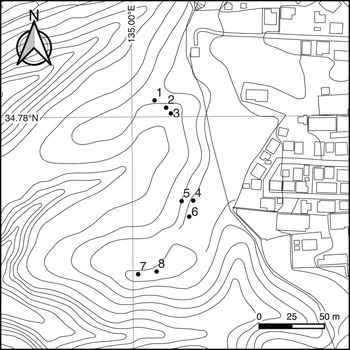
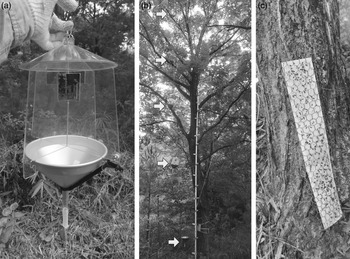
This study was conducted in a warm temperate secondary forest located inside the Mikiyama Forest Park, Hyogo, Japan (34.78° N, 135.00° E; Fig. 1). Damage caused by Japanese oak wilt was observed in Q. serrata in this area in 2019. In June 2022, eight Q. serrata individuals with no history of P. quercivorus infection were selected. The height of the eight canopy trees ranged from 9.65 m to 13.72 m. A rope was hung from a branch inside the canopy, and interception traps were attached to this rope at heights of approximately 1, 3, 5, and 7 m above the ground for all eight trees. Additionally, a trap was attached to two of the eight trees at a height of approximately 9 m (Fig. 2B). The lower end of the rope was fastened to the trunk base. A transparent interception trap (Sankei Chemical Co., Ltd., Kagoshima, Japan) was used without attractant chemicals. Originally, the trap consisted of a roof, interception plates, and a pan to collect insects. The pan was replaced with a stainless steel funnel, and a plastic tube covered with nylon mesh was attached to the bottom (Fig. 2A). In addition to interception traps, sticky sheet traps (Kamikiri-hoihoi; Earth Biochemical, Tokushima, Japan), 8 × 50 cm in size, were set up at the basal part of the trunk of each tree, at heights of 10–60 cm aboveground (Fig. 2C), to monitor the landing population of P. quercivorus.
Location of the eight Quercus serrata trees on which interception traps and sticky sheet traps were set up in an urban, warm temperate forest in Japan.

A, Interception traps were used to capture Platypus quercivorus inside and outside the canopy of Quercus serrata. B, Five interception traps were hung from the upper branches of Q. serrata. C, Sticky sheet traps were set up on the basal part of Q. serrata. A high number of beetles were captured.

The first traps were set up on 7 July for trees numbered 1, 5, and 7. For these three trees, the first collection of trapped beetles and replacement of tubes and sticky sheets were performed on 14 July. On the same day, traps were set up for the remaining five trees, and beetle collection and trap replacement were conducted at approximately one-week intervals until 31 October. Beetles were collected 16 times, and the number of trapped beetles was counted in the field or laboratory. The presence of holes bored by P. quercivorus was also checked in the basal part of the trunk, at 0.5 m aboveground or lower, on each day of trap setup and beetle collection.
Although interception traps were attached to the rope at 2-m intervals, traps in the canopy were not placed exactly at 2-m intervals vertically. The position of each trap depended on the angle at which the rope stretched from the upper branch to the basal part of the trunk. The height and horizontal distance of each trap from the main trunk of the tree were measured using a measuring pole (ST-15 m; Taketani Trading Co. Ltd., Osaka, Japan). We regarded the leaves at the highest position as the top of the canopy and those at the lowest position as the bottom of the canopy. Heights at the top and bottom of the canopy were measured using the same pole to categorise each trap according to the two groups: the traps within and the traps below the canopy.
Model construction and selection
A hurdle model was constructed to predict the number of beetles captured using the interception traps. This model was applied to deal with an excessive number of zeros in the data (Zuur et al. Reference Zuur, Ieno, Walker, Saveliev and Smith2009): 68% of captured beetles were zero. The model consists of two parts: a zero-hurdle part that predicts the probability of beetle collection using an interception trap and a count part that predicts the number of beetles captured using interception traps after the first beetle was collected. A binomial distribution was assumed for the former, and a negative binomial distribution was assumed for the latter. The interval between beetle collections was at least six days and at most 12 days. The logarithm of the interval period was incorporated into the count part of the model as an offset term to account for this difference. The candidate explanatory variables for each part were (1) number of beetles captured using sticky traps, (2) height of the interception trap, and (3) horizontal distance from main trunk. The first variable was incorporated into both parts of the model. Because the second and third variables were weakly correlated in a small data set with one or more captured beetles (32% of all data), either variable was incorporated into each part of the model. Consequently, four candidate models with different combinations of explanatory variables were constructed, and the model with the lowest Akaike information criterion was selected as the full model. Model selection was performed by deleting insignificant variables individually from the full model until the deletion caused a significant decrease in the likelihood of the model. The model construction and selection were performed using the pscl package, version 1.5.5 (Zeileis et al. Reference Zeileis, Kleiber and Jackman2008), and the lmtest package, version 0.9-40 (Zeileis and Hothorn Reference Zeileis and Hothorn2002), of R, version 4.1.3 (R Core Team 2022).
Results
Holes bored by P. quercivorus were observed on five of the eight trees on the first day of trap setting on 7 July. On 14 July, beetle boring activity was observed in one additional tree, and hole boring by beetles was observed in the remaining two trees on 21 July. All eight trees were attacked by P. quercivorus in July.
A total of 34 interception traps were set up on eight trees. Their height ranged from 0.57 to 9.38 m, and the horizontal distance from the main trunk ranged from 0.2 to 2.8 m. Among the traps, 21 were located within the canopy and 13 were located below the canopy. In total, 53 male beetles and 66 female beetles were caught in traps located within the canopy and 338 males and 443 females were caught in traps located below the canopy. Regarding the sticky sheet traps set up at the bases of the eight trees, 2957 males and 3147 females were captured.
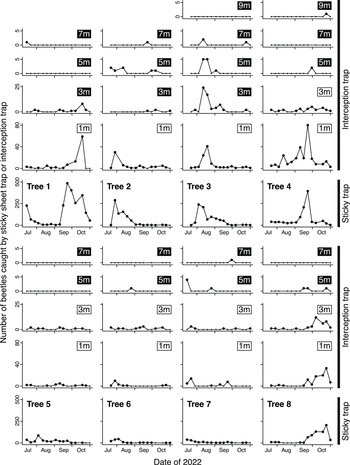
Figure 3 shows the changes in the number of beetles caught using the sticky sheets and interception traps. Beetles were caught in interception traps at all heights from 1 to 9 m, and the number decreased with increasing height. The proportion of events in which one or more beetles were captured was 68.6% at 1 m, 49.2% at 3 m, 12.4% at 5 m, 4.2% at 7 m, and 3.4% at 9 m. The period of peak beetle capture on sticky traps differed among individual trees and generally coincided with the peak period of beetle capture in the interception traps for the same tree.
Numbers of Platypus quercivorus caught using sticky sheet traps and interception traps set up on eight Quercus serrata trees in a warm temperate forest in Japan, according to the type of trap, height of the traps aboveground, and whether the traps were within or below the trees’ canopy, per tree. The height of the traps is described in the top right of each graph with the data for interception traps. The black-highlighted height description shows that the trap was set up within the canopy, and the height enclosed with a rectangle shows that the trap was set up below the canopy. Small dots indicate zero counts.

The model selection results for predicting the number of beetles caught in the interception traps are shown in Table 1. A model that included the number of beetles caught in the sticky trap and the height of the interception trap in the zero-hurdle part, including the number of beetles caught in the sticky trap and the horizontal distance from the main trunk in the count part, was selected as the full model, and no variables were deleted in the model selection process. The number of beetles caught in the sticky traps positively affected both the zero-hurdle and count parts. The height of interception had a negative effect on the zero-hurdle part, and the horizontal distance from the main trunk had a negative effect on the count part.
Results of the model to predict the number of ambrosia beetles, Platypus quercivorus, caught using interception traps set up within and outside the canopy of each of eight Quercus serrata host trees. Two candidate explanatory variables were prepared for the zero-hurdle and count parts. The estimated slopes, their standard errors, and Z- and P-values are described for variables selected for the best fit model. The number of observations was 512.

* Number of beetles caught in sticky sheet traps set up on the basal part of the trunk (beetle hole–boring sites).
† Height (m) of the interception trap from the ground.
‡ Horizontal distance (m) from the main trunk to the interception trap.
*** Indicates significant P-value.
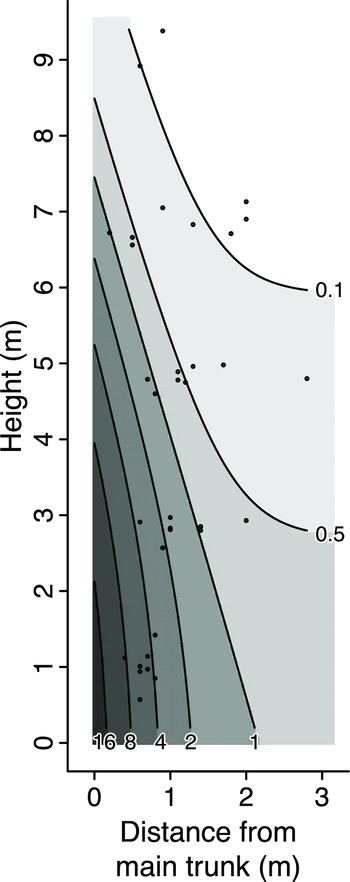
Based on the model described in Table 1, predictions were made by changing the height of the interception trap from 0 to 9.4 m and the horizontal distance from the main trunk from 0 to 3 m (Fig. 4). Another explanatory variable, the number of beetles caught in the sticky traps, was set to 100. The predicted values decreased exponentially with increasing height and horizontal distance from the main trunk.
Number of Platypus quercivorus caught using interception traps predicted using the hurdle model. The values were calculated by assigning 100 to the number of beetles caught in a sticky sheet trap. The results of the model showed an increase in the probability of beetle capture with a decrease in height, and an increase in the number of beetles with a decrease in horizontal distance from the main trunk. Changes in the colour from light to dark grey indicate an increase in the predicted number of beetles. Small dots show the location of 34 interception traps set up on Quercus serrata in this study.

Discussion
The hole-boring activity of P. quercivorus was observed in the basal portions of all trees. The phenology of beetle capture in sticky traps generally coincided with that in interception traps (Fig. 3), and the number of beetles caught in sticky traps positively correlated with the number of beetles caught in interception traps (Table 1). These results suggest interception traps captured the beetles approaching the basal part of the host tree before they reached the base and began boring holes. Another possibility is that beetles targeting adjacent trees may be trapped using interception traps. This was possible because, in some cases, the subject trees were located nearby (Fig. 1). However, the period of peak beetle capture differed even among closely located trees (Fig. 3). Therefore, it is likely that beetle capture using interception traps corresponded to beetle capture using sticky traps on the same tree.
Beetles were captured at all heights, ranging from 1 to 9 m. This is the first study to confirm that P. quercivorus flies in the canopy of a target tree at the time of their attack. The number of trap captures decreased exponentially with increasing height (Fig. 3). The high abundance of P. quercivorus at lower trap locations is a general pattern for ambrosia beetles, as reported in previous studies (Ulyshen and Hanula Reference Ulyshen and Hanula2007; Ulyshen and Sheehan Reference Ulyshen and Sheehan2019; Sweeney et al. Reference Sweeney, Hughes, Webster, Kostanowicz, Webster, Mayo and Allison2020). The model analysis results in the present study showed that the probability of beetle capture increased with decreasing height and that the number of collected beetles increased with decreasing horizontal distance from the main trunk (Table 1). The model prediction showed that the number of captured beetles increased as the trap moved closer to the base of the tree and their hole-boring site (Fig. 4). This can be interpreted as the beetles approaching from the top, with their density increasing as they approach their boring site. However, the number of beetles caught at higher positions was too small (Fig. 3) to determine their flight path. Instead, active flight around the basal part of the tree and around the beetle boring site may increase the probability of a flying beetle being caught by traps, and this probability may decrease as the beetle moves farther away from the basal area of the trunk.
The hole density of P. quercivorus is concentrated at the base of the host tree, and the high volume of sapwood at this location is thought to be beneficial for beetles (Hijii et al. Reference Hijii, Kajimura, Urano, Kinuura and Itami1991). Hijii et al. (Reference Hijii, Kajimura, Urano, Kinuura and Itami1991) observed beetle holes at a maximum height of 9 m, although the number was overwhelmingly small compared with the number of holes observed at the base. Therefore, our results can also be interpreted as beetles approaching the basal part of the tree from the side, going up to a higher position, seeking a place to bore holes, and being trapped by interception traps. Assuming that beetles prefer the basal area of their target trees, they may have begun boring holes from that site upwards. They are thought to avoid being in close vicinity to holes bored by conspecifics (Soné et al. Reference Soné, Mori and Ide1998), and it has been suggested that the density of holes on the bark surface is a determining factor for beetle reproductive success (Yamasaki et al. Reference Yamasaki, Iizuka and Futai2012). Beetles are thought to gradually move upwards as the space to bore holes at the base is filled, and beetle behaviour to search for a place to bore holes at higher positions is thought to be observed later than the peak attack period. This possibility can be eliminated because the peak periods of beetle capture at higher positions generally coincide with those of beetle capture using sticky traps at the basal level (Fig. 3).
Interception traps were set up both within and below the canopy. The approaching path of the beetle can be better clarified by setting traps above the canopy (Cunningham-Minnick et al. Reference Cunningham-Minnick, Roberts, Kane, Milam and King2022). It should be noted that the interception trap used in this study was originally designed to trap beetles approaching from the side. This trap can also intercept beetles approaching diagonally from above but cannot trap beetles approaching directly from above. Therefore, improving the trap’s structure is necessary to further clarify the movement of beetles inside the host canopy.
The effects on beetle capture of the height and horizontal distance from each host tree’s main trunk were evaluated in this study. We designed a variation in height by attaching interception traps to a rope at 2-m intervals. In contrast, variation in the distance from the main trunk was small, 0.2–2.8 m, and was a by-product of the different ways to set up the rope among trees. The crooked trunk that is typical of Q. serrata also contributes to this variation. To improve the design of the present study, it was necessary to hang ropes on multiple branches in a single-tree canopy and set up traps at multiple distances and directions from the main trunk.
In conclusion, the flying population of P. quercivorus inside the canopy of their target tree was confirmed up to a height of 9 m, although the trap captures were extremely low at higher positions. Methods for collecting beetles should be improved in future studies to clarify the approach path of P. quercivorus to their host tree in more detail.
Acknowledgements
We thank the staff at the Mikiyama Forest Park for allowing us to conduct this study. We thank all members of the Laboratory of Forest Biology, Kyoto University, for their assistance with fieldwork and their help and advice during the study. This study was supported by a Grant-in-Aid for Scientific Research from the Japan Society for the Promotion of Science (Grant no. 21H02234).
Competing interests
The authors declare they have no competing interests.