INTRODUCTION
One of the most important goals in palliative care is to provide the best possible quality of life (QoL) to patients until the time of death according to the World Health Organization (2002), that is to provide supportive care, including keeping patients free from physical and psychological distress. QoL encompasses physical, psychological, social, and spiritual/existential dimensions. It is primarily a subjective feeling and therefore every patient will experience a unique QoL (Haas, Reference Haas1999). It also includes negative as well as positive components (Moons et al., Reference Moons, Budts and De Geest2006). If QoL is neglected it will lead to more suffering for patients and consequently may even hasten death (Rummans et al., Reference Rummans, Bostwick and Clark2000).
Ten million people in the world became ill with cancer in 2000, and 60% of them died that same year due to their illness. In 2003 about 49,000 people in Sweden were diagnosed with cancer, and 63% of them were 65 years old or older. The same year 21,300 people died of cancer (The National Board of Health and Welfare, 2007). Incurable cancer frequently generates distressful physical symptoms and psychological and social distress. Existential experiences concern reflections about life and death (Thomé et al., Reference Thomé, Dykes and Gunnars2003a) and the importance of retaining a sense of hope and meaning in life (Greisinger et al., Reference Greisinger, Lorimor and Aday1997). A majority of studies concerning how cancer affects patients' lives describe the management of physical symptom such as, for example, cancer pain (Boström et al., Reference Boström, Sandh and Lundberg2004) and the advances within the area (Grossman et al., Reference Grossman, Dunbar and Nesbit2006). Physical symptoms and existential issues, especially meaning, need more attention in palliative care as patients score low within these areas (Lo et al., Reference Lo, Woo and Zhoc2002). Several randomized quantitative studies evaluate the outcomes of cancer treatment such as, for example, palliative surgical treatment for gastric cancer or chemotherapy for lung cancer (Hartgrink et al., Reference Hartgrink, Putter and Klein Kranenbarg2002; Soo et al., Reference Soo, Wang and Tham2006). Patients with incurable cancer in a palliative phase at home experience problems such as difficulty in doing heavy housework, limitations in physical performance, coping with the unpredictability of the future, and living with the fear of metastases (Osse et al., Reference Osse, Vernooij-Dassen and Schade2005).
Home care is increasing in palliative care and is a possible choice for patients with incurable cancer. The care at home is provided by healthcare professionals and contributes to patients’ QoL and replaces hospital care (Thomé et al., Reference Thomé, Dykes and Hallberg2003b). According to Peters and Sellick (Reference Peters and Sellick2006) home-based palliative care has been found to produce greater improvement in patients’ physical and psychological health and QoL when compared to that of patients admitted to a hospital. One of the primary goals in nursing is to assess how people respond to illness (King et al., Reference King, Haberman and Berry1997), and caring for patients with incurable cancer is complex when dealing with everyday care situations (Tishelman et al., Reference Tishelman, Bernhardson and Blomberg2004). In palliative care health care professionals handle difficult situations by striving to be both accessible and at the same time protect their privacy (Blomberg & Sahlberg-Blom, Reference Blomberg and Sahlberg-Blom2007). They are on the front line, providing emotional care and support to patients with incurable cancer and their families (Corner, Reference Corner2002; Quinn, Reference Quinn2003; Skilbeck & Payne, Reference Skilbeck and Payne2003). De Araujo et al. (Reference de Araujo, da Silva and Francisco2004) found that communication related to dying patients is challenging and of the utmost importance when helping patients to solve problems in daily life.
Family life is a key component for patients’ QoL (Spiroch et al., Reference Spiroch, Walsh and Mazanec2000), as is their desire to be respected and to be able to show feelings to loved ones (Greisinger et al., Reference Greisinger, Lorimor and Aday1997). Good relations with the family have a positive effect on patients’ psycho-spiritual well-being, but emotional distress may distract psycho-spiritual well-being (Lin & Bauer-Wu, Reference Lin and Bauer-Wu2003). Spiritual well-being affects patients’ QoL (Hampton et al., Reference Hampton, Hollis and Lloyd2007), and spiritual thoughts are not uncommon as patients strive to comprehend, manage, and find meaning in illness (Strang & Strang, Reference Strang and Strang2001).
This study focused on the meaning of QoL for patients with incurable cancer. Physical well-being and the meaning of existence are reduced among patients with cancer in the terminal phase of the illness, and little is known about how these aspects influence patients’ general QoL (Lo et al., Reference Lo, Woo and Zhoc2002). The objective of this study was to elucidate the meaning of quality of life as narrated by patients with incurable cancer approaching death in palliative home care.
METHODS
Approval was secured from the Ethical Committee at the Medical Faculty, Umeå University (No. 01-320011113). In qualitative studies it is important to create a multifaceted ethical framework (Holloway & Wheeler Reference Holloway and Wheeler1995). Therefore, it was important in this study to keep patients’ vulnerability to the fore. Autonomy was taken into particular consideration, and patients were informed of the fact that they could withdraw from the study at any time without any effects on their future care.
Participants and Setting
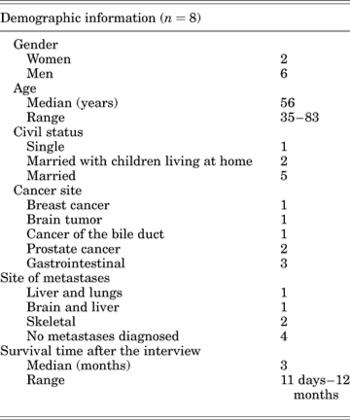
This qualitative study involved eight participants, resident in the County of Jämtland in Sweden. The participants were over 18 years of age and spoke and understood Swedish. They had been living with metastatic cancer for several months and were currently being cared for by a palliative home care team (PHT) (Table 1). So that we could select patients close to or in the terminal phase, their functional status had to be on level 3 on the Eastern Cooperative Oncology group Scale of Performance Status (ECOG PS; ECOG 3 = confined to bed or chair more than 50% of their waking hours (ECOG, 2006). If physicians on the PHT or medical records confirmed that a patient had dementia or memory problems he or she was excluded from the study. The main reasons for patients refusing to participate in this study was that they felt too weak and tired (n = 8) to become involved or that they did not want to talk about the illness as they were afraid this would induce awkward feelings (n = 4).
Demographic and clinical information (n=8)

Procedure
Nurses and physicians in the PHT recommended patients for this study to the first author. Twenty-five patients were contacted by telephone about participation. Five patients declined immediately. The rest agreed to receive a letter of written information and informed consent and 12 of these declined participation. A total of 8 patients accepted participation in this study. Information concerned patients’ autonomy; notes and the tape-recorded transcriptions relating to this would be kept secure. Patients were asked continually during the study if they felt that they had the strength to continue participating. The main motivation for participation was that they regarded it as being important to contribute to findings that may, in the future, help other patients facing the same problems.
The authors in this study, E.D., B.A., and C.M.J., contributed to the design and analysis of the study; C.M.J. also collected data and was responsible for the drafting of the manuscript; G.Ö. independently checked the findings; all authors contributed in the revisions of the manuscript; E.D. supervised the study.
Interviews
Data were collected from narrative interviews in order to obtain in-depth descriptions about the meaning of QoL (Mishler, Reference Mishler1986). Interviews were conducted between 2004 and 2006 in the patients’ homes. During all interviews patients, with the exception of one, were lying down in their bed in a room apart from the rest of the house. The interviews lasted for about 60 min, including short breaks, and were audio recorded and transcribed verbatim. One general question was asked in this study to understand what meaning patients give QoL “Would you please describe how you experience your situation?” To clarify and investigate experiences further follow-up questions were asked, for example, “What do you think?” or “How do you feel?”
Content Analysis
To clarify the meaning of the content in the text an interpretative content analysis was used in this study (Baxter, Reference Baxter, Montgomery and Duck1991). Interpretative content analysis is more complex than descriptive and involves going beyond and reading between the lines of the descriptive data. It is an analytic orientation process in which the understanding of the text is clarified and understood through seeking the content and the meaning in a phenomenon (Patton, Reference Patton2002). The analysis was performed in the following steps:
• To gain a first understanding of the phenomenon and its context the interpretation process started by the authors reading the text several times and simultaneously listening to the recorded interviews.
• The texts were transformed and classified into meaning units, with the authors subsequently determining what was meaningful to code.
• Codes were constructed into preliminary subthematic and thematic units that reflected the underlying meaning of the text, and further analysis was carried out.
• Subthemes and themes were repeatedly discussed and reflected on by the authors until consensus was reached. To ascertain credibility an independent coder finally evaluated the content formed in the analysis in order to check trustworthiness of subthemes and themes.
RESULTS
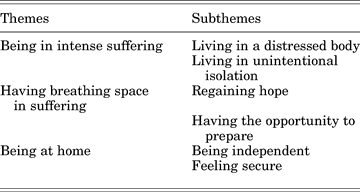
The content in the text is described in three themes and six subthemes presented in Table 2. Illustrations are formed with quotes for subthemes and marked with a number for each patient.
The content of the text described in themes and subthemes

Being in Intense Suffering
Living in a Distressed Body
As the cancer progressed, either acute complications arose or the general state of health deteriorated, which clearly led to a decline in patients’ QoL. During this phase the patients described that they “lived in a distressed body.” Their body was exposed to unexpected symptoms such as, for example, abdominal fistulas, pleural effusions, or side effects (e.g., chemotherapy-induced nausea). Patients described that they could lie in bed making plans for different activities and in the next minute realize that they did not have the strength to carry them out.
You know there are many compli—complications. You know … You have cancer and that you do indeed have cancer but it is not only just cancer. … There is one thing after the other. And just when you start to recover, “Bang” you have another set-back. And I have experienced this several times. So well yes—Of course things are difficult at times. (No. 1)
Living in a distressed body was like living with a death sentence that controlled one's whole life. Existence became insecure because they did not know when death would occur. It was a struggle between life and death because the will to live was resilient but deep inside the patients were reminded that their time was limited. Patients described that they felt as if they were prisoners in their own bodies, because their physical status hindered them from getting out of bed, restricted their social life, and restrained their will to live. The body could not be trusted and they felt controlled by this weakness.
I thought I cannot cope with this any longer and then I actually cried. I was crying when the physicians were here. I said, I do not want to live. I do not want to live if I am going to feel like this. I do not want to live like this. And then … Then it is so strange because you only think about yourself. Suddenly the family is no longer there. I was in my own little world defending myself, because I really did not want to be part of all this. Apparently you suppress feelings. And you only live to survive. (No. 2)
Living in Unintentional Isolation
In addition the illness itself and phases of intense suffering contributed to patients living in unintentional isolation, that is, being cut off from the outside world. They also described that, because they were physically marked by illness, they were not as mobile as they had been. This limited physical contact with loved ones contributed to the feeling of not being loved. For example, one patient described that she could no longer lift her arms so that she could hug family members or close friends. This curbed togetherness with family and contributed to a feeling of loneliness and was emotionally difficult to handle. Unintentional isolation was also described as if patients no longer could be part of the family's future plans, and that future goals therefore no longer existed. They knew that death was close because they felt that the illness had entered a new phase and they took one day at a time. This contributed to a feeling of being even more physically and mentally imprisoned.
I am becoming more reserved. That is why it is so difficult (sad). I daren't be open about my feelings anymore. It is as if people dislike me even more when I am (sad). And then I cry more (sad). (No. 8)
Patients described their worries about what health care staff or friends would think of them and the fact that they were afraid of becoming a burden to others. This gave the patients a feeling of being an outsider. They felt transformed both physically and mentally, which made them afraid of being unloved. To bridge the feeling of being isolated, despite being confined to bed, the patients strived to keep up an ideal daily life and did not talk about the illness with the family.
Having Breathing Space in Suffering
Regaining Hope
When the complication phase abated and the patients had received medical treatment, which had resulted in positive outcomes, they accessed a phase of respite from distress and regained hope. During this phase patients’ QoL clearly increased and they recovered slowly from intense suffering. Regaining hope made patients more calm and peaceful and gave them time to reflect upon existential issues.
I believe that people have a soul and once we are finished with this poor shell of a body, we move on. Move on to another place—not another person, just another place and we live on. (No. 4)
Periods of effective symptom control included many good days because they did not suffer from physical pain, insomnia, or loss of appetite. This contributed to an inner peace that enhanced life with a good quality and a feeling of optimism and hopefulness. They felt happier and did not feel as ill as they had during the episodes when they were in intense suffering, and as long as they stayed in bed they felt almost healthy. They had more strength to participate in daily life. They felt more useful to other family members; for example, they could help them pay their bills via the Internet, which gave the patients a sense of hope. Feeling hopeful also stirred thoughts that a miracle could maybe take place after all. Something outside their control might make them better and stop the illness from progressing.
But you never know—things can change—the weather can change—because I sort of follow the weather—I feel very dependent on weather. When it's warm and sunny I feel much better. (No. 6)
Regaining hope increased, motivated, and nourished the will to live even if patients lived in an insecure existence. To appreciate life as it was at the time and have a feeling of living well also contributed to a sense of hope. They described a sense of triumph because they were still alive despite many difficult complications and a personal proximity to death.
Having the Opportunity to Prepare
Acquiring a breathing space from their suffering gave them time to prepare not only themselves but also their families for the forthcoming death. They knew that they could live through difficult situations, which helped them be prepared for the next time complications occurred.
During the entire autumn I just didn't seem to notice how time passed. I felt so depressed for some reason or other. And it's only now that I am beginning to feel a little better and I am able to grasp what's happening. I really felt like life was over. Well—every week brought something else. Now I am pleased to note that things are much better. My body seems to be holding together. (No. 7)
To be prepared also meant having time to reflect about themselves as individuals, which was a way of “balancing one's books.” The relatively slow progression of the illness gave them time to prepare for death and let go of life. This provided a feeling of safety and courage to revalue life, allowing them to come to an insight and enabling them to communicate difficult feelings. They took the initiative to talk with the family about funeral arrangements, that is, preparing themselves and loved ones for the forthcoming death. Being prepared also included their awareness of the complexity of leaving loved ones and for the family that would be left behind.
Then I don't think things are so difficult for me at all. It's much more difficult for those who will be left behind, who have to fix everything for me. It will most surely take a year or more for them to get over this. (No. 6)
Being at Home
Being Independent
The patients described that it was wonderful being cared for at home because it provided independence. With regard to the secure confidence of having significant others as family caregivers and PHT at hand providing everything they needed alleviated suffering. It was the whole package of social support provided at home that facilitated the possibility to be autonomous and increased the potential of experiencing optimal QoL.
I can make my own decisions—I am able to decide over things in an entirely different way than in hospital. If I decide I want them to come later than 8 o'clock in the morning—even although we have agreed to that time—I can just phone and change the time to 9 or 10. And if I want to skip my drip like I did before … at least one day last week, I just phone them and we agree on this. (No. 1)
One bright spot in patients’ lives was having a spouse, children, and grandchildren helping them whenever they needed, and because they were at home they could choose when to receive visits or not. The “feeling of home” was described as a safe and privileged feeling because at home they felt familiar with the environment. They could look at and touch their personal belongings, which made it possible to preserve independence and contributed to a sense of well-being.
To be able to recognize scents, see my own things and smell my own towels and bed linen—the feeling of being at home is positive. I have always felt safe and secure in hospital but then again I have never felt insecure at home. Yes, I must say things are as good as I could possibly expect in this situation. The good life is not always necessarily a healthy life. (No. 2)
Feeling Secure
Patients described that the provision of palliative support at home provided a sense of security. Receiving effective pain relief and information enhanced the feeling of independence and security. It was satisfactory that the PHT was easy to reach and patients experienced an honest and equable communication with nurses and physicians. Patients experienced that the team had time to listen and supported them when they needed to express the inexpressible to family members, for example, when it was difficult to speak with family about the illness. Their care needs were met and fulfilled quickly, and they felt that everything was taken care of. Patients did not, for example, have to spend their time negotiating with staff in primary care to arrange an appointment when they were suffering severe pain. It was a relief to be able to entrust physical as well as psychological deterioration to the PHT.
When I feel that I can't hang on I become sad. But then someone has always comes along and says “No, no, we need to do something about this. This won't do.” And then I become hopeful again. Hope won't help me to live longer—it's not a condition—but I want to live well and feel good the days that I have left to live. (No. 2)
Patients described how it was possible for them to influence medical treatment in consultation with the team. The team was worth their weight in gold as they were committed and provided affirmative care that relieved suffering, because they provided patients with a sense of security and QoL.
DISCUSSION
In the present study data were collected in accord with a hermeneutic view to capture the subjective reality of patients. It was difficult to recruit those patients who were confined to bed more than half of the day for the study. Many patients declined participation because they were too weak and tired or afraid that complex feelings that were difficult to handle would be invoked during the interview. Conclusively, if other participants had been included in the study the outcome may have been different. When planning the study we also discussed how extensive the interviews should be, and we found that if patients were allowed shorter breaks 60 min was not too long. Neither did the patients express that it was emotionally painful to participate. On the contrary, they thought that participation in the interviews was both positive and therapeutic. This is also described by Barnett (Reference Barnett2001).
One limitation was that, when conducting this study, eligible patients were primarily men. The intention was not to have a gender perspective when interpreting the text, but rather to be sensitive to each patient's story and reflect on the message in the text. This study showed that it is feasible to carry out interviews with patients more confined to bed than physically active. This was a strength, but also the use of an interpretive content analysis that elucidated the meaning of patients QoL in home care. The findings were described in three themes.
The first theme, being in intense suffering, entailed episodes when unexpected physical complications weakened the body. This suffering contributed to an extremely insecure existence, which led to a diminished QoL that is similar to that described in a study by Rehnsfeldt and Eriksson (Reference Rehnsfeldt and Eriksson2004). They found that unbearable suffering may be concealed and is a struggle with death fought by patients alone, so consequently meaning in life cannot be devised. Life has only one extremity such as, for example, only death or darkness. Penrod (Reference Penrod2007) describes that living with uncertainty is highly individual and includes existential perspectives. In our study patients experienced that their whole existence became uncertain because they did not know the meaning or the implications of physical complications. It was like living with a death sentence, an experience similar to findings in a study of men inflicted with prostate cancer (Maliski et al., Reference Maliski, Helleman and McCorkle2002). We found that living with a death sentence involved not knowing when life would come to an end, thus enhancing the sense of uncertainty and unpredictability. According to Penrod (Reference Penrod2007) the grade of uncertainty or not knowing is related to how individuals balance their sense of confidence and control. In our study it is likely that the patients had both a low sense of confidence and control during phases of intense suffering. In addition this isolated patients unintentionally as physical complications and treatments restricted them from participating in normal family life. This also restrained the will to live, which may affect their self-reliance and sense of control. Chochinov et al. (Reference Chochinov, Hack and Hassard2005) found that the will to live and existential variables were highly correlated. In the present study patients were afraid of becoming a burden to the family and health care professionals, especially if unpredicted complications reduced their ADL functions more. Patients’ limited togetherness with family gave them a feeling of loneliness and excluded them from being a part of a social life. In another study it was found that existential isolation may be a reason for existential distress (Sand & Strang, Reference Sand and Strang2006). That is if illness cuts off the patient from interactions with the world outside the patient may acquire a feeling of loneliness. Situations in their environment could also activate the sense of loneliness, for example, being left alone when needing help from significant others or being treated by others in an undignified or unsympathetic way.
The second theme, having breathing space in suffering, provided an opportunity to recover balance in life when intense suffering abated. Rehnsfeldt and Eriksson (Reference Rehnsfeldt and Eriksson2004) found that when patients became aware that they were suffering it could be alleviated. In our study a breathing space in suffering provided the patients with a respite from distress and gave them an opportunity to regain hope and optimism, which increased QoL. They even experienced a sense of wellness. Literature shows that men with incurable prostate cancer alternate between experiences of illness and wellness. Wellness was achievable despite incurable cancer and despite deteriorating performance status (Lindqvist et al., Reference Lindqvist, Widmark and Rasmussen2006). Breathing space in suffering infused new life into the experience of suffering, as patients felt an inner peace when they regained hope and optimism, which was imperative for experiencing a positive QoL. These positive emotions were a consequence of the body being given a chance to acquire a respite; consequently the mind was able to concentrate on the present situation. Miller et al. (Reference Miller, Manne and Taylor1996) found that experiencing positive feelings at the end of life may make it easier to find meaning and hope in life, despite living in an extreme life situation. In our study, acquiring breathing space in suffering included being happy and harmonious and provided an opportunity to reflect on existential issues. Patients found comfort in imagining a life after death in the sense that the soul would live on after the last breath. A systematic analysis by McClain-Jacobson et al. (Reference McClain-Jacobson, Rosenfeld and Kosinski2004) showed that having a belief in an afterlife had a positive effect on patients’ psychological status. Patients felt less unhappy and had lower levels of hopelessness.
In the present study, having breathing space in suffering afforded patients time and the strength necessary to prepare themselves and the family for the forthcoming death. Even if preparedness has barely been researched, it was recounted in a literature review by Hebert et al. (Reference Hebert, Prigerson and Schultz2006) that family caregivers are not as ready for the death of their loved ones as one may think. Staff in palliative care often have open communication on the subject of death and dying, which helps families to prepare themselves better.
The third theme, being at home, describes that having family members and the PHT providing care and support helped the patients to feel independent and secure. Rehnsfeldt and Eriksson (Reference Rehnsfeldt and Eriksson2004) describe that, together with caregivers, the patient can accept endurable suffering and create a meaning with the suffering. In our study, patients knew that backup was available from family or nurses and physicians in the PHT on hand, who could take charge of the situation when necessary. The feeling of independence they acquired at home may, on the other hand, be a result of the fact that the patients were actually dependent on care. A qualitative study by Strandberg et al. (Reference Strandberg, Norberg and Jansson2001) in medical care showed that the patient was dependent on being surrounded by nurses. This relationship provided personal and familiar feelings of the utmost importance to patients while at the same time it alleviated feelings of loneliness. This may well mean that, in order to feel independent when living with terminal illness, a certain amount of dependency is required.
Patients in the present study described that they felt secure in palliative care when supported by the PHT because everything was taken care of. When the patients experienced being in intense suffering and lost control this affirmative care relieved them from acute symptoms, provided medical treatment, and took control of the situation. In addition to this, just knowing who to turn to when problems arose also provided a sense of security, which had a positive effect on their QoL. This study also showed that it is vital for nurses and physicians to understand that the pattern of QoL is individual. Health care professionals have to adjust care to the present phase of each individual and to create as much breathing space in suffering as possible.
ACKNOWLEDGMENTS
Our sincere gratitude to the patients for the heroic manner in which they contributed to this study and to the palliative home care team Storsjögläntan, to the County of Jämtland Cancer and Nursing Society, and Mid Sweden University for funding this study.