According to the Food and Agriculture Organization of the United Nations, India is the largest milk producing country in the world due to its large bovine population comprising of approximately 210 million cattle and 112 million buffaloes. Approximately 60% of the world's buffalo milk comes from India and buffaloes contribute to around 55% of the total milk production in India. Riverine buffaloes are an integral part of Indian livestock economy and are preferred over cattle as a dairy animal because of the high milk fat content which fetches a higher market price (Ahlawat et al. Reference Ahlawat, Vij and Tantia2003).
Conformational traits of the udder and teats have a direct relation with milk production potential in dairy animals including buffaloes (Thomas et al. Reference Thomas, Svennersten-Sjaunja, Bhosrekar and Bruckmaier2004; Prasad et al. Reference Prasad, Rao, Sudhakar, Gupta and Mahender2010; Deng et al. Reference Deng, Badri, Atta and Hamad2012). The udder and teat measurements vary in different stages of lactation and parities and also between breeds and individuals in the same herd (Tilki et al. Reference Tilki, Inal, Colak and Garip2005; Abdullah et al. Reference Abdullah, Javed, Khalid, Ahmad, Bhatti and Younas2013). The morphological characteristics of teats have high heritability and can be used in breeding programmes to improve milk production and quality (Coban et al. Reference Coban, Sabuncuoglu and Tuzemen2009; Nakov et al. Reference Nakov, Hristov, Andonov and Trajchev2014).
The most common cow-related risk factors for mastitis are breed, parity, stage of lactation, udder and teat morphology, udder oedema, milk production, milk somatic cell count (SCC) and reproductive disorders (Nyman et al. Reference Nyman, Ekman, Emanuelson, Gustaffson, Holtenius, Person Waller and Hallen Sandgren2007; Valde et al. Reference Valde, Lystad, Simensen and Osteras2007; Nakov et al. Reference Nakov, Hristov, Andonov and Trajchev2014). These factors may play a significant role in decision making by the dairy farmers at the time of selection of dairy animals to lower the incidence of mastitis.
The teat is the first line of defence against intramammary infection (IMI). Thus, udder and teat morphometric traits are among the potential risk factors that may predispose the animal to intramammary infections (Okano et al. Reference Okano, Koetz Junior and Bogado2015). It is important that teats have a suitable morphology to reduce susceptibility to the invasion of pathogenic organisms. The probability of mastitis occurring varies considerably between different teat and teat-end shapes, sizes, and teat placement (Bardakcioglu et al. Reference Bardakcioglu, Sekkin and Toplu2011). Previously, studies on the risks of developing SCM in dairy cows in India have indicated the possible effects of teat length (TL), teat diameter (TD), and teat morphology (Bhutto et al. Reference Bhutto, Murray and Woldehiwet2010; Singh et al. Reference Singh, Bansal and Gupta2014). Uzmay et al. (Reference Uzmay, Kaya, Akbas and Kaya2003) and Singh et al. (Reference Singh, Bansal and Gupta2014) identified longer teats as a potential risk factor for mastitis. The TD was also found to be positively correlated with the IMI in lactating cows (Kuczaj, Reference Kuczaj2003; Singh et al. Reference Singh, Bansal and Gupta2014). Bharti et al. (Reference Bharti, Bhakat, Pankaj, Bhat, Prakash, Thul and Japheth2015) reported that teats with flat/wide teat-ends were more susceptible to clinical mastitis.
The dairy buffalo is considered to be less susceptible to mastitis than the dairy cow (Mustafa et al. Reference Mustafa, Farhat and Tooba2013). Some important udder morphological characteristics of the buffalo may influence any difference from the cow in predisposition for infections and inflammations, e.g. the tighter teat sphincter of buffaloes (Uppal et al. Reference Uppal, Singh, Roy, Nauriyal and Bansal1994). Although the dairy buffalo has huge economic importance, very little work has been done to demonstrate associations between teat morphological traits and the occurrence of mastitis in this species. Considering the importance of conformation of the mammary gland in the occurrence of bovine mastitis, the present study was aimed to evaluate the morphometric features of teats in Murrah and Nili-Ravi breeds of buffalo and their associations with udder health at the quarter level.
Material and methods
Farm management
The study was conducted at the dairy farm of the University, Ludhiana, Punjab, India using high-producing Murrah and Nili-Ravi buffaloes. The lactating animals used were loose housed and milked twice daily, at 04.00 and 16.00 h. As required for experimental purposes some animals were machine-milked using individual bucket milkers designed for buffalo milking (DeLaval, Tumba, Sweden). The milking machine operated at a vacuum of 55 kPa with 60 : 40 pulsation at 1 Hz. Animals were fed fresh green seasonal fodder when available, otherwise silage. Supplementary concentrate was fed according to milk yield.
Animals
Healthy Murrah (n = 47) and Nili-Ravi (n = 34) were selected at random from the herd. The animals varied in parity (mean 2·6 ± 0·2; range 1–9) and stage of lactation (mean 4·2 ± 0·4 months; range 1–12 months). The average test day milk production was 7 L (range 1–17 L).
Teat morphometry
All buffalo were stimulated for milk let down by calf or manual massage of the udder after washing. At the time of evening milking, teat morphological parameters recorded were:
Teat length: Defined as the distance (cm) from base of the teat to tip of the teat, measured by a tape
Teat diameter: Diameter (cm) of the teat at the mid of the teat barrel, measured by Vernier calipers
Teat-end to floor distance: Distance (cm) of the teat-tip from the floor forming an angle of 90° with the floor, measured by a tape
Teat shapes: Classified as bottle, conical, cylindrical, and ‘others’ (not any of these three categories)
Teat-end shapes: Classified as flat, round or pointed
Collection and analysis of milk samples
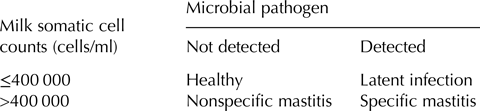
Quarter foremilk samples (10 ml) were collected aseptically into sterile glass tubes after discarding the first few strips of milk. Samples were stored at 4 °C until analysed for bacteriology and cell count within 1 h of collection. Bacteriological examination was performed at a mastitis laboratory of the University, according to the recommended tests and standard procedures (Hogan et al. Reference Hogan, González, Harmon, Nickerson, Oliver, Pankey and Smith1999). Somatic cells numbers (SCC) were estimated using an automatic somatic cell counter (SomaScope Smart, DELTA Instruments, The Netherland). Both absolute (×103 cells/ml) and log 10SCC cells/ml values were calculated. The quarter health status was defined on the basis of SCC and bacteriology of foremilk samples according to the International Dairy Federation criteria (IDF, 1987) (Table 1). Both perfectly healthy quarters and quarters with latent infections were grouped as ‘healthy quarters’ since it is generally assumed that a latent infection induces no significant inflammatory reaction in an udder. A ‘mastitis group’ represents both non-specific and specific mastitis quarters together. At the animal level, an udder was considered mastitic if at least one quarter was affected by non-specific or specific mastitis.
Definition of quarter health status as per the International Dairy Federation criteria (IDF, 1987)

Statistical analysis
The data were analysed using SAS (version 9.3, SAS Inst. Inc., Cary, NC, USA). Associations of teat and teat-end shapes with breed (Murrah and Nili-Ravi) and quarter health (healthy and SCM) were examined using Chi-Square test (χ2) of independence of factors. Data on teat morphometry were analysed using the general linear model procedure using following model:
 $$Y_{ijklm} = {\rm \mu} + {\rm} B_i + {\rm} QL_j + {\rm} QP_k + {\rm} QH_l + {\rm} e_{ijklm}$$
where Y ijklm: individual teat morphometric parameter; μ: general mean; B i: effect of breed (Murrah and Nili-Ravi); QL j: effect of left and right side teats; QP k: effect of fore and hind teats, QH l: effect of quarter health (healthy and SCM) and e ijklm: residual error.
The data on log10SCC were analysed using the general linear model with following model:
 $$Y_{ijklm} = {\rm \mu} + {\rm} B_i + {\rm} TS_j + {\rm} ES_k + {\rm} QH_l + {\rm} e_{ijklm}$$
where Y ijklm: mean log10SCC; μ: general mean; B i: effect of breed (Murrah and Nili-Ravi); TS j: effect of teat shape (bottle, conical, cylindrical and other); ES k: effect of teat-end shape (flat, round, and pointed), QH l: effect of quarter health (healthy and SCM) and e ijklm: residual error.
Pearson's correlation was used to find the relationship between teat morphometric parameters and log10 SCC. Statistical significance was defined at P-value of <0·05.
Results and discussion
Prevalence of SCM
A total of 324 quarter foremilk samples from 81 apparently healthy lactating Murrah (188 teats) and Nili-Ravi (136 teats) buffaloes were analysed for bacteriology and SCC. The prevalence of SCM was 21% at animal level with 1·54% and 9·26% of the quarters were having specific and nonspecific mastitis, respectively. The prevalence of SCM was low compared with the findings of Hardenberg (Reference Hardenberg2016) (28·6% animal level and 10·6% quarter level) and Sharma & Sindhu (Reference Sharma and Sindhu2007) (33% quarter level) but was high compared with a study by Bulla et al. (Reference Bulla, Rana, Sharma and Beniwal2006) (6·23% quarter level). The difference in prevalence of SCM may be due to the criteria used to define mastitis, different husbandry practices, diagnostic techniques, environmental conditions and immune status of animals. Most of the IMI were caused by coagulase negative staphylococci (59%) followed by Staphylococcus aureus (31%) and Corynebacterium species (10%). In buffaloes, Staphylococcus species usually predominate (39%) in both clinical and SCM followed by Streptococcus species (31–32%) in SCM (Sharma & Sindhu, Reference Sharma and Sindhu2007; Kaur et al. Reference Kaur, Verma, Bansal, Mukhopadhyay and Arora2015; Talukder et al. Reference Talukder, Rahman, Mahmud, Alam and Dey2016).
Teat morphometry
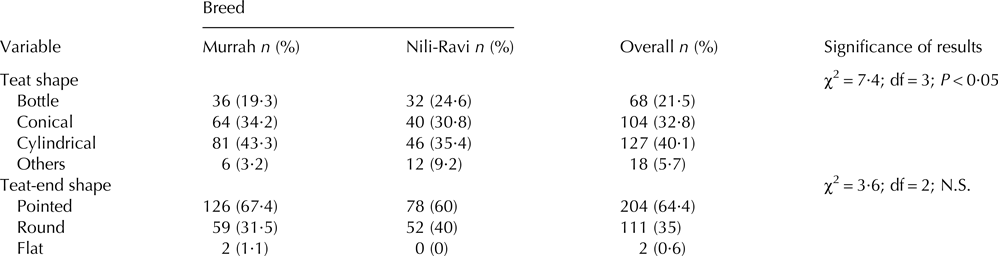
A total of 317 teats (187 teats in Murrah and 130 teats in Nili-Ravi breed) were examined for teat and teat-end shapes (Table 2). Overall, cylindrical teats were predominant (40·1%) followed by pointed or conical (32·8%), bottle shaped (21·5%), and ‘others’ (5·7%). Cylindrical teats were the most common shape (Murrah 43·3% and Nili-Ravi 35·4%); the distribution of teat shapes differed significantly between the breeds (χ2 = 7·4; df = 3; P < 0·05). These results are similar to previous studies on Murrah buffaloes (Thomas et al. Reference Thomas, Svennersten-Sjaunja, Bhosrekar and Bruckmaier2004; Bharadwaj et al. Reference Bharadwaj, Dixit, Sethi and Khanna2007; Prasad et al. Reference Prasad, Rao, Sudhakar, Gupta and Mahender2010) who also reported a high frequency of cylindrical teats. The high frequency of cylindrical teats commonly reported may indicate selection as such teat shapes are associated with increased milk yield, compared with other teat shapes (Bharadwaj et al. Reference Bharadwaj, Dixit, Sethi and Khanna2007; Prasad et al. Reference Prasad, Rao, Sudhakar, Gupta and Mahender2010).
Association between teat morphology and breeds of buffalo (Murrah and Nili-Ravi)

N.S.: Non-significant
Figures in parenthesis indicate percentage.
The most prevalent teat-end shape was pointed (64·4%) followed by round (35%) (Table 2). Between the breeds, Murrah had 67·4% and Nili-Ravi had 60% pointed teat-ends. Flat teat-ends were rare. Various other teat-end shapes (inverted, pointed disk, round flat, round ring) reported in different cattle breeds (Coban et al. Reference Coban, Sabuncuoglu and Tuzemen2009) were absent in the buffaloes.
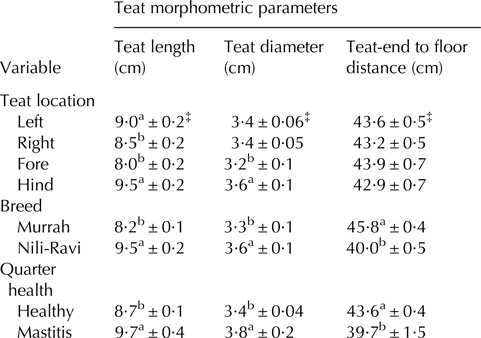
The morphometric parameters measured are reported in Table 3 and differed significantly (P < 0·05) between the breeds. The overall TL and TD were 8·8 ± 0·1 and 3·4 ± 0·04 cm, respectively. Teat location was significantly associated with TL and TD; left side teats were longer than right side teats. Similarly, hind teats were longer, and thicker, than fore teats (P < 0·05). Teats were longer and wider in Nili-Ravi breed and they were placed nearer to the floor as compared with Murrah breed. Chandrasekar et al. (Reference Chandrasekar, Das, Bhat, Singh, Parkunanan, Japheth and Bharti2016) found longer and wider hind teats, as compared with fore teats, in primiparous Nili-Ravi buffaloes. Prasad et al. (Reference Prasad, Rao, Sudhakar, Gupta and Mahender2010) reported a positive correlation of TD and TL with average daily milk yield in Murrah buffaloes. The teat-end to floor distance did not vary significantly between left and right side teats or fore and hind teats. Prasad et al. (Reference Prasad, Rao, Sudhakar, Gupta and Mahender2010) reported smaller (TL: 7·8 ± 0·2 cm) and thinner (TD: 2·8 ± 0·02 cm) teats in Murrah buffaloes. In Nili-Ravi buffaloes, the teat width was slightly lower while the average TL was similar to the findings of Abdullah et al. (Reference Abdullah, Javed, Khalid, Ahmad, Bhatti and Younas2013). The difference in teat thickness between hind and fore teats was higher in buffaloes than those reported in dairy cows (0·05–0·1 cm) (Kuczaj, Reference Kuczaj2003; Weiss et al. Reference Weiss, Weinfurtner and Bruckmaier2004).
Teat morphometric parameters of buffaloes according to teat location, breed and quarter health

‡ Values are Mean ± se
For each variable, means in columns with different superscripts differ significantly (P < 0·05)
Teat morphometry and quarter health
The average TL and TD of teats with SCM was 9·7 and 3·8 cm, respectively, and the distance of such teats from the floor was 39·7 cm (Table 3). All these morphometric parameters were significantly associated with poor udder health (P < 0·05)
According to Berry et al. (Reference Berry, Buckley, Dillon, Evans and Veerkamp2004), dairy cows with longer teats are genetically predisposed to a higher incidence of mastitis. Generally, it is assumed that longer teats are more prone to physical injuries as they are placed closer to floor, and teat lesions are a well-documented risk factor for mastitis (Breen et al. Reference Breen, Bradley and Green2009; Bhutto et al. Reference Bhutto, Murray and Woldehiwet2010). However, Hussain et al. (Reference Hussain, Javed, Khan and Muhammad2013) observed significant association between smaller teats and mastitis (P < 0·05 to P < 0·001) in Nili-Ravi buffaloes. Also, Hussain et al. (Reference Hussain, Javed, Khan and Muhammad2013) found a significant association between TD (measured at the apex, mid and base of the teat) and mastitis (P < 0·05 to P < 0·001). Rathore (Reference Rathore1976) reported that larger diameter teats had a larger orifice which remained open for a longer period, thus facilitating pathogens to enter the udder. Longer teats have been suggested to result in more liner slips and to incur more teat end lesions, both related to mastitis incidence in dairy cows (Rogers et al. Reference Rogers, Hargrove, Lawlor and Ebersole1991; Mein et al. Reference Mein, Reinemann, Schuring and Ohnstad2004). No evidence for this has yet been found for dairy buffaloes. Previously, a smaller teat-end to floor distance was shown to be associated with increased risk of SCC or IMI in dairy cows (Porcionato et al. Reference Porcionato, Soares, Reis, Cortinhas, Mestieri and Santos2010; Singh et al. Reference Singh, Bansal and Gupta2014).
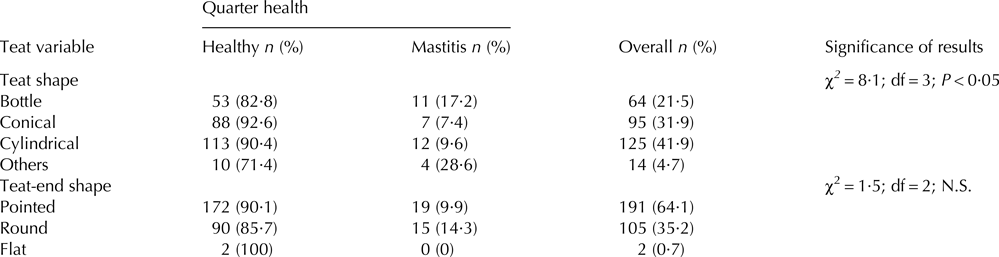
Teat shape was significantly associated with SCM (χ2 = 8·1; df = 3; P < 0·05; Table 4). The animals with teats classified as ‘others’ (28·6%) had a higher incidence of SCM, followed by those with bottle shaped teats (17·2%). Conical teats (7·4%) were the least associated with SCM in this study. With respect to teat-end shape, SCM was more frequently seen in round (14·3%) and pointed (9·9%) teat-ends. However, the effect of teat-end shape on SCM incidence was not of statistical significance. On the contrary, in dairy cows, Chrystal et al. (Reference Chrystal, Seykora, Hansen, Freeman, Kelley and Healey2001) indicated that herds in which teat-ends increase in score from pointed to inverted had increased susceptibility to mastitis. Likewise, Coban et al. (Reference Coban, Sabuncuoglu and Tuzemen2009) observed significantly higher SCC with inverted teats. These dissimilarities in findings could be related to genetic differences between breeds, the subjective nature of teat-end evaluation methods, and milking procedures.
Association between teat morphology and quarter health in buffaloes

N.S.: Non-significant.
Figures in parenthesis indicate percentage.
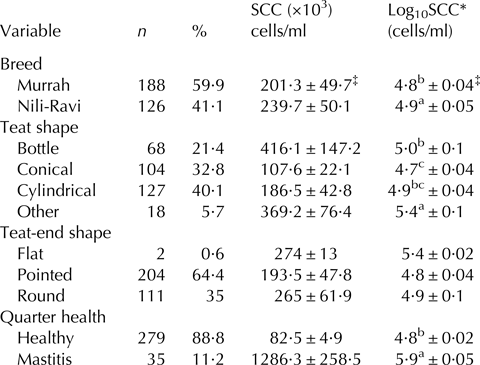
The log10SCC was significantly higher in Nili-Ravi buffaloes as compared with Murrah buffaloes (Table 5). This may be due to the differences in the teat morphometric parameters in these breeds, as discussed above. The teats of the Nili-Ravi buffaloes were longer, wider and placed closer to the ground, thus possibly making them more susceptible to SCM. Further, teats classified as ‘others’ had significantly higher cell counts (250 000 cells/ml) compared with the other shapes (P < 0·05). Conical shaped teats had the lowest cell count. No significant difference in SCC was observed with respect to teat-end shape, although the means were highest in teats with flat (274 000 cells/ml) and round (265 000 cells/ml) teat-ends. The SCC was significantly higher (P < 0·05) for animals suffering from SCM (794 000 cells/ml) compared with healthy animals (63 100 cells/ml).
Somatic cell counts (SCC) in buffaloes according to breed, teat morphology and quarter health

* Log base 10 transformation of SCC
‡ Values are Mean ± se
For each variable, means in columns with different superscripts differ significantly (P < 0·05)
A higher prevalence of SCM and SCC was related to teats that had an undefined shape. Similarly, teats with flat or rounded ends had a higher prevalence for SCC and SCM, respectively. However, no consensus could be drawn from the results of the present study regarding the effect of teat and teat-end shape on quarter health in these buffaloes. Hussain et al. (Reference Hussain, Javed, Khan and Muhammad2013) found a significant (P < 0·001) association between teat shape (classified as pointed, cylindrical, round and flat) and occurrence of mastitis in Nili-Ravi buffaloes; teats with round and cylindrical shapes being more susceptible to mastitis than pointed teats. On the contrary, Sharma et al. (Reference Sharma, Das, Ghosh, Banerjee and Mukherjee2017) did not observe any association between milk SCC and different teat shapes in high yielding crossbred cows. With respect to teat-end shapes, it has been reported that as the teat-end shape changes from pointed toward flat and inverted, SCC increases (Seykora & McDaniel, Reference Seykora and McDaniel1985). Slettbakk et al. (Reference Slettbakk, Jørstad, Farver and Holmes1995) reported that teats with flat teat-ends were more susceptible to clinical mastitis. However, Chrystal et al. (Reference Chrystal, Seykora and Hansen1999) showed no relationship between teat-end shape and SCC in cows.
No correlation was found between SCC and TL and TD in this study. On the contrary, Bharti et al. (Reference Bharti, Bhakat, Pankaj, Bhat, Prakash, Thul and Japheth2015) observed a positive correlation of SCC with TL and TD. Coban et al. (Reference Coban, Sabuncuoglu and Tuzemen2009) and Sharma et al. (Reference Sharma, Das, Ghosh, Banerjee and Mukherjee2017) also observed a positive correlation between mastitis and TD. However, a negative correlation between SCC and teat-end to floor distance was found in this study (P < 0·05). Similar findings were also reported by Sharma et al. (Reference Sharma, Das, Ghosh, Banerjee and Mukherjee2017) in dairy cows.
In conclusion, this study showed the relationship between some teat morphometric traits and poor udder health in lactating buffaloes. Similar to dairy cows, buffalo teats that had undefined shapes, that were longer and wider, and placed nearer to the floor had more associations with SCM and SCC. These morphometric traits should be included in breeding programmes to select against undesirable dairy type traits and so reduce the incidence of mastitis and improve milk production in Indian dairy buffaloes.