1. Introduction
Crustal-scale shear zones often host regional-scale mineralization because they provide suitable conduits for the circulation of hydrothermal fluids and emplacement of magma. Consequently, for shear zone-hosted hydrothermal mineralization it is often a common notion that shear deformation facilitates mineralization, although such perceptions are not always convincingly demonstrated with robust geochronological data. To develop any comprehensive model for the physicochemical-temporal evolution of shear zone-hosted mineralization, it is thus important to understand the temporal relationship of mineralization with shear deformation.
The polymetallic mineralization in the Singhbhum Shear Zone (SSZ) in eastern India is represented by several U, Cu and apatite-magnetite deposits with elevated concentrations of rare earth elements (REEs), Au, Co, Ni, Mo and Te, etc. Recent studies suggest that the mineralization in the SSZ has many characters akin to Fe-oxide–Cu–Au (IOCG)-type mineralization (Pal et al. Reference Pal, Barton and Sarangi2009, Reference Pal, Trumbull and Wiedenbeck2010, Reference Pal, Chaudhuri, McFarlane, Mukherjee and Sarangi2011 a,b, Reference Pal, Banerjee, Dutta and Sarangi2022; Pal & Bhowmick, Reference Pal and Bhowmick2015). The polymetallic ores are hosted in deformed, metamorphosed and metasomatized rocks where both the ore bodies and ore minerals show signatures of post-mineralization shear deformation (Pal et al. Reference Pal, Barton and Sarangi2009, Reference Pal, Sarkar, Mishra and Sarangi2011 b; Ghosh et al. Reference Ghosh, Dutta, Samanta and Pal2013; Chowdhury et al. Reference Chowdhury, Pal, Papineau and Lentz2020; Samanta et al. Reference Samanta, Pal, Biswas, Patnaik and Pachamuthu2021). In situ dating of ore minerals suggests four major events of mineralization and mobilization at c. 1.88 Ga (light rare earth element (LREE)-mineralization; laser ablation inductively coupled plasma mass spectrometry (LA-ICP-MS) U–Pb dating of allanite and monazite), c. ≥1.82−1.80 Ga (U–LREE-mineralization; LA-ICP-MS U–Pb dating of monazite and electron microprobe analysis (EMPA) U–Th–PbTotal dating of uraninite), c. 1.66−1.64 Ga (Y + heavy rare earth element (HREE) ± U mineralization; LA-ICP-MS U–Pb dating of allanite and EMPA U–Th–PbTotal dating of uraninite) and 950 ± 50 Ma (primarily remobilization/redistribution; LA-ICP-MS U–Pb dating of epidote, monazite, florencite and EMPA U–Th–PbTotal dating of uraninite) (Pal et al. Reference Pal, Chaudhuri, McFarlane, Mukherjee and Sarangi2011 a, Reference Pal, Basak, McFarlane and Sarangi2021; Pal & Rhede, Reference Pal and Rhede2013). Further, two stages of apatite mineralization at c. 1950 ± 100 Ma and c. 1600 ± 50 Ma, magnetite mineralization at c. 1950 ± 100 Ma (Vinogradov et al. Reference Vinogradov, Tugarinov, Zhykov, Sapnikova, Bibikova and Khorre1964) and sulphide mineralization at 1766 ± 82 Ma (Johnson et al. Reference Johnson, Dasgupta and Smith1993) are reported. Multiple events of sulphide and magnetite formation/mineralization are known in the SSZ (Pal et al. Reference Pal, Barton and Sarangi2009, Reference Pal, Sarkar, Mishra and Sarangi2011 b; Ghosh et al. Reference Ghosh, Dutta, Samanta and Pal2013; Chowdhury et al. Reference Chowdhury, Pal, Papineau and Lentz2020). It is, however, unclear which magnetite + apatite and sulphide mineralization events the 1950 ± 100 Ma and 1766 ± 82 Ma dates, respectively, represent. Based on 207Pb/206Pb of uraninite concentrates from different deposits in the SSZ, Krishna Rao et al. (Reference Krishna Rao, Aggarwal and Rao1979) reported an age of c. 1.58–1.48 Ga for uranium mineralization. However, it is known that there were multiple stages of hydrothermal fluid influx in the SSZ which has modified the geochemical signatures of existing uraninite (Pal & Rhede, Reference Pal and Rhede2013). Therefore, it is also unclear what the age obtained from the uraninite concentrates signifies. On the other hand, studies in the adjoining Proterozoic North Singhbhum Mobile Belt (NSMB), of which the SSZ is an integral part, suggest metamorphism occurred over a protracted period between c. 1.56 and 1.30 Ga (Mahato et al. Reference Mahato, Goon, Bhattacharya, Mishra and Bernhardt2008; Rekha et al. Reference Rekha, Upadhyay, Bhattacharya, Kooijman, Goon, Mahato and Pant2011; Chatterjee et al. Reference Chatterjee, De, Ranaivoson, Mazumder and Arima2013). However, the actual timing of shear deformation within the SSZ located on the southern boundary of the Proterozoic mobile belt remains unknown. Here, we directly date the shear deformation event using Re–Os dating of syn-shearing massive molybdenite occurring along shear surfaces in shear bands in the Jaduguda uranium deposit and discuss its implications for the timing of mineralization with respect to shear deformation and metamorphism in the SSZ.
2. Geological setting
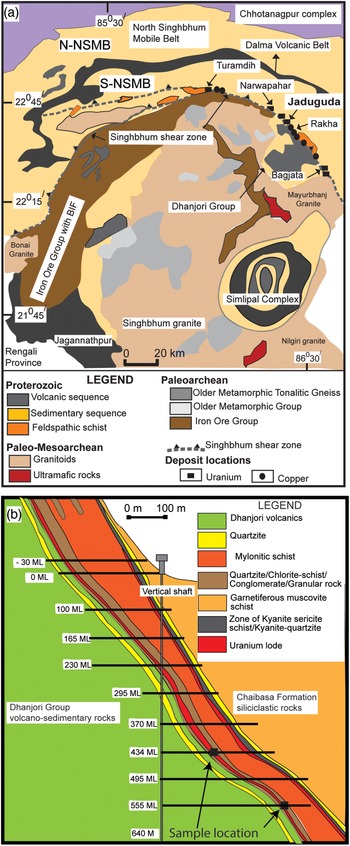
The SSZ in eastern India is a ∼200 km long arcuate belt located close to the boundary between the Archaean craton in the south and the Proterozoic NSMB in the north (Fig. 1a). The Singhbhum Craton is a granite-greenstone terrain that evolved over a protracted period during Palaeoarchaean and Mesoarchaean times (c. 3.57−3.10 Ga) (Moorbath et al. Reference Moorbath, Taylor and Jones1986; Goswami et al. Reference Goswami, Mishra, Wiedenbeck, Ray and Saha1995; Mishra et al. Reference Mishra, Deomurari, Wiedenbeck, Goswami, Ray and Saha1999; Acharyya et al. Reference Acharyya, Gupta and Orihashi2010; Tait et al. Reference Tait, Zimmermann, Miyazaki, Presnyakov, Chang, Mukhopadhyay and Sergeev2011; Nelson et al. Reference Nelson, Bhattacharya, Thern and Altermann2014; Upadhyay et al. Reference Upadhyay, Chattopadhyay, Kooijman, Mezger and Berndt2014, Reference Upadhyay, Chattopadhyay and Mezger2019; Dey et al. Reference Dey, Topno, Liu and Zong2017; Olierook et al. Reference Olierook, Clark, Reddy, Mazumder, Jourdan and Evans2019; Pandey et al. Reference Pandey, Mezger, Ranjan, Upadhyay, Villa, Nägler and Vollstaedt2019). The NSMB is subdivided into the northern and southern NSMB (N-NSMB and S-NSMB, respectively; Fig. 1a). The supracrustal province of the NSMB comprises the Chaibasa, Dhalbhum, Dalma and Chandil formations (from south to north) belonging to the Singhbhum Group. The supracrustal rocks of the S-NSMB located in the south of the Dalma Volcanic Belt experienced a major deformation and metamorphic event between c. 1.60 and 1.55 Ga and potentially mark the earliest amalgamation of the S-NSMB with the Singhbhum Craton (Rekha et al. Reference Rekha, Upadhyay, Bhattacharya, Kooijman, Goon, Mahato and Pant2011; Chakraborty et al. Reference Chakraborty, Upadhyay, Ranjan, Pruseth and Nanda2019).
(a) Geological map of the Singhbhum craton with the location of the Jaduguda deposit (redrawn from Saha, Reference Saha1994). BIF – banded iron formation; N-NSMB – north North Singhbhum Mobile Belt; S-NSMB – south North Singhbhum Mobile Belt. (b) Schematic cross-section of the Jaduguda hill showing the uranium ore lodes and the locations of molybdenite samples (compiled and modified from Gupta et al. Reference Gupta, Kundu, Sarangi, Husain and Barik2004 and Srinivasan & Sarangi, Reference Srinivasan and Sarangi1998).

The SSZ occurs close to the stratigraphic boundary between the Dhanjori Group and the Chaibasa Formation of the Singhbhum Group. The SSZ is interpreted to represent a deep-seated, crustal-scale, N-dipping tectonic dislocation zone (Sarkar & Saha, Reference Sarkar and Saha1962; Banerji, Reference Banerji1969, Reference Banerji1981), which localized penetrative shear deformation during top-to-south thrust movement of the NSMB block onto the southern Archaean Singhbhum Craton (Ghosh & Sengupta, Reference Ghosh and Sengupta1987; Sengupta & Ghosh, Reference Sengupta and Ghosh1997; Mukhopadhyay & Matin, Reference Mukhopadhyay and Matin2020; Roy & Matin, Reference Roy and Matin2020). Based on structural observations, such as a continuous increase in the deformation intensity, increasing fold tightness and continuity of mineral lineation from the NSMB to the SSZ, Ghosh & Sengupta (Reference Ghosh and Sengupta1987) suggested that the progressive deformation in the mobile belt and in the SSZ was synchronous. The SSZ is largely a ductile shear zone (Ghosh & Sengupta, Reference Ghosh and Sengupta1987; Sengupta & Ghosh, Reference Sengupta and Ghosh1997; Joy & Saha, Reference Joy and Saha2000; Roy & Matin, Reference Roy and Matin2020). However, local brittle/brittle–ductile deformation synchronous with ductile shearing is also described (Roy & Matin, Reference Roy and Matin2020). Regional crustal shortening and progressive ductile shearing associated with this southward crustal movement resulted in the development of pervasive mylonitic foliation that dips towards the north (in the central part of the SSZ near Jamshedpur) or the NE (in the eastern segment of the SSZ, including the study area), and formation of down-dip mineral/stretching lineation (Ghosh & Sengupta, Reference Ghosh and Sengupta1987). The mylonitic foliation represents the C-fabric of the mylonites (Roy & Matin, Reference Roy and Matin2020; Samanta et al. Reference Samanta, Pal, Biswas, Patnaik and Pachamuthu2021). The down-dip lineation is roughly parallel to the striations on slickenside surfaces occasionally seen on syn-shearing quartz veins that are emplaced parallel to the mylonitic foliations (Ghosh & Sengupta, Reference Ghosh and Sengupta1987).
The Jaduguda uranium deposit, located in the central segment of the mineralized SSZ, occurs near the boundary between the volcano-sedimentary rocks of the Dhanjori Group and the siliciclastic rocks of the Chaibasa Formation of the Singhbhum Group (Pal et al. Reference Pal, Basak, McFarlane and Sarangi2021). There are two mineable uranium lodes, referred to as the footwall and the hanging wall lodes (Fig. 1b), separated by a 60–100 m wide barren zone. The hanging wall side of the hanging wall lode is represented by siliciclastic rocks of the Chaibasa Formation, and the footwall side of the hanging wall lode is represented by volcano-sedimentary rocks of the Dhanjori Group. The uranium ore lodes and the region between these two uranium lodes are strongly sheared. The footwall lode is the principal ore lode having a width of ∼4 m, which in some mining levels attains a width of 20–30 m (Sarangi & Shastry, Reference Sarangi and Shastry1987). The rocks in the Jaduguda deposit are intensely sheared forming a pervasive S–C fabric and mylonitic foliation parallel to the C-foliation of the mylonitic fabric in the host rock (cf. Mishra & Singh, Reference Mishra and Singh2003). The foliation is defined by the preferred orientation of biotite and chlorite grains. There are various sets of shear planes in the rocks. The three planar structures, such as bedding planes, foliation/schistosity and shear planes are mutually parallel to one another (Venkataraman et al. Reference Venkataraman, Shastry and Srinivasan1971) and strike NW–SE with a dip varying from 40° to 60° towards the NE. The down-dip lineation on the mylonitic foliation is defined by stretched minerals, mineral aggregates and pebbles (Venkataraman et al. Reference Venkataraman, Shastry and Srinivasan1971).
3. Sample description
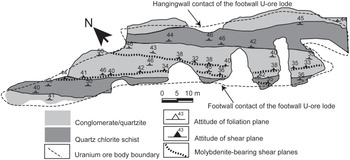
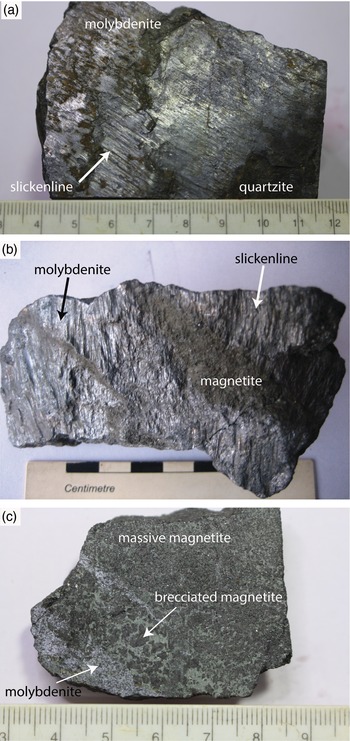
Molybdenite is a common accessory mineral associated with uranium ores in the Jaduguda deposit (Sarkar, Reference Sarkar1982). It occurs in two different modes. Disseminated flakes of molybdenite occur in the footwall uranium lode and in the rocks located between the footwall and the hanging wall uranium lodes. This molybdenite is associated with uraninite and Ni-sulphides such as millerite and pentlandite (cf. Sarkar, Reference Sarkar1982). On the other hand, prominent shear surfaces (tens of metres but generally not exceeding 100 m at stretch) hosting millimetre-wide massive molybdenite transect the footwall uranium lode where the width of the lode is 20–30 m (this study; Sarkar, Reference Sarkar1982; Sarangi & Shastry, Reference Sarangi and Shastry1987). A number of such shear surfaces are often localized within tens of centimetres wide shear zones/bands. The molybdenite-bearing shear surfaces strike NW–SE and are parallel (similar to the other shear planes as stated above) to the mylonitic foliation in the surrounding rocks (Fig. 2) (Venkataraman et al. Reference Venkataraman, Shastry and Srinivasan1971; Sarangi & Shastry, Reference Sarangi and Shastry1987). Molybdenite commonly occurs on slickenside surfaces in quartzite, chlorite schist and magnetite-rich bands/pockets (Fig. 3). The striations/slickenlines on the molybdenite-bearing slickenside surfaces generally run parallel to the down-dip lineation on the mylonitic foliation (cf. Ghosh & Sengupta, Reference Ghosh and Sengupta1987 for down-dip striations on syn-shearing quartz veins). For this study, massive molybdenite (N = 3) defining slickenlines on slickenside surfaces on (a) a massive magnetite body on the footwall side of the footwall uranium lode at the 434 m level (J-434A, J-434B) and (b) on quartzite in the footwall uranium lode at the 555 m level (JM-01) were collected (Fig. 3a, b). Similar molybdenite-bearing shear surfaces transecting the uranium lode have been described from the shallower levels in the Jaduguda mine (Sarkar, Reference Sarkar1982). The studied molybdenite layers are composed of flakes of molybdenite and chlorite. The magnetite body at the contact with the molybdenite-bearing shear planes is locally brecciated, and molybdenite-chlorite occurs up to a distance of 1–2 cm from the slickenside surface into the matrix of the brecciated magnetite (Fig. 3c).
Geological map of W3–W5 stope at the 434 m mining level showing the rock types, foliation in the host rocks along with the location and attitude of molybdenite-bearing shear surfaces (redrawn from Sarangi & Shastry, Reference Sarangi and Shastry1987). Sample for this level was collected from a shear plane on the magnetite body close to the footwall contact of the uranium lode. Sample from the 555 m level was collected from similar shear planes in quartzite.

Molybdenite on slickenline surfaces on (a) quartzite and (b) massive magnetite. (c) Unpolished sample cut from the sample in (b) showing the locally brecciated nature of magnetite close to the shear surface and molybdenite cementing the magnetite fragments.

4. Re–Os geochronology of molybdenite
Three representative samples, two from the 434 m level and one from the 555 m level were analysed. The rhenium–osmium molybdenite dating was undertaken using a well-established methodology of isotope dilution negative thermal ionization mass spectrometry (ID-NTIMS) at the Durham Geochemistry Centre (Selby & Creaser, Reference Selby and Creaser2001; Lawley & Selby, Reference Lawley and Selby2012; Li et al. Reference Li, Selby, Condon and Tapster2017). In brief, a pure molybdenite separate was obtained using the HF methodology and standard mineral separation techniques (Lawley & Selby, Reference Lawley and Selby2012). An aliquot of the molybdenite was analysed for its Re–Os systematics through digestion and mixing with a known amount of tracer solution (185Re + normal Os) in a sealed carius tube at 220 °C for 24 hours. The Os and Re were isolated and purified using solvent extraction and microdistillation, and solvent extraction and anion chromatography, respectively. Rhenium and Os isotopic measurements were determined by NTIMS on a ThermoScientific Triton mass spectrometer in static Faraday mode on Faraday detectors. Although negligible, the Re–Os data were blank corrected (Re = 2.4 pg, Os = 0.25 pg, with an 187Os/188Os value of 0.24 ± 0.01 (n = 1)). All sources of analytical, mass spectrometry and decay uncertainty were propagated to yield the presented Re–Os data and ages in Table 1.
Molybdenite rhenium–osmium data and age synopsis of the Jaduguda deposit

* uncertainty including only mass spectrometry uncertainty.
† uncertainty including all sources of analytical uncertainty.
‡ uncertainty including all sources of analytical uncertainty plus decay constant.
Sample JM-01 from the 555 m level possesses 4.5 ppm 187Re and 125 ppb 187Os, which yield a Re–Os date of 1638.3 ± 12.6 Ma. The two samples from the 434 m level are more enriched in 187Re (163–167 ppm) and 187Os (2772–2829 ppb), which yield Re–Os dates of 1602.2 ± 8.2 Ma (J-434A) and 1595.4 ± 8.2 Ma (J-434B).
5. Discussion and implications
The restricted occurrence of the studied massive molybdenite (unlike the disseminated molybdenite) localized along the shear surfaces transecting the uranium ores suggests that this molybdenite postdates the main uranium mineralization (≥1.82 Ga; Pal & Rhede, Reference Pal and Rhede2013) at Jaduguda. Based on studies from shallower levels in the Jaduguda mine, Sarkar (Reference Sarkar1982) also opined that thie shear surface (and vein)-hosted molybdenite postdates the disseminated molybdenite that is associated with uranium mineralization. Multiple lines of evidence, such as (a) a parallel geometrical relationship between the molybdenite-bearing shear surfaces and the pervasive mylonitic foliation in the country rock, which is again parallel/quasi-parallel to the regional shear foliation (C-plane of the mylonitic fabric) and the shear zone boundaries in this sector, and (b) the parallel orientation of the slickenlines on molybdenite-bearing slickenside surfaces and the down-dip lineation on the mylonitic foliation of the country rock, suggest that the molybdenite and the host shear planes/bands formed synchronously with the regional ductile shear deformation that characterizes the SSZ. Therefore, the Re–Os molybdenite date constrains the timing of ductile shear deformation in the SSZ.
We propose that the c. 1.64−1.59 Ga date obtained from the molybdenite marks the pervasive event of ductile shear deformation in the SSZ. The molybdenite Re–Os ages are close to the timing of the second generation of allanite/epidote from the Jaduguda and the Bagjata uranium deposit and that of Y + HREE ± U metasomatism in the Jaduguda deposit (c. 1.66–1.64 Ga), which modified the texture and composition of existing older (≥c. 1.82 Ga) uraninite (Pal et al. Reference Pal, Chaudhuri, McFarlane, Mukherjee and Sarangi2011 a, Reference Pal, Basak, McFarlane and Sarangi2021; Pal & Rhede, Reference Pal and Rhede2013). The timing of the pervasive metamorphic event at c. 1.59–1.56 Ga in the S-NSMB is suggested to record the closure of the S-NSMB basin (Rekha et al. Reference Rekha, Upadhyay, Bhattacharya, Kooijman, Goon, Mahato and Pant2011). The overlapping and younger age (1.59−1.56 Ga) of this metamorphism compared to the shear deformation (1.64−1.59 Ga) reported in the present study is in accordance with the understanding that metamorphism outlasted shear deformation in the SSZ (Sengupta et al. Reference Sengupta, Mukhopadhyay, Sengupta and Hoffbauer2005). The new age data in conjunction with (a) the micro-textural and micro-structural relationships of the ore minerals with the host-rock fabric suggesting pre-/early-shearing growth of some generations of ore minerals (Pal, et al. Reference Pal, Barton and Sarangi2009; Ghosh et al. Reference Ghosh, Dutta, Samanta and Pal2013; Chowdhury et al. Reference Chowdhury, Pal, Papineau and Lentz2020), (b) the morphology of the ore bodies with overprints of ductile deformation (Samanta et al. Reference Samanta, Pal, Biswas, Patnaik and Pachamuthu2021) and (c) previously published ages of mineralization (see Section 1; Johnson et al. Reference Johnson, Dasgupta and Smith1993; Pal et al. Reference Pal, Chaudhuri, McFarlane, Mukherjee and Sarangi2011 a, Reference Pal, Basak, McFarlane and Sarangi2021; Pal & Rhede, Reference Pal and Rhede2013) and metamorphism (Mahato et al. Reference Mahato, Goon, Bhattacharya, Mishra and Bernhardt2008; Rekha et al. Reference Rekha, Upadhyay, Bhattacharya, Kooijman, Goon, Mahato and Pant2011) collectively suggest that the polymetallic mineralization in the SSZ initiated much before the onset of ductile shearing and concomitant metamorphism. The rocks in the NSMB are interpreted to have been originally deposited diachronously over a protracted period in an intracontinental extensional setting (Bhattacharya & Mahapatra, Reference Bhattacharya and Mahapatra2008; Bhattacharya et al. Reference Bhattacharya, Nelson, Thern and Altermann2015; De et al. Reference De, Mazumder, Ohta, Hegner, Yamada and Bhattacharyya2015; Mazumder et al. Reference Mazumder, De, Ohta, Flannery, Mallik, Chaudhury, Chatterjee, Ranaivoson, Arima, Mazumder and Eriksson2015; Olierook et al. Reference Olierook, Clark, Reddy, Mazumder, Jourdan and Evans2019). Moreover, in most tectonic models, the present location of the SSZ is interpreted, implicitly or explicitly, to be the loci of earlier deep-seated faults (concomitant with extension) on the northern margin of the Singhbhum craton, which later localized penetrative deformation and metamorphism during southward thrusting of the S-NSMB onto the Archaean Singhbhum Craton at the time of closure of the extensional basin (Banerji, Reference Banerji1969, Reference Banerji1981; Mukhopadhyay, Reference Mukhopadhyay and Sychanthavong1990; Gupta & Basu, Reference Gupta and Basu2000; Bhattacharya & Mahapatra, Reference Bhattacharya and Mahapatra2008; Bhattacharya et al. Reference Bhattacharya, Nelson, Thern and Altermann2015). Recently, Chakraborti et al. (Reference Chakraborti, Kimura, Ray, Kumar Deb and Chakrabarti2021) reported a c. 1.88 Ga gabbroic body from the Chaibasa Formation in the northeastern part of the NSMB and suggested that these gabbroic bodies were emplaced during the rift-drift transition of the Chaibasa intracontinental rift basin. Crustal-scale thermal perturbation and widespread extension-related c. 1.88 Ga mafic dyke swarms are also known from the Bastar and the Dharwar cratons (French et al. Reference French, Heaman, Chacko and Srivastava2008; Belica et al. Reference Belica, Piispa, Meert, Pesonen, Plado, Pandit, Kamenov and Celestino2014; Shellnutt et al. Reference Shellnutt, Hari, Liao, Denyszyn and Vishwakarma2018). This crustal-scale extensional event in the NSMB in particular, and in peninsular India in general, coincides with the first event of hydrothermal LREE-mineralization at 1.88 Ga in the SSZ (Pal et al. Reference Pal, Chaudhuri, McFarlane, Mukherjee and Sarangi2011 a, Reference Pal, Basak, McFarlane and Sarangi2021). To our knowledge, the ≥1.82−1.80 Ga hydrothermal U–LREE-mineralization event has not yet been directly linked by robust dating with the extensional events in the NSMB. However, considering the multi-stage evolutionary history of the NSMB extensional basin during Palaeoproterozoic time (Bhattacharya et al. Reference Bhattacharya, Nelson, Thern and Altermann2015; Olierook et al. Reference Olierook, Clark, Reddy, Mazumder, Jourdan and Evans2019 and references therein), we interpret that the major hydrothermal mineralization and associated alteration in the SSZ took place in Palaeoproterozoic time (c. 1.9−1.8 Ga) along crustal-scale faults during the initial opening of the extensional basin and reactivation of the faults during subsequent extensions, way before the closing of the S-NSMB basin and concomitant shear deformation at the Palaeoproterozoic–Mesoproterozoic boundary (c. 1.65−1.60 Ga). As a corollary of this interpretation we further propose that shearing did not trigger the primary hydrothermal mineralization in the SSZ, rather hydrothermal mineralization and consequent widespread alteration in Palaeoproterozoic time (c. 1.9−1.8 Ga) along crustal-scale extensional faults on the northern periphery of the Singhbhum granite complex (between the Dhanjori Group and Chaibasa Formation) later localized shear deformation at the time of thrusting of the NSMB over the Archaean craton at the Palaeoproterozoic–Mesoproterozoic boundary (c. 1.65–1.6 Ga; also see Pal et al. Reference Pal, Basak, McFarlane and Sarangi2021). The overprinting shear deformation and metamorphism, however, resulted in redistribution/reorganization of the existing metal/mineral inventory with or without neo-mineralization.
Acknowledgements
We thank the Chairman and Managing Director of Uranium Corporation of India Limited for allowing collection of samples from the mine during the 2012 field season. The analytical cost for molybdenite dating was met from ‘Departmental support towards upgradation in research’ in the thrust area ‘Advanced material research’ to DCP through JU RUSA 2.0 of the University Grants Commission, Government of India. We thank Chris Ottley and Geoff Nowell for analytical support. We sincerely acknowledge the critical review and very constructive suggestions from David Lentz and another anonymous reviewer, and Olivier Lacombe, the editor, which helped to significantly improve the manuscript. Constructive discussion with Nibir Mandal is also thankfully acknowledged.