INTRODUCTION
Current neurobiological models of addiction emphasize the central role of drug-related stimuli in maintaining addictive behaviour (Robinson & Berridge, Reference Robinson and Berridge1993; Goldstein & Volkow, Reference Goldstein and Volkow2002; Lubman et al. Reference Lubman, Yucel and Pantelis2004). For example, the incentive-sensitization theory posited by Robinson & Berridge (Reference Robinson and Berridge1993) suggests that repeated use of a drug causes stimuli associated with the drug to acquire incentive value; as the number of paired stimuli–drug presentations increase, the incentive value of these stimuli intensifies, making them increasingly ‘wanted’. With further use, drug cues acquire excessive incentive salience, ‘wanting’ transforms into excessive drug craving, and drug cues become potent perpetuators of further drug-seeking and drug-taking despite subjective awareness of associated adverse consequences. In support of this model, addicted individuals show an attentional bias for substance-related words and pictures (Franken et al. Reference Franken, Kroon and Hendriks2000; Lubman et al. Reference Lubman, Peters, Mogg, Bradley and Deakin2000; Robbins & Ehrman, Reference Robbins and Ehrman2004), while cue-exposure paradigms reliably induce craving and increase blood flow within reward-related brain regions (Childress et al. Reference Childress, Mozley, McElgin, Fitzgerald, Reivich and O'Brien1999; Wang et al. Reference Wang, Volkow, Fowler, Cervany, Hitzemann, Pappas, Wong and Felder1999; Daglish et al. Reference Daglish, Weinstein, Malizia, Wilson, Melichar, Britten, Brewer, Lingford-Hughes, Myles, Grasby and Nutt2001; Goldstein & Volkow, Reference Goldstein and Volkow2002; Lubman et al. Reference Lubman, Yucel and Pantelis2004).
Although this remains a widely accepted and well-articulated theory, supporting experimental evidence in human addicts is still largely lacking (Lubman et al. Reference Lubman, Yucel and Pantelis2004). In addition, drug users rarely cite cues as major precipitants of relapse (Bradley et al. Reference Bradley, Phillips, Green and Gossop1989; Miller & Gold, Reference Miller and Gold1994), suggesting that addicts may not be fully aware of the role such stimuli play in directing their behaviour. Studies that seek to investigate the role of drug cues in addiction require paradigms that directly probe central attentional processes. Such studies should incorporate methodologies that have the capacity to index allocation of processing resources to specific stimuli, irrespective of the individual's awareness. Paradigms using event-related potentials (ERPs) are particularly appropriate for addressing such questions, as ERPs provide a direct measure of cortical activity, with sufficient temporal precision to distinguish between the rapid perceptual and cognitive processes occurring during stimulus processing (Luck et al. Reference Luck, Woodman and Vogel2000).
In keeping with this notion, a number of recent ERP studies have examined electrophysiological processing of drug-related stimuli within a variety of different addicted populations (Warren & McDonough, Reference Warren and McDonough1999; Herrmann et al. Reference Herrmann, Weijers, Wiesbeck, Aranda, Böning and Fallgatter2000, Reference Herrmann, Weijers, Wiesbeck, Boning and Fallgatter2001; Franken et al. Reference Franken, Stam, Hendriks and van den Brink2003, Reference Franken, Kai, Stam, Hendriks and van den Brink2004; van de Laar et al. Reference van de Laar, Licht, Franken and Hendriks2004). For example, alcohol-related stimuli have been shown to elicit enhanced P300 amplitudes among alcoholics (Herrmann et al. Reference Herrmann, Weijers, Wiesbeck, Boning and Fallgatter2001), while smoking cues have been shown to produce similar ERP outcomes in smokers (Warren & McDonough, Reference Warren and McDonough1999). The P300 is thought to index the process of ‘context-updating’, such that stimuli classified as salient and/or task relevant attract greater attentional resources and produce a larger P300 (Pritchard, Reference Pritchard1981). Although recent studies of heroin and cocaine users did not find enhanced P300 amplitudes to drug-related cues (Franken et al. Reference Franken, Stam, Hendriks and van den Brink2003, Reference Franken, Kai, Stam, Hendriks and van den Brink2004; van de Laar et al. Reference van de Laar, Licht, Franken and Hendriks2004), the authors did report evidence of larger cue-evoked slow positive waves.
Environmental stimuli may capture attentional resources either through individual executive control (such as during a goal-directed task) or through their inherent motivational significance. Previous ERP studies of addicted populations have used passive viewing tasks that do not distinguish between automatic and controlled aspects of attentional processing, despite the availability of ERP paradigms that index both types of attentional processes (Ito & Urland, Reference Ito and Urland2003). For example, the ‘oddball’ task is a well-validated ERP paradigm that indexes the attentional salience of stimuli by the elicitation of the P300 component (Pritchard, Reference Pritchard1981). However, to date, ERP studies of drug cues in addicted populations have not used oddball designs, making it difficult to distinguish whether observed differences in electrophysiological processing relate to discrepancies in participants' intentional viewing strategies (i.e. whether they are consciously choosing to focus attention on drug stimuli) or the inherent motivational significance of drug stimuli (i.e. whether drug stimuli capture attentional resources non-volitionally, such as when attention is directed towards a non-drug-related task). Distinguishing between these possibilities is important in order to understand the role of attentional processes in the maintenance of addictive behaviours. To this end, the present study is the first to use an oddball design to examine processing of drug cues when participants are required to perform a non-drug-related task. It was hypothesized that heroin-related images would elicit larger P300s (compared with neutral stimuli) in opiate-dependent individuals (compared with non-opiate dependent individuals), despite attention being actively directed towards task-relevant oddball stimuli.
METHOD
Fourteen methadone-maintained (MM) heroin addicts and 14 age-, sex- and IQ-matched control subjects (drug treatment workers) were recruited from local drug services in Manchester, UK. MM subjects had all previously injected heroin, and met ICD-10 criteria for opiate dependence (WHO, 1992). Right-handed drug treatment workers with no lifetime history of substance use disorder or intravenous drug use were recruited as controls. All MM subjects were right-handed and on a stable dose of oral methadone mixture. MM subjects were excluded if dependent on any other non-prescribed medication. All subjects were assessed by a psychiatrist (D.I.L.), and were found to be in good general health, with no history of major mental illness, significant head injury or neurological disorder. Written informed consent was obtained from all subjects.
All subjects were asked to complete the Beck Depression Inventory (BDI; Beck et al. Reference Beck, Ward, Mendelson, Mock and Erbaugh1961) and the State–Trait Anxiety Inventory (STAI; Spielberger et al. Reference Spielberger, Gorsuch, Lushene, Vagg and Jacobs1983). MM subjects were asked about their current and past drug use, and completed the Severity of Dependence Scale (SDS, a five-item self-rating scale of psychological dependence, with a maximum score of 15; Gossop et al. Reference Gossop, Darke, Griffiths and Hando1995), the Short Opiate Withdrawal Scale (SOWS, a 10-item self-rating scale of the signs and symptoms of opiate withdrawal, with a maximum score of 30; Gossop, Reference Gossop1990), and a pre- and post-test visual analogue craving scale ranging from 0 (no craving) to 9 (extreme).
Visual stimuli included 48 opiate-related pictures (consisting of drug paraphernalia and scenes of an unidentified addict ‘cooking up’ and injecting heroin) and 48 neutral stimuli (depicting the same individual working in similar fashion with pieces of wood and carpentry tools, shot in the same location). All stimuli were scanned into a computer and resized to the same dimensions. Twenty-four oddball images were also selected, consisting of 12 opiate-related and 12 neutral stimuli in which a white cup (the target) was clearly identifiable somewhere within the picture. Equal proportions of the opiate, neutral and target stimuli were randomly allocated to one of two experimental blocks of 60 pictures.
Each subject was presented with 20 practice trials (neutral filler pictures, including four containing a white cup) and two blocks of 60 randomized experimental trials. Three filler pictures were presented at the beginning of each experimental block. A white fixation cross was displayed for 500 ms in the middle of the screen at the beginning of each trial, which cued participants to attend to this region of the monitor. After the fixation cross was removed, there was a blank screen for 500 ms. Pictures (16·5 cm long×11·5 cm high) were subsequently displayed for 500 ms with a 2·5 s inter-stimulus interval prior to the presentation of the next fixation cross. The order of picture presentation within each block was computed using random number tables, and each participant was presented with the same sequence of stimuli. Subjects were instructed to press a button as quickly as possible whenever a target stimulus (white cup) was displayed. All subjects were given a 2-min rest period between the two experimental blocks. Neurostim 2.0 (Neuroscan Inc., San Antonio, TX, USA) software was used to control stimulus presentation and to record response latency.
Each subject was fitted with an electrode cap (Electro Cap International, Inc., Eaton, OH, USA), and 31 channels of electroencephalography (EEG) and one channel of electro-oculography (EOG) were recorded, with a linked-ear reference. Electrode impedances were kept at 5 kΩ or less. A Synamp 1 and Scan 4.0 (Neuroscan Inc.) EEG acquisition system was used, and the EEG signal was amplified and passed through a bandpass filter (0·16–30 Hz). The EEG and EOG were sampled continuously at 250 Hz, and digitized by a 16-bit analogue-to-digital converter.
The EEG was epoched into 1200 ms segments including a 200 ms pre-stimulus baseline and a 1000 ms post-stimulus period. EEG epochs for each electrode were sorted into stimulus categories and averaged for each participant. Components were identified using temporal principal components analysis (Dien & Frishkoff, Reference Dien and Frishkoff2005) on data points between 0 and 600 ms post-stimulus. The first component (which accounted for 39% of the variance) corresponded to a positive going waveform between 280 ms and 600 ms post-stimulus, and the factor score for this component was used to quantify the P300 component.
RESULTS
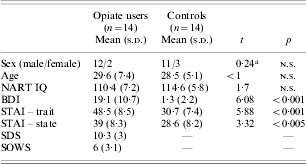
The two groups did not differ significantly in gender ratio, age or National Adult Reading Test (NART)-estimated IQ (Nelson, Reference Nelson1982) (see Table 1). The MM group reported a high level of psychological dependence on heroin (mean 10·3, compared with mean scores of between 5·2 and 8·7 in previous studies of heroin-using samples; Gossop et al. Reference Gossop, Darke, Griffiths and Hando1995), and low levels of withdrawal symptoms [mean SOWS score of 0·2 (6/30) is suggestive of no withdrawal symptoms; Gossop, Reference Gossop1990]. Subjects had first used heroin aged 18·9 (s.d.=3·7) years and had been using opiates for an average of 10·8 (s.d.=7·2) years. The mean dose of methadone prescribed was 53·9 mg (s.d.=26·7). Despite this, 35·7% had used heroin within the past 7 days, although the median number of days since heroin was last used was high at 83·5 (2·5–296). Non-dependent drug use among the MM group included cannabis (nine users), alcohol (three), amphetamine (three) and ecstasy (one).
Group characteristics, mean scores (s.d.)

s.d., Standard deviation; n.s., not significant; NART, National Adult Reading Test; BDI, Beck Depression Inventory; STAI, State–Trait Anxiety Inventory; SDS, Severity of Dependence Scale; SOWS, Short Opiate Withdrawal Scale.
a χ2 value, df=1.
Latency data from trials with subject errors were removed, and reaction times less than 200 ms or more than 2 s were excluded to eliminate latencies associated with anticipatory or excessively delayed responses. Percentage correct responses were also calculated for each subject. The groups did not differ on reaction times to target stimuli, although the MM group were significantly less accurate at target detection [89·9% (s.d.=14·9) v. 98·8% (s.d.=2·5), t=2·22, p<0·05]. MM subjects did not show any change in their craving scores following task completion [pre-test mean 3·6 (s.d.=3·1), post-test mean 3·6 (s.d.=3·5), t=0·16, n.s.] and did not report any increase in their desire to use heroin.
Data from two controls and one MM subject were excluded from statistical analysis because less than 17 artefact-free trials were available from one or more stimulus categories (averaging over less than 17 trials provides inadequate reliability because of poor signal-to-noise ratio; Todd, Reference Todd2005). Statistical analyses were conducted on P300 amplitudes derived from nine central sites (F3, Fz, F4, C3, Cz, C4, P3, Pz, P4) with a 3-stimulus category (neutral, opiate, oddball) by 3 anterior–posterior (frontal, central, parietal) by 3 laterality (right, central, left) by 2 group (MM, control) mixed model repeated measures analysis of variance. To protect against violations of sphericity, the Greenhouse–Geisser epsilon correction was applied. This analysis revealed significant main effects of stimulus category [F(2, 46)=10·17, p<0·001], anterior–posterior region [F(2, 46)=52·05, p<0·0001] and laterality [F(2, 46)=4·31, p<0·05]. Contrasts revealed that the P300 was significantly larger to opiate and oddball pictures than neutral pictures, that it was larger at central and parietal than frontal sites, and that it was larger at midline than lateral sites.
The overall main effect of group was not significant [F(1, 23)=1·20, n.s.]. Furthermore, there were no group differences in the specific P300 response to neutral [F(1, 23)=2·66, n.s.] or opiate pictures (F<1), although there was a non-significant trend for the control group to have a larger response to the oddball stimuli than the MM group [F(1, 23)=3·171, p=0·09].
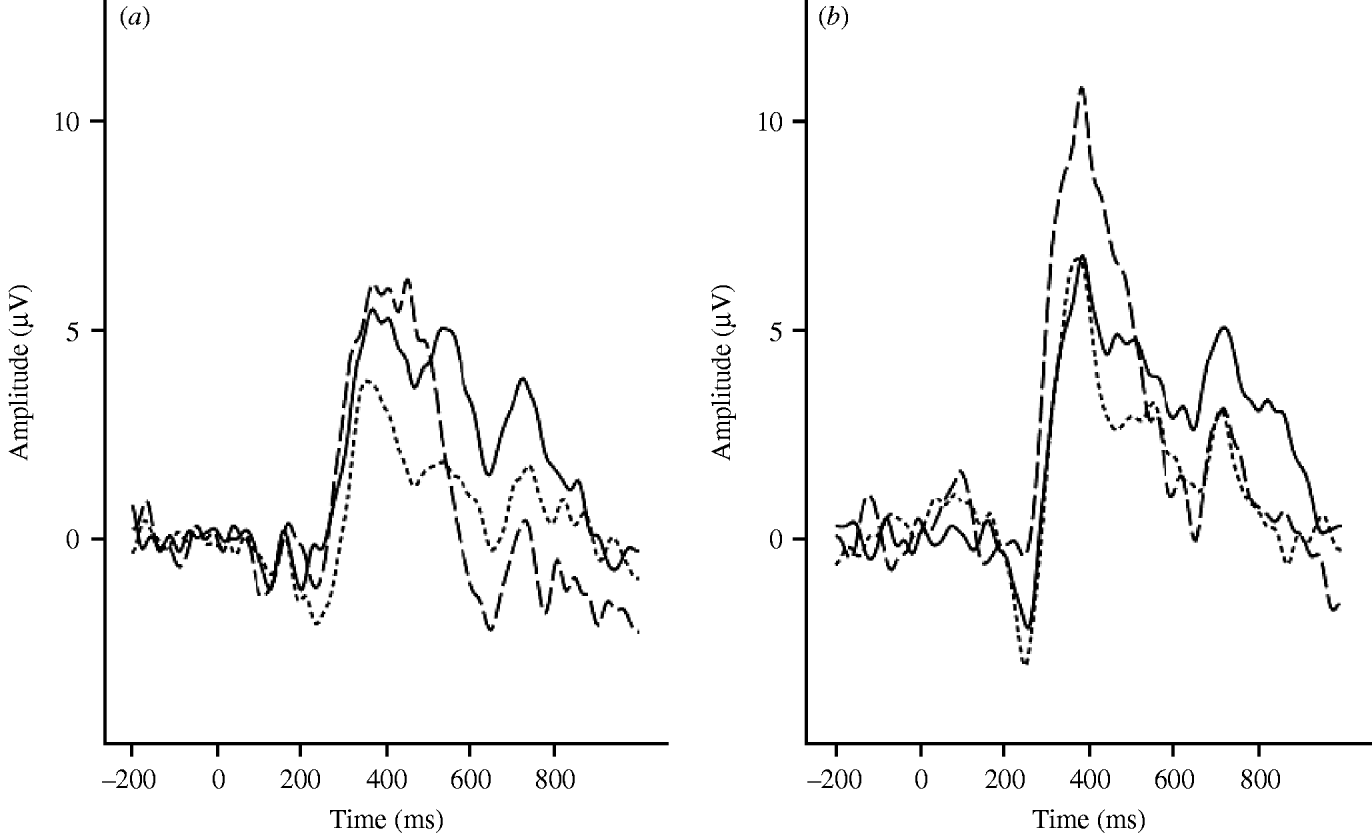
To test the hypotheses in this study, specific contrasts within the stimulus category effect, and their interaction with group, were examined. The contrast between neutral and oddball stimuli was significant [F(1, 23)=17·31, p<0·001] but showed no effect of group (F<1). The contrast between neutral and opiate stimuli was also significant [F(1, 23)=16·26, p<0·001] and was significantly modified by group [F(1, 23)=4·39, p<0·05]. Further tests revealed that although the magnitude of the P300 elicited by opiate stimuli was significantly larger than that elicited by neutral stimuli in the MM group [F(1, 12)=26·40, p<0·001], there was not a significant difference between these conditions in the control group [F(1, 11)=1·48, n.s.]. While there was no significant difference between P300 amplitudes elicited by opiate and oddball stimuli, there was a non-significant trend for this to be modified by group membership [F(1, 23)=3·58, p=0·07]. Further tests revealed that although there was not a significant difference between these conditions among the control subjects (F<1), there was a non-significant trend for the opiate stimuli to elicit larger P300s than the oddball stimuli in the addicted group [F(1, 12)=3·34, p=0·09]. Grand mean ERP waveforms for each condition and group are presented in Fig. 1.
Grand mean event-related potentials (ERPs) for nine central sites (F3, Fz, F4, C3, Cz, C4, P3, Pz, P4) for (a) methadone-maintained heroin addicts and (b) controls. Condition: - - - - -, neutral; ––––, opiate; – – –, oddball.

DISCUSSION
Utilizing a novel visual oddball paradigm, we have demonstrated that drug-related stimuli evoke significantly greater P300 amplitudes than equi-probable non-drug pictures in opiate addicts. This suggests that for this population, drug cues have implicit motivational salience, and are able to capture attentional resources even when attention is directed elsewhere. These findings are consistent with previous behavioural studies of attentional processing in opiate addiction (Franken et al. Reference Franken, Kroon and Hendriks2000; Lubman et al. Reference Lubman, Peters, Mogg, Bradley and Deakin2000). For example, using a pictorial probe detection task, Lubman et al. (Reference Lubman, Peters, Mogg, Bradley and Deakin2000) reported that MM opiate addicts demonstrate an attentional bias to opiate-related visual stimuli, while Franken et al. (Reference Franken, Kroon and Hendriks2000) observed an attentional bias for drug-related words among a sample of recently detoxified heroin addicts. In the latter study, a significant correlation was found between craving scores and response time latencies to heroin words. Similar findings have been reported across a range of addicted populations (see Robbins & Ehrman, Reference Robbins and Ehrman2004 for a comprehensive review), including individuals with alcohol dependence (Sharma et al. Reference Sharma, Albery and Cook2001), compulsive gambling (McCusker & Gettings, Reference McCusker and Gettings1997), nicotine dependence (Mogg et al. Reference Mogg, Bradley, Field and De Houwer2003) and cocaine use (Hester et al. Reference Hester, Dixon and Garavan2006).
Importantly, in the current study, drug-related stimuli did not evoke greater P300 amplitudes in a control group familiar with drug paraphernalia and injecting behaviour (i.e. drug treatment workers). This suggests that familiarity alone is not sufficient to direct attentional processes. Rather, the cue must be personally motivationally salient (either appetitive or aversive) for the P300 to be enhanced when attention is directed elsewhere. In line with this notion, patients with anxiety disorders demonstrate larger P300s to fear-related stimuli (Pauli et al. Reference Pauli, Dengler, Wiedemann, Montoya, Flor, Birbaumer and Buchkremer1997), while combat-related stimuli evoke greater P300s among veterans with post-traumatic stress disorder (PTSD) compared to veterans without PTSD (Attias et al. Reference Attias, Bleich, Firman and Zinger1996).
These results are also consistent with previous ERP studies, where stimuli with rewarding incentive value evoke larger P300 amplitudes (Begleiter et al. Reference Begleiter, Porjesz, Chou and Aunon1983). Although recent ERP research in addicted populations has also demonstrated differential electrophysiological processing of alcohol/drug cues (Herrmann et al. Reference Herrmann, Weijers, Wiesbeck, Aranda, Böning and Fallgatter2000, Reference Herrmann, Weijers, Wiesbeck, Boning and Fallgatter2001; Franken et al. Reference Franken, Stam, Hendriks and van den Brink2003, Reference Franken, Kai, Stam, Hendriks and van den Brink2004; van de Laar et al. Reference van de Laar, Licht, Franken and Hendriks2004), such studies used passive viewing tasks and could not assess the inherent motivational salience of drug cues when attention was directed elsewhere. Our results suggest that drug cues automatically capture attentional resources in addicted subjects, even when engaged in a non-drug-related task. Furthermore, no change in craving score over the course of the experiment was observed in the addicted group, suggesting that drug cues can capture attentional resources and therefore potentially influence behaviour, without evoking sustained subjective craving responses. Research investigating subjective reasons for relapse in drug users supports this notion. Miller & Gold (Reference Miller and Gold1994) reported that only 7% of drug users cited craving as a primary factor, whereas a significant proportion (41%) attributed their relapse to an ‘impulsive action’.
The high accuracy scores suggest that neither subject group found the paradigm particularly difficult, and that both groups actively attended to the task. However, the MM group did make significantly more mistakes on the picture task, raising the possibility that they were less motivated or attentive to the primary task. Nevertheless, the MM group did not differ on latency of response and retained a 90% accuracy rate, indicating they were sufficiently engaged with the task to perform at a high level. This suggests that any decrement in attention or motivation in the MM group was marginal, rather than reflecting a significant degree of non-engagement with the task. Instead, differences in accuracy rates may relate to interference effects from the drug stimuli, such that the MM group were less efficient at recognizing target stimuli. This is in keeping with the reported ERP findings, including the non-significant trend for oddball stimuli to elicit a smaller P300 within the MM group.
A key limitation of this study is the small sample size, and it is unclear how generalizable these results are to the wider heroin-using population. These findings require replication in a larger sample and across different addicted groups. Furthermore, no biological assays were conducted on the day of testing to confirm recent abstinence from heroin or other illicit drugs. However, the MM group reported low SOWS scores, suggesting that they were stable on their prescribed methadone and were not dependent on illegal opiate supplies. In addition, all subjects guaranteed that they had taken their methadone dose at the usual time that day, and that they had not used any other drugs in the past 24 h. Although this was not checked formally, none of the subjects appeared to be intoxicated or in withdrawal, and all maintained concentration during the entire length of the experiment.
An additional confound is that the subject groups were not matched on depressive and anxiety symptomatology, although it is important to note that no participant met criteria for a current mood or anxiety disorder. The findings in the current study relate to differences in ERP response to drug cues, rather than affective stimuli, suggesting that differential P300 responses were unlikely to have been specifically driven by differences in anxiety and depression scores. Furthermore, high rates of anxiety and depressive symptoms are commonly reported in studies of addicted populations, including those on substitution pharmacotherapy (Abbott et al. Reference Abbott, Weller and Walker1994; Mason et al. Reference Mason, Kocsis, Melia, Khuri, Sweeney, Wells, Borg, Millman and Kreek1998).
An additional limitation relates to the absence of a non-drug-related emotionally salient class of stimuli (e.g. sexual imagery, highly aversive images). As discussed by Robbins & Ehrman (Reference Robbins and Ehrman2004), studies of attentional bias in substance abuse need to control for the possibility that substance users find all emotional cues especially salient, rather than drug-related stimuli alone. Future studies should be mindful of this issue, and include relevant emotionally valenced stimuli within their design.
The differential ERP response observed among opiate addicts in this study provides important, if preliminary, evidence that the P300 may be an objective index of the incentive motivational properties of drug cues in addiction. If so, it may provide an important biological marker of prognosis, including susceptibility to relapse.
ACKNOWLEDGEMENTS
D.I.L. was supported by an MRC Training Fellowship. L.A.P. was supported by a Wellcome Training Fellowship.
DECLARATION OF INTEREST
None.