


Introduction
War is defined by uncertainty. Technologies and doctrines evolve between conflicts, making it impossible to fully anticipate the best way to fight the next war. Adversaries misrepresent their strategies and capabilities. And a fog of contradictory information and flawed intelligence always shrouds combat. For all these reasons, military organisations that can accurately detect performance gaps and rapidly generate viable alternative tactics, techniques, and procedures (TTPs) possess a distinct advantage over those that cannot. In essence, adaptive military organisations are effective military organisations.
For scholars, policymakers, and military leaders alike, the challenge is to understand why some military organisations have proven better at adapting than others. Indeed, while the British and German armies are oft-cited examples of military organisations particularly adept at adaptation,Footnote 1 we have few generalisable theories to explain why. As Rosen points out, variables that appear to foster change in one case seem to impede such change in another.Footnote 2 Similarly, despite the tendency to broadly portray some military organisations as more dynamic and flexible than others, such sweeping characterisations usually fall apart under scrutiny. Some particularly adaptive organisations, such as the German Army, lost the wars they waged. Other military organisations may have failed to change for reasons beyond their control, such as political constraints.Footnote 3 Especially problematic for scholars and leaders in search of a universal theory of adaptation, most militaries have a decidedly mixed track record. For example, the US military proved more successful at adapting to counterinsurgency in Iraq than in Vietnam.Footnote 4
We take a different approach to understanding why some militaries are better at adaption. Instead of generating and testing a universal theory, we follow the example set by the business and economics literatures on organisational change and disaggregate adaptation into a multi-step process.Footnote 5 Rather than trying to explain every step in the process, we focus on the first step – detecting failure. We argue that institutionalised feedback loops are a critical mechanism for facilitating detection, which must occur for the adaptation process to begin.
To be clear: by institutionalised feedback loop we mean something specific. It is not enough to generate after action reports or circulate lessons learned memoranda. War produces an overwhelming amount of information. Unfiltered and unrestrained, the routine production and widespread dissemination of small unit experience is more likely to cause information overload than it is to trigger change. We posit that feedback loops will prove most effective when they proactively filter information. To do so, they need to include frontline personnel and dedicated specialists, create a protected space for dissent, and disseminate analysis directly to senior tactical leaders.
The remainder of the article is structured as follows: After reviewing the literature, we present our model of recognising failure, focusing on the necessary elements of a good institutionalised feedback loop. We then illustrate this model using the case from which it was developed: British counterinsurgency operations in the Southern Cameroons from 1960–1. We test our model against a very different case, while still controlling for known prerequisites for adaptation: the evolution of the British Army's assault tactics on the Western Front during the First World War. We also leverage within case variation, showing that the British Expeditionary Force's efforts to formalise and institutionalise its feedback loops in 1917 led to a much greater capacity to recognise shortcomings in its infantry assault tactics. We conclude by discussing two key lessons for militaries seeking to become more adaptive organisations.
A new, but rapidly evolving, literature
The literature on wartime adaptation has only emerged within the past decade. Previously, scholars of military change tended focused on peacetime innovation – sweeping, top-down technological and doctrinal shifts that took years to unfold.Footnote 6 Two concurrent developments persuaded the field to shift away from innovation and towards wartime adaptation, typically defined as incremental, bottom-up changes in tactics, techniques, and procedures that take root over a compressed time span.Footnote 7 The first occurred when Grissom called on innovation scholars to pay more attention to bottom-up change in his heavily cited review of the military innovation literature.Footnote 8 The second involved the US military's struggle to adapt to the wars in Iraq and Afghanistan. The nature and duration of those conflicts generated a wealth of data, sparked scholarly interest in the issue, and convinced the Department of Defense to increase funding for related research.
Despite its relative youth, the wartime adaptation literature has quickly generated a wide range of important insights and vigorous debates. In his 2010 article, ‘Improving in War’, Farrell offers one of the most influential theories of such bottom-up change. He enumerates several preconditions that maximise the likelihood of successful adaptation: prospective defeat, decentralisation, and leader turnover.Footnote 9 Subsequent research echoes many of Farrell's core insights. Examining the Israeli Defense Force's operations against Hezbollah, Marcus concurs that change is most likely in military organisations with weak central doctrine, numerous informal networks between officers to facilitate communication, a lack of ‘ownership’ over ideas, and a collaborative learning culture.Footnote 10 In his study of the French Army during Afghanistan, Schmitt finds that French units readily learned from their NATO allies, although material constraints and historical preferences caused them to modify borrowed practices to some degree.Footnote 11 Kollars, Muller, and Santora theorise that diversity within a given community of practice facilitates bottom-up learning, especially when it occurs as a structured, dialectic process.Footnote 12
Although most work on adaptation suggests that decentralisation and weak institutional controls (for example, informal vs formal doctrine and frequent leadership turnover) are positively associated with adaptive behaviour, some scholars disagree. Contrasting the development of gun trucks in Vietnam and Iraq, Kollars finds that frontline troops are always engaged in bottom-up experimentation.Footnote 13 However, the degree to which the broader institution captures and transmits these low-level experiments depends on the centralisation of its knowledge networks. For example, in Vietnam, the US Army possessed decentralised knowledge networks, leading to the loss or duplication of most experimental solutions. In contrast, during the Iraq War, the Army grouped technicians working on gun trucks into two locations, thereby inadvertently centralising the relevant knowledge networks and facilitating effective bottom-up change. Similarly, the authors of this article argue elsewhere that decentralisation is necessary but insufficient for explaining organisational change, particularly in cases where political imperatives or the costs associated with implementation prohibit certain types of adaptation.Footnote 14
As important and relevant as these insights are, the literature on military adaptation still suffers from at least three important gaps. First, the adaptation literature takes for granted that military organisations in general – and frontline troops in particular – know when they are failing. Torunn Laugen Haaland aptly frames the problem: ‘Lessons are rarely objective truths waiting to be discovered. They are rather biased and fluid interpretations of confusing events. Identified lessons serve multiple purposes, and widely accepted lessons may not result in adaptation because other concerns may be considered more important.’Footnote 15
We agree with this critique. The existing literature seeks to explain adaptation after the performance gap has already been identified. Such an approach is incomplete. Combat generates mountains of raw information and frontline troops – although they possess the most immediate and often visceral experiences of failure – are often the least equipped to understand its root causes, if only because they operate where the fog of war is thickest and time constraints are at their most severe. Moreover, for good reason, frontline troops are trained to fight, not analyse. As a result, it is hard to know if a tactic, technique, procedure, or piece of equipment worked (or failed) because it was inherently sound (or flawed) or because of some other set of confounding factors.
Second, empirical testing has been notably skewed toward insurgency/counterinsurgency campaigns, with the noteworthy exception of Kollars's work on the Eighth Army Air Force during the Second World War. Learning and adaptation are surely just as important to conventional combat as they are to unconventional and asymmetric warfare, a deepening policy concern given recent geopolitical developments in East Asia and Europe. We cannot be confident that theories of wartime adaptation apply to conventional conflicts until we test them against relevant cases. For example, it is entirely possible that decentralisation seems like an important variable driving adaptation precisely because of the decentralised nature of counterinsurgency combat. However, when applied to conventional combat operations, the opposite may well hold true.
Finally, the literature is inconsistent about its unit of analysis. Some scholars look at frontline battalions while others examine divisions, armies, and/or the entire organisation. This provides ample room for cherry-picking cases. Given the nature of warfare, it would be exceptionally rare for absolutely no frontline units to engage in ad hoc experimentation or adaptation. Within any fighting organisation, some unit at some level of operation will try something new – whether existing strategy, doctrine, or TTPs are working. Therefore, it is almost always possible to find a unit engaged in a process of ‘adapting’ (or attempting to adapt). While interesting, this is also largely irrelevant to the vital question of military effectiveness. Policymakers and military leaders are interested in adaptation, not for its own sake, but because they want to make their soldiers, sailors, and airmen more effective on the battlefield. Thus, the relevant question is not, ‘are some units trying new ideas?’ – because surely some will and some will not, for all sorts of idiosyncratic reasons. Rather, the relevant question is ‘did the part of the organization that was tasked with winning this war adapt?’
From this perspective, scholars should focus on the highest-ranking command within a given military organisation assigned with the mission of fighting and winning the war in question. In some cases, a battalion task force may have been the highest-ranking command assigned to handle a crisis or contingency. If a platoon or company within that battalion engaged in bottom-up adaptation, but the overarching battalion did not change its operating procedures, then it is inaccurate (or at least irrelevant) to say that change occurred. However, if experiments within a single platoon ‘trickled up’ to influence that battalion's operations, then adaptation truly did occur. The same standard should apply in cases where a regiment, a division, an army, or the entire military has been charged with winning a war.
We realise our focus on the highest-ranking command within a given military organisation privileges a vertical (that is, a top-down) view of learning. We readily acknowledge that wartime learning encompasses other meaningful modes of knowledge transmission, including between individuals (liberal), frontline units (horizontal), and civilian actors and agencies (external).Footnote 16 Nevertheless, we adopt a top-down view for the purposes of this article, because other forms of learning are probably neither necessary nor sufficient on their own to enable widespread, enduring shifts in doctrine and practice. Change of this magnitude requires endorsement by top-level leaders in order to divert resources, update training, and overcome resistance among frontline leaders who oppose change, particularly in hierarchical military organisations.
We address these gaps by breaking down the adaptation process and theorising how military units recognise when they are failing. After illustrating this new model against the counterinsurgency case in which it was developed, British operations in the Southern Cameroons, we then test it against a case of conventional warfare: the British Expeditionary Force during the First World War. Each case focuses on the highest-ranking command in theatre tasked to win the war.
Recognising failure: Feedback loops as a mechanism of adaptation
Our theory starts from the beginning of the causal story. Adaptation is a multi-phase process, with each step presenting unique tasks and obstacles. We seek to explain adaptation's first phase – detecting failure and/or a performance gap – and develop a mechanism for how this happens. While the prerequisites that Farrell identifies (clear threat, decentralisation, supportive leadership, and leadership turnover) make adaptation more likely,Footnote 17 we argue that they are not decisive in the absence of a fifth variable: institutionalised feedback loops that make detection possible in the first place. Understanding how feedback loops function can thus provide important insights into how militaries might adapt better.
Rosen was the first military innovation scholar to emphasise feedback loops.Footnote 18 As he aptly points out, no matter how visionary the leader, they cannot foster change without recognising its need in the first place. Leaders rely on feedback loops to continually update them on performance. Unfortunately, we still lack a systematic way to understand how these loops operate – a theory to help militaries make detection routine instead of ad hoc. We are thus left to wonder: what makes a feedback loop effective? And how do they facilitate detection?
To answer these questions, we begin with three presuppositions. First, someone in the organisation must realise that units are failing to meet their objectives, or that the price of success is unnecessarily high. Second, information that objectives are not being met, or that the objectives themselves are inappropriate, must make it into the hands of leaders with decision-making power. Third, the information must arrive in a way that ensures it will be noticed and its importance recognised. Military commanders are constantly bombarded with information, much of it raw and contradictory. This is especially true at the tactical level, where commanders must often process feedback in real time.
To meet these conditions, we posit that the key causal mechanism enabling militaries to detect battlefield shortcomings are institutionalised feedback loops that link information generated at the front lines with intelligence assets and senior tactical leaders. It is not enough, however, to merely provide commanders with information – as many existing after action programmes do. Too often, the literature on military change in general, and arguments about feedback loops in particular, ignore the fact that commanders at every level are literally drowning in data. As Clausewitz opined, ‘many intelligence reports in war are contradictory; even more are false, and most are uncertain’.Footnote 19 This is perhaps even truer in modern war, where reams of data are constantly being collected and commanders are often buried under mountains of poor information and superficial analysis.Footnote 20
Rather, we suggest that feedback loops become more useful, and more likely to detect tactical failure and the corresponding need for adaptive behaviour, the more they filter information before it reaches commanders’ desks. Indeed, this was a solution first identified (at a rudimentary level) by Napoleon as he grappled with commanding an immensely expanded and dispersed military machine. His new general staff churned out daily, weekly, and fortnightly situation and intelligence reports, covering everything from local food availability, to the state of uniforms and equipment, to reconnaissance missions, to prisoner interrogations, to after action reports on battles. What Napoleon found was that this mountain of information proved difficult to manage, especially as reports were aggregated into increasingly summarised and almost meaningless forms for his perusal. To cut through the morass, he developed what van Creveld termed ‘the directed telescope’ – a small group of officers who would be tasked, as needs arose, to find, collate, and interpret the information Napoleon needed.Footnote 21
In a modern context, the basic concept of Napoleon's directed telescope can be revamped to provide the critical function of filtration – to cut through the noise and provide military commanders with knowledge of their failures. First, such filtration requires the use of dedicated analytic assets that can effectively assess and then package lessons learned so that they gain the attention of senior tactical officers. This might seem obvious, but one would be surprised at how often intelligence staffs find themselves marginalised and tasked with busy work (for example, laminating maps) instead of engaging in genuine analysis. Our key theoretical contribution is thus adding this new element of filtration to the established concept of feedback loops.
Filtration requires knowing what information is necessary. Like leaders, filters can just as easily ignore relevant facts, transmit the wrong information, and fall prey to confirmation bias – fixating on information that fits with pre-existing expectations.Footnote 22 The question then becomes, how can the potential for bias and the generation of misinformation during the filtration process be minimised? We argue that analytic assets are more likely to capture and process the right kinds of information when they meet the following three criteria: they are staffed with specialists, incorporate front-line personnel, and create a protected space for dissent (see Figure 1).
Institutionalised feedback loops.
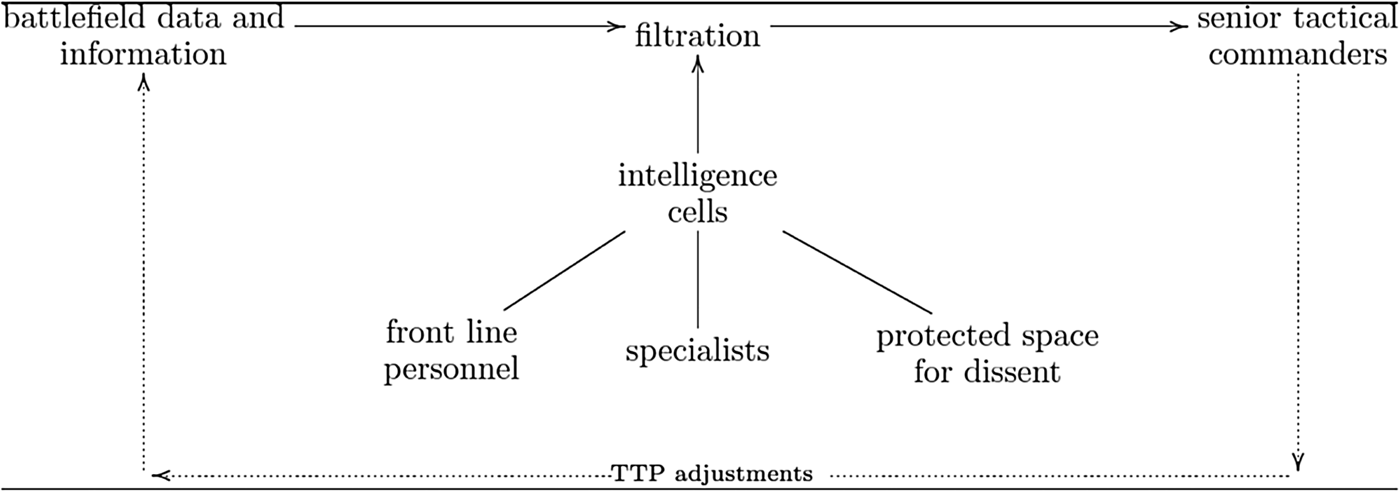
First, analytic cells must be staffed with personnel who possess specialised knowledge relevant to the current adversary, the type of war being waged, and the local context. This experience can take many forms, including formal study (for example, graduate school), extensive interaction (via foreign affairs officer programmes and the like), or past combat experience (for example, previous tours of duty in a similar environment). Scholars agree that specialists have a decided advantage over generalists when it comes to organisational change.Footnote 23 This may sound counterintuitive, since expertise could interfere with openness to new ideas. Modern organisations, however, are highly complex. War is no different. Generalists and amateurs often lack the appropriate expertise to monitor performance, even under stable conditions.
Second, analytic units work best when they integrate frontline personnel, giving them a substantive role in analysing information.Footnote 24 This helps overcome the paradox of frontline experience: allowing soldiers with detailed personal experiences of on-the-ground failures, as well as vital knowledge of local conditions and enemy TTPs,Footnote 25 to reflect and contribute to a more analytic process. Successful integration entails more than soliciting debriefs or after action reports (AARs). Indeed, such exercises are often seen as a distraction by combat troops already short on time to rest, recuperate, and refit between missions. The process should work best when frontline personnel are rotated through the analytic intelligence cell on a regular basis. Alternatively, intelligence personnel can be sent on tours with combat units. Critically, insights from troops with firsthand knowledge of combat conditions will only inform the adaptive process to the degree that these soldiers have the time, safety, and opportunity to reflect and share their thoughts with analysts.
Third, these integrated analytic cells must include a protected space for dissent. If no one can safely criticise the choices of commanders, particularly high-ranking or excessively popular ones, then problems may not be brought to their attention. Dissent can be institutionalised in many ways, from an informal culture of criticism to formally designating ‘red cells’ (teams tasked with presenting a dissenting point of view). Regardless of how it is institutionalised, dissenters must be protected from punishment and promoted as readily as their peers.
Finally, even the best information and filtration processes are not useful if the resulting intelligence does not reach the right ears. We contend that the leaders who matter most in the context of military adaptation are senior tactical leaders with direct authority over frontline units (for example, those engaged in combat). Who counts as the appropriate senior tactical leader depends on context – the type of war being fought, the technology of weaponry, and the nature of the terrain. In modern counterinsurgencies, it will rarely extend below the level of battalion command, nor above the level of division command. In large-scale, high-intensity conventional wars, however, it is entirely possible that division, corps, army, or even theatre commanders are the appropriate senior tactical leader on whom we should focus our attention.
To summarise our argument: the first step in adaptation involves recognising failure and detecting the need for change. Clear threats, decentralised authority, leadership support, and leadership turnover make detection more likely. But the presence of an effective feedback loop, that filters information and disseminates it to tactical commanders, is decisive. Filtration, in turn, is most effective when intelligence units are led by specialists, actively integrate frontline soldiers, and institutionalise a protected space for dissent.
Why compare a battalion in Southern Cameroons with the BEF on the Western Front?
Our theoretical model was developed inductively through an analysis of archival documents on the small British counterinsurgency campaign in the Southern Cameroons, where the British did quickly recognise their own failures and performance gaps. We first present the materials from this case as an illustrative example of how institutionalised feedback loops can help filter information and identify operational failures. This further provides evidence of the plausibility of our mechanisms. We then test our model against the evolution of assault tactics by frontline British Expeditionary Force (BEF) infantry units during the First World War. The BEF case also meets established prerequisites for military adaptation, including decentralisation of command and an institutional culture supportive of dissent.Footnote 26
However, there are sharp differences in context between these two cases. Indeed, we are intentionally employing a ‘most different’ case study design that may strike some as implausible. The magnitude of challenges faced by the BEF – embroiled in a conventional war involving the mass mobilisation, deployment, and coordination of national militaries – surely dwarf those of the single battalion stationed in Cameroon. Yet, maximising contextual variation on a wide range of independent variables, while holding the outcome constant (successful learning) and then process tracing the mechanisms of learning, has important advantages at this stage of theory development. Principally, it provides for a difficult test of our theoretical model insofar as we must demonstrate the parallel unfolding of mechanisms across vastly different contexts.Footnote 27 This particular case also allows us to probe the model's applicability to conventional warfare. If our proposed causal mechanisms indeed operate in this very different battlefield context, then we can have greater faith in their generalisability across a wide range of wars.
Additionally, the BEF case permits us to leverage within case variation over time, since the British Army institutionalised its feedback loop midway through the war. This complements the ‘most different’ cross-case comparison by exerting maximal within-case control over important contextual factors (same war, same front, same adversary, same army, etc.) while varying the outcome (failure versus success at recognising failure).Footnote 28 We can thus isolate the impact of an institutionalised feedback loop, demonstrating how its presence/absence was vital to whether adaptation occurred. As a final note of caution, our exclusive focus on the British military has its limitations. Future work will need to test the model against other military organisations with different institutional cultures and command systems.
The British Army in the Southern Cameroons
Four decades after the First World War, the British found themselves embroiled in counterinsurgency wars across their retrenching empire. These wars required an army that was flexible, adaptive, and could successfully respond to the constantly shifting tactics of highly motivated insurgents. Analysing the case of the Southern Cameroons, we argue that by this time the British Army had adopted many of the requisite characteristics of a learning institution and could complete the vital first step of adaptation: recognising its own failures. Moreover, they were able to do so because of a sophisticated, institutionalised feedback loop that integrated specialists and frontline soldiers, protected dissent, and disseminated information to vital senior tactical commanders.
Background: A growing insurgency
By the late 1950s, the British colonial government in the Southern Cameroons faced a growing insurgency that had spilled over the border from French-controlled Cameroon, trusteeship having been split following Germany's defeat in the First World War. In 1955, after widespread riots and amid fears of communist influence, the French banned the pro-independence political party, the Union des Populations du Cameroun (UPC), and barred its members from participating in the all important pre-decolonisation parliamentary elections. The UPC responded by organising an armed wing, the ALNK (Armée de Liberation Nationale Kamerun), which launched a guerrilla campaign against the French colonial government. Based among the southern Bamiléké and Bassa ethnic groups, refugees and UPC operatives alike quickly began flowing across the porous and unguarded border into British territory, bringing the conflict with them.Footnote 29 Reluctant to become involved but unable to any longer deny the deteriorating security situation, on 1 August 1960, the British government deployed an intervention force, the 1 King's Own Royal Border Regiment, on a mission of auxiliary support to the local colonial government.Footnote 30 British involvement in the war lasted 15 months, never involved more than a single deployed battalion, and ended with the political decision to withdraw.
Institutionalised feedback loops
In their fight against the ALNK, the British forces employed a highly refined feedback loop that allowed them to successfully identify organisational failures. Here, we take the battalion as the key unit of analysis as this was the highest unit charged with obtaining victory in the field. The two deployed battalions – the 1 King's Own followed by their replacements, the 1 Grenadier Guards – were able to use intelligence cells to filter large amounts of raw information into vital lessons learned and to distribute those lessons both up and down the chain of command, including to both senior and junior tactical leaders in the field.
Like most wars, even the relatively small conflict in the Southern Cameroons generated large volumes of raw data. British and French military, police, and intelligence units were engaged in a continuous flow of information. Archival documents record a broad range of information being recorded and tracked, including the outcomes of operations, casualties (government, insurgent, and civilian), arrests, the leadership and cell structure of the insurgents, locations of arms caches, training camps and leadership cells, shifts in ALNK tactics and training, as well as such amorphous things as political and current events, local attitudes, and civilian support.Footnote 31
A specially designated intelligence team transformed this raw information into actionable intelligence and lessons learned. This team also possessed the three characteristics we hypothesise as being necessary to separate useful and relevant information from background noise. Specifically, they included specialists, integrated frontline personnel, and offered a protected space for dissent.
First, the intelligence cell included specialists in both counterinsurgency operations and colonial administration. The 1 King's Own and 1 Grenadier Guards possessed a standard complement of intelligence soldiers. A French liaison officer, three Special Branch officers, and a handful of Cameroonian soldiers augmented these intelligence ‘generalists’. A three-man interrogation team was added in April 1961.Footnote 32 The Special Branch officers were especially important in this regard, since they had long been stationed in the colony and were experts trained to deal with political extremists, subversion, terrorism, and insurgency.Footnote 33 Many of the ‘regular’ British intelligence officers also possessed extensive training and experience in postcolonial Africa and counterinsurgency operations. Between the end of the Second World War and the intervention in the Southern Cameroons, British forces confronted civilian uprisings, terrorism, and insurgency in India, Palestine, Malaya, Kenya, Cyprus, Aden, Borneo, and Northern Ireland.Footnote 34 It is highly likely that all of the career intelligence officers assigned to the 1 King's Own and the 1 Grenadier Guards had previous personal experience fighting insurgents.
Second, British intelligence teams were physically near the front line, co-located with the headquarters company at Beau. Intelligence officers also spent a lot of time traveling through the area of operations, visiting frontline companies, interrogating detainees, and interacting with the population. Commanders, intelligence officers, and police forces – both British colonial police and native police forces – met to exchange information each week.Footnote 35 British and French intelligence officers also held joint planning and debrief meetings each month – above and beyond military intelligence liaison officers’ day-to-day activities coordinating joint intelligence.Footnote 36
Finally, the British intelligence process tolerated dissent. Dissent was not formalised per se (for example, with a red cell). The intelligence and other military reports, however, are remarkable for the frankness with which relatively junior officers criticise policies and practices. After returning to Britain, 1 King's Own submitted a particularly scathing after action report. It complained that a translator shortage – of French speakers ironically enough – interfered with intelligence collection and analysis. It also accused Special Branch Headquarters of ignoring its request for more operatives and remanded the War Office for its lethargic and belated attempts to address these issues. Perhaps most striking, in his official turnover report to the Grenadier Guards, the commanding officer of the 1 King's Own, Lt Col. Robinson, accused the British government of deploying ground forces without giving them a mission. This was an extraordinarily bold critique for a ‘mere’ battalion commander to levy against the War Office.
Even the most relevant and accurate lessons learned, beautifully filtered and packaged, are useless if key leaders pay no attention to them. A series of regular intelligence reports ensured that this was not the case for British tactical leaders in the Southern Cameroons. First, the battalion intelligence section wrote periodic intelligence reports (Perintreps) on a fortnightly basis and disseminated them both up the chain of command, to the War Office and Force Commander, and across the unit to the frontline companies. Second, frontline units wrote after action reports (AARs) after significant events, and submitted them to the battalion's intelligence and operations sections. Third, British intelligence officers assigned to French units wrote military liaison officer, or MILO, reports, and disseminated them to the Force Commander as well as the War Office. And, finally, the outgoing Force Commander wrote turnover reports for his incoming successor.
The distribution lists associated with these reports clearly indicate that frontline tactical commanders received and read these succinct and filtered lessons learned. Both Battalion Commanders, Lt Col. Robinson and Lt Col. Fraser, their intelligence officers, and their frontline company commanders received copies of the reports. Key leaders, moreover, carefully read and digested their Perintreps, AARs, MILOs, and turnover reports. Virtually every archived copy includes formal responses, attached handwritten remarks, or comments in the margins. The critical tone found in many comments suggests that British officers took these reports very seriously and not as a pro forma part of their job.
Recognising failure
This institutionalised feedback loop allowed the British to pass vital information to tactical commanders, assess critical gaps in performance, as well as understand the unintended effects of their combat activities – an especially important capability in counterinsurgency. The intelligence reports, especially the Preintreps, generally demonstrate broad and accurate knowledge of the local situation. They also gave commanders sophisticated information on insurgent units, including their size, leaders, movements, camp locations, armaments, fortifications, foreign training, and tactical innovations.Footnote 37
Most importantly, the British battalion on the ground accurately identified three primary failures in their operational effectiveness. First, from both their own AARs and exchanges with French intelligence officers, they were able to recognise the large-scale failure of their offensives against insurgent camps. The ALNK were using these bases in the Southern Cameroons to launch frequent attacks into French controlled territory and it was a key joint priority to dismantle them.Footnote 38 Yet, the operations against the camps rarely achieved any surprise and allowed insurgents to escape into the forest through preplanned evasion routes and then across the unguarded and porous border.Footnote 39 For instance, in Operation ALLSOPPS, Company B of 1 King's Own launched a major offensive against an insurgent encampment near the border that was initially regarded a success. Subsequent MILO reports from British intelligence officers attached to French forces, however, allowed British commanders to see that ALLSOPPS simply displaced violence instead of eradicating it, with the targeted insurgents re-emerging later in French controlled territory.Footnote 40
Second, delayed analysis of prisoner interrogations and captured documents was prohibiting the timely generation of actionable intelligence and hindering operations. Insurgent cells would soon realise that a member had been arrested and relocate their camps. If there were any serious delays in processing, this would nullify the most useful information extracted from captives. The reports pinned this problem on a scarcity of both intelligence personnel and, most critically, translators.Footnote 41 As early as January of 1961, after only five months in theatre, requests for additional personnel resources began flowing to superiors back in Britain.Footnote 42
Third, the battalion identified their legal context as a major obstacle to engaging in effective operations. Unlike other counterinsurgencies the British had recently fought in colonies like Kenya and Malaya, no State of Emergency had been declared in the Southern Cameroons. Without the framework and protection provided by Emergency law, British troops were not allowed to discharge their weapons without first being fired upon. This single prohibition prevented British units from achieving tactical surprise in their raids or from impeding insurgents from fleeing the area.Footnote 43
Despite clearly recognising operational failures, the British nonetheless departed the Southern Cameroons after only 15 months, having largely failed in their mission. By this time, the ALNK had grown in strength to ten to twelve thousand insurgents in the Southern Cameroons alone. They controlled significant territory on both sides of the French/British border, especially in the Tombel/Mt Koupe area. They had also developed the ability to manufacture local firearms, were engaged in frequent attacks against colonial forces, and had begun forcibly recruiting civilians.Footnote 44 Even the French – typically adverse to interference in their colonies – were sending repeated requests for increased assistance, the execution of additional offensive operations, and the re-exertion of territorial control prior to British decolonisation.Footnote 45 Rather than commit more troops and follow their own battalion's recommendations, however, the government decided to withdraw, leaving the insurgent problem to France and the soon-to-be-independent nation of Cameroon.Footnote 46 Regardless of this fundamentally political choice, and despite the ultimate failure of adaptation in this case, the British did recognise their failings and engage in the first step of the adaptive process – and they were able to do so because of the institutionalised feedback loops that were well developed within this particular British battalion.
The British Army on the Western Front
Contemporary historians hold the British Expeditionary Force (BEF) up as a canonical example of a wartime learning organisation.Footnote 47 Over the course of the First World War, it undertook a range of profound doctrinal changes. One such adaptation involved the evolution of its infantry assault tactics. Yet, the path to change was neither straightforward nor easy.
With the onset of trench warfare in late 1914, British combat units were quick to experiment using novel tactics, techniques, and procedures to cross ‘No Man's Land’. However, by mid-1915, BEF units began to converge on a decidedly less effective approach to attacking, which involved sending assault units ‘over the top’ in successive waves of stereotyped, linear formations. Such tactics defined how most British infantry attacked on the Western Front until at least 1917. This approach was undoubtedly a logical response to the BEF's decision to emphasise artillery firepower in the form of intricate and increasingly powerful pre-assault bombardments and creeping barrages; as well as limited ‘bite and hold’ operations designed to grab and consolidate portions of a defensive position before German reserves could counterattack. Unfortunately, these linear and stereotyped tactics resulted in heavy casualties and made it hard for assault units to press the attack in the absence of artillery support, as evidenced by the army's losses during the Somme Offensive.
Starting in mid-1916, some BEF divisions and corps began to diverge from this practice by experimenting with new ways of attacking across No Man's Land. However, stereotyped, linear formations of riflemen remained the norm. It was not until early 1917 that GHQ recognised the need for a theatre-wide shift in infantry unit assault tactics and began explicitly endorsing the alternative methods of attack that frontline units had been working on for some time. We suggest that this recognition was made possible, at least in part, because of GHQ's decision to adopt an institutionalised feedback loop in the form of Training Branch.
The unit of analysis
Within the overarching British Army, which included garrison units as well as those serving in other theatres of war (such as Gallipoli, Salonika, Mesopotamia, Italy, and Palestine), the BEF was the highest operational command tasked with defeating the German Army on the Western Front. It grew rapidly over the first two years of the war, from an initial commitment of four infantry and one cavalry divisions, totaling 150,000 soldiers in August 1914, to 1.8 million soldiers by mid-1916. Despite this radical expansion and transformation, the BEF was remarkably consistent in its top leadership. It had only two Commanders-in-Chief: Field Marshal Sir John French, who led the BEF from August 1914 until December 1915, and Field Marshal Sir Douglas Haig, who remained in command until the end of the war. General Headquarters (GHQ) served as their headquarters staff.
The BEF thus constitutes the most appropriate unit of analysis for evaluating adaptation on the Western Front. Lower level units surely recognised the costs associated with flawed assault tactics. However, individual units – even relatively large ones like divisions, corps, and armies – could not decisively influence events across the entire front. More importantly, the majority of units fighting on the Western Front would continue to operate as they always had until the BEF's top leaders, particularly those in charge of writing and promulgating official training manuals, acknowledged that existing infantry tactics, techniques, and procedures were failing to produce the desired results at an acceptable price. Again, ad hoc detection might be analytically interesting, but it is pragmatically irrelevant. The Western Front was a war of attrition waged by mass armies. Isolated incidents of adaptation occurred throughout the conflict. Given the millions of men involved on both sides of the front, it would be surprising to discover otherwise. But until those in charge recognised that their tactics were failing, military effectiveness would remain poor and victory either elusive or unnecessarily costly.
The initial failure to achieve strategic and operational imperatives
Britain's overarching war aim was to eject German forces from Belgium and France. British politicians fiercely debated the best way to realise this goal. Some favoured a direct approach, attacking German units along the Western Front. Others, including Churchill, wanted to attack Germany's allies so as to pressure the German High Command to divert forces away from that theatre.Footnote 48 The BEF played a consistent role in both grand strategies: its objective was to maintain continuous pressure on German lines on the Western Front until a decisive breakthrough was achieved or the German Army bled to death, whichever came first.Footnote 49
The BEF nevertheless had to navigate two important constraints as it endeavoured to accomplish its primary mission, both of which plausibly impacted its ability to adapt. First, because Britain chose to fight the First World War as part of a coalition, the BEF was consigned to play the role of junior partner to the French Army until near the end of the conflict.Footnote 50 This imperative compelled the BEF's commanders to send their men into action sooner, and less prepared, than they might have otherwise preferred. Second, Britain, to paraphrase Strachan's pithy formulation, decided to wage a continental war without first bothering to build a continental-sized army.Footnote 51 The BEF therefore needed nearly two years to come to full strength. In fact, British commanders did not expect to achieve a decisive breakthrough until 1916 at the earliest.Footnote 52 Rather, the British high command sought to generate manpower and materiel until such a time that its allies and adversaries were exhausted, allowing the British Army to enter the war in decisive force so as to set the terms for peace.Footnote 53
Operationally, the BEF began shifting toward an artillery-centric approach in its offensives by the spring of 1915. In crude terms, the goal was to rely on artillery firepower so as to conserve infantry manpower. As Griffith describes it, British infantry primarily advanced in ‘a series of more or less successive linear waves, moving forward by alternate rushes covered by fire where possible, or simply moving forward directly if the enemy had already been suppressed by artillery’.Footnote 54 In essence, commanders relied upon increasingly powerful artillery bombardments and intricate fire support plans (for example, ‘creeping’ barrages) to destroy German defences and suppress German infantry before sending waves of infantry across No Man's Land to occupy the objective and ‘mop up’ pockets of resistance.
Tactically, the state of communications technology in 1915 made it hard to coordinate the artillery and infantry operations. Thus, infantry tactics needed to correspond to strict artillery timelines. The result was that units moved across the battlefield in waves of linear formations and were primarily comprised of riflemen augmented with bombers (soldiers carrying satchels of hand grenades). They no longer attempted independent manoeuvre.
Unfortunately, these infantry tactics came at a high price. Linear formations were vulnerable to enfilading fire, particularly from machine gun positions that invariably survived the artillery bombardment. The relative absence of small unit manoeuvre made it difficult to take advantage of terrain or weak points in the defensive line. And because most infantrymen still carried rifles, they found it hard to generate high volumes of firepower if they found themselves without artillery support.
Infantry losses quickly mounted. It took British assault troops roughly ten days to advance one kilometer at Festubert in May 1915. Later that fall, at the Battle of Loos, the BEF lost 43,000 men, gaining almost no ground and suffering nearly four times as many casualties as the Germans.Footnote 55 And, of course, the BEF suffered nearly 58,000 casualties on the first day of the Somme offensive in July 1916. To be sure, individual units quickly began to experiment with more flexible assault tactics in the wake of the debacle on July 1st.Footnote 56 Ironically, some of these experiments resembled assault tactics used in 1914 and early 1915, before the shift to ‘bite and hold’ offensive operations.Footnote 57 GHQ, however, did not yet undertake a systematic attempt to change how British infantry units manoeuvred across No Man's Land. In fact, the main lesson that GHQ seemed to learn from the Somme was that planning ought to be even more meticulous and assaults even more methodical.Footnote 58 GHQ did not appear to seriously contemplate that existing assault tactics were resulting in unnecessarily high casualties and preventing infantry units from leveraging terrain, exploiting gaps in German defences, or pressing forward in the absence of artillery support. Instead, losses mounted as most British infantrymen continued to attack in linear wave formations – depending on mass, momentum, and artillery firepower to produce the desired results.
An incomplete feedback loop
Why did GHQ not discern the need to revise and update the BEF's assault tactics after the costly battles of 1915–16? The merits of its ‘bite and hold’ artillery-centric approach notwithstanding, large infantry units lumbering across the battlefield in unwieldy, stereotyped formations and without access to organic firepower absorbed high losses. Not only had BEF units used more flexible assault tactics earlier in the war, we now also know that the German high command had been experimenting with so-called ‘storm troop’ tactics since early 1915.Footnote 59
We suggest that an important piece of the explanation revolves around the BEF's feedback system. Prior to early 1917, it lacked a well-institutionalised feedback loop, which integrated frontline personnel into doctrinal analysis and provided optimal filtration of information.Footnote 60 The absence of such a mechanism made it harder for senior commanders to develop an adequate understanding of why existing assault tactics were not producing the desired results at an acceptable price.
At least three structural factors impeded the BEF's efforts to collect, analyze, and transmit feedback. First, the British Army suffered from a staff officer shortage at war's start. For a variety of reasons, Britain had long preferred a small, long-serving professional army instead of the mass conscription model used in Germany and France. The army's colonial mission meant that units deployed independently for long periods of time, further reducing the need for centralised staff work. As a result, the British General Staff had fewer than 450 officers to support an active duty force of 247,432 in August 1914.Footnote 61 In comparison, by 1918 the BEF had three thousand officers supporting mobilisation and analysis on the Western Front alone.Footnote 62 Yet, numbers tell only part of the story. The British General Staff, created not long before the war in 1906, was much younger than its German counterpart, which had been in continual existence since 1814. Staff officers were also an elite club within the German officer corps. They were selected on a largely meritocratic basis and their education was qualitatively and quantitatively superior to that received by British staff officers.Footnote 63 Nor did the best and brightest within the British officer corps consider attending the staff college or serving on the General Staff – rather than education and achievement, promotion depended heavily on patronage and personal connections.Footnote 64
Second, the British General Staff was immediately overwhelmed by the daunting challenge of expanding the BEF.Footnote 65 It grew from six to seventy divisions between August 1914 and December 1916.Footnote 66 The demands of recruiting (and later drafting), equipping, training, and deploying the largest military force in British history undoubtedly competed for intellectual bandwidth with the need for tactical, operational, and doctrinal analysis.Footnote 67 Moreover, regular staff officers did not trust their New Army counterparts, whom the long-serving professionals regarded as having been promoted too rapidly.Footnote 68 Staffs at every level of command reacted to such conditions by centralising control and compartmentalising information.
Third, the BEF's staff procedures remained suboptimal early in the war. Every division and corps used a different set of reporting forms and practices, hindering the flow of information and ideas.Footnote 69 Inefficient staff processes were compounded by the fact that the BEF constantly rotated divisions through corps and corps through armies, which prevented staffs from learning – let alone synchronising – their respective procedures and practices. For example, 12 different divisions rotated through IV Corps over the course of 1916.Footnote 70 Perhaps most problematic in terms of integrating frontline perspectives into doctrinal analysis, the BEF's GHQ stopped rotating its senior staff officers through the front lines, because it worried that too many of them were getting killed.Footnote 71
This is not to say the army completely ignored after action reporting. As early as October 1914, the War Office's Central Distribution Section (CDS) began producing a series of pamphlets, entitled Notes from the Front, on an ad hoc basis.Footnote 72 In November 1915, such updates were disseminated via the more systematic Stationary Service (SS) manuals.Footnote 73 But the highest operational command in theatre, GHQ, was not formally integreated into the process of vetting, writing, and disseminating these pamphlets. Moreover, instead of reflecting genuine filtration, these reports tended to pass along seemingly workable ideas without deep assessment or analysis. Travers argues that as late as 1916, GHQ still had not ‘instituted any method for analyzing lessons learned or for a meaningful discussion of tactics. There was, in fact, a serious lack of liaison between GHQ and the rest of the army.’Footnote 74
Cumulatively, the result of these structural problems was that the BEF lacked the sort of institutionalised feedback loop that might have otherwise helped it to detect problems with its assault tactics. Despite attempts to transmit lessons learned and best practices through the Notes from the Front and other pamphlets, these documents tended to convey unfiltered information and ideas that had not received rigorous vetting. Meanwhile, both staff officers’ struggle to manage the army's massive growth amid suboptimal practices and the absence of formal conduits for transmitting and processing lessons learned, created a disconnect between senior commanders and the front lines.
Building a better feedback loop: GHQ creates Training Branch
We contend that an improved institutionalised feedback loop played an important causal role in helping the BEF recognise the inherent shortcomings of attacking in successive waves and in initiating a systematic search for alternatives.Footnote 75 From February 1917, the BEF began formalising how it processed and analysed information. The single most important change involved GHQ's decision to create a new directorate, Training Branch, to coordinate training and doctrinal analysis. Although doctrinal publications existed before 1917, Training Branch filled an important gap by serving as a dedicated focal point for assessment and by rationalising the process by which GHQ wrote and disseminated doctrine.Footnote 76
First, it improved GHQ's ability to collect, analyse, and distribute lessons learned to tactical commanders across the Western Front – even those that were not engaged in active sectors. While historians debate the degree to which Training Branch formalised and harmonised doctrine within the British Army,Footnote 77 it is clear that the production of doctrinal publications meaningfully increased after Training Branch took over responsibility for producing and disseminating the aforementioned SS manuals in February 1917.Footnote 78 Moreover, compared to previous versions, these new manuals demonstrated sound critical analysis and did not hesitate to identify important gaps and shortcomings in existing practices. With the benefit of hindsight, we also know that many of the tactical precepts espoused did indeed represent a better way to fight on the Western Front.Footnote 79
Second, as a permanent organisation responsible for managing doctrinal assessment and dissemination across the BEF, Training Branch integrated specialists with frontline, combat-experienced commanders. Particularly in 1917, Training Branch tended to generate lessons learned by convening working groups of staff officers and commanders to assess and suggest doctrinal updates. This practice ensured that the resulting doctrine ‘would reflect what was actually happening at the front and would thereby allow the dissemination of experience across the BEF’.Footnote 80 More important, because it was a stable unit with an explicit mandate, Training Branch would have turned its staff officers into doctrine specialists over time, regardless of an officer's previous background or experience.
With this new feedback mechanism, GHQ's attitude towards the BEF's assault tactics began to shift. By spring of 1917, GHQ was both actively seeking out lessons learned from subordinate units and distributing them across the BEF as official pamphlets. SS 158, for example, described tactical experiments used by the First, Third, Fourth, and Fifth armies involving the use of combat engineers, small unit fire and movement, and providing assault forces with more lightweight automatic firepower.Footnote 81 Other updates discussed work on flexible formations and manoeuvre by subplatoon-sized units.Footnote 82
Moreover, GHQ formally endorsed changes to infantry assault tactics. Of particular importance was its publication and endorsement of SS 143, Instructions for the Training of Platoons for Offensive Action in February 1917.Footnote 83 This pamphlet directed every unit to ensure companies were divided into platoons.Footnote 84 Platoons were to ‘constitute a unit for fighting and training, and should consist of a homogenous combination of all the weapons with which the infantry is now armed’.Footnote 85 GHQ also sought to make sure platoons had sufficient lightweight infantry weapons, such as Lewis light machine guns and rifle grenades.Footnote 86
These changes set the foundation for a transformation in British assault tactics. By 1918, Griffith argues that the BEF's infantry tactics were as dynamic and sophisticated as those used by the German Army. Others, including Bidwell, Graham, Strachan, and Boff are more circumspect, but agree that the BEF's tactics were far more flexible and advanced than they had been at the beginning of the war.
In summary, the BEF did not fully recognise the shortcomings associated with its infantry assault practices between early 1915 and 1916. The situation changed rapidly during the second half of the war when the BEF not only perceived the need for serious changes, but also began experimenting with new tactics and procedures. Although we cannot solely attribute this turnaround to Training Branch, there is compelling evidence that it played an important causal role by helping GHQ establish an institutionalised mechanism for filtering analysis and facilitating the widespread distribution of lessons learned.
What if materiel – not tactical doctrine – represented the BEF's primary obstacle?
Our argument is based on the assumption that tactical doctrine represented the BEF's principal impediment to succeeding on the Western Front. However, we recognise that some military historians might contend that material shortages, not doctrinal flaws, prevented the BEF from realising its military objectives. According to this logic, British units lacked sufficient artillery and ammunition until 1916 at the earliest. Furthermore, no change in infantry tactics would have made a difference until solutions to these materiel problems were found. If this view is correct, it means we are unfairly criticising the BEF for failing to solve a problem that did not exist.
We acknowledge that the BEF faced serious material shortages, but we nevertheless see at least three problems with the view that it could not – and should not – have addressed its tactical deficiencies until it had enough guns and shells. First, a robust body of scholarship convincingly demonstrates that all three armies on the Western Front needed better tactics – not more materiel – to overcome deadlock.Footnote 87 Second, it was precisely because the BEF was locked in a war of attrition on the Western Front that it needed new tactics at least as much as it needed more material. Better tactics would have allowed combat units to both conserve manpower and inflict heavier casualties on the German Army. Third, materiel was, at best, a necessary but not sufficient part of the solution to deadlock. Ammunition and artillery alone would not have allowed the BEF to prevail on the battlefield, as evidenced by the fact that their French ally started the war in a far better material situation – and indeed, adopted a far more artillery-centric approach for part of the conflict – and yet still found itself stymied. If materiel solutions were both necessary and sufficient to explain the BEF's ultimate victory on the Western Front, then it becomes puzzling why the BEF nonetheless saw it necessary to transform its warfighting doctrine, especially over the course of the war's final two years. Nor does it make sense did the BEF have to wait for more shells and guns before it could identify and begin to solve problems with its infantry tactics.
Conclusion
Adaptation is critical to military success, in both conventional and counterinsurgency wars. In trying to understand why some militaries are better at adapting than others, we break adaptation down into its constituent steps and address the first one: recognising failure. Under battlefield stress and overwhelmed by information, it is in fact very difficult for soldiers and their leaders to understand when they are tactically failing – and yet they must do so for any change to occur.
We have argued that institutionalised feedback loops allow militaries to recognise failure when they exhibit two core characteristics: they filter information and integrate tactical commanders into the dissemination of findings. Moreover, effective filtration requires an analytic process that creates protected spaces for dissent and includes both frontline personnel and specialists. We illustrated this theory using the case from which it was developed, British counterinsurgency operations in the Southern Cameroons, and then tested it against a case study of conventional warfare, using the within case variation of the BEF on the Western Front for added leverage. When the British military, long held as adept learners, possessed such institutionalised feedback loops they were able to recognise their failures and begin the process of adaptation. At the beginning of the First World War, however, prior to institutionalising a proper feedback mechanism, they did not fully grasp their shortcomings.
Our findings should be considered a first step in better understanding a rich and complex process of learning. Future research should test our model of identifying failure against a wide variety of case studies – across both different types of military organisations and war fighting contexts. Military adaptation researchers can also build on our findings by theorising the next phases of learning and by building bridges between the phases.
For militaries keen to become better learning organisations, our findings suggest two key lessons: First, nothing substitutes for valuing dissent. If no protected space exists for challenging current strategic and tactical doctrines, then their failures will go unremarked. Second, some type of institutionalised filtration process needs to digest raw data and intelligence and distribute the findings. Simply circulating after action reports or other sources of experience and intelligence to all commanders will only bury everyone in unvalued information, undermining the seriousness with which such reports are prepared in the first place.
Acknowledgements
The authors thank Stephen P. Rosen, Adam Grissom, Risa A. Brooks, Travis Sharp, Matthey Fay, and the anonymous reviewers for their constructive feedback of earlier drafts.
Dr Michael A. Hunzeker is Assistant Professor in the Schar School of Policy and Government, George Mason University. His research focuses on military learning, conventional deterrence, and war termination. He is the author of Dying to Learn: Wartime Lessons from the Western Front (Cornell University Press, 2021) and his work has been published in journals such as Security Studies; The Journal of Strategic Studies; and the RUSI Journal. Author's email: mhunzeke@gmu.edu
Dr Kristen A. Harkness is Senior Lecturer in the School of International Relations at the University of St Andrews. Her research focuses on understanding how ethnicity shapes the loyalty and behaviour of military institutions in Africa and has been funded by the British Academy. She is the author of When Soldiers Rebel: Ethnic Armies and Political Instability in Africa (Cambridge University Press, 2018) and her work has been published in journals such as Democratization; The Journal of Conflict Resolution; The Journal of Peace Research; and The Journal of Strategic Studies. Author's email: kh81@st-andrews.ac.uk



