INTRODUCTION
Qualitative error analyses of neuropsychological performance was first introduced by Edith Kaplan to provide a finer grained process oriented approach to behavioral output across clinical populations (Kaplan, Reference Kaplan, Boll and Bryant1988). Expanded scores and categorization of various error types based on this “Boston Process Approach” to neuropsychological assessment were deemed less likely than conventional quantitative approaches to result in Type 2 errors when assessing for alterations in performance (Kaplan, Reference Kaplan, Boll and Bryant1988). The Boston Process Approach to qualitative error analysis in dementia has been shown effective in understanding subtle group distinctions in behavior not accounted for by quantitative standardized scores (Lamar, Swenson, Kaplan, & Libon, Reference Lamar, Swenson, Kaplan and Libon2004, for review). For example, within the context of equal numbers of intrusions and perseverations on a list learning test, Davis and colleagues (Davis, Price, Kaplan, & Libon, Reference Davis, Price, Kaplan and Libon2002) applied a qualitative error analysis of these responses. Individuals with Alzheimer’s disease (AD) made more semantically related intrusions and repeated these intrusions across trials as compared to individuals with vascular dementia (VaD).
While neuropsychological research has shown the effectiveness of a more qualitative approach to differentiating dementia subtypes, neuropsychological investigations in dementia have historically focused on cognitive profiles of impairment derived from quantitative analyses. Much of the work in this area highlights the striking anterograde amnesia in AD (e.g., Baillon et al., Reference Baillon, Muhommad, Marudkar, Suribhatla, Dennis and Spreadbury2003) in contrast to the executive dysfunction in VaD (i.e., Traykov, Baudic, Thibaudet, Rigaud, Smagghe, & Boller, Reference Traykov, Baudic, Thibaudet, Rigaud, Smagghe and Boller2002). A recent meta-analysis (Mathias & Burke, Reference Mathias and Burke2009) determined that quantitative scores derived from verbal memory testing resulted in a large enough effect size (d ≥ .8), and met additional confidence interval criteria, to merit distinction as variables that would successfully discriminate between AD and VaD. In contrast, none of the quantitative measures of attention and executive function such as time to completion on the Trail Making Test met criteria for successful group differentiation (Mathias & Burke, Reference Mathias and Burke2009). This may be due in part to the lack of subtle distinctions afforded by a quantitative approach to executive performance.
Using a qualitative error analysis of incorrect responses on the Wechsler Adult Intelligence Scale-Revised (WAIS-R) Similarities subtest, which requires participants to describe how two target items are alike, we have reported conceptually based executive dysfunction in patients with AD when compared with more pervasive impairment seen in patients with VaD (Giovannetti et al., Reference Giovannetti, Lamar, Cloud, Swenson, Fein and Kaplan2001). This pattern of performance was detected despite equal performance on quantitative measures of Similarities performance (i.e., total score). More specifically, when zero-point responses are coded to reflect patients’ ability to attain mental set, patients with AD produce incorrect responses that are vague, but nonetheless superficially related to the given word pair (i.e., dog-lion – they’re alive). By contrast, individuals with VaD produce errors that suggest a blatant loss of mental set (i.e., dog-lion – a dog can eat a lion). Thus, individuals with AD are able to establish mental set but demonstrate difficulty with higher-level response selection, that is, trouble selecting a response with the appropriate degree of abstraction (Giovannetti et al., Reference Giovannetti, Lamar, Cloud, Swenson, Fein and Kaplan2001). In contrast, individuals with VaD appear unable to operate within the parameters of the task.
Another possible reason for the lack of discriminatory strength of attention and executive measures in Mathias and Burke’s (Reference Mathias and Burke2009) recent meta-analysis may be due to the fact that vascular risk factors—known to negatively impact executive functioning (Desmond, Tatemichi, Paik, & Stern, Reference Desmond, Tatemichi, Paik and Stern1993; Elias, Elias, D’Agostino, Sullivan, & Wolf, Reference Elias, Elias, D’Agostino, Sullivan and Wolf2005; Robbins, Elias, Elias, & Budge, Reference Robbins, Elias, Elias and Budge2005)—are present in AD as well as VaD (Breteler, Reference Breteler2000; Helzner et al., Reference Helzner, Luchsinger, Scarmeas, Cosentino, Brickman and Glymour2009). The classic vascular risk factors of aging, as defined by investigators from the Rotterdam Study, include hypertension, Type 2 diabetes mellitus, and hypercholesterolemia (Breteler, Reference Breteler2000). These vascular risk factors are often considered a hallmark of VaD and a contributing factor to small vessel disease (Fazekas et al., Reference Fazekas, Kleinert, Offenbacher, Schmidt, Kleinert and Payer1993) and executive dysfunction (Lamar, Catani, Price, Heilman, & Libon, Reference Lamar, Catani, Price, Heilman and Libon2008) in this population. Vascular risk factors are also associated with AD (Breteler, Reference Breteler2000; Helzner et al., Reference Helzner, Luchsinger, Scarmeas, Cosentino, Brickman and Glymour2009; Luchsinger, Reitz, Honig, Tang, Shea, & Mayeux, Reference Luchsinger, Reitz, Honig, Tang, Shea and Mayeux2005) and may contribute to the white matter alterations documented in this population (Gurol et al., Reference Gurol, Irizarry, Smith, Raju, Diaz-Arrastia and Bottiglieri2006). Only recently have researchers begun to investigate whether vascular risk factors impact executive dysfunction in AD. The President’s Council on Bioethics (2005) reports that 15 to 18 million Americans 65 years and older will develop some form of dementia including AD by 2050. Given that over 35% of this same age group will have at least one comorbid vascular risk factor (Lyketsos et al., Reference Lyketsos, Toone, Tschanz, Rabins, Steinberg and Onyike2005), it is important to understand the impact of vascular comorbidities on the clinical presentation of AD.
Emerging evidence suggests that vascular risk factors combined with AD may lead to more severe pattern of executive impairment than AD alone. For example, the presence of diabetes in conjunction with AD impairs retrieval of information (Reitz, Patel, Tang, Manly, Mayeux, & Luchsinger, Reference Reitz, Patel, Tang, Manly, Mayeux and Luchsinger2007) and working memory (Arvanitakis, Wilson, Bienias, Evans, & Bennett, Reference Arvanitakis, Wilson, Bienias, Evans and Bennett2004) to a greater extent than AD alone. African Americans with AD and comorbid hypertension show significantly poorer performance on executive indices of the Mattis Dementia Rating Scale reflecting initiation/perseveration and abstract conceptualization when compared with normotensive African Americans with AD (Goldstein et al., Reference Goldstein, Ashley, Freedman, Penix, Lah and Hanfelt2005). Furthermore, an increase in the number of vascular comorbidities (e.g., hypertension and hypercholesterolemia) in patients with mild to moderate AD has been associated with impaired mental manipulation on WAIS-III Digits Backward and poorer verbal reasoning on the Similarities subtest than that seen in patients with mild to moderate AD alone (Goldstein, Ashley, Endeshaw, Hanfelt, Lah, & Levey, Reference Goldstein, Ashley, Endeshaw, Hanfelt, Lah and Levey2008). Whether individuals with AD who also have comorbid vascular risk factors show a distinct qualitative pattern of impairment on executive measures like the Similarities subtest has yet to be addressed in the literature.
In the current study, we examined the impact of vascular risk factors on conceptually based executive dysfunction in AD using our previously developed error analysis of incorrect responses on the Similarities subtest (Giovannetti et al., Reference Giovannetti, Lamar, Cloud, Swenson, Fein and Kaplan2001). Zero-point responses were scored in set if the answer was vaguely related to how the word pair was alike (e.g., dog-lion: “they can be trained”) and out of set if the response was completely unrelated to the task of stating how the items were alike (“a lion can eat a dog”). Individuals with VaD and associated vascular comorbidities produce more out of set than in set errors (Giovannetti et al., Reference Giovannetti, Lamar, Cloud, Swenson, Fein and Kaplan2001). Furthermore, individuals with AD and increasing numbers of vascular comorbidities show a more severe pattern of executive impairment than those with AD alone (Goldstein et al., Reference Goldstein, Ashley, Freedman, Penix, Lah and Hanfelt2005, Reference Goldstein, Ashley, Endeshaw, Hanfelt, Lah and Levey2008). Thus, we hypothesized that individuals with AD and multiple vascular comorbidities including hypertension, diabetes, and/or hypercholesterolemia would produce greater numbers of out of set errors during Similarities when compared to individuals with AD and few to no vascular comorbidities.
METHODS
Participants
Participants were recruited from the outpatient memory assessment clinics at The Wesley Woods Center on Aging and Grady Memorial Hospital. The clinical diagnosis of probable AD was made using NINCDS-ADRDA (McKhann, Drachman, Folstein, Katzman, Price, & Stadlan, Reference McKhann, Drachman, Folstein, Katzman, Price and Stadlan1984) criteria by experienced neurologists in The Emory Alzheimer’s Disease Research Center (A.W.A., J.J.L., & A.I.L.). This study was approved by the Emory University Institutional Review Board with consent obtained according to the Declaration of Helsinki.
We excluded participants who had neuroradiologic evidence of current or previous large-vessel strokes or a neurologic examination consistent with current or previous strokes. Participants were excluded if there was any history of psychiatric (Axis I) disorders (APA, 1994), alcohol or substance abuse, or neurologic conditions which could affect cognition such as seizures or significant head injury resulting in hospitalization.
When using the Boston Process Approach on Similarities zero-point responses in past research (Giovannetti et al., Reference Giovannetti, Lamar, Cloud, Swenson, Fein and Kaplan2001), we used a cutoff for overall dementia severity using the Mini-Mental State Examination (MMSE ≥ 17; Folstein, Folstein, & McHugh, Reference Folstein, Folstein and McHugh1974) and a cutoff for depressive symptomatology using the Geriatric Depression Scale (GDS ≤ 10; Yesavage, Reference Yesavage1988). We used these cutoffs in the current sample as well. As a result 45 participants averaging 75 years of age contributed data to the final analyses.
Vascular Comorbidities
The vascular comorbidities of hypertension, diabetes, and hypercholesterolemia were chosen based on research indicating their impact on executive functioning in aging (e.g., Elias, Elias, Sullivan, Wolf, & D’Agostino, Reference Elias, Elias, Sullivan, Wolf and D’Agostino2005; P. Elias et al., Reference Elias, Elias, Sullivan, Wolf and D’Agostino2005; Kilander, Nyman, Boberg, Hansson, & Lithell, Reference Kilander, Nyman, Boberg, Hansson and Lithell1998; Robbins et al., Reference Robbins, Elias, Elias and Budge2005) and dementia (e.g., Arvanitakis et al., Reference Arvanitakis, Wilson, Bienias, Evans and Bennett2004; Goldstein et al., Reference Goldstein, Ashley, Freedman, Penix, Lah and Hanfelt2005, Reference Goldstein, Ashley, Endeshaw, Hanfelt, Lah and Levey2008). We determined cutoff points for each vascular comorbidity using published guidelines of expert panels including The Expert Committee on the Diagnosis and Classification of Diabetes Mellitus (2003); The National Cholesterol Education Program Expert Panel (2001); and The Joint National Committee on Prevention, Detection, Evaluation, and Treatment of High Blood Pressure (Chobanian et al., Reference Chobanian, Bakris, Black, Cushman, Green and Izzo2003). In addition to objective measurements, we conducted a comprehensive review of study participants’ medical records, including all available hospital and primary care physician documents—both recent and remote. Furthermore, we obtained a detailed medical history from significant others.
Hypertension
Blood pressure readings were obtained after a minimum of 30 min interaction with the research nurse to mitigate against elevations due to anxiety. Two readings separated by 2 min were averaged, with additional readings obtained if the first two readings differed by more than 5 mmHg. Hypertension was defined as systolic blood pressure (BP) 140 mmHg or higher, diastolic BP 90 mmHg, or higher or taking antihypertensive medication (Chobanian et al., Reference Chobanian, Bakris, Black, Cushman, Green and Izzo2003).
Type 2 diabetes mellitus
Blood draws were obtained following at least an 8-hr fasting period. Diabetes was defined according to the Expert Committee on the Diagnosis and Classification of Diabetes Mellitus (2003) as a fasting plasma glucose level of 126 mg/dl or higher (7.0 mmol/L), or taking insulin or oral hypoglycemic agents.
Hypercholesterolemia
A fasting (no caloric intake for at least 8 hr) serum lipid profile was obtained for each participant. Hypercholesterolemia was established by a serum total cholesterol level of 240 mg/dl (6.2 mmol/L) or greater, or taking medications for the expressed purpose of lowering cholesterol levels as stated by the National Cholesterol Education Program Expert Panel (2001).
Incorrect diagnosis of a vascular risk factor as being present (i.e., overdiagnosis) or absent (i.e., underdiagnosis) was controlled by several means. All of the criteria above included a provision for the presence of a vascular risk factor if the individual took medication specifically for its treatment. Thus, a normal reading alone was not interpreted as absence of that condition. In the example of hypertension, blood pressure readings were obtained after a minimum of 30 min interaction with the research nurse to guard against elevations due to anxiety. At least two readings, and in some cases additional readings, were obtained. In the example of Type 2 diabetes and hypercholesterolemia, patients were fasting when their glucose and cholesterol levels were obtained. Finally, we also reviewed patients’ medical records (including those from outside physicians) to confirm our classifications for patients with elevated readings but not on medications. In the case of discrepancies, we relied on the objective readings taken during the study. This method is the “gold standard” for diagnosis as put forth by the Expert Panels outlined above.
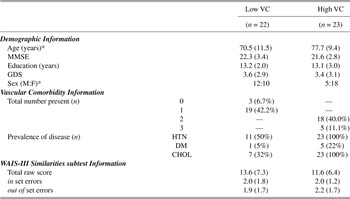
Each participant received a binary score for the presence (1) or absence (0) of individual vascular comorbidities. The three categories were summed to create a composite index of vascular comorbidity (maximum = 3). Patients with AD and 0 to 1 vascular comorbidities (VC) comprised a Low VC group (n = 22), while patients with AD and 2 to 3 VC made up a High VC group (n = 23). We have applied similar binary grouping in the past to both cognitive (Lamar, Goldstein, Libon, Ashley, Lah, & Levey, Reference Lamar, Goldstein, Libon, Ashley, Lah and Levey2006) and demographic (Goldstein et al., Reference Goldstein, Ashley, Endeshaw, Hanfelt, Lah and Levey2008) data analyses. A breakdown of demographic and vascular comorbidity information as it relates to the current study participants is found in Table 1.
Group data

* indicates p < 0.05.
Note. All values depict means (standard deviations) unless otherwise stated in table. VC = vascular comorbidities; MMSE = Mini-Mental State Examination; GDS = Geriatric Depression Scale; HTN = hypertension; DM = Type 2 diabetes mellitus; CHOL = hypercholesterolemia; WAIS-III = Wechsler Adult Intelligence Scale-III.
WAIS-III Similarities Administration and Scoring
Individuals received the WAIS-III Similarities subtest as part of a comprehensive neuropsychological evaluation. The Similarities subtest was administered and scored according to the WAIS-III manual (Wechsler, Reference Wechsler1997) by individuals blind to participants’ vascular comorbidities. All responses given a score of zero as outlined by the WAIS-III manual were then coded using previously established criteria (Giovannetti et al., Reference Giovannetti, Lamar, Cloud, Swenson, Fein and Kaplan2001) for the following qualitative errors:
I. In set responses
a. Vague responses—A superficial albeit superordinate categorical response (e.g., dog & lion: “they eat”).
b. Subordinate responses—A shared concrete attribute (e.g., coat & suit: “they both have sleeves”) or highly specific property about the Similarities pair that may not be correct in all instances (e.g., boat & automobile: “they both have motors”).
II. Out of set responses
a. One Object responses—A response to only one member of the word pair (e.g., coat & suit: “one is minus a pair of pants”).
b. Juxtapositions—A description of how one member of the word pair might interact with the other member (e.g., fly & tree: “the fly has a place to land”).
c. Different responses—An accurate description of how the two items of the word pair are different (e.g., eye & ear: “you see with your eyes and hear with your ears”).
Intra-rater (M.L.) reliability for a subset of participants (n = 32) was high (in set: r = .97, out of set: r = .99; both p levels < .001) as was inter-rater (M.L. & D.J.L.) reliability (in set: r = .71, out of set: r = .91; both p levels < .001). As stated above, all scoring, including scoring for reliability measures was done blind to participants’ vascular comorbidities.
RESULTS
Neither qualitative error variable, in set nor out of set (Table 1), violated assumptions of normality when tested in the overall sample and within individual groups using the Kolmogrov-Smirnov statistic (all p values > .05). Thus, parametric tests were used for all analyses.
Between-Group Analyses
Separate analyses of variance (ANOVA) investigating group differences across measures of age, overall cognitive status, years of education, and depressive symptomatology revealed a significant difference in age only [High > Low VC; F(1,43) = 5.2; p < .05; Table 1]. The sex frequency distribution between groups was also significantly different, χ2(1, N = 45) = 5.1; p < .05, with the Low group containing more men than the High group. Thus, we used age and sex as covariates in all analyses.
Quantitative & qualitative similarities performance
An analysis of variance controlling for age and sex (ANCOVA) investigated between-group differences on WAIS-III Similarities total raw score. No significant between-group differences were found, F(1,41) = 0.14; p = .71. A 2 × 2 ANCOVA controlling for age and sex investigated between-group differences for in set and out of set error production. Neither the two-way interaction, F(1,41) = 0.85; p = .36, nor the main effects [group: F(1,41) = 0.25; p = .62; error: F(1,41) = 0.13; p = .72] was significant.
Post-hoc Analyses
A closer inspection of our group divisions, reliant on the presence of either 0–1 or 2–3 vascular comorbidities, revealed similar numbers of individuals with one versus two vascular risk factors. Approximately 42% of our AD sample had one vascular risk factor and 40% had two (Table 1). Furthermore, it is unclear that there is a difference between having one compared to two vascular risk factors (Goldstein et al., Reference Goldstein, Ashley, Endeshaw, Hanfelt, Lah and Levey2008). In light of this, we collapsed our binary group divisions and investigated the impact of increasing vascular comorbidities on qualitative error production in the entire AD sample through a series of one-tailed Pearson product moment correlations. We conducted one-tailed analyses because we believed, much like our a priori hypothesis regarding the negative impact of multiple vascular comorbidities on out of set error production in AD, that increasing numbers of vascular comorbidities would be associated with increasing numbers of out of set errors.
Presence of vascular risk factors
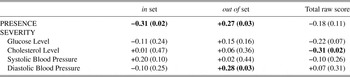
Separate one-tailed Pearson product moment correlations between the number of vascular comorbidities and the number of in set and out of set errors controlling for age and sex revealed a significant dissociation. The presence of increasing numbers of vascular comorbidities was associated with decreasing in set errors (r = −0.31; p = .02). In contrast, the presence of increasing numbers of vascular comorbidities was associated with increasing out of set errors (r = +0.27; p = .03). A one-tailed partial correlation between Similarities total raw score and number of vascular comorbidities was not significant (Table 2).
Correlations between in set and out of set errors and vascular comorbidities

Note
All numbers represent r-values (p level) with degrees of freedom (1,41). Bolded values signify significant associations based on one-tailed p ≤ 0.05.
Severity of vascular risk factors
We performed a more in-depth assessment of the relationship between the severity of individual vascular risk factors and performance on the WAIS-III Similarities subtest by looking at actual values (i.e., systolic and diastolic blood pressure, and glucose and cholesterol levels) as opposed to categorical presence or absence of each vascular risk. One-tailed Pearson product moment correlations controlling for age and sex did not reveal any significant associations between in set or out of set errors and glucose or cholesterol levels (Table 2). There was a significant association between increased out of set errors and elevated diastolic blood pressure (r = +0.28; p = .03). Only cholesterol levels were significantly associated with Similarities total raw score (r = −0.31; p = .02).
DISCUSSION
We found that the number of vascular risk factors in mild AD did not contribute to impairment in overall performance on the WAIS-III Similarities subtest. Using the Boston Process Approach to qualitative error analysis, however, we found significant associations to specific forms of zero-point error production. Thus, as the number of vascular comorbidities increased in our AD sample, the production of out of set errors also increased, whereas in set errors decreased. Thus, the type of errors produced by patients with AD and increasing vascular comorbidities became more indicative of executive dysfunction akin to that seen in VaD (Giovannetti et al., Reference Giovannetti, Lamar, Cloud, Swenson, Fein and Kaplan2001)—a neurodegenerative disorder traditionally associated with vascular comorbidities. These relationships may be due, in part, to the role of hypertension, particularly elevated diastolic blood pressure, on executive functioning in AD.
Of the vascular diseases investigated, it was the severity of diastolic blood pressure that showed a significant association to out of set error production in mild AD. The majority of our sample (34 of 45 or 75%) met The Joint National Committee on Prevention, Detection, Evaluation, and Treatment of High Blood Pressure criteria (Chobanian et al., Reference Chobanian, Bakris, Black, Cushman, Green and Izzo2003) for hypertension. Upon closer inspection, two-thirds of these patients were uncontrolled on their antihypertensive medications based on onsite blood pressure evaluations the day of testing. This suggests that uncontrolled hypertension in AD may lead to subtle alterations in executive functioning.
In contrast to the qualitative effects of vascular comorbidities on differential error production during Similarities performance, we did not observe a significant relationship between increased number of vascular comorbidities and poorer quantitative (i.e., standardized) performance. We previously found that AD patients with both hypertension and hypercholesterolemia obtained lower total Similarities subtest scores than patients with only one or no vascular comorbidities (Goldstein et al., Reference Goldstein, Ashley, Endeshaw, Hanfelt, Lah and Levey2008). A certain degree of corroborative support exists in the current study, however, when considering the severity of hypercholesterolemia on Similarities performance. An increase in cholesterol levels was significantly associated with a decrease in total Similarities subtest scores in our AD sample. Participant and methodological differences across studies may explain the variation in results. Unlike the previous study, the current investigation included patients who were milder in cognitive severity on the MMSE and fasting at the time of measurement of their vascular comorbidities. Future research is necessary to fully examine the relationship between dementia severity and specific vascular comorbidities on verbal reasoning and abstraction in AD.
In the absence of dementia, there is evidence that vascular risk factors negatively impact verbal reasoning and abstraction. For example, elevations in blood pressure (Robbins et al., Reference Robbins, Elias, Elias and Budge2005), the presence of diabetes (Desmond et al., Reference Desmond, Tatemichi, Paik and Stern1993), and high cholesterol levels (P. Elias et al., Reference Elias, Elias, Sullivan, Wolf and D’Agostino2005) are all independent vascular risk factors that negatively impact verbal reasoning and abstraction in nondemented older adults. When they occur together, the degree of executive impairment is significantly increased (Brady, Spiro, McGlinchey-Berroth, Milberg, & Gaziano, Reference Brady, Spiro, McGlinchey-Berroth, Milberg and Gaziano2001; P. Elias et al., Reference Elias, Elias, D’Agostino, Cupples, Wilson and Silbershatz1997; Knopman et al., Reference Knopman, Boland, Mosley, Howard, Liao and Szklo2001). The majority of work investigating these vascular risk factors in AD has focused on overall measures of cognition (Bhargava, Weiner, Hynan, Diaz-Arrastia, & Lipton, Reference Bhargava, Weiner, Hynan, Diaz-Arrastia and Lipton2006) or composite scores encompassing multiple cognitive domains (Helzner et al., Reference Helzner, Luchsinger, Scarmeas, Cosentino, Brickman and Glymour2009). Our preliminary results combined with our previous work (Goldstein et al., Reference Goldstein, Ashley, Freedman, Penix, Lah and Hanfelt2005, Reference Goldstein, Ashley, Endeshaw, Hanfelt, Lah and Levey2008) are, to our knowledge, some of the first exploring the impact of vascular comorbidities on a specific cognitive domain. These findings point toward subtle alterations within verbal reasoning and abstraction in the presence of increasing vascular comorbidities and AD. To gain a better sense of the clinical significance of these results, a larger study of multiple executive measures incorporating standardized and qualitative error analysis methods is warranted.
We acknowledge that we lacked information pertaining to mid-life development and/or presence of each vascular risk factor. While this information has proven useful in understanding later development of cognitive dysfunction and dementia in an aging population (Breteler, Reference Breteler2000; Elias et al., Reference Elias, Sullivan, D’Agostino, Elias, Beiser and Au2004; Launer, Reference Launer2005), we were interested in understanding how the current presence of specific vascular risk factors impacted an established profile of executive impairment in AD (Giovannetti et al., Reference Giovannetti, Lamar, Cloud, Swenson, Fein and Kaplan2001) at the time of evaluation. Furthermore, we did not delineate between AD patients with vascular comorbidities controlled by medication from those not controlled by medication or the duration of this medical (in-)stability across the lifespan. Such comparisons were not possible in the current study due to our small sample size. Future large-scale studies incorporating these methodological variations are, therefore, necessary to confirm and extend our preliminary findings.
Our study was limited to patients who were followed in Memory Disorders Clinics. Recruitment through this clinic may have restricted the range of resulting vascular comorbidities, thereby making our group divisions reliant on the presence of either one or two vascular diseases. These factors, combined with our use of a binary presence/absence outcome measure for each vascular risk factor, may have negatively impacted the magnitude of our correlations.
In summary, this is, to our knowledge, the first study attempting to identify the impact of vascular comorbidities on a specific profile of impairment derived from a qualitative error analysis in AD. Our results suggest an interplay of vascular comorbidities and mild AD on the shift from conceptually based errors (i.e., dog-lion – they’re alive) to a more blatant loss of mental set (i.e., dog-lion – a dog can eat a lion) during the Similarities subtest. This may be due, in part, to the additional impact of hypertension, specifically elevated diastolic blood pressure, in AD. It is important to expand the Boston Process Approach of qualitative error analysis across other executive test measures and cognitive domains to fully understand the contribution of vascular risk factors to patterns of cognitive impairment in mild AD. In addition, future research should incorporate additional vascular risk factors such as smoking and cardiac disease including atrial fibrillation and myocardial infarction or composite indices of vascular risk (Wolf, D’Agostino, Belanger, & Kannel, Reference Wolf, D’Agostino, Belanger and Kannel1991). Such directed study may ultimately provide support for more focused patient and caregiver education concerning the presentation of cognitive dysfunction and the aggressive management of vascular risk factors in affected individuals.
ACKNOWLEDGMENTS
This research was supported by the Alzheimer’s Association Senator Hatfield Award (FCG) and The Emory Alzheimer’s Disease Research Center (NIH-NIA AG025688; AL). Portions of these data were presented at the 10th International Research Conference on Alzheimer’s Disease and Related Disorders July 2006 in Madrid, Spain. There are no conflicts of interest.