


Old age psychiatry has seen a move in recent years towards the assessment and management of people in their own homes and away from traditional hospital-based out-patient visits in the belief that domiciliary clinics enhance clinical assessment (Reference BenbowBenbow, 1990). Blood investigations are a frequent aspect of these assessments and require the patient to attend a hospital or general practice clinic for venepuncture. To support this change in practice, we established a domiciliary phlebotomy service to remove the need for attendance at hospital or health centre purely for blood investigations. The taking of blood samples in patients’ homes has been described as an adjunct to home care services for older people and as a service to haematology patients (MacKenna & Niles, 1995).
Establishment of the service was assisted by the enthusiasm of the phlebotomists to develop their role and their recognition of the inefficient use of phlebotomy time in hospital clinics. However, there were initial concerns that the phlebotomists might be mistaken for doctors carrying drugs of potential misuse and thus be at risk in the community. To reduce this risk, a case resembling a sports bag was used to carry equipment and samples. It was established that the National Health Service (NHS) Trust’s insurance would cover the new service. A request form was introduced, stating the patient’s name, address, date of birth, investigations required and any additional information to assist the phlebotomist, e.g. contact points, directions to a difficult address and notes about unusual circumstances. The phlebotomist recorded the length of journey, whether the visit was successful, any difficulties encountered and sometimes clinical feedback. If requested, the patient was contacted by telephone before the visit. This paper describes the development of the service and its activity during the first 20 months.
Method
A pilot scheme for the patients of one consultant (D.A.) was subsequently extended to all patients of the Mersey Care NHS Trust’s old age psychiatry service (four consultant teams). The phlebotomy clinic occupied one session of phlebotomy time each week. All referrals for domiciliary phlebotomy in the first 20 months were included. The referral form was used to provide patient and visit data.
A sample of patients representing all referrals from one consultant (D.A.) was analysed in more detail. Information was obtained from reviewing the case notes and from the consultant’s personal knowledge of the patients. Psychiatric diagnoses were made using ICD-10 criteria (World Health Organization, 1992). Medical problems causing significant functional impairment and the patients’ social circumstances were also recorded.
It was important to establish whether the patients would have been able to attend a hospital phlebotomy clinic, so an assessment was made of how patients would have travelled to hospital had it been necessary to do so. This was recorded as ‘independent travel’, ‘escorted by another’ or ‘hospital transport’. An assessment was also made of whether the patient was housebound; for the purpose of this report, this was defined as the person being unable to leave home unaccompanied to complete purposeful tasks. Whether this inability was due to physical or psychiatric reasons (e.g. dementia or agoraphobia) was also recorded.
The phlebotomist’s travel expenses were compared with the predicted cost of ambulance transport for patients who would have needed it to attend a hospital clinic. The phlebotomist’s time was already contracted for on a sessional basis and the only additional cost was the purchase of a carrying case. At the time of the study, travel costs were reimbursed at an average of £ 0.39 per mile, and the cost of a return ambulance journey was £ 10.36.
Results
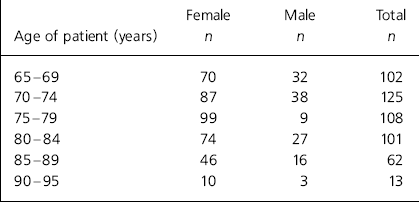
During the study period, 511 visits were made to 307 patients; 376 visits were to women (female:male ratio 2.8:1). The age and gender distribution is shown in Table 1. The phlebotomy visit was unsuccessful in 41 instances (8.0% of visits). On 34 occasions, the patient was not at home, four patients were in hospital and three refused to have blood taken. Four patients accounted for 20 (49%) failed visits.
Distribution of home phlebotomy visits according to patient age and gender
| Female | Male | Total | |
|---|---|---|---|
| Age of patient (years) | n | n | n |
| 65-69 | 70 | 32 | 102 |
| 70-74 | 87 | 38 | 125 |
| 75-79 | 99 | 9 | 108 |
| 80-84 | 74 | 27 | 101 |
| 85-89 | 46 | 16 | 62 |
| 90-95 | 10 | 3 | 13 |
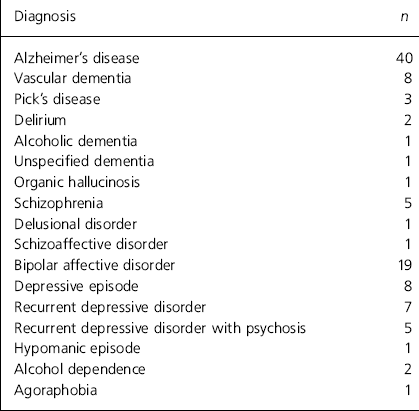
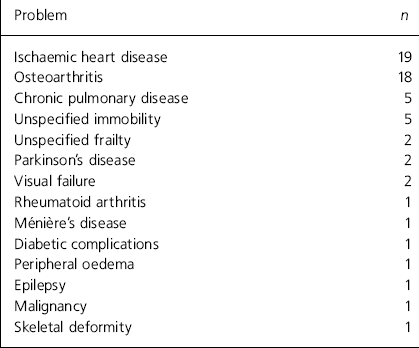
A sample of 105 patients under the care of one consultant (D.A.) were examined in more detail. These patients accounted for 240 visits - almost half of the total. Their psychiatric diagnoses and medical disorders impairing function are listed in Tables 2 and 3. Of this sample, 33 patients lived alone, 35 with another person, 29 in nursing or residential homes, 6 in sheltered accommodation and 2 in group homes for the mentally ill. By the definition used for this study 74 (70%) were considered housebound: 38 for psychiatric reasons, 13 for physical reasons and 23 for both. Thirty-one (30%) patients would have been able to attend a hospital clinic independently; 15 (13%) would have been unable to attend unaided but had family or carers who could convey them; 59 (56%) were in neither category and were considered in need of transport by ambulance.
Patients’ ICD-10 diagnoses
| Diagnosis | n |
|---|---|
| Alzheimer’s disease | 40 |
| Vascular dementia | 8 |
| Pick’s disease | 3 |
| Delirium | 2 |
| Alcoholic dementia | 1 |
| Unspecified dementia | 1 |
| Organic hallucinosis | 1 |
| Schizophrenia | 5 |
| Delusional disorder | 1 |
| Schizoaffective disorder | 1 |
| Bipolar affective disorder | 19 |
| Depressive episode | 8 |
| Recurrent depressive disorder | 7 |
| Recurrent depressive disorder with psychosis | 5 |
| Hypomanic episode | 1 |
| Alcohol dependence | 2 |
| Agoraphobia | 1 |
Medical problems impairing patients’ function
| Problem | n |
|---|---|
| Ischaemic heart disease | 19 |
| Osteoarthritis | 18 |
| Chronic pulmonary disease | 5 |
| Unspecified immobility | 5 |
| Unspecified frailty | 2 |
| Parkinson’s disease | 2 |
| Visual failure | 2 |
| Rheumatoid arthritis | 1 |
| Ménière’s disease | 1 |
| Diabetic complications | 1 |
| Peripheral oedema | 1 |
| Epilepsy | 1 |
| Malignancy | 1 |
| Skeletal deformity | 1 |
The total distance travelled by the phlebotomist during the study period was 730 miles (1.4 miles per visit), incurring a cost of £285 (£0.39/mile). The 59 patients who were predicted to have required ambulance transport would have incurred a transport cost of £611 (£10.36 per return journey). If this consultant activity were representative and were applied to the total study population, then 125 journeys would have required ambulance transport at a cost of £1295, producing an estimated financial saving in travel costs during the study period of £1010.
Discussion
This descriptive study demonstrates the feasibility of providing domiciliary phlebotomy as part of a community old age psychiatry service.
The failure rate of visiting was low (8%) compared with the non-attendance rate of 21% for out-patient appointments in the department’s hospital clinics over the same period. Over four-fifths of the failed visits (34/41) occurred because the patient was not at home. This does not mean that these patients would have been capable of attending a hospital or health centre; for example, the patient might only be able to go short distances or complete simple journeys. In fact, four patients were responsible for half of the failed visits and for the vast majority the service was effective.
The phlebotomists felt that most patients preferred the domiciliary arrangement. This impression is supported by a satisfaction survey conducted by the phlebotomist of 40 patients, all of whom were equally or more satisfied with the home service. Patients appreciated the convenience of being seen at home, compared with the difficulties of attending out-patient departments. There might also be benefits for relatives and carers who would no longer need to convey patients to hospital.
A marginal financial saving was calculated for travelling costs in this particular service. Our predicted use of ambulance transport may be an underestimate, as Benbow (Reference Benbow1990) reported that this was required for 79.6% of hospital clinic appointments. However, travelling costs are only one element of the cost of the service. The purpose of this study was to establish the feasibility of domiciliary phlebotomy, and it does not claim to demonstrate cost-benefit. Furthermore, the catchment area of the study is a geographically small inner-city and urban district, and findings may not apply to large or rural areas.
No practical difficulty was experienced in transporting samples and anticipated problems did not materialise. Indeed, phlebotomists found this method of working rewarding and began passing on clinical information to the doctors about patients they had become used to visiting.
Domiciliary phlebotomy is a logical and feasible development to support the management of patients in their own homes. In our experience, the number of failed visits can be minimised by the phlebotomist always visiting on the same day, and making telephone contact before visiting patients who have had a previous failed visit.


 Open access


eLetters
No eLetters have been published for this article.