Introduction
Marigold (Tagetes spp.) is a multipurpose flowering plant belonging to the Asteraceae family (Taylor, Reference Taylor2011). It is in great demand for decoration as an ornamental cut flower and landscape plant (Vasudevan et al., Reference Vasudevan, Kashyap and Sharma1997) as well as has roles in the food colouring industry (Barzana et al., Reference Barzana, Rubio, Santamaria, Garcia-Correa, Garcia, Ridaura Sanz and López-Munguía2002), aromatherapy (Marotti et al., Reference Marotti, Piccaglia, Biavati and Marotti2004), the therapeutic and cosmetic industry (Maity et al., Reference Maity, Nema, Abedy, Sarkar and Mukherjee2011), and phytoremediation (Sun et al., Reference Sun, Zhou, Xu, Wang and Liang2011). Because of its importance and increased production, breeding programmes are ongoing to develop varieties for characteristics such as attractive colour, high yield and good shape (Karuppaiah and Kumar, Reference Karuppaiah and Kumar2010) by creating hybrids for commercial cultivation.
Tagetes spp. contains about 50 species. Two commonly used species are T. erecta L. and T. patula L. (The plant list, 2010; Taylor, Reference Taylor2011). The diploid (2n= 2x= 24) T. erecta L. is known as the African marigold and is tall with large flowers, while the tetraploid (2n= 4x= 48) T. patula L. is known as the French marigold and is small with smaller flowers (Gilman, Reference Gilman2011; Taylor, Reference Taylor2011).
In recent years, molecular marker technology has become a useful tool for generating new varieties (Winter and Kahl, Reference Winter and Kahl1995; de Vicente et al., Reference de Vicente, Guzman, Engels and Ramanatha Rao2005). Additionally, it is commercially important for the identification of hybrid purity, genetic diversity and characterization of varieties in germplasm that differentiate individual plants for germplasm management and for parental selection as well. Moreover, where markers are found to be related to a trait of interest, they provide a means of effective selection of the plants having the desirable characteristic (de Vicente et al., Reference de Vicente, Guzman, Engels and Ramanatha Rao2005).
Among the several kinds of molecular markers commonly employed, the simple sequence repeat (SSR) or microsatellite marker is one of the most effective and widely used marker types with advantages including reproducibility, co-dominant inheritance and high abundance (Powell et al., Reference Powell, Machray and Provan1996). For marigolds, only limited SSR markers have been developed, and this study, therefore, aimed to develop SSR markers specific to marigold using the inter-SSR (ISSR) technique and a SSR-enriched genomic DNA library and to evaluate SSR markers derived from sunflower (Helianthus annuus) in marigolds. In addition, the study aimed to investigate the genetic relationship and taxonomic classification of marigolds using novel markers.
Materials and methods
Plant materials and DNA extraction
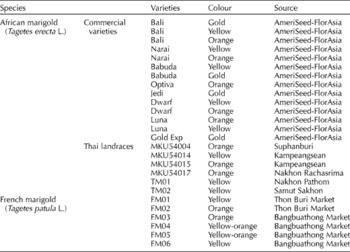
Genomic DNA of 26 samples of marigold including 20 African marigolds (T. erecta L.) consisting of 14 commercial varieties and six Thai landraces and six French marigolds (T. patula L.) as shown in Table 1 was extracted from young marigold leaves using a modification of the cetyltrimethylammonium bromide (CTAB) method (Doyle and Doyle, Reference Doyle and Doyle1987). Leaf tissue samples were ground to a fine powder in liquid nitrogen and lysed with CTAB extraction buffer (2% CTAB, 20 mM EDTA, 100 mM Tris–HCl, 1% Polyvinylpyrrolidone (PVP), 1.4 M NaCl and 0.1% sodium bisulphite) plus 0.2% SDS. Protein was then removed by extraction with 24:1 (v/v) chloroform–isoamyl alcohol. DNA was precipitated using isopropanol, washed with 70% ethanol and resuspended in deionized water with RNase A (final concentration 100 μg/ml). DNA concentration was determined using the NanoDrop™ 1000 Spectrophotometer (Thermoscientific, DE, USA).
List of marigold samples used for simple sequence repeat evaluation and genetic analysis

Development of SSR markers using the ISSR technique
Ten ISSR primers consisting of (5′–3′) AGAGAGAGAGAGAGAGC, AGAGAGAGAGAGAGAGG, GACAGACAGACAGACA, ACACACACACACACACT, ACACACACACACACACC, GGGTGGGGTGGGGTG, AGAGAGAGAGAGAGAGYC, AGAGAGAGAGAGAGAGYA GAGAGAGAGAGAGAGAYT and CACACACACACACACARG were used to generate DNA fragments from five samples of African marigold by PCR. The PCRs were set up in a total volume of 20 μl containing 50 ng of DNA, 0.2 mM of each dNTP, 3.5 mM MgCl2, 10 pmol of each primer and 1 U of Taq polymerase (Promega, WI, USA) in the manufacturer-supplied buffer. PCR cycles were run as follows: 94°C for 5 min, then 40 cycles of 94°C for 30 s, 60°C for 90 s and 72°C for 90 s, and ending with 72°C for 5 min. The amplified fragments were separated on 5% denaturing polyacrylamide gels and visualized by silver staining as described by Benbouza et al. (Reference Benbouza, Jacquemin, Baudoin and Mergeai2006). The polymorphic bands containing SSRs were excised and incubated at 37 °C for 2 h in 20 μl of sterile distilled water. The eluted DNA bands were then reamplified and purified before being cloned. To clone the fragments, SSR-containing fragments were ligated with the pGEM-T easy vector and transformed into Escherichia coli DH5α by the heat shock method according to the manufacturer's instructions. The positive clones were selected for sequencing, and SSR-flanking primers were designed from the sequences of the clones and the database using Websat (http://wsmartins.net/websat/). SSRs were initially tested for amplification by PCR, and the products were separated by polyacrylamide gel electrophoresis as described above. The markers generating clear and scorable bands were evaluated in all DNA samples with the same technique.
Development of SSR markers using a SSR-enriched genomic DNA library
The genomic DNA of an African marigold was digested with three different restriction enzymes, AluI, HaeIII and AfaI (Takara, Japan). A SSR-enriched genomic DNA library was constructed as described previously by Sraphet et al. (Reference Sraphet, Boonchanawiwat, Tangphatsornroung, Boonseng, Tabata, Lightfoot and Triwitayakorn2011). In the hybridization step, (AG)20 and (CAG)20 biotinylated repeat oligonucleotide probes were used to enrich the SSR fragments. The products from the SSR-enriched genomic DNA library were cloned and, after sequencing, were used for primer design and sample evaluation as described already.
Determination of the feasibility of transferring SSR markers from sunflower (H. annuus)
Sixty-three pairs of SSR primers developed in the sunflower, namely IUB1, 5, OSU2, 4, HNCA2 (Whitton et al., Reference Whitton, Rieseberg and Ungerer1997), HT279, 293, 297, 311, 314, 317, 324, 329, 382, 383, 387, 419, 421, 424, 490, 446, 506, 538, 545, 559, 558, 561, 591, 601, 617, 619, 632, 654, 656, 664, 673, 675, 683, 696, 719, 723, 751, 765, 793, 803, 808, 815, 817, 834, 872, 882, 900, 916, 923, 940, 946, 960, 966, 999, 1021, 1048, 1052 and 1057 (Heesacker et al., Reference Heesacker, Kishore, Gao, Tang, Kolkman, Gingle, Matvienko, Kozik, Michelmore, Lai, Rieseberg and Knapp2008), were initially tested for amplification using two DNA samples (one from an African marigold and the other from a French marigold) and comparing with those specific to sunflower by PCR as described above. The markers generating clear and scorable bands were then evaluated in all DNA samples.
DNA analysis
The genotypes of 26 marigold samples were scored manually. The software TFPGA 1.3 (Miller, Reference Miller1997) was used to calculate unbiased and direct count heterozygosities, percentage of polymorphic loci (using the 95% criterion) and Hardy–Weinberg equilibrium (HW). Genetic distance determination, cluster analysis and dendrogram construction were performed with the Unweighted Pair Group Method with Arithmetic Mean (UPGMA) using the same software. Polymorphism information content (PIC) values were calculated using the PowerMarker program (Liu and Muse, Reference Liu and Muse2005), whereas resolving power (R p) values were calculated using the following formula: R p= ΣIb, where Ib = 1 − (2 × |0.5 − p|), where p is the proportion of the 26 marigold samples containing the I band (Prevost and Wilkinson, Reference Prevost and Wilkinson1999).
Results
Evaluation of SSR markers in marigolds
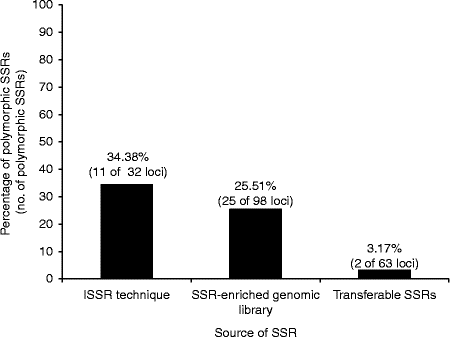
A new set of SSRs specific to marigold was developed using the ISSR technique and SSR-enriched genomic DNA library. Through the ISSR technique, 32 SSRs were developed, and the results indicated that 20 SSRs could amplify specific products. Of these, 11 SSRs exhibited polymorphism within the studied population and accounted for 34.38% of the developed SSRs. Among the 98 SSRs derived from the SSR-enriched genomic DNA library, 41 SSRs were specifically amplified and 25 SSRs (25.51% of the total developed SSRs based on a SSR-enriched genomic DNA library) were polymorphic markers. Primer sequences and accession numbers are given in Table S1 (available online). In addition, investigation of the transferability of SSRs originating from sunflower revealed that 35 of the 63 pairs of SSR primers could amplify the DNA of marigolds, but only two pairs (3.17%) exhibited polymorphism as indicated in Fig. 1 (an example of an amplified DNA by SSR is shown in Fig. S1, available online).
Percentage of polymorphic simple sequence repeats (SSRs) generated using the inter-SSR (ISSR) technique, SSR-enriched genomic DNA library and transferable SSRs derived from sunflower.

The number of polymorphic bands, heterozygosity, HW, PIC and R p of each primer obtained from the evaluation of the 38 SSR markers in all the marigold samples are given in Table S1 (available online). A total of 112 alleles were observed. The number of alleles per locus ranged from 2 to 7, and most of the primers amplified two alleles per locus. All alleles were polymorphic, and therefore the percentage of polymorphism of all loci was 100%. The expected heterozygosity ranged from 0.11 to 0.76, with an average value of 0.48, and the observed heterozygosity varied from 0.00 to 1.00, with an average value of 0.32. Significant HW was detected in 15 of the 38 loci. The PIC values, which reflect allele diversity and frequency among samples, ranged from 0.10 to 0.71, whereas R p values ranged from 0.23 to 2.77. The highest R p was found in TE89.
Genetic relationship and taxonomic classification
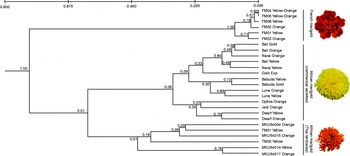
The two best-known species of marigolds are the African and French marigolds (The plant list, 2010; Taylor, Reference Taylor2011), while in Thailand there are landraces belonging to T. erecta L. Therefore, the molecular phylogeny was analysed in these three populations belonging to two species, namely commercial varieties of African marigold, Thai landraces of African marigold and French marigold. The dendrogram constructed based on the UPGMA cluster using Nei's (Reference Nei1972) genetic distance separated the 26 marigold samples into two main clusters according to taxonomic classification, including species of African marigold and French marigold (Fig. 2). The genetic distance between the African marigold and the French marigold is 0.79. The cluster of African marigold was also further divided into two clusters (commercial varieties and Thai landraces) with a genetic distance of 0.33 according to originating regions. The highest divergence was observed between FM05 and MKU54017, whereas the highest similarity was observed between FM04 and FM05, with genetic distances of 0.99 and 0.00, respectively. Bootstrap values at each node are also shown in Fig. 2, the highest value was at the node that separated the African marigold cluster from the French marigold cluster.
Dendrogram of 26 marigold samples based on Nei's genetic distance calculated using 36 polymorphic markers developed in this study and two polymorphic transferable markers.

Discussion
SSR markers specific to marigold were successfully generated using the ISSR technique and SSR-enriched genomic DNA library. As there are markers that have been reported in sunflower, a flowering plant of the same family, the transferability of these markers to marigold was also evaluated. Among the three methods, the ISSR technique was found to generate the highest percentage of polymorphic SSRs (Fig. 1), indicating that it is an effective method for developing SSRs in marigolds. However, a SSR-enriched genomic DNA library is more practical for generating large numbers of SSRs. The low level of transferability of SSRs between sunflower and marigold suggests that the SSR-flanking regions are not well conserved between these species. Even though low numbers of alleles per locus were observed, according to Kalinowski (Reference Kalinowski2002), this has no effect on the estimation of genetic distances and equivalent results can be accomplished using alleles within or across the loci, and the only important factor is the total number of alleles.
In genetic relationship analysis, the African marigold and the French marigold were separated into different clusters with the highest genetic distance. Accordingly, the highest bootstrap value was at the major node that separated the African marigold cluster from the French marigold cluster. This indicated that the association was strong. The set of SSRs used in this study could also classify commercial varieties and Thai landraces of African marigold. This indicates that the SSR markers are effective for classifying populations and for analysing the genetic relationship. Moreover, the markers can be used to classify most commercial varieties of African marigold, although the markers could not differentiate the varieties ‘Bali’ and ‘Narai’, which share the same female parent. The SSR markers were able to identify almost all the samples, except FM04 and FM05, which have the same morphological traits and were collected from the same area and therefore possibly have the same genotype. However, the markers are effective at identifying individual marigolds. These SSRs will be useful in genetic differentiation of marigolds that have not been reported elsewhere, but only in related taxa such as sunflower (Heesacker et al., Reference Heesacker, Kishore, Gao, Tang, Kolkman, Gingle, Matvienko, Kozik, Michelmore, Lai, Rieseberg and Knapp2008).
Conclusions
It is well known that SSRs are effective markers for genetic analysis, and several techniques can be used to develop SSRs. In this study, it was found that the ISSR technique, which is a low-cost technique, yielded the highest percentage of polymorphic SSRs, although SSR-enriched genomic DNA libraries are more practical if a large number of SSRs are required. Although transferable SSR markers are often suitable for rapidly generating usable SSRs, few transferable markers from sunflower can be utilized in the genetic analysis of marigold. Herein, we report 38 polymorphic SSRs specific to marigold that are applicable for species characterization and individual identification, as well as genetic diversity analysis. These markers will be an effective tool for industrial and genomic research of this flowering plant.
Supplementary material
To view supplementary material for this article, please visit http://dx.doi.org/10.1017/S1479262114000100
Acknowledgements
Financial support from AmeriSeed-FlorAsia and the Institute of Molecular Biosciences, Mahidol University are acknowledged. Some of the Thai marigolds were kindly provided by Ms Nongluck Kongsiri.