1. INTRODUCTION
Precise Point Positioning (PPP) and Network-based Real-Time Kinematic (NRTK) are two representative techniques for high accuracy Global Navigation Satellite System (GNSS)-based positioning (Kouba and Heroux, Reference Kouba and Heroux2001; Wuebbena et al, Reference Wuebbena, Schmitz and Bagge2005). Based on observations from a stand-alone GNSS receiver and the IGS precise orbit and clock products, PPP positioning accuracy can reach cm- to dm-levels for static or kinematic applications (Bree et al, Reference Bree, Tiberius and Hauschild2009). However, due to the fact that PPP-based solutions use real-valued float ambiguities, i.e. non-integer un-differenced (UD) phase ambiguities, long convergence times are experienced (Zumberge et al, Reference Zumberge, Heflin, Jefferson, Watkins and Webb1997). NRTK does not have this drawback as observations from one of the (virtual) network reference stations are used by the NRTK user and the virtual station's observations contain the error corrections that are derived from the reference network. This allows the NRTK users to perform fast Integer Ambiguity Resolution (IAR) and realise positioning with accuracy at the cm-level using only a few epochs of data (Vollath et al, Reference Vollath, Deking, Landau, Pagels and Wagner2000; Wu et al, Reference Wu, Zhang and Silcock2008; Odijk et al, Reference Odijk, Verhagen, Teunissen, Hernandez-Pajares, Juan, Sanz, Samson and Tossaint2010).
A novel UD PPP-RTK concept, which is a synthesis of PPP and NRTK, is proposed and analyzed in this paper, and some of its test results and performance assessment are demonstrated. There are two differences between our PPP-RTK concept and those existing ones (for example, Wuebbena et al, Reference Wuebbena, Schmitz and Bagge2005; Zhang et al, Reference Zhang, Wu, Wu, Rizos, Roberts, Ge, Yan, Gordini, Kealy, Hale, Ramm, Asmussen, Kinlyside and Harcombe2006; Geng et al, Reference Geng, Teferle, Meng and Dodson2010; Li et al, Reference Li, Zhang and Ge2010). First, the UD observations, rather than their ionosphere-free combinations, are used directly to provide the ionospheric corrections. Secondly, all the corrections can be obtained in one go, i.e. no step-wise processing procedures are required, thus the consistency amongst different types of corrections can be assured.
Two distinct parts in the implementation of our PPP-RTK approach are. First, the UD observations are processed at the network level. After eliminating the rank deficiencies with re-parameterization, or S-basis choice (De Jonge, Reference De Jonge1998), the network parameters can be estimated in real-time with a Kalman-filter or recursive least squares. Once the network ambiguities are successfully resolved, the ambiguity-fixed (biased) satellite clocks, (biased) satellite phase biases, and the (interpolated) ionospheric delays for the user's location will be saved and ready for sending to the PPP users that are within the network region. Secondly, after correcting their observations with the network corrections, the PPP users can perform IAR and positioning just as they do in the case of NRTK.
In the following sections, we first derive the observation equations of our PPP-RTK approach and special attention is given to rank defects and parameter estimability. Subsequently, the performance of the PPP-RTK approach will be tested and its capability for fast IAR and high accuracy user positioning is demonstrated.
2. THE PPP-RTK CONCEPT
In this section, the full-rank observation equations of our PPP-RTK concept are given. This is done for data processing of both the network and the user sites. Although the work presented in this contribution only used single- and dual-frequency GPS data, the proposed PPP-RTK concept is also applicable to multi-frequency and multi-GNSS applications. In the following sub-sections, we firstly discuss the network observation equations and then the user observation equations.
2.1. Network Processing
For a receiver-satellite pair r−s, the UD carrier phase and code observation equations on frequency j can be given as (Teunissen and Kleusberg, Reference Teunissen and Kleusberg1998):
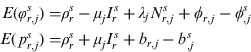
where E(·) denotes the expectation operator, φ r,js and p r,js denote the phase and code observable, respectively, ρ rs=l rs+τ rs+dt r−dts is the sum of all the frequency-independent items, l rs is the receiver-satellite range, τ rs the slant tropospheric delay, dt r and dts are the receiver and satellite clock errors respectively, I rs is the (first-order) slant ionospheric delay on the L 1 frequency (μ j=λ j2/λ 12), N r,js is the integer phase ambiguity, λ j the wavelength of frequency j, ϕ r,j and ϕ ,js are the frequency-dependent phase biases, while b r,j and b ,js are that of their code counterparts. Note that all the bias terms are in units of metres.
For the purpose of simplifying our equations in the following sections, the following assumptions for the network processing are made:
• The network consists of n stations (r=1,…n) and all the stations track the same m satellites (s=1,…m) on the L 1 and L 2 frequencies (j=1,2);
• The geometric range of the receiver to the satellite l rs is known from the known position of the reference station and the satellite provided by the IGS precise orbit.
For practical purposes and the flexibility of our approach, we now discuss the approach for the following two cases: 1) the satellite clock information is provided externally, i.e. it is available to the users, and 2) the satellite clock information is not available, thus it must be provided by the regional network.
2.1.1. When Satellite Clocks Are Available
The satellite clocks given below are assumed known from an external source e.g. from IGS:

Then the code observation equation expressed in Equation (1) can be reformulated:

In Equation (3), all the code biases originating from p r,js and dt Is are absorbed by the estimable receiver clock and the slant ionospheric delays. Their re-parameterised forms are therefore given as:
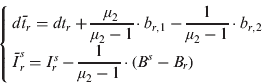
where the Bs=b ,2s−b ,1s and B r=b r,2−b r,1 are the satellite and receiver Differential Code Biases (DCBs), respectively (Sardon and Zarraoa, Reference Sardon and Zarraoa1997; Yuan and Ou, Reference Yuan and Ou2001).
Similarly, the network phase observation equations can be obtained after the same re-parameterisation:

Due to the opposite sign of the ionospheric group and phase delays, the code biases within  and
 cannot be cancelled as in the code observation expressed in Equation (3). Hence, the re-parameterised phase biases are given as:
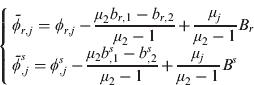
Due to the linear dependence between N r,js,  and
 , there would be a rank defect of f(n+m) in the design matrix of Equation (5). One possible solution to this problem is to choose, per frequency, the phase biases of the first receiver (here
 ), the ambiguities from the first satellite to all involved receivers (here N r,j1) and the ambiguities from the first receiver to all visible satellites (here N 1,js) as S-basis (Teunissen et al, Reference Teunissen, Odijk and Zhang2010). Then the network phase equations can be expressed as:

Where  ,
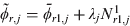 and
 . Thus in Equation (6), we can find the integer double differenced (DD) ambiguities N r1,js1.
To avoid possible additional rank defects, the slant tropospheric delays τ rs in both Equations (3) and (6) can be further parameterised:

where T r is the station-wise Zenith Tropospheric Delay (ZTD) and mf rs is a mapping function.
To summarise, when the satellite clock information is available from an external source, the PPP-RTK network processing of the phase and code data can be based on the following set of full-rank, re-parameterised observation equations:

2.1.2. When Satellite Clocks Are Unavailable
When the external satellite clocks are not available, they can be derived from a regional reference network. In this case, the network observation equations need to accommodate the additional unknowns and additional (near) rank defects. These rank defects are due to the linear dependence between the satellite clocks and receiver clocks, and the near linear dependence between the satellite clocks and the ZTD mapping functions. This problem can be solved by choosing the clock and ZTD of the first receiver to be the S-basis. Then the final full-rank observation equations of the network become:

where  is the estimable ZTDs,
 and
 are the redefined satellite and receiver clocks, respectively.
The network corrections that are provided to the PPP users include  and
 , which are essential for the user's fast IAR in PPP and the interpolated
 which also help to improve the performance of IAR (Yuan et al, Reference Yuan, Huo, Ou, Zhang, Chai, Wen and Grenfell2008a; Yuan et al, Reference Yuan, Tscherning, Knudsen, Xu and Ou2008b; Li et al, Reference Li, Zhang and Ge2010). Although not tested in this contribution, the ZTDs from the network processing method can be also used to facilitate the user's PPP-IAR. The network processing strategy presented above can be used in both real-time and post-processing modes.
2.2. PPP Processing
In the previous section, it was discussed that the ionospheric delays, i.e.  in Equation (4), derived from the network processing need to be interpolated in the spatial domain for generating the ionospheric delay corrections at the PPP user's approximate position. Several interpolation methods can be used for this purpose and the Kriging method (Jarlemark and Emardson, Reference Jarlemark and Emardson1998) was selected in this research. The covariance function selected for the use of this method is a simple linear function of the inter-station distance. The resulting interpolated ionospheric delays can be expressed as:
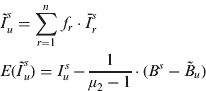
where f r is the coefficient of the interpolation, subscript u denotes the user, I us is the ionospheric delay of the user receiver u to the satellite s, Bs is the satellite's DCB, which is free from the interpolation process and  is the “interpolated” DCB for the PPP user.
After applying the network-based corrections and the elimination of rank defects, the linearised PPP-RTK observation equations become:

Where l u,0s is the approximate geometric range, μ us is the unit vector of the geometric range from the satellite to the user receiver, Δx u denotes the vector increment of the receiver position and the forms of  ,
 and
 are similar to those in the network equations, see Equation (8). The term
 in Equation (10) stems from the difference between the interpolated ionospheric delays
 and the estimable ionospheric delays
 .
Obviously, in Equation (10) N u1,js and  are linear dependent, its resulting rank defect could be eliminated by choosing, per frequency, the first satellite's single differenced (SD) ambiguity N u1,j1 as the S-basis. After
 in Equation (10) is replaced with
 , where
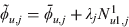 , the full-rank observation equation for PPP users can be obtained.
The source of satellite clock estimate  in Equation (10) is either the IGS clock estimate dt Is or the regional network-based satellite clock estimate
 , which depends on the strategy adopted in the network processing, as discussed in sections 2.1.1 and 2.1.2. Based upon both types of satellite clocks, the user's PPP-RTK observation equations can be cast into a unified frame as given by Equation (10). Note, however, that the interpretations of the estimable parameters and
 are different in the two cases: when provided from IGS, the results of dt Is, the and are in the IGS frame; while when calculated from the regional network, the estimates of
 , and can only be relative to the T 1 and
 that have been absorbed by
 . In our case studies discussed in the next section, the satellite clock parameters are assumed to be unavailable and they were estimated from the regional network.
3. CASE STUDIES
Based on the two CORS networks, one in northern China and the other in Perth, Western Australia, our PPP-RTK approach was tested. The performance of the network processing and the fast IAR capability for both dual- and single-frequency PPP at the user's end are demonstrated.
3.1. Northern China CORS: Dual-frequency PPP
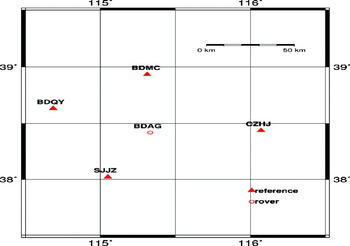
This CORS network is a medium-scale network consisting of four stations with inter-station distances ranging from 60 to 100 km, see Figure 1. Trimble GPS data on two frequencies: L1 and L2 (L1-L2-C1-P2) on 29th April 2009 with 30 sec sampling rate were collected.
The configuration of the northern China CORS network consisting of four reference stations (triangles), and the BDAG station (circle) is the user station.

3.1.1. Network Processing Results
Our network processing strategy is characterised as follows. The standard deviations of the UD phase and code observations were set to 3 mm and 30 cm, respectively. All the observations were weighted according to their elevation and the elevation cut-off angle of 5 degrees was used. A Kalman-filter was used for the real-time data processing. The residual ionospheric and ZTD tropospheric delays are modelled as a random walk process; the clock errors are modelled as white noise, while the DD integer ambiguities are treated as constants.
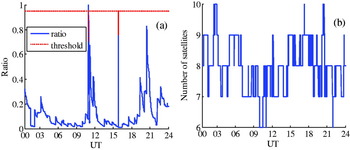
For both network-IAR and user-IAR, the LAMBDA method was used (Teunissen, Reference Teunissen1995; Teunissen et al. Reference Teunissen, De Jonge and Tiberius1996). For the validation of the integer ambiguity results, the fixed-failure rate FFRatio test was used (Teunissen and Verhagen, Reference Sardon and Zarraoa2009). The epoch-wise full IAR was started after the filter's 10 epochs (5 min) initialisation. The float ambiguities corresponding to newly risen satellites were only considered for resolution after 60 epochs’ (30 min) filtering. Panel (a) of Figure 2 shows the result of ambiguity resolution with a success rate of about 2873/2880≈99·7%. The epochs with wrongly fixed ambiguities are corresponding to the periods during which the satellites were frequently rising and setting, as revealed in panel (b).
IAR results for the northern China CORS: panel (a) FFRatio test- and threshold values versus time; panel (b) number of tracked satellites versus time.

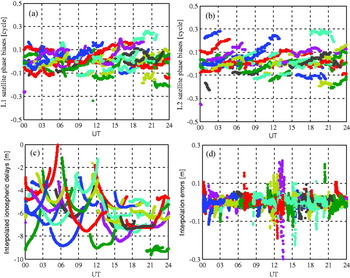
Figure 3 shows the network processing results. In the two upper panels of this figure, the estimated dual-frequency phase biases are shown for each satellite's continuous arc. The two lower panels of Figure 3 show the interpolated ionospheric delays and their errors/accuracy. These error estimates are obtained from comparing the interpolated delays with the reference values of the ionospheric delays at BDAG (user), which could be derived from post-processing the GPS data of the network together with BDAG. Note that most of the interpolation errors/accuracy at BDAG is less than 1 dm for all the satellites, except those in some periods when the ionosphere was in disturbed conditions (i.e. 12:00–13:00 UT).
Processing results of the northern China CORS network: panels (a) & (b): L1 & L2 satellite phase biases (in units of cycles) respectively; panels (c) & (d): interpolated ionospheric delays and their errors (in units of metres) respectively. Different colours correspond to different satellites.

3.1.2. Dual-frequency PPP Result
During the static PPP processing, the epoch-wise interpolated ionospheric delays were used as pseudo observations, whose standard deviations were set to 1 dm to account for the interpolation errors.
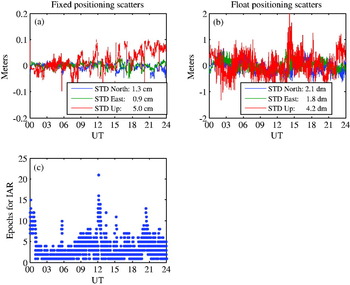
Figure 4 shows the dual-frequency PPP-RTK performance at the BDAG location. The bottom panel indicates that the number of epochs needed for successful IAR is always less than 30 (15 mins) and most of the time even under 10 (5 mins). The corresponding accuracy of the ambiguity-fixed positioning (with respect to the known ground-truth) is about 1 cm and 5 cm for the horizontal and vertical components, respectively, while the accuracy of the ambiguity-float positioning is in the range of 2–4 dm.
Dual-frequency PPP-RTK positioning for the user station BDAG within the northern China CORS network: panels (a) and (b): fixed & float positioning scatters respectively; panel (c): number of epochs needed for successful IAR versus time of the day.

3.2. Perth CORS: Single-frequency PPP
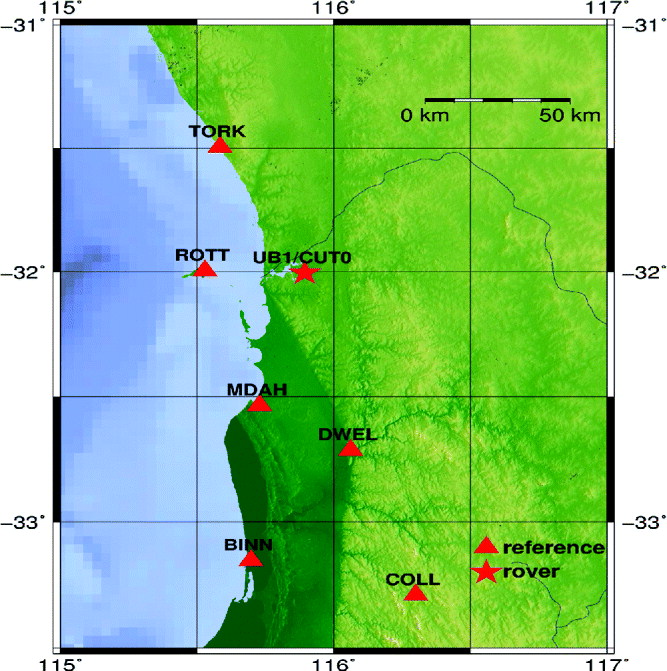
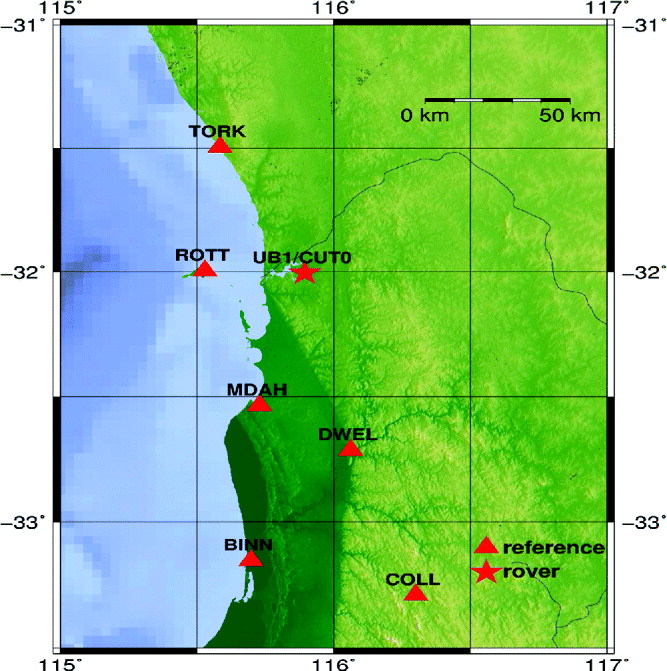
The Perth CORS network consists of six stations with inter-station distances in the range of 60–180 km, see Figure 5. The dual-frequency (L1-L2-C1-P2) Trimble NetR5 GPS data collected on 23rd October 2010 with the 30 sec sampling rate was selected for the test of the network processing, while the single-frequency (C1-L1) UBlox GPS data was used for the test of the user's PPP processing. The configuration of the network and the user station are displayed in Figure 5. The test results are shown in Figure 6.
Configuration of the Perth CORS network (triangles) and the single-frequency PPP user: UB1 (star); the CUT0 is a dual-frequency receiver for forming a zero baseline with UB1.
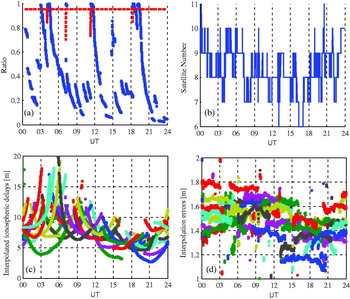
Perth network processing results: panel (a) FFRatio test- and threshold values versus time; panel (b) number of tracked satellites versus time; panels (c) & (d) interpolated ionospheric delays at UB1 and their errors respectively. Different colors correspond to different satellites.

3.2.1. Perth Network Processing Results
For the network data processing, the same strategy as for the northern China network was used. Panel (a) in Figure 6 shows the results of ratio tests for network IAR with success rate roughly 2571/2782≈92·4%. The performance is slightly worse than that of the northern China network. This may be attributed to both the scale of the network and the increase in the number of ambiguities per epoch.
To weight out the performance of ionosphere interpolation, the reference ionospheric delays at UB1 are derived from post-processing the dual-frequency GPS data from the reference network and the CUT0. Panel (d) in Figure 6 shows the differencing values of the interpolated ionospheric delays and these references, from which the STD value calculated for the ionospheric interpolation precision is 1·4 dm (Ciraolo et al, Reference Ciraolo, Azpilicueta, Brunini, Meza and Radicella2007).
3.2.2. Single-frequency PPP Results
The procedure and settings were similar as before, but with the standard deviation of the pseudo ionospheric observables set to 1·4 dm.
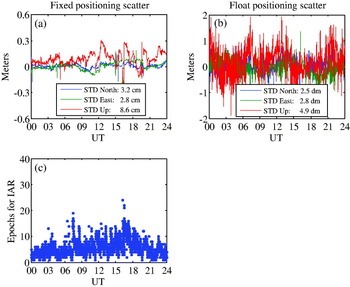
Similar to Figure 4, Figure 7 shows the full IAR performance of the single-frequency PPP-RTK positioning. From the bottom panel, it can be seen that the maximum number of epochs needed for IAR in PPP is less than 40 (20 mins) and the averaging number of epochs needed for IAR is about 10 (5 mins). The accuracies of the ambiguity-fixed positioning in the horizontal component are in the range of 2–3 cm and in the vertical direction is less than 1 dm. In contrast, the accuracies of the ambiguity-float positioning in three components are in the range of 2–5 dm.
Results of PPP-RTK at the single-frequency UB1 station, each panel has the same meaning as those in Figure 4.

4. CONCLUSIONS
In this contribution, we described a novel PPP-RTK approach and demonstrate its potential for high accuracy positioning which is due to the realised PPP-user integer ambiguity resolution capabilities. To emphasise the flexibility of our approach, we also show the data processing methods for the two the eases: with and without satellite clock information provided externally.
In our PPP-RTK approach the UD GNSS network observations are processed by solving a re-parameterised, full-rank system of observation equations. The re-parameterisation eliminates the system rank defect, thereby estimable parameters in the network can be obtained. These estimable parameters include the SD (biased) receiver clocks, the (biased) satellite clocks, the (biased) phase and code instrumental delays, the DD ambiguities, the SD ZTDs and the ionospheric model parameters. After network ambiguity is resolved, the PPP-user uses the relevant ambiguity-fixed network parameters (e.g. biased satellite clock, satellite phase bias and interpolated ionospheric slant delay) in his own estimation procedure, which enables the PPP-user to perform integer ambiguity resolution and realise cm-level positioning. Our PPP-RTK concept combines the merits of both PPP and network-based RTK. Its performance is demonstrated by the tests of two CORS networks: one is a northern China network and the other is a Western Australia network near Perth.
ACKNOWLEDGMENTS
This work was conducted in the context of the Australian ASRP research project “Space Platform Technologies”. Data from the West Australian Network is kindly provided by GPS Network Perth. The authors thank two reviewers, Dr Suqin Wu and Prof. Xiufeng He, for their constructive comments. The second author is the recipient of an Australian Research Council (ARC) Federation Fellowship (project number FF0883188). All this support is gratefully acknowledged.