


INTRODUCTION
During David Cameron’s first term as Conservative prime minister, Philip Hollobone—a socially conservative member of the Tory right wing—was the most rebellious member of Parliament (MP) in the House of Commons. He voted against his own party leadership in 19.9% of votes, a remarkable figure in Westminster where party cohesion is typically very high. He rebelled despite the fact that the vast majority of the government’s agenda moved policies in his preferred ideological direction. He was even willing to rebel against his party on votes containing core conservative principles, saying that they did not go far enough. In 2013, he went so far as to vote against the Queen’s Speech—the annual statement of the government’s policy agenda. It was the first rebellion by government MP’s against their own agenda since 1946. Hollobone, along with three other Conservative MPs, instead put forward an “Alternative Queen’s Speech” outlining policies such as bringing back the death penalty, privatizing the BBC, and banning the Burka.Footnote 1
Hollobone’s own remarks suggest that he uses such votes to connect with his constituents, signaling to them his independent spirit and ideological purity, saying to the BBC that he rebels because his role is to “represent constituents in Westminster, it’s not to represent Westminster in the constituency.”Footnote 2 However, despite such a public commitment to independence in voting, in the previous parliamentary term, when the Conservatives were in opposition facing a Labour government, he rebelled against his own party leadership almost five times less, just 4.3% of the time. Why would the same MP behave so differently in these two settings?
We argue that his change in voting behavior when in government compared with opposition highlights features of Westminster politics that the theoretical and empirical literature on postwar parties and parliamentary democracy has largely overlooked, namely the link between government agenda control, ideology, and backbencher rebellion. We demonstrate that backbencher rebellions are much more likely to occur among ideologically extreme MPs when their party is in government. The Hollobone vignette reflects a broader pattern: Governing parties experience higher levels of rebellion than opposition parties because the exact same ideological extremists rebel more frequently when their party controls government, while moderates’ rebellious behavior remains largely unaffected by changes in government control. This result is surprising given that most of the theoretical literature on party unity in parliamentary systems focuses on government rather than opposition unity (e.g., Diermeier and Feddersen Reference Diermeier and Feddersen1998; Huber Reference Huber1996). Moreover, because we examine within individual changes, these patterns cannot be accounted for by the more mundane explanation that parties’ delegations tend to be larger and more ideologically diverse when in government than in opposition.
We present a theory of rebellion in Westminster parliamentary systems that links government agenda control, ideology, and constituency representation. Because the government has control over the legislative agenda, government party ideologues are able to rebel on policy grounds, allowing them to represent the interests of certain segments of their constituency without appearing to support the policy platform of the opposition. Opposition ideologues, on the contrary, find it difficult to vote against their party without appearing to support the policy prerogatives of the government. They are less able to use rebellion as a tool to connect with constituents. To test our theory, we draw on an extensive new database of rebellion on divisions (roll call votes) and related debates in the House of Commons. We link the likelihood of rebellion to ideology and government status, with ideology measured using the content of parliamentary debates surrounding welfare politics using Wordscores (Laver, Benoit, and Garry Reference Laver, Benoit and Garry2003). We demonstrate that ideologically extreme MPs rebel more frequently, especially when in government, and are likely to pair their rebellion with participation in debate, thus emphasizing their position.
VOTING IN THE WESTMINSTER SYSTEMS
Any model of voting and rebellion in Westminster must account for two empirical regularities: very high levels of party unity and a government versus opposition divide (Baughman Reference Baughman2004; Kam Reference Kam2009; Spirling and Quinn Reference Spirling and Quinn2010; Dewan and Spirling Reference Dewan and Spirling2011). Indeed, partisan politics dominates so much of the decision-making calculus of MPs that ideological voting is, at best, a secondary motivation (Hix and Noury Reference Hix and Noury2015). Nevertheless, we see historical variation in parties’ average levels of unity (Eggers and Spirling Reference Eggers and Spirling2016), variation in individuals’ propensity to rebel (Gaines and Garrett Reference Gaines and Garrett1993), and that British voters value the dyadic link between themselves and their representatives (Bertelli and Dolan Reference Bertelli and Dolan2009; Bowler Reference Bowler2010; Cain, Ferejohn, and Fiorina Reference Cain, Ferejohn and Fiorina1987; Vivyan and Wagner Reference Vivyan and Wagner2012), including a representative’s independence from the party (Campbell et al. Reference Campbell, Cowley, Vivyan and Wagner2016; Vivyan and Wagner Reference Vivyan and Wagner2015). Nevertheless, the relative rarity of individual defections from party line voting in the United Kingdom and elsewhere has resulted in literature that either (a) focuses on explanations for aggregate levels of party unity (e.g., Carey Reference Carey2007; Sieberer Reference Sieberer2006), or (b) has relied on issue-specific explanations for defections from the party line (Schonhardt-Bailey Reference Schonhardt-Bailey2003; Berrington and Hague Reference Berrington and Hague1998; Cowley and Norton Reference Cowley and Norton1999; Lynch and Whitaker Reference Lynch and Whitaker2013; Heppell Reference Heppell2013). Less research offers general theories of individual-level rebellion (but see Kam Reference Kam2009). We draw theoretical insights from literature focusing on both aggregate and individual levels of analysis.
Theoretical literature on aggregate-level party unity has examined how institutions and government agenda control induce discipline among governing parties (e.g., Diermeier and Feddersen Reference Diermeier and Feddersen1998; Heller Reference Heller2001; Huber Reference Huber1996). The need to pass a policy agenda and the requirement that government have the confidence of parliament leads governing parties to demand loyalty from their backbenchers. Indeed, the literature on British political development highlights the relationship between government agenda control and party loyalty (Cox Reference Cox1987). Beyond the United Kingdom, theoretical work suggests that governments can control the agenda to avoid legislative defeat (if not disunity) (Cox and McCubbins Reference Cox and McCubbins2005; Tsebelis Reference Tsebelis2002).Footnote 3 Theoretical scholars have paid less attention to conditions that might foster high levels of unity among the opposition, although Dewan and Spirling (Reference Dewan and Spirling2011) offer a model in which opposition parties can achieve more favorable policy outcomes by committing their MPs to vote en bloc. If the opposition can remain unified, the government must compromise with its own potential rebels rather than with those from the opposition.Footnote 4 Others suggest that opposition parties may be able to avoid taking controversial stances on divisive issues in ways that governing parties cannot, leading the opposition to show higher levels of cohesion (Sieberer Reference Sieberer2006).
Literature focused on rebellion asks a slightly different, albeit related, question, namely conditional on some existing level of dissent, which MPs (or groups of MPs) are most likely to publicly rebel from the party line. In contrast to aggregate-level studies of party unity, this literature tends not to consider government agenda control as a explanation for rebellion. Instead, it focuses on an MP’s ideology, likelihood of promotion up the party ranks, and length of tenure in parliament (Kam Reference Kam2009). Virtually all empirical literature on rebellion in Westminster, both quantitative and qualitative, examines rebellion (often conceived of as a group activity) on the government back benches (e.g., Benedetto and Hix Reference Benedetto and Hix2007; Cowley and Norton Reference Cowley and Norton1999; Gaines and Garrett Reference Gaines and Garrett1993; Garner and Letki Reference Garner and Letki2005). Rebellion among opposition backbenchers, or lack thereof, receives little attention.Footnote 5 Given the political and policy consequences of government backbencher rebellion, the empirical focus on governing parties is not surprising. However, because the existing literature has not directly compared individual-level MP behavior while in the opposition to their behavior while in the government, we argue that researchers do not know the full extent of the empirical puzzle and have yet to fully explore the impact of government agenda setting on rebellion.
We provide a general theory of individual defections from party votes in which electoral incentives drive MP behavior. We are certainly not the first to pursue such an effort (see, among others, Kam Reference Kam2009; Carey Reference Carey2008). Prior efforts focus on questions of individual agency amid refusals of ministerial positions (Benedetto and Hix Reference Benedetto and Hix2007; Kam et al. Reference Kam, Bianco, Sened and Smyth2010; Eggers and Spirling Reference Eggers and Spirling2016; Piper Reference Piper1991; Tavits Reference Tavits2009), individual ideology (Kam Reference Kam2001), general socialization toward acquiescence to party leaders’ preferences (Crowe Reference Crowe1986), strategic opposition as a function of a commitment mechanism (Dewan and Spirling Reference Dewan and Spirling2011), and constituent preferences on salient parliamentary issues (Schaufele Reference Schaufele2014; Bowler Reference Bowler2010; Pattie, Fieldhouse, and Johnston Reference Pattie, Fieldhouse and Johnston1994; Johnston et al. Reference Johnston, Cowley, Pattie and Stuart2002; Longley Reference Longley1998; Vivyan and Wagner Reference Vivyan and Wagner2012). In contrast, we combine theorizing on government agenda control—key to studies of aggregate-level behavior—with explanations found in the individual-level literature to build a new theory. We consider how governing parties’ commitment (and ability) to change policy interacts with individual ideology to generate electoral incentives for MPs to craft an image of independence through rebellion. In doing so, we contribute to the growing literature on representation and electoral signaling through legislative votes and speech (Bäck, Debus, and Müller Reference Bäck, Debus and Müller2014; Herzog and Benoit Reference Herzog and Benoit2015; Proksch and Slapin Reference Proksch and Slapin2012).
IDEOLOGY AND GRANDSTANDING IN THE HOUSE OF COMMONS: A THEORY
Our theory of rebellion in Parliament hinges on a theory of elections and representation. As many before us, we view MPs as agents of two (potentially) competing principals—their party and their voters. Electoral incentives affect the degree to which MPs are beholden to these principals (Carey Reference Carey2007; Hix Reference Hix2004). The Westminster system, coupling single member district plurality elections with parliamentary democracy, empowers parties. Parties exercise significant control over candidate selection and voters typically consider a vote for a particular MP as a vote for that MP’s party. Nevertheless, an MP’s name features prominently on the ballot, and MPs have a strong incentive to engage in activities that boost their name recognition among voters (Cain, Ferejohn, and Fiorina Reference Cain, Ferejohn and Fiorina1987). As voters value some degree of independence among their MPs (Campbell et al. Reference Campbell, Cowley, Vivyan and Wagner2016; Vivyan and Wagner Reference Vivyan and Wagner2015), rebellion is clearly one mechanism for generating individual recognition (Kam Reference Kam2009, 113–117). As Kam (Reference Kam2009, 103) points out, “British MPs appear to use dissent and constituency service as complementary vote-winning strategies.” The question remains, though, under what conditions is rebellion from the party an effective strategy? We argue that the answer relates to conditions under which MPs are best able to use their dissent as a mechanism to communicate policy stances to voters for electoral gain. In short, government backbenchers, and particularly those who stake out more extreme ideological positions, are better positioned to turn dissent into an asset than opposition backbenchers and moderates.
Dissent is not a strategy that MPs can employ with too much regularity.Footnote 6 There are real costs associated with dissent for both the party and the MP. For the party, mass dissent is embarrassing. It can water down the party’s message, potentially costing it votes at election time (Kam Reference Kam2009, Chapter 6). For governing parties, mass dissent can jeopardize the party’s legislative program and even potentially lead a government to collapse. For the dissenting MP, at the extreme, the party leadership could remove the whip, kicking the MP out of the parliamentary party, or revoke support at election time. But well before taking these drastic measures, the party could sanction the MP by discounting the MP’s policy priorities or overlooking the MP when considering promotions within the party hierarchy. The costs of these sanctions may vary across MPs. The sanctions are least costly to those electorally secure MPs less likely to move up the ministerial ranks who have created an electoral profile for themselves somewhat distinct from the party, thus insulating them from party punishment mechanisms. MPs must carefully weigh the benefits of dissent against the costs and only rebel when they are able to fully exploit the electoral advantages of taking a stand that contradicts their party’s main message.
A backbencher can benefit from rebellion in two different ways, and they are not mutually exclusive. The first is ideologically (or spatially), and the second is through the opportunity to communicate a policy stance to voters. We describe the ideological motivations first. Following a spatial logic, an MP may oppose a bill on ideological grounds if she prefers the legislative status quo to the policy proposed in the bill. Standard Downsian spatial voting suggests that for any reasonable set of status quo locations, only MPs holding moderate positions on a given policy would vote against the majority of their party (Downs Reference Downs1957). Suppose that a Conservative government bill is the subject of a division in parliament. This bill is likely to move policy in a conservative direction relative to the status quo. Very few members of the opposition Labour Party (or other left-wing opposition parties) have an ideological incentive to support a proposal that moves policy away from the preferred position of their party. The few members of the opposition who might defect would be moderate MPs, sufficiently conservative to side with the government on occasion. Likewise, one could imagine that moderate Conservatives, who view their own government as having pushed policy too far, might vote against their party on occasion, too. In unidimensional, single-issue voting, we would never expect ideological extremists to defect when moderates do not. Within ideologically well-sorted parties, spatially motivated defections should be rare and come from the middle.Footnote 7
The second way an MP could benefit from dissent is to use a rebellious vote as an opportunity to highlight her preferred policy position and to distinguish her stance from that of the party. She could seek to garner electoral support from an ideologically driven subset of the electorate by vocally standing up against a policy that has a reasonable chance of becoming law but that this particular ideological constituency opposes. The MP and the constituency may both prefer the status quo over the bill, and the MP may use rebellion to signal to voters her ideological discontent in a legitimate attempt to block passage of the bill. But even if an MP prefers the bill over the legislative status quo, she may rebel to signal that, in an ideal world, she would have preferred a different policy. This strategy is particularly effective when the bill has sufficient support to pass regardless of the actions taken by the individual MP. For example, an MP could advocate for a policy that goes substantially beyond the policy as stated in the bill, saying that although policy is moving in the right direction, it does not go far enough. The actual act of crossing the aisle on the division is important, as these rebellions receive significant press coverage.Footnote 8
Thus, regardless of an MP’s spatial utility for a bill, rebellion can provide an opportunity to signal a policy stance and connect with a subset of ideologically driven voters at the expense of party unity. We argue, though, that MPs’ ability to benefit from rebellion in this manner is conditional on their party being in government and possessing control of the parliamentary agenda. The set of MPs who benefit from voters perceiving them as distinct from their own party differs greatly for the governing party and opposition. Rebellion, when in the opposition, may look like support for the government and its policy agenda. Opposition moderates, who might on occasion support government policies, would prefer to see their own party make policy change and get credit for it. Indeed, Dewan and Spirling (Reference Dewan and Spirling2011) offer a spatial logic to suggest that even moderate opposition members can be better off by binding themselves to their party and voting strategically against the government. Among more ideologically extreme opposition MPs, it would be very difficult to connect with ideologically driven constituencies within their party by offering support to a government that usually moves policy in the wrong direction.
Government MPs, in contrast, are better able to argue that their government is generally doing the “right” thing but happens to have gotten it “wrong” on this particular issue. A government backbencher wishing to oppose her own government could do so under two different conditions. First, the backbencher may support the bill but feel that it does not go far enough. She wishes to say that the government should be doing more, without actually defeating the bill. Second, if a bill moves policy away from from her ideal point (e.g., a Labour government passes cuts in unemployment benefits), the MP may genuinely wish to defeat the measure. Both scenarios create opportunities for government backbenchers to demonstrate independence from the party and garner name recognition, but they have different policy implications and risks.
In both instances, MPs who occupy the ideological fringes of the party—as opposed to moderates—are most likely to rebel. In the first scenario, if an extremist MP knows with a high degree of certainty that the bill will pass regardless of her actions (moving policy in her direction), the MP may benefit by opposing her own party, saying that policy change does not go far enough. Such rebellion is conditional on the extremist’s ability to explain that her defection is not a preference for the status quo, but instead a preference for even larger policy shifts. In other words, ideologically extreme members of a governing party may use divisions as opportunities to “grandstand” or cast a strategic vote against their own party to signal ideological purity to voters, so long as they have a mechanism for defending that defection.
Floor debates offer a prime opportunity for MPs to explain their votes. Debates provide a good conduit for MPs to explain ideological differences. Party leaders generally lack formal mechanisms to prevent particular MPs from speaking or to determine what they say. MPs often use their speeches to dissent from the party line even when they vote with it, meaning that their speeches provide insight into intraparty differences (Proksch and Slapin Reference Proksch and Slapin2015). If an MP wishes to speak in a debate, the MP can register her desire to participate with the nonpartisan Speaker of the House. The parliamentary rules of procedure give the Speaker wide latitude to control debate. Members stand to “catch the Speaker’s eye” when they wish to speak. The Speaker’s primary concern is provide partisan balance, choosing speakers from alternate sides of the aisle, not whether a speaker wishes to express a view at odds with the party leadership. While MPs may not always be able to participate in debate as they like—demand for speaking time may at times outstrip supply—if rebels demand more speaking time in particular instances, they should also participate at higher rates at these times.
In the second scenario, if a sufficient number of MPs genuinely oppose a policy, making government defeat a real possibility, rebellion becomes a riskier strategy. The costs for both the MP and the party are greater, but so is the possibility for the MP to generate press for her position. The press pays more attention to votes when there is a chance of government defeat. Here, a government backbencher may legitimately prefer the status quo over the bill, but she has to determine whether any potential spatial benefits and opportunities for grandstanding outweigh the costs imposed by the party. Depending on the nature of the issue, some MPs may prefer the status quo and use the spatial gain as an opportunity to grandstand, as well. But the benefits of grandstanding would have to be large relative to the costs imposed by the party.
Lastly, we argue that the party is less able to impose costs on MPs who generally hold extreme positions. Moderates tend to wish to climb the party ladder and they have their eyes on ministerial positions (Benedetto and Hix Reference Benedetto and Hix2007; Kam et al. Reference Kam, Bianco, Sened and Smyth2010). They are also less likely to represent easily identifiable ideological groups. Extremists are likely better able to connect to ideological constituencies within the party, and any punishment the party metes out may even help foster the view of the MP as a maverick willing to show independence from the party.
The incorporation of utility from grandstanding and strategic party disloyalty among governing party members implies a different set of hypotheses than a simple spatially motivated account of defection. Our account of strategic party disloyalty suggests that (1) the same MPs are more likely to rebel when their party is in government than when in opposition, (2) among governing party members, ideological extremists are the most likely to defect, and (3) those ideologically extreme governing party MPs are likely to telegraph their defection by speaking in parliamentary debate when they do so. Accordingly, differences in the distributions of party dissent and the prevalence of parliamentary speech paired with dissent among MPs when in government and opposition offer a critical test of our theory. We lay out the following hypotheses based on our theory.
Hypothesis 1: The probability of dissent increases when an MP’s party is in government.
Hypothesis 2: The probability of dissent increases among more ideologically extreme governing party MPs.
Hypothesis 3: The probability of a parliamentary speech paired with a dissent increases among more ideologically extreme governing party MPs.
Before proceeding to test our theoretical argument using data on dissent and speech in the House of Commons, we briefly address the two alternative models. The first is that we find less rebellion within parties when in the opposition simply because they are smaller and more cohesive than when in government. This argument assumes that those members most likely to rebel when in government were also the most electorally vulnerable. The loss of electorally vulnerable members’ seats caused the party to move from government to opposition. The remaining MPs are more ideologically cohesive. In contrast, the governing party gained seats by adding marginal members who are more likely to dissent. We rule out this argument by looking at within-MP changes in rebellion across time. In other words, we ask whether the exact same members were more likely to rebel when in the government than the opposition. We also examine whether more electorally secure or more vulnerable members were likely to rebel and find no evidence of electoral vulnerability mattering in a consistent manner.
A second possible argument is the purely spatial logic put forward by Dewan and Spirling (Reference Dewan and Spirling2011). They explicitly reject electoral signaling arguments such as ours as a driver of opposition cohesion. Their basic argument is that, on an issue-by-issue basis, moderates in the opposition are better off in a policy sense if they can bind themselves to vote against the government. Thus, moderates in the government are a more likely source of rebellion. Their model would predict that the identical MP should be more loyal when in opposition than when in government. We view this argument as plausible but not necessarily contradictory to ours. It is entirely possible that on an issue-by-issue basis some extremists are indeed “moderates,’ or stake out a position close to the opposition on a particular issue, and these are the issues where we observe defection. However, if there were no electoral signaling story, we would not expect any differences in debate activity. We would argue that if even if the spatial story holds true, government MPs are still able to use issues to connect with voters in a way that opposition members are not. Moreover, our theory can explain rebellion in instances when their theory cannot—namely, we would predict defection among government MPs when they truly take an extreme position and the status quo is likely to move in their direction, as suggested by the Hollobone anecdote in the introduction. A spatial model does not predict defection in these instances.
DATA ON DIVISIONS, DEFECTIONS, AND DEBATES
To test our hypotheses, we compare individual MP behavior on divisions and speeches when their parties move from government to opposition. We take advantage of two changes in government—the switch from the Conservative government of John Major to the Labour government of Tony Blair in 1997, and the switch from Gordon Brown’s Labour government to David Cameron’s Conservative/Liberal Democrat government in 2010. Prior to Labour winning in 1997, they had been in opposition for 18 years. When the Conservatives came to power in 2010, they had been in opposition for 13 years. Because we are specifically interested in how individuals change their behavior as a result of the change in government, we only examine MPs from the Labour and Conservative parties.
Of course, the 2010–2015 government was a coalition of the Conservatives and Liberal Democrats. We assume that the presence of the Liberal Democrats as the junior coalition partner did not drastically affect the behavior of the Conservative Party backbenchers. From the perspective of the spatial model, so long as the coalition generally preferred policies to the right of the previous Labour government, the presence of the Liberal Democrats should not change our expectations regarding Conservative Party backbencher behavior. If anything, the presence of the moderate Liberal Democrats in government makes the coalition period a particularly good parliament in which to look for evidence in support of our theory. To the extent that the Liberal Democrats moderated government proposals, we would expect extremist Conservatives to have an increased incentive to rebel, emphasizing that the government does not represent truly conservative interests.Footnote 9
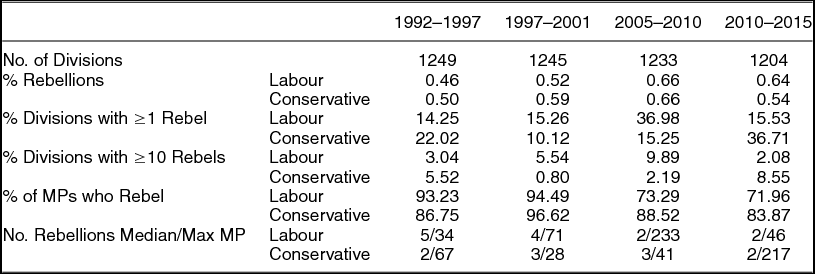
Our analysis below demonstrates that patterns of rebellion during the period of coalition government look similar to those in the earlier periods. Moreover, the number of divisions and overall percentage of rebels on those divisions look very much like the patterns we find in the earlier periods for both Labour and the Conservatives. A slightly higher percentage of divisions experience ten or more rebels, but the numbers are comparable to the previous period of Conservative government (5.52% compared with 8.55%). The most notable difference in the coalition period is that the very most rebellious Conservative MPs seem to have rebelled more. These results are largely in line with initial analyses of the coalition government that find higher levels of rebellion confined to a small number of rebels. These rebellions had little impact on the passage of the government’s agenda or the overall style of government, making the coalition largely business as usual (Yong Reference Yong, Yong and Hazell2012).
Data on MPs’ rebellions from their parties on parliamentary divisions were gathered from www.theyworkforyou.com for the 2005–2015 period. For the earlier period, 1992–2001, the data were parsed directly from Hansard XML files available at www.hansard-archive.parliament.uk. We identify free votes (those that are not subject to any whipping) and drop them from the analysis.Footnote 10 Additionally, we gathered information on parliamentary debate participation for debates associated with divisions. Thus, for every division, we are able to identify who rebelled against their party (defined as voting against the party majority) and who gave a speech during the debate associated with that division. Table 1 provides information on the number of divisions per parliament and the number of rebellious acts we record. Specifically, for both parties in each period, we report rebellious acts as a percentage of the total number of votes cast (excluding free votes), the percentage of divisions experiencing one or more rebels, the percentage of divisions experiencing greater than ten rebellions, the percentage of MPs who rebelled at least once, and the number of times the median and maximum MP (with respect to rebellion) rebelled. These data (and all subsequent analyses) drop any MP who switched party during the period of observation.Footnote 11
Summary Statistics

The summary data are in line with previous studies of rebellion in the United Kingdom (e.g., Kam Reference Kam2009). They demonstrate that while rebellion is rare—fewer than 1% of recorded votes are rebellious—rebellious MPs and divisions experiencing rebellion are common. Most MPs vote against the majority of their party least once over the course of a parliamentary term, and a small number do so with some frequency. Additionally, the percentage of divisions experiencing at least one rebellious vote is reasonably high.
Others have suggested that voting patterns may differ depending on the nature of the division, when it occurs within the parliamentary agenda (Bräuninger, Müller, and Stecker Reference Bräuninger, Müller and Stecker2016; Coman Reference Coman2012), and whether a vote is recorded (Hug Reference Hug2010).Footnote 12 Using the extensive division titles provided by www.theyworkforyou.com for the later period of our study (2005–2015), we identify where and when in the parliamentary agenda these divisions occur.Footnote 13 The vast majority of divisions are votes on clauses and amendments to bills following the second reading stage, once the bill has passed to committee. A much smaller number occur at the time of a bill’s second or third readings, either in an attempt to decline a reading, to make an amendment to the motion to hold a reading, or on the reading itself. Lastly, divisions on opposition days—days on which the opposition controls the parliamentary agenda—are quite common. In line with our theory, though, rebellion on these divisions is very rare.
ANALYSES OF REBELLION
We now proceed to our statistical models of rebellion. We employ fractional logit models with MP-level random effects. Our dependent variable is a proportion—the number of times an MP rebelled from her party over the total number of divisions within a parliamentary term—making ordinary least squares (OLS) is an inappropriate modeling strategy.Footnote 14 An individual MP’s level of rebellion is properly viewed as a series of binomial trials coded one if a legislator rebels against her party on a division and zero otherwise. Fractional logit models take proportions in which the numerator and denominator are known and expands them out into sets of zeros and ones. For example, we may observe 100 instances of an MP opposing his or her party out of 1,000 votes. This implies there are 100 ones and 900 zeroes in a binary coding of that MP’s opposition to her party. From this setup, a standard logistic regression emerges to predict the probability of an outcome, given some attributes of the groups (in this case, legislators), but with no information about the trials (in this case, divisions) themselves. We estimate separate models for two periods, 1992–2001 and 2005–2015, each consisting of two parliamentary terms. MPs who serve in both terms during a period appear in the data twice, while those who serve in only one term appear only for the term they serve. By incorporating MP varying intercepts, we remove the between-unit variance in rebellion and concentrate on the within-unit variance, meaning we examine within-MP change.
We are first and foremost interested in whether MPs tend to rebel relatively more when their party is in government or in opposition and whether some MPs are more affected by this shift than others. As we hypothesize above, we expect more ideologically extreme members to be more affected by a change in government control. Measuring MP-level ideological extremity over time in the House of Commons is very difficult. The most common approach to date has been to use measures obtained from candidate surveys (Benedetto and Hix Reference Benedetto and Hix2007; Kam Reference Kam2009; Kam et al. Reference Kam, Bianco, Sened and Smyth2010). We do not take this approach for two reasons. First, response rates for these surveys are rather low, meaning scholars either rely heavily on multiple imputation methods for missing data or only examine a small subset of MPs; and second, using these data require researchers to match anonymous survey responses to individual MP parliamentary records by merging on uniquely identifying constituency level data. Data for later periods do not allow for such merging. Other approaches using Early Day Motions are harder to implement and only available for limited time periods (Kellermann Reference Kellermann2012).
Instead, we take three different approaches. First, previous research has demonstrated that ideologically extreme members are most likely rebel, while moderates are much less likely to do so (Benedetto and Hix Reference Benedetto and Hix2007; Cowley and Norton Reference Cowley and Norton1999; Kam Reference Kam2009). Indeed, rebellious extremists are precisely the reason why classical techniques for scaling roll call votes do not provide measures of ideology in the United Kingdom (Spirling and McLean Reference Spirling and McLean2006), and often rebelliousness is taken as an indication of extremism. Thus, we first simply examine whether those MPs who rebel the most are more likely to alter their behavior when in government than when in opposition. This simple measure allows us to preserve as much data as possible and allows us to understand how government agenda-setting impacts rebellious behavior amongst those MPs with the highest propensity to rebel.
Of course, if this were the only analysis we provided, we would be saying little about the role of ideology. Thus, we examine two further measures of ideology. First, some backbencher MPs within the House of Commons join ideological groups known to take positions on the ideological extreme of the party. In the case of Labour, the Socialist Campaign Group has represented the hard left wing of the party dating back to 1982. Within the Conservatives, the hard right wing has been represented by various groups over the years including the Conservative Monday Club,Footnote 15 the Cornerstone Group representing traditional social conservatives and the “No Turning Back Group” representing Thatcherite free marketeers. We create a dummy equaling one for any MP that we have determined to have been associated with any of these groups. A list of these MPs can be found in Appendix B.
Lastly, we estimate ideology based on speeches on welfare-related bills using the Wordscores method (Laver, Benoit, and Garry Reference Laver, Benoit and Garry2003), and we examine the effect of the interaction between our ideology measure and government status on rebellion. We provide a brief description of the Wordscores estimation below, along with a fuller description and validity checks in Appendix A.Footnote 16
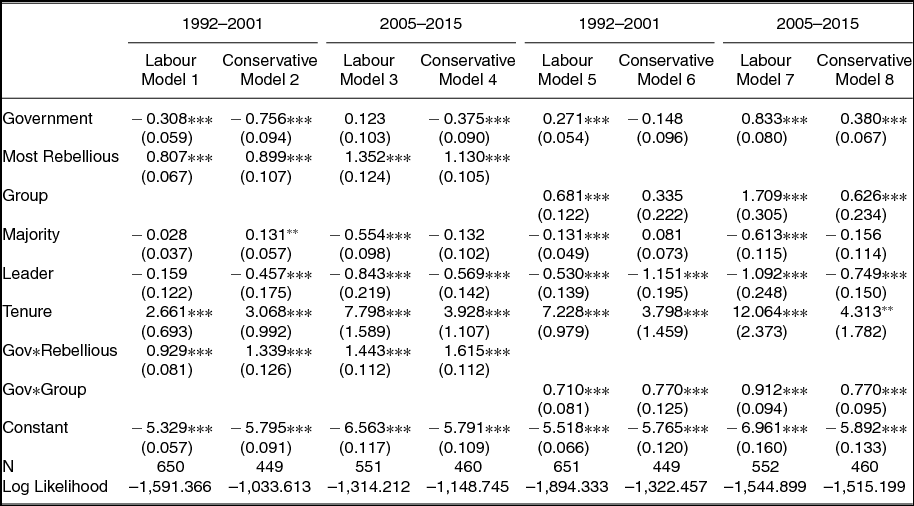
The eight models in Table 2 offer initial evidence in favor of our theory. In models 1–4, we regress overall MP rebelliousness on two dummy variables and their interaction. Government takes on a value of one when an MP’s party is in government and zero when in opposition. Most Rebellious takes on a value of one for the 25% most rebellious MPs and zero otherwise. The model controls for MPs’ electoral security by including their vote majority from the previous election, for holding a leadership position, and for the length of time they have served in parliament.Footnote 17 Although endogenous—we regress rebellion on rebellion—the first four models offer a simple specification that allows us to demonstrate that those members who rebel the most act very differently when in government and in opposition. The positive and statistically significant effects of the interaction terms imply that, for both parties in both time periods, the members who rebel the most are even more likely to rebel when in government than in opposition. In models 5–8, we regress rebellion on our group membership dummy and the interaction of this dummy with the Government dummy. We find a positive coefficient on group membership, which is statistically significant in three of the four models, with the exception being the earlier period for the Conservatives. On average, members belonging to these ideological groups are more rebellious. More importantly, we find a positive and statistically significant effect on the interaction term across all four models; MPs belonging to these extreme groups rebel even more frequently when their party is in government than in the opposition. We also find a strong and statistically significant effect for Tenure, with longer-serving MPs rebelling more frequently. As expected, leaders are much less likely to rebel, while there appears to be no clear-cut pattern with respect to an MP’s electoral majority.
Effect of Government Status on Rebellion: Fractional Logit Models with Random Effects

*** p < .01; **p < .05; *p < .1 in a two-tailed t-test
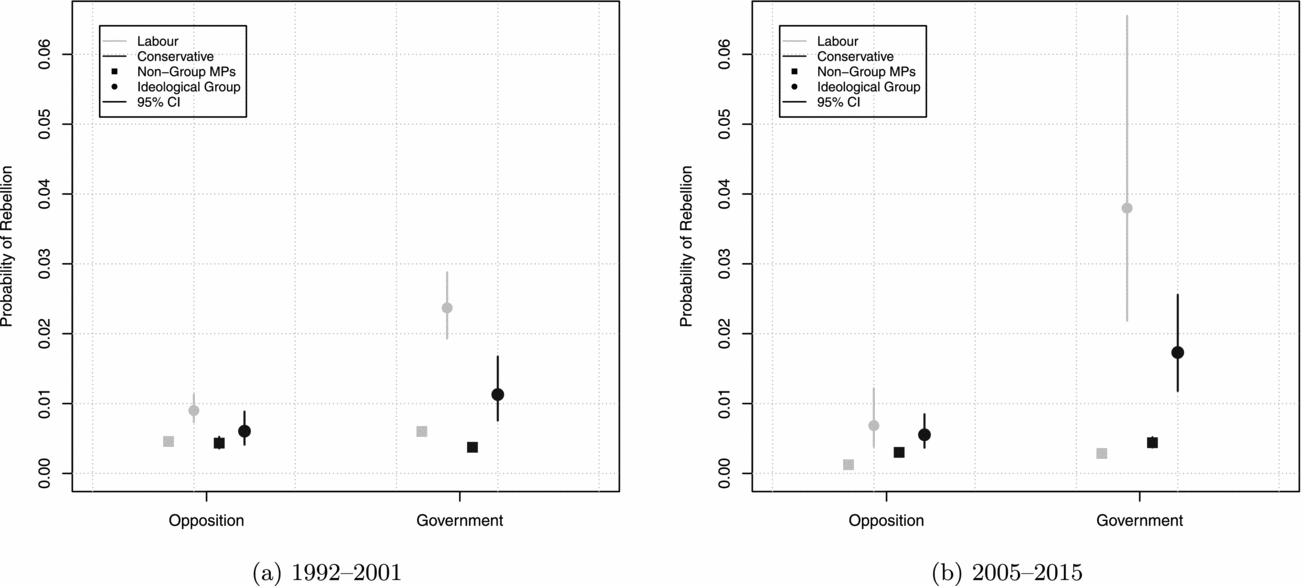
To give our logistic regression results some substantive meaning, we plot the probability of a rebellious vote by a party member belonging to an ideological group as the member moves between government and opposition party status using the results from models 5–8 in Table 2. These predicted probabilities appear in Figure 1.Footnote 18 The predictions for Labour are lighter, and those for Conservatives are darker. Circles represent predictions for group members while squares are those for nonmembers. The lines represent 95% confidence intervals. The figures show that MPs who do not belong to ideologically extreme groups tend to rebel with relatively equal frequency when in government and opposition. However, among MPs belonging to ideological groups (the circles), dissent is much more frequent when in government than in opposition. The rate of rebellion increases approximately 2.5 times.
Probability of a Rebellious Vote in Government and Opposition by Group Membership

Using data on the nature of divisions in the later period from Bräuninger, Müller, and Stecker (Reference Bräuninger, Müller and Stecker2016), we have rerun the 2005–2015 models, keeping only divisions on items sponsored by the governing party, excluding private member bills—in other words, items the government wants to pass. All of our results hold in this subset of divisions offering further evidence for our theory. We have examined whether any differences exist in rebellious behavior within the Labour Party when the leadership shifted from John Smith to Tony Blair and again when Tony Blair stepped down as Prime Minister, allowing Gordon Brown to take over. We find no statistical differences in the levels of rebel following these leadership changes. See Appendices D and E for more information.
Wordscores Ideology
While illustrative of the pattern suggested by our theory, the results in Table 2 can be pushed further by explicitly looking at measures of ideology. To do so, we use Wordscores to estimate ideology from parliamentary speech. The estimates are based on an original collection of every speech related to welfare in the House of Commons from 1987 to 2007. The House of Commons is a good place to use speech data to measure legislators’ policy positions because, as discussed above, British MPs enjoy very substantial autonomy to speak as they choose.
We use speeches on welfare issues for both methodological and substantive reasons. Methodologically, by restricting the estimation to a single issue area, we avoid problems that may arise when speeches from several different areas are combined. Research on scaling speech has demonstrated that estimation of ideology from multidimensional speech can be quite difficult (Lauderdale and Herzog Reference Lauderdale and Herzog2016). If the distribution of MPs’ ideologies is multidimensional (for instance, on economic versus social issues), then some MPs could accidentally be scored as centrist simply because they take extreme but opposite positions across dimensions. Likewise, with multiple topics, there could be a danger of conflating genuine extremism (a tendency to speak in extreme ways) with a tendency or requirement to talk a lot about topics that are relatively extreme to begin with. The latter is a particular concern in a parliamentary system like the United Kingdom, where some MPs are also ministers with formal requirements to speak about their own issue area.
Substantively, the welfare state is a controversial and highly politically charged issue that very clearly divides British political parties in a traditional left–right space, both between and – more importantly for our purposes—within each party. The Labour Party originally created, and then staunchly defended, traditional welfare programs throughout most of its history. But under Tony Blair’s leadership, it introduced significant welfare reforms that included cuts to major programs and the introduction of means-testing and “welfare-to-work” initiatives (Rhodes Reference Rhodes2000; Clasen Reference Clasen2005). Within the Labour Party, these reforms were hugely controversial and caused major internal strife, including the backbench rebellions of Tony Blair’s first term as prime minister (1997–2001) (Cowley Reference Cowley2002). Similarly, much of David Cameron’s time as prime minister was taken up with far-reaching welfare reforms, which caused splits within the Conservatives, between the coalition parties, and within Labour as it struggled to articulate a coherent response. Finally, since Wordscores is a supervised algorithm, the choice of training data is crucial in estimation. Because welfare reform was such a charged issue throughout the period that we consider, it is easy to identify ideologically extreme factions that anchor the estimated scale, as we discuss below.
The speeches include both regular debates and scheduled question times for relevant ministries, including all questions to ministers for Social Security, and a subset of questions to Treasury ministers that cover welfare issues. They were divided into two periods. The first runs from the 1987 election up to the death of John Smith, Tony Blair’s predecessor as Labour leader, in June 1994, when Labour largely remained a traditional Social Democratic Party. The second runs from June 1994 until June 2007, the era of “New Labour” under Tony Blair, when it embraced welfare reform. Each MP is represented in one or both of the two periods by a single document, consisting of all speeches they made about welfare in that time. MPs appearing in both periods feature as two separate documents, although many only feature in one period, depending on when they were in office or when they spoke on welfare issues. It is necessary to split MPs in this way due to ideological change over time amongst Labour MPs, who shifted substantially to the center under Blair. In our article, the 1987–1994 speeches are used to estimate ideological extremity for MPs in the 1992–2001 period, and the 1994–2007 speeches are used to estimate extremity for the later 2005–2015 period. This division of periods not only corresponds to important changes within the Labour Party, but it also allows us to avoid issues of endogeneity as the speeches we use to estimate ideology largely predate the periods of rebellion we examine.
Finally, MPs whose total speeches about welfare comprised only a handful of sentences were discarded, as these documents do not contain sufficient information to estimate the MP’s position. Because of this, and because some MPs did not make a single speech about welfare, we estimate positions for only a sample of all MPs who held office over the period. Nonetheless, many of the most prominent names are included, both ministers and backbenchers, and there is very substantial ideological diversity among the MPs. Appendix A contains more information on those MPs included.
Wordscores requires the identification of reference texts. Our reference documents were chosen based on membership in the ideological groups described earlier; they were not selected by pre-examining the speeches. For Labour, the left-wing reference document consists of all speeches made by members of the Far Left “Socialist Campaign Group” during the pre-Blair era, when the party as a whole was more left-wing. It contains many famous figures from the Labour Left, including Diane Abbott, Tony Benn, Jeremy Corbyn, and George Galloway. In total, 23 Socialist Campaign Group MPs were included in the reference document. On the right, we used speeches made by secretaries of state in the later period who were responsible for the welfare state, all of whom were close to Tony Blair, supported welfare reforms, and were clearly situated on the right of the party (Alistair Darling, Andrew Smith, David Blunkett, Harriet Harman, and John Hutton). By definition, their rhetoric in parliament supported the more centrist Blair administration.
For the Conservatives, the left-wing reference document consists of all MPs (in both periods) who were members of the “Tory Reform Group.” This is a moderate faction that has advocated for moving the Conservatives to the center and is associated with socially progressive, pro-European views. Its membership includes a number of famous moderates, including Kenneth Clarke, Michael Heseltine, and Douglas Hurd, as well as MPs who defected to either Labour or the Liberal Democrats, including Alan Howarth and Emma Nicholson. The right-wing reference document contains members of the Thatcherite “No Turning Back” group. As the name suggests, this group argues for a continuation of Margaret Thatcher’s conservative economic policies, and includes famous names from the Right, including Iain Duncan-Smith, John Redwood, and Liam Fox.
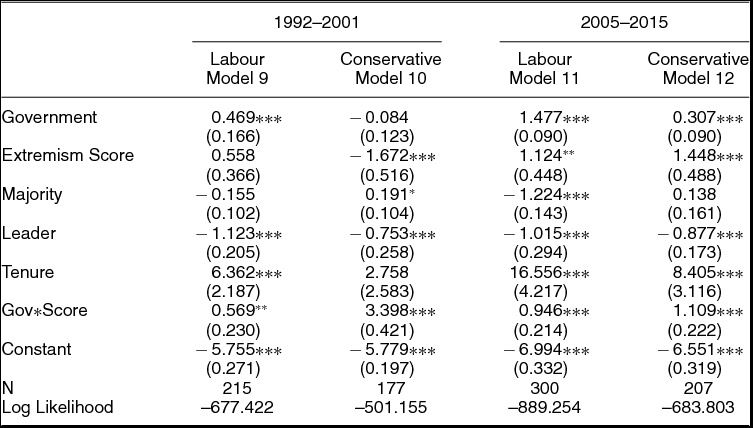
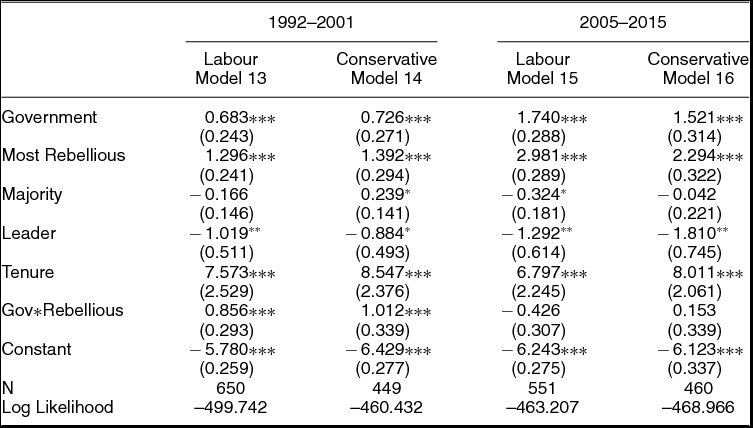
Our Wordscores measures of ideological extremism display statistically significant, albeit moderate, bivariate correlation with the number of rebellions in each party and period. In Table 3, we present results from a multilevel fractional logit model with varying intercepts for MPs predicting rebellion as a function of party status in government, MPs’ ideological extremity, and critically, and interaction of these two covariates. Extreme MPs generally rebel more frequently with the exception of the Conservatives in the early period. Most importantly, the interaction term across all models is positive and statistically significant. Ideological extremists in the Labour and Conservative Parties react to their governing party status in precisely the same way in both time periods, namely by becoming more rebellious. Like the previous models, these results also control for MPs’ recent vote share, tenure, and leadership. Overall, our evidence strongly support our contention that ideologically extreme MPs become more likely to rebel when their party becomes the governing party.
Effect of Government Status on Rebellion: Fractional Logit Models with Random Effects (Extremism Scores)

*** p < .01; **p < .05; *p < .1 in a two-tailed t-test
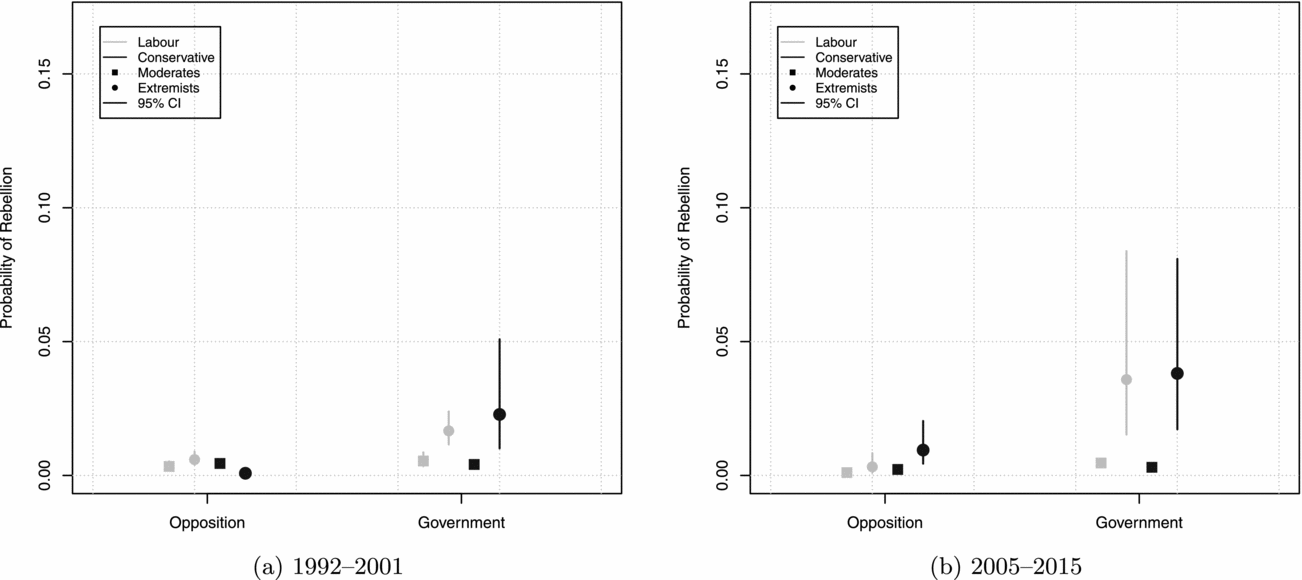
To facilitate the interpretation of the coefficients in Table 3, we again plot the predicted probability of a rebellion by both moderate and extreme MPs for the period 1992–2001 and 2005–2015 in Figure 2. We differentiate within the plot between rebellion rates when these MPs are in government and in the opposition. As the figure makes plain, changes in rebellion by moderate MPs as their party switches between government and opposition are quite small in magnitude. In contrast, the likelihood of ideological extremists’ rebelling significantly increased, moving from opposition to government. Thus, both in terms of statistical significance and substantive magnitude, ideological extremists have strong reactions to change in governing party status that are in line with our theoretical expectations.
Probability of a Rebellious Vote in Government and Opposition by Extremism (Wordscores)

These analyses allow us to make two key points. First, the most rebellious MPs and those belonging to groups known to harbor more extreme ideological views rebel in substantively different ways than other MPs. Namely, they do so relatively more frequently when in government. Second, using a measure of ideology based on speech content, we show that the most rebellious MPs tend to be ideological extremists who are also more likely to rebel when in government. We suggest that this pattern emerges because extremists use rebellion to develop individual identities distinct from their party, helping signal a sort of ideological purity to ideological constituencies.
Rebel Speeches
Our theory suggests that when ideological extremists rebel in government, they ought to try to explain that rebellion by pairing dissent on divisions with a speech on the floor of parliament. That is, they are likely to defend their rebellion in a public forum as part of their efforts to signal their ideological position to voters. Of course, we do not believe that voters pay any direct attention to parliamentary debate. Rather MPs may highlight their participation on the floor when communicating with constituents in other ways, such as e-mails, newsletters, or perhaps social media. MPs often craft their message on the floor of parliament in terms of their constituency and their voters. Using a simple dictionary, we find that a minimum of 20–25% of all speeches during debates linked to divisions contain constituency language, with only little variation between party and parliamentary term.Footnote 19
Table 4 predicts the probability that an MP gives a speech during a debate in which she has cast a rebellious vote (i.e., engages in grandstanding) conditional on her overall speech-making activity. In other words, our dependent variable is
 $\frac{\text{Total Speeches on Rebel Votes}}{\text{Total Speeches}}$
. As in our previous analyses, we model this proportion using a fractional logistic regression with varying intercepts for individual MPs. As independent variables, we include a dummy variable noting whether a particular MP’s party is the governing party, whether the MP is one of the 25% most rebellious members of her party (we use the 25% most rebellious variable here so as to preserve as much data as possible, having already demonstrated above that ideological extremists are more likely to rebel), an interaction of these two variables, and controls for a member’s previous electoral vote share, whether the MP held a senior (or leadership) role, and the MP’s length of tenure. If our expectations are correct, the most rebellious members should be more likely to pair a rebellious vote with a speech and to do so more often when their party controls government.
Effect of Government Status on Rebellious Speech: Fractional Logit Models with Random Effects

*** p < .01; **p < .05; *p < .1 in a two-tailed t-test
As in our earlier models, we differentiate between the periods 1992–2001 and 2005–2015 to allow for any temporal heterogeneity in response to changes in government control. The results in Table 4 show that MPs are more likely to dedicate a higher proportion of their speeches to rebellious votes when in government. This effect is captured by the coefficient on the government dummy variable and suggests that even for moderate members, the move from opposition to governing party implies an increased need to defend rebellions from the party line through speech. In line with our theory, the most rebellious members of both parties also make a higher proportion of their speeches on divisions when they rebel. We have run models using the Wordscores extremism variable and the results are substantively the same. But note that in this model, the 25% most rebellious variable has a clear interpretation—we wish to know whether rebellious members attach a higher proportion of their speeches to rebellion. Interestingly, the interaction term is positive and significant in the earlier period, but not the later period. Rebels tend to couple their rebellion with speech at higher rate both in and out of government (but, of course, they rebel much less frequently when in opposition).
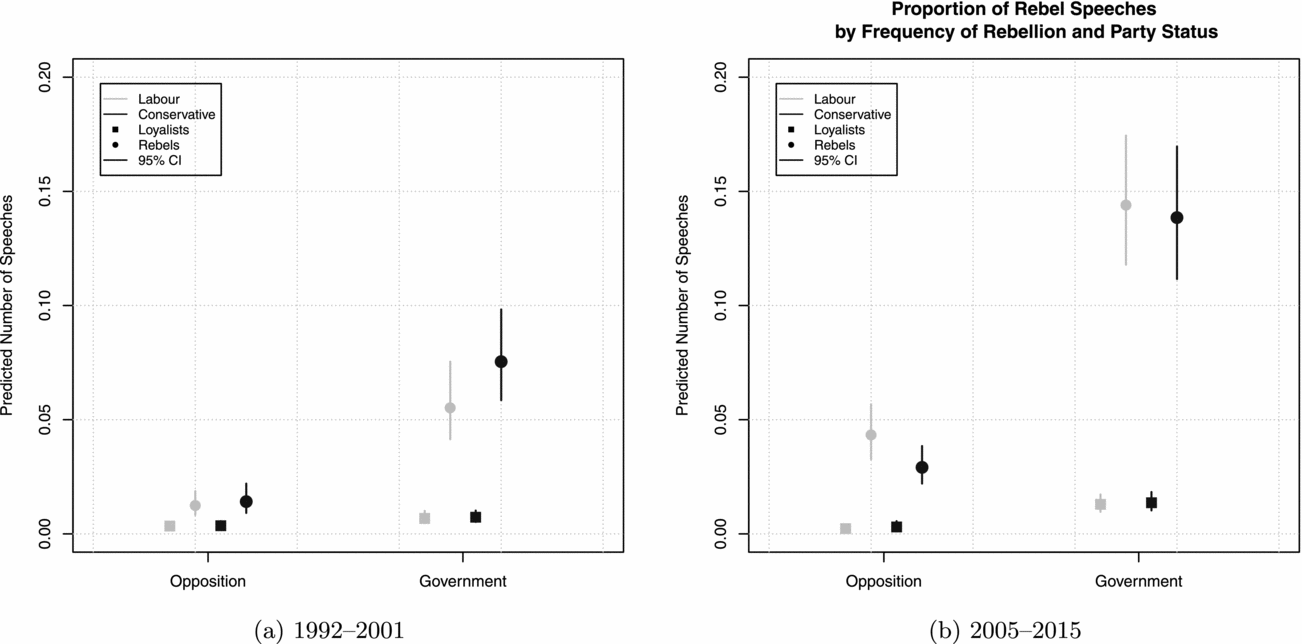
Figure 3 plots the predicted probability of a rebel vote–speech pair out of all speeches for typically loyal and typically rebellious members of each party when in opposition and in government based on the coefficients reported in Table 4. The figure shows that the predicted probability of a rebel vote–speech pairing increases when a member moves from opposition to government, but the highest probability of such a pairing comes from rebels in government. This probability is not just the likelihood of a rebel vote–speech pair in absolute terms, but rather the probability of a rebel vote–speech pair out of total speeches given. These changes in the probability of a rebel vote–speech pair are quite large. For example, in the latter time period under study, a rebellious member of the Labour Party uses just under 5% of her speeches during times of rebellion. However, this same member uses nearly 15% of her total speeches to discuss rebellion when in government. Not only do we find rebellious behavior at odds with extant models, but we find that the most rebellious MPs speak about that rebellion at unusually high rates. It is not just that extremists (or rebels) speak frequently, and not even that they speak frequently when in government, but that they speak frequently in government when they rebel, compared both to how frequently they speak when in opposition, and how frequently they speak when they do not rebel.
Probability of a Rebellious Speech as a Function of Rebellion on Divisions

In sum, the evidence from the parliamentary record suggests that the most rebellious MPs rebel even more when their party is in government. Those same rebellious MPs tend to be ideological extremists, and they are more likely to pair rebellion on divisions with a speech on the floor. These patterns offer strong support for our theory that these extremists engage in this rebellion for reasons of position-taking. Such patterns are unlikely to be explained through models focused on policy spaces, balancing between proposals and status quo locations, or commitments to party politics. Instead, the patterns fit with a theory that suggests that rebellion provides a means for MPs to differentiate themselves from their party, perhaps to connect with constituents for electoral gain.
Evidence for a Constituency Connection
We have provided evidence that ideologues rebel more often when in government and participate in debates when they do so. We next look for evidence of a link between constituency characteristics and rebellion on divisions. Specifically, we examine rebellions within Tony Blair’s Labour government during its first term on divisions related to welfare state politics; Blair’s first term was particularly notable for the government’s “welfare-to-work” initiatives. We use information from Cowley (Reference Cowley2002) to code every Labour MP who rebelled on at least one division related to welfare politics. We then relate rebellion to the proportion of each MP’s working-age constituents using benefits. This measure has a direct link to the bills brought by Blair, which cut back or restricted access to working-age benefits. There is significant variation in the use of benefits across constituencies ranging from 6% to 39%, so the percentage receiving benefits offers a clear measure of constituents’ needs. The earliest these benefits data are available is 2000, making this the year that we use. This slightly postdates most of the welfare bills, but the measure changes very little over subsequent years. In a bivariate logit model with rebellion as the dependent variable, we find that the percentage of working-age constituents using benefits correlates strongly with rebellion on these welfare-related divisions. The relationship is statistically significant (p = 0.016) and moving from the first decile of the constituency benefits variable to the ninth decile increases the likelihood of rebellion by approximately 11 percentage points, from approximately 14% to 25%. Of course, this correlation cannot provide evidence of a causal link between constituency characteristics and rebellion, but combined with evidence from survey experiments regarding the values that voters place on rebellion (Campbell et al. Reference Campbell, Cowley, Vivyan and Wagner2016), it is plausible that Labour MPs in these constituencies view rebellion as a means to connect with voters.
DISCUSSION: THE LABOUR PARTY UNDER CORBYN
We expect our findings to hold under what we consider to be the normal working conditions of a Westminster parliament. Our theory of party cohesion rests in part on the assumption that party leaders depend on the support of their parliamentary party to remain in power and that they represent mainstream views within the party. The vote of no confidence—if passed—normally would result in the removal of an unpopular or ineffective leader in either government or opposition. The Labour Party under Jeremy Corbyn represents an important exception to this general rule. A change to the procedure for party leader elections effectively removed the requirement that a leader be vulnerable to the vote of no confidence.Footnote 20 Jeremy Corbyn received the minimum number of nominations from the parliamentary party (just 35 out 232 Labour MPs) to be placed on to the ballot for election by the wider party membership, and the Parliamentary Labour Party (PLP) never truly viewed him as a legitimate candidate. After less than a year as leader, Corbyn suffered a mass resignation of his shadow cabinet, and a vote of no confidence over his handling of the EU referendum campaign. However, Corbyn’s right to automatic inclusion on the ballot for what was to be his second successful leadership election campaign confirmed the inability of the PLP to act decisively with regard to its own leadership.
The imposition of a leader on the PLP affects our expectations for the ideological source of rebellions and for the overall maintenance of party discipline. Corbyn is a left-wing ideologue with a record of voting against Labour positions and no experience whatever in frontbench politics. Under Corbyn, the position of the party leadership has moved to the Left, with fewer rebellions from the ideological extreme of the party. This is likely the case simply because frontbench positions have been filled by leftist MPs loyal to Corbyn, thereby reducing the number of possible backbench rebellions from the Left. Regular rebels since Corbyn’s election come from the ideological right of the party. Frank Field, Graham Stringer, and Kate Hoey (MPs with more socially conservative views) are now the most rebellious members in the Labour Party.
From the point of view of our model, we would argue that Corbyn’s leadership is an historical anomaly. While preferences amongst MPs remain at odds with party policy determined by principals external to parliament, we expect to see high levels of rebellious activity and breakdowns in party discipline, more broadly.
CONCLUSION
This article has provided the first analysis of the UK House of Commons to systemically evaluate how individual-level voting behavior changes as function of the interaction between government agenda control and individual-level ideology. It does so over four different parliaments by examining two changes in governing party. We link our findings on rebellion to debate on those same rebellious divisions. In doing so, we believe we have created the most extensive database on voting behavior and speech in the House of Commons for the period under investigation. Lastly, this represents one of the very few studies to examine rebellion among opposition parties—a necessary step, we believe, to understand the level and importance of dissent within governing parties.
Our results suggest that those ideological extremists who rebel the most engage in even more rebellion when their party controls government. Moreover, they advertise their rebellion through legislative speech. Coupled with existing findings that British voters value some level of rebellion (Campbell et al. Reference Campbell, Cowley, Vivyan and Wagner2016; Vivyan and Wagner Reference Vivyan and Wagner2012, Reference Vivyan and Wagner2015), we take this as evidence that they engage in this behavior to advertise their position to constituents who likely agree with them.
While we have provided preliminary empirical evidence that MPs engage in rebellion to represent constituents, future work will need to look at exactly how MPs use rebellion and rebellious speech to connect with voters. Studies could look at the content of legislative speech to try to ascertain its intended audience (e.g., the constituency or the party). Or they could examine how voters react to (the advertisement of) rebellion, and whether this reaction varies if the rebellious MP is in the government or opposition and whether rebellion affects policy outcomes. A more micro-level examination of such strategies goes beyond the scope of this article. Nevertheless, we believe our findings provide a platform for studies of dissent going forward.
SUPPLEMENTARY MATERIAL
To view supplementary material for this article, please visit https://doi.org/10.1017/S0003055417000375.
Replication materials can be found on Dataverse at https://doi.org/10.7910/DVN/10HLY3.




Comments
No Comments have been published for this article.