


Background
The reliance on multiple clinical indicators to define specific psychiatric disorders has motivated the application of statistical methods designed to examine empirically the underlying construct represented by the indicators (Kendler et al. Reference Kendler, Karkowski-Shuman, O'Neill, Straub, MacLean and Walsh1997, Reference Kendler, Karkowski and Walsh1998; Sullivan et al. Reference Sullivan, Kessler and Kendler1998; Bulik et al. Reference Bulik, Sullivan and Kendler2000; Keel et al. Reference Keel, Fichter, Quadflieg, Bulik, Baxter, Thornton, Halmi, Kaplan, Strober, Woodside, Crow, Mitchell, Rotondo, Mauri, Cassano, Treasure, Goldman, Berrettini and Kaye2004). To date, the symptom structure of post-traumatic stress disorder (PTSD) has been examined chiefly by factor analytic methods (Buckley et al. Reference Buckley, Blanchard and Hickling1998; King et al. Reference King, Leskin, King and Weathers1998; Taylor et al. Reference Taylor, Kuch, Koch, Crockett and Passey1998; Asmundson et al. Reference Asmundson, Frombach, McQuaid, Pedrelli, Lenox and Stein2000; Simms et al. Reference Simms, Watson and Doebbeling2002). The goal of factor analysis is to examine if observed variables can be explained largely in terms of a small number of underlying dimensions. An alternative approach to latent structure analysis aims to identify homogeneous groups of individuals, without making any assumption about the nature of the grouping (e.g. nominal or ordinal). Breslau et al. (Reference Breslau, Reboussin, Anthony and Storr2005) applied this approach to two independent datasets, and reported results from a latent class analysis (LCA) of the list of criterion symptoms of DSM-IV PTSD. The theoretical rationale for supposing a categorical latent variable in PTSD is outlined in Breslau et al. (Reference Breslau, Reboussin, Anthony and Storr2005) and other publications (e.g. Horowitz, Reference Horowitz1976; Young, Reference Young1995; Breslau et al. Reference Breslau, Chase and Anthony2002; McNally, Reference McNally2003; Asmundson et al. Reference Asmundson, Stapleton and Taylor2004). Briefly, the definition of PTSD in the DSM has an internal logic; the syndrome's features are interrelated and linked to an etiological stressor. The disturbance has been described as a psychological process, in which painful memories of a trauma are re-experienced and are accompanied by increased arousal, which alternates with symptoms of avoidance and emotional numbing. The individual defining symptoms are non-specific; it is their configuration and link with a traumatic memory that transform them into a distinct disorder. Empirical support for the integrity of the specified symptom configuration (beyond the sheer number of symptoms) has been reported (Breslau et al. Reference Breslau, Lucia and Davis2004a).
Breslau et al. (Reference Breslau, Reboussin, Anthony and Storr2005) identified three discrete classes: no disturbance, intermediate disturbance and pervasive disturbance, with the third class approximating a subset of the sample meeting DSM-IV PTSD criteria as defined by the diagnostic interview. In that analysis, the estimated probabilities of reporting of all symptoms increased across classes, suggesting that the three classes represent increasing levels of severity. The three classes also varied qualitatively, with the emotional numbing cluster appearing to distinguish the class of pervasive disturbance. Specifically, the higher weight of numbing symptoms in the pervasive disturbance class, relative to other classes, suggests that classes vary not only in severity but also in symptom configuration (Breslau et al. Reference Breslau, Reboussin, Anthony and Storr2005).
Here we extend the LCA investigation reported in Breslau et al. (Reference Breslau, Reboussin, Anthony and Storr2005) and, using one of the datasets from that report, we examine whether the DSM-IV criterion symptoms measure PTSD differentially by trauma type (assaultive violence and other traumas) and gender (male and female). The focus on type of trauma and gender is guided by evidence that, among trauma-exposed community residents, the probability of PTSD is higher in females than males and in victims of traumas involving assaultive violence than victims of other traumatic events (Kessler et al. Reference Kessler, Sonnega, Bromet, Hughes and Nelson1995; Breslau et al. Reference Breslau, Chilcoat, Kessler, Peterson and Lucia1999, Reference Breslau, Wilcox, Storr, Lucia and Anthony2004b; Tolin & Foa, Reference Tolin and Foa2006). When a disorder is represented by multiple measures, subgroup differences may reflect differences in the occurrence of the disorder or differences in the measurement of the disorder (‘over-reporting’ of symptoms by one subgroup compared with the other). Tests of measurement invariance shed light on this distinction. The null hypothesis is that the latent structure of PTSD does not vary across subgroups defined by gender and trauma type. Evidence against the null hypothesis would raise doubts as to the nature of subgroup differences, specifically, whether the differences in the probability of PTSD between subgroups reflect bias in measurement, rather than heterogeneity in the occurrence of PTSD.
Method
Sample and data
Data come from one of the two samples used in the LCA analysis of Breslau et al (Reference Breslau, Reboussin, Anthony and Storr2005). Participants were young adults (mean age 21 years) from a prospective study of first-grade cohorts selected from a public school system of a large mid-Atlantic city in the United States in 1985–1986 as part of The Johns Hopkins University Prevention Research Center (Baltimore, MD, USA) (Kellam et al. Reference Kellam, Werthamer-Larsson, Dolan, Brown, Mayer, Rebok, Anthony, Laudolff and Edelsohn1991; Kellam & Anthony, Reference Kellam and Anthony1998). Between 2000 and 2002, nearly 75% (n=1698) of the original sample was re-interviewed; 1401 reported exposure to one or more DSM-IV traumatic events. Detailed information on the study appears elsewhere (Breslau et al. Reference Breslau, Wilcox, Storr, Lucia and Anthony2004b; Storr et al. Reference Storr, Reboussin and Anthony2004; Wilcox & Anthony, Reference Wilcox and Anthony2004). Complete data for the analysis were available on 1360 individuals. The institutional review board of The Johns Hopkins University and Michigan State University institutional review board, where analyses were conducted, approved the study. Written consent was obtained.
The interview schedule for assessing exposure to traumatic events and PTSD was developed, used, and evaluated in the 1996 Detroit Area Survey of Trauma (Breslau et al. Reference Breslau, Kessler, Chilcoat, Schultz, Davis and Andreski1998a). The interview began with a complete enumeration of traumatic events, using a list of 18 types of traumatic events, which operationalized the DSM-IV definition as explicated in its text. An endorsement of an event type was followed by questions on the number of times an event of that type had occurred and the respondent's age at each time. A list of all the traumatic events reported by the respondents was read by the interviewer and the respondent was asked to identify the one event that was the most upsetting, the worst trauma. PTSD was evaluated in connection with this event, using the PTSD section of the Diagnostic Interview Schedule, version IV, and the World Health Organization Composite International Diagnostic Interview, version 2.1 (APA, 1994; WHO, 1997). A clinical reappraisal study found good concordance with diagnoses based on the structured interview (Breslau et al. Reference Breslau, Kessler and Peterson1998b). In this analysis, we classified trauma types into two categories: assaultive violence (rape, held captive/kidnapped, shot/stabbed, sexual assault other than rape, mugged/threatened with a weapon, and badly beaten) (n=303) and other qualifying traumatic events (e.g. serious accidents, witnessing killing, natural disaster, learning about unexpected sudden death of a loved one) (n=1057).
Statistical analysis
LCA classifies subjects into discrete classes using their responses to a set of items (here PTSD criterion symptoms), so that subjects in a specific class have similar symptom profiles. The likelihood function of LCA is composed of two types of parameters: the marginal proportions, which are the percentages of people falling within each class (γ parameters), and the item response probabilities (ρ parameters), which are percentages of individuals within each class reporting each symptom. Comparison of estimated ρ parameters across subgroups is a useful strategy for quantifying measurement invariance, because the meaning of the latent classes is determined only by ρ parameters. By comparing the model fit with the ρ parameters held constant across subgroups of interest against an alternative model with freely varying parameters, we gain evidence of whether the proposed latent class structure is invariant across the subgroups. The presentation is organized in four parts.
First, we evaluated LCA models according to two classification variables; gender and trauma type. For each of four subgroups, 16 PTSD criterion symptoms were mapped onto the two-class LCA, and then onto an increasing number of classes (up to six), to identify the smallest number of classes that adequately fit the data. We then allowed for the dependence of two items within a class to improve model fit. We used 50 different sets of starting values for the following analyses and selected the solution with the best fit, which corresponds to the highest likelihood. The log-likelihood ratio statistic (G 2) with number of parameters (k), Akaike's Information Criterion (AIC) and Bayesian Information Criterion (BIC) (the lower the value, the better the fit) was compared across models.
Second, for the initial step in testing measurement invariance, we compared the latent structure of PTSD according to two variables, gender (male or female) and trauma type (assaultive violence or other traumas) and their cross-classification, using LCA. We fitted three sets of the LCA models with different gender-by-trauma-type combinations, where the ρ parameters were allowed to vary across the group variables: gender and trauma type, trauma type only, and gender only.
Third, to delineate the sources of measurement variance, we examined the heterogeneity of response probabilities (ρ parameters) of each symptom across subgroups. Using the Bayesian algorithm, hypothesis tests were conducted to identify individual items that differ in responses within a class across subgroups. The differences in the estimated ρ parameters between subgroups and their corresponding 95% confidence intervals (CI) are reported.
Fourth, we applied latent class logistic regression (LCLR), with gender as a covariate, to examine potential differences in latent class prevalence associated with gender (Bandeen-Roche et al. Reference Bandeen-Roche, Miglioretti, Zeger and Rathouz1997; Chung et al. Reference Chung, Flaherty and Schultz2006). In LCLR, the γ parameters (class prevalence) are modeled as a function of the covariate through a logistic regression, which is analogous to logistic regression, except that the response variable (i.e. membership in the latent classes) is not directly observed.
Results
Application of the LCA model across four subgroups
We first examined the suitability of the initial LCA model in Breslau et al. (Reference Breslau, Reboussin, Anthony and Storr2005) across four subgroups, classified by cross-tabulating gender by trauma type (assaultive violence versus other). Comparison of BIC in Table 1 reveals that three-class models are superior to the other models for the four subgroups, defined by trauma type (assaultive versus non-assaultive) and gender. We allowed the physiological and psychological reactivity (criteria B4 and B5) to be dependent within a latent class. As described in Breslau et al. (Reference Breslau, Reboussin, Anthony and Storr2005), these two items are described by similar phrases, refer to the same situations (occasions that remind the person of the traumatic event), and are presented to respondents in sequence. Moreover, this pair of items has high bivariate residuals under LCA models where any local dependence is not allowed. BIC values for the three-class LCA with local dependence indicate better fit than those from the standard three-class model across all subgroups except females with assaultive violence. The BIC difference between the two three-class models for this subgroup, however, is inconsequential (2557.49 v. 2552.79). In addition, AIC values indicate that a three-class model with a dependency is superior to a model without a dependency (2398.64 v. 2402.93). We chose the three-class model with a local dependency for all subgroups because the associations among the 16 PTSD criterion symptoms were adequately represented according to model fit criteria and the rule of parsimony. Additional analysis, which compared BIC values of models with three to six classes with local dependence, revealed that the three-class model provides the smallest BIC across the four subgroups (Table 1).
Model fit indices for latent classes of post-traumatic stress disorder symptoms according to trauma type and gender

G 2, Log-likelihood ratio statistic; k, number of parameters; AIC, Akaike's Information Criterion; BIC, Bayesian Information Criterion; LCA, latent class analysis.
Testing measurement invariance
To examine whether the three latent classes vary according to trauma type and gender, we compared three LCA models, where the ρ parameters were allowed to vary across gender and trauma type (model 1), trauma type only (model 2) and gender only (model 3). Table 2 shows the model fit indices. The G 2 statistic indicates that all three models adequately fit the data [i.e. less than degrees of freedom (df)], but that model 2 (the three-class LCA with different ρ parameters across trauma types), which has the smallest AIC and BIC, fits the data best.
Model fit indices of a series of three-class latent class analysis where the ρ parameters are allowed to vary across group variables
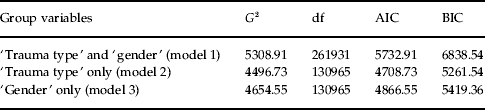
G 2, Log-likelihood ratio statistic; df, degrees of freedom; AIC, Akaike's Information Criterion; BIC, Bayesian Information Criterion.
Fig. 1 presents the estimated mean number of symptoms for each of the four symptom clusters across classes (individual item plots are included in Appendices 1 and 2). The mean number of symptoms in a cluster was calculated by summing the corresponding ρ parameter estimates (Breslau et al. Reference Breslau, Reboussin, Anthony and Storr2005). The first plot in Fig. 1 shows the difference in the means of the PTSD symptom clusters by trauma type and gender, corresponding to model 1. The second and the third plots display the difference in the means by trauma type alone (model 2) and by gender alone (model 3). Comparing these plots, we see that a large part of the difference from model 1 is associated with trauma type, indicating that measurement variance is attributable to trauma type to a greater extent than to gender.
Estimated mean number of symptoms for three sets of the three-class latent class analysis models: (a) model 1, (b) model 2, (c) model 3. —, Class 1; - - -, class 2; ⋅-⋅-⋅, class 3. 1, Female and other; 2, female and assaultive; 3, male and other; 4, male and assaultive; A, assaultive; O, other; M, male; F, female.

To test for measurement invariance across the two trauma types, we fitted another three-class LCA, where the ρ parameters were constrained to be equal for each trauma type and compared this constrained model to a freely estimated model (i.e. model 2). The value of G 2 for this constrained model is 4635.22 with 131 016 df, and AIC and BIC are 4745.22 and 5032.06, respectively. Comparing this constrained model with model 2 (see Table 2), we found that model 2 has a lower AIC but a higher BIC. In addition, there is a G 2 difference of 138.50 with 51 df. This drop is statistically robust (p<0.05). These results, combined with judgment based on Table 2 and Fig. 1, indicate that the latent structure of PTSD differs between the two trauma types.
Identifying the source of measurement variance
We performed tests to identify the specific symptoms that show differential reporting by trauma type for members of the same disturbance class. A formal test of these differences is presented in Table 3. A difference greater than 0 indicates a higher reporting probability (i.e. ρ parameter) associated with assaultive violence versus other trauma types, and CIs not containing 0 indicate a statistically robust difference. Table 3 shows that those who experienced assaultive trauma were more likely to report psychological and physiological reactivity, avoidance, detachment, restricted affect and exaggerated startle response in the presence of intermediate and pervasive disturbance (classes 2 and 3), and less likely to report concentration problems in the presence of intermediate disturbance (class 2). The largest differences are observed in two emotional numbing symptoms, C5 (detached) and C6 (restricted affect) in the presence of pervasive disturbance (class 3) and in the exaggerated startle in the presence of intermediate and pervasive disturbance (classes 2 and 3).
Bayesian estimates of the ρ parameter difference with 95% CIs

CI, Confidence interval.
* Difference is statistically robust (p<0.05).
Fig. 2 presents the results for symptom clusters. The two trauma types are differentiated in several clusters (the numbing cluster for class 2 and class 3, the arousal cluster for class 1, the re-experiencing cluster for class 2 and the avoidance cluster for class 3). However, the widest gap between assaultive violence and other traumas is in the emotional numbing cluster for class 3.
Estimated mean number of symptoms from the three-class latent class analysis across trauma types. —, No distress; - - -, intermediate; ⋅-⋅-⋅, pervasive; A, Assaultive violence; O, other trauma types. * Difference is statistically robust (p<0.05).

For both trauma types, there are robust associations between the LCA-derived class 3 (based on posterior probabilities estimates) and the survey-derived DSM-IV PTSD status. However, the association between class 3 and survey-based DSM-IV PTSD is stronger for assaultive violence than for other traumas types: odds ratios are 89.2 (95% CI 35.4–224.4) and 47.7 (95% CI 26.0–87.3) for assaultive and for other trauma types, respectively. This suggests that class 3 approximates the DSM-IV PTSD definition more closely for victims of assaultive violence than for victims of other traumatic events.
Class prevalence by gender and trauma type
Using LCLR, we examined class membership by gender and trauma type. Estimated class prevalence proportions for assaultive violence and other traumas are reported in Table 4, as is the estimate of the male–female differences in class membership. With respect to assaultive violence, the estimated odds ratios of belonging to class 2 (versus class 1) and class 3 (versus class 1) are 2.2 and 9.6 for females versus males, respectively. In contrast, no gender difference is observed for other traumas. The results of LCLR also show a gender difference in class prevalence for subjects who experienced assaultive violence: females are more likely to be in class 3 (28.2 v. 6.4%) and less likely to be in class 1 (24.2 v. 48.1%), compared with males in corresponding trauma groups.
Estimated post-traumatic stress disorder class prevalence and latent class logistic regression-estimated association between post-traumatic stress disorder class membership and being female for each trauma type
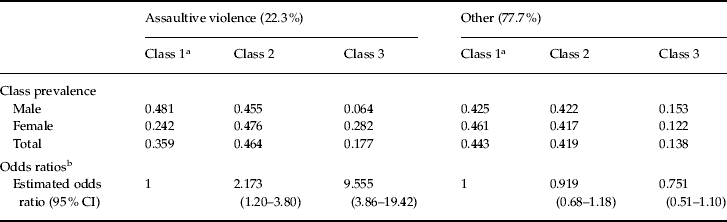
CI, Confidence interval.
a Class 1 is the baseline.
b Being male is the reference category for the odds ratios.
Discussion
This investigation extends our previous work (Breslau et al. Reference Breslau, Reboussin, Anthony and Storr2005) in two ways. First, we examined the initial LCA model of PTSD for the four subgroups, defined by cross-classifying the sample by trauma type (assaultive versus not assaultive) and gender; and second, we tested measurement invariance of the list of PTSD symptom-indicators across these subgroups. The application of LCA to the multiple symptoms yielded three similar classes for the four subgroups, indicating similarity in structure of PTSD across the subgroups. The analysis of measurement invariance revealed that, with respect to gender, there was no evidence of differential symptom reporting within the same disturbance class. Items that measure PTSD criterion symptoms appear to represent the construct of PTSD equally in males and females. This methodological finding has implication for interpreting the observed gender differences in the conditional probability of PTSD. Specifically, the finding that proportionately more female than male victims of assaultive violence experienced pervasive disturbance is likely to reflect a substantive difference, rather than gender-related bias in reporting.
We detected evidence of measurement variability associated with trauma type. In the presence of disturbance (i.e. both classes 2 and 3), victims of assaultive violence were more likely to report PTSD symptoms, especially symptoms of emotional numbing and startle. The relative excess in reporting symptoms of emotional numbing was higher in the presence of pervasive than intermediate disturbance (i.e. class 3 than class 2). Thus the study suggests that classification based on the DSM-IV criterion symptoms results in heterogeneity in measurement by trauma type. Specifically, victims of non-assaultive trauma with pervasive PTSD-related disturbance report less severe distress (fewer symptoms) than victims of assaultive violence with pervasive disturbance do. In the absence of a ‘gold standard’, we cannot determine whether victims of assaultive violence over-report PTSD symptoms, or victims of other trauma under-report them. However, we found that the pervasive disturbance class approximates the DSM-IV PTSD more closely for victims of assaultive violence than for victims of traumas of lesser magnitude. Identifying the source of this reporting bias merits further research. These findings suggest the possibility that disturbance experienced by victims of assaultive violence is more severe than the disturbance experienced by victims of other traumas. Alternatively, the defining symptoms of PTSD in DSM-IV might be less useful in detecting disturbance in victims of other trauma types: the etiology and psychopathology of PTSD-related disturbance among victims of events of lower magnitude might be different and perhaps more heterogeneous.
Acknowledgements
The study was supported by grants MH-44586 (N.B.) and DA-1-R03-021639 (H.C.) from the National Institutes of Health (Bethesda, MD, USA).
Declaration of Interest
None.
Appendix 1
Estimated item-response probabilities

Estimated item-response probabilities (ρ parameters) for three-class latent class analysis model: (a) model 1, (b) model 2, (c) model 3. —, Class 1; - - -, class 2; ⋅-⋅-⋅, class 3. 1, Female and other; 2, female and assaultive; 3, male and other; 4, male and assaultive; A, assaultive; O, other; M, male; F, female.
Appendix 2
Estimated item-response probabilities across trauma types

Estimated item-response probabilities (ρ parameters) across trauma types for the three-class latent class analysis model. —, No distress; - - -, intermediate; ⋅-⋅-⋅, pervasive; A, Assaultive violence; O, other trauma types. * Difference is statistically robust (p<0.05).



