

Introduction
Article 27 of the United Nations Convention on the Rights of Persons (UNCRPD) recognises ‘the right of persons with disabilities to work, on an equal basis with others [including] the right to the opportunity to gain a living by work freely chosen or accepted in a labour market and work environment that is open, inclusive and accessible to persons with disabilities’ (United Nations, 2006). However, specific to acquired brain injury (ABI), the long-term physical, cognitive, emotional and behavioural issues experienced have traditionally posed barriers to open employment post injury (Brasure et al., Reference Brasure, Lamberty, Sayer, Nelson, Macdonald, Ouellette and Wilt2013; Hooson, Coetzer, Stew & Moore, Reference Hooson, Coetzer, Stew and Moore2013; Powell et al., Reference Powell, Glang, Pinkelman, Albin, Harwick, Ettel and Wild2015). In Australia, there are over 700,000 people living with an ABI, and three in four are aged 65 years or under and therefore of working age (ABS, 2018). Compared with the Australian national average (79%) and others with disability (53.5%), people with ABI have low employment rates (30%) (ABS, 2018; AIHW, 2019).
Research examining differences in vocational outcomes of people with ABI and a matched Australian normative sample living without disability also demonstrated the impact of ABI on productivity rates. With key demographic variables (age, gender, living location, living situation) held constant, the ABI participant group was 420% more likely to experience reduced economic participation than the normative sample, when prior to their injury they were most often working full time (Migliorini, Enticott, Callaway, Moore & Willer, Reference Migliorini, Enticott, Callaway, Moore and Willer2016). This sudden loss of a key life role negatively impacts not only financial resources and time spent in productivity tasks but also social connection and community integration for people with brain injury (Callaway et al., Reference Callaway, Enticott, Farnworth, McDonald, Migliorini and Willer2017; Winkler, Unsworth & Sloan, Reference Winkler, Unsworth and Sloan2006).
Returning to work is an important stage in rehabilitation for a person with ABI, and long been identified as central to effective community-based support and improved quality of life long term (Cullen, Chundamala, Bayley & Jutai, Reference Cullen, Chundamala, Bayley and Jutai2007; Willer & Corrigan, Reference Willer and Corrigan1994). However, a range of factors have been identified that may lead to poor employment outcomes following ABI. These include more severe injuries, older age, pre-injury psychological treatment, post-injury cognitive disturbance and fatigue, availability of social support following the ABI and studying or having a blue-collar occupation at the time of injury (Dahm & Ponsford, Reference Dahm and Ponsford2015; Howe et al., Reference Howe, Andelic, Perrin, Røe, Sigurdardottir, Arango-Lasprilla, Lu, Løvstad and Forslund2018; Libeson, Downing, Ross & Ponsford, Reference Libeson, Downing, Ross and Ponsford2020). Although these influencing factors have been well documented, evidence on best practice approaches to guide vocational rehabilitation programs and open employment pathways, and effectively support a person with ABI to return to work, is lacking (Donker-Cools, Daams, Wind & Frings-Dresen, Reference Donker-Cools, Daams, Wind and Frings-Dresen2016; Fadyl & McPherson, Reference Fadyl and McPherson2009; Ntsiea, Van Aswegen, Lord & Olorunju, Reference Ntsiea, Van Aswegen, Lord and Olorunju2014; Piccenna et al., Reference Piccenna, Pattuwage, Romero, Lewis, Gruen and Bragge2015; van Velzen, van Bennekom, van Dormolen, Sluiter & Frings-Dresen, Reference van Velzen, van Bennekom, van Dormolen, Sluiter and Frings-Dresen2011). Furthermore, Australian businesses lack confidence employing people with disabilities due to limited knowledge, information and understanding, and employers may be unclear about steps to use both human and technology supports to build employment access and inclusion (Australian Network on Disability, 2018; Gentry, Kriner, Sima, McDonough & Wehman, Reference Gentry, Kriner, Sima, McDonough and Wehman2015; Waterhouse, Kimberley Jonas & Glover, Reference Waterhouse, Kimberley, Jonas and Glover2010; Weaver, Reference Weaver2015).
Australia is nearing completion of a 10-year National Disability Strategy, with a vision to build ‘an inclusive Australian society that enables people with disability to fulfil their potential as equal citizens’ (Department of Social Services, 2010, p. 22). One of the key principles of the Strategy is a focus on economic security, with identification that ‘work is essential to an individual’s economic security and is important to achieving social inclusion. Employment contributes to physical and mental health, personal wellbeing and a sense of identity’ (Department of Social Services, 2010, p. 42). An important policy development within the 10-year strategy has been the launch of a $22B National Disability Insurance Scheme (NDIS) for people aged under 65 years at the time of Scheme entry, who experience significant and permanent disability (National Disability Insurance Scheme, 2013).
The NDIS has been designed to offer individualised planning linked to ‘reasonable and necessary’ supports to build the social and economic participation of people with disability (National Disability Insurance Scheme, 2016). It aims to move from people with disability, including ABI, being passive recipients of care to Scheme participants who are empowered consumers planning for and choosing to purchase human, equipment and technology supports aligned with their personal aspirations, including employment goals. The Scheme offers a significant focus on co-design of services and supports that meet individual requirements (Steel, Buchanan, Layton & Wilson, Reference Steel, Buchanan, Layton and Wilson2017). More recently, the Agency that administers the Scheme –NDIA – has identified the need to take a stronger focus on economic participation outcomes of Scheme participants. With this focus in mind, in November 2019, the NDIA launched an NDIS Participant Employment Strategy (National Disability Insurance Scheme, 2019).
Whilst the NDIS is a major reform, designed to use policy to drive the system change required to increase employment rates, the NDIA recognises a need to address broader barriers to work for people with disability (National Disability Insurance Scheme, 2019). For people with ABI, the high unemployment rates highlight the significant barriers they face in gaining and maintaining open employment and the challenge Australia faces as a signatory to the UNCRPD. Given these typically poor mainstream employment outcomes post ABI, the aims of this study were to (1) use a co-design approach with people with experience of ABI to review existing vocational pathways, identifying enablers and barriers to open employment following ABI and considering features for effective employment pathway design and (2) use ABI lived experience, employer perspectives and allied health and social insurer expertise to identify supports that employers and people with ABI need to ensure access to, and sustainability of, mainstream employment.
Method
Ethical approval
The study received approval from Monash University Human Research Ethics Committee. Consent was obtained from all participants.
Participants
Purposive sampling was used with participants recruited either: (1) via public domain information on key stakeholders working in the area of ABI and employment or (2) from consumer and professional networks of the research team. Twelve people (11 females and one male) participated in the study. The participants had varied personal and professional experiences of employment pathways following ABI. The focus groups consisted of two people with ABI sustained following road traffic accidents, who were both over 20 years post injury, were currently working in volunteer roles but not paid employment, had lived experience of paid employment pathways following ABI and greater than 6 months experience within mainstream employment settings. There were also two mainstream employers who were currently providing work to people with disability including ABI in open employment settings. One of these employers was providing work to two people, and the other employed four people with disability. In addition, there were six allied health professionals (one speech pathologist, two neuropsychologists and three occupational therapists), all of whom have experience providing capacity-building supports, including vocational rehabilitation to people with ABI. There were also two representatives from social/injury insurance funders who hold portfolio responsibility for disability employment.
Procedure
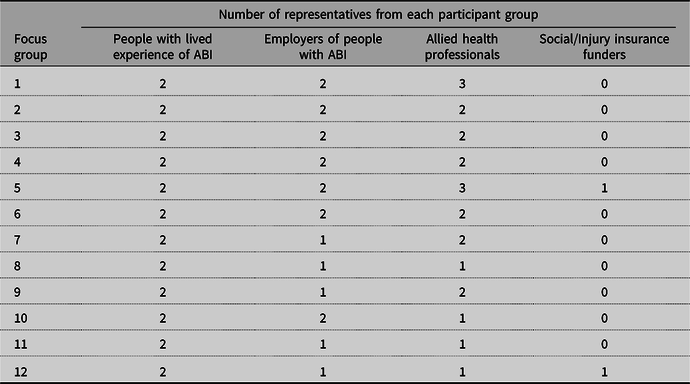
People with ABI, employers of people with ABI, allied health professionals and social/injury insurance funders were invited to participate in focus groups to discuss employment initiatives and strategies to facilitate workplace diversity and inclusion. The participant composition of each focus group is listed in Table 1. Willing participants signed the consent form and were invited to attend fortnightly focus groups scheduled between January and May 2019. Focus groups were held in a University meeting room in Melbourne, Victoria. Each focus group was co-facilitated by the first and second authors. Each focus group was 2 h in duration and was audio recorded with permission and subsequently transcribed verbatim.
Schedule of Focus Groups

Methods of data generation
Information sources
An online search was conducted via a web search engine. In addition, the NDIS, Department of Social Services, Australian Network on Disability and state-government disability and employment department websites were searched. A combination of search terms was used including disability; acquired brain injury; employment; pathway; initiative; traineeship; internship; Australia. The search was conducted between December 2018 and March 2019 and sourced 29 existing employment initiatives in Australia, including traineeships and internships (see Table 2). Four initiatives offered existing services to people with ABI, whilst other initiatives could be accessed by people with a range of disabilities, targeted a specified population (e.g. people with autism) or alternatively offered options for other marginalised groups without disability who traditionally experience low employment rates (e.g. young disadvantaged individuals) but which may be suitable for people with ABI.
Employment initiatives in Australia

Qualitative data collection
Twelve focus groups were conducted. As shown in Table 1, all included two representatives with lived experience of ABI, at least one employer of people with ABI, and at a minimum one allied health representative experienced in ABI and employment options. Two of the 12 included representatives from social/injury insurance funders. During each focus group, the first author presented details of two or three existing employment initiatives, drawn directly from public domain information available on the initiatives. The qualitative data generated from the focus groups were constructed through discussions between participants and the first and second authors, who also kept reflective notes throughout each session (Krefting, Reference Krefting1991). Data collection explored each group member’s personal perceptions about the existing initiative/s presented, with participants asked what they saw as potential positive or negative features in the design of each initiative; element(s) in the initiative’s design that they considered valuable for someone with an ABI; aspects of the initiative they felt could pose challenges for someone with ABI and if they had any personal (person with ABI) or professional (other groups) experience of any of the design features of each initiative. Data of a more factual nature were also collected, with participants asked to reflect on their own experience(s), and asked to describe enablers and barriers to employment following ABI, and potential supports that employers and people with ABI need to ensure sustainability of mainstream employment.
Analyses
A comparative method of content analysis of the qualitative data was undertaken, using a 15-point checklist for thematic analysis (Braun & Clarke, Reference Braun and Clarke2006). This approach was used as it allows themes and patterns within the data to be identified in relation to the research questions whilst also acknowledging that analysis is shaped to some extent by the researchers’ disciplinary knowledge and standpoint (Clarke & Braun, Reference Clarke and Braun2013). The first stage of the thematic analysis involved the first author reading each transcript, with items of potential interest noted (Clarke & Braun, Reference Clarke and Braun2013, pp. 202–203). Single words or brief phrases from the research data were used to name codes and subsequently the identified themes. Attempts were made to ensure that coding processes were thorough, inclusive and comprehensive, rather than generated from a few specific examples by multiple collaborative reviews (Braun & Clarke, Reference Braun and Clarke2006). During analyses, attention was given to the enablers and barriers that had been described, as well as potential supports that employers and people with ABI need to ensure sustainability of mainstream employment. For the purpose of triangulation, the researcher also kept a reflective journal throughout the data collection period and this was reviewed during analysis (Krefting, Reference Krefting1991). Emerging data patterns were identified based on the research aims with an initial set of codes developed (Corbin & Strauss, Reference Corbin and Strauss2008).
Whilst the first author led the analysis, peer checking undertaken by the second author who had co-facilitated the focus groups, to aid methodological rigor (Krefting, Reference Krefting1991). This process comprised discussion between the first and second author, including any differences in interpretation, with the enablers, barriers and supports refined to achieve consensus. The lived and professional expertise of the focus group members allowed identification of enablers, barriers and strategies to guide the development of a new approach to employment entry, support and graded skill development, tailored for and by people with ABI.
Trustworthiness
To explore the credibility of results and check for resonance and usefulness, synthesised member checking was used in a further two focus groups undertaken with the lived experience experts with ABI and treating health professionals (Birt, Scott, Cavers, Campbell & Walter, Reference Birt, Scott, Cavers, Campbell and Walter2016). During this follow-up, the emerging themes from the qualitative data, including identified enablers, barriers and strategies, as well as the features of the new employment pathway were presented, tested and refined to ensure co-constructed knowledge (Birt et al., Reference Birt, Scott, Cavers, Campbell and Walter2016). Initially, there were seven components of the pathway, but within the member checking process, participants suggested two of the seven could be combined to reduce the complexity. Participants also suggested some changes to the wording of the components to aid understanding for the target audience. The final five components, including operationalisation of each component, and name of the pathway were finalised through discussion until consensus was reached (Bradley, Curry & Devers, Reference Bradley, Curry and Devers2007).
Results
Three enablers emerged from the data: (1) collaborative, flexible and team approach; (2) customised recruitment and human resource strategies and (3) buddy/support system for all employees. In addition, three additional themes emerged that could be an enabler or barrier to successful employment: (4) employer readiness; (5) workplace-related factors and (6) condition-related factors. Finally, to grow mainstream employment pathways for people with ABI, three strategies emerged from the data: (7) job carving; (8) individual placement and support and (9) pre-vocational skills training and assistive technology.
The identified enablers, barriers and strategies are discussed individually below, with participant quotations to illustrate the main points. Table 3 summaries how these were integrated into the five components of a new employment pathway, tailored for people with ABI, called ‘Employment CoLab’ (see Fig. 1). ‘Employment CoLab’ represents a collaboration between the employee, employer, paid/informal supporters and funders.
Employment CoLab Infographic.

Co-Design approach to inform the development of Employment CoLab

Collaborative, flexible and team approach
Participants discussed the importance of a collaborative, team approach as a key enabler to growing and sustaining mainstream employment of people with ABI, with close attention paid to both the employee and employer needs:
I have found that having a supportive team, including my employer, family and health professionals has assisted me to trial different employment pathways. [Participant 1 with ABI].
I think being able to have conversations with the person’s team would be beneficial, for myself as the employer, but also for the people I’m working with who have an ABI. I feel like I have just been learning as I go, in terms of what support the person needs, but I’m not sure I always get it right, its often feels very much like trial and error. [Employer 2].
Short-term or time-limited support was seen as inadequate based on the often variable nature of both a workplace and the outcomes of the ABI. A range of communication systems (e.g. email, phone, video link) and clear communication contact persons (both employer and supporter) were identified as key. In addition, ensuring the employee and employer felt they had ‘permission’ to provide honest feedback on work progress was considered to offer more potential to grow a collaborative, problem-solving approach and was in contrast to guarded communication where issues may not be raised by the employee or employer until the work option was breaking down:
[Participant 1 with ABI] ‘For someone with a disability it can be difficult for them to speak up’. [Occupational Therapist] ‘So I think that is why it is important to have someone to advocate for them’. [Participant 2 with ABI] ‘Yeah, you might speak in private to family members or carers or whatever, but there is that concern with employers that you are going to lose your job if you say something, or you are going to look bad’. [Occupational Therapist] ‘I think having a check in with the employer and employee is really important, so any issues can be addressed quickly, rather than them becoming a big issue’.
Many of our clients have been employed multiple times, but often for short stints. A vocational provider will meet with the employee with ABI every six weeks and have a chat, and we will do phone check ins with the employee and the employer, but sometimes we don’t find out about any problems until it’s too late, and then we have to do a lot of work to try and recover roles back. So, I think having the support available upfront would make a big difference. [Social/injury insurance funder 1].
Customised recruitment and human resource strategies
Traditional recruitment strategies, which do not customise the application or interview approach to target the strengths of the individual, prove challenging for people with ABI. The ability to offer customised recruitment and human resource processes, including a range of application types (e.g. written or video), interview styles (e.g. ‘meet and greet’ vs formal interview with standard questions) and the ability to use paper-based as well as online human resource systems all build the opportunity for the person to maximise their participation in these processes. Pre-employment work task trials and on-the-job training were also seen as beneficial, offering the person with ABI, a means to demonstrate their strengths:
I love the idea of a work trial, as that is what blows me out of the water, the interview. I look good on paper, I have all the qualifications, but I really hate it when in an interview they ask ‘can you give us an example of when you had to do something in the workforce’, and I haven’t been in a workforce so I just make up something from my volunteering. They are abstract questions, so it’s always when I leave the room or when I’m at home that I’m like ‘Oh, I should have said that’. [Participant 1 with ABI].
The Government are saying that we aren’t going to give you money unless you can demonstrate diversity in your workforce. Employers need to show that they are invested in diversity of workforce. So I think there are some good policy that is influencing practice now that wasn’t there five years ago, and I think that will require changes in how we recruit people into roles. [Employer 1].
In addition, a list of tasks was considered to be more beneficial than a job description to understanding their role in a workplace:
People with ABI love structure, so having a list of tasks rather than just a job description would mean the person knew what the job involved. [Participant 1 with ABI].
For most of the people I work with, that more structured role is going to be helpful to their learning through that practice than having a whole lot of change. [Occupational Therapist].
Buddy/support system for all employees
Inclusive workplace strategies that include a workplace ‘buddy’ or mentoring system was considered beneficial. Nevertheless, it was important that these initiatives are offered to all staff, so not to ostracise the employee with disabilities:
I’m very much about not being singled out, like ‘there’s that person with a disability they have a buddy. So, what I liked at [name of employer] is that every new employee had a buddy. [Participant 1 with ABI].
Employees will have a supervisor, and sometimes they may also have a mentor, but a buddy role sounds like something that would be a good to shape in some way into the workplace. [Employer 2].
The matching of buddies was also flagged as being critical to ensuring benefit, so that the buddy provided a key contact for informal/peer support within the workplace:
At [name of employer] I was matched with someone much younger than me, and we did not gel at all. No one checked in and asked, ‘are you gelling?’ [Participant 1 with ABI].
Models that offer ongoing support, so that any changes experienced in the workplace may align with buddy input, were also seen as beneficial:
We just had to put aside 15 minutes a week to sit and chat and bounce off each other. There would be little questions you didn’t want to ask the manager, so having a buddy meant I could ask them. [Participant 1 with ABI].
Employer readiness
Employer readiness to engage and effectively employ people with an ABI could be an enabler or barrier to successful employment. Participants felt that ability diversity was sometimes lacking in the workplace:
I feel some employers don’t look past my disability to give me a chance. Employer commitment to diversity and inclusion in recruitment and the workplace is really important. [Participant 1 with ABI].
Workplace-related factors
A range of workplace factors could either enable or pose barriers to employment for a person with ABI. A lack of knowledge of people with ABI and their strengths and challenges were identified as a key barrier, as well as a workplace that included high levels of stress:
What assisted me following my injury were employers who have a broad understanding of ABI, and considered my strengths and support needs specific to my injury, and a workplace that does not carry a lot of stress or pressure. [Participant 2 with ABI].
Others include the need to ensure reasonable adjustments are made in order to perform the job in a way that minimises the impact of their disability:
My current employer understands the possible outcomes of brain injury, and has worked with me to effectively accommodate these in the workplace. They installed an automatic door for me to use, which assisted my independence. [Participant 1 with ABI].
Employers might want to diversify their workplace, but they won’t necessarily understand the specific needs of people with disability. I think there is a need to help employers understand the strengths of someone that could be offered into the workforce that wants to be employed after brain injury, as well as some considerations they will need to make. [Employer 1].
Condition-related factors
A range of sequelae were noted to impact employment for people with ABI which need to be closely considered and accommodated through both task analysis, as well as potential job carving and structuring of weekly work hours. These include difficulty learning new information, issues with fatigue, problems with vision and hearing, change in self-identity (including reduced confidence and/or sense of loss of function), attentional and memory difficulties and cognitive behavioural, communication and interpersonal issues that may occur after ABI and impact work function:
My role was initially structured and I learnt through practice. But then there was a lot of change, and I was spending a whole lot of time trying to learn new systems. I wasn’t able to learn and do the new work, in the new way, and it was constantly a battle. And that lessened how much I valued myself, and my confidence. [Participant 2 with ABI].
Interdisciplinary team support was seen as an important factor in collaboratively working to compensate for or remediate these issues:
I call on my allied health team if I have any issues, they help with my confidence, help to make those in the workplace aware of my disability, and advocate for me. They also help to reduce my stress levels as I can talk through any issues or concerns that I have. [Participant 2 with ABI].
Job carving
Job carving was identified as offering real potential to grow long-term and viable employment pathways for people with ABI. However, it was important to identify work that was needed by an organisation and had budget available to sustain it. This was in contrast to job carving that involved creating a new role that would offer some work experience, but was likely to be unsustainable financially for the employing organisation if work need or budget for employee salary was not present long term:
One of the obstacles I faced was that often work trial roles are only maintained while funding is available. They told me, ‘We can afford you when we get the incentive but once the incentive finishes then the job stops’. So it is important the work roles have both an established employer need and budget behind them so that they are sustainable. [Participant 1 with ABI].
Budget cuts was a challenge for me, this led to the role no longer being available. [Participant 2 with ABI]
Sometimes an employer will say they are open to diversifying their workforce, but then will start asking questions about what financial incentive is going to be offered and for how long. We want employment to be sustainable for our clients. [Social/injury insurance funder 2].
Individual placement and support
A return to work approach that includes flexible, individualised placement and support was identified as important for a person with ABI. For those with the most severe injuries, the needs of individuals last a lifetime, and it was important to ensure ongoing support before and during employment to ensure employment is sustained over time:
Having ongoing meetings, not too often, but regular checks to see how things are going would be a good thing. [Neuropsychologist].
Long-term support would be important to have for someone with an acquired brain injury. [Speech pathologist].
Having someone to call upon would be great as an employer, just having someone to talk to about how best to support the employee with ABI would be so helpful. [Employer 2].
A job coach was considered an effective means to address employee needs and facilitate this support and also offered the potential to support the employer to make accommodations and educate people in the work environment.
Pre-vocational skills training and assistive technology
The need for pre-vocational skill training was discussed, which included public transport training, use of standard computer and assistive technology systems (e.g. dictation software), as well as building effective routines of personal care (e.g. medication management, morning routine). The burgeoning area of smart technologies that offer cognitive support in the completion of everyday tasks was considered an emerging opportunity that could enable greater autonomy and independence in work tasks for people with ABI:
To help me do my job, I utilise assistive technologies in the workplace, including an electronic diary, and dictation software, as well as devices to record meetings, take notes and set reminders. [Participant 1 with ABI].
I use the calendar on my mobile phone to help with my memory, and create a monthly to do list. This allows me to see what I have done and what I still need to do. [Participant 2 with ABI].
Employment CoLab
Table 3 provides a summary of how the identified enablers, barriers and strategies were integrated into the new approach to employment entry, support and graded skill development, tailored for and by people with ABI, called ‘Employment CoLab’. The first component is ‘Employer Engagement’ and involves identifying an industry or employer need. The second component is ‘Role Identification’ which involves engaging the employer and documenting their business and human resource need. In addition, education is provided to the employer to build workplace readiness for working with people with ABI. The third component is ‘Recruitment’, and this involves using a collaborative approach to source suitable candidates who are subsequently invited to an onsite job assessment where suitability for the role is assessed through a supportive and practical process. The fourth component is ‘Employment Commences’, where on the job support is provided, that is tailored to the support needs of the employee and employer. The fifth component is ‘During Employment’, and for the lifetime of the role, support is provided to both the employee and employer, with regular feedback sessions facilitated by the CoLab consultant between the employee, employer and other relevant supports.
Discussion
The UNCRPD to which Australia is a signatory, when coupled with the new disability policy environment in Australia, offers both leadership as well as practical guidance for incentivising growth of open employment pathways for people with disability. Although the NDIS Participant Employment Strategy is a major strategic reform, there remains a need to address barriers to work for people with disability (National Disability Insurance Scheme, 2019). The aim of this study was to examine current options and develop pathways to open employment for people with Acquired Brain Injury, co-designed by those stakeholders expert in, and impacted by, options available (ABS, 2018; AIHW, 2019; Callaway et al., Reference Callaway, Barclay, McDonald, Farnworth and Casey2015). Co-design helped gather knowledge about enablers and barriers to employment of people with ABI, as well as practical strategies to facilitate workplace diversity and inclusion. These were used to guide the development of a new pathway to mainstream employment, called ‘Employment CoLab’.
Employment CoLab is a person-centred collaborative approach, between employee with ABI, employer, paid/informal supporters and funders. The importance of a collaborative, team approach resonates with past research with people with ABI. In a review of 12 studies, Donker-Cools et al. (Reference Donker-Cools, Daams, Wind and Frings-Dresen2016) found that the most effective interventions offered a tailored approach and involved the person with ABI and the employer. As part of Employment CoLab, a bridging plan is developed, which is tailored to the needs of the employee with ABI and the employer. This plan aligns with the recommendations of Ntsiea and colleagues (Reference Ntsiea, Van Aswegen, Lord and Olorunju2014), as it includes an evaluation of the working tasks, hours, environment, job coaching and advice on coping strategies. Furthermore, Employment CoLab includes a work trial and on-the-job training, both of which have been identified as enablers to increasing employment and productivity following ABI (Piccenna et al., Reference Piccenna, Pattuwage, Romero, Lewis, Gruen and Bragge2015; Willer & Corrigan, Reference Willer and Corrigan1994).
The pathway also includes pre-vocational skills training for the employee with ABI and considers how assistive technology could benefit them in the role. A co-designed approach to application of assistive technology is an identified enabler of participation in everyday tasks, including work (Powell et al., Reference Powell, Glang, Pinkelman, Albin, Harwick, Ettel and Wild2015; Steel et al., Reference Steel, Buchanan, Layton and Wilson2017). Specific to Employment CoLab, and return to work, the burgeoning area of smart technologies offers potential for cognitive support to enable greater autonomy and independence in work tasks after ABI. In other populations of people with disability, the use of handheld mobile devices for cognitive support has demonstrated some positive impact on the number of hours of job coaching required (Gentry et al., Reference Gentry, Kriner, Sima, McDonough and Wehman2015). Video modelling and technology-enabled visual work systems have also demonstrated potential for growing on-the-job independence (Weaver, Reference Weaver2015).
Another key component of Employment CoLab is that attention is paid to both the workplace and the employer. A systematic review of effective return to work interventions after ABI found addressing the workplace and involving the employer might improve return to work after ABI (Donker-Cools et al., Reference Donker-Cools, Daams, Wind and Frings-Dresen2016). Furthermore, knowledge of ABI and support of the employer and work colleagues is an identified workplace factor that could enable or pose barriers to the employment of people with ABI (van Velzen et al., Reference van Velzen, van Bennekom, van Dormolen, Sluiter and Frings-Dresen2011). Successful employment of people with ABI, where the ABI has been disclosed to the employer, includes ‘credible and reliable information sources to understand the person’s disability and associated issues (Piccenna et al., Reference Piccenna, Pattuwage, Romero, Lewis, Gruen and Bragge2015, p. 8). The need for both general ABI training as well as (with employee consent) individualised training relating to the specific needs of the employee with ABI is another component of Employment CoLab.
Furthermore, as part of the Employment CoLab pathway, ongoing training and support are available for both the employee with ABI, the employer and work colleagues. This is enabled by Australia’s new no-fault lifetime support scheme of the NDIS. It is also consistent with the return to work approach described by Willer and Corrigan (Reference Willer and Corrigan1994) that includes flexible, individualised placement and support and a lifetime resourcing focus, as enablers to return to work following ABI. In addition, they identified that for those with the most severe injuries, ‘needs of individuals last a lifetime; so should their resources’, and they discussed the importance of services being planned for the life of the individual or, at least, until they are no longer needed (Willer & Corrigan, Reference Willer and Corrigan1994, p. 657).
Employment CoLab, together with effective social disability insurance approaches, aims to build new opportunities for people with ABI to gain and sustain employment in the open employment market and receive open employment wages. The next stage of the study involves a pilot and evaluation of Employment CoLab in collaboration with a vocational rehabilitation specialist service in Melbourne, Victoria, to establish the ultimate success of the pathway in improving employment outcomes for people with ABI. Benefits and identified key learnings will be documented for replication and scaling for use by others across Australia and beyond, with consideration also given to how the pathway may support people with ABI who do not receive funding through the NDIS or other forms of funding, but are eligible for Disability Employment Services in order to receive support from a vocational provider.
Study limitations
There were a number of limitations in this study. These included the small sample size and reliance on focus groups as the single methodology used which may risk uneven weighing of participant responses. The researchers were cognisant of this potential limitation and the need to facilitate shared responses across multiple stakeholder groups, with this spread demonstrated in the varied participant responses represented in the qualitative data reported. The participants were a heterogeneous group sampled purposively and with varied personal and professional experiences of employment pathways following ABI. Only two of the twelve had lived experience of ABI and employment pathways. Future research will now include recruitment of a larger number of lived experience experts to review and provide critique of the new pathway.
Conclusion
A strength of this study is the co-design approach to develop a new employment pathway for people with ABI, informed by those stakeholders impacted by options available. Harnessing perspectives of lived experience experts, employers and allied health and social insurer professionals, provided a means to gather varied knowledge of enablers and barriers to employment following ABI. This also helped identify practice guidance and operationalise strategies to build strategic and enduring employer partnership to grow employment opportunities for people with ABI who traditionally are under-represented in employment. This informed development of a new approach to employment entry, support and graded skill development, tailored for people with ABI, called ‘Employment CoLab’.
The new employment pathway, coupled with effective lifetime person-centred social disability insurance approaches, offers opportunities to build inclusive, sustainable and scalable economic participation by people with ABI in Australia. To establish the effectiveness of Employment CoLab, the next stage of work involves a pilot and evaluation of the pathway with four key stakeholders – employees with ABI, co-worker/s, employers and informal/paid supporters. Benefits, issues and identified key learnings will be documented for pathway refinement, replication and scaling by others in the disability sector over time.
Financial support
This study was funded by the Department of Economic Development, Jobs, Transport and Resources, through the Jobs Victoria Innovation Fund, project number GA-F75357-2388.
Conflicts of interest
None.
Ethical standards
The authors assert that all procedures contributing to this work comply with the ethical standards of the relevant national and institutional committees on human experimentation and with the Helsinki Declaration of 1975, as revised in 2008.