Introduction
On 13 October 1949, less than two weeks after the establishment of the People's Republic of China (PRC), an industrial exhibition was held in China's Lüshun-Dalian (‘Lüda’) region. The Lüshun-Dalian region had been controlled by Japan since 1905, following its victory in the Russo-Japanese War (1904–1905).Footnote 1 The People's Republic of China's national newspaper, the People's Daily, covered the exhibition and celebrated the ‘brave and hardworking Chinese people’ who, using ‘advanced technology’, and with the assistance of ‘our Soviet friends’, had produced an ‘industrial miracle’ in China's Northeast.Footnote 2 Yet the People's Daily article very quickly took a sombre turn, and went on to describe some of the ‘extreme complications’ still facing the Chinese Communist Party in industrial centres across Northeast China. Chief among these, the newspaper noted, was the low level of technical expertise and industrial development in China, and the fact that Chinese workers in the region—who could remember life under Japanese control—regarded new Soviet technology and industrial expertise as inferior to that first introduced to the region by Japan.
Illustrating these points, the People's Daily article described an old labourer who worked at the Zhongchang railway in Dalian. He was responsible for riveting storage tanks at the railway, but found that his rivets were failing and causing the storage tanks to leak. The Soviet technician who managed the railway told the old labourer that in the cold winters of Northeast China it was common for metal rivets to contract and crack. The Soviet technician therefore instructed the labourer to first heat the storage tanks before trying to insert the rivets. The old Chinese labourer was having none of this, however. He retorted that, ‘the Japanese managed the railroad whatever [the weather] for more than 40 years, their management was bad but it cannot compare to your bad management. When did the Japanese [rivet] like this?’ The People's Daily article described how the Soviet technician ‘patiently explained’ the new procedure to the old labourer more than a dozen times, but eventually realized the difficult task of getting Chinese workers like this labourer to abandon their old ways. The People's Daily lamented that ‘blind worship of capitalism’ explained why workers like the old labourer had failed to abandon Japanese practices, and reminded its readers that only ‘our Soviet friends’ are ‘wholly devoted to rebuilding Lüda industry’ and ‘training their Chinese younger brothers’.Footnote 3
To contrast the old labourer's worship of ‘imperialistic’ Japanese ways, the People's Daily article went on to tell the uplifting story of Liang Qixiang, a young worker from Dalian, who had contributed to strengthening ‘New China’ by educating himself, learning from the Soviet technicians, and raising his technical skills:
The young driver, Liang Qixiang, who bitterly hated the Japanese, but admired the Soviet Union, was deeply committed to studying politics but had failed his technical exams. Afterwards, Liang realized that China was unable to realize the transition to socialism because it was so backward industrially, and at last he came to understand the significance of ‘technology‘ (jishu).Footnote 4 From then on, he worked hard to increase his technical skills. He scored more than eighty per cent on his exams and within six months had learned how to drive. However, he was still desperate to learn more from the Soviet technicians and the older drivers, and so every evening after he finished work and returned home he would study his technical books late into the night. With this painstaking study, he learned how to drive a 2600-ton wagon in just two years. His skill was such that he also learned how to tow a ninety-nine wagon train uphill. This former 22-year-old young fisherman, who had only two years of service, became the labour hero of the whole Lüda region.Footnote 5
This People's Daily article, published so soon after the establishment of the People's Republic of China, encapsulates the profound sense of urgency experienced by the Chinese Communist Party in its early months and years in power. The new regime understood the importance of reconstructing China and transforming it into a modern and powerful industrialized country through the use of advanced technology. Yet, however lofty their goals, the Chinese Communist Party's ability to undertake this reconstruction was fundamentally limited by China's extreme lack of indigenous technology and industrial skills. While the People's Daily lambasted the ‘hated’ Japanese imperialists and their exploitation of China, its description of young workers like Liang Qixiang also unwittingly attested to the fact that most Chinese workers possessed only very basic technical skills, and that many still viewed Japanese technology and industrial practices as more familiar than, and superior to, newer Soviet efforts. There was a tension between the Chinese Communist Party's desire to wipe the slate clean and build a modern, industrial utopia, and the realization that it could not do so without first drawing on Japanese technology and expertise.
This article examines how the Chinese Communist Party went about this process of ‘reconstructing China’ in the early years after 1949 and the way in which it drew on the vestiges of the Japanese empire to do so. For, despite its protestations on the pages of the People's Daily, the Chinese Communist Party in fact made active use of Japanese technicians and industrial technology left behind in Northeast China after 1949. These Japanese were the remnants of Japan's colony of Manchukuo, which became home to more than 1.2 million Japanese civilians (as well as 600,000 Japanese soldiers) after Japan established the colony in 1932.Footnote 6 To achieve its goal of transforming Manchuria into a high-technology, industrialized region that could supply Japan's industrial and military needs, the Japanese government had invested heavily in the region. It had dispatched huge quantities of Japanese industrial goods and thousands of Japanese technicians and industrial workers to Manchuria.Footnote 7 When the Chinese Communist Party came to power in 1949, between 20,000 and 30,000 Japanese nationals were still living in the Northeast region of Manchuria. This article studies how, between 1949 and 1953—when they were eventually repatriated home—the Chinese Communist Party embraced these Japanese technicians, scientists, and engineers in order to acquire new technology and industrial techniques, training less skilled Chinese workers, and helping to rebuild factories, mines, railways, and other industrial sites in Northeast China.
This four-year period from 1949 to 1953 was an important moment of both continuity and change in China's history. It was a moment of continuity because, like the Nationalist government before them, China's Communist officials opportunistically made use of Japanese technicians to rebuild China's war-torn economy and re-open the railways, power plants, and mining sites of Northeast China. Daqing Yang and others have shown how the Nationalist government's use of Japanese technicians and industrial technology between 1945 and 1949 was an ‘important, if unintended, legacy of the Japanese empire’.Footnote 8 This article shows how this legacy continued beyond 1949, and draws on newly available archival evidence to demonstrate how this post-1949 legacy was manifest in practice. While the Communists could have elected to expel all remaining Japanese on ideological grounds—as they did to other foreign nationals—and to use only Soviet technical expertise, the Chinese Communist Party instead employed a deliberate strategy to maximize the contribution of Japanese technicians in Northeast China, and to seek out Japanese expertise when Soviet assistance was lacking.Footnote 9 The article explores how the Party classified Japanese technicians according to their levels of technical skill, deployed them in key industrial sites around Northeast China, and used them to train low-skilled Chinese workers.
At the same time, however, this four-year period between 1949 and 1953 was also a moment of profound change in China. It marked the beginning of the Chinese Communist Party's long-term reconceptualization of national power, and the role of technology and industrial capability in it. The onset of the Cold War—and in particular the Korean War—provided the catalyst for this reconceptualization of national power. As the Korean War unfolded in Northeast Asia, China was at war with the United States, the world's most powerful industrialized nation. The Chinese Communist Party watched as the United States rehabilitated Japan and its military-industrial complex as a bulwark against communism, and implemented a set of economic embargoes designed to deny China access to industrial goods and other ‘war-producing’ materials. This militarized Cold War environment transformed Chinese Communist Party thinking about the relationship between technology, industrial power, and war. The Party now understood that industrialization was not only necessary for China's economic development, but was also critical to China's ability to produce the kinds of machinery and weapons needed to secure and strengthen China in its struggle against powerful new enemies such as the United States. This understanding of national power had a much longer history in imperial Japan, which had invested heavily in shipbuilding, railways, heavy chemical and other industrial sites across Northeast China to underpin its war machine.Footnote 10 However, it would take a cataclysmic event such as the Korean War to force the Chinese Communist Party—a predominantly rural, guerrilla-war fighting regime—to fully understand the technological and industrial basis of national power. As the Party underwent this transformation in thinking, Japanese technicians—who had built so many of the original industrial sites across Northeast China—took on far greater significance. The Chinese Communist Party took steps to delay the repatriation of skilled Japanese technicians, put them in charge of some of its most important industrial sites, and employed propaganda techniques to convince a domestic Chinese population—still suffering from the traumas of war with Japan—of the legitimacy of drawing on the skills of these technicians. Though most of the Japanese technicians would be repatriated in 1953, their use by the Chinese Communist Party symbolized the start of China's long-term recognition that industrial capability and advanced technology formed the basis of national power.
Exploring the ongoing legacy of the Japanese empire, and the reconceptualization of national power by the Chinese Communist Party, is now possible given the opening up of the People's Republic of China's archives in recent years and, in particular, the Chinese Foreign Ministry Archive.Footnote 11 This article draws on two sets of recently declassified Chinese archives: the records of Chinese Foreign Ministry deliberations on Japan's post-war role in Asia, and reports of the Committee for the Management of Japanese in Northeast China (Dongbei ribenren guanli weiyuanhui), a Chinese Communist Party committee designed to manage the thousands of Japanese left behind in China's Northeast. These reports are frank in their discussion of the economic and security challenges facing the new Chinese Communist Party regime and, in particular, China's desperate need for technology and industrial expertise to meet these challenges. Of course, we must be careful not to overstate the difficulties that faced the Party in its early years in power. As scholars such as Neil Diamant have cautioned, Chinese Communist Party archival documents from the 1950s—and in particular ‘investigation reports’ (diaocha)—have a tendency to over-emphasize the many problems and limitations facing the Party.Footnote 12 Nevertheless, careful use of these newly available documents provides an important window into the Party's goal of reconstructing China as an advanced industrial power, and the particular role they envisaged for Japanese technicians and technology.
Drawing on the expertise of Japanese technicians
In October 1948, one year before the establishment of the People's Republic of China, the Chinese Communist Party created a Committee for the Management of Japanese in Northeast China (Dongbei Ribenren guanli weiyuanhui). The Committee was made up of seven officials, including representatives from the Department of Industry (gongyebu), Public Security Bureau (gong'anbu), the Northeast Railway headquarters (tielu zongju), the Political Affairs Unit of the Northeast Military (junqu zhengzhibu), and the Harbin municipal administration (Ha'erbin shizheng). In late 1949, the Committee was further extended to include representatives from the Foreign Affairs Bureau (waishiju), the Northeast People's Government (Dongbei renmin zhengfu), and the Shenyang Municipal Government (Shenyang shizhengfu).Footnote 13 One of the earliest tasks undertaken by the Committee was to collect statistics and other information that would allow the Northeast government and Foreign Affairs bureau to better understand ‘the situation of Japanese in Northeast China’.Footnote 14
When the Second World War (known in China as the ‘War of Resistance against Japan’) drew to a close in 1945, millions of Japanese nationals had been repatriated back to Japan as part of a major Allied repatriation effort of Japanese forces from around Asia.Footnote 15 In China, however, the protracted end to the Second World War, and the outbreak of civil war between the Chinese Nationalists and Communists, complicated these repatriation efforts. In August 1945, the Soviet Union made a late entry into the war against Japan, and transported hundreds of thousands of Japanese military age men back to labour camps in Siberia.Footnote 16 Furthermore, amid the general confusion of the Chinese civil war (1946–1949), countless other Japanese were overlooked by the Nationalist government's Management Office for Japanese Civilians and Prisoners of War (Riqiao fu guanli chu). Some Japanese failed to be repatriated because of illness, because they could not afford to travel from the Chinese countryside to the departure points in major cities and coastal ports, or because they were accidentally separated from their official deportation groups. Still other Japanese chose to stay behind in China because of work opportunities or because they had little desire to return to Japan.Footnote 17 Finally, the Nationalist government deliberately ‘kept back’ a number of Japanese nationals, particularly in Northeast China, whose skills and labour they needed. The Nationalists used Japanese prisoners of war as soldiers during the civil war, and would later welcome senior Japanese military officers to Taiwan to help rebuild and retrain Nationalist forces.Footnote 18 In cities such as Beijing, Tianjin, and Shanghai, the Nationalists also drew on the skills of Japanese engineers and technicians to help get major factories and industrial sites back up and running.Footnote 19
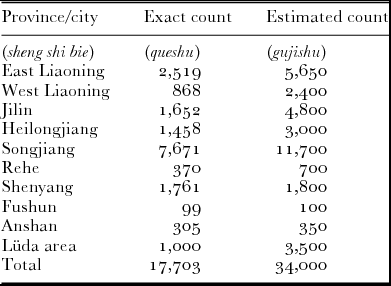
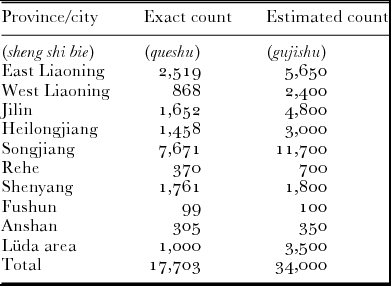
By September 1949, Chinese Communist Party officials estimated that 34,000 Japanese were still living in cities and provinces around the Northeast (as seen in Table 1), although a later calculation undertaken in June 1950 revised this figure down to 20,797.Footnote 20 Based on this later figure, Japanese nationals comprised 14 per cent of all foreign nationals in China, more than any other country except for the Soviet Union. Within the Northeast, the majority of Japanese were living in the cities of Harbin (in what was then referred to as ‘Songjiang’ province) and Shenyang, both of which had been leading sites of Japanese administrative and military control in the 1930s and 1940s.Footnote 21 Large numbers could also be found in the Lüshun-Dalian region.
Statistics on Japanese in Northeast China, September 1949 (by city or province).
Source: FMA File No. 105-00224-02, p. 16.
Yet the Committee was not interested in merely collating statistics on the geographic location of the Japanese in Northeast China. Rather, by August 1949, it had become clear that the Committee's core purpose was to find ways to draw on the particular expertise of those Japanese still living in the region. In one of its earliest reports to the Chinese Communist Party Foreign Ministry, the Committee argued that,
[Japanese] technicians have been working in the Northeast for the last two to three decades, and today the economic recovery of the Northeast region really requires the help of Japanese technicians.Footnote 22
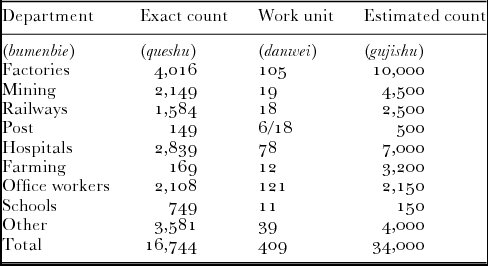
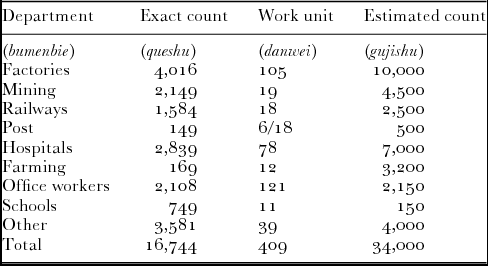
In line with its view that Japanese technicians could contribute to the ‘economic recovery of the Northeast’, the Committee further argued that ‘it is very important that we increase the leadership and education of Japanese in the Northeast to better enable them to work for us’, and sought ‘to mobilize additional Japanese to help contribute to the economic development of Northeast China’.Footnote 23 To this end, the Committee began collecting statistics on the different departments in which the Japanese served. As Table 2 indicates, the majority of these Japanese were found in factories, mines, hospitals, and administrative offices.
Numbers of Japanese in the Northeast by department.
Source: FMA File No. 105-00224-02, p. 18.
Note: The correct sub-total in column 2 should read ‘17,344’ rather than ‘16,744’, but the author has elected to reproduce the sub-total as depicted in the original document.
In collecting these statistics, Party officials categorized the Japanese on the basis of their expertise as skilled or unskilled workers. They divided the Japanese into four categories depending on whether they were ‘technicians’ (jishuzhe), ‘skilled workers’ (jishu gongren), ‘ordinary workers’ (yiban gongren), or ‘office workers’ (zhiyuan).Footnote 24 Among the Japanese in Northeast China, 12 per cent were designated as ‘technicians’, 23 per cent were ‘skilled workers’, 23 per cent were ‘ordinary workers’, 4 per cent were ‘office workers’, and the remaining 38 per cent were ‘family members’ (jiazu).Footnote 25 The Chinese Communist Party's classifications present an interesting counterpoint to earlier classifications drawn up by Japanese colonizers in Manchuria during the 1920s, 1930s and 1940s. As Mariko Asano Tamanoi indicates, the categories used by Japanese officials in Manchukuo often reflected wider political purposes. At times, for instance, the Japanese sought to blur the lines between colonizer and colonized in order to mount the argument to foreign audiences who were critical of Japan's invasion that the ‘independent’ nation of Manchukuo did not belong to any one race, but was instead home to a ‘harmonious’ group of ‘five races’ (Han Chinese, Mongols, Manchus, Japanese, and Koreans).Footnote 26 Like their Japanese counterparts, the Chinese Communist Party's classification of Japanese after 1949 also reflected a broader purpose. In this case, however, that purpose was the Party's goal of quickly rebuilding the Chinese economy and drawing on whatever expertise they could to do so. Though crude, it provides evidence that the Party understood China's desperate need for skilled workers who could operate advanced technology, provide training, and rebuild China's war-torn economy.Footnote 27
Reports from the Committee to the Northeast government and Foreign Ministry indicate that these Japanese technicians provided vitally important technical expertise across a range of industries in Northeast China. For instance, the Hegang Mine in Heilongjiang Province was home to more than 1,200 Japanese workers. In September 1949, Japanese working at the mine had introduced the ‘longwall’ method, a form of underground mining where the coal wall is mined in a single slice. This ‘longwall’ technique, the Committee noted, had improved the safety and efficiency of the mine.Footnote 28 Indeed, it was so successful that the Committee had rolled out the Japanese ‘longwall’ method in other mines around Northeast China.Footnote 29 Japanese technicians also played an important role in introducing important new technologies to industrial sites in the region. One example was Akita Shun, a 45-year-old metallurgical engineer based at the Northeast Army's Department of Industry. In the latter half of 1949, Akita and other Japanese engineers had developed a new high-steel hexagonal drill to be used in mining around the region. According to the Committee's reports, this new drill allowed for more efficient mining than previous methods used by Chinese engineers, and they estimated that it had increased mining output at the Northeast Army's Department of Industry by 40 per cent.Footnote 30 Another example was Seki Hiroyuki, who worked as a ceramic engineer at the South Manchurian Railway's Central Research Laboratory (Mantetsu Chūō Shikenjo) in Dalian. Between 1949 and 1953, Seki not only pursued his own research into ceramic engineering, but also helped to train younger Chinese technicians and research assistants, and spent time translating Japanese scientific textbooks into Chinese for the benefit of his Chinese peers.Footnote 31
Based on these and other contributions, the Committee wrote to the Northeast People's Government and Ministry of Foreign Affairs that the expertise and technology provided by these and other Japanese technicians was ‘highly significant’ to the development of the Chinese economy.Footnote 32 Unfortunately, these reports do not allow us to quantify the extent to which Japanese technical expertise and labour contributed to China's overall economic output in 1949 and early 1950. Nevertheless, we can glean some measure of their importance to Chinese Communist Party officials by examining their role within the context of the Party's wider reconstruction goals. The question of how to rebuild and reconstruct China's war-torn economy was foremost in the minds of officials in China in the wake of the Second World War. In China, first the Nationalist government and later the Chinese Communist Party encountered the grave reality of an economy that had been ruined by the eight-year War of Resistance against Japan. The war destroyed 55 per cent of China's total industrial and mining capital, and damaged almost all of China's bridges, rail lines, and shipping infrastructure. By the end of the war, China's industrial output was just 30 per cent of pre-war levels. The economy was further eroded by the plundering of Northeast China's industrial base by the Russian occupying army, hyperinflation of more than 230 per cent annually in some parts of China, and the ensuing civil war between the Communists and the Nationalists.Footnote 33 The combination of these events left China's economy reeling and helped to pave the way for the Communists to come to power.
For the Chinese Communist Party, the rapid reconstruction of China's economy was a necessary first step. It vowed to ‘reconstruct’ China by embracing a Marxist-Leninist style of revolution, which appealed not only because of its revolutionary ideology, but also because it provided a developmental model that offered ‘a shortcut to modernity for backward countries’.Footnote 34 In particular, this Soviet development model championed heavy industry, centralized planning, and collectivization of agriculture. Nevertheless, for all their enthusiasm, the Chinese Communist Party believed that China's economy was still ‘too industrially backward’ (gongye tai luohou le) to begin a wholesale implementation of the Soviet development model in 1949.Footnote 35 China's economy was predominantly an agrarian one where large swathes of the country—outside of cities such as Shanghai and Dalian—had yet to make the transition to industrialization.Footnote 36 By comparison, the Soviet Union had been at a much more advanced level of economic development on the eve of its own socialist revolution in 1917.Footnote 37 In March 1949, Mao Zedong therefore stated that before China could be turned into ‘a great socialist state’, the Chinese Communist Party must first ‘transform China from an agrarian country into an industrial state’.Footnote 38
Yet China's Communist leaders had little experience upon which to draw to undertake this industrial reconstruction, particularly in the urban areas most in need of rebuilding.Footnote 39 While the Soviet Union was an ideological ‘elder brother’, it would not provide much in the way of practical assistance to China until 1951. Indeed, Soviet technicians did not begin arriving in China in large numbers until late 1952 and 1953, so there were, at most, a few hundred Soviet technicians available to the Chinese Communist Party in their first few years in power.Footnote 40 By comparison, and even using the most conservative Party estimates, we can count at least 2,400 Japanese technicians and skilled workers employed at the factories, industrial sites, railways, and mines of Northeast China during the same period.Footnote 41 Moreover, these Japanese had spent years constructing, repairing, and managing the major industrial sites of the Northeast, and their familiarity with the region's industries was an extremely valuable resource for a government trying to rapidly rebuild. While the Chinese Communist Party's vision of ‘reconstruction’ may have been Soviet-inspired, the reality was that the Party had far more immediate access to Japanese technology and expertise in its first months and years in power. This was the legacy of the Japanese empire: systematic efforts by the Japanese imperial government in the 1930s and 1940s to cultivate high levels of economic interdependence between the industrialized economy of Japan and the raw materials, agriculture, and labour of Northeast China. Though this interdependence had been cultivated to supply Japan's war economy, its legacy left the Chinese Communist Party with an important economic base—and access to Japanese technology and expertise—with which to begin the urgent process of post-war reconstruction.
Key Japanese officials and technicians also felt a strong sense of obligation to contribute to China's post-war reconstruction. Japanese technicians such as Marusawa Tsuneya, former director of the Manchurian Railway's Central Research Laboratory in Dalian, elected to stay behind in China long after the early repatriation ships had left because he was motivated by a sense of obligation to China. Marusawa felt a duty to use his skills to help rebuild China, a country that had been destroyed through the actions of his own imperialistic government, and so he continued to work on technical projects in Dalian until 1953.Footnote 42 Another Japanese who shared Marusawa's sense of obligation to China was Ōkita Saburō, an engineer and researcher who had worked in Japan's Ministry of Greater East Asia during the war (and who was subsequently moved to the Foreign Ministry at the end of the war).Footnote 43 Ōkita was born in the Japanese-controlled city of Dalian, and after completing his education as an electrical engineer at Tokyo Imperial University, returned to North China in 1939 to establish the North China Power Company under the auspices of the Kōain, Japan's Asia Development Institute.Footnote 44 As an engineer, he had been directly involved in developing major industrial infrastructure in North and Northeast China. Ōkita opposed Japan's military policies in China, but also understood the important technological and industrial basis of Japanese national power.Footnote 45 These experiences in Northeast China led Ōkita, in 1945, to draft a major report for the Japanese Foreign Ministry, examining the reconstruction of Japan's post-war economy. The report outlined a future development strategy for Japan that was justified on both economically rational and moral grounds. Ōkita recognized that Japan's future economic prosperity depended on the revival of its heavy industrial sector, but he argued that Japan could no longer use the militaristic policies of the 1930s to sustain that heavy industry. Those militaristic policies—which relied on the colonization of Manchukuo to produce raw materials for heavy industry, and the protection and subsidizing of the domestic heavy industry sector to produce munitions—had wreaked havoc on Japan's Asian neighbours and Japan's own domestic population, the report argued. Instead, Ōkita suggested, Japan could secure its future as an advanced industrial power by exporting its technology and industrial equipment to China in exchange for imports of raw materials. Moreover, he argued that Japan had an obligation to use its industrial capacity to assist the industrialization of its less powerful Asian neighbours.Footnote 46 Calling on Japan to exchange technology with other countries, Ōkita wrote,
The past political, militaristic, and formalistic character of Japanese diplomacy will weaken in the future, whereas economic and technical issues will become the most important and real problems for the nation's diplomacy. Such issues as the participation and cooperation of Japanese technology in industrialization in Asian areas . . . will assume a basic importance for Japanese diplomacy in the future.Footnote 47
Of course, ideas about the role of Japan as an advanced industrial nation that could contribute to Asian industrial development had a long history in pre-war and wartime Japan. These ideas were most famously encapsulated by the concept of the ‘Greater East Asia Co-Prosperity Sphere’, drafted by Japanese technocrats working between Manchuria and Japan in the 1930s and 1940s.Footnote 48 Whatever the economic merits of these ideas, however, they had been badly corrupted by Japan's highly aggressive approach to forceful colonization and economic development in Asia. Ōkita's report therefore reflected an important understanding that the industrial and military dimensions of Japanese power must now be disentangled. Yet although Ōkita's ideas would ultimately go on to exert a great influence on Japan's post-war development strategy and economic ties with Asia, his ideas would first be buffeted by the onset of the Cold War. The outbreak of the Korean War in June 1950 caused a major rethink across Asia of the linkages between technology, industrial capability, and national power. While some Japanese officials such as Ōkita were attempting to sever the link between technology, industrial capability, and military strength, elsewhere in China and in American-occupied Japan, officials were instead working to fuse the technological, industrial, and military dimensions of national power.
Technology and industrialization in Cold War Asia
As the Cold War descended on Northeast Asia, Chinese Communist Party officials began to articulate new thinking about the relationship between industrialization, technology, and military strength. It is within this context that we can understand how and why the Chinese Communist Party came to see Japanese technicians as even more significant for China's reconstruction. Two intertwined processes led to this evolution in Chinese thinking. The first involved American-led efforts to reform Japan and rehabilitate that country as a key American ally in the struggle against communism in Asia. The second was the outbreak of the Korean War in June 1950, when North Korean leader, Kim Il-Sung, launched artillery attacks on the city of Kaesong along the 38th parallel. Both of these processes transformed Chinese Communist Party thinking about the industrial nature of modern warfare; they observed how Japan was being rearmed and reindustrialized by the United States, and began to consider their own industrial vulnerabilities relative to those two countries. For the Chinese Communist Party, Japanese technicians were no longer merely an expedient solution for China's post-war reconstruction needs. Instead, they came to embody the technological and industrial expertise that was so desperately needed in China as the country's leaders embarked on war with the United States, the world's most powerful industrialized nation. These themes would have major implications for Japanese technicians in Northeast China.
The American occupation of Japan in 1945 had initially been designed to disarm Japan according to the principles of the 1945 Potsdam Declaration and to ‘remould’ Japan as a Western-style democracy.Footnote 49 Douglas MacArthur, supreme commander for the Allied Powers, set about dismantling Japan's ‘war-producing industries’, breaking up the Japanese zaibatsu that had controlled these industries, and putting together plans for a reparations programme that would transfer much of the machinery and equipment that underpinned Japan's industrial empire to its less-developed neighbouring states in Asia.Footnote 50 Yet within two years of the war's end, there had been a dramatic shift in American thinking vis-à-vis the economic relationship between China and Japan. In 1947, President Truman announced his plans to bolster the strength of the capitalist world as a way of containing the Soviet threat. The economic rehabilitation of Japan was central to these plans. Architect of the American Marshall Plan, George Kennan, argued that Japan was one of ‘five centers of industrial and military power in the world’ that mattered most to American security interests, and believed that without economic rehabilitation, a weak Japan was at risk of becoming a drain on American resources or falling to the Soviets.Footnote 51 Over the course of 1947 and 1948, the United States set about planning Japan's economic recovery, paying particular attention to the need to protect Japan's industrial resources.
The outbreak of the Korean War in 1950—and the Chinese Communist Party's decision to intervene in the war in October that year—further reinforced to American officials the importance of a strong Japan that could contribute to the United States’ Cold War containment strategy. American officials believed that rehabilitating Japan's military-industrial complex would not only help to strengthen Japan's own war-torn economy, but would also provide goods that American forces could use in Korea.Footnote 52 The American decision to procure industrial goods from Japan for use in Korea transformed Japan's economy. During the first year of the conflict, Japanese exports increased by over 60 per cent, and American direct procurement of industrial goods accounted for around one-third of Japan's total export trade.Footnote 53 Japanese manufacturers provided the United States with ammunition, light weapons, and napalm bombs, and Japanese workers performed repair and service work on American tanks, aircraft, and military vehicles.Footnote 54 Major manufacturing companies such as Toyota also received critical injections of funds and transfers of Western industrial technology, and used this boost to begin the research and development that would underpin their economic success in the future.Footnote 55
Japan's economic transformation and its role within the United States’ Asia containment strategy had a profound effect on Chinese Communist Party thinking about the relationship between technology, industrial power, and war, and on the lives of the Japanese technicians living in Northeast China. In mid-1950, the Chinese Foreign Ministry began to seriously formulate policy on its future relationship with Japan. These discussions were initiated in response to the United States’ rehabilitation of Japan, and its subsequent plans to enter into a Peace Treaty and Security Treaty with Japan. In May that year, the Chinese Foreign Ministry established a Japan Peace Treaty Deliberation Group (waijiaobu duiRi heyue shenyi weiyuanhui), comprised of more than 35 officials and Japan-experts from Beijing and Shanghai.Footnote 56 One of the strongest themes to emerge during the meetings of the Party's Deliberation Group was the industrial and technological capability that underpinned Japan's military power and which had made Japan such a significant threat to China during the Second World War. Like the Allied Powers in 1945, the Party's Peace Treaty Deliberation Group recognized that Japan's industrial and technological capabilities had enabled the Japanese military to develop advanced weaponry, and that the development of its heavy industrial sector had allowed Japan to rapidly mobilize for war in the 1930s.Footnote 57 Chinese Communist Party officials drew two lessons from this observation. First, the Deliberation Group argued that it was necessary to limit Japan's future war potential, not only by destroying Japanese military arms and equipment, but also by removing its military-industrial complex.Footnote 58 The Party drew an explicit connection between Japan's industrial rehabilitation and the military threat posed by Japan. Editorials in the People's Daily throughout the Korean War warned that the United States had revived the very industries that had underpinned imperial Japan's military-industrial complex, including steel, heavy chemicals, electric power, railways, and telecommunications.Footnote 59
Second, the Peace Treaty Deliberation Group recognized that,
Today's wars are industrial wars and wars of goods and materials, thus the importance of economic planning for war is not second to that of military [planning for war].Footnote 60
Furthermore, they argued that success in war would be decided on the basis of a country's ‘ability to achieve self-sufficiency in modern industrial resources’, ‘the military's daily rate of consumption’, and ‘the speed of daily industrial output’.Footnote 61 In modern wars, therefore,
. . . opposing aggression requires removing the aggressor's weapons, but removing its weapons is only part of [a country's] actual strength; stopping a country's re-armament requires limiting its latent potential.Footnote 62
This view of modern warfare represented a major shift for a party whose approach to warfare had been strongly based on the tradition of guerrilla-style resistance.Footnote 63 In this new age of industrialized warfare, the Peace Treaty Deliberation Group argued that China, too, needed to set about acquiring the advanced technology and industrial goods necessary to become a powerful, industrialized state. Yet within the Chinese Communist Party there were, unsurprisingly, different emphases placed on how best to achieve these goals. Chairman Mao and the majority of the central leadership believed that China could best develop as an advanced industrial power by protecting the fledgling industrial development that had begun to take place in Northeast China. To protect this region, they argued, China had no choice but to intervene in the Korean War. In a cable to Zhou Enlai following an emergency Party meeting on 13 October 1950, Mao wrote that if China did not enter the war,
The entire Northeast Frontier Force will be tied down, and the power supplies in South Manchuria will be controlled. In short, we hold that we should enter the war, we have to enter the war.Footnote 64
Similarly, in an address to senior cadres of the Northeast Military Region on the eve of the war, commander of the Chinese People's Volunteers, Peng Dehuai, argued that postponing what the Chinese Communist Party saw as an inevitable war in Korea would only further harm China's emergent industrial development efforts and give the United States time to arm and increase the industrial capabilities of its allies. In a statement that underscored Chinese Communist Party understanding of the critical relationship between the production of industrial goods such as iron and steel and a country's overall national strength, Peng asked his cadres:
Would it be better for us to relax for a while and fight a war three to five years from now? Of course it would be better. However, we would still have to fight a war three to five years from now. Such a war would destroy our small industry, whose construction will have taken us three to five years. At that time, American imperialists will have armed Japan, and Japan will be able to dispatch a relatively large number of troops, so it would not be easy for us to stop an invasion. By that time, American imperialists will probably also have armed West Germany, and we should not neglect the huge output of iron and steel of West Germany. . . Therefore, it is better for us to fight an early war rather than a late one.Footnote 65
As Peng's speech indicates, the Chinese Communist Party was intensely aware of China's industrial weakness relative to industrialized powers such as the United States, and even more aware that the strategic power balance was shifting out of China's favour as the United States rehabilitated the industrial capabilities of Japan and West Germany.
On 17 October 1950, Mao therefore gave the order for the Chinese People's Volunteers to cross the Yalu River into northern Korea. As the Korean War erupted on the border with Northeast China in late 1950, the presence of so many Japanese in that area created a new set of challenges for Party officials in the region. Though Japan, still occupied by the United States, did not officially become a member of the American-led United Nations coalition in Korea, it was, as we have seen, providing significant logistical and manufacturing support to American forces in Korea. Indeed, as Adam Cathcart has shown, Chinese Communist propaganda songs from the Korean War period directly condemned the American rearmament of Japan for this purpose.Footnote 66 How then, did Chinese Communist Party officials in the Northeast deal with Japanese enemy aliens in their territory?
By the middle of October 1950, the Committee for the Management of Japanese in Northeast China was reporting that Japanese technicians in the city of Andong (now Dandong) had started to ‘panic’ (konghuang) at the sight of American planes dropping bombs in Korea.Footnote 67 Zhao Anbo, the head of the Committee, was concerned that the Chinese Communist Party did not have a good handle on the loyalties of the Japanese under their authority. In a report marked for the special attention of Premier Zhou Enlai, Zhao described his fear that Japanese ‘enemy agents’ (dite), ‘suspicious elements’ (xianyi fenzi), and ‘personnel kept on from the old [Nationalist] regime’ (liuyong renyuan) could pose a threat to China in this new Cold War environment.Footnote 68 The Committee had carried out some intelligence work, and believed that a small number of the Japanese in the Northeast were ‘agents’ (tewu) of the Guomindang and the United States who had ‘specially come to destroy us’.Footnote 69 In particular, the Shenyang branch of the Public Security Bureau believed there were approximately 400 Japanese who were members of ‘reactionary’ parties or organizations in the Northeast, and vowed to maintain their vigilance regarding these individuals.Footnote 70 Furthermore, Zhao issued special instructions on how to deal with the Japanese ‘when the Northeast enters a situation of war’.Footnote 71 Reflecting Chinese Communist Party fears that it was only a matter of time before the Korean War would spread to the Chinese mainland, Zhao informed public security offices (gong'an jiguan) in the Northeast that they should strengthen their supervision of ‘ordinary Japanese’ by stepping up identity checks, prohibiting Japanese from travelling outside their home cities, and forbidding them from sending letters overseas.Footnote 72 In addition, Zhao instructed public security officials to arrest suspicious Japanese living in cities such as Andong, Ji'an, Linjiang, and Changbai along the Yalu River bordering Korea, and to transport them to ‘North Manchuria’ (BeiMan).Footnote 73 In this new militarized Cold War environment, the presence of so many Japanese enemy aliens posed new political and security challenges for the Committee.
Yet despite this risk, the lives of the Japanese technicians were simultaneously affected by the more sanguine policy views of Chinese Communist Party leaders such as Zhou Enlai, who was premier and foreign minister, and Chen Yun, one of the Party's leading economic experts. Zhou and Chen had initially opposed China's involvement in the Korean War, arguing that China's economy could not withstand yet another costly war, and that the country should focus instead on economic development, land reform, and the unemployment crisis.Footnote 74 Furthermore, Zhou and Chen saw Japanese industrial expertise as critically important for China's future economic development. In May 1950, Zhou Enlai called on Chen Yun and a group of other economic experts to work out how to turn the ‘stagnant’, ‘sporadic’, and ‘small-scale’ trade relationship with Japan back into the ‘relatively close’ economic relationship the two countries had enjoyed in the past.Footnote 75 Zhou—who had received the reports of the Foreign Ministry's Peace Treaty Deliberation Group—acknowledged that China did not yet ‘have a clear understanding of Japan's foreign policy’. Nevertheless, he also recognized that Japan possessed a range of industrial goods and machinery that China badly needed to rebuild its economy.Footnote 76 Chen Yun's report demonstrated that Japan was producing a range of industrial goods such as metals (copper, silver, gold, iron, tin), electrical goods, and industrial equipment which ‘our side needs’ for its industrial development, and recommended measures to increase imports of these goods from Japan.Footnote 77
Chen Yun's own views about the importance of Japanese technology, industrial goods, and expertise had developed during the Chinese civil war when he was dispatched to Manchuria and put in charge of the takeover and post-war reconstruction of Harbin and Shenyang. As we saw above, these two cities were home to thousands of Japanese technicians, and had achieved high levels of industrial development under Japanese control. In both cities, Chen showed great respect for local technicians and engineers working at industrial sites, and believed that drawing on their expertise and allowing them to continue working in their jobs was the best way to rebuild the economy in the Northeast and ensure a smooth Communist takeover.Footnote 78 It is not surprising, then, that in February 1952, when he had become head of the Finance and Economy Commission tasked with bringing order to China's national economy, Chen Yun argued that the industrial facilities introduced to Northeast China by the Japanese would be vital to China's reconstruction efforts. As he stated:
The original facilities of the major industries in Northeast China were lost after ‘15 August’ [the date of the Japanese surrender in the Second World War], but although these factories lost important equipment, the foundations of these factories still exist. Purchasing equipment in order to rebuild or expand these factories rather than opening new factories elsewhere, will allow us to invest much less, achieve results much more quickly, and speed up [our development].Footnote 79
For Chinese Communist Party leaders such as Zhou Enlai and Chen Yun, China's most pressing security challenge was its own industrial and technological weakness, rather than the presence of a handful of counter-revolutionary Japanese. Meeting this challenge could best be achieved by rebuilding and expanding Japanese-built industrial sites in the Northeast, importing Japanese industrial goods and materials, and drawing on the expertise of Japanese technicians. Yet Zhou and Chen's vision was complicated when the United States introduced an economic embargo on China in December 1950 in response to China's entry into the Korean War.Footnote 80 In a bid to contain what it saw as a growing Chinese Communist threat, the United States introduced strict trade controls that prevented American companies and those of its allies from exporting industrial goods to Communist China. Like the Chinese Communist Party, the United States also understood the relationship between industrial power and military strength, and thus sought to limit Communist China's access to ‘war-producing materials’.Footnote 81 Without access to foreign replacement parts and industrial equipment, the Chinese Communist Party was now even more dependent on Japanese technicians who could develop new industrial technology and repair existing machinery and equipment. In response, the Committee for the Management of Japanese in Northeast China therefore increased rather than decreased its use of Japanese technicians. For instance, it introduced policies designed to hold onto the most skilled Japanese technicians and recommended to the central government that only those Japanese who were ‘sick and weak’ (bingruozhe), or those who ‘could not find regular or proper employment’ (wuguding, zhengdang zhiyezhe), should be repatriated back to Japan. That is, only ‘those Japanese whose work is of no benefit to the economic recovery of the Northeast’ should be permitted to return home.Footnote 82 Although small numbers of Japanese were repatriated in 1949, 1950, and 1951, the Committee was careful not to repatriate the most skilled Japanese technicians.Footnote 83 Reports from Japanese repatriates confirm these policies adopted by the Committee. According to 55-year-old Tsuru Suzuki, a Japanese woman who lived in Northeast China with her two adult children until being repatriated in March 1952, it was ‘comparatively easy for women, children and old people to obtain permission to return home’, but it was ‘not . . . easy for technicians to get permission’.Footnote 84
Furthermore, the Committee began to put Japanese in charge of leading industrial sites in the Northeast. For example, at the Hegang Mine in Heilongjiang Province, the Committee was so impressed with the skills of the Japanese engineers, that in late 1950 it put Japanese technicians in charge of four of the six operation sites at the mine.Footnote 85 The Committee's willingness to put Japanese in these important positions is where the Chinese Communist Party's approach to the Japanese technicians begins to contrast with the approach taken by the previous Nationalist government. Although the Nationalists had ‘kept back’ a number of skilled Japanese technicians after 1945 to assist in rebuilding post-war China, the Nationalists’ antipathy towards the Japanese often prevented them from making the most of Japanese expertise. Leading Nationalist officials such as T.V. Soong and Jiang Jingguo, who were in charge of rebuilding industries in the former Japanese-occupied areas of China, so despised the Japanese that they refused to make use of their skills or to put them in charge of key industries.Footnote 86 By contrast, Communist officials on the Northeast Committee reported to Zhou Enlai in late 1951 that, despite some concern about the political and security risks posed by Japanese ‘enemy agents’ living in the region, ‘when all is said and done, the bad [Japanese] elements are in the minority’.Footnote 87 Whatever they may have thought of the Japanese technicians’ political loyalties, the Committee recognized the vital contribution they could make to China's industrial development.
Growing Cold War tensions
Zhou Enlai's relatively sanguine attitude towards the Japanese raises questions about how the Chinese Communist Party sought to convince its own domestic Chinese population of the legitimacy of drawing on the skills of erstwhile ‘enemy’ Japanese technicians. The Party reconciled this potential challenge by publicly portraying the Japanese technicians in Northeast China as fellow victims in the international struggle against imperialism. Beginning in 1950, the Committee for the Management of Japanese in Northeast China organized propaganda and education efforts to condemn the ‘imperialistic’ United States and Japanese governments, but portrayed the Japanese people as common victims in this struggle. For instance, between January and April 1950, the Committee held a photographic exhibition in Shenyang which documented Japanese suffering under American occupation. Japanese visitors to the exhibition were encouraged to sign a petition calling for the trial and punishment of the Japanese emperor as a war criminal.Footnote 88 Furthermore, at some of the major industrial sites in Northeast China, such as the Hegang Coal and Steelworks, the Jixi Iron and Steelworks, and the Dongbei Railway, the Committee organized joint mass meetings of Japanese and Chinese workers to denounce American imperialism and symbols of Japanese imperialism such as the Japanese emperor.Footnote 89 This approach towards the Japanese technicians was part of a wider discursive strategy, adopted by the Chinese Communist Party in the early 1950s, to draw a clear distinction between the handful of ‘militaristic’ Japanese leaders who had led Japan to war and the millions of ‘peace-loving’ Japanese people who were fellow partners in the struggle against imperialism.Footnote 90 By portraying the Japanese technicians and Japanese people in general in this way, the Chinese Communist Party not only sought to build a base of support within China and Japan for undermining American imperialism in Asia, but also sought to legitimize its strategy of using Japanese technicians in the Northeast.
As the Korean War unfolded, the expertise of these Japanese technicians was most felt at industrial sites which had been plundered by the Soviet Red Army following the Soviet victory against Japan in Manchuria in August 1945.Footnote 91 One of the industrial sites worst hit by the Soviet Red Army was the Anshan Iron and Steelworks in Liaoning Province, which was originally established in 1918 as a subsidiary of the Japanese-controlled South Manchuria Railway Company.Footnote 92 The Soviets stripped Anshan of so much valuable industrial equipment that the Chinese Communist Party later complained that the Soviets had left only ‘empty buildings’ behind.Footnote 93 The Committee therefore turned to two Japanese engineers, Seki Koyuki and Nishi Kuzuyuji, for help in repairing and rebuilding these industrial sites. Throughout the duration of the Korean War, Seki conducted research into the development of high-quality silica bricks and pyrometric cones, two vital pieces of industrial technology that were needed to run the furnaces at Anshan and other ironworks around China.Footnote 94 Similarly, Nishi, a Japanese engineer who had worked in the Manchukuo Iron Company, led efforts to rebuild the industrial equipment at Anshan. The assistance of these and other Japanese technicians meant that, by the early 1950s, yearly production levels at Anshan had reached 500,000 tons of iron a year. Though this still paled in comparison to production levels of 1,400,000 tons per year under the Japanese, Nishi predicted that by 1955 or 1956 Chinese production would ‘top’ pre-war levels.Footnote 95 It was these sorts of industrial achievements that Chen Yun had envisaged when he advocated quickly rebuilding the Japanese-developed sites in Northeast China rather than opening new industrial sites elsewhere.
Yet despite the Chinese Communist Party's enthusiasm for these Japanese technicians, Cold War tensions had created difficulties for many of the Japanese technicians living in the Northeast. The American trade embargo on China had the effect of making China far more dependent on the Soviet economic bloc, and on the Soviet Union generally for its industrial and technological expertise, than the Chinese Communist Party had previously envisaged.Footnote 96 In late 1952, the Party began actively promoting a campaign to ‘learn from the Soviet Union’, and encouraged all Chinese workers to learn Russian so that they could read Russian-language technical manuals.Footnote 97 Furthermore, hundreds of new Soviet industrial experts began arriving in Northeast China.Footnote 98 The Committee for the Management of Japanese in Northeast China tried to encourage the Japanese technicians to learn to ‘work closely’ with these Soviet technicians, but on the whole, the arrival of the Soviets was not welcomed by the Japanese. A few politically sympathetic Japanese, such as Kobayashi Shigeru, the chief engineer of the Andong Paper Mill, and Doctor Akasaka of the Chinese University of Medical Sciences, actively praised the skills of the Soviet technicians and their assistance to China. However, most Japanese, who had experienced the brutality of the Soviet Army in Manchuria in 1945, regarded the Soviet Union as the ‘enemy’ (choushi).Footnote 99 The Japanese technicians also spoke with disdain about the quality of Soviet machinery and expertise, saying that ‘the Soviet Union took good American and Japanese machinery from China, and brought bad Soviet machinery into China’.Footnote 100
Furthermore, it was clear that both the Japanese and Soviet technicians in China felt threatened by the presence of the other. The Committee reported that after the arrival of the Soviets, the Japanese technicians seemed to feel that they were ‘no longer popular’ (ziji chibukaile) and that their skills were no longer needed.Footnote 101 The Soviet Union also had concerns about the presence of so many Japanese technicians in Northeast China. Soviet experts were not willing to allow Japanese technicians to work in factories and industrial sites where they might be exposed to advanced Soviet technology, presumably because they feared that the Japanese would leak these technological secrets to Tokyo or Washington.Footnote 102 Indeed, prior to 1949, Moscow had pressured the Chinese government to expel the 3,500 Japanese technicians living in Dalian, because they wished to replace the Japanese with Soviet technicians and therefore guarantee Soviet influence on China.Footnote 103
Despite their best efforts, it was becoming harder for Party officials in Northeast China to justify and manage this Japanese presence in the region. In late 1951 and 1952, Japan's Yoshida government stepped up its efforts to repatriate all remaining Japanese from ‘Red China’, and radio broadcasts from Tokyo tried to build up Japanese anticipation by reporting that ‘Chairman Mao is considering repatriating all Japanese within the year’.Footnote 104 Those Japanese in Northeast China with family members back in Japan also began receiving letters from Japan urging them to return home.Footnote 105 Party officials in Northeast China noted that many Japanese were growing increasingly unhappy with life in China and wished to return home. Although a number of Japanese technicians had volunteered to stay behind in China out of a sense of responsibility to contribute to China's post-war reconstruction, the day-to-day reality of life in China was taking its toll. Japanese technicians with children were worried about the quality of schools and universities in Communist China, and feared that their children would receive a poor education.Footnote 106 Furthermore, the Committee also observed that not all of the Japanese technicians believed they were paid adequately, given their superior technical skills.Footnote 107 By 1951, the Committee's policy of not repatriating skilled Japanese workers had become problematic as more and more Japanese started demanding to be repatriated back to Japan. The Committee was deeply concerned that the repatriation issue was causing a good deal of ‘chaos and disorder’ (hunluan) among the Japanese, and therefore disrupting economic development in the Northeast.Footnote 108 They noted that in the first half of 1950 there had been five instances of suicide, and that a number of young people had become ‘slack’ (sanman) and had ‘lost all ambition’ (zibaoziqi) to work.Footnote 109
The confluence of these different pressures—the Yoshida government's campaign for Japanese repatriation, Soviet suspicion of the presence of so many Japanese in Northeast China, and Japanese technicians’ own desire to return home—came to a head in November 1952. In that month, the Chinese central government released a ‘Resolution Dealing with Overseas Japanese in China’ (guanyu chuli zaiHua Riqiao wenti de jueding). The Resolution decreed that ‘apart from a few war criminals, anti-revolutionary forces, and those who had important top-secret information about China’, all Japanese who wished to go home would be allowed to do so.Footnote 110 Unfortunately, available archives do not presently allow us to determine whether Party officials in the Northeast supported this decision to repatriate the Japanese technicians and other skilled workers, or whether they were simply responding to orders from above. Nevertheless, the international Cold War context again provides important clues as to why the central government made this decision to begin repatriating the Japanese in November 1952. In April that year, Japan and the Republic of China (Taiwan) signed a Treaty of Peace that ended the state of war between the two sides, and paved the way for Japan's diplomatic recognition of Taiwan as the legitimate government of China. Cut off from the possibility of forming diplomatic relations with Japan, the Chinese Communist Party now had to look for alternative ways to establish ‘unofficial’ ties with Japan. The repatriation of Japanese from Northeast China was one issue that the Party believed it could leverage in order to try and build some kind of relationship with Japan.Footnote 111 On 1 December 1952, the Xinhua News Agency announced that the People's Republic of China was willing to negotiate the repatriation of Japanese nationals with three Japanese organizations. These were the Japanese Red Cross, which was an official organization linked to the Japanese government; the Japan-China Friendship Association, a pro-China organization made up of left-wing intellectuals, politicians, and individuals from the Japanese business world who felt a strong need to atone for Japan's aggression in China during the war; and the Japanese Peace Liaison Committee, another left-wing Japanese organization which had been created to lobby for a peace treaty with the People's Republic of China.Footnote 112 In doing so, China's Communist leaders had found a way of using the issue of Japanese repatriation to open up an unofficial channel of communication with Japan.Footnote 113 Over the course of 1952 and 1953, the Chinese Foreign Ministry and Chinese Red Cross worked with these Japanese organizations to repatriate the majority of Japanese back to Japan. While a handful of Japanese technicians were kept back and sent to other provinces around China, by October 1953, over 26,000 Japanese had returned to Japan.Footnote 114
Conclusion
In October 1949, the People's Daily article celebrating the Lüshun-Dalian industrial exhibition triumphantly declared that:
Hundreds of new factory managers and tens of thousands of new technicians, who have been developed from workers into technical intellectuals over the past three years, have taken the technology, which was previously the monopoly of the Japanese—technology such as that used in shipbuilding, railways, machinery, refineries, and chemical industries—and have put it in the hands of the Chinese workers.Footnote 115
Yet statements such as these belie the much messier reality faced by the Party when it came to power in 1949. The Chinese workers encountered by the Party possessed only basic technical skills, and were more enamoured by the industrial practices of previous Japanese colonizers than by those offered by the Soviet Union. Before the Party could embark on its programme of ‘reconstructing’ China into a modern, industrialized power, it needed thousands of highly skilled technicians to run the railway, machinery, and chemical industries of the Northeast. The legacy of the Japanese empire in Manchukuo, and the protracted dissolution of that empire, meant that these skills were held by the Japanese technicians, scientists, and engineers still living in Northeast China after 1949. Continuing a process first started by the Nationalist government before them, the Chinese Communist Party moved quickly to embrace this Japanese legacy, and put Japanese technicians to work in the mines, railroads, and scientific laboratories across Northeast China.
As the Cold War descended on Asia, however, these Japanese technicians took on far greater significance to the Chinese Communist Party's modernizing project. The eruption of the Korean War, and the American decision to revive Japan's military-industrial complex as a bulwark against Chinese communism, catalysed the beginning of a long-term reconceiving of national power within the Chinese Communist Party. Looking back at Japan's technological and industrial prowess during the Second World War, Party officials came to understand that China desperately needed technological and industrial capabilities if it was to fight ‘modern wars’ against industrialized powers. Indeed, their concern for industrial and technological power helps to explain the Party's fateful decision to enter the Korean War in October 1950. The three-year war would wreak havoc on the Chinese economy, further delaying China's post-Second World War reconstruction, and denying it access to badly needed industrial imports from Japan and the United States. Nevertheless, Mao ultimately took the decision to enter the Korean War because he believed that the risk of a permanent American presence on the Korean peninsula would jeopardize industrial resources in Northeast China and prevent the Chinese Communist Party from undertaking the rapid industrialization that China needed to become a modern and powerful nation. Scholars such as Chen Jian have argued that the Party's decision to enter the Korean War was shaped by an ideology of anti-imperialist nationalism that stemmed from China's experience of imperialism and war at the hands of foreign powers.Footnote 116 Like Chen Jian, I agree that ideology matters in explaining China's foreign policy and national security decision-making during the Chinese Communist Party's early years in power. Yet the evidence presented in this article suggests that we need to re-emphasize the industrial and technological dimension of China's experience of imperialism and war, and the role played by industry and technology in the Party's Cold War reconceiving of national power. Through exploring how the Chinese Communist Party made use of these Japanese technicians, we can see that technology and industrialization were central to the Party's efforts to transform China into a modern and powerful nation that could stand up to foreign powers.
Though the Chinese Communist Party's use of these Japanese technicians between 1949 and 1953 was short-lived, it was not merely a blip in the history of the China-Japan relationship nor short-term expediency. As their faith in the Soviet economic model weakened, and as relations with the Soviet Union soured in the late 1950s, the Chinese Communist Party would once again turn to Japan. In 1964, Japan became China's leading trade partner; in the 1960s and 1970s, thousands of Japanese technicians and industrial experts began visiting China to provide advice on the industrial development of the Chinese economy; and in the 1980s and 1990s, Japan became China's most important source of industrial and technological official development assistance.Footnote 117 Today, although China's leaders have taken great steps to develop their own indigenous technologies, and notwithstanding serious political and security tensions in the China-Japan relationship, China continues to rely on Japanese high-technology transfers and technical expertise in its search to become a modern and powerful nation.Footnote 118
Ultimately, the first few years of the People's Republic of China marked the beginning of China's reconceiving of the industrial and technological basis of national power. In the 1950s, the Chinese Communist Party believed that without developing a more advanced industrial economy, China would not be able to stand up to foreign powers and reclaim its place as a major power in the international system. These same concerns continue to shape contemporary China. As the country makes the transition from a developing country to an advanced, industrialized one, China's leaders recognize the vital role of technology and industrial development in building both a modern economy and a modern military. From the National Medium- and Long-Term Program for Science and Technology Development (2006–2020) to the development of China's military-industrial complex, industrial and technological advancement underpins China's conception of national power.Footnote 119