1. Introduction
Income inequality is a politically divisive topic that increasingly grabs news headlines and the attention of academics, policymakers and other influential thought leaders around the world. A recent World Economic Forum survey indicates that income inequality is the issue expected to have the biggest global impact in the near future.
While most estimates indicate that income inequality has increased in the developed world over the past several decades (e.g., OECD, 2011; Piketty, Reference Piketty2014), there is also substantial evidence that inequality is relatively rigid over long periods of time (Easterly, Reference Easterly2007; Lindert Reference Lindert, Atkinson and Bourguignon2000; Lindert and Williamson, Reference Lindert, Williamson, Bordo, Taylor and Williamson2003). This is particularly common in societies where the economic and political elite have collaborated to establish a legal framework that benefits members of their own classes relative to the masses (Sokoloff and Engerman, Reference Sokoloff and Engerman2000). Holcombe (Reference Holcombe2015) refers to such economic systems as political capitalism.
One hypothesis that explains the persistence of inequality over time comes from the work of economic historians Engerman and Sokoloff (Reference Engerman, Sokoloff and Haber1997, Reference Engerman and Sokoloff2002, Reference Engerman, Sokoloff, Banerjee, Bénabou and Mookherjee2006). Their work suggests that contemporary inequality has deep historical roots attributable to factor endowments such as climate, geography and natural resources. When endowments were favorable for the establishment of large slave plantations and/or mines, the economic and political elite successfully collaborated to institute rules and policies intended to protect their economic interests. This created inequality before the law characterized by highly unbalanced access to private property rights, biased contract enforcement and a potentially corrupt law enforcement and judicial system. In turn, inequality before the law hindered the economic opportunities available to the masses, retarding economic mobility and creating an environment characterized by perpetually high levels of economic inequality over multiple generations (Bennett and Cebula, Reference Bennett, Cebula, Cebula, Hall, Mixon and Payne2015; Engerman and Sokoloff, Reference Engerman, Sokoloff, Banerjee, Bénabou and Mookherjee2006).
Meanwhile, if endowments were favorable for the establishment of smaller scale farms to efficiently grow grains such as wheat and corn, then property tended to be distributed more evenly across households. With widespread property and small business ownership, rules and policies were instituted that provided private property rights protections and evenhanded contract enforcement by the evolving judicial and law enforcement systems. The emergent legal system was characterized by the rule of law and provided more widespread economic opportunities, creating an environment conducive to economic mobility and a more egalitarian distribution of income.
Easterly (Reference Easterly2007) distinguishes between two types of inequality that he suggests are often confused in the theoretical and empirical analysis of inequality. First is structural inequality, which is persistent over long periods of time and attributable to non-market mechanisms such as conquest, colonization, slavery and land distributions by the state that create a distribution of income in favor of the elite. Second is market inequality, which reflects an income distribution that is shaped by market forces that tend to reward a combination of talent, motivation and/or sheer luck, which are unevenly distributed across individuals, regions, firms and industries. Structural inequality is unambiguously bad while market inequality can have both positive and negative effects – e.g., it could harm development through constraints on human capital accumulation and occupational choice, but it could also provide important market incentives that promote economic growth.
The Engerman–Sokoloff hypothesis thereby suggests that countries whose endowments provided an incentive to develop a legal system characterized by institutions inconsistent with the rule of law will be more likely to exhibit higher levels of economic inequality than countries with endowments more favorable for the development of legal systems that effectively and impartially protect private property and enforce contracts. The rule of law therefore serves as a mechanism to deter extreme and persistent structural income inequality, at least relative to countries with legal institutions designed to primarily serve the interests of the elite.
Although the Engerman–Sokoloff hypothesis has been influential in the development literature and has attracted its fair share of critics (e.g., Przeworski, Reference Przeworski2005), there has been little empirical evidence documenting its validity. This paper provides an empirical test of the Engerman–Sokoloff hypothesis that the rule of law is associated with greater income equality for a sample of up to 98 countries. Using long-run net income Gini coefficients from the Standardized World Income Inequality Database (SWIID) (Solt, Reference Solt2009) and the Fraser Institute's legal system and property rights index (Gwartney et al., Reference Gwartney, Lawson and Hall2013), instrumented for with a measure of the suitability of land for growing wheat relative to sugarcane (Easterly, Reference Easterly2007), the potential causal impact of the rule of law on income equality is estimated. The impact of the rule of law on equality is both statistically and economically significant. Conditioning on several geographic variables, ethnolinguistic fractionalization and legal tradition, a standard deviation increase in the rule of law is associated with about a 1.7 point decrease in the long-run average Gini coefficient. These results are robust to a number of additional control variables, two alternative measures of the rule of law, an alternative instrument, the exclusion of strategic subsamples and the robust-to-outliers instrumental variable estimator of Desbordes and Verardi (Reference Desbordes and Verardi2012).
The remainder of the paper is organized as follows. Section 2 describes the data used in the empirical analysis and section 3 motivates the identification strategy. The main empirical results are presented in section 4, followed in section 5 by a robustness analysis. Section 6 offers concluding remarks.
2. Data
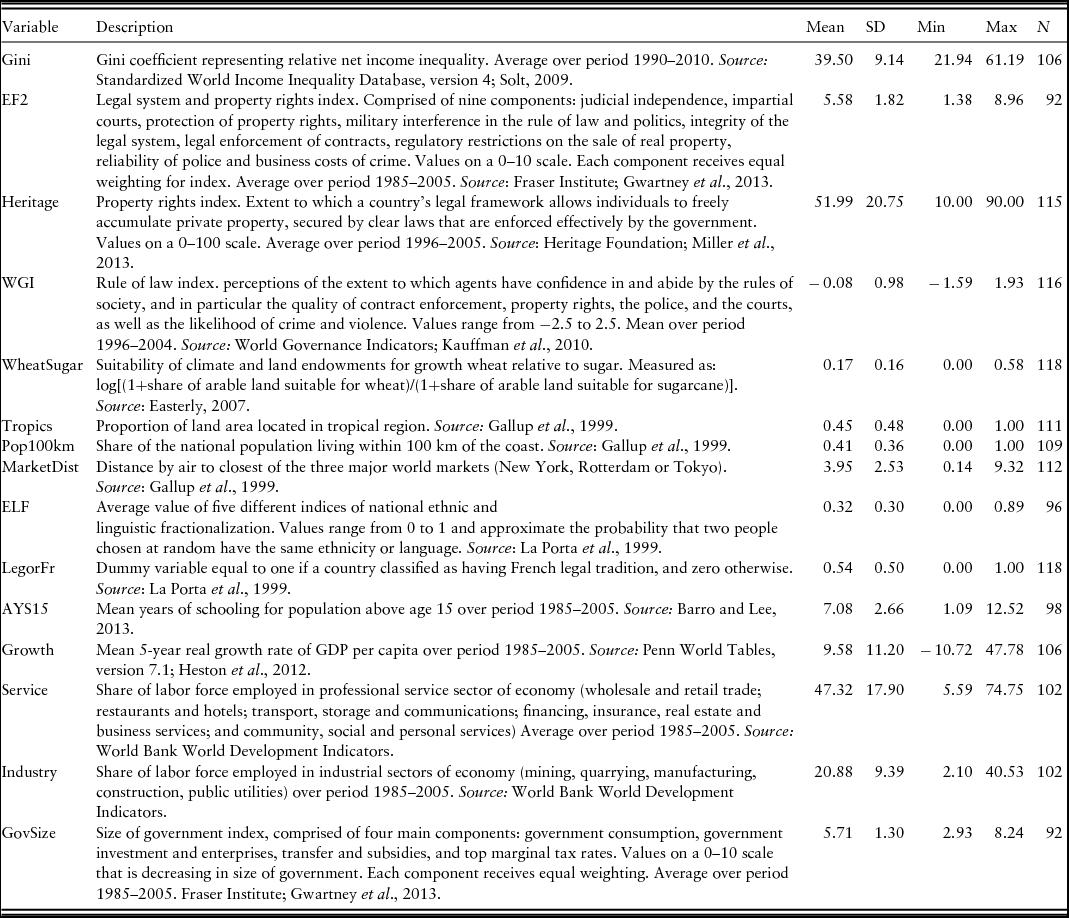
The data used in the empirical analyses of sections 4 and 5 is described below. Table 1 provides summary statistics as well as descriptions of all the variables.
Variable description, sources and summary statistics

Income inequality
The net income Gini coefficients from the SWIID, version 4.0 are used as the measure of income inequality (Solt, Reference Solt2009). The Gini coefficients take values between 0 (complete equality) and 100 (complete inequality). Consistent with previous evidence that income inequality is fairly persistent over time (Easterly, Reference Easterly2007; Lindert, Reference Lindert, Atkinson and Bourguignon2000; Lindert and Williamson, Reference Lindert, Williamson, Bordo, Taylor and Williamson2003), the SWIID Gini measures also reveal a relatively high time dependence. The correlations between the Gini coefficient and its lagged values of 5, 10, 15 and 20 years are 0.933, 0.886, 0.837 and 0.747, respectively. Because income inequality has been relatively rigid since 1990, the average Gini coefficient over the period 1990–2010 is used.Footnote 1
Rule of law
Levine (Reference Levine2005: 62) states that the ‘law, property rights and contracting are inseparable. . .legal systems consist of the entire apparatus of courts, procedures and institutions associated with enforcing property rights’. Consistent with this view, area 2 of the Economic Freedom of the World index – legal institutions and property rights (EF2) – is used as the primary measure of the rule of law. EF2 is an index comprised of the following nine components: judicial independence; impartial courts; protection of property rights; military interference in rule of law and politics; integrity of the legal system; legal enforcement of contracts; regulatory restrictions on the sale of real property; reliability of police and business costs of crime. All of the components are converted to a relative 0–10 scale that is increasing in the degree to which they are consistent with the rule of law. Each component is weighted equally for the EF2 index (Gwartney et al., Reference Gwartney, Lawson and Hall2013).
The correlation between EF2 and its lagged values up to 20 years ranges from 0.671 to 0.936. Because institutions also tend to change very slowly (North, Reference North1991), the average chain-linked EF2 measure over the period 1985–2005 is used.Footnote 2 It is purposefully lagged relative to the inequality measures so that observed legal institutions precede income inequality, weakening the possibility that inequality influences the development of the legal institutions.
Two alternative measures of the rule of law are used in the sensitivity analysis of section 5. First is the rule of law index from the World Governance Indicators (WGI), which takes values from approximately −2.5 to 2.5 that are increasing in the rule of law (Kauffman et al., Reference Kauffman, Kraay and Mastruzzi2010). Next is the property rights index from the Heritage Foundation's Index of Economic Freedom (Heritage), which takes values ranging from 0 to 100 that are increasing in the rule of law (Miller et al., Reference Miller, Kim and Holmes2013). See Bennett et al. (forthcoming) for a detailed assessment of the three rule of law measures.
Factor endowments
We use as a measure of factor endowments the measure of the suitability of land and climate for growing wheat relative to sugarcane (WheatSugar) developed by Easterly (Reference Easterly2007). WheatSugar is measured as the log of the ratio of one plus the share of arable land suitable for growing wheat to one plus the share of arable land suitable for growing sugar, or
 ${\rm{log}}( {\frac{{1 + {\rm{share\ land\ suitable\ for\ wheat}}}}{{1 + {\rm{share\ land\ suitable\ for\ sugarcane}}}}} )$
. In reduced form estimates, Easterly shows that WheatSugar is negatively associated with income inequality, but we contend that this measure of factor endowments affects inequality through the establishment of legal institutions that shape the rule of law. Section 3 provides theoretical and statistical support for the plausible validity of WheatSugar as an exogenous instrument for the rule of law.
Control variables
Our baseline estimate conditions on population fractionalization, two measures of geography and legal tradition because these factors have deep historical roots that are not very likely to have been influenced by institutions. Sturm and De Haan (Reference Sturm and De Haan2015) find that countries with more fractionalized populations exhibit less income redistribution. Accordingly, we control for ethno-linguistic fractionalization (ELF) and expect it to be positively correlated with net income inequality. Gallup et al. (Reference Gallup, Sachs and Mellinger1999) argue that countries remotely located from world markets and without access to water shipping routes are developmentally constrained, so we control for closest distance to one of the three major world markets (MarketDist) and the share of population living within 100km of the coast (Pop100km), and anticipate a positive relationship between both variables and inequality because severely underdeveloped countries are generally characterized by high levels of inequality.
We also condition on a nation's legal tradition, which was ‘formed centuries ago in Europe and spread via conquest, colonization and imitation around the world (Levine, Reference Levine2005: 62)’. Governments in countries with French civil law tradition ‘enjoy greater latitude in their abilities to funnel resources toward politically advantageous ends (Ibid.: 65)’, while the English common law tradition is often associated with strong property and contracting rights that constrain the ability of government to allocate resources (La Porta et al., Reference La Porta, Lopez-de-Silanes and Shleifer2008; Mahoney, Reference Mahoney2001). Accordingly, we include a dummy variable equal to 1 if a country is classified by La Porta et al. (Reference La Porta, Lopez-de-Silanes, Shleifer and Andrei1999) as having French civil law and 0 otherwise.
For robustness, we also include several additional variables that potentially influence income inequality. Forbes (Reference Forbes2000) and Scully (Reference Scully2002) provide evidence of a positive trade-off between economic growth and inequality, so we control for the average 5-year growth rate over the period 1985–2005 (Growth). Economies traditionally transition from an agricultural to an industrial and eventually a service-based economy as they develop, and the Kuznets (Reference Kuznets1955) hypothesis suggests that inequality increases during early stages of economic development but eventually declines during later stages of development. Following Carter (Reference Carter2006) and Bennett and Nikolaev (Reference Bennett and Nikolaev2015), we control for the shares of the labor force employed in the industrial (Industry) and service sectors (Service). Finally, we control for the size of government using area 1 of the EFW index (EF1) to account for the effect of government allocation on the income distribution. Growth, Industry, Service and EF1 represent the averages over the period 1985–2005, intentionally lagged relative to the inequality measure to minimize potential endogeneity, but we do not include them in the baseline estimates because they are potentially impacted by a nation's legal institutions.
3. Factor endowments as a plausible exogenous source of variation in the rule of law
The endowment theory of legal origins contends that a region's climate, geography, natural resources and/or population endowments ‘shaped the initial formation of property rights and the initial systems for defining, defending and interpreting property rights [and] have had long-lasting ramifications on property rights and private contracting today (Levine, Reference Levine2005: 75–76)’. One variety of the endowment theory is the geographic determinism hypothesis associated with economic historians Engerman and Sokoloff (Reference Engerman, Sokoloff and Haber1997; Reference Engerman and Sokoloff2002; Reference Engerman, Sokoloff, Banerjee, Bénabou and Mookherjee2006),Footnote 3 who stress that natural resource endowments related to mining and agriculture shaped the evolution of economic and legal institutions in the Americas following European colonization. Regions endowed with climates and land suitable for the production of cash crops such as sugarcane, tobacco and coffee, as well as large populations of unskilled native populations, provided European immigrants with an incentive to establish large slave plantations to take advantage of economies of scale. This resulted in the emergence of an elite class of landowners and initially large degrees of economic and political inequality in theses colonies. The elite class had an incentive to protect their positions by institutionalizing a legal code and other policies that served their interests, while systematically denying legal rights and economic opportunities to the rest of the population. Inequality before the law perpetuated structural economic inequality over time.Footnote 4
Meanwhile, regions that were relatively uninhabited by natives and were endowed with climates and land suitable for the production of grains such as wheat created an economic environment conducive to smaller scale family farming. Most adult male immigrants to these regions became land owners and established independent family farms. As a result, a sizeable middle class emerged and the initial distribution of economic and political power was more equal such that more egalitarian legal institutions emerged that provided widespread protection of property and enforcement of contract, promoting economic opportunity and a greater degree of economic equality.Footnote 5
Factor endowments more favorable for growing grains such as wheat relative to cash crops such as sugarcane resulted in a larger share of farms being family-owned. Indeed, Easterly (Reference Easterly2007) constructs a measure of the suitability of climate and land endowments for growing wheat relative to sugarcane (WheatSugar), and shows that it is a strong predictor of the share of family farms.
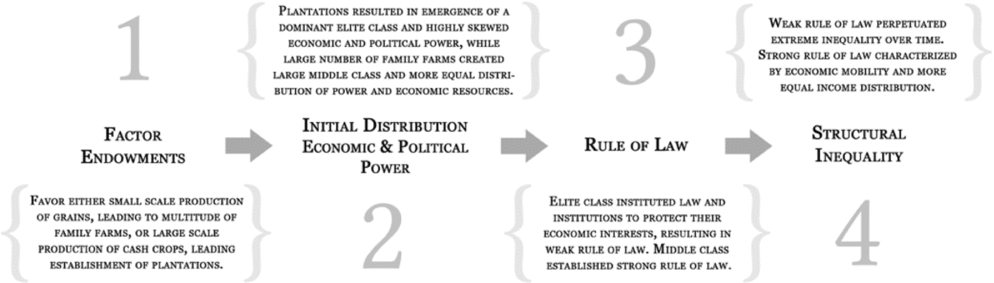
In reduced-form estimates, Easterly shows WheatSugar to be negatively and statistically significantly correlated with income inequality. Our hypothesis, however, is that factor endowments affect the distribution of income through the channel of the rule of law. Figure 1 summarizes this causal mechanism. When more farms were family-owned, legal institutions developed that protected private property and provided even-handed contract enforcement. This laid the foundation for an open economic system offering widespread opportunities to earn a dignified living, resulting in economic mobility and a more equal distribution of income. When the converse was true, an inegalitarian rule of law developed that only protected the interests of the economic and political elite, hindering opportunity for mobility and generating structural inequality.
Link between factor endowments and structural inequality.

Our main argument here is that while factor endowments played an important role in the initial distribution of income, as economic development took off and most societies moved from agricultural to manufacturing and eventually serviced based economies, it was the already established institutions associated with the rule of law that perpetuated inequality. This allows us to use WheatSugar, the exogenous suitability of land for wheat versus sugar, as a natural instrument for the rule of law and estimate the causal impact of the rule of law on structural inequality. A prolific historical literature has identified this instrument a priori. Furthermore, as Easterly (Reference Easterly2007) points out, WheatSugar is a particularly attractive instrument because it identifies variation ultimately associated with structural inequality rather than market inequality. Finally, two additional benefits of an empirical strategy that has a well-defined a priori hypothesis are (1) avoiding the potential for data mining by running numerous cross-section regressions, and (2) alleviation of measurement error associated with the uncertainty of the data on income inequality.
Simple correlations provide some preliminary evidence for our hypothesis. First, WheatSugar is about as good a predictor of our measure of the rule of law (EF2) as it is of inequality (−0.54 vs. 0.49). Second, EF2 is better correlated with inequality than WheatSugar (−0.63 vs. −0.54).
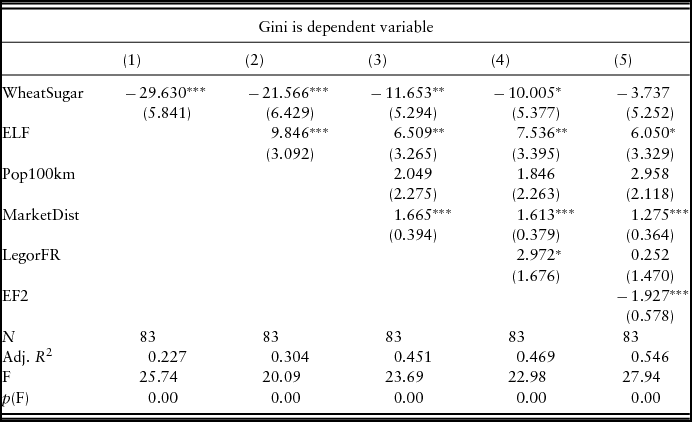
Table 2 presents the results from reduced-form OLS regressions of Gini on WheatSugar. The simple regression in column 1 reveals that WheatSugar is negatively and highly significantly correlated with income inequality. Column 2 adds ELF, which enters positive and is highly significant statistically. Column 3 adds two geographic factors, distance from major markets (MarketDist) and the share of the population living within 100 km of the coast (Pop100km). Both enter with a positive sign but only MarketDist is statistically significant. Column 4 adds French civil law tradition (LegorFR), which enters positively and marginally significant statistically. WheatSugar remains negative and statistically significant at 10 percent or better in columns 2–4; however, it loses statistical significance and the magnitude of the coefficient declines by more than 60 percent once EF2 is added to the model in column 5. Meanwhile, EF2 enters positively and is highly statistically significant. The results of these reduced-form estimates provide statistical evidence that WheatSugar is a plausibly exogenous instrument for EF2, as the former is no longer a statistically significant predictor of inequality after controlling for the rule of law and conditioning on additional factors such as fractionalization, geography and legal tradition.
Reduced form OLS estimates
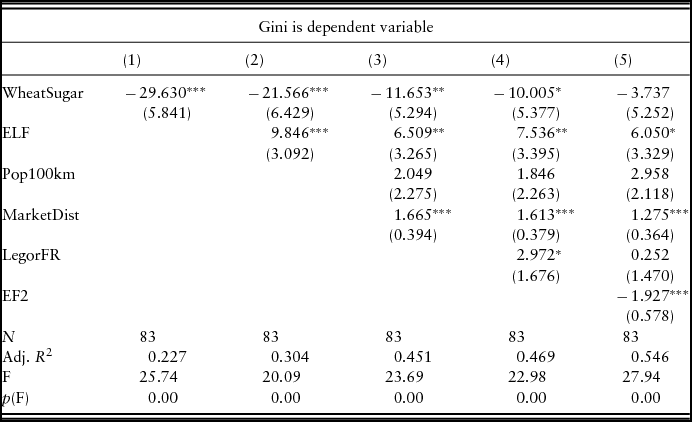
Robust standard errors in parentheses. Constant term omitted for space. See Table 1 for variable descriptions. ***p < 0.01, **p < 0.05, *p < 0.1.
4. Main results
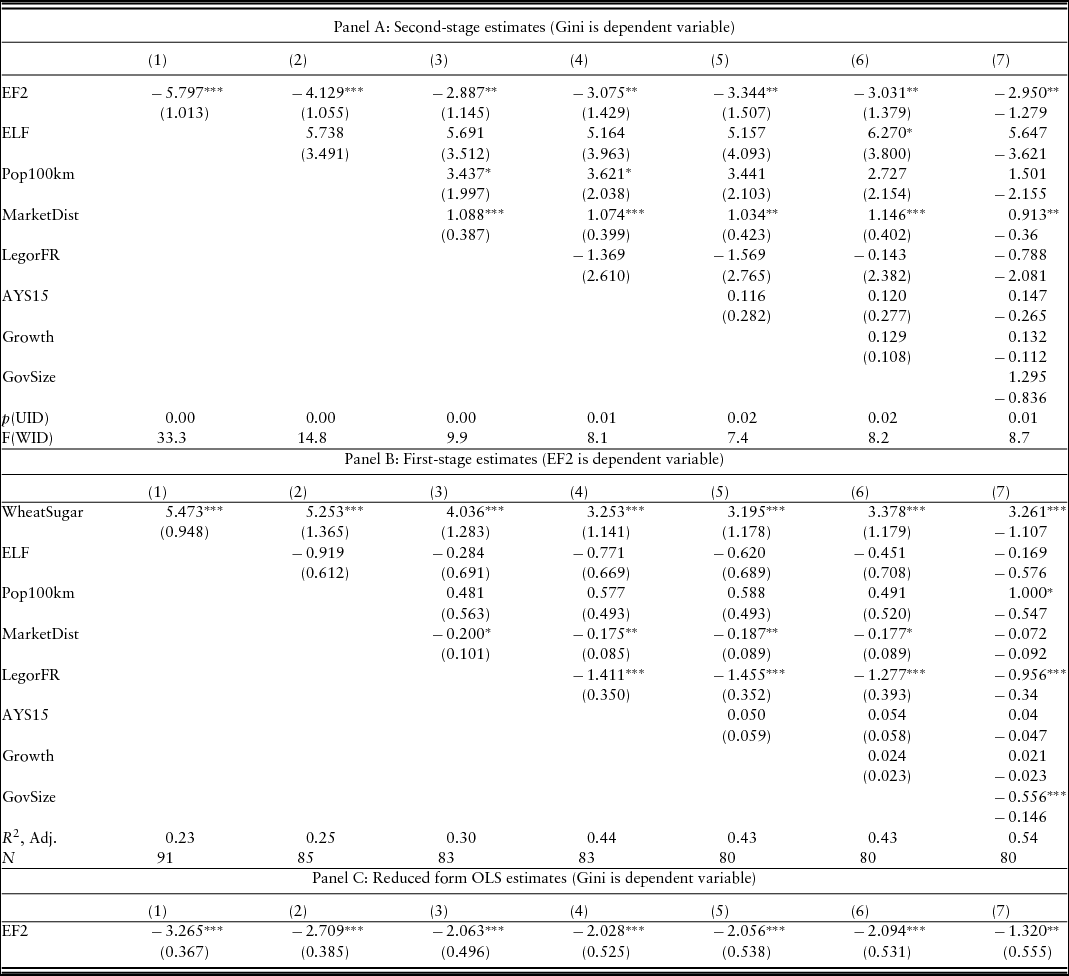
We use the two-stage least squares estimator (2SLS) to estimate the potential causal impact of the rule of law, as measured by EF2, on income inequality, as measured by Gini. We instrument EF2 with WheatSugar, a measure of the suitability of land for growing wheat relative to sugarcane. Panels A and B of Table 3 present the second- and first-stage results, respectively. Panel C provides reduced-form OLS estimates of the partial effect of EF2 on Gini for comparison.
2SLS estimates
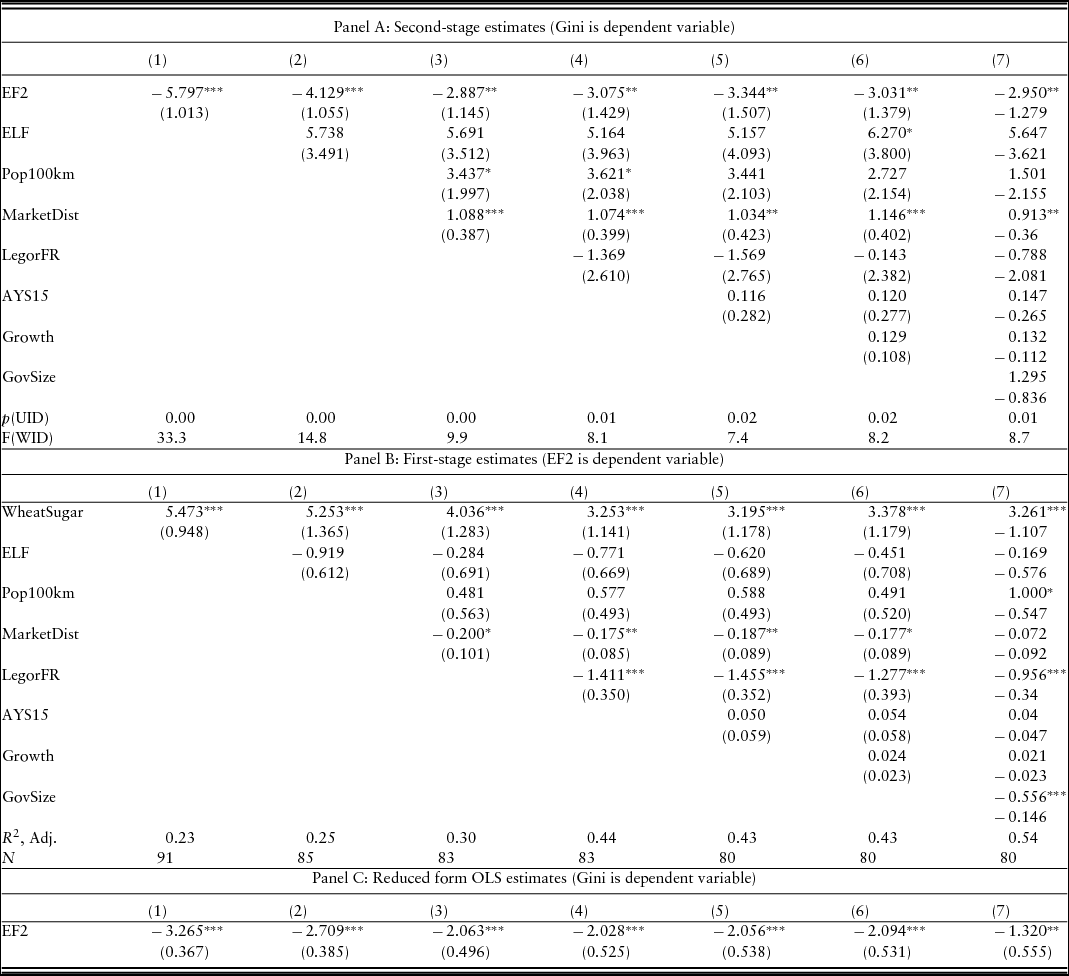
Robust standard errors in parentheses. p(UID) is p-value of underdentification LM statistic. F(WID) is Kleibergen-Papp F-statistic for weak identification. All specifications include a constant – omitted for space. Specifications in panel C include the same set of control variables as indicated in corresponding second stage estimate – omitted for space. See Table 2 for variable descriptions. ***p < 0.01, **p < 0.05, *p < 0.1.
Column 1 of Table 3 does not include any control variables. In the first-stage, the 5.473 coefficient on WheatSugar is statistically significant at the 1 percent level. The −5.797 coefficient on EF2 in the second-stage is also highly statistically significant. Column 2 conditions on ELF, which enters negatively in the first-stage and positively in the second, although neither is statistically significant at conventionally accepted levels. WheatSugar remains highly significant in the first stage and the magnitude of the coefficient is only marginally smaller. Although the coefficient on EF2 in the second stage is reduced to −4.129, it remains highly statistically significant.
Column 3 of Table 3 conditions on the two measures of geography, the share of the population living within 100 km of the coast (Pop100km) and closest proximity to major world markets (MarketDist). Pop100km enters positively in both stages, but is only statistically significant at the 10 percent level in the second-stage. MarketDist enters negatively and positively in the first- and second-stages, respectively, and is statistically significant at 10 percent or better in both. WheatSugar remains highly significant in the first-stage, although the magnitude of the coefficient declines to 4.036. The −2.887 coefficient on EF2 remains statistically significant at the 5 percent level.
Column 4 of Table 3 conditions on legal tradition by including a dummy variable equal to one for countries with French civil law heritage (LegorFR). LegorFR is negative in both stages, but is only statistically significant (at the 1 percent level) in the first-stage. Because population fractionalization, geography and legal heritage are largely exogenous factors with deep historical roots, this specification is treated as the baseline model. WheatSugar remains highly significant in the first-stage with a coefficient of 3.253. The predicted difference in EF2 measure between a country with the most and least favorable conditions for growing wheat relative to sugarcane is 1.89 points, slightly more than a full standard deviation. EF2 is statistically significant at the 5 percent level in the second-stage and the −3.075 coefficient suggests that a single point increase in EF2 (0.55 standard deviations) is associated with a more than 3-point reduction in the Gini coefficient (1/3 standard deviation).
As an illustration, consider Ecuador and the Dominican Republic, two Latin American countries with French legal origins and significant coastal populations. The WheatSugar values for Dominican Republic and Ecuador are 0.218 and 0.026, respectively. The first-stage estimates predict that the relatively more suitable conditions for growing wheat in the Dominican Republic should result in it having an EF2 value about 0.63 points higher than Ecuador. The actual difference in EF2 values between Dominican Republic (4.72) and Ecuador (4.01) is 0.71, which the second-stage estimates predict will result in a 2.18 point lower Gini coefficient in the former. The Gini value for Dominican Republic is 45.15, which is 3.13 points lower than the 48.28 Gini coefficient in Ecuador. All else equal, the baseline estimate suggests that the difference in the rule of law between these two countries explains about 70 percent of the difference in their levels of inequality.
Column 5 of Table 3 adds the average educational attainment of the adult population (AYS15) to the baseline specification, while columns 6 and 7 add the average 5-year growth rate of the economy (Growth) and the size of government index (EF1), respectively. In all three specifications, WheatSugar remains positive and highly significant in the first-stage and EF2 negative and statistically significant at the 5 percent level in the second-stage, and their coefficients are relatively stable.
Table 3 also reports results from tests of under-identification and weak instruments. The p-value of the Kleibergen and Papp (Reference Kleibergen and Papp2006) rk LM statistics is reported as p(UID). Under the null, EF2 is unidentified. The null is easily rejected in all specifications. The Kleibergen–Papp F-statistic for weak identification is reported as F(WID). The F(WID) values should be compared to the Stock and Yogo (Reference Stock and Yogo2002) critical values to determine the IV bias and test size distortions. The null for each test is that WheatSugar is a weak instrument for EF2. If F(WID) is greater than the critical values for each test, then the null is rejected. The critical values for a 10, 15, 20 and 25 percent maximal IV size bias for a single endogenous regressor are 16.38, 8.96, 6.66 and 5.53, respectively. Because there is a single endogenous regressor, the rule of thumb critical value of 10 can be used to approximate a 5 percent test that the worst case relative bias is 10 percent or less. The F(WID) values in Table 3 range from 7.4 in column 3 to 33.3 in column 1, and the baseline specification in column 4 has a F(WID) = 8.1, suggesting that WheatSugar is a relatively strong instrument for EF2.
5. Robustness analysis
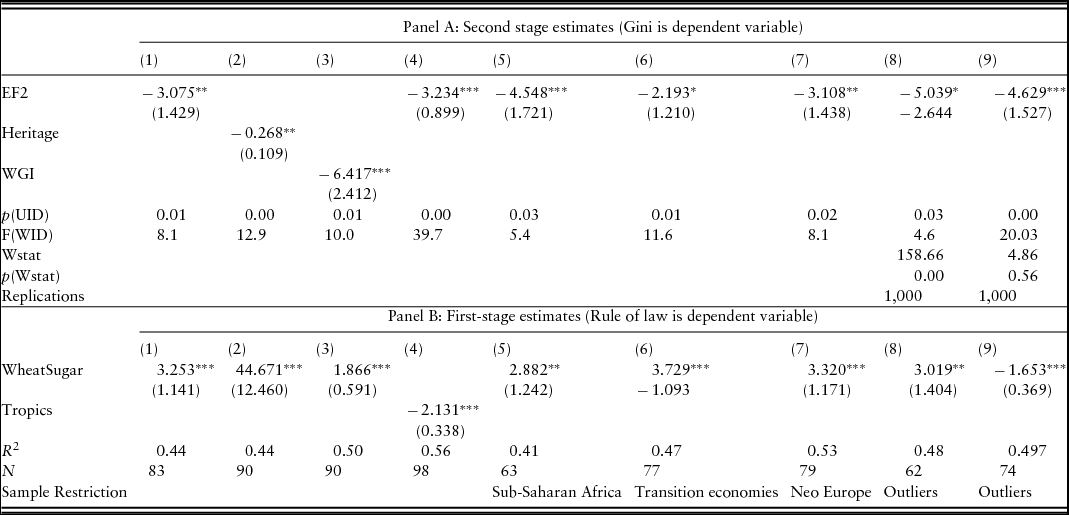
Table 4 presents results from a variety of robustness tests. The estimates in column 1 serve as the baseline and are reproduced from column 4 of Table 3. The remaining specifications condition on the geography, fractionalization and legal tradition variables, although we do not report the results for these controls to preserve space.
Robustness analysis
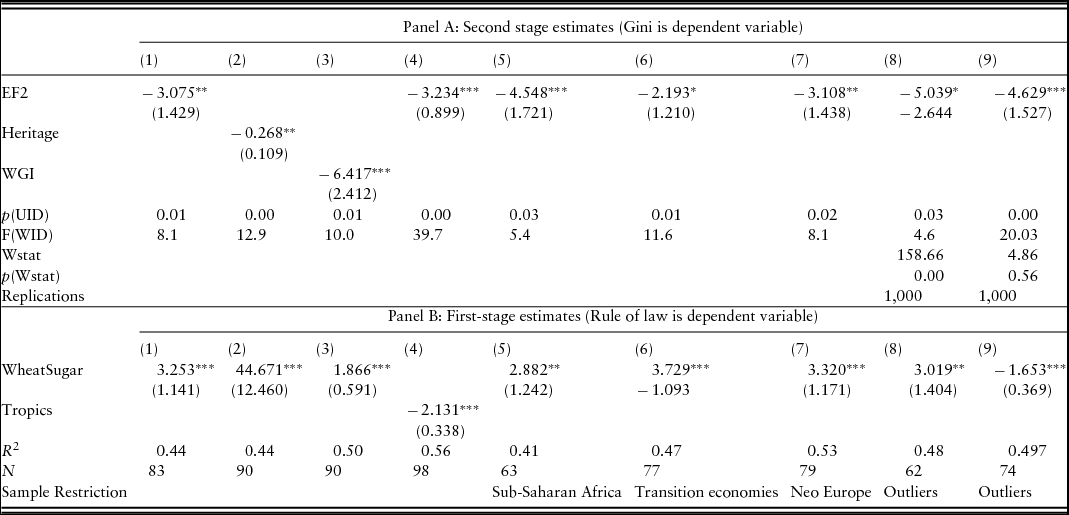
Robust standard errors in parentheses. Baseline estimate in column 1 is reproduced from column 4 of Table 3. All subsequent specifications include same set of covariates – omitted for space. Specifications 2 and 3 use an alternative measure of property rights. Specifications 4 and 9 use Tropics as an alternative IV. Specifications 5 and 6 omit the countries of Sub-Saharan Africa and transition economies, respectively. Specification 7 omits Australia, Canada, New Zealand and the United States. Specifications 8 and 9 use the Desbordes and Verardi (Reference Desbordes and Verardi2012) robust instrumental variables estimator. (UID) is p-value of underidentification LM statistic. F(WID) is Kleibergen-Papp F-statistic for weak identification. Wstat and p(Wstat) denote the outlier statistic and p-value of outliers test statistic, respectively. See Table 2 for variable descriptions. ***p < 0.01, **p < 0.05, *p < 0.1.
The previous results utilize EF2 as the measure of the rule of law, but there are several alternative measures available. Specifications 2 and 3 use the Heritage Foundation property rights (Heritage) and the WGI rule of law (WGI) indices, respectively. WheatSugar is positive and highly significant in both first-stage estimates, and the rule of law negative and statistically significant at 5 percent or better in both second-stage estimates. Note that the three rule of law measures are scaled differently, so the coefficients are not directly comparable.
Column 4 of Table 4 uses an alternative instrument, the share of the population living in the tropics (Tropics). Tropics is fairly strongly correlated (−0.538) with WheatSugar and the settlement strategy hypothesis of Acemoglu, Johnson and Robinson (Reference Acemoglu, Johnson and Robinson2001) suggests that tropical regions provided poor settlement conditions such that settlers pursued an extractive strategy, resulting in weak property rights institutions. Thus, Tropics is a good alternative instrument and it enters negatively and highly significant in the first-stage. More importantly, EF2 is highly significant in the second-stage and the −3.234 coefficient is fairly similar to the baseline.
Columns 5, 6 and 7 of Table 4 exclude the countries of Sub-Saharan Africa, transition economies and the four Neo-European nations (Australia, Canada, New Zealand, United States), respectively.Footnote 6 WheatSugar remains statistically significant at 5 percent or better in the first-stage and EF2 negative and statistically significant at 10 percent or better in the second-stage in all three samples. Relative to the baseline, the absolute value of the magnitude of the effect of EF2 on Gini increases for the subsample that excludes Sub-Saharan Africa, but declines for the one excluding the transition economies. Although the magnitude of the estimated effect of the rule of law changes when strategically excluding sets of countries that may be driving the results, EF2 remains a negative and statistically significant predictor of income inequality. Meanwhile, the estimated effect of EF2 is very similar to the baseline for the sample excluding the Neo-European nations.
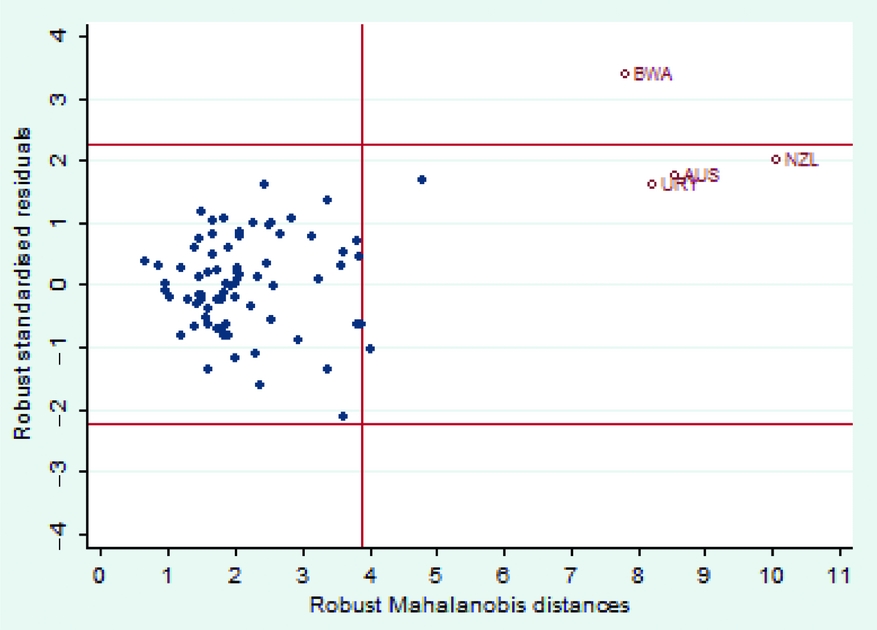
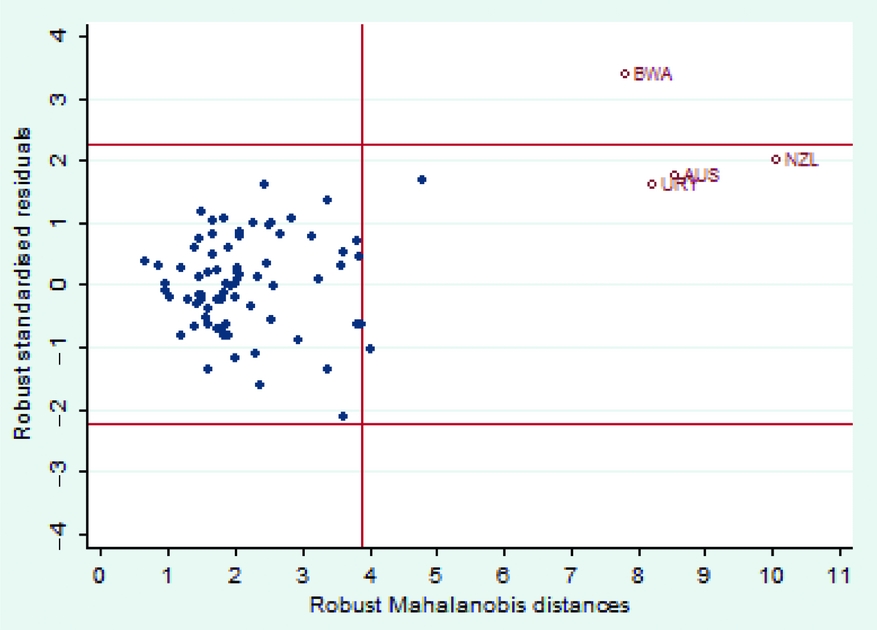
Column 8 of Table 4 provides the results from the Desbordes and Verardi (Reference Desbordes and Verardi2012) robust instrumental variable estimator (RIV) test procedure using 1,000 bootstrap replications and a 0.99 cut-off level. The Hausman test statistic, Wstat = 158.66, and corresponding p-value, p(Wstat) = 0.00, suggest that outliers sufficiently distort the IV estimates such that robustness should be favored at the expense of efficiency. Appendix Figure A1 identifies the various types of outliers. The resulting RIV estimates are based on a sample of 62 countries. WheatSugar remains positive and statistically significant in the first-stage and the magnitude of the coefficient is only marginally smaller than the baseline estimate. EF2 is statistically significant at the 10 percent level in the first-stage and its coefficient of −5.039 is nearly 60 percent larger than the magnitude of the baseline estimate. The null for the rest of under-identification is rejected at the 5 percent level, but the F(WID) = 4.6 is suggestive of a weak instrument, which potentially explains the noticeably large magnitude of the EF2 coefficient estimated by RIV.
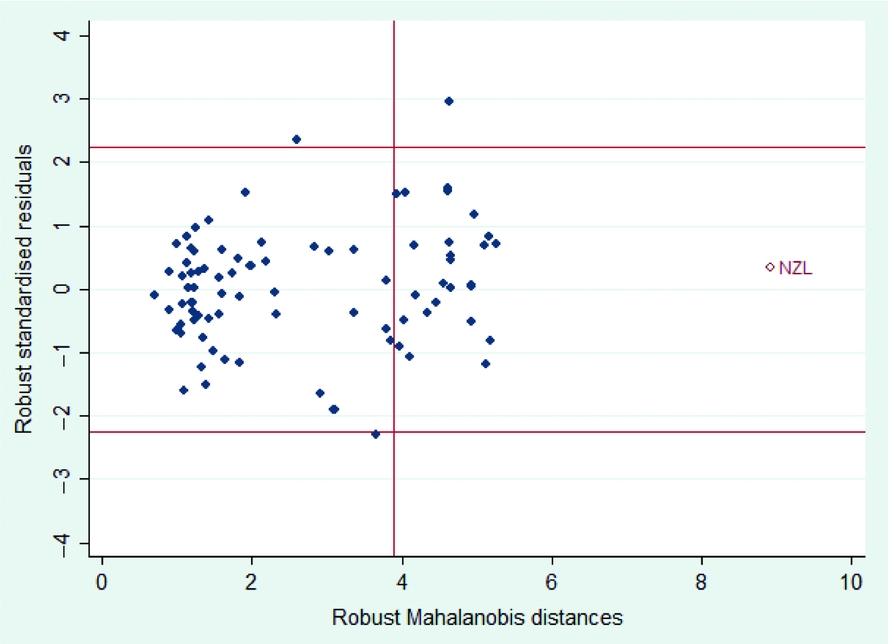
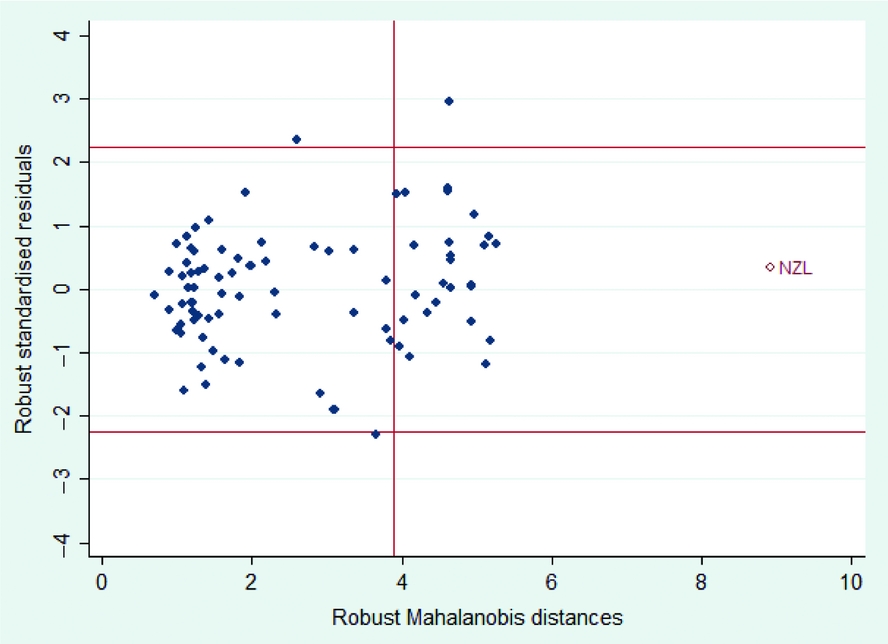
Finally, column 8 of Table 4 provides the results of RIV estimation using the alternative instrument, Tropics, which enters negatively and highly significant in the first-stage. EF has a coefficient of −4.629 and is statistically significant at the 1 percent level. F(WID) = 20.03, suggesting that the instrument is quite strong and the null of under-identification is easily rejected. The Hausman test statistic, Wstat = 4.86, and corresponding p-value, p(Wstat) = 0.56, suggest that the presence of outliers, which are indicated in Appendix Figure A2, are not significantly distorting the IV estimates, so the efficiency gain of the IV estimates in column 4 is preferential to the robustness of the RIV estimates in column 8.
6. Conclusion
This paper provides an empirical test of the Engerman–Sokoloff hypothesis that a nation's factors endowments affected contemporary inequality through the development of the rule of law. When endowments were favorable for large-scale plantations, the economic and political elite collaborated to design legal institutions that protected their economic interests while systematically denying the same rights to the majority of the population, resulting in a perpetuation of economic inequality over long periods of time.
We use the mean net income Gini coefficients from the SWIID over the period 1990–2010 as our measure of inequality and the mean chain-linked legal institutions and property rights index from the Economic Freedom of the World index over the period 1985–2005 as a measure of the rule of law. Instrumenting the rule of law with a measure of factor endowments, the suitability of land for growing wheat relative to sugarcane, we estimate the potential causal effect of the rule of law on long-run inequality. The results suggest that after conditioning on ELF, geography and legal tradition, the rule of law exerts an economically and statistically significant negative effect on income inequality. The results are robust to a number of additional control variables, two alternative measures of the rule of law, an alternative instrumental variable, strategic sample restrictions and robust IV estimation.
The empirical evidence presented here support the Engerman–Sokoloff hypothesis that the elite's historical efforts to influence the rule of law, when successful, have perpetuated economic inequality. One potential limitation of this study is that factor endowments may have exerted an influence on inequality through channels besides legal institutions. For instance, it has been suggested that economic inequality has historically been perpetuated through political inequality by limiting the voting franchise, as well as by a lack of public investment in schooling institutions, both of which may have also been influenced by factor endowments and/or colonization policies (Klerman et al., Reference Klerman, Mahoney, Spamann and Weinstein2011; Mariscal and Sokoloff, Reference Mariscal, Sokoloff and Haber2000). Inequality may also have been influenced by economic institutions and policies besides the rule of law (e.g., Bennett and Vedder, Reference Bennett and Vedder2013; Scully, Reference Scully2002), although the historical link between factor endowments and contemporary fiscal, monetary, trade and regulatory policies is less clear, and as Bennett and Nikolaev (Reference Bennett and Nikolaev2015) point out, the theory and empirical evidence on the relationship between the various areas of economic freedom and inequality is ambiguous. Because there is generally a high correlation between the various types of economic, legal and political institutions, it is difficult to disentangle these various channels empirically without additional exogenous instruments, but this would be an area fruitful for additional research.
Additionally, the theory outlined here may present somewhat of a paradox in terms of its policy implications. A country with a very unequal distribution of land attributable to its factor endowments could, for example, be tempted to improve the rule of law and in doing so reduce structural inequality by violating the legal protections of current landowners in order to redistribute land more widely. Recent land reforms efforts in Latin America countries such as Bolivia and Peru serve as an illustration of this apparent contradiction between short-run legal security and long-run rule of law.
Acknowledgements
We thank Toke Aidt, James Gwartney, Börke Tunali, participants at the 2015 Public Choice and European Public Choice conferences, and two anonymous referees for comments on earlier versions of this paper.
Appendix
Identification of outliers – model 7, Table 4.
Identification of outliers – model 8, Table 4.
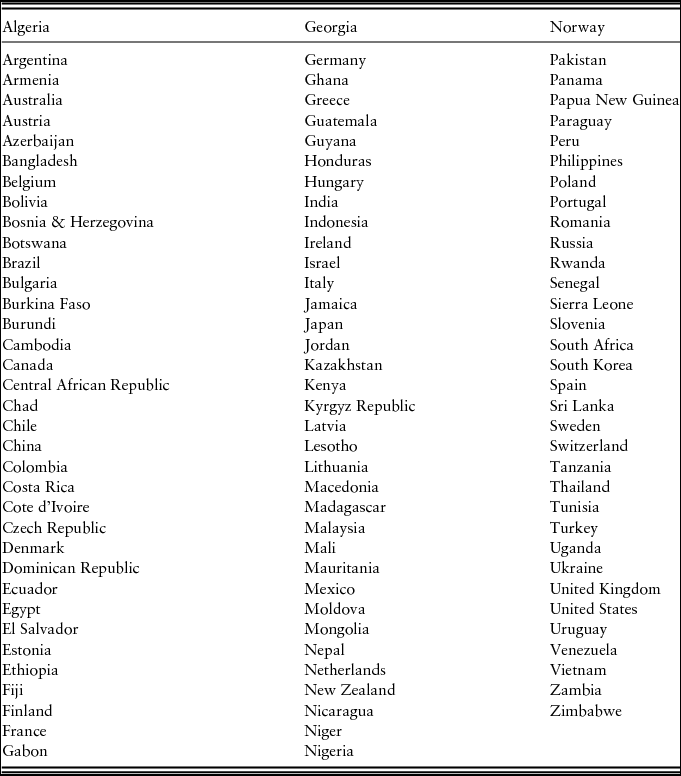
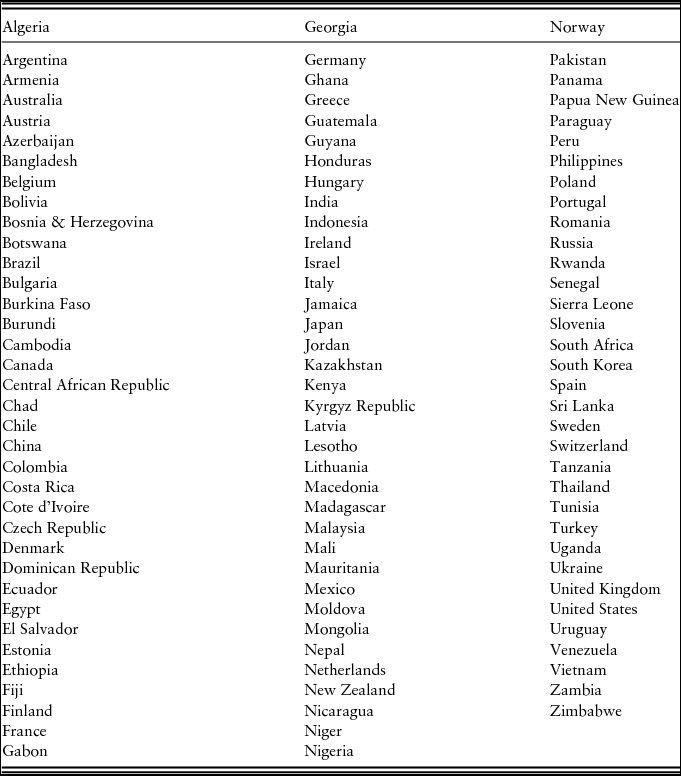
List of countries