Introduction
Stroke is a leading cause of mortality and long-term disability among adults in the United States. 1 To date, intravenous tissue plasminogen activator (tPA) remains the only Food and Drug Administration (FDA; Silver Spring, Maryland USA)-approved pharmacologic agent for the treatment of acute ischemic stroke.Reference Jauch, Saver and Adams 2 Due to the narrow time window for tPA administration, challenges in identifying ischemic stroke patients who are eligible to receive tPA and delayed presentation to the emergency department (ED), tPA is only administered to less than 15% of acute ischemic stroke patients in the United States.Reference Adeoye, Hornung, Khatri and Kleindorfer 3 – Reference Kwan, Hand and Sandercock 8
Approximately one-half of stroke patients use Emergency Medical Services (EMS) to enter the health care system, and this is associated with shorter times to physician evaluation, stroke team care, brain imaging, as well as a higher proportion of patients receiving tPA, shorter time-to-tPA administration, and improved patient outcomes.Reference Minnerup, Wersching, Unrath and Berger 9 – Reference Mosley, Nicol, Donnan, Patrick, Kerr and Dewey 21 Favorable outcomes following tPA treatment are strongly associated with earlier administration time.Reference Emberson, Lees and Lyden 22 Despite this, there may exist opportunities to further decrease the time from EMS contact to tPA administration by identifying prehospital barriers to care that may affect an EMS provider’s ability to identify, care for, and subsequently transport the acute stroke patient to an appropriate stroke center.
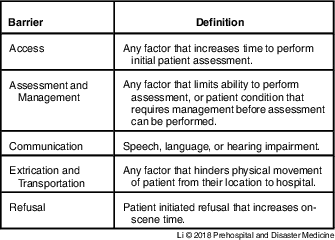
The process of EMS providers getting a patient from the scene to the ED may be complicated due to limited resources and the uncontrolled nature of the prehospital setting. Some EMS providers may encounter numerous barriers to providing care that may affect the quality of care they provide, and ultimately, patient outcomes. Some barriers to providing prehospital care may include: access (eg, EMS providers unable to open the door to a patient’s house and requiring the fire department to gain access to the patient); extrication and transportation (eg, patient being trapped in an enclosed space and EMS providers unable to remove the patient); communication (eg, patient unable to communicate in English); assessment and management (eg, patient having another problem that requires immediate evaluation or intervention); and refusal (eg, patient or family member initially refusing transport to the hospital).
The frequency and types of barriers to providing care to ischemic stroke patients encountered by EMS providers have been under-studied. By describing the types of barriers encountered by EMS providers, and quantifying the frequency of barriers to providing care, interventions to mitigate these barriers may be developed and implemented to aid in increasing the number of patients eligible for tPA administration. The objectives of this study were thus to (1) describe barriers to providing prehospital care to stroke patients, (2) identify predictors of these barriers, and (3) assess the impact of these barriers on EMS on-scene time and tPA administration.
Methods
Study Design
This was a retrospective cohort study of ischemic stroke patients arriving via EMS to the ED of one of two study hospitals from January 1, 2012 through May 31, 2016. The University of Rochester’s (Rochester, New York USA) Institutional Review Board approved the conduct of this study with a waiver of informed consent.
Study Setting and Population
Patients were identified using the American Heart Association’s (AHA’s; Dallas, Texas USA) Get With The Guidelines-Stroke (GWTG-S) registry at two hospitals (Strong Memorial Hospital and Highland Hospital) affiliated with the University of Rochester Medical Center in Rochester, New York. Strong Memorial Hospital is an 838-bed tertiary referral center, a Joint Commission (Oakbrook Terrace, Illinois USA)-certified Comprehensive Stroke Center, and a New York State-Designated Stroke Center. Highland Hospital is a 261-bed hospital and is also a New York State-Designated Stroke Center. Criteria to be a New York State-Designated Stroke Center include having an acute stroke team with 24/7 capabilities; providing stroke education to EMS providers, health care providers, patients, families, and the community; and participating in quality assurance activities and submitting data regarding performance measures. 23
The GWTG-S registry is a national, voluntary, quality-improvement program initiated by the AHA.Reference Schwamm, Fonarow and Reeves 24 Individual hospitals collect their own data using a standardized data collection form, and data from hospitals are submitted to the national GWTG-S registry. The data collection form collects a wealth of information, including: arrival and admission information, demographics, medical history, prior medications, diagnosis and evaluation, symptom timeline, thrombolytic and reperfusion therapies, brain imaging, in-hospital treatments and complications, as well as discharge information, diagnosis, and treatments. 25 – Reference Xian, Fonarow and Reeves 27 Both study hospitals use registered nurses who have received standardized training and follow a common data dictionary to abstract GWTG-S registry data.
The greater Rochester (Monroe County) area uses a tiered response EMS system, comprised of emergency medical technicians and paramedics. Twenty-five different ambulance services respond to more than 130,000 calls for service each year from a population of approximately 750,000 in rural, suburban, and urban areas. All calls to 911 are answered by a single public safety answering point and all EMS providers follow uniform protocols. As all four hospitals in the region are New York State-Designated Stroke Centers, regional prehospital care protocols dictate that EMS providers can transport suspected stroke patients to any hospital in the region. 28
Patients were included in this study if they had a discharge diagnosis of ischemic stroke, arrived via EMS from January 1, 2012 through May 31, 2016, and lived in Monroe County, New York. Patients were excluded if they were transported by EMS from another health care facility (such as urgent care centers, other EDs, primary care offices, or skilled nursing facilities) or had no prehospital medical record.
Study Protocol
Ischemic stroke patients were identified from the GWTG-S registries at the study hospitals and relevant variables were obtained from the registries, including: patient age, sex, race, ethnicity, date of arrival, whether tPA was administered, and time of tPA administration. Patients’ hospital electronic medical records were then accessed to manually abstract additional variables not captured by the GWTG-S registry, including marital status, living arrangement, and residential address. In Monroe County, all EMS medical records are scanned into the patient’s hospital electronic medical record. The EMS medical records were manually reviewed by a study investigator (TL) to abstract the following variables: dispatched level of EMS care, emergency medical dispatch code, address of the EMS response, prehospital times, chief complaint, prehospital assessments and interventions, as well as any documented extenuating circumstances or barriers to prehospital care. The majority of EMS agencies in this region use an electronic medical record system platform that includes a section with checkboxes for documenting extenuating circumstances or barriers to care. The EMS providers may also document barriers to care in the free-text narrative section of the EMS medical record. These sections were thoroughly reviewed to abstract information regarding barriers to prehospital care. Data from these three sources (GWTG-S registry, hospital medical record, and EMS medical record) were merged to create a master analytic dataset with both prehospital and ED information regarding stroke care.
Data Analysis
Two investigators (TL and JTC) independently reviewed each documented barrier to providing care and categorized them using the definitions shown in Table 1. These categories of barriers and definitions were developed based on prior prehospital care experience and knowledge. Discrepancies in the categorization of barriers were resolved through a consensus discussion. Although outcome variables of interest were available to investigators, the investigators categorized the barriers to providing care in a blinded fashion. A subject identification number was attached to each barrier, and each barrier was categorized independently by the two investigators without looking at the outcome variables, such as EMS on-scene time and tPA administration. After all barriers were categorized, the barriers were merged with the analytic dataset.
Definitions Used to Categorize Barriers to Care

Subjects were divided into one of two groups: (1) those without documented barriers to care, and (2) those who had one or more documented barrier(s) to care. Data were then quantitatively analyzed using SAS 9.4 (SAS Institute; Cary, North Carolina USA). Descriptive statistics, including frequencies and proportions, were used to describe the study sample and barriers. Age was categorized (<55, 55 to 69, 70 to 84, and ≥85 years) based on prior EMS literature,Reference Jones, Wasserman, Li and Shah 29 its distribution, and clinical relevance. A series of bi-variate analyses, using chi-square tests or Fisher’s exact tests, where appropriate, were used to examine differences between patients with and without barriers to care. Then, a backward elimination model building process was used to construct a multi-variable logistic regression model to identify predictors of barriers to care. All variables associated with the outcome variable (barriers to care) at the P<.20 level were entered into a logistic regression model. Variables were individually eliminated from the model, starting with the variable with the largest P value. Variables that were statistically significant at the P<.05 level were retained. The Hosmer-Lemeshow goodness-of-fit test was used to assess model fit. Lastly, to assess the impact of barriers on care, Wilcoxon rank sum and chi-square tests were used to assess differences in EMS on-scene time and proportion of patients receiving tPA in the ED according to whether EMS providers encountered barriers to care. The EMS on-scene time was defined as the interval from the time EMS arrived at the patient to the time EMS departed the scene. The EMS on-scene time was analyzed as both a continuous variable (in minutes) and a dichotomous variable (<15 minutes vs ≥15 minutes) according to the AHA’s recommendation for EMS on-scene time.Reference Jauch, Saver and Adams 2 A P value of <.05 was considered statistically significant.
Results
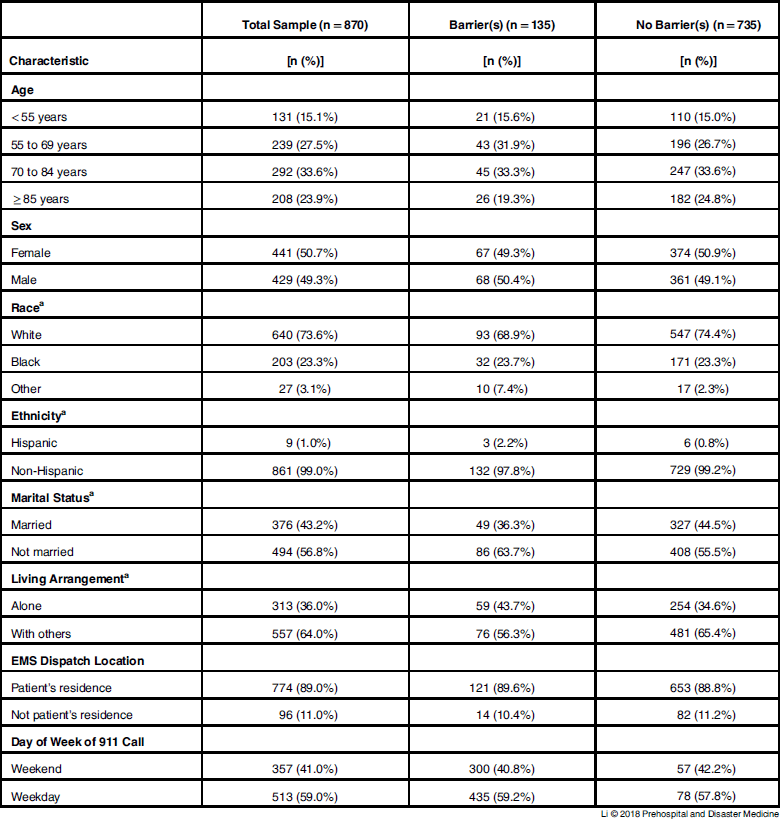
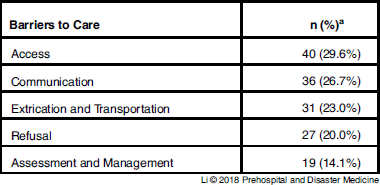
A total of 925 ischemic stroke patients met the inclusion criteria; however, 55 (5.9%) patients were excluded due to missing EMS medical records, resulting in a study sample of 870 subjects. Characteristics of the study sample are presented in Table 2. The majority of subjects were 70-84 years of age (33.6%), female (50.7%), and white (73.6%). The EMS providers documented at least one barrier to care for 15.5% of their patients (Table 3). The most common barriers were related to access (29.6%), communication (26.7%), and extrication/transportation (23.0%). Other barriers were related to refusal (20.0%) and assessment and management (14.1%).
Characteristics of the Study Sample

Note: Column percentages may not add up to 100% due to rounding.
Abbreviation: EMS, Emergency Medical Services
a Variable evaluated in multi-variable analysis.
Barriers to Care (n=135)

Note: Barriers to care are not mutually exclusive.
a Percentages are out of 135.
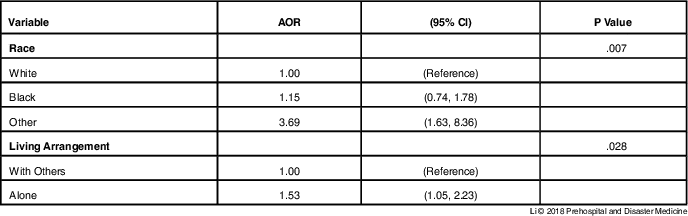
Race, ethnicity, marital status, and living arrangement were associated with barrier(s) to care in bi-variate analyses (Table 2), and subsequently, were evaluated in multi-variable analysis. Race and living arrangement were the only two significant predictors of barrier(s) to care in this multi-variable logistic regression model (Table 4). The Hosmer-Lemeshow goodness-of-fit test indicated good model fit (P value=.938). Compared with patients of white race, patients of other races (American Indian/Alaska Native, Asian, and Native Hawaiian or Pacific Islander) had 3.69 times the odds of having barrier(s) to care (95% CI, 1.63-8.36). Patients who lived alone, compared with patients who lived with others, had 1.53 times the odds of having barrier(s) to care (95% CI, 1.05-2.23).
Final Multi-Variable Logistic Regression Model: Significant Predictors of Barriers to Care (n=870)

Abbreviations: AOR, adjusted odds ratio; CI, confidence interval.
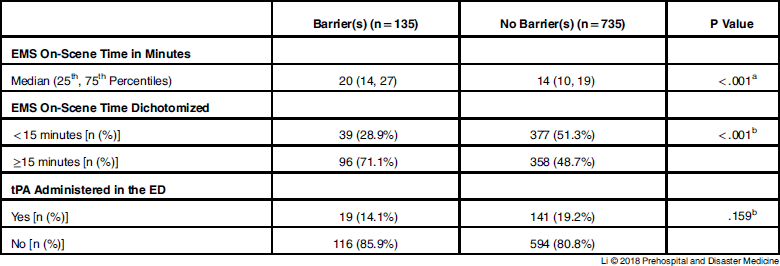
Median EMS on-scene time was 20 minutes among patients who had barrier(s) to care and 14 minutes among patients without (P<.001; Table 5). When EMS on-scene time was dichotomized into <15 minutes and ≥15 minutes according to the AHA’s recommendation, EMS on-scene time was <15 minutes among 29.6% of patients who had barrier(s) and 51.3% of patients without barrier(s) to care (P<.001). However, the proportion of patients who were administered tPA in the ED was not significantly different according to whether there were barrier(s) to prehospital care (14.1% among those with barrier(s) versus 19.2% among those without barrier(s); P=.159).
Impact of Barriers on EMS On-Scene Time and tPA Administration (n=870)

Abbreviations: ED, emergency department; EMS, Emergency Medical Services; tPA=tissue plasminogen activator.
a Wilcoxon rank sum test P value.
b Chi-square test P value.
Discussion
The narrow therapeutic window for tPA administration makes acute ischemic stroke a time-sensitive medical emergency. Each 15-minute decrease in time-to-treatment is associated with one additional month of disability-free life.Reference Meretoja, Keshtkaran and Saver 30 Therefore, rapid identification of stroke patients and transport to a stroke center is critical. This study described barriers to providing prehospital care among a cohort of ischemic stroke patients and found that the presence of one or more barriers increased EMS on-scene time, but this did not affect the proportion of patients receiving tPA.
Some EMS providers encountered barriers to providing stroke care for a sizable proportion of patients. Not surprisingly, EMS on-scene time was longer for patients with barriers to care. The identification of barriers to providing prehospital care may inform the development of mitigation strategies to decrease EMS on-scene time. For example, although widely utilized emergency medical dispatch protocols query the 911 caller to determine if access may be impeded by locked doors, this information may wish to be re-verified in the stroke population who may be unable to reach the door. As a result, additional resources (eg, the fire department) may be required as part of the initial dispatch so that forcible entry can be performed expeditiously. Interestingly, among the 40 patients in this study sample who presented with an access barrier, 62.5% lived alone.
Similarly, as would be expected in this cohort of ischemic stroke patients, patient extrication was often an impediment to timely care. Although this barrier is likely present across a wide variety of patients presenting with various complaints in the prehospital setting, the ischemic stroke patient likely has a motor deficit resulting in their limited ability to aid in extrication. Enabling rapid extrication from a residence is a core function of EMS, and it will be critical for EMS agencies to identify operationally appropriate and safe ways to remove patients with deficits in a timely fashion. Perhaps the fire department or additional EMS units (eg, a second ambulance or a fly car) could be mobilized during the initial dispatch to facilitate prompt extrication.
Communication barriers were frequent and warrant further investigation. All barriers in this study were identified through provider documentation in the EMS medical record rather than direct observation. Therefore, it is unclear whether these barriers were related to the provider’s challenge in assessing a patient with a communication deficit resulting from an acute stroke, or whether there are specific racial, ethnic, language, or cultural barriers that make communication difficult. Some patients spoke a language other than English, and EMS providers reported difficulties in communicating with these patients (eg, difficulty obtaining a chief complaint or history of present illness, and difficulty explaining assessments and interventions to patients). Based on these data, among the 135 patients who had a barrier to care, 10 patients were of other races (American Indian/Alaska Native, Asian, and Native Hawaiian or Pacific Islander), and EMS providers documented a communication barrier for all 10 of these patients. Communication barriers are common in health care and their negative impact on care has been well-established.Reference Cohen, Rivara, Marcuse, McPhillips and Davis 31 – Reference Hampers and McNulty 34 Although 911 dispatchers often have third-party telephonic interpretation services available to them, this resource is less available for EMS providers in the field.Reference Tate, Hodkinson, Meehan-Coussee and Cooperstein 35 Even among EMS agencies that subscribe to third-party telephonic interpretation services, EMS providers often encounter logistical issues, limitations of their equipment, and time delays in accessing an interpreter in the field.Reference Tate, Hodkinson, Meehan-Coussee and Cooperstein 35 Therefore, interventions to address communication barriers in the prehospital setting when EMS providers are providing care to patients may be needed, but further work is also necessary to determine best practices, particularly in patients who may have neglect, receptive, or expressive aphasia associated with their stroke.
Other less-common barriers to care were related to refusal or assessment and management. Some patients (and/or family members of patients) initially refused transport to the hospital, and EMS providers had to spend additional time on-scene to convince the patient (and/or their family members) to go to the hospital. In an era where informed consent and patient autonomy are important, spending the additional time on-scene to explain the situation, risks, and benefits of refusing transport to the patient/family members is imperative. Optimal methods of handling patient refusals among stroke patients remain to be determined but speak to the continued importance of community education on the signs, symptoms, and importance of rapid identification and treatment for patients having a stroke.
A small proportion of EMS providers documented barriers related to assessment and management, which often resulted from other patient conditions (eg, respiratory distress, unconsciousness, or traumatic injuries) that required immediate assessment and management before stroke-specific care could be provided. Barriers of this nature are difficult to predict and are unlikely to be disproportionately present in the ischemic stroke population compared with other medical illnesses.
More than one-half (51.3%) of patients without barriers to care had an EMS on-scene time of less than 15 minutes, while only 28.9% of patients with a barrier met the same performance goal. As there was not a statistically significant difference in the proportion of patients getting tPA, one could suggest that such a time difference is negligible. However, a 5.1% absolute difference in the proportion of patients receiving tPA could be argued to be clinically meaningful. Further, it is unclear whether the eligibility for tPA in each of the two groups was the same. As the number of patients with barriers receiving tPA was small, further work is needed to determine whether barriers to care identified in this study are also associated with decreased recognition of stroke and calling 911, and therefore, there is little effect of prolonged on-scene time among patients who were already outside of the eligibility window for tPA at the time that they call 911. Although not a specific objective of this study, data showed that among the 160 patients in the sample who received tPA, median time from symptom onset to tPA administration was 164 minutes (25th percentile, 75th percentile: 142, 177 minutes) among those who had barrier(s) to care and 113 minutes (25th percentile, 75th percentile: 91, 134 minutes) among those who did not have barriers to care (Wilcoxon rank sum test P<.001). There is a strong association between favorable clinical outcomes and shorter symptom onset-to-treatment times.Reference Emberson, Lees and Lyden 22 Therefore, any delays in the prehospital phase of care may result in a lower probability of neurologic improvement after tPA treatment. As efforts have been made to streamline the evaluation of acute stroke patients in the ED to shorten treatment times, similar work in the prehospital phase of care can likewise shorten symptom onset-to-treatment times.
Limitations
There are several limitations worthy of acknowledgement. First, the generalizability of these results is unknown because the study sample was drawn from ischemic stroke patients from two hospitals, under the same academic medical center, in a single EMS system. Due to the geography and demographics of patients who may have presented to other hospitals in the region, the types and frequency of barriers encountered by EMS providers may be different. Second, although each EMS medical record was reviewed in its entirety to identify barriers to providing care, it is possible for some EMS providers to have encountered barrier(s) to providing care, but they did not document them, resulting in an under-estimation of the extent of barriers to providing stroke care in this community. Third, 55 patients did not have EMS medical records available for review, and the barriers to care among these patients may vary in nature from barriers in the study sample. Fourth, as with many retrospective studies, the possibility of unmeasured confounders cannot be excluded. Lastly, findings of this study may not be applicable to other countries, where racial factors may have little influence on clinical care.
Conclusion
Barriers to providing prehospital care were documented in 15.5% of ischemic stroke patients. The majority of these barriers to providing care were related to patient access, communication, and extrication. Non-white race and living alone were predictive of having barriers to providing prehospital care. Although EMS on-scene time was longer for patients with barriers to care, the proportion of patients receiving tPA in the ED was not significantly different.