Most children acquire words with relative ease and at an astoundingly fast rate, although there are substantial individual differences. Infants typically demonstrate the first signs of comprehension at approximately age 0 ; 9, and begin to spontaneously produce words by the end of their first year (Fenson, Dale, Reznick, Bates, Thal & Pethick, Reference Fenson, Dale, Reznick, Bates, Thal and Pethick1994). By age 1 ; 5, children are learning about five words per week with this rate accelerating in subsequent years (Anglin, Reference Anglin1993; Fenson et al., Reference Fenson, Dale, Reznick, Bates, Thal and Pethick1994). By their sixth birthday, children's lexicons are comprised of approximately 10,000 words (Anglin, Reference Anglin1993).
Although a vast number of studies have explored different sources of input that may contribute to young children's word learning, most of the empirical research has focused on situations where participants are being directly addressed. Fewer studies have examined how children attend to and learn from overhearing third-party interactions (Akhtar, Jipson & Callanan, Reference Akhtar, Jipson and Callanan2001; Akhtar, Reference Akhtar2005; Floor & Akhtar, Reference Floor and Akhtar2006). As young children spend a significant portion of their daily lives in multi-speaker environments where much of the talk is not being directly addressed to them (Akhtar, Reference Akhtar, Hall and Waxman2004; Barton & Tomasello, Reference Barton and Tomasello1991; Bloom, Reference Bloom, Kuhn and Siegler1998; Dunn & Shatz, Reference Dunn and Shatz1989), overhearing contexts represent vital sources of input in children's early learning experiences and it is important to understand how and what children learn from them.
Several observational studies suggest that children from Western middle-class communities actively monitor third-party interactions. For instance, Dunn & Shatz (Reference Dunn and Shatz1989) conducted one-hour naturalistic observations of the interactions of second-born children with their mother and an older sibling across a period of one year (from age 2 ; 0 to 3 ; 0). Results indicated that the toddlers tended to ‘intrude’ in the conversations of their mother and sibling by including information that was both new and relevant to the ongoing conversation. Similarly, Barton & Tomasello (Reference Barton and Tomasello1991) reported that children as young as age 1 ; 7 successfully engaged in triadic interactions and conversations by joining ongoing conversations between their mothers and older siblings. Additionally, Oshima-Takane, Goodz & Derevensky (Reference Oshima-Takane, Goodz and Derevensky1996) found that significantly more second-born children than first-borns correctly produced first person pronouns at age 1 ; 9, and second person pronouns at age 2 ; 0. These researchers propose that second-born children acquired personal pronouns earlier than first-borns because they benefited from overhearing conversations between their parents and older siblings (Oshima-Takane, Reference Oshima-Takane1988; Oshima-Takane et al., Reference Oshima-Takane, Goodz and Derevensky1996).
The aforementioned studies suggest that toddlers monitor third-party conversations. A series of recent experiments has systematically examined children's ability to learn new words from the interactions of others. Akhtar et al. (Reference Akhtar, Jipson and Callanan2001) found that toddlers as young as age 2 ; 0 were able to learn novel object labels equally well when they observed a third-party interaction as when they were directly addressed. In addition, Akhtar (Reference Akhtar2005) found that two-year-old children were able to learn a novel object label through overhearing when they were distracted by an attractive toy as well as when they did not have something to distract them from the overheard conversation. Further, analyses examining children's attention patterns indicated that they were more likely to shift their gaze from the distracter toy toward the experimenter when she uttered a novel label (e.g. ‘I'm gonna show you the toma.’) than when she said a neutral phrase (e.g. ‘I'll show you this one.’). These results demonstrate that young children attend to and learn new information through overhearing even when they are involved in another unrelated engaging activity (i.e. playing with a toy).
Given the amount and variety of information children are likely exposed to in third-party interactions, they must be capable of filtering the information in terms of its importance and relevance. The goal of the present studies was to assess this filtering capacity by investigating which elements (i.e. novel versus neutral information and labels versus facts) toddlers are more likely to monitor and learn as they overhear a third-party conversation. Specifically, the current studies examine what type of information toddlers are more likely to (a) attend to and (b) learn as they overhear a third-party conversation while concurrently involved in an engaging activity.
In particular, both studies assess whether children at this age are especially attuned to novel conventional information. The hypothesis is that children should be more likely to attend to and learn conventional information – i.e. information that is shared by a community of people – than information that is idiosyncratic – i.e. information that pertains to a single individual. In order to address this hypothesis, the main contrast in the present studies was between the learning of novel object labels versus novel idiosyncratic facts about objects. This contrast was selected because whereas preschoolers are equally capable of learning novel labels and facts about objects in direct interactions (Markson & Bloom, Reference Markson and Bloom1997), they seem to treat only the former as conventional knowledge (Diesendruck & Markson, Reference Diesendruck and Markson2001). The present studies thus assessed toddlers' tendency to attend to and learn novel labels and facts through overhearing.
Study 1
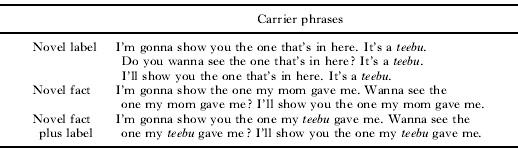
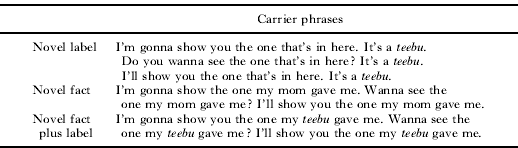
Study 1 examined what elements (i.e. novel versus neutral information; and labels versus facts versus facts containing novel labels) children chose to monitor and which they were more likely to learn. Since previous findings suggest that toddlers can learn novel labels through overhearing (Akhtar et al., Reference Akhtar, Jipson and Callanan2001; Akhtar, Reference Akhtar2005; Floor & Akhtar, Reference Floor and Akhtar2006), the current study examined if the results would vary if a longer utterance (with length in time equivalent to the one used for the other carrier phrases) was used to introduce the novel label (‘I'm gonna show you the one that's in here. It's a teebu.’). In addition, the present study included a novel fact condition (‘I'm gonna show you the one my mom gave me.’). Finally, the third condition presented a novel fact containing a novel label (‘I'm gonna show you the one my teebu gave me.’) to examine if children would be more likely to learn a new fact if it included a novel word (i.e. teebu) instead of a high-frequency word (i.e. mom).
Consistent with previous findings (Akhtar, Reference Akhtar2005; Akhtar et al., Reference Akhtar, Jipson and Callanan2001; Floor & Akhtar, Reference Floor and Akhtar2006), it was hypothesized that children would be more likely to look toward the experimenter when she presented new information (i.e. novel label, novel fact, and novel label plus fact) than when she uttered neutral information (neutral utterances). In addition, it was predicted that children would learn the new information.
Method
Participants
Seventy-two toddlers ranging between ages 2 ; 0 and 2 ; 6 (M=2 ; 3) participated, with equal numbers of females and males in each condition. Most of the children were from middle- to high-income families and all but two lived with both parents. The majority of the mothers (n=62) and fathers (n=54) reported at least an undergraduate degree. The majority of the children were of European-American descent (n=56), eight were Hispanic, one was African American and seven were Asian. Thirteen additional children participated but were excluded because a parent guided the child's attention (two children), the child did not engage at all with the distracter toy (one child), the child interrupted the training phase by trying to open the buckets (four children), the child failed to respond in the comprehension test (one child), or due to equipment failure (one child), or experimenter error (four children). Participants were identified from a database of families who had expressed interest in being included in studies of child development. Each child received a small gift for their participation.
Materials
The familiar objects consisted of a set of four toys that children were likely to know the names of (i.e. a ball, a doll, a cup and a spoon). A replacement set of four toys (i.e. a bear, a cat, an apple and a comb) was available as substitutes when parents reported that their children did not know a word for a given object. The familiar objects were used to familiarize the children with the procedures for the training phase and comprehension trial (see ‘Procedure’). The novel objects consisted of four objects that the children were not likely to recognize or have a name for: a wooden square made of colouful and movable wooden cylinders, rings and spheres; a colorful plastic object made of two spheres joined by a cylinder that could be manipulated into different positions and shapes; a colorful and odd-shaped rattle; and a colorful plastic rattle shaped like a spiky sphere that could be turned around at its middle section. A separate set of four novel objects (i.e. a round object made of colorful rubber loops; a colorful wooden noise-maker; a colorful object made of plastic links that could be moved around into different shapes; a colorful set of small wooden rectangles joined by an elastic band) was available as substitutes when parents reported that their children were familiar with or had a name for any of the novel objects (see ‘Procedure’).
A hiding apparatus consisting of four opaque buckets covered with lids and mounted in a row on a wooden plank was used to introduce all of the objects, one by one. When lids were placed on the buckets, the toys inside were not visible. The distracter toy consisted of a row of four dinosaur eggs that could be opened by pressing and turning different knobs to reveal colorful baby dinosaurs inside the eggs.
Parents completed a basic demographic form and the short form version (Level II, Form A) of the MacArthur-Bates Communicative Development Inventory (M-BCDI; Fenson, Pethick, Renda, Cox, Dale & Reznick, Reference Fenson, Pethick, Renda, Cox, Dale and Reznick2000). The children sat at a small round table, which was positioned approximately three feet away from the experimenters. From this position, participants were able to view the experimenter, confederate and the hiding apparatus only by turning to the right. An 8-mm video camera behind a one-way mirror was used to record the experimental sessions and it was primarily aimed at the child's face.
Design
The study involved a between-subjects design with participants randomly assigned to one of three conditions: novel label (‘the teebu that's in here’), novel fact (‘the one my mom gave me’), novel fact plus label (‘the one my teebu gave me’). All participants were exposed to the same procedure, except during the training phase, when the carrier phrase corresponding to their assigned condition was used to introduce the target object (see Table 1), and at the end, when they were asked a comprehension question for their assigned condition (e.g. for the novel fact plus label condition, ‘Which one is the one my teebu gave me?’). All participants were asked a preference question (e.g. ‘Which one is your favorite one?’) and the order of the comprehension and preference questions was counterbalanced across children within each condition. Novel objects were always presented in the same order, but presentation of the information associated with them was counterbalanced so that each object was assigned each type of information the same number of times. Since objects were extracted in the same order, the order of utterances was the same in the three rounds for any given participant. Two female experimenters conducted the sessions.
Carrier phrases used in Study 1
Procedure
One female experimenter and one female confederate conducted the sessions in a laboratory playroom. A hidden observer behind a one-way mirror videotaped all sessions and kept a written record of the toy(s) chosen by the children on the comprehension and preference trials. Each child participated individually in a single session that lasted up to 30 minutes.
Before starting, parents were asked whether their child owned the same or similar toys to those used as novel objects. If a parent responded yes, the given toy(s) were substituted with others from the replacement set. In these cases (n=7 in Study 1; n=9 in Study 2), participants were assigned to conditions in which one of the original four novel objects served as the target. In addition, parents were asked to determine whether their child knew a name for each of the familiar toys. If a parent indicated that the child did not know a name for one or more familiar objects, these were exchanged with others from the replacement set for which the parents reported that the child did know a name.
Parents were instructed not to interact with their child throughout the session and to respond minimally, with gestures and short utterances, if the child insisted on getting their attention. Parents were asked not to encourage or guide their child's attention to anything in particular. They were also asked not to look at the experimenter and confederate, but to instead continue filling out the forms throughout the session. During the session, parents sat on a sofa in the playroom, where they completed the basic information form and the vocabulary form.
Familiarization phase
At the beginning of each session, the experimenter presented to the child the four familiar objects by pulling them out of the hiding apparatus, one by one. Before presenting each object, the experimenter produced a neutral phrase (e.g. ‘I'm gonna show you what's in here.’). Each familiar object was returned to its bucket before presenting the next one. The purpose of this phase was to familiarize children with the training phase procedure.
Familiar items comprehension test
Following the familiarization phase, the confederate quickly removed the hiding apparatus from the child's sight. Then the experimenter placed the four familiar toys on the tray and asked the children to show or hand her one object at a time (e.g. ‘Can you show me the doll?’). Each object was replaced before proceeding to the next trial. The purpose of this task was to elicit giving and showing responses. After the child had correctly chosen at least three objects consecutively, the experimenter proceeded with the pre-exposure to the novel objects.
Pre-exposure to the novel objects
The experimenter presented the four novel items, by pulling them out of the hiding apparatus, one at a time. Before presenting each object, the experimenter uttered a neutral phrase (e.g. ‘I'm gonna show you what's in here.’). Each novel object was returned to its bucket before presenting the next object. The purpose of this phase was to familiarize children with the novel objects.
Transition phase
The experimenter invited the child to sit at the table and demonstrated actions by pressing or turning the knobs on the distracter toy to open the eggs and reveal dinosaurs of different colors. When the child seemed engaged with this toy, the experimenter told them she would play with the confederate for a while. The chair where the child sat was positioned so that they could only view the experimenter, confederate and the hiding apparatus by turning their head 90 degrees to the right.
Training phase
The experimenter and the confederate did not establish eye contact or interact with the child throughout the training rounds. Once the child began playing with the distracter toy, the experimenter and confederate proceeded through three training rounds. Each round consisted of the experimenter finding and showing each of the four novel objects, one at a time. Each object was always found in the same location and in the same order on each round.
Before each hidden object was extracted, the experimenter produced a series of three utterances. For the three non-target novel objects, these utterances had neutral content (i.e. ‘I'm going to show you the one that's in here. Do you want to see the one that's in here? I'm gonna show you the one in here.’). For the target novel object, the utterances varied according to the child's condition. Table 1 contains the carrier phrases (i.e. utterances) with which the experimenter introduced the novel target objects in each condition (i.e. novel label, novel fact, and novel fact plus label).
After producing the three utterances for a given object, the experimenter opened the relevant bucket, removed and held up the novel object found inside, smiled and gasped, and then handed the toy to the confederate. The confederate performed an action on or with the toy (for approximately 3 seconds) and then returned it to the experimenter. The experimenter placed each novel object back in its bucket before pulling out another novel object. All carrier phrases were introduced before the object became visible.
Comprehension and preference control trials
After completing the training phase, the experimenter invited the child to play with the novel objects, placing all of them on the floor. After the child had manipulated the objects for about one minute, they were placed in random positions on a tray. The child was then asked a comprehension and a preference question. The order of the comprehension and preference trials was counterbalanced, with the experimenter distracting the children for about 30 seconds between each trial (e.g. by commenting on their clothing or something in the room, or by playing with the distracter toy).
On the preference control trial, children were asked to show or give to the experimenter ‘the one you like best’ or ‘your favorite one’. For the comprehension trial, children assigned to the novel label condition were asked, ‘Can you show me the teebu?’ Participants assigned to the novel fact condition were asked, ‘Can you show me the one my mom gave me?’ Children assigned to the novel fact plus label condition were asked, ‘Can you show me the one my teebu gave me?’ To ensure that the experimenter did not inadvertently cue the children, she established eye contact before each request and did not look at the objects. If a child did not respond, the question was repeated until s/he chose a toy. On average the question was asked two times (M=1·93, SD=1·07).
Coding and reliability for comprehension and preference trials
The on-line observer noted which object the children chose on the comprehension and preference trials. An independent coder blind to the hypotheses reviewed all of the videotaped sessions to record which object the children had chosen for each trial and agreed with the on-line observer on 100% of the trials.
Attention coding
Each of the three training rounds consisted of four segments during which the experimenter talked about each of the upcoming objects (using three neutral utterances for each of the three non-target objects and three utterances containing novel information about the target object, identified with video and audio output, for a total of 12 segments. After identifying the segments, each participant's attention during each segment was coded by advancing the video images frame by frame with the audio turned off. Coders (blind to the language models being presented) categorized participants' attention (as indexed by the direction of their gaze) within each segment into one or more of the following categories: attending to the experimenters (E), the distracter toy (D), the parent (P) or to something else (Other). The coding categories were not mutually exclusive since the segments ranged from 3 to 4 seconds in length and the child could have alternated his/her gaze between more than one thing during any given segment. For instance, within a single segment, a child could have initially directed his/her gaze to the distracter toy while actively manipulating it (D), then turned to look at his/her parent (P), and then turned to look at the experimenters (E). In this case, the given segment would have been coded as attending to D, P and E. Given that the coding categories were not mutually exclusive, when categories overlapped, credit was given to each one of the categories that applied. Percentage of segments attending to D, P or E was calculated by counting the number of segments in which these categories were coded, and dividing the sum by twelve. For attention during the presentation of the novel information, attending to D, P or E was calculated by counting the number of segments in which these categories were coded, and dividing the sum by three. For attention during the presentation of neutral information, attending to D, P or E was calculated by counting the number of segments in which these categories were coded, and dividing the sum by nine.
A second level of coding identified shifts of attention during the twelve training segments by advancing the images frame by frame with the audio turned off. Shifts to attend to the experimenters were coded when the participants switched attention from the distracter toy, their parent, or something else to look at the experimenters for at least 1 second. After completing both levels of coding, coders went back (with audio) and identified which segments contained novel (target) information and which were neutral models (non-targets) and then coded the shifts of attention into one of two mutually exclusive categories: shifts to target and shifts to non-target. The attention patterns of the entire sample were coded by three independent coders, two of whom agreed on 97% of the coding decisions (range=83–100%). Discrepancies were resolved through discussion while reviewing the videotapes.
Results and discussion
Expressive vocabulary
The mean scores for the reported number of different words produced by the children in the three conditions did not differ from each other (F(2,69)=0·27, p=0·77, ηp2=0·01). There were no gender differences in the mean scores for the reported expressive vocabulary in the novel label (t(22)=−0·21, p=0·84), novel fact (t(22)=−0·685, p=0·50), or fact plus label (t(22)=0·234, p=0·82) conditions.
Preference and comprehension data
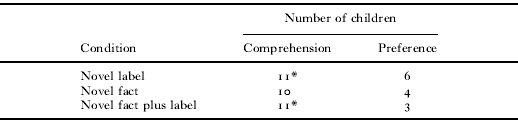
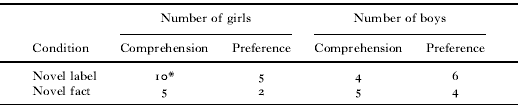
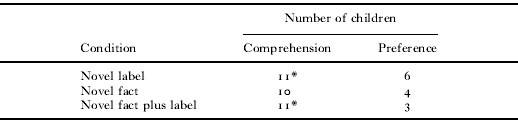
Binomial tests (with chance probability=0·25) were conducted to test whether the choice of the target object was significantly different from chance (p<0·05). To obtain above-chance performance, the binomial test required at least 11 out of 24 children in each condition to choose the correct object. Table 2 displays the number of children in each condition (fact, fact plus label, and label) who chose the correct object in response to the comprehension and preference questions. The number of children who chose the correct object during the comprehension trial was above chance in the label and the fact plus label conditions (p=0·02), but not in the novel fact condition. The number of children who chose the target in response to the preference question was at chance in all three conditions. Comprehension did not differ significantly between conditions (χ2(2, N=72)=0·11, p=0·95), and neither did preference p=0·52 (Fisher's exact probability test). Combined results are presented for girls and boys given that there were no gender differences in learning.
Number of participants (out of 24) in each condition who chose the target object on the comprehension and preference trials in Study 1
* p<0·05 (binomial test).
It is important to take into account that some children chose the target object on both the comprehension and preference trials. Four children in the label condition, three in the fact condition and one in the fact plus label condition chose the target object on both the comprehension and preference trials. Sign tests taking into account all possible score combinations (ties, chose target during preference trial but not comprehension trial, chose target during comprehension trial but not preference trial) indicated that a significantly higher number of children chose the target object during the comprehension trial than in the preference trial only in the fact plus label condition (p=0·04). Given the sign test results, it is possible that children in the novel label condition chose the target object because they preferred it and not necessarily because they learned the label. It is also possible that participants preferred the target object because it was presented with a novel label.
Overall, these results suggest that children learned the novel label and the novel fact plus label, but not the novel fact. The present findings suggest that toddlers may attend to novel labels they overhear (see ‘Attention analyses’ below) and can learn both novel labels and facts containing novel labels from overheard conversations.
Attention analyses
One of the goals of Study 1 was to examine what type of information (i.e. novel label, novel fact, and novel fact plus label) participants were more likely to attend to as they monitored the third-party conversation while concurrently engaged with the distracter toy. Therefore, it is important to assess (a) the extent to which the children were engaged with the distracter toy throughout the training phase, as well as (b) the type of information that the children chose to attend to.
The extent to which the children engaged with the distracter toy was assessed by: (a) comparing the mean percentage of segments attending to the distracter toy to the mean percentage of segments attending to the experimenters; and (b) comparing the mean percentage of segments attending to the distracter toy to an expected mean of zero (one-sample t-test) to determine if they were reliably engaged with the distracter toy.
Collapsed over conditions, participants spent a significantly greater percentage of the segments attending to the experimenters (M=77·08, SD=23·64) than to the distracter toy (M=56·71, SD=27·04); (t(71)=3·81, p<0·001). Although the participants' overall attention to the experimenters was significantly higher than their overall attention to the distracter toy, a one-sample t-test comparing the mean percentage of segments attending to the distracter toy to a hypothesized mean of zero produced significant results (t(71)=17·80, p<0·001), suggesting that participants were also reliably engaged with the distracter toy. There were no condition differences in attention to the experimenter during the presentation of all objects (F(2,69)=1·04, p=0·36, ηp2=0·03), or in attention to the experimenter during the presentation of the target objects (F(2,69)=0·85, p=0·43, ηp2=0·02).
A second purpose of the attention analyses was to examine the type of information that the children chose to attend to. In order to determine if children were more likely to spend a greater percentage of segments attending to the experimenter when presenting the target object than when presenting the non-targets, the mean percentage of segments attending to the target was compared to the mean percentage of segments attending to the non-targets. A mixed ANOVA: object type (2) ¥ condition (3) revealed only a significant main effect of object type (F(1,69)=12·26, p<0·001, ηp2=0·15), indicating that across conditions, participants spent a significantly greater percentage of segments attending to the experimenter during the presentation of the target object (M=84·30, SD=27·96) than during the presentation of the non-target objects (M=74·69, SD=24·83).
Another goal of the attention coding was to examine shifts of attention to the experimenters. In order to determine whether children were more likely to shift their attention to the experimenters when presenting the target object than when presenting the non-targets, the mean frequency of shifts to attend to the target was compared to the mean frequency of shifts to attend to the non-targets divided by three (since there were three non-target objects). A mixed ANOVA: object type (2) ¥ condition (3) revealed only a significant main effect of object type (F(1,69)=18·22, p<0·001, ηp2=0·21), indicating that across all conditions children were more likely to shift attention to the target object (M=1·35, SD=1·14) than to any of the non-targets (M=0·78, SD=0·52).
Finally, across conditions, there was a significant positive correlation between comprehension and attention to the experimenters during the presentation of the target objects (r(72)=0·27, p=0·02). Conversely, attention to the distracter toy during the presentation of the target objects was inversely correlated with comprehension performance (r(72)=−0·25, p=0·04). That is, children who attended more to the experimenter (and less to the distracter toy) during the presentation of the target object were more likely to choose the target object in response to the comprehension question.
Overall, the attention results are consistent with previous findings (Akhtar, Reference Akhtar2005). Although participants attended more to the experimenters than to the distracter toy, they were also reliably engaged with the distracter toy. In addition, children attended more to the experimenter during the presentation of the target object – i.e. when they heard carrier phrases with new information – than during the presentation of the non-target objects – i.e. when they heard neutral phrases – and they were more likely to shift their attention to the experimenters when the latter were talking about the target object than when they were talking about the non-targets.
It is noteworthy that there were no differences either in the total amount of attention or in shifts of attention as a function of the type of novel information overheard. That is, children attended equally to the target object whether the experimenter pronounced a novel label, a novel fact, or a novel fact plus label in reference to it. One possible explanation for this null finding is that, as in previous studies (Akhtar et al., Reference Akhtar, Jipson and Callanan2001; Akhtar, Reference Akhtar2005), three of the four novel objects were presented with neutral phrases, whereas only one of the novel objects was introduced with a novel piece of information. Therefore, it is possible that the children attended to the novel piece of information more because it was said less frequently and therefore was more salient than the neutral phrases. Hence, an arguably more sensitive context in which to assess children's differential weighting of novel information is a situation where different things are being said about each of the novel objects. Study 2 provides such a context by using different phrases for each of the novel objects.
Study 2
Study 2 examined what elements (i.e. novel versus neutral information; labels versus facts) children chose to monitor and which (labels or facts) they were more likely to learn, in a situation where they were exposed to all these different types of information. Half of the participants were randomly assigned to a novel label condition, and the other half to a novel fact condition. The only difference between these two conditions was in terms of the comprehension question children were asked at the end of the procedure. In the novel label condition, the experimenter asked children, ‘Which one is the teebu?’ and in the novel fact condition, the experimenter asked children, ‘Which one did my mom give me?’
On the basis of previous findings, it was hypothesized that children would be more likely to attend to the third-party interaction when new information (i.e. novel label and novel fact) was presented than when neutral information (neutral label and neutral phrase) was presented. It was also predicted that children would more reliably learn a novel label than a novel fact.
Method
Participants
Forty-eight toddlers ranging between 2 ; 0 and 2 ; 6 months of age (M=2 ; 3) participated in the study, with equal numbers of females and males in the two conditions. Most of the children were from middle- to high-income families and all but one lived with both parents. The majority of the mothers (n=37) and fathers (n=31) reported at least an undergraduate degree. The majority of the children were of European-American descent (n=38), six were Hispanic, one was African American, one was Asian, and two did not report ethnicity. Seven additional children participated but were excluded because a parent guided the child's attention (one child), the child did not engage at all with the distracter toy (two children), the child interrupted the training phase by trying to open the buckets (two children), or due to experimenter error (two children). All participants were identified from the same database as in Study 1. Each child received a small gift for participating.
Materials
The materials were the same as those used in Study 1.
Design
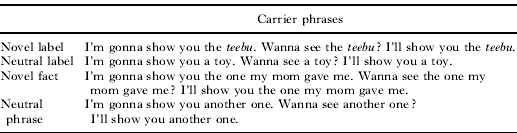
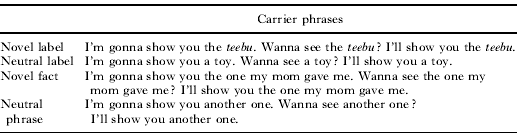
Each child heard a different phrase for each novel object (see Table 3). Thus, all children were exposed to the same carrier phrases, but during the test phase, half of them were asked a comprehension question about the novel label and half were asked a comprehension question about the novel fact. As in Study 1, all children were also asked a preference question (e.g. ‘Which one do you like best?’) and the order of the comprehension and preference questions was counterbalanced across children in each condition. Novel objects were always presented in the same order, but presentation of the information associated with them (i.e. novel label, novel fact, neutral label, and neutral phrase) was counterbalanced so that each object was assigned each type of information the same number of times. As in Study 1, objects were extracted in the same order, so the order of utterances was the same in the three rounds for any given participant.
Carrier phrases used in Study 2
Procedure
Study 2 followed the same procedure as Study 1, except for the utterances used as carrier phrases to introduce the novel objects during the training phrase and the questions asked during the comprehension trial. Table 3 contains the utterances that preceded the presentation of the novel objects (i.e. novel label, novel fact, neutral label, neutral phrase).
On the preference control trial, the children were asked to show or give to the experimenter ‘the one you like best’ or ‘your favorite one’. To assess comprehension, children assigned to the novel fact condition were asked, ‘Can you show me the one my mom gave me?’ Children assigned to the novel label condition were asked, ‘Can you show me the teebu?’ On average the question was asked two times (M=1·96, SD=0·77).
Coding and reliability for comprehension and preference trials
Study 2 followed the same coding and reliability procedures described in Study 1 for the comprehension and preference trials. The on-line observer and the blind coder agreed on 100% of the comprehension and preference trials.
Attention coding
Each of the three training rounds consisted of four segments (i.e. presentation of novel label, novel fact, neutral label, and neutral phrase) for a total of twelve segments, which were identified with video and audio output. The attention coding and reliability procedures were the same as in Study 1. The attention patterns of the entire sample were coded by three independent coders, two of whom agreed on 98% of the coding decisions (range=83–100%). Discrepancies were resolved through discussion while reviewing the videotapes.
Results and discussion
Expressive vocabulary
The mean scores for the reported expressive vocabulary of the children in the novel label and novel fact conditions did not differ from each other (t(46)=−1·772, p=0·08). There were no gender differences in the mean scores for the reported expressive vocabulary in the novel label (t(22)=1·293, p=0·21) or the novel fact (t(22)=1·612, p=0·12) condition.
Preference and comprehension data
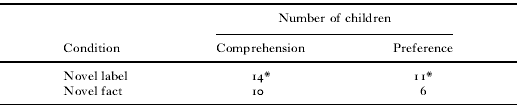
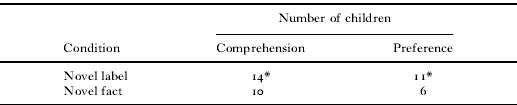
Binomial tests (with chance probability=0·25) were conducted to test whether the choice of the target object was significantly different from chance (p<0·05). To obtain above-chance performance, the binomial test required that at least eleven out of twenty-four children in a condition had to choose the correct object. Table 4 displays the number of children in each condition (label and fact) who chose the correct object in response to the comprehension and preference questions. The number of toddlers who chose the correct object during the comprehension trial was above chance in the label condition (p<0·01), but not in the fact condition. The number of children who chose the correct object in response to the preference question was above chance in the label condition (p=0·02), but not in the fact condition. Comprehension did not differ significantly between conditions (χ2(1, N=48)=1·33, p=0·25), and neither did preference (χ2(1, N=48)=2·28, p=0·13). However, comprehension differed significantly between boys and girls within the label condition (χ2(1, N=48)=6·17, p=0·01), but not within the fact condition (χ2(1, N=48)=0·00, p=1).
Number of participants (out of 24) in each condition who chose the target object on the comprehension and preference trials in Study 2
* p<0·05 (binomial test).
Five children in the label condition chose the target object during both the comprehension and preference trials, while none of the children in the fact condition did so. Sign tests taking into account all possible score combinations (ties, chose target during preference trial but not comprehension trial, chose target during comprehension trial but not preference trial) indicated that the patterns were not different from chance in either condition. Thus, these more stringent tests indicated no learning in either condition. As in Study 1, however, we cannot determine, based on these findings, the directionality of this relationship.
Given that there were gender differences in learning, results were analyzed separately for boys and girls. To obtain above-chance performance (p<0·05), the binomial test required that at least seven out of twelve boys or girls in each condition had to choose the target object. Table 5 displays the number of boys and girls in each condition (i.e. label and fact) who chose the correct object in response to the comprehension and preference questions. The number of girls who chose the correct object during the comprehension trials was above chance only in the label condition (p=0·01); the number of girls who chose the target in response to the preference question was at chance in both conditions. Girls' comprehension of the novel label was significantly higher than comprehension of the novel fact (p=0·03) (Fisher's exact probability test). The boys demonstrated chance performance on comprehension and preference in both conditions. Boys performed equally in the label and fact conditions (p>0·05) (Fisher's exact probability test).
Number of girls and boys (out of 12) in each condition who chose the target object on the comprehension and preference trials in Study 2
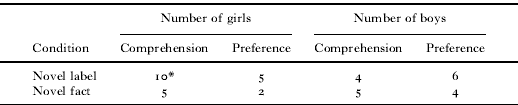
* p<0·05 (binomial test).
Four girls and one boy in the label condition chose the target object in both the comprehension and preference trials, while none of them did so in the fact condition. Sign tests taking into account all possible score combinations indicated that the number of girls and boys choosing the target object in response to the comprehension question was at chance in both conditions. As in Study 1, the sign test results raise the possibility that children in the novel label condition chose the target object because they preferred it and not necessarily because they learned the label. It is also possible that participants preferred the target object because it was presented with a novel label.
Overall, results suggest that girls learned the novel label but not the novel fact, while boys did not learn either. As in Study 1, the comprehension data indicate that young children are somewhat better at learning novel labels than novel facts in an overhearing context.
Attention analyses
One of the objectives of Study 2 was to assess what type of information (i.e. novel versus neutral information; labels versus facts) participants were more likely to attend to as they monitored the third-party conversation while concurrently engaged with a distracter. Since the comprehension analyses indicated gender differences in learning, the attention analyses are presented separately for boys and girls, as well as collapsed across gender.
As in Study 1, the extent to which the children engaged with the distracter toy was assessed by: (a) comparing the mean percentage of segments attending to the distracter toy to the mean percentage of segments attending to the experimenters; and (b) comparing the overall percentage of segments attending to the distracter toy to an expected mean of zero (one-sample t-test) to determine if they were reliably engaged with the distracter toy.
Collapsed over conditions, participants spent a significantly larger percentage of the segments attending to the experimenters (M=79·34, SD=20·4) than to the distracter toy (M=47·05, SD=25·9); (t(47)=5·20, p<0·01). This was true for girls (M=76·04, SD=23·9) (t(23)=2·51, p=0·02) and boys (M=82·64, SD=16·1) (t(23)=5·32, p<0·01). However, one-sample t-tests showed that the mean percentage of segments attending to the distracter toy was significantly different from zero for all participants (t(47)=12·6, p<0·01) (M=47·05, SD=25·9). Similar results were obtained for girls (M=51·4, SD=26·9) (t(23)=9·37, p<0·01) and boys (M=42·7, SD=24·6) (t(23)=8·50, p<0·01), suggesting that both boys and girls reliably engaged with the distracter toy.
A second purpose of the attention analyses was to examine the type of information that the children chose to attend to. This goal was accomplished by examining: (a) the mean percentage of segments attending to the experimenter versus the distracter toy during the presentation of the novel label, novel fact, neutral label, and neutral phrase; and (b) the mean frequency of shifts away from the distracter toy, parent, or something else to attend to the experimenter during the presentation of the novel label, novel fact, neutral label, and neutral phrase.
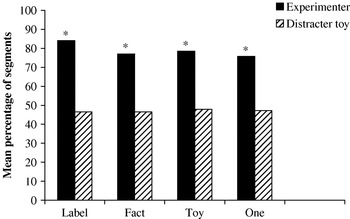
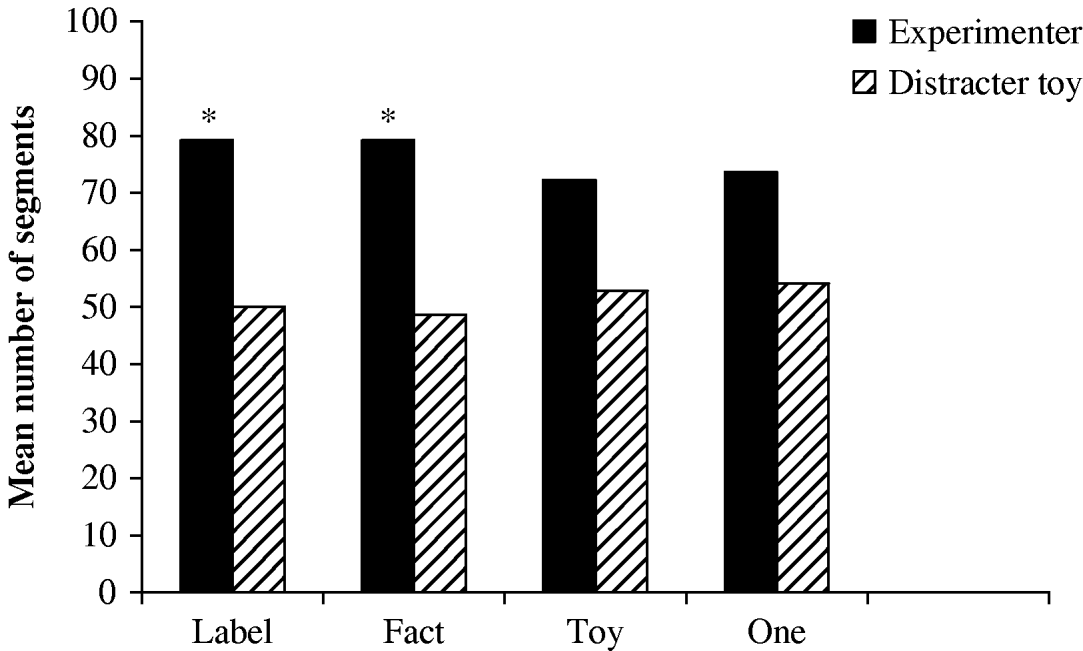
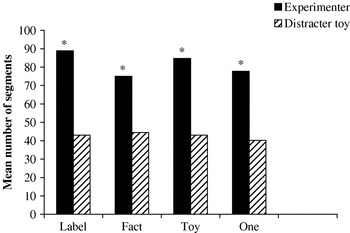
The mean percentage of segments attending to the experimenter versus the distracter toy during the presentation of the novel label, novel fact, neutral label, and neutral phrase is depicted in Figures 1 (for all participants), 2 (for girls) and 3 (for boys). Overall, participants paid reliably more attention to the experimenters during the presentation of the novel label (M=84·03, SD=24·78) than during the presentation of the novel fact (M=77·08, SD=26·77); (t(47)=2·02, p=0·05). Girls paid equal attention to the experimenter during the presentation of the novel label (M=79·17, SD=29·18) and the novel fact (M=79·17, SD=25·66); (t<1). Boys paid significantly more attention to the experimenters during the presentation of the novel label (M=88·89, SD=18·82) than during the presentation of the novel fact (M=75·00, SD=28·23); (t(23)=2·63, p=0·02).
Mean percentage of segments attending to the experimenter versus the distracter toy in Study 2.

Girls: Mean percentage of segments attending to the experimenter versus the distracter toy in Study 2.
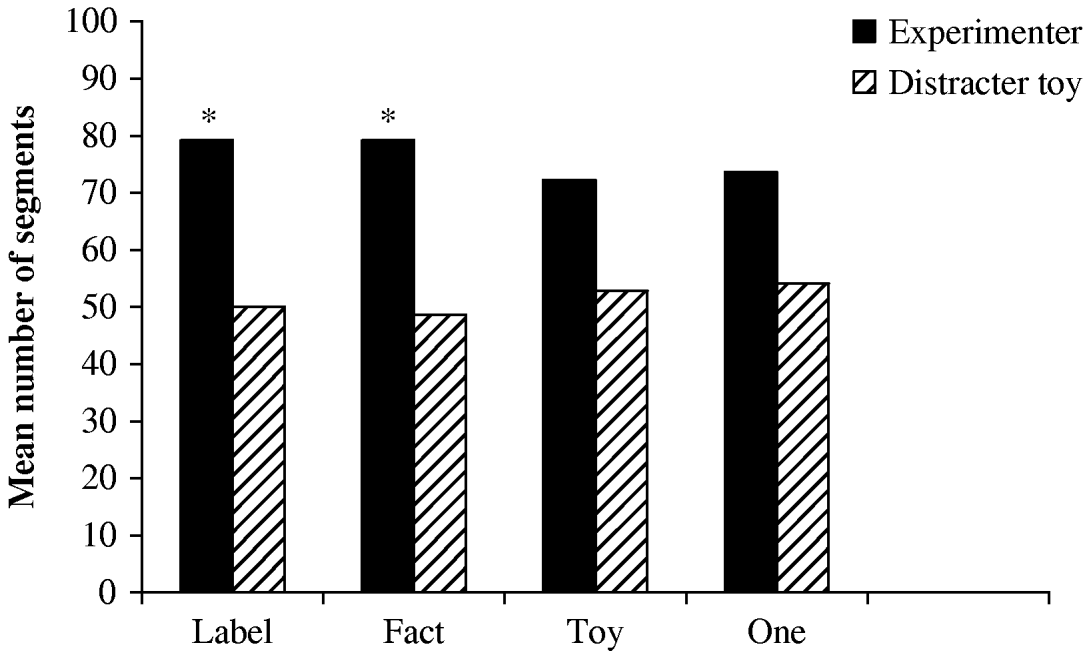
Boys: Mean percentage of segments attending to the experimenter versus the distracter toy in Study 2.

Across participants, attention to the experimenter was significantly higher than attention to the distracter toy for each type of information (novel label, t(47)=5·42, p<0·01; novel fact, t(47)=4·41, p<0·01; neutral label, t(47)=4·16, p<0·01; and neutral phrase, t(47)=3·41, p<0·01). For the girls, there was no significant difference in attention to the experimenter versus the distracter toy during the presentation of the neutral label (t(23)=1·66, p=0·11) and neutral phrase (t(23)=1·64, p=0·12). However, girls' attention to the experimenter versus the distracter toy was significantly higher during the presentation of both the novel label (t(23)=2·52, p=0·02) and the novel fact (t(23)=3·11, p<0·01). On the other hand, boys' attention to the experimenter was significantly higher than their attention to the distracter regardless of the information being presented (novel label, t(23)=6·146, p<0·001; novel fact, t(23)=3·051, p<0·006; neutral label, t(23)=4·861, p<0·001; and neutral phrase, t(23)=3·191, p<0·004).
Shifts of attention toward the experimenter were examined by: (a) comparing the mean frequency of shifts away from the distracter toy, parent, or something else to attend to the experimenter when she presented novel (i.e. novel label and novel fact) versus neutral information (neutral label, and the neutral pronominal phrase); and (b) comparing the mean frequency of shifts to attend to the experimenter when she presented the novel label versus the novel fact. Overall (across conditions and gender), there were no significant differences in the mean frequency of shifts toward the experimenter when presenting novel versus neutral information or when presenting the label versus the fact.
Results indicate that girls learned the novel label, while boys did not. Neither boys nor girls learned the novel fact. In other words, girls seemed to weigh the novel pieces of information differently, privileging novel labels over novel facts. This issue is further discussed in the ‘General discussion’. The finding of gender differences was somewhat unexpected given that previous studies (Akhtar et al., Reference Akhtar, Jipson and Callanan2001; Akhtar, Reference Akhtar2005) have not found gender effects in word learning through overhearing. However, the attention analyses may provide some insight about the comprehension results and gender differences.
Boys attended more to the experimenter than to the distracter toy, regardless of the type of information that was being presented. In contrast, girls attended more to the experimenter than to the distracter toy only during the presentation of novel information (novel label and novel fact). Therefore, it seems that girls attended more strategically to the third-party conversation by focusing their attention on the experimenter only when new information was presented.
In combination, the comprehension and attention results reveal that girls were using a more strategic approach when attending to the third-party conversation. This discriminatory strategy might have enabled girls to use their cognitive resources more efficiently, and thus learn the most relevant pieces of information. Boys, in turn, might not have made effective use of their cognitive resources since they were indiscriminately monitoring the third-party conversation, and consequently their learning was hampered.
General discussion
The current studies contribute to the existing literature on young children's ability to attend to and learn from overhearing by following up on earlier findings (Akhtar et al., Reference Akhtar, Jipson and Callanan2001; Akhtar, Reference Akhtar2005), and varying the type of information overheard. The results of both studies suggest that two-year-olds are able to monitor and learn new information while concurrently engaged with a distracter, but that they deploy these capacities differently depending on the type of information available.
Study 1 used a between-subjects design in which children were only exposed to one of the following types of information: novel label (‘the teebu’), novel fact (‘the one my mom gave me’), novel fact plus label (‘the one my teebu gave me’). In a sense, Study 1 thus assessed the ‘absolute’ appeal of novel information to children's attention and eventual learning. In order to more directly address the ‘relative’ salience of different kinds of information, Study 2 utilized a design in which participants were exposed to both of the following two kinds of information about objects: novel label (‘the teebu’) and novel fact (‘the one my mom gave me’).
The results of Study 1 indicate that children learned both the novel label and the novel fact containing a novel label, but not the novel fact. Attention data suggest that participants who learned the information attended more strategically by attending more to the experimenter during the presentation of the target object than during the presentation of the non-target objects. In addition, attention to the distracter toy during the presentation of the target object was inversely correlated with comprehension performance, suggesting that children who attended more to the distracter toy during the presentation of the target object were more likely to choose a non-target object in response to the comprehension question.
In Study 2, only girls learned the novel label, and neither boys nor girls learned the novel fact. The attention data suggest that while boys focused their attention on the experimenter (versus the distracter) regardless of the type of information being presented, girls attended more strategically by focusing their attention on the experimenter (versus the distracter) only when new information was presented.
Although unexpected, these results regarding gender are consistent with those from previous studies suggesting an advantage in early language skills for girls (Huttenlocher, Haight, Bryk, Seltzer & Lyons, Reference Huttenlocher, Haight, Bryk, Seltzer and Lyons1991; Oviatt, Reference Oviatt1985; Reznick & Goldfield, Reference Reznick and Goldfield1992). Even though this advantage seems to be small (Fenson et al., Reference Fenson, Dale, Reznick, Bates, Thal and Pethick1994), future studies should assess the mechanisms underlying gender differences in early word learning. For instance, findings from Trehub & Shenfield (Reference Trehub and Shenfield2007) suggest that while girls engage in more holistic language processing, boys are more analytic. In particular, they found that girls aged 1 ; 3 learned words presented in sentences but not in the context of single words. Conversely, boys aged 1 ; 3 learned from single-word presentations, but not from sentential contexts. In addition, differences in learning might be associated with gender differences in memory processes. For example, some findings indicate that girls demonstrate better phonological working memory but poorer semantic retrieval procedures than boys (Merriman, Marazita & Lipko, Reference Merriman, Marazita and Lipko2009). Therefore, it seems that girls are more likely to resolve word learning tasks by using sound form recognition procedures, while boys are more likely to depend on their ability to retrieve the meanings.
As in Akhtar (Reference Akhtar2005), participants in Study 1 were more likely to shift attention to the experimenters during the presentation of novel information; however, this was not the case in Study 2. An important difference between these studies is that in Study 2, different utterances were used to introduce each of the four objects, while in Study 1 (as in Akhtar, Reference Akhtar2005), the same neutral utterances were used to introduce the three non-target objects. Therefore, the shift data suggest that when repetitive information was used to present the non-target objects, participants were more likely to shift attention from something else to attend to the experimenter when new information was being presented. Conversely, when different types of information were used to introduce all novel objects, there were no significant differences between participants' shifts to attend to the experimenter. These results suggest that the novel information stands out in the context of repetitive information.
In both studies, children did not learn the novel fact, which was particularly unexpected in Study 1, given that (in contrast with Study 2) the novel objects were introduced in a less demanding context where all the non-targets were presented with a neutral phrase, making the presentation of the target object unique. At the same time, it seems contradictory that participants learned the novel fact plus label since it has higher memory demands because it contains two new elements of information. However, these results are consistent with a recent finding that significantly more two-year-olds learned a novel fact containing a novel label than a novel fact without a novel label (Schwartz, Behrend & Ransom, Reference Schwartz, Behrend and Ransom2009).
These findings regarding the learning of facts, combined with the present and preceding findings on the learning of labels, shed new light on children's capacity to learn through overhearing. When memory demands are not too high, infants aged 1 ; 6 can learn novel words (Floor & Akhtar, Reference Floor and Akhtar2006) and novel actions (Herold & Akhtar, Reference Herold and Akhtar2008) from third-party interactions. By the age of 2 ; 0, children are equally good at learning new words when they are directly addressed, as when they monitor a third-party conversation (Akhtar et al., Reference Akhtar, Jipson and Callanan2001), and they can do so even while concurrently involved in an engaging activity (Akhtar, Reference Akhtar2005). Children aged 2 ; 6, but not two-year-olds, were able to learn an embedded novel verb (Akhtar et al., Reference Akhtar, Jipson and Callanan2001). The current studies reveal that two-year-olds – and especially girls – strategically turn their attention to third-party interactions, and eventually learn from them, when certain types of information are being divulged. That is, children attend to and learn conventional information quite effectively, but do so to a lesser extent with regard to idiosyncratic facts.
In recent years, there has been a renewal of interest in the mechanisms that enable children to acquire cultural information. Some proposals have emphasized the importance of pedagogical cues to orient children towards the relevant information to be acquired (Csibra & Gergely, Reference Csibra, Gergely, Munakata and Johnson2006). Others have focused on children's sensitivity to intentionality as a critical skill in the acquisition of symbolic forms (Tomasello, Carpenter, Call, Behne & Moll, Reference Tomasello, Carpenter, Call, Behne and Moll2005). Yet others have stressed how children need to assess the trustworthiness of sources in order to select the information to be learned (Koenig & Harris, Reference Koenig and Harris2005). The present findings may be taken to indicate that, from a young age, children strategically select the kinds of information they attend to and learn from their environment, even when all the above factors are held constant.
Across the world, children from different cultures are exposed to language in a wide variety of contexts. Findings from cross-cultural studies indicate that in many communities, very young children rarely participate as direct conversational partners with adults (Brown, Reference Brown1998; de León, Reference de León1998; Lieven, Reference Lieven, Gallaway and Richards1994; Ochs & Schieffelin, Reference Ochs, Schieffelin, Shweder and LeVine1984; Schieffelin & Ochs, Reference Schieffelin and Ochs1986; Watson-Gegeo & Gegeo, Reference Watson-Gegeo, Gegeo, Schieffelin and Ochs1986) and, arguably, children learn some proportion of their early language by observing and overhearing third-party conversations. There also is a growing amount of evidence that children in these communities learn a variety of social and cognitive skills by actively paying attention to third-party interactions and conversations. For example, in some communities children learn by ‘listening in’ and through ‘keen observation’ of ongoing mature community activities, in which they are present but not directly addressed (Morelli, Rogoff & Angelillo, Reference Morelli, Rogoff and Angelillo2003; Rogoff, Reference Rogoff2003; Rogoff, Paradise, Mejía Arauz, Correa-Chávez & Angelillo, Reference Rogoff2003). Therefore, future studies should also examine differences in the attentional and learning patterns of children who are growing up in communities where the norm is to learn from these types of third-party interactions (e.g. Rogoff, Reference Rogoff2003; Rogoff et al., Reference Rogoff, Paradise, Mejia Arauz, Correa-Chavez and Angelillo2003).
The present studies started from the observation that within Western societies, children are often exposed to, and acquire, linguistic and conceptual skills from sheer observation of multi-party interactions in which they are not the addressees (Akhtar, Reference Akhtar, Hall and Waxman2004; Barton & Tomasello, Reference Barton and Tomasello1991; Bloom, Reference Bloom, Kuhn and Siegler1998; Dunn & Shatz, Reference Dunn and Shatz1989). The guiding hypothesis was that in order to successfully learn information in these kinds of contexts, children may have certain biases as to what type of information is worth attending to and learning. The present findings intimate that indeed, in overhearing contexts, two-year-olds privilege information that is conventional – object labels – over certain idiosyncratic and arbitrary facts that may not be generalizable – personal facts (see Diesendruck & Markson, Reference Diesendruck and Markson2001). Future studies should help delineate the scope of these biases, as well as their sources, and relative contribution to cultural learning.