Introduction
In Australia, as is the case worldwide, the population is ageing, with the proportion of people aged 65 and over projected to increase to around 20 per cent within the next two decades (Australian Bureau of Statistics, 2013). According to the World Health Organization, everyone should have the opportunity to achieve healthy ageing, defined as the process of developing and maintaining the functional ability to engage in meaningful activities that are important for achieving physical, social and mental wellbeing in older age (Beard et al., Reference Beard, Officer, de Carvalho, Sadana, Pot, Michel, Lloyd-Sherlock, Epping-Jordan, Peeters, Mahanani, Thiyagarajan and Chatterji2016). However, it has been recognised globally that healthy ageing is significantly influenced by the social determinants of health, with factors such as socio-economic disadvantage being associated with significantly poorer health in older age and shorter life expectancy (World Health Organization, 2017). In Australia, older people experiencing socio-economic disadvantage, social isolation, disability, or from culturally and linguistically diverse (CALD) backgrounds have been identified as being at greater risk of poorer outcomes (Federation of Ethnic Communities’ Councils of Australia, 2015; Commissioner for Senior Victorians, 2016; Australian Institute of Health and Welfare, 2016, 2017).
Regular physical activity (PA) is well-accepted as a vital contributor to healthy ageing, with benefits including improved functional health, prevention or delay of physical and cognitive disability (Komatsu et al., Reference Komatsu, Yagasaki, Saito and Oguma2017), and prevention of chronic disease (Chodzko-Zajko et al., Reference Chodzko-Zajko, Proctor, Fiatarone Singh, Minson, Nigg, Salem and Skinner2009). Sustained participation is important in order to deliver the health and wellbeing benefits associated with PA (Stiggelbout et al., Reference Stiggelbout, Popkema, Hopman-Rock, de Greef and van Mechelen2004; Farrance et al., Reference Farrance, Tsofliou and Clark2016), however, the proportion of older people meeting PA recommendations has been reported to be low (Sun et al., Reference Sun, Norman and While2013; Keadle et al., Reference Keadle, McKinnon, Graubard and Troiano2016). Organised PA conducted at clubs, community centres and recreational facilities represents a promising avenue for enhancing adherence to regular PA, as highlighted by a recent review of community-based group exercise programmes for older people (Farrance et al., Reference Farrance, Tsofliou and Clark2016). Key contributors to long-term adherence in these programmes were identified to include social connectedness, and the empowering effects of achieving gains in physical health and wellbeing (Farrance et al., Reference Farrance, Tsofliou and Clark2016). At the same time, it is evident that factors related to disadvantage create significant challenges for adherence, with another review finding that greater adherence to exercise programmes among older people was associated with higher socio-economic status, better health status, greater physical and cognitive ability, and fewer depressive symptoms (Picorelli et al., Reference Picorelli, Pereira, Pereira, Felício and Sherrington2014).
Few studies have specifically examined the factors affecting adherence to organised PA among older people from socially disadvantaged backgrounds. Those that have, have identified barriers such as poor physical and mental health (Garmendia et al., Reference Garmendia, Dangour, Albala, Eguiguren, Allen and Uauy2013), access constraints (Hartley and Yeowell, Reference Hartley and Yeowell2015) and psycho-social factors such as feeling in the minority (Hartley and Yeowell, Reference Hartley and Yeowell2015; Koehn et al., Reference Koehn, Habib and Bukhari2016). Meanwhile, facilitators have been reported to include social opportunities and feeling part of a peer group (Belza et al., Reference Belza, Chiang, Seman and Hsin-Chun Tsai2008; Garmendia et al., Reference Garmendia, Dangour, Albala, Eguiguren, Allen and Uauy2013; Hartley and Yeowell, Reference Hartley and Yeowell2015; Koehn et al., Reference Koehn, Habib and Bukhari2016), culturally supportive environments (Belza et al., Reference Belza, Chiang, Seman and Hsin-Chun Tsai2008; Koehn et al., Reference Koehn, Habib and Bukhari2016), physical and mental benefits (Belza et al., Reference Belza, Chiang, Seman and Hsin-Chun Tsai2008; Garmendia et al., Reference Garmendia, Dangour, Albala, Eguiguren, Allen and Uauy2013; Hartley and Yeowell, Reference Hartley and Yeowell2015), and low-cost and accessible programmes (Belza et al., Reference Belza, Chiang, Seman and Hsin-Chun Tsai2008; Garmendia et al., Reference Garmendia, Dangour, Albala, Eguiguren, Allen and Uauy2013; Hartley and Yeowell, Reference Hartley and Yeowell2015; Koehn et al., Reference Koehn, Habib and Bukhari2016). These findings have been derived mainly from the perspectives of older adult participants, and their potential value in informing programme strategies to promote adherence is acknowledged. However, most of these studies were conducted using participants from a limited range of socially disadvantaged groups (mainly those from CALD and/or low socio-economic backgrounds) who were recruited mainly from the same PA programme (Belza et al., Reference Belza, Chiang, Seman and Hsin-Chun Tsai2008; Garmendia et al., Reference Garmendia, Dangour, Albala, Eguiguren, Allen and Uauy2013; Koehn et al., Reference Koehn, Habib and Bukhari2016). Very few of these studies have also examined the perspectives of providers, or considered the diversity of provider types and settings in which organised PA is offered in the community. This is despite the fact that providers are in a key position to provide important insights, and influence many of the factors identified as affecting adherence (Belza et al., Reference Belza, Chiang, Seman and Hsin-Chun Tsai2008; Hawley-Hague et al., Reference Hawley-Hague, Horne, Skelton and Todd2016). This study, therefore, aimed to identify the actions perceived by a range of programme providers and older people as being effective for promoting adherence to organised PA, with a focus on those relevant to older people experiencing socio-economic disadvantage, social isolation, living with a disability or from CALD backgrounds.
Methods
Design
Semi-structured interviews and focus groups were used to provide a comprehensive insight into the range of barriers affecting adherence to organised PA, and the strategies considered beneficial for addressing these in order to promote adherence among socially disadvantaged groups. Telephone interviews were conducted with community service providers to gain an in-depth account of their experience and perspectives regarding approaches for promoting adherence in organised PA among older people from priority groups. Focus groups were conducted with older person participants in existing PA programmes to stimulate discussion and the sharing of views on the factors that limit and support adherence to the programme. Ethics approval was obtained from the Monash University Human Research Ethics Committee.
Recruitment
Potential organisations were identified using information from community directories, data collected during a 2016 audit of structured PA programmes for older people in the state of Victoria and recommendations from community organisations. A purposive approach was used to ensure a range of organisation types and priority groups were represented. In total, 49 community service providers in Victoria were invited to participate, on the basis that they engage closely with socially disadvantaged older adults, in particular those experiencing socio-economic disadvantage or social isolation, from CALD backgrounds or living with a disability. Publicly available information indicated that 35 of the 49 organisations offer PA programmes as a regular component of their services (PA providers), while the remaining organisations did not appear to offer PA programmes (NPA providers). Organisations were followed up by telephone and email until 30 organisations were recruited, comprising 20 PA providers and ten NPA providers, primarily located within the Melbourne Metropolitan area. Two organisations declined to participate because of limited engagement with older people or insufficient capacity to take part. The remaining organisations did not respond to the invitation or attempts to follow-up. Recruited organisations comprised community and welfare support agencies (CW; N = 9), migrant services (MS; N = 6), community health services (CHS; N = 4), local government (LG; N = 4), recreation services (RS; N = 4) and disability services (DS; N = 3). The types of PA offered by recruited PA providers ranged from sports or exercise programmes run by recreation, disability and community health services, to multi-faceted activity groups incorporating a PA component run by local government, community, migrant and welfare support agencies. All programmes were conducted on an ongoing basis. Interview participants were mainly managers, team leaders or co-ordinators of programmes for older people.
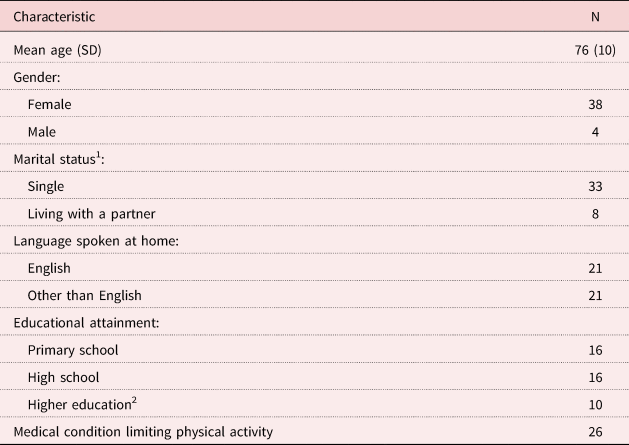
Interview participants from five of the organisations facilitated recruitment of focus group participants from the PA programmes that they offered for older people. These organisations represented MS (N = 2), LG (N = 2) and RS (N = 1). Older people were informed that participation was voluntary and that their decision to participate (or not) would not affect their ongoing ability to take part in the PA programme. Forty-two older people participated in the focus groups, with each group ranging from six to 11 participants. Table 1 presents the characteristics of the focus group participants.
Characteristics of focus group participants

Notes: N = 42. SD: standard deviation. 1. N = 41. 2. Includes vocational education and training, college and university.
Procedure
All interviews and focus groups were conducted from May to July 2017, by a research assistant trained in qualitative methods TN. TN was assisted by interpreters, who were independent of the provider organisations, at two of the focus groups as participants had limited ability to converse in or understand English. Both interpreters were certified by the National Accreditation Authority for Translators and Interpreters.
Written informed consent was obtained from all participants at the start of the focus group. Providers gave their informed consent by confirming their participation by email or telephone prior to interviews being conducted. Interviews and focus groups were audio recorded, and all participants agreed to the use of their de-identified data for publication. Interviews were conducted by telephone, while focus groups were held at the venues where participants attended their PA programmes. The average duration of the interviews was 48 minutes, and 60 minutes for the focus groups.
Semi-structured interview guides were used for the interviews and focus groups to explore perspectives on the key barriers, enablers and strategies affecting awareness of, and initial and continued participation in, organised PA among older adults from similar backgrounds. Questions were asked to explore the key factors that motivate participants to continue in programmes long term, main barriers that prevent adherence, the strategies used to encourage adherence and suggestions for encouraging increased adherence.
Data analysis
Audio recordings were transcribed and imported into NVivo 11. For the two audio recordings of focus groups conducted with an interpreter, only the English-spoken questions and interpreted responses were transcribed. A thematic approach was used to analyse the data, using coding frameworks developed for the provider interviews and focus groups. A preliminary coding framework was developed by TN using a general inductive approach (Thomas, Reference Thomas2006). Upper-level codes were based on the main interview topics (e.g. ‘adherence barriers’) and lower-level codes were derived using in vivo coding and refined to reduce overlap and redundancy (Thomas, Reference Thomas2006). TN and another research assistant used the draft coding framework to code a sample of transcripts from ten interviews and two focus groups independently, then collaboratively identified modifications required to the framework to minimise redundant codes and cover additional codes. The two coders used the modified framework to code a further sample of ten interviews and two focus groups independently, resolving discrepancies by discussion. Key themes were identified based on the repetition of barriers and strategies reported by providers, and consistency with the main themes that emerged from the focus groups. Older people's perspectives were taken into account where they verified or provided further insights about the importance of particular issues and value of certain strategies identified by providers. Participant views were consistent with the perspectives of providers, but not all strategies identified by providers were repeated by participants. These strategies have still been acknowledged due to their reported use and effectiveness with selected sub-groups.
Descriptive analysis of demographic data provided by the focus group participants was conducted using IBM SPSS Statistics 24.
Results
Three key themes emerged regarding the barriers thought to be significant in affecting adherence to organised PA among socially disadvantaged older people: deteriorating health, lack of belonging and loss of motivation. Providers described how different aspects of social disadvantage may affect the susceptibility of older people to experiencing these barriers, the manner in which these barriers arise, and the types of strategies used to encourage adherence depending on the particular needs and sensitivities of the priority group. The main barriers and strategies are described, supported by selected quotes to illustrate key findings, the participant identifiers being focus group participant (FG), type of provider (PA or NPA) and the type of organisation of the provider (CW, MS, CHS, LG, RS and DS).
Deteriorating health
It was widely reported by providers and focus group members that deteriorating health is a major reason why participants cease attending PA programmes, whether of their own accord or because providers can no longer support their increased needs. Providers tended to accept discontinuation as an inevitable consequence of deteriorating health, a sentiment that was reflected in participants’ comments: ‘And we're getting [health] problems and then you can't come anymore, isn't it? That's what it is’ (FG1, LG).
Providers recognised this was not a barrier that uniquely affects those experiencing social disadvantage, but rather older people more generally. However, it was observed that certain aspects of social disadvantage (such as socio-economic disadvantage) may render older participants more susceptible to, and less able to manage, deteriorating health. As one provider described:
Also too the client group often are smokers, they don't necessarily have a good diet and all those things impact. Are not always so good at remembering to take their medication or they decide they're not taking their medication anymore, or I've got schizophrenia but I'm not taking any medication. Then that impacts on their behaviour, and what they're going to do, and whether they can actually follow through and do that. (NPA6, CW)
Poor wellbeing was also identified as a significant contributor towards temporary lapses among participants experiencing socio-economic disadvantage. As one provider explained, these participants tend to be unwell to begin with so there is an assumption that their attendance is subject to being well enough and ‘in a good space’ (PA14, CHS). As a result, action is not usually taken to promote adherence other than to maintain a degree of flexibility in programmes that allows a person to resume their participation after a period of absence:
When they're unwell, we don't see them … there's a strong understanding that someone might attend for a period of time and then not be in a position to attend for all sorts of reasons, whether it's, normally it's health, it could be four, six nine months and then they'll recontact. So, it's not unusual for someone to go through that pattern of attending for a period of time and then disappearing for a while then recontact. (PA14, CHS)
Providers did, however, demonstrate active efforts to support adherence by accommodating different abilities and participants’ changing requirements due to deteriorating health. In particular, providers mentioned the importance of a flexible approach which allows activities to be modified to enable participation by people of all abilities (including those affected by disability). This was illustrated in various ways, such as creating different options for how a person can participate in the same activity (e.g. putting a ball in the basket of a participants’ walker so they can still ‘dribble’ in a game of walking basketball; allowing a person to participate in an adventure course by using their mobility scooter), providing specialised equipment (e.g. balls with sounds for those with vision impairment) and adapting the delivery of instructions so they can be readily understood by those affected by disability or impairment (e.g. tactile methods or more specific verbal instructions to assist those with vision impairment; or simplifying instructions to help someone with dementia to follow the class). It was reported that additional encouragement may also be needed to build participants’ confidence in their capacity to continue PA participation notwithstanding their changing health condition:
We're trying to encourage people to be positive and focus on what you can do rather than what you can't do, focus on what you still have rather than what you've lost because that's one of the challenges, is when people acquire vision loss they often initially think about all the things they used to do and how they used to do it. You need to let go of that and say well I need to adapt to a different way of doing something. (PA16, DS)
Lack of belonging
Most providers and participants identified social factors as important determinants of adherence to PA programmes. Social connections and support were widely cited by participants and providers as a primary motivator for continued attendance. The ability to get out of the house and interact with others was reported to help alleviate depression for those experiencing social isolation:
Each of us has got whatever goes in our own private lives. Sometimes you can open up and talk about it with somebody [from the group] sitting next to you and you're not sitting at home with your door shut and wondering, ‘What am I going to do today?’ or ‘I'm feeling awful today. Who can I talk to?’ (FG5, RS)
As one provider described, organised PA may provide one of the few opportunities for socially isolated or disadvantaged older people to experience social inclusion and meet their social needs:
Others that are coming along, it's actually – the first step that they are having into social inclusion, you know? They are getting out of the house – like I said, some people it might the only time they leave the house for the whole week is to participate in a [organisation name] activity. (PA1, CW)
The opportunity to interact with others in a safe and comfortable environment was highlighted as an important factor supporting adherence for participants from CALD backgrounds or experiencing isolation: ‘We all are from the Middle East and we have the same mentality and similar customs and traditions. We don't feel estranged and they all wear the same attire’ (FG4, MS).
In addition, the value that participants gain from establishing rapport and friendship with others was recognised by one provider as an important factor that can help overcome other barriers such as cost:
They go, they have an absolute ball. By four sessions they've built up a really good rapport, because you know, by the time they've built up that rapport they've now built up friendships. Now they're assessing the loss of the friendship before the $10, and that is a much easier thing to evaluate. You can now better evaluate that cost benefit ratio. (NPA5, CW)
Conversely, providers mentioned that feelings of isolation, lack of social support and loss of belonging are significant factors that can lead participants to discontinue their participation in a particular programme. The importance of creating a welcoming and culturally inclusive environment was highlighted by one provider who observed that this was why many of their CALD participants were prepared to travel considerable distances to attend their branch, compared to other branches that were more conveniently located:
I think it's the culture of the [organisation] yeah. And I was talking to a couple of them down at [another branch] and they said oh some of our people on the desk, for some reason they're a little bit older and she said a different nationality walks through the door and she said you can almost see the look of horror on the person sitting behind the desk. (PA9, RS)
The factors that were thought to be important for fostering a culturally inclusive environment did not necessarily depend on having staff or volunteers from the same cultural background or who could speak the same language, although this was still considered helpful. Rather, it was regarded as more important to demonstrate cultural sensitivity such as by becoming informed about participants’ language and culture:
Learning about a new culture and learning about the new language – you don't need to learn the full language. Having an understanding of why they are what they are, would help. It would bridge the gap. The instructor, once they're familiar, could have a better understanding of the group. That could facilitate a huge motivational boost for this group to continue to go. (NPA9, CW)
The ability of the instructor to foster a non-judgemental environment was considered important, not only for CALD participants but any older person who may be concerned about feeling different or less able than others in the class:
I personally think it comes from the instructor. I think they set the tone of the class. I think that's the same with disability. So if the instructor's being, like if someone comes in and maybe they aren't quite at the same fitness level as everyone else, but the instructor does everything possible to make them feel welcome and not stand out, then the members do it as well. (PA18, LG)
It was noted that negative experiences where the person may have encountered stigma or rejection at PA providers they have previously participated at can have broader-reaching effects that lead a person to abandon the type of PA associated with that provider. One provider described the impact of this in relation to many of their clients who had been made to feel unwelcome at other providers after developing dementia:
So they've had this wonderful, beautiful experience, they've had a sense of belonging because that's what any type of activity or role you do with others is such a sense of belonging, and then if you're removed from that group that you felt you belonged with that activity that you may have done that time becomes null and void in your mind. Well that's what sometimes happens for some of our people living with dementia. (NPA10, CW)
In recognising belonging as an important factor for adherence, many providers reported taking great care in creating a positive and inclusive initial experience for newcomers. A widely mentioned strategy involved creating bonding opportunities, such as inviting newcomers to join the group for tea or coffee after class. Providers considered the process of inviting (without pressuring) participants to join social activities as being valuable in itself for fostering a sense of belonging, particularly for those who are socially isolated. More discrete ways of creating bonding opportunities that were sensitive to the social anxieties of participants were also described:
So it was kind of subtly done. It was kind of like, right, we're running a group and here's – you know, because it's the normal meet and greet, you know, ‘Oh, hi I'm this person. I'm that, I'm that.’ That just probably puts people on the spot a little bit. If you did it with everybody and you went round the group, everyone's now doing it and you're then doing activities and you're kind of giving people jobs, like say, ‘Oh, can you show this person this thing? Can you show that person that?’ and forcing that person to engage with everyone on a different level. (NPA5, CW)
Providers highlighted the importance of ‘keeping tabs’ on newcomers and actively supporting anyone who appears uncomfortable or disconnected within the group environment:
I say to [my leaders] be aware that a person can be in your class and still be isolated. So if there's anybody in your class who you think is standing back, not taking part, bring them in, don't leave them sitting on the outside. It's like being the wall flower at the dance you know, don't allow it to happen. (PA9, RS)
It was emphasised by several providers that ongoing effort is required to foster belonging as a way of promoting adherence. Providers used a variety of actions to demonstrate ongoing care, such as texting or calling participants if they had missed classes, which was also reported to provide an opportunity to find out about any barriers that the provider can help address to support adherence. Adopting this approach was considered to be particularly valuable for encouraging adherence among participants who are socially isolated or experiencing socio-economic disadvantage, and who as a result of mental health or behavioural issues may be accustomed to unstable relationships:
That's awesome, for people to be missed, because that's worked with homeless people for over 20 years that's often the hardest thing, is that people say, ‘I could die and no one would know. No one would even, it wouldn't be a blimp on anyone's radar.’ Making sure that that is no longer the case is really important for people. (PA1, CW)
Providers also considered it important to show an interest, and seek to build a personal connection with their participants, as a way of building trust and demonstrating care. Helpful strategies were thought to include taking opportunities to socialise with participants (e.g. before or after class, during outings), learning participants’ names, checking in on participants following significant events (e.g. the passing of a family member or an operation they have undergone) and engaging a regular instructor. The benefits of engaging a regular instructor was described by one provider as follows:
Therefore, for some of the more isolated people they know them by name, they know their back story, they've had lots of conversations with them. It's kind of that personal connection that's really kind of critical I think because then they're go I'm going back there and Kim's going to be there, and you know I've got that connection point. They know who I am and I'm welcome, I belong to that group. (PA10, RS)
CALD participants in one focus group also identified the personal connection that they had with their leader as a primary motivator for their adherence to the activity programme. When asked to elaborate on the reasons, participants responded with:
she helps people even after hours. Although it's not part of the hours allocated to her, she goes over time. She goes out of her way to help people. Even when some people die, she goes to their house and offers condolences. When my husband passed away, she came to my house and offered her condolences. She is like our sister. (FG4, MS)
Loss of motivation
Providers identified loss of motivation as affecting adherence for various reasons. Providers identified that many clients experiencing socio-economic disadvantage were particularly susceptible to loss of motivation due to their often challenging life circumstances:
sometimes kind of chaos enters their life without anything they can do too much about it or financial strain and that sort of thing all tends to sort of throw you off your things like exercise. (PA6, CHS)
Insufficient interest was another factor identified as contributing to loss of motivation. Providers referred to the challenges associated with fostering adherence amongst some cultural groups, due to their preference for non-active pursuits (e.g. socialising around food) and low prioritisation of PA.
Providers and focus group participants identified two important enablers to adherence that they considered helpful for addressing motivational barriers: an understanding and appreciation of the benefits of PA, and enjoyment of the activity. In this respect, many providers adopted a user-centred or co-designed approach to help identify activities that would be of interest to participants. Such an approach was described as empowering for some CALD groups, although it was recognised that a degree of relationship and capacity building may be required before participants are able to engage properly in the process:
One of the difficulties we must understand is that the [participants] come from a culture that is very suppressed, in terms of voice. They were never empowered to actually have a say in what they wanted to do. So, when we started the programme, we couldn't get a word out of them; it was so hard. They would not tell us what they wanted to do, and a lot of it was what we did, because we thought it was best. (PA11, MS)
It was apparent from the focus groups that realisation of the functional benefits of activity was an important driver for adherence. As the CALD participants of one particular focus group expressed (through an interpreter):
Yeah I know that exercise is very important for me and it's very good and I feel very good as well because I've got diabetes and that affect my eyes as well, but when I finish exercise my eyes getting a little bit brighter, I feel better. (FG3, MS)
Some providers mentioned focusing their efforts on activities that could deliver more tangible physical outcomes for participants (not only social or emotional benefits), while others expressed a desire to offer more interesting or intensive physical activities for their participants than their limited PA expertise allowed:
But I think would be really interesting to – if we have more co-operation with other providers, like, you know, all the fitness gyms or, like, they have a personal trainer who are interesting to provide, you know, more intensive or small group kind of session for the seniors. I think that would be also really interesting for some of the Chinese people they know to engage more regular activity; the physical activities. (PA3, MS)
The added functional benefits gained from using equipment at a gym were also highlighted by participants from one particular group as a key reason for why they enjoy the PA sessions even more than when they were held in a community space:
They are working on the treadmill, they using shoulder presses and stuff like that and all this other equipment, so they're very happy in there. They feel a lot better when it comes to their wellbeing, feels very flexible and light. (FG3, MS)
The setting in which the activity is conducted was also identified as a significant factor that affects enjoyment. Providers found that participants tended to enjoy activity in natural settings (e.g. by the ocean, in a park), and opportunities to visit places that they might otherwise have difficulty accessing, due to lack of confidence using public transport or inability to afford the fees that normally apply to use facilities like the gym:
Well there are those clients that love the outdoors. Our client group are all living inner city, some are living in high rises, so to get away from the city, to be where it's a bit more green, and it's a bit more open, and also too sometimes they would walk more than they'd even realised, if you know what I mean. I don't know [than if] they were just walking down the street or something. (NPA6, CW)
Other strategies that were identified as being helpful for fostering enjoyment included creating fun through laughter, music and friendly competition/challenges, and providing positive reinforcement and incentives through praise and rewards (e.g. certificates, pedometers):
Yeah, for the CALD women, they really appreciated certificates at the end – I suppose that they'd achieved something. And just … you know, they were quite proud to show me, every week, how many new steps they'd taken, so that I could record them. (NPA4, CW)
An added benefit of engaging participants in fun activities is that it can help build trust and rapport that allows vulnerable participants to seek assistance in relation to their other needs. This can give providers an opportunity to link participants to other services that can address these needs which, in turn, helps enable improved adherence to PA programmes in the longer term. As one provider described:
It's funny, we found on average they tend to come to us and they would spend probably two months just having fun, then they would build up that rapport, then they would suddenly start to vent and they would start to offload all their stresses and all their other issues and they start saying, ‘I'm cold, I'm homeless, I can't live like this anymore, I need your help’, and then we can start linking them into all these services … once we get them actually sorted and maybe into housing or something, other support services, they then start participating back in rec [recreation] and focusing on their rec programmes again. (NPA5, CW)
Discussion
Social disparities in PA participation among older adults have been widely reported, which has stimulated qualitative research in a number of Western countries concerning the barriers to PA by different socially disadvantaged and under-represented sub-groups (Belza et al., Reference Belza, Chiang, Seman and Hsin-Chun Tsai2008; Horne and Tierney, Reference Horne and Tierney2012; Phoenix et al., Reference Phoenix, Griffin and Smith2015). Recently, the World Health Organization issued a Global Action Plan for PA, which includes actions to expand and strengthen programmes to engage older adults and the least active in communities, including vulnerable or marginalised sub-groups (World Health Organization, 2018). Much of the research in this area has focused on identifying strategies and barriers that affect participation in organised PA among specific sub-groups, and primarily from the perspectives of participants rather than providers. However, this has not recognised the practical value to be gained from the experiences and learnings of providers who have successfully engaged with sub-groups in organised PA, or examined the actions that can address the substantial and enduring barriers to participation experienced by older people affected by multiple aspects of disadvantage. The present study addresses this need for knowledge about the strategies that may be effective across multiple sub-groups of disadvantage, with a focus on those experiencing socio-economic disadvantage, social isolation, living with a disability or from CALD backgrounds. A focus was placed on gaining an in-depth understanding of provider perspectives, with participant perspectives offering verification of many of the key themes identified, and providing subjective insight into how particular strategies (particularly in relation to lack of belonging and loss of motivation) can be beneficial for promoting adherence. Despite the diversity of programme providers and target groups in this study, there was an overarching similarity in the types of barriers experienced across sub-groups, including deteriorating health, lack of belonging and loss of motivation. However, there was found to be differences in how these barriers arise and, consequently, the actions likely to be suitable and effective for different groups.
A clearer understanding was gained in this study in relation to how deteriorating health may impede adherence among those affected by disability (and the associated strategies found to be helpful). The emergence of disability in later life, or the worsening of disability, were identified as potential barriers to adherence due to psychological factors (e.g. where the person is uncertain about their current capabilities) or organisational factors (e.g. where the provider is unable to support higher needs or has discriminatory attitudes towards certain disabilities). Providers indicated that those experiencing socio-economic disadvantage tend to be more susceptible and less able to manage poor health due to the complexity of their life circumstances, vulnerability to multiple physical, mental and social risk factors, and lack of access to resources to address health problems. There was a sense of acceptance among providers that not much could be done, other than to afford the person flexibility to return when they were able to. Other strategies were found to indirectly assist in addressing this barrier, such as using follow-up text messages or phone calls to absentees not only as a means of demonstrating care and concern (separately considered helpful for promoting adherence through a sense of belonging), but also a practical means of finding out about potential health-related needs that the provider can help to address. In addition, creating a fun environment was referred to as a way of enhancing motivation, and also of building rapport with participants so that they feel comfortable about approaching the provider for assistance. For some sub-groups of socio-economically disadvantaged older persons (e.g. those experiencing homelessness for the first time), this can be particularly beneficial if they are otherwise reluctant to seek help out of shame or fear of being perceived as dependent (Burns and Sussman, Reference Burns and Sussman2019).
The strategies for addressing the barriers posed by acquired or worsening disability focused on supporting affected participants to adapt to their new circumstances. This may involve helping the person to gain acceptance about their new limitations while at the same time finding practical ways to demonstrate how they can continue to participate, even if it requires modification of the way they undertake the activity or use of additional aids. Providers may need additional training to improve their capacity to implement these strategies, such as by developing motivational interviewing skills and an understanding of how to modify activities and other potential constraints effectively to facilitate participation (Trahan et al., Reference Trahan, Kuo, Carlson and Gitlin2014; Burton et al., Reference Burton, Clancy and Cowap2017).
In this study, it was highlighted that social relationships were a major reward and powerful enabler for priority groups, but also a domain that presented significant risks to adherence. According to previous research, social factors may create significant adherence barriers to organised PA for hard-to-reach groups because they can be disempowering (Horne and Tierney, Reference Horne and Tierney2012), produce feelings of disparity (Hartley and Yeowell, Reference Hartley and Yeowell2015) or contribute to perceptions of incapability (Burton et al., Reference Burton, Clancy and Cowap2017).
The strategies described by providers as being helpful to promoting a sense of belonging emphasise the importance of ensuring a positive and inclusive initial experience, creating a safe and stigma-free environment, and providing opportunities to forge relationships that enable participants to feel supported and valued. The primary importance of these factors has been highlighted previously in a study exploring the views of participants with major depressive disorder in relation to the features considered ideal for PA programmes (Sims-Gould et al., Reference Sims-Gould, Vazirian, Li, Remick and Khan2017). Other research (Belza et al., Reference Belza, Chiang, Seman and Hsin-Chun Tsai2008; Hartley and Yeowell, Reference Hartley and Yeowell2015) has indicated the value of culturally specific programmes involving participants from similar CALD backgrounds, making it easier for participants to feel safe and comfortable when participating in organised PA. This was reinforced in this study by older focus group participants from a Middle Eastern background. However, it has also been suggested that older adults from CALD backgrounds can adapt to heterogeneous settings as long as there are some people in the group with whom they can initially identify (Hartley and Yeowell, Reference Hartley and Yeowell2015). This suggests that what is most important is being culturally inclusive to accommodate a greater diversity of participants. As the present study shows, this requires instructors to demonstrate cultural sensitivity and willingness to accommodate the language and behavioural norms of participants, although they do not need to share the same background as participants.
A range of strategies to demonstrate care were described as beneficial, and while some methods can be time intensive (e.g. follow-up text messages and telephone calls to participants who miss classes), others are less so, such as taking opportunities before or after class to get to know participants. Older adults who took part in focus groups in this study confirmed the value of these strategies, and what instructors do outside classes to demonstrate care and personal interest in their participants, which can greatly help with adherence. It has previously been reported that CALD and frail older people greatly value opportunities to share food and chat with other participants after attending exercise classes (Stickney and Vilshanskaya, Reference Stickney and Vilshanskaya2005). This study provides an added insight from older adults and providers about the importance of providing bonding opportunities for older people experiencing social isolation, and the need to consider the social anxieties of such participants in the creation of suitable opportunities. The development of rapport with instructors has been previously identified as a motivator towards continued participation (Franco et al., Reference Franco, Tong, Howard, Sherrington, Ferreira, Pinto and Ferreira2015). The findings of this study support the value of retaining a regular instructor who can help to establish an ongoing rapport and connection with individuals. Additional training may be required for instructors to develop the skills necessary to build relationships and foster inclusive environments for participants who have diverse backgrounds, abilities and psycho-social needs.
The maintenance of motivation was referred to as having a significant effect upon adherence, which could be addressed by ensuring the PA is of interest and of functional benefit to participants, considering the suitability and appeal of the programme setting, and prioritising enjoyment. A user-centred approach was widely regarded by providers as being helpful for identifying activities of interest. As this study revealed, such an approach can uncover unexpected activities of interest (such as gym-based activities that are not culturally familiar), however, the challenges described in relation to engaging with some CALD groups highlights the need for skilled facilitators who understand the processes for implementing this approach. The motivating role of functional improvement has previously been identified as important for older adults affected by cognitive or physical impairment (Dohrn et al., Reference Dohrn, Ståhle and Roaldsen2016; Lindelöf et al., Reference Lindelöf, Lundin-Olsson, Skelton, Lundman and Rosendahl2017) and from CALD backgrounds (Belza et al., Reference Belza, Chiang, Seman and Hsin-Chun Tsai2008), but the present study also highlights that providers may need to build the capacity of their instructors, or forge partnerships with other organisations who have specialised PA expertise or facilities, to deliver functionally rewarding PA programmes for participants.
In considering strategies for promoting adherence to organised PA among older adults from hard-to-reach groups, it is important to recognise that individuals may be affected by multiple forms of disadvantage and to have needs that vary over time, highlighting the need for tailored action to support programme adherence. It is also important not to overlook the practical factors that are critical to ensuring accessibility (in particular, affordability and provision of transport if programmes are not held in convenient locations). Killingback et al. (Reference Killingback, Tsofliou and Clark2017) have suggested, in relation to community-based group exercise programmes, that these may be regarded as ‘hygiene factors’ (drawing on the motivation–hygiene theory of Herzberg; Herzberg, Reference Herzberg1987) that are fundamental to adherence, because while they may not be significant contributors to participant satisfaction, failure to address these can lead to programme dissatisfaction and non-adherence.
The strengths of this study include the diversity of participants involved (both older people and service providers) and representation across priority groups. A limitation was that recruitment was not restricted to providers who could demonstrate high rates of adherence among hard-to-reach groups, or participants who were strong adherers (typically measured as participation for six months or longer; Farrance et al., Reference Farrance, Tsofliou and Clark2016). However, the insights shared by providers show that engagement with hard-to-reach groups is a journeying process that takes time to be successful, hence there is value in learning about strategies that have been found to mitigate disengagement, even if high rates of adherence have not yet been achieved. Another limitation was that, while the number of interviews and focus groups conducted was sufficient to reach data saturation in relation to common factors affecting adherence across the hard-to-reach groups overall, they may not have been sufficient to identify the range of issues for each particular sub-group.
Conclusions
The strategies for improving older people's adherence to organised PA have been under-studied, particularly for groups which are hard to reach and who have much to gain from participation. This study has revealed how issues such as poor health, difficulties with social engagement and loss of motivation, which have been identified as influences upon adherence to PA by older people generally, may be compounded and entail greater complexity among those who come from positions of socio-economic disadvantage, cultural and linguistic diversity, and psycho-social impairment. It has highlighted the additional knowledge and skills, planning, tailoring, time and resources that will be required to support high needs and under-represented older people to participate in structured PA opportunities, and to adhere sufficiently to achieve the physical, mental and social benefits that these offer.
Acknowledgements
The authors wish to thank all individuals and community organisations who participated in this study.
Author contributions
BJS and GN conceptualised and designed the study. TN collected, analysed and interpreted the data. All authors were involved in drafting the manuscript or revising it critically for important intellectual content, and approved the final manuscript.
Financial support
This work was supported by the Victorian Department of Health and Human Services (reference number C4181).
Conflict of interest
The authors declare no conflicts of interest.
Ethical standards
This study received ethics approval from the Monash University Human Research Ethics Committee (8427). Informed consent was obtained from all participants.