Introduction
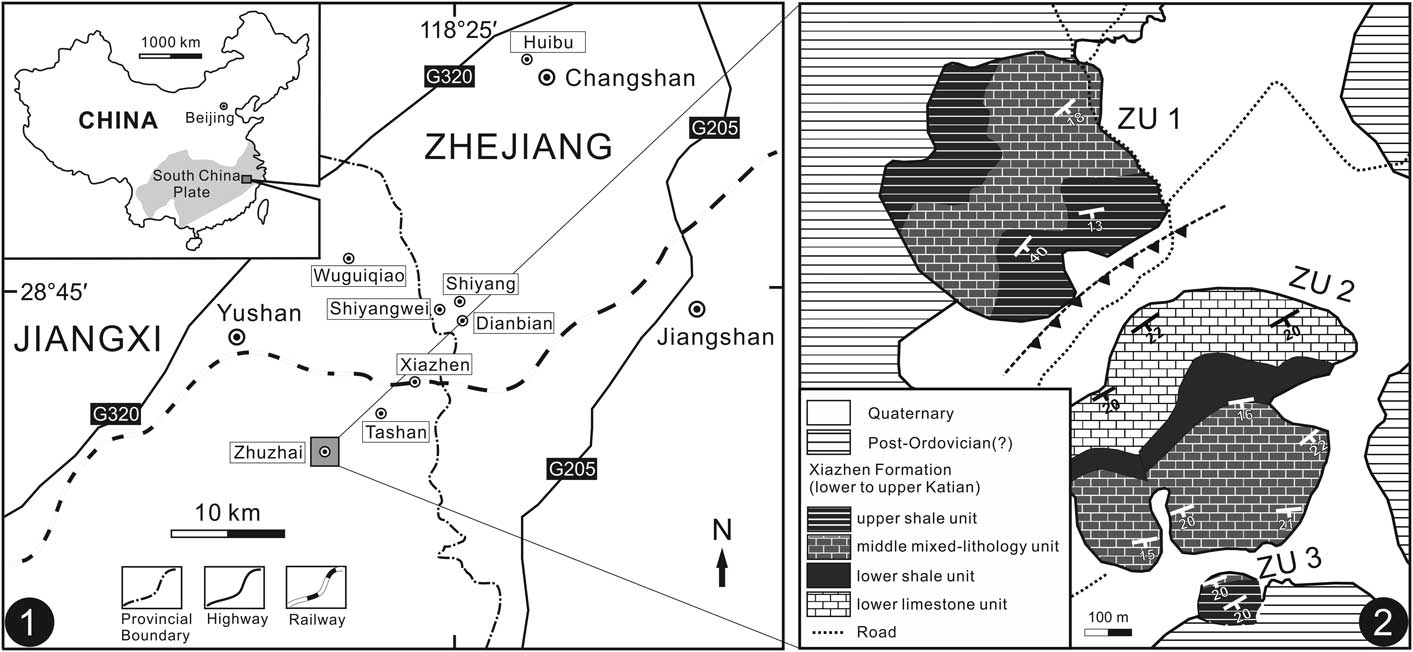
The Jiangshan-Changshan-Yushan Triangle (JCYT), located along the border between Jiangxi and Zhejiang provinces in southeastern China, has long been known as the classic area for study of the Ordovician System in South China (Fig. 1.1; Zhang et al., Reference Zhang, Chen, Yu, Goldman and Liu2007). Although tabulate corals are among the most significant fossil components in Upper Ordovician sequences of the JCYT, they have received surprisingly little attention. Since several preliminary investigations (Yu, Reference Yu1960; Yu et al., Reference Yu, Wu, Zhao and Zhang1963; Lin and Chow, Reference Lin and Chow1977), there has not yet been a significant published description of these fossils. There is clearly the need for a comprehensive systematic treatment.
(1) Map of China showing the South China Plate, with enlargement showing vicinity of Jiangshan, Changshan, and Yushan (JCYT area), and location of Zhuzhai; (2) geological map in vicinity of Zhuzhai, showing the locations of sub-sections ZU 1, ZU 2, and ZU 3 (adapted from Lee et al., Reference Lee, Park, Woo, Kwon, Lee, Guan, Sun, Lee, Liang, Liu, Rhee, Choh, Kim and Lee2012).

The halysitid tabulate Catenipora Lamarck, Reference Lamarck1816 is characterized by cylindrical corallites joined one to another in linear ranks (chain-like in transverse section), leaving vertical lacunae (open spaces) in the corallum (Hill, Reference Hill1981). The objectives of the present study are to characterize the species of Catenipora in the Xiazhen Formation from Zhuzhai, which is located in Yushan County, Jiangxi Province of South China, and to document and assess their paleoecological distribution in seven stratigraphic intervals representing various depositional environments. A statistical procedure adopting both traditional and geometric morphometrics is conducted to distinguish and identify the species.
Traditional multivariate morphometrics based on linear measurements have been applied to solve taxonomic issues associated with fossil corals, including scleractinians (Foster, Reference Foster1979, Reference Foster1980, Reference Foster1984, Reference Foster1985; Cairns, Reference Cairns1989; Budd et al., Reference Budd, Johnson and Potts1994; Budd and Klaus, Reference Budd and Klaus2001) and more recently cateniform tabulates (Bae et al., Reference Bae, Elias and Lee2006a, Reference Bae, Elias and Lee2008; Wang and Deng, Reference Wang and Deng2010). This approach has proved effective in the discrimination of closely related species. As Cheetham (Reference Cheetham1987) and Jackson and Cheetham (Reference Jackson and Cheetham1990) pointed out, the results of such applications demonstrate that discrimination of morphospecies via a strict sequence of multivariate statistical procedures provides a non-arbitrary criterion for species identification.
In more recent years, geometric morphometrics with refined characters and landmarks have been introduced to distinguish species of scleractinians (Budd et al., Reference Budd, Johnson and Potts1994, Reference Budd, Nunes, Weil and Pandolfi2012; Budd and Klaus, Reference Budd and Klaus2001; Budd and Pandolfi, Reference Budd and Pandolfi2004, Reference Budd and Pandolfi2010; Klaus and Budd, Reference Klaus and Budd2003; Fukami et al., Reference Fukami, Budd, Levitan, Jara, Kersanach and Knowlton2004). Geometric morphometrics comprise a set of techniques retaining geometric properties of objects throughout the analysis (Rohlf and Marcus, Reference Rohlf and Marcus1993). Shape variation within a sample of landmark configurations is represented by parameters that describe the shape deformations and can be analyzed with classic multivariate analytical methods (for methodological details, see Dryden and Mardia, Reference Dryden and Mardia1998). The present study represents the first application of landmark-based morphometric analyses to tabulates, thereby expanding the scope of quantitative approaches to problems involving morphological variability and species discrimination in this extinct group of corals.
Geological setting
The Upper Ordovician Xiazhen Formation is characterized by carbonates intercalated with clastic deposits, and contains abundant stromatoporoids, corals, algae, and trilobites (Chen et al., Reference Chen, Rong, Qiu, Han, Li and Li1987; Bian and Zhou, Reference Bian and Zhou1990; Zhang et al., Reference Zhang, Chen, Yu, Goldman and Liu2007; Kwon et al., Reference Kwon, Park, Choh, Lee and Lee2012; Lee et al., Reference Lee, Park, Woo, Kwon, Lee, Guan, Sun, Lee, Liang, Liu, Rhee, Choh, Kim and Lee2012; Lee, Reference Lee2013). The carbonate successions in the study area were deposited on the Zhe-Gan Platform on the northern side of the Cathaysian Oldland, and these strata are well exposed near the border between Jiangxi and Zhejiang provinces (Fig. 1.1, 1.2) (Chen et al., Reference Chen, Rong, Qiu, Han, Li and Li1987; Rong and Chen, Reference Rong and Chen1987; Wu, Reference Wu2003; Zhang et al., Reference Zhang, Chen, Yu, Goldman and Liu2007; Zhan and Jin, Reference Zhan and Jin2007; Rong et al., Reference Rong, Zhan, Xu, Huang and Yu2010). Numerous Upper Ordovician reef complexes were previously described from the shallow platform lagoon to marginal reef deposits of the Sanqushan Formation and its landward equivalent, the Xiazhen Formation (Yu et al., Reference Yu, Bian, Huang, Chen, Fang, Zhou and Shi1992; Bian et al., Reference Bian, Fang and Huang1996; Webby, Reference Webby2002; Li et al., Reference Li, Kershaw and Mu2004). The shallow platform carbonates of the Sanqushan and Xiazhen formations grade into contemporaneous fine-grained clastics of the Changwu Formation on the distal Zhe-Gan Platform toward the Zhe-Wan Basin (Chen et al., Reference Chen, Rong, Qiu, Han, Li and Li1987; Li et al., Reference Li, Kershaw and Mu2004).
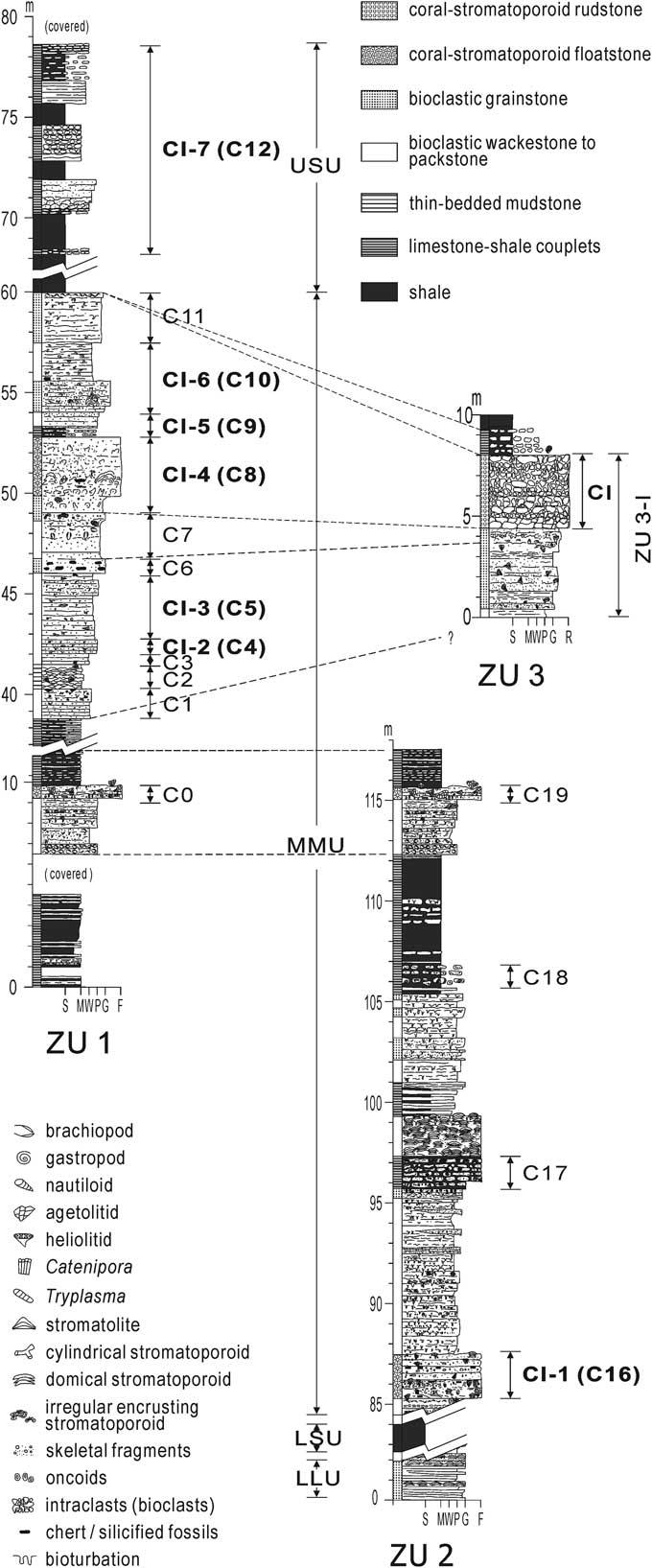
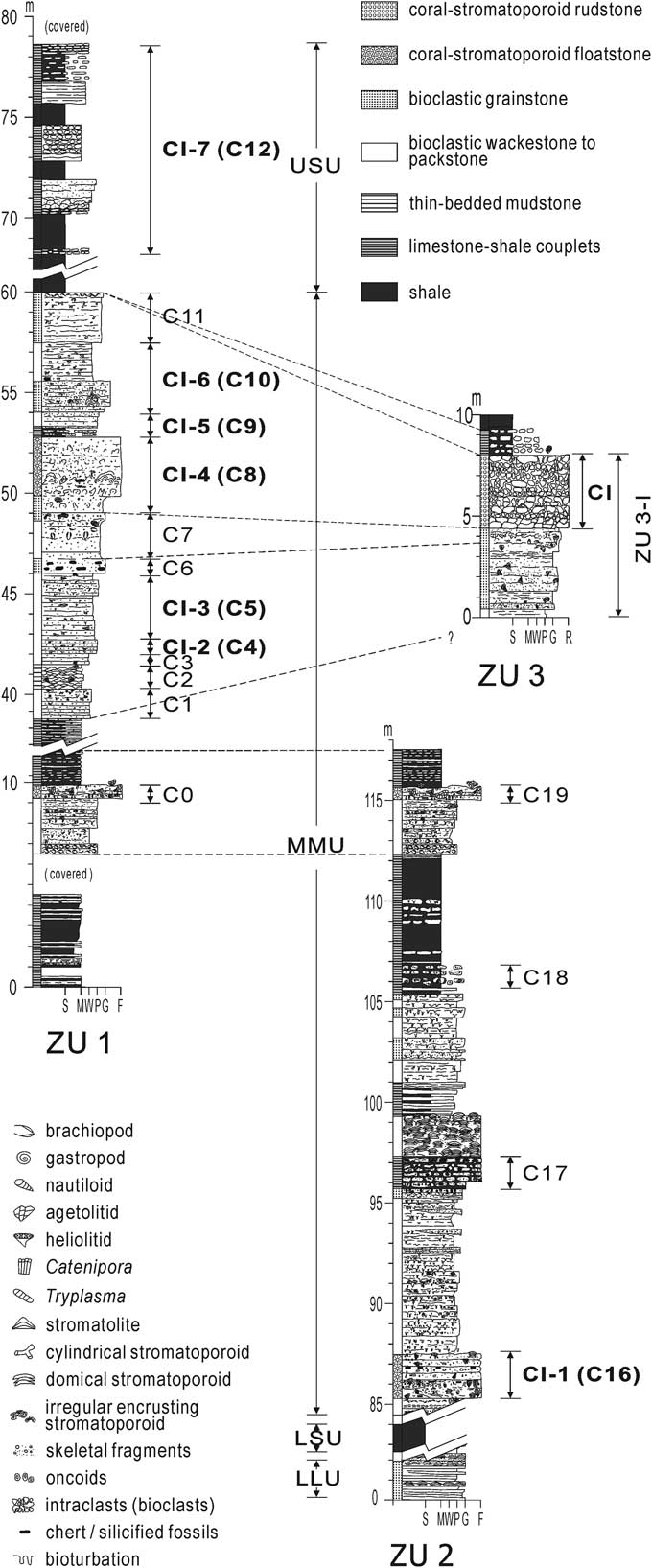
The Xiazhen Formation at Zhuzhai, where specimens of Catenipora used in this study were collected, has recently been re-measured and described in detail by Lee et al. (Reference Lee, Park, Woo, Kwon, Lee, Guan, Sun, Lee, Liang, Liu, Rhee, Choh, Kim and Lee2012), based on the integration of lithological and paleontological data; we follow their interpretations and stratigraphic revisions. They compared data from the three exposures (designated as sub-sections ZU 1, ZU 2, and ZU 3, separated by Quaternary deposits) and demonstrated that stratigraphic intervals of the various sub-sections overlap (Figs. 1.2, 2). The entire formation was measured as more than 204.5 m thick. The depositional environments of the coral beds were interpreted as back reef to marginal platform. Fossils such as graptolites and conodonts, which have well-constrained biostratigraphic utility, have not been reported from the Xiazhen Formation. However, based on corals and a proposed correlation with the Changwu Formation, the Xiazhen Formation was estimated to be early to late Katian (mid Ashgill) in age (Zhang et al., Reference Zhang, Chen, Yu, Goldman and Liu2007).
Lithostratigraphic columns and correlation of the Xiazhen Formation in subsections ZU 1–ZU 3 at Zhuzhai, South China (adapted from Lee et al., Reference Lee, Park, Woo, Kwon, Lee, Guan, Sun, Lee, Liang, Liu, Rhee, Choh, Kim and Lee2012). Specimens of Catenipora examined in the present study were collected from intervals CI-1–CI-7 (bold). LLU, lower limestone unit; LSU, lower shale unit; MMU, middle mixed-lithology unit; USU, upper shale unit; S, shale; M, mudstone; W, wackestone; P, packstone; G, grainstone; F, floatstone; R, rudstone.
Materials and methods
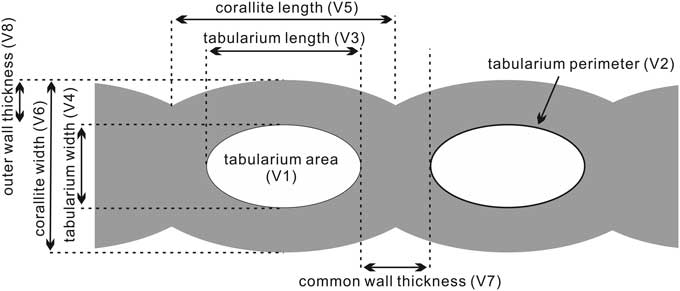
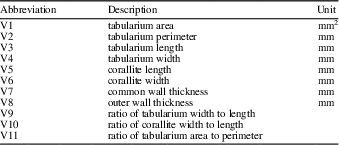
Over 300 coralla of Catenipora were collected from the Xiazhen Formation at Zhuzhai between 2002 and 2011. The specimens were slabbed transversely and/or longitudinally. A number of transverse and longitudinal thin sections and acetate cellulose peels were prepared for the identification of specimens. Several sets of transverse serial thin sections from the central part of some coralla were prepared to investigate the intra- and intercolony variation and colony growth pattern. The majority of specimens are superficially well preserved, but their internal structures are commonly obscured due to recrystallization and silicification. As a result, 143 relatively well-preserved coralla were selected for description and morphometric analysis (Supplemental Data 1). Eleven morphological characters (V1–V11; Table 1) were employed for the multivariate analysis, which involved 136 of the coralla. Areal and/or linear measurement data were obtained for the following eight characters: tabularium area, tabularium perimeter, tabularium length and width, corallite length and width, common wall thickness, and outer wall thickness (V1–V8, respectively; Fig. 3). The quantitative measurements of the morphological characters were obtained using an image analysis system (IMT 2000).
Schematic transverse section of two corallites in Catenipora, depicting the eight morphological characters measured in this study (V1–V8; see Table 1 for units).

Morphological characters used in this study of Catenipora Lamarck, Reference Lamarck1816.

In a previous morphometric study of Catenipora, Bae et al. (Reference Bae, Elias and Lee2006a) randomly selected 20 mature corallites per thin section for the measurements, as suggested by Dixon (Reference Dixon1974). To test the validity of such a sample size for the present study, 20 mature corallites were selected and measured in a thin section from the central growth axis of the mature part of a corallum, for each of five specimens representing a range of coralla having different corallite sizes. Then, for each thin section, ten of the measured corallites were selected randomly and their average values for eight morphological characters were compared to those of the 20 corallites (Table 2). The two-tailed t-test shows that there is no significant difference between the values of the two samples of the data, indicating that a sample size of ten mature corallites per thin section or peel is legitimate for the analysis. The majority of the coordinates used in the multivariate analysis are the average values of the ten mature corallites chosen from a thin section or peel of each corallum. For a few fragmentary coralla with a small number of mature corallites, average values of four to nine corallites per thin section or peel were employed for species determination by the multivariate analysis. A test similar to the one outlined above for ten corallites indicated that a sample size of four corallites is valid to represent a corallum in most cases.
Measurements of eight morphological characters (V1–V8; see Table 1 for abbreviations and units) and results of two-tailed t-test to compare averages of 10 and 20 mature corallites in five coralla of Catenipora from the Xiazhen Formation at Zhuzhai (NIGPAS specimen numbers). Asterisk indicates that the difference between averages is indistinguishable at significance level 0.01 using t-test.

Traditional multivariate morphometric analysis in this study was carried out following the procedure of Bae et al. (Reference Bae, Elias and Lee2006a), but was modified when necessary to incorporate the characteristic features of Catenipora from the Xiazhen Formation. Cluster analysis based on the principal component score matrix was performed to classify the 136 coralla. The major clusters extracted from the dendrogram were considered to represent different morphospecies. To provide statistical support for the morphospecies, 24 replicates belonging to 16 coralla selected from the 136 coralla were incorporated into the cluster analysis. Then, the statistical validity of morphospecies identified by the cluster analysis was tested by canonical discriminant analysis. Once the morphospecies were legitimized, descriptive statistics and bivariate plots were employed to examine intra- and interspecific variation of the morphospecies. The quantitative measurements of the morphological characters were statistically processed using PASW (version 17.0 for Windows) for multivariate analysis.
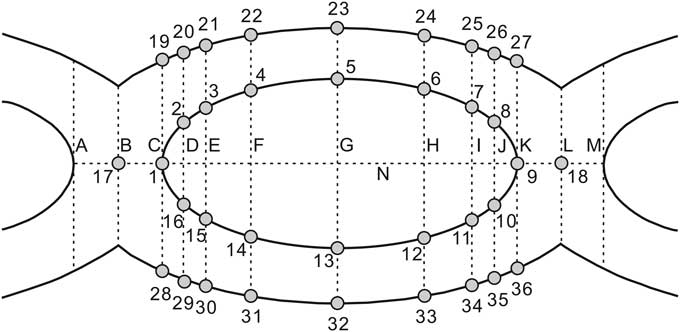
The morphospecies were then compared with the types and/or figured specimens of the three species of Catenipora previously reported from the JCYT (Table 3) using landmark-based geometric morphometric analysis. Two-dimensional coordinate data were collected from 36 landmarks on each corallite (Fig. 4), with eight to ten mature corallites on average analyzed for each corallum. Dotted lines (Fig. 4), which were used to confirm the location of landmarks for each corallite, were drawn using CorelDRAW 15 (Corel Corporation) before digitizing all the landmarks. A generalized Procrustes superimposition was used to remove the differences in position, orientation, and size of the landmark coordinates, as suggested by other researchers (e.g., Rohlf and Slice, Reference Rohlf and Slice1990; Bookstein, Reference Bookstein1991; Goodall, Reference Goodall1991). Corallite size was measured as an independent variable using centroid size. Shape variation among coralla was then estimated using a principal component analysis performed on the coordinates projected into a tangent shape space (for procedural details, see Dryden and Mardia, Reference Dryden and Mardia1998). Thin-plate spline (TPS) on the mean shape of each morphospecies and species was used to visualize the shape variation. Discriminant analysis combining the shape coordinates and centroid size was conducted to further compare the morphospecies and three species of Catenipora. The geometric morphometrics were carried out using such TPS software series as tpsDig, tpsThin, and tpsRelw (Rohlf, Reference Rohlf2005).
Schematic transverse section of a corallite in Catenipora, showing location of the 36 landmarks used in the two-dimensional geometric morphometrics. Positions of landmarks 1–36 in each corallite are delineated by the dashed lines A–N. Vertical dashed lines A–M are parallel to each other and perpendicular to the horizontal dashed line N, which divides the corallite in half lengthwise. The dashed line B is midway between dashed lines A and C, which pass through the ends of two neighboring tabularia; similarly at the other end of the corallite, the dashed line L is midway between dashed lines M and K. Dashed lines D–J are located at positions 1/16, 1/8, 1/4, 1/2, 3/4, 7/8, and 15/16 of the way between dashed lines C and K, from left to right.

Seven types and/or figured specimens of Catenipora species previously reported from the Upper Ordovician at locations in the JCYT, South China.

Repositories and institutional abbreviations.—All coralla described and used in this study, as well as two type specimens of C. zhejiangensis (holotype 10427 and paratype 159393; see Table 3), are housed in the collection of the Nanjing Institute of Geology and Palaeontology (NIGPAS), Nanjing, China. The other four types and a figured specimen (J-33-22, J-33-25, J-33-32, J-34-46, and J-33-29; see Table 3) are supposed to be reposited in the Geological Museum of China (GMC) in Beijing (Lin and Chow, Reference Lin and Chow1977), but their location is unknown. The measurements of those five specimens were made using published photographs.
Results of multivariate morphometrics
Multivariate analysis and resulting morphospecies
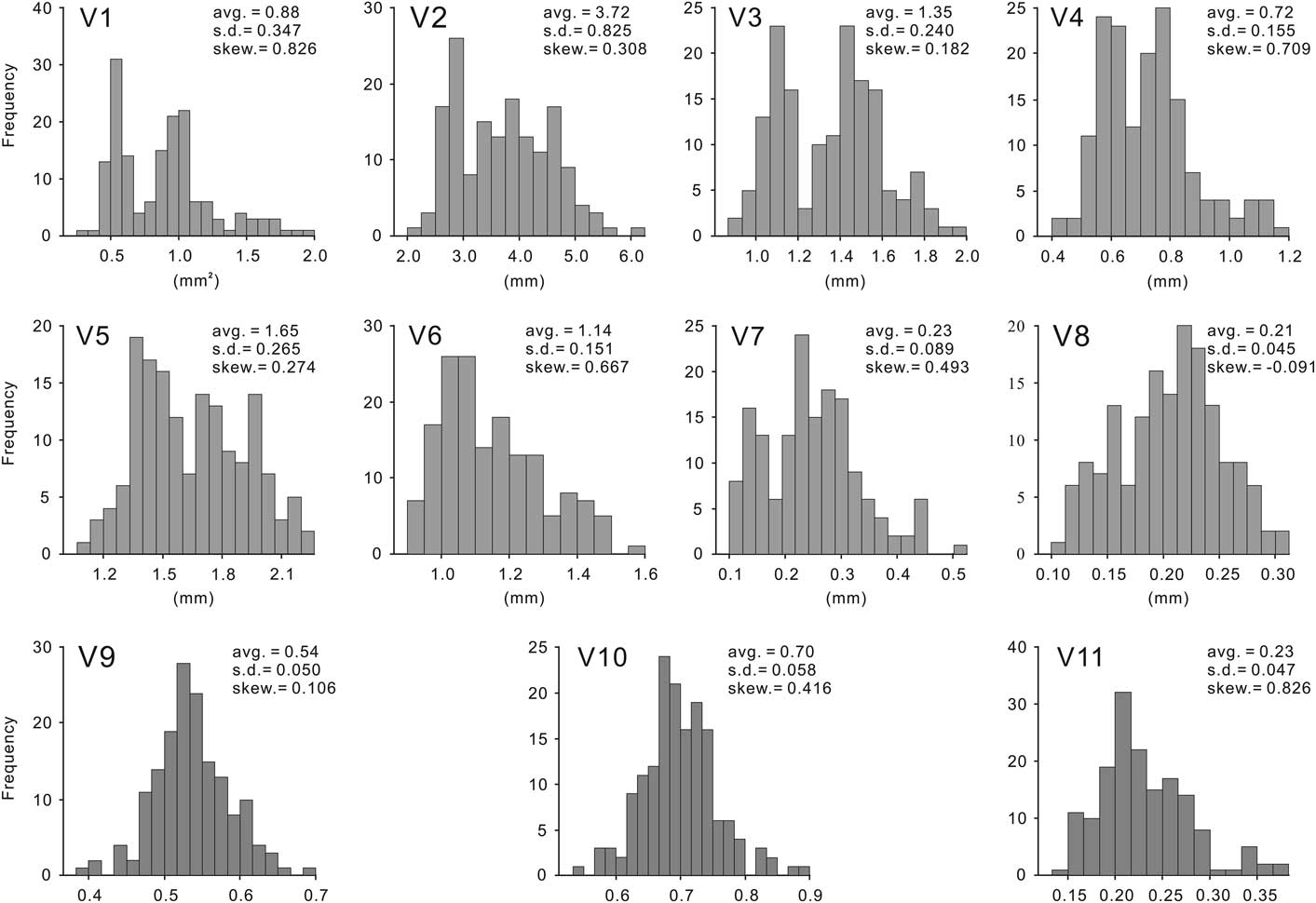
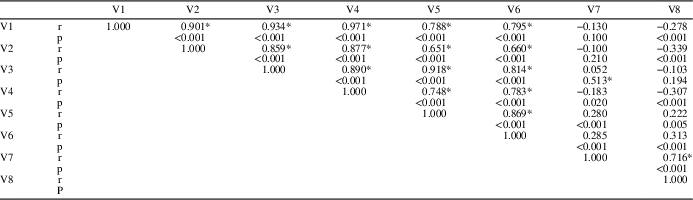
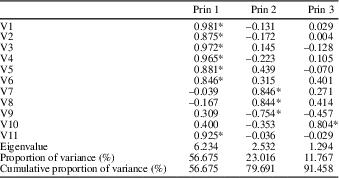
Before conducting multivariate analysis, frequency histograms were constructed to examine the variation of the 11 morphological characters (V1–V11; see Table 1). The histograms reveal a considerable range of variation for each character (Fig. 5). Although there is general continuity of the variation, multiple modes in some histograms suggest that more than one species may be included. The Shapiro-Wilk test indicates that six of the characters (V2, V5, V7, V8, V9, and V10) are normally distributed at the significance level of 0.01. Correlation analysis and principal component analysis (PCA) were conducted to examine the relation among the 11 morphological characters. The Pearson correlation coefficient was calculated for the raw data matrix to measure the similarity between morphological characters (Table 4). Six characters related to corallite size display strong positive correlation with each other at a significance level of 0.01: tabularium area, tabularium perimeter, tabularium length, tabularium width, corallite length, and corallite width (V1–V6, respectively). In addition, common wall thickness (V7) and outer wall thickness (V8) display moderately strong positive correlation with each other. Eigenvalues and their associated eigenvectors of the 11 morphological characters were computed from the correlation matrix (Table 5). The first principal component is heavily weighted on the six morphological characters shown to be strongly positively related by the simple correlation procedure: tabularium area, perimeter, length, and width, and corallite length and width (V1–V6, respectively; Tables 4, 5). This implies that there is variation in the size of corallites. The first principal component is also heavily weighted on the ratio of tabularium area to perimeter (V11), which reflects the shape of the tabularium (Table 5). Among these positively related characters, the eigenvector of tabularium area (V1) for the first principal component is the highest. The second principal component is heavily weighted on three characters (Table 5). Common wall thickness (V7) and outer wall thickness (V8) are positively related, whereas the ratio of tabularium width to length (V9) is negatively related. The third principal component is heavily weighted on the ratio of corallite width to length (V10; Table 5).
Frequency histograms of 11 morphological characters (V1–V11; see Table 1 for abbreviations) for 136 coralla of Catenipora from the Xiazhen Formation at Zhuzhai (avg., average; s.d., standard deviation; skew., skewness).

Simple correlation matrix of eight morphological characters (V1–V8; see Table 1 for abbreviations) selected from 136 coralla of Catenipora from the Xiazhen Formation at Zhuzhai [r, Pearson correlation coefficient; p, Probability by t-test (H0: Rho = 0, Prob. > |r|)]. Asterisks indicate values showing strong similarity between the morphological characters at significance level 0.01 using t-test.

First three principal components (Prin 1–Prin 3) extracted from principal component analysis of 136 coralla and 11 morphological characters (V1–V11; see Table 1 for abbreviations) of Catenipora from the Xiazhen Formation at Zhuzhai. Asterisks indicate values showing that V1–V6 and V11 are heavily weighted on Prin 1, V7–V9 on Prin 2, and V10 on Prin 3.

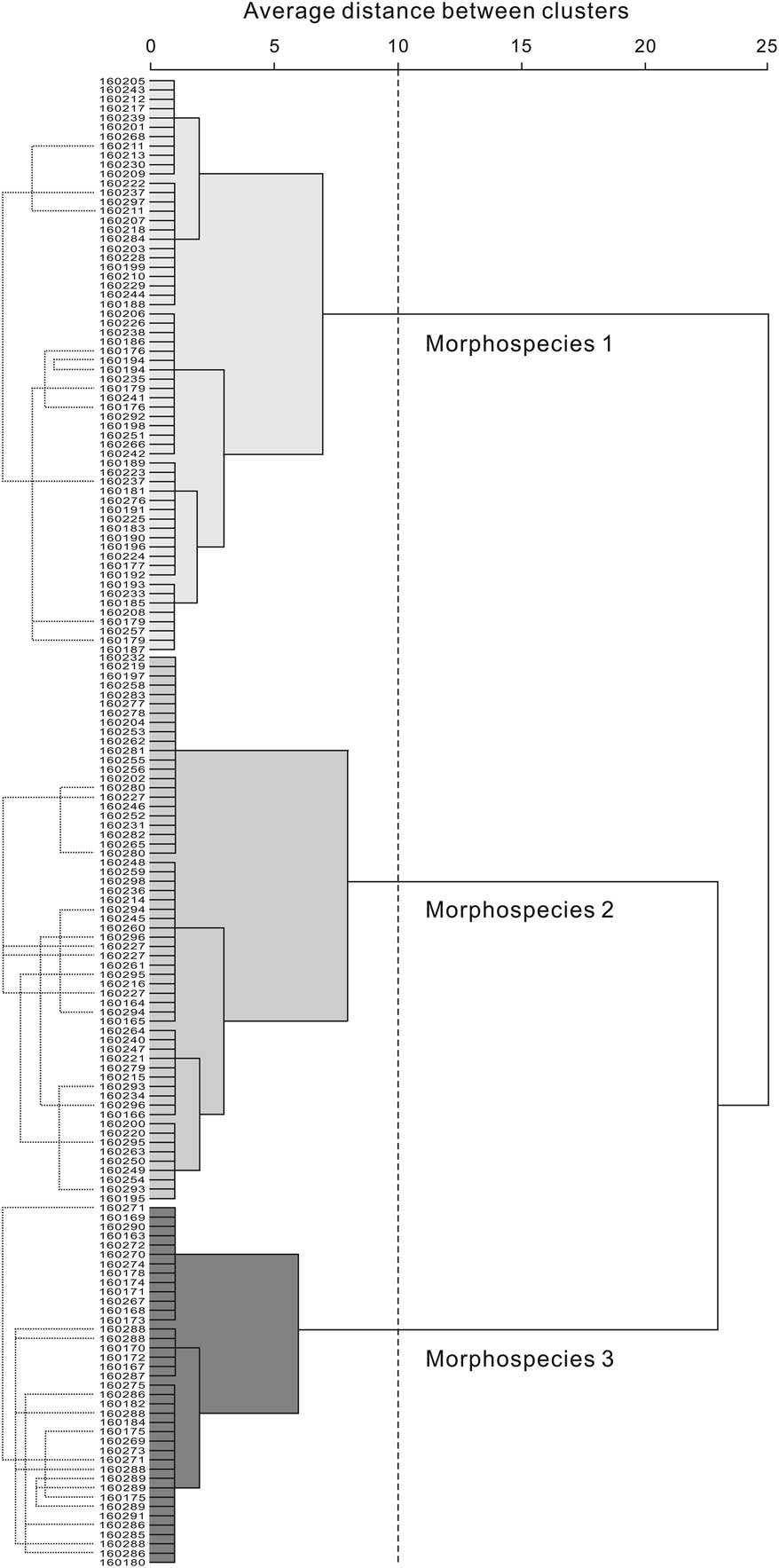
The correlation analysis reveals that some morphological characters in the raw data set show strong relations (Table 4). This suggests that the characters may be dependent on each other, which may be detrimental to producing meaningful results using cluster analysis. Assuming that principal components extracted from PCA are theoretically uncorrelated (Jackson, Reference Jackson1991; Jolliffe, Reference Jolliffe2002), the cluster analysis was performed for the score matrix of the first three principal components, which account for 91.5% of the total variance (Table 5). Pearson correlation distances were calculated to demonstrate the closeness and similarities of the coralla. The unweighted pair-group method using arithmetic average (UPGMA) was also employed to cluster the coralla. The equivalent dendrogram from the cluster analysis displays the presence of three major clusters at a relative average distance of 10 (Fig. 6). The three major clusters are considered to be effective because the 16 original coralla and their corresponding 24 replicates are correlated into the same clusters. This indicates that the three clusters are independent of each other; the nested smaller clusters within the three major clusters are connected with one another by the original coralla and their corresponding replicates. The three major clusters are named morphospecies 1–3.
Cluster analysis of 136 coralla of Catenipora (identified by NIGPAS numbers) and 24 replicates based on the principal component score matrix with 11 morphological characters. Dashed line indicates recognition of three major clusters (morphospecies 1–3) at relative average distance 10 between clusters. To the left of the specimen numbers, lines link coralla and their replicates that are split within and/or between small clusters within the three major clusters.

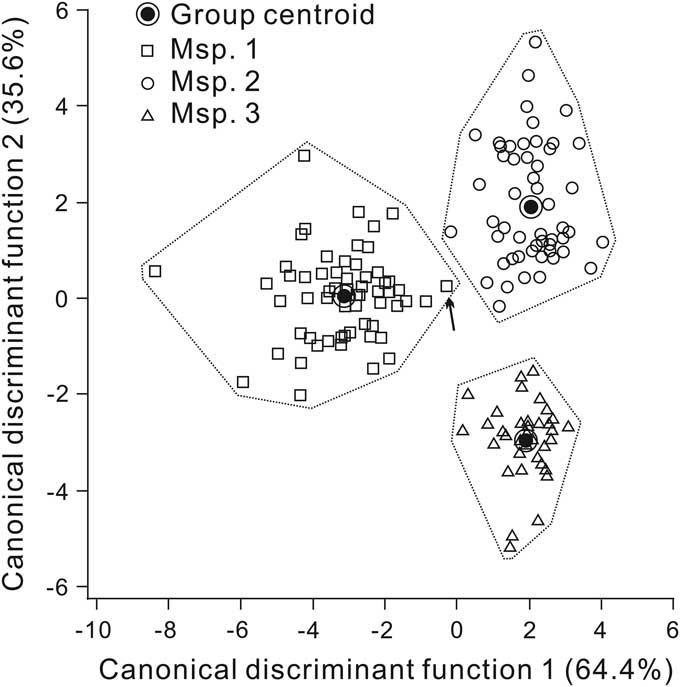
Canonical discriminant analysis using the 11 original morphological characters (V1–V11) was performed to find linear combinations of characters, which best summarize the differences among the three morphospecies. Two canonical discriminant functions, accounting for 100% of the variance, were obtained; functions 1 and 2 explain 64.4% and 35.6% of the variance, respectively (Fig. 7). Canonical discriminant scores for each corallum, computed using the coefficients of the canonical discriminant function, show the discrimination of three morphospecies. The result suggests that the three morphospecies extracted from cluster analysis are distinguishable from each other based on the 11 morphological characters. Another discriminant analysis using resubstitution and cross-validation methods was performed to calculate probabilities of misclassification in each morphospecies. The pooled covariance matrix was used in calculating the squared Mahalanobis distances between the morphospecies from which the discriminant function was computed. The analysis by resubstitution method using the linear discriminant function demonstrates that all but one of the 136 coralla of the three morphospecies were correctly classified into their a-priori morphospecies (see arrow in Fig. 7). The misfit corallum, however, was still clustered within morphospecies 1 because the average values for its morphological characters are closer to those of morphospecies 1 than morphospecies 2. Discriminant analysis supports the classification scheme generated by the cluster analysis.
Plot of canonical discriminant scores of 136 coralla of Catenipora using two canonical discriminant functions, showing morphospecies 1–3 (Msp., morphospecies). Arrow points to one corallum, which is not correctly classified to its a-priori morphospecies under the cross-validation method.

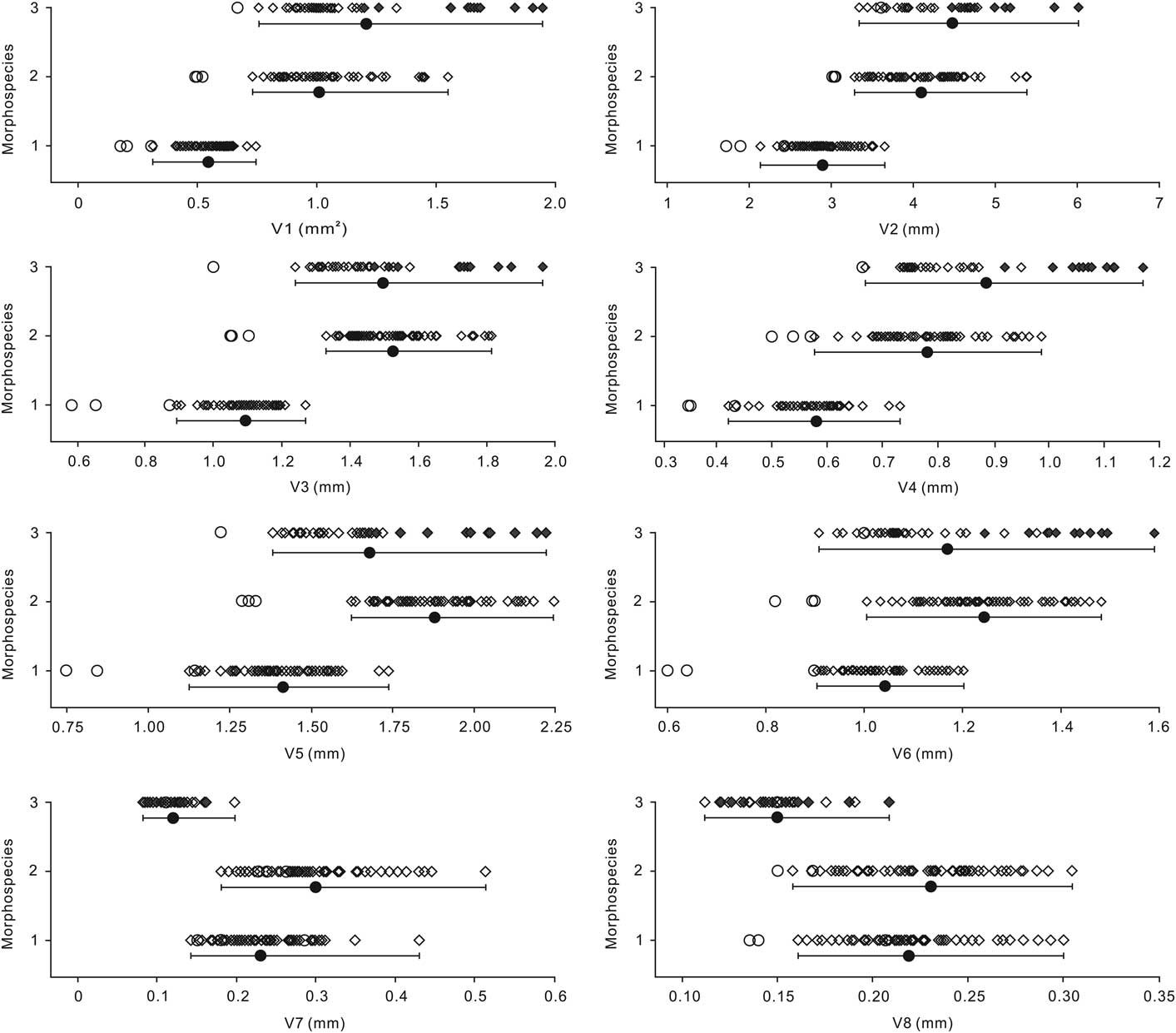
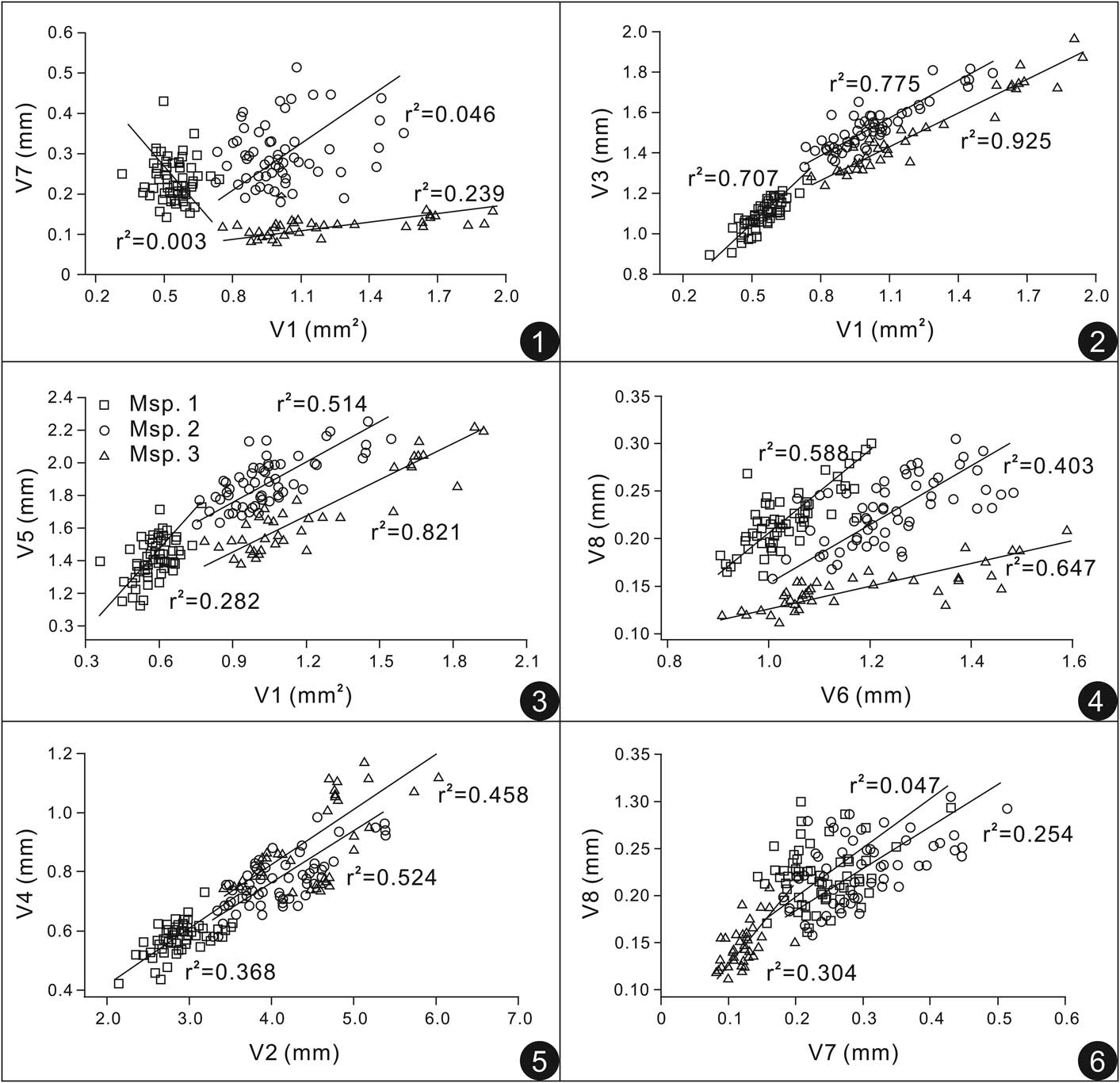
Descriptive statistics of morphological characters V1–V8 were calculated for the three morphospecies represented by 136 coralla. For each character, the overall average values for the three morphospecies are distinctive (Fig. 8). The ranges of average values for the coralla of each morphospecies, however, partially overlap in most cases, especially between morphospecies 2 and 3 (Fig. 8). Based on the morphological characters that show minimal overlap of ranges among the three morphospecies, tabularium area (V1) is the most valid character for distinguishing morphospecies 1 from the other two, and common wall thickness (V7) is most valid for distinguishing morphospecies 3 from the other two. Therefore, tabularium area and common wall thickness are most useful for distinguishing the three morphospecies (Fig. 9.1).
Variation of eight morphological characters (V1–V8; see Table 1 for abbreviations) for morphospecies 1–3 of Catenipora (each corallum is represented by a rhombus, which is shaded for coralla of morphospecies 3 from interval CI-1; solid circles and lines represent overall averages and ranges for each morphospecies, respectively; open circles represent types and/or figured specimens of C. zhejiangensis, C. shiyangensis, and C. dianbiancunensis, which correspond to morphospecies 1–3, respectively).

(1–6) Selected bivariate plots of morphological characters (V1–V8; see Table 1 for abbreviations) based on morphospecies 1–3 of Catenipora resulting from cluster analysis (identification of symbols shown in (3); Msp., morphospecies; each point on a plot represents a corallum; r, Pearson correlation coefficient).

Bivariate plots with r² (r, Pearson correlation coefficient) were also prepared to evaluate character variability among the three morphospecies (Fig. 9). Among morphological characters V1–V8, V1–V6 in each morphospecies have strong positive correlations, and the close similarity between morphospecies 2 and 3 is apparent in three plots (Fig. 9.2, 9.3, 9.5). Given the relationship among these characters, they are considered uninformative for discriminating morphospecies 2 and 3. In comparison, a combination of any characters from V1–V6 with V7 or V8 shows the relative distinctiveness of the three morphospecies (Fig. 9.1, 9.4). A plot of V7 and V8 demonstrates that morphospecies 3 is easier to identify, whereas morphospecies 1 and 2 almost completely overlap (Fig. 9.6). In general, the bivariate plots show differences in the variability of the three morphospecies for some morphological characters, which are useful in distinguishing the morphospecies from each other. The differences of these eight characters among the three morphospecies are considered to be informative and the morphological variation within each morphospecies is significant.
Identification of morphospecies
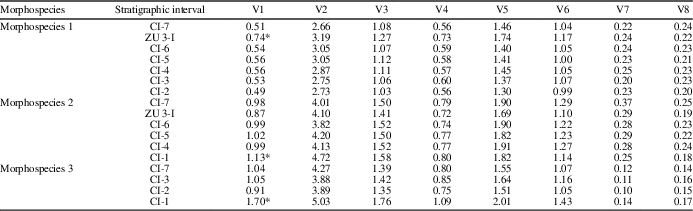
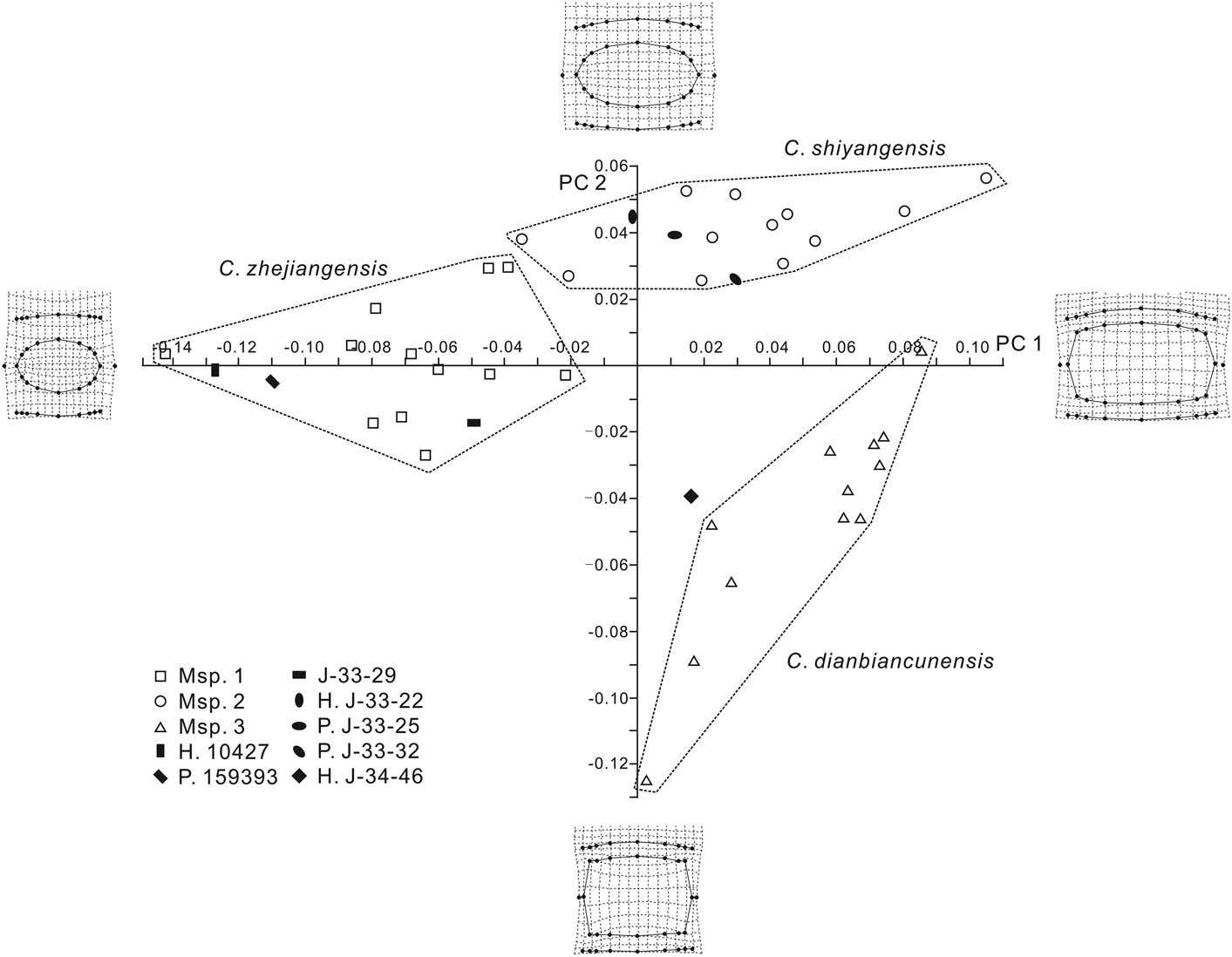
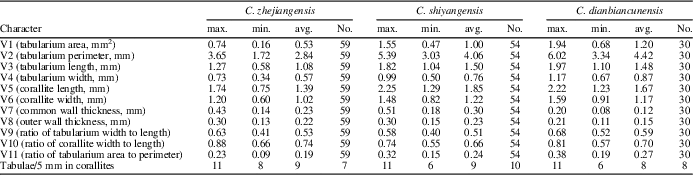
The three morphospecies were compared with similar forms occurring elsewhere in the JCYT. Data are from seven types and/or figured specimens representing three species of Catenipora reported from the unnamed Upper Ordovician strata in Shiyangwei and the mid-upper Sanqushan Formation in Shiyang and Dianbian, approximately 15 km northeast of Zhuzhai (Fig. 1.1; Table 3). According to Yu et al. (Reference Yu, Bian, Huang, Chen, Fang, Zhou and Shi1992), the uppermost Sanqushan Formation is correlative with the Xiazhen Formation exposed at Zhuzhai. Therefore, the types and/or figured specimens are considered to be stratigraphically equivalent to or slightly lower than the Catenipora coralla at Zhuzhai. Based on a preliminary qualitative morphological inspection, especially regarding the shape of corallites and lacunae, morphospecies 1–3 were considered to be comparable with the types and/or figured specimens of C. zhejiangensis Yu in Yu et al., Reference Yu, Wu, Zhao and Zhang1963, C. shiyangensis Lin and Chow, Reference Lin and Chow1977, and C. dianbiancunensis Lin and Chow, Reference Lin and Chow1977, respectively. For statistical analysis, the selected eight morphological characters (V1–V8; see Table 1) were measured on the seven types and/or figured specimens (Table 6). The average values related to corallite size for holotype 10427 and J-33-29 of C. zhejiangensis (V1–V6) differ from morphospecies 1 in being lower, but the common wall thickness (V7) is within the intraspecific variation of morphospecies 1 (Table 6; Fig. 8). However, the average values of V1–V8 for paratype 159393 of C. zhejiangensis are within or very close to the range of intraspecific variation of morphospecies 1 (Table 6; Fig. 8). The average values of size-related characters (V1–V6) for the type specimens of C. shiyangensis are lower than those of morphospecies 2, but the common wall thickness (V7) is within the intraspecific variation of morphospecies 2 (Table 6; Fig. 8). The average values of tabularium area (V1), tabularium length (V3), and corallite length (V5) calculated for holotype J-34-46 of C. dianbiancunensis are lower than those of morphospecies 3, but most characters (V2, V4, V6–V8) are within the intraspecific variation of morphospecies 3 (Table 6; Fig. 8).
Average values of eight morphological characters (V1–V8; see Table 1 for abbreviations and units) for seven types and/or figured specimens of three Catenipora species reported from the Upper Ordovician of the JCYT (H., holotype; P., paratype).

The corallite size of specimens representing a species of Catenipora might be expected to show some differences at different stratigraphic positions and geographic locations. For example, the average values of size-related characters (V1–V6; see Table 1) for coralla of morphospecies 3 in interval CI-1 at sub-section ZU 2 are distinctly higher than for those in the other intervals and sub-sections of the Xiazhen Formation at Zhuzhai (Table 7; Figs. 2, 8). The discrepancy in corallite size of specimens from different intervals and/or locations is considered to reflect intraspecific genetic differences and/or environmental differences.
Average values of eight morphological characters (V1–V8; see Table 1 for abbreviations and units) for three morphospecies of Catenipora in stratigraphic intervals of the Xiazhen Formation at Zhuzhai. Asterisks indicate stratigraphic intervals where tabularium area (V1) of morphospecies is largest.

To determine whether morphospecies 1–3 correspond to C. zhejiangensis, C. shiyangensis, and C. dianbiancunensis, landmark-based geometric morphometric analysis was conducted. This was based on 12 well-preserved coralla selected to represent each of the three morphospecies (total 36 coralla) and seven types and/or figured specimens representing the three species, focusing on their shape comparisons. Thirty-six landmarks were captured for the shape of each corallite (Fig. 4). Using the Procrustes superimposition, the raw landmark positions were transformed into shape coordinates, which were processed for the subsequent principal component analysis. A plot of the first two principal components, which account for 93.8% of the total variation among the coralla, shows clear separation of the three morphospecies (dashed polygons in Fig. 10). The classification of all coralla into their morphospecies is consistent with the result of the previous traditional morphometric analysis. The shape variation along the first principal component is strongly correlated with the ratio of tabularium width to length, common wall thickness, and outer wall thickness. The second principal component is strongly correlated with the shape of the tabularium, common wall thickness, and outer wall thickness. All the types and/or figured specimens of C. zhejiangensis and C. shiyangensis are located within the variation of morphospecies 1 and 2, respectively, suggesting the equivalency of corallite shape between the morphospecies and types and/or figured specimens (Fig. 10). The type specimen of C. dianbiancunensis is located outside, but close to, the variation of morphospecies 3 (Fig. 10). Therefore, it is considered that the corallite shape of morphospecies 3 is correlated to the type specimen of C. dianbiancunensis.
Results of principal component analysis on shape coordinates of 36 coralla selected from morphospecies 1–3 from the Xiazhen Formation at Zhuzhai and seven types and/or figured specimens of three Catenipora species from the JCYT (see Table 3; Msp., morphospecies; H., holotype; P., paratype). Principal components 1 (PC 1) and 2 (PC 2) represent 66.08% and 27.72%, respectively, of total variation among superimposed coralla and types and/or figured specimens. Variation of corallite shape associated with negative and positive ends of PC 1 and PC 2 are illustrated by deformation grids.

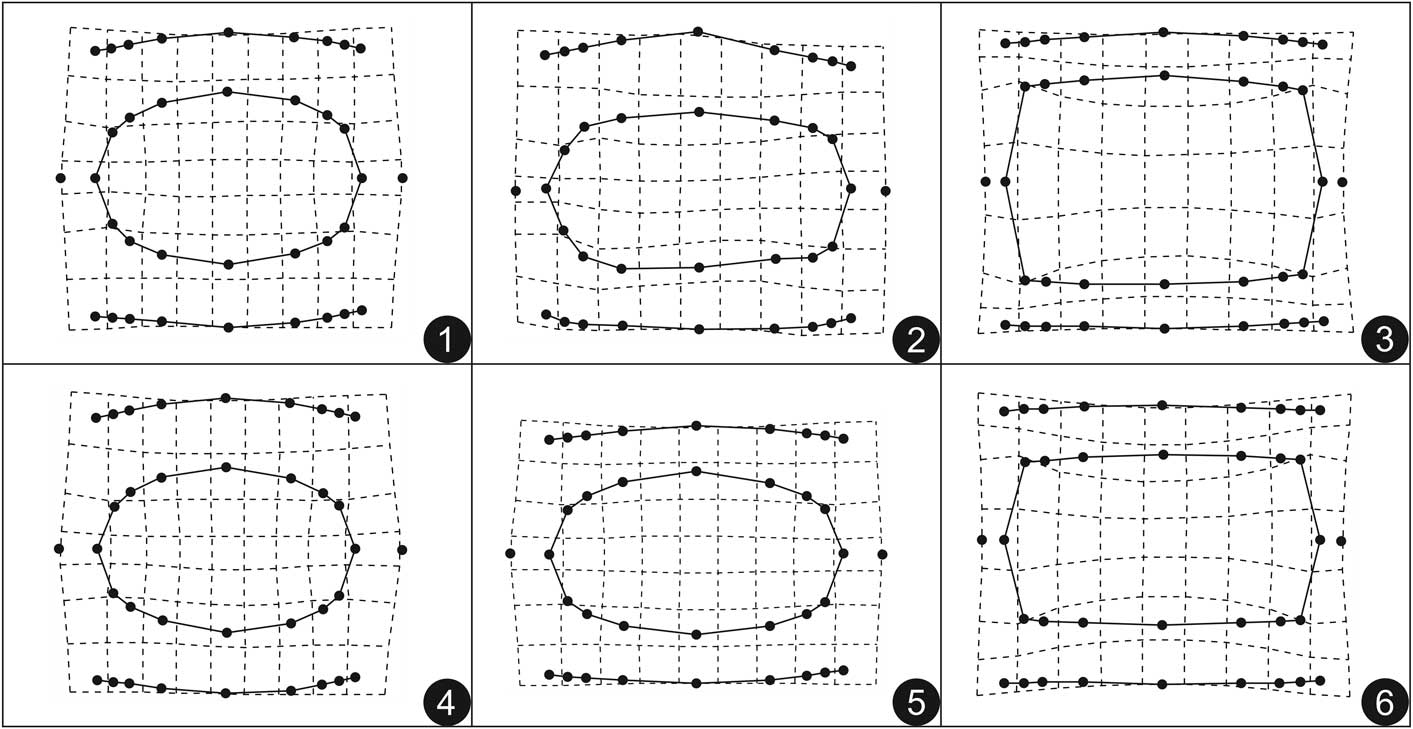
The similarities and differences among the three morphospecies and corresponding species of Catenipora were visualized by thin-plate spline (TPS) transformation. The grids in TPS show the deformation of the mean shape of morphospecies and species (Fig. 11) with respect to the consensus shape of all the coralla and types and/or figured specimens. The comparison of their deformation reveals that the corallite shape of morphospecies 1 is similar to that of C. zhejiangensis, morphospecies 2 to C. shiyangensis, and morphospecies 3 to C. dianbiancunensis.
Mean shape of morphospecies (1–3) from the Xiazhen Formation at Zhuzhai and Catenipora species (4–6) from the JCYT (see Table 3) as seen by thin-plate spline (TPS) transformations: (1) mean shape of 12 coralla of morphospecies 1; (2) mean shape of 12 coralla of morphospecies 2; (3) mean shape of 12 coralla of morphospecies 3; (4) mean shape of three types and/or figured specimens of C. zhejiangensis; (5) mean shape of three type specimens of C. shiyangensis; (6) shape of type specimen of C. dianbiancunensis.

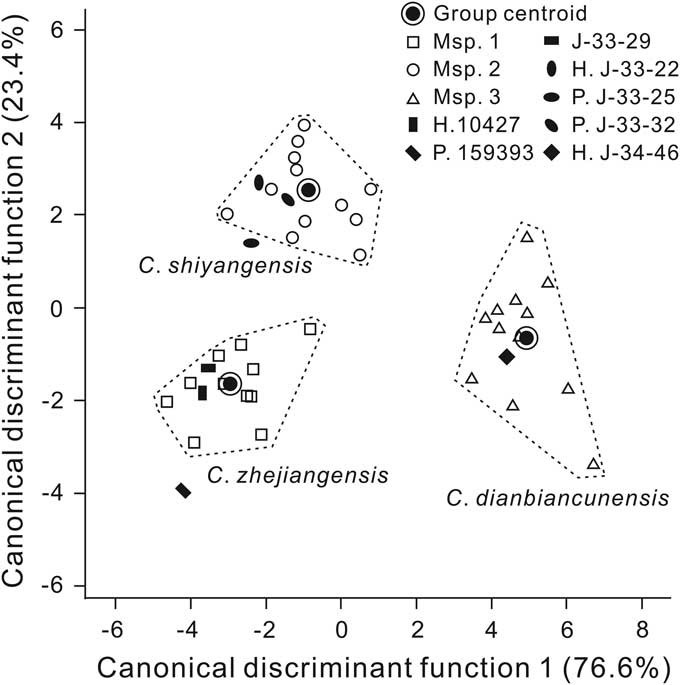
To compare both shape and size between the morphospecies and species, a canonical discriminant analysis was performed for the mean shape coordinates and the average centroid size of the 36 coralla and seven types and/or figured specimens. The plot of canonical discriminant functions 1 and 2, which accounts for 100% of the variance, demonstrates clear separation of the three morphospecies (dashed polygons in Fig. 12). All the coralla are clustered within the range of their corresponding morphospecies. Holotype 10427 and J-33-29 of C. zhejiangensis are within the range of variation of morphospecies 1 and close to the group centroid. Paratype 159393 of C. zhejiangensis is located outside morphospecies 1, but closer to the centroid of morphospecies 1 than to the others. Holotype J-33-22 and paratype J-33-32 of C. shiyangensis are within the range of variation of morphospecies 2 and close to the group centroid. Paratype J-33-25 of C. shiyangensis is located immediately outside morphospecies 2, but closer to the centroid of morphospecies 2 than to the others. Holotype J-34-46 of C. dianbiancunensis is within the range of variation of morphospecies 3 and close to the group centroid. The result of the canonical discriminant analysis indicates that morphospecies 1–3 correspond to C. zhejiangensis, C. shiyangensis, and C. dianbiancunensis, respectively, with regard to both corallite shape and size.
Discriminant analysis combining shape coordinates and centroid size of 36 coralla of morphospecies 1–3 from the Xiazhen Formation at Zhuzhai and seven types and/or figured specimens of three Catenipora species from the JCYT (see Table 3) (Msp., morphospecies; H., holotype; P., paratype). Canonical discriminant functions 1 and 2 account for 100% of variance.

The qualitative morphological characters of coralla representing the morphospecies and types and/or figured specimens of the species were also compared. Morphospecies 1 and C. zhejiangensis possess polygonal or sub-polygonal to slightly elongated lacunae and relatively poorly developed septa. Morphospecies 2 and C. shiyangensis have elongated to meandering lacunae and generally well-developed septa. Morphospecies 3 and C. dianbiancunensis are most distinct in that no junctions of different ranks have been found; septa are extremely rare. Examinations of serial sections from coralla of morphospecies 3 reveal that the relatively long ranks are not connected with one another, but remain highly sinuous and meandering during their vertical development. It seems likely that enclosed lacunae comparable to those of other Catenipora species are truly absent in morphospecies 3 and C. dianbiancunensis, providing a valuable diagnostic character. The overall statistical results and comparisons of qualitative morphological characters lead us to conclude that morphospecies 1–3 can be identified as C. zhejiangensis Yu in Yu et al., Reference Yu, Wu, Zhao and Zhang1963, C. shiyangensis Lin and Chow, Reference Lin and Chow1977, and C. dianbiancunensis Lin and Chow, Reference Lin and Chow1977, respectively.
Systematic paleontology
Class Anthozoa Ehrenberg, Reference Ehrenberg1834
Subclass Tabulata Milne-Edwards and Haime, Reference Milne-Edwards and Haime1850
Order Halysitida Sokolov, Reference Sokolov1947
Family Halysitidae Milne-Edwards and Haime, Reference Milne-Edwards and Haime1849
Genus Catenipora Lamarck, Reference Lamarck1816
Type species
Catenipora escharoides Lamarck, Reference Lamarck1816 from the Silurian of Gotland, Sweden.
Catenipora zhejiangensis Yu in Yu et al., Reference Yu, Wu, Zhao and Zhang1963
Figures 13.1, 13.3, 13.5, 13.8, 14.1, 14.4, 15.2–15.4
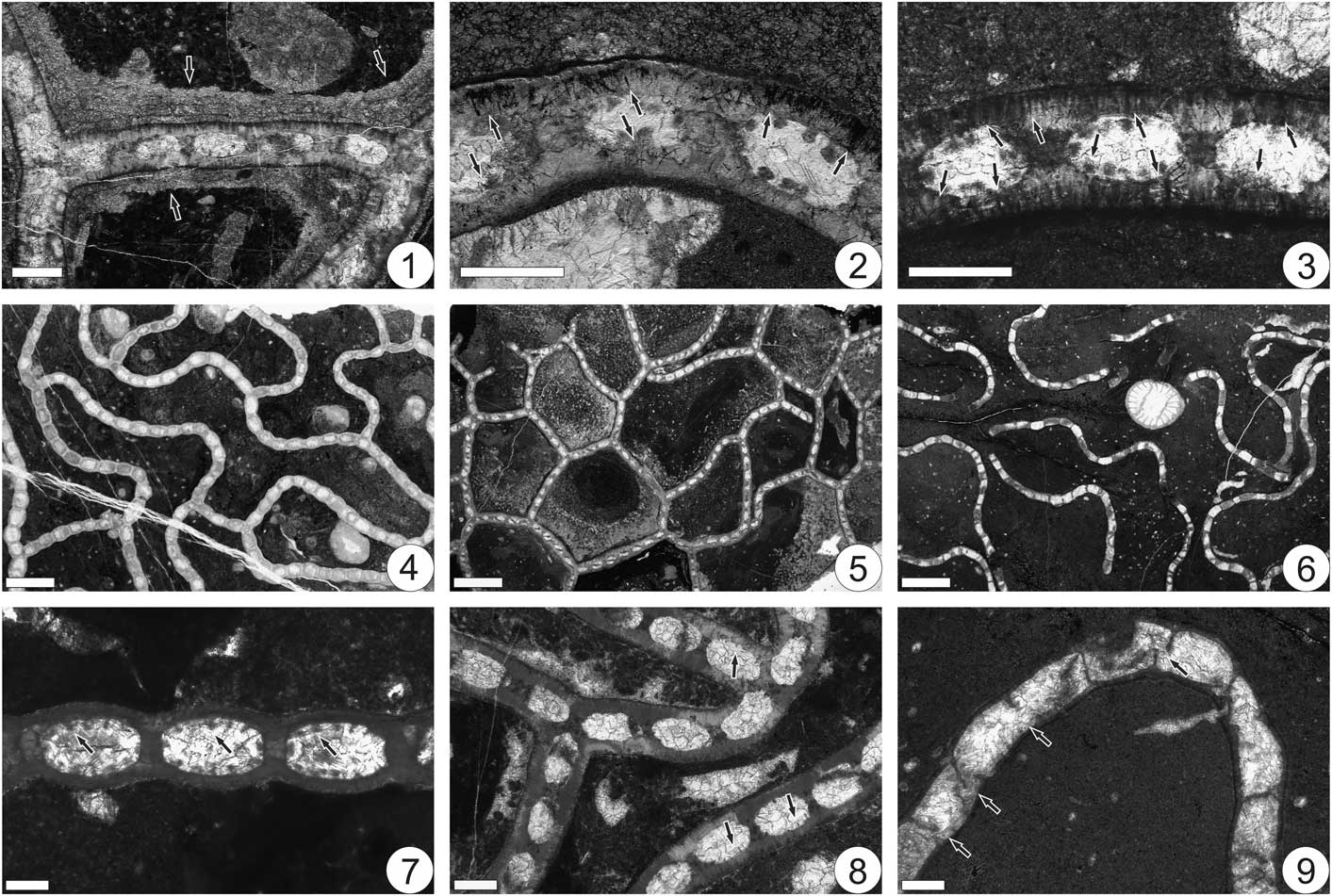
Transverse thin sections of Catenipora Lamarck, Reference Lamarck1816 from the Xiazhen Formation at Zhuzhai, South China: (1) C. zhejiangensis Yu in Yu et al., Reference Yu, Wu, Zhao and Zhang1963 from interval CI-4 showing ranks overgrown by clathrodictyid stromatoporoid (arrows), NIGPAS 160211; (2) C. shiyangensis Lin and Chow, Reference Lin and Chow1977 from CI-7 showing microborings (arrows) in the outer wall and thick septal spines, NIGPAS 160299; (3) C. zhejiangensis from CI-7 showing microborings (arrows) in the outer wall and thick septal spines, NIGPAS 160266; (4) C. shiyangensis from CI-4 showing elongated shape of lacunae, NIGPAS 160300; (5) C. zhejiangensis from CI-5 showing polygonal shape of lacunae, NIGPAS 160301; (6) C. dianbiancunensis Lin and Chow, Reference Lin and Chow1977 from CI-7 showing that there are no junctions of ranks, NIGPAS 160288; (7) C. shiyangensis from CI-4 showing well-developed septal spines (arrows), NIGPAS 160302; (8) C. zhejiangensis from CI-2 showing poorly developed septal spines (arrows), NIGPAS 160179; (9) C. dianbiancunensis from CI-7 showing rectangular shape of corallites and fusion between corallites (arrows), NIGPAS 160288; (1–3, 7–9) scale bar is 1 mm, (4–6) scale bar is 5 mm.

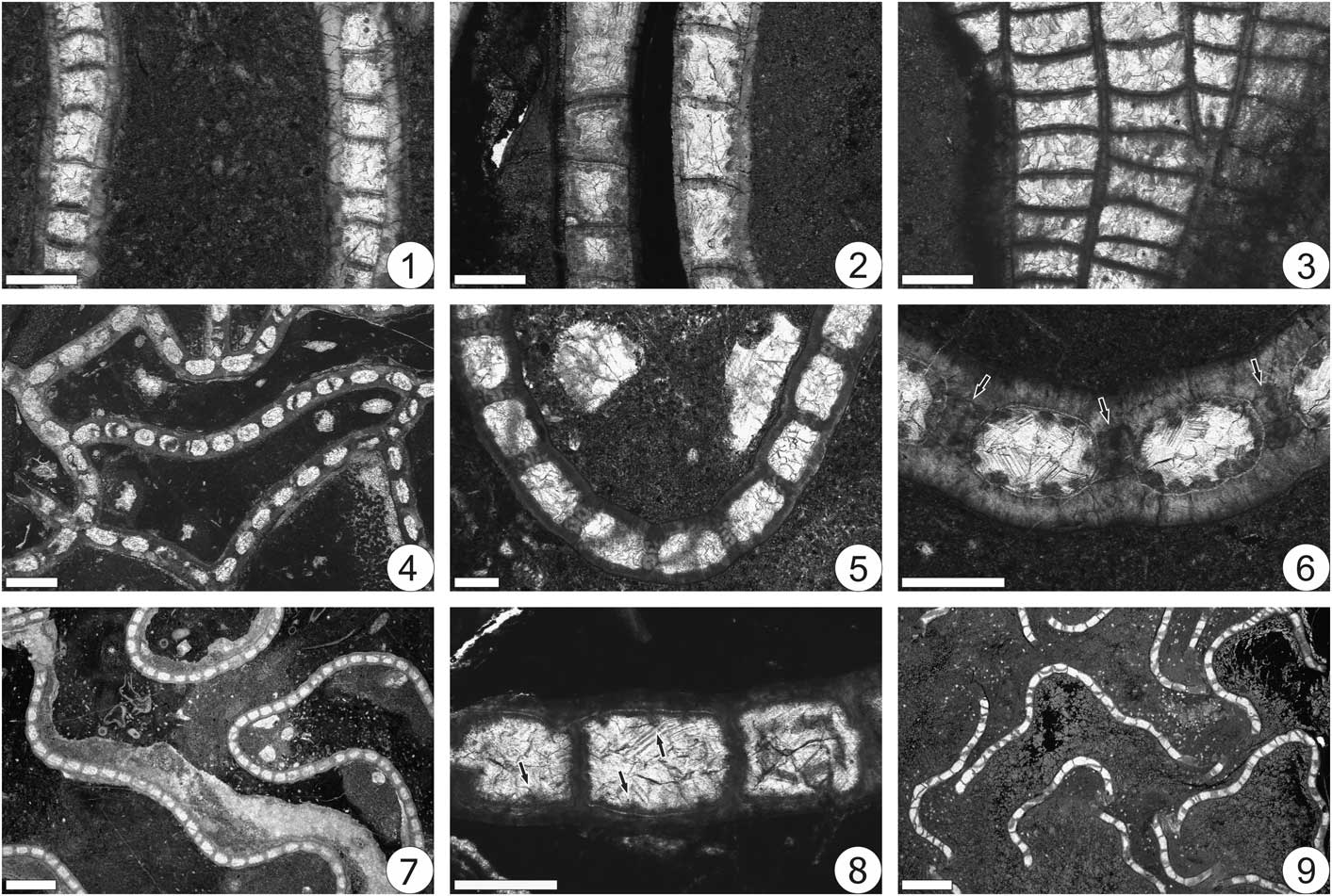
Longitudinal (1–3) and transverse (4–9) thin sections of Catenipora Lamarck, Reference Lamarck1816 from the Xiazhen Formation at Zhuzhai, South China: (1) C. zhejiangensis Yu in Yu et al., Reference Yu, Wu, Zhao and Zhang1963 from interval CI-4, NIGPAS 160303; (2) C. shiyangensis Lin and Chow, Reference Lin and Chow1977 from CI-7, NIGPAS 160304; (3) C. dianbiancunensis Lin and Chow, Reference Lin and Chow1977 from CI-7, NIGPAS 160305; (4) C. zhejiangensis from CI-2 showing elongated polygonal lacunae, NIGPAS 160179; (5) C. shiyangensis from CI-4 showing sub-rectangular tabularia, NIGPAS 160202; (6) C. shiyangensis from CI-7 showing thickened septal spines and presence of balken structure (arrows) in the common wall, NIGPAS 160282; (7) C. shiyangensis from CI-4 showing sinuous lacunae, NIGPAS 160202; (8) C. dianbiancunensis from CI-7 showing septal spines (arrows), NIGPAS 160291; (9) C. dianbiancunensis from CI-7 showing variable growth directions of the ranks, NIGPAS 160288; (1–6, 8) scale bar is 1 mm, (7, 9) scale bar is 5 mm.

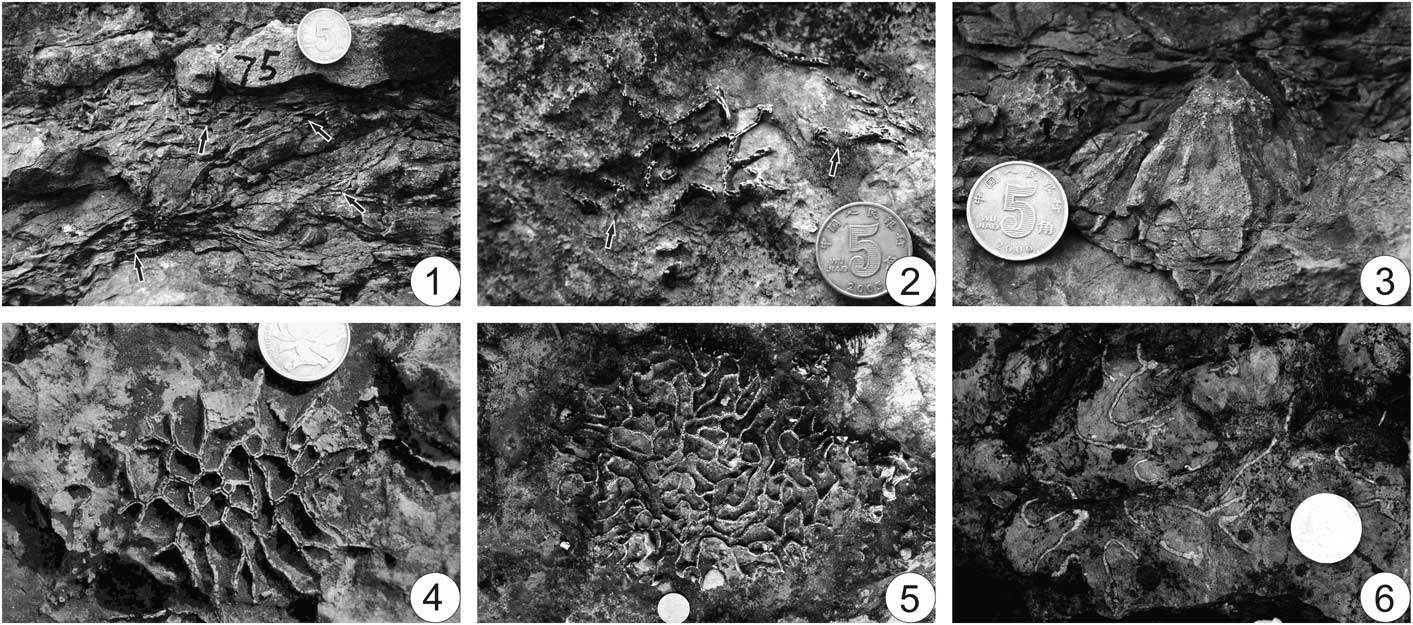
Field photographs of Catenipora Lamarck, Reference Lamarck1816 from the Xiazhen Formation at Zhuzhai, South China: (1) fragmented coralla (arrows) of C. shiyangensis Lin and Chow, Reference Lin and Chow1977 in shale of interval CI-5; (2) fragmented corallum (arrows) of C. zhejiangensis Yu in Yu et al., Reference Yu, Wu, Zhao and Zhang1963 in CI-2; (3) overturned corallum of C. zhejiangensis in CI-5; (4) corallum of C. zhejiangensis in CI-4; (5) corallum of C. shiyangensis in CI-5; (6) corallum of C. dianbiancunensis Lin and Chow, Reference Lin and Chow1977 in CI-7; coin diameter is 20.5 mm.

1960 Catenipora (Catenipora?) minima Reference YuYu, p. 83, pl. 9, figs. 6, 7.
1963 Catenipora (Catenipora?) zhejiangensis Yu in Reference Yu, Wu, Zhao and ZhangYu et al., p. 291, pl. 91, fig. 4a, 4b.
1977 Catenipora zhejiangensis; Reference Lin and ChowLin and Chow, p. 160, pl. 40, figs. 2a, 2b, 3a, 3b.
Holotype
NIGPAS 10427 from the Upper Ordovician at Shiyangwei, South China.
Diagnosis
In transverse section, shape of corallites ovate to elliptical; tabularium elliptical to elongated elliptical. Ranges of corallite length 0.75–1.74 mm, width 0.60–1.20 mm; tabularium area 0.16–0.74 mm2, length 0.58–1.27 mm, width 0.34–0.73 mm; common wall thickness 0.14–0.43 mm; outer wall thickness 0.13–0.30 mm. Septa poorly to relatively well developed. Balken structure present. Ranks generally of two to six corallites. Shape of lacunae polygonal, sub-polygonal, or elongated. Tabulae complete, flat or slightly concave or convex.
Occurrence
Upper Ordovician: common in Xiazhen Formation at Zhuzhai, mid to upper Sanqushan Formation at Huibu, Shiyang, and Wuguiqiao, and Upper Ordovician strata at Shiyangwei, South China.
Description
Corallum discoidal, relatively small, rarely more than 10 cm in diameter and height. In transverse section, corallite and tabularium size, common wall and outer wall thickness highly variable (Table 8); shape of corallites ovate to elliptical (Fig. 13.8); shape of tabularium elliptical to elongated elliptical (Fig. 13.8); septa usually short and rare (Fig. 13.8), but relatively well developed and thick in certain stratigraphic intervals (Fig. 13.3); balken structure present in common wall (Fig. 13.3, 13.8). Ranks commonly consist of two to six corallites, but range is one to more than ten. Lacunae variable in size; shape mostly polygonal or elongated polygonal (Figs. 13.5, 14.4). Tabulae mostly complete, moderately thin, flat or slightly concave or convex (Fig. 14.1).
Descriptive statistics for morphological characters V1–V11 and spacing of tabulae for three species of Catenipora, based on coralla from the Xiazhen Formation at Zhuzhai and types and/or figured specimens from the mid to upper Sanqushan Formation at Shiyang and Dianbian, and Upper Ordovician strata from Shiyangwei, JCYT, South China (max., maximum; min., minimum; avg., average; No., number of coralla and types and/or figured specimens).

Materials
Holotype NIGPAS 10427 and paratype NIGPAS 159393 (Yu, Reference Yu1960; Yu in Yu et al., Reference Yu, Wu, Zhao and Zhang1963); both from Upper Ordovician at Shiyangwei. An additional 58 coralla were included in this study: NIGPAS 160176, 160177, 160179, 160181, 160183, 160185–160194, 160196, 160198, 160199, 160201, 160203, 160205–160213, 160217, 160218, 160222–160226, 160228–160230, 160233, 160235, 160237–160239, 160241–160244, 160251, 160257, 160266, 160268, 160276, 160284, 160292, 160297, 160301, 160303; all from the Xiazhen Formation at Zhuzhai.
Remarks
Yu (Reference Yu1960) erected C. minima for an occurrence in the JCYT. Later, he realized that the species name was occupied by Halysites minimus Tcherneychev, Reference Tchernychev1937 from the Upper Silurian of Arctic Russia, which had subsequently been transferred to Catenipora (Buehler, Reference Buehler1955) and is now referred to as C. minima (e.g., Klaamann, Reference Klaamann1966). Yu (in Yu et al., Reference Yu, Wu, Zhao and Zhang1963) considered the Chinese and Russian species to be different in corallite size and average spacing of tabulae, and therefore he renamed his Chinese species C. zhejiangensis.
The type specimens of C. zhejiangensis (holotype 10427 and paratype 159393; see Yu, Reference Yu1960; Yu in Yu et al., Reference Yu, Wu, Zhao and Zhang1963) are quite different from one another in corallite size-related characters (Table 6), suggesting significant intraspecific variation. Except for paratype 159393, the specimens described by Yu (Reference Yu1960; in Yu et al., Reference Yu, Wu, Zhao and Zhang1963) and Lin and Chow (Reference Lin and Chow1977) tend to be smaller in corallite size-related characters than the coralla of this species from the Xiazhen Formation at Zhuzhai (Table 6; Fig. 8). However, all these materials are considered to be conspecific due to the similarities in the shape of corallites, as evaluated by the principal component analysis and discriminant analysis (Figs. 10, 12) and discussed in the text. Our emended diagnosis is based on all materials.
Lin and Chow (Reference Lin and Chow1977) mentioned that septa are undoubtedly present in C. zhejiangensis. Based on our collection, septal development is quite variable. In intervals CI-2 and CI-3, septa are rare (Fig. 13.8); in CI-4 and CI-5, septal spines are commonly observed in the corallites; and in CI-7, septa are relatively well developed (Fig. 13.3). The shape of lacunae is also variable. In CI-2, CI-3, and CI-7, lacunae are relatively elongated (Fig. 14.4), whereas in CI-4, CI-5, and CI-6 they are more polygonal (Figs. 13.5, 15.4).
In comparison with C. shiyangensis and C. dianbiancunensis, C. zhejiangensis tends to have lower values of corallite size-related morphological characters, especially tabularium area (Table 8; Fig. 8). The elliptical corallites and tabularia of C. zhejiangensis are generally less elongated than those of C. shiyangensis, and differ from the rectangular corallites and tabularia of C. dianbiancunensis (Fig. 10).
Catenipora shiyangensis Lin and Chow, Reference Lin and Chow1977
Figures 13.2, 13.4, 13.7, 14.2, 14.5–14.7, 15.1, 15.5
1977 Catenipora shiyangensis Reference Lin and ChowLin and Chow, p. 161, pl. 41, figs. 1a, 1b, 2a, 2b, 3a, 3b.
Holotype
GMC J-33-22 from the Sanqushan Formation at Shiyang, South China.
Diagnosis
In transverse section, shape of corallites elongated elliptical to sub-angular; tabularium elongated elliptical to sub-rectangular. Ranges of corallite length 1.29–2.25 mm, width 0.82–1.48 mm; tabularium area 0.47–1.55 mm2, length 1.04–1.82 mm, width 0.50–0.99 mm; common wall thickness 0.18–0.51 mm; outer wall thickness 0.15–0.30 mm. Septa generally well developed; septal spines needle-like to thick, short, maximum number 12. Balken structure present. Ranks generally of five to ten corallites. Shape of lacunae sub-polygonal, elongated, sinuous. Tabulae complete, flat or slightly concave or convex.
Occurrence
Upper Ordovician: common in the Xiazhen Formation at Zhuzhai, and mid to upper Sanqushan Formation at Huibu, Shiyang, and Dianbian, South China.
Description
Corallum discoidal or irregular in shape, size variable from 5 cm in diameter and height to more than 30 cm in diameter and height. In transverse section, corallite and tabularium size, common wall and outer wall thickness highly variable (Table 8); shape of corallites elongated elliptical to sub-angular (Figs. 13.7, 14.5, 14.6); shape of tabularium elongated elliptical to sub-rectangular (Figs. 13.7, 14.5, 14.6); septa relatively poorly developed to usually well developed (Figs. 13.2, 13.7, 14.5, 14.6), up to 12 in number, variable in thickness from needle-like to thick, short (Figs. 13.2, 13.7, 14.5, 14.6); balken structure present in common wall (Figs. 13.2, 14.5, 14.6). Ranks of three to more than ten corallites, commonly five to ten. Lacunae of variable size and shape, broad, elongate, sub-polygonal, sinuous (Figs. 13.4, 14.7). Tabulae mostly complete, moderately thin, flat or slightly concave or convex (Fig. 14.2).
Materials
Fifty-five coralla: NIGPAS 160164–160166, 160195, 160197, 160200, 160202, 160204, 160214–160216, 160219–160221, 160227, 160231, 160232, 160234, 160236, 160240, 160245–160250, 160252–160256, 160258–160265, 160277–160283, 160293–160296, 160298–160300, 160302, 160304; all from the Xiazhen Formation at Zhuzhai.
Remarks
The type specimens of C. shiyangensis described by Lin and Chow (Reference Lin and Chow1977) possess smaller corallites than the coralla collected from the Xiazhen Formation at Zhuzhai (Table 6; Fig. 8). However, they are considered to be conspecific due to the similarities in the shape of corallites as evaluated by the principal component analysis and discriminant analysis (Figs. 10, 12). Our emended diagnosis is based on all materials.
Lin and Chow (Reference Lin and Chow1977) mentioned that the septa in C. shiyangensis are extremely well developed, thick, and short. Based on the collections from the Xiazhen Formation at Zhuzhai, septal development ranges from relatively poor to well developed and the thickness of the septal spines is quite variable. In addition to the elliptical tabularia mentioned by Lin and Chow (Reference Lin and Chow1977), sub-rectangular tabularia similar to those of C. dianbiancunensis are also observed (Figs. 10, 14.5). The shape of lacunae is highly variable. Some coralla from intervals CI-4, CI-6, and CI-7 possess large, sinuous lacunae (Figs. 13.4, 14.7).
Corallite size-related characters of C. shiyangensis are generally larger than those of C. zhejiangensis, especially tabularium area and length (Table 8; Fig. 8). The corallites and tabularia of C. shiyangensis are generally more elongated than those of C. zhejiangensis, and less rectangular than those of C. dianbiancunensis (Fig. 10). Catenipora shiyangensis also differs from C. dianbiancunensis in having balken structure and thicker common walls (Table 8; Fig. 8).
Catenipora dianbiancunensis Lin and Chow, Reference Lin and Chow1977
Figures 13.6, 13.9, 14.3, 14.8, 14.9, 15.6
1977 Catenipora dianbiancunensis Reference Lin and ChowLin and Chow, p. 160, pl. 40, fig. 1a, 1b, 1c.
Holotype
GMC J-34-46 from the Sanqushan Formation at Dianbian, South China.
Diagnosis
In transverse section, shape of corallites sub-angular to rectangular; tabularium sub-rectangular to rectangular or irregular. Ranges of corallite length 1.23–2.22 mm, width 0.91–1.59 mm; tabularium area 0.68–1.94 mm2, length 1.10–1.97 mm, width 0.67–1.17 mm; common wall thickness 0.08–0.20 mm; outer wall thickness 0.11–0.21 mm. Septa scarce, needle-like. Ranks commonly of more than five corallites, no junctions of different ranks. Tabulae complete, flat or slightly concave or convex.
Occurrence
Upper Ordovician: common in the Xiazhen Formation at Zhuzhai and Tashan, and from the mid to upper Sanqushan Formation at Dianbian, South China.
Description
Coralla irregular in shape, largest complete specimen 15 cm long and 10 cm wide. In transverse section, corallite and tabularium size, common wall and outer wall thickness highly variable (Table 8); shape of corallites sub-angular to rectangular (Figs. 13.9, 14.8); fusion common between corallites by an opening in middle of common wall (Fig. 13.9 arrows); shape of tabularium sub-rectangular to rectangular (Figs. 13.9, 14.8); septa scarce, needle-like, rarely thick (Fig. 14.8); common wall thin. Number of corallites per rank highly variable, usually more than five; growth directions of ranks variable (Figs. 13.6, 14.9); no junctions between ranks. Tabulae complete, flat or slightly concave or convex (Fig. 14.3).
Materials
Thirty coralla: NIGPAS 160163, 160167–160175, 160178, 160180, 160182, 160184, 160267, 160269–160275, 160285–160291, 160305; all from the Xiazhen Formation at Zhuzhai.
Remarks
As mentioned by Lin and Chow (Reference Lin and Chow1977), the coralla of C. dianbiancunensis are composed of many different ranks. However, they did not point out that there are no junctions between the ranks, which is a diagnostic feature of this species. Another notable feature is that growth direction often varies among the ranks (Figs. 13.6, 14.9). Compared with the type specimen described by Lin and Chow (Reference Lin and Chow1977), coralla from the Xiazhen Formation at Zhuzhai have larger values for corallite size-related characters, including tabularium area, length, and width, as well as corallite length (Table 6; Fig. 8). The size-related characters in coralla from interval CI-1 tend to be distinctively larger than in those from other stratigraphic intervals (morphospecies 3 in Table 7; Fig. 8). Corallite size in this species is highly variable among coralla. Our emended diagnosis is based on all materials.
Corallite size-related characters of C. dianbiancunensis tend to be larger than those of C. zhejiangensis, especially tabularium area and length (Table 8; Fig. 8). Corallites of C. dianbiancunensis typically have thinner common walls and outer walls than C. zhejiangensis and C. shiyangensis (Table 8; Fig. 8). The corallites and tabularia of C. dianbiancunensis are more rectangular than those of C. zhejiangensi and C. shiyangensis (Fig. 10).
Wang and Deng (Reference Wang and Deng2010) proposed that C. dianbiancunensis is conspecific with C. subovata Yu, Reference Yu1960 from the Middle Ordovician Taoqupo Formation in Shannxi Province, North China, based on a cluster analysis using published data. However, C. subovata displays junctions of different ranks, which are not observed in C. dianbiancunensis; it is unlikely that the two species are conspecific. Catenipora parallela Schmidt, Reference Schmidt1858, which has been identified in the Upper Ordovician Teluochipu Group at Batang, southwestern China, has disjointed chains, as mentioned by Deng and Zhang (Reference Deng and Zhang1984). However, its corallites differ in shape and size from those of C. dianbiancunensis. Klaamann (Reference Klaamann1966) mentioned that Eocatenipora parallela (= Catenipora parallela), which occurs in the Ashgill of Vormsi Island, Estonia, possesses disjointed chains, a character similar to that of C. dianbiancunensis. The shapes of corallites and tabularia of E. parallela and C. dianbiancunensis are also similar, but the size of corallites in the former species is smaller. It is likely that E. parallela and C. dianbiancunensis are closely related.
Catenipora and Eocatenipora Hamada, Reference Hamada1957 have been distinguished primarily on the basis of colony growth form. Catenipora is characterized by ranks of corallites that join to fully enclose lacunae. Eocatenipora is considered to have ranks that may or may not join, and some corallites that are distally cylindrical and unconnected to others (Hill, Reference Hill1981). Coralla of C. dianbiancunensis and E. parallela, which consist of relatively long ranks that do not join, seem to represent an end member of those two generic definitions. Further study of the range of growth forms may demonstrate that Eocatenipora is a junior synonym of Catenipora, a possibility that has been raised by previous workers (e.g., Laub, Reference Laub1979). We, therefore, follow Lin and Chow (Reference Lin and Chow1977) in assigning C. dianbiancunensis to the latter genus.
Discussion
Distribution
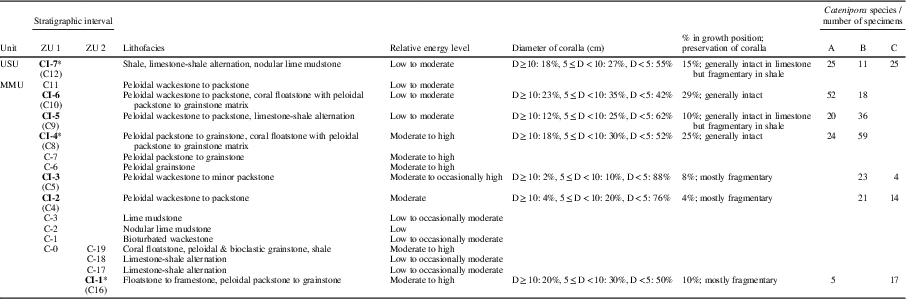
Catenipora occurs in seven stratigraphic intervals in sub-sections ZU 1 and ZU 2 and in the upper part of ZU 3-I (CI in Fig. 2), representing the middle mixed-lithology unit (MMU) and upper shale unit (USU) of the Xiazhen Formation (Fig. 2; Table 9). In interval CI-1, C. dianbiancunensis is commonly found on bedding surfaces, whereas C. shiyangensis occurs more or less scattered throughout this interval. Through intervals CI-2 and CI-3, C. zhejiangensis retains its abundance whereas C. dianbiancunensis decreases upward sharply. The majority of coralla found in CI-2 and CI-3 are overturned and fragmented (Fig. 15.2), possibly reflecting moderate-energy depositional conditions punctuated with periodic high-energy transportation followed by deposition.
Nature of stratigraphic intervals and Catenipora coralla, and distribution of species (A, C. shiyangensis Lin and Chow, Reference Lin and Chow1977; B, C. zhejiangensis Yu in Yu et al., Reference Yu, Wu, Zhao and Zhang1963; C, C. dianbiancunensis Lin and Chow, Reference Lin and Chow1977) in the Xiazhen Formation (MMU, middle mixed-lithology unit; USU, upper shale unit), sub-sections ZU 1 and ZU 2 at Zhuzhai, South China. Catenipora-bearing intervals (CI) are in bold. Asterisks indicate the presence of reefs.

The next occurrence of C. zhejiangensis is in interval CI-4, where it becomes abundant (Table 9; Fig. 15.4). Catenipora shiyangensis also reappears in CI-4, but is less common than the former species. In interval CI-5, C. zhejiangensis remains most abundant, but its predominance over C. shiyangensis decreases significantly (Table 9). Compared with interval CI-4, a greater proportion of coralla are overturned in CI-5 (Fig. 15.3). In interval CI-6, a decrease in the proportion of C. zhejiangensis is offset by a dramatic increase of C. shiyangensis. Large coralla of C. shiyangensis become abundant in the middle to upper part of this interval. There is a gradual increase in the proportion of C. shiyangensis from interval CI-4 to CI-6 (Table 9).
Above a thick shale interval in the lower part of the upper shale unit (USU), all three species of Catenipora reappear in interval CI-7, which is composed of alternating shale and limestone (Fig. 2; Table 9). Abundant C. dianbiancunensis (Fig. 15.6) and C. shiyangensis occur toward the upper part of the interval, whereas C. zhejiangensis becomes uncommon and irregularly distributed.
In addition to their occurrence in the Xiazhen Formation at Zhuzhai, C. shiyangensis and C. zhejiangensis are both present in the mid to upper Sanqushan Formation at Shiyang and Huibu (Lin and Chow, Reference Lin and Chow1977), ~15 km and ~40 km to the northeast, respectively (Fig. 1.1). Elsewhere, C. shiyangensis is known from the mid to upper Sanqushan Formation at Dianbian near Shiyang, and C. zhejiangensis occurs in the Upper Ordovician near Shiyang at Shiyangwei, and to the northwest in the mid to upper Sanqushan Formation at Wuguiqiao (Lin and Chow, Reference Lin and Chow1977). Catenipora dianbiancunensis is present at Zhuzhai and nearby in the mid to upper Sanqushan Formation at Tashan and at Dianbian (Lin and Chow, Reference Lin and Chow1977). However, C. dianbiancunensis is not observed at Huibu, suggesting that its distribution in the JCYT is limited. Coralla are much less abundant at Huibu than at Zhuzhai, with the majority of them being C. shiyangensis.
Taphonomy
Catenipora was previously reported to be the dominant reef-former in the Xiazhen Formation, with nearly 50% of the reef frameworks composed of in situ coralla (Bian et al., Reference Bian, Fang and Huang1996; Li et al., Reference Li, Kershaw and Mu2004). In the present study, however, it was found that the majority of Catenipora coralla throughout the formation are significantly fragmented and not preserved in growth position (Table 9).
The preservation potential of Catenipora is related to lithology as well as the inferred depositional energy level. A small proportion of coralla are found in growth position and they are predominantly in limestone, whereas coralla in shale are mostly fragmented because of differential compaction (intervals CI-5 and CI-7; Table 9). Such relations are ubiquitous throughout the formation and are well documented by differential preservation of coralla within limestone-shale alternations (Fig. 15.1). The effect of differential compaction is more conspicuous in cateniform coralla than other massive tabulate corals such as cerioid agetolitids or coenenchymal heliolitids.
Paleoecology
Among the three species of Catenipora in the Xiazhen Formation, C. zhejiangensis is overall the most common and widely distributed, with coralla preserved in all Catenipora-bearing intervals except for the lowest one (CI-1). Catenipora zhejiangensis is prevalent in moderate-energy calcareous deposits (CI-2 and CI-3). When C. zhejiangensis co-occurred with C. shiyangensis in low- to high-energy calcareous deposits (CI-4 to CI-6), it became subordinate to C. shiyangensis over time. With its relatively small coralla and polygonal lacunae, C. zhejiangensis appears to have been structurally sturdier than the other two species, suggesting that it was capable of remaining intact under higher energy conditions. It appears that C. zhejiangensis was capable of colonizing low- to high-energy calcareous substrates, but especially favored moderate- to high-energy environments where it could out-compete C. dianbiancunensis. However, in low- to moderate-energy environments, C. zhejiangensis was often overshadowed by C. shiyangensis. The shape of lacunae in C. zhejiangensis appears to have been more elongated under low- to moderate-energy conditions (CI-2, CI-3; Fig. 14.4) and polygonal with more or less straight chains of corallites in moderate- to high-energy environments (CI-4; Fig. 15.4). There seems to have been a corresponding increase in corallum size and improvement in the development of septa (CI-2 through CI-4).
The increasing proportion of C. shiyangensis compared with C. zhejiangensis from interval CI-4 to CI-6 indicates that C. shiyangensis became the dominant species on calcareous substrates when energy levels decreased from moderate/high (CI-4) to low/moderate (CI-6). Catenipora shiyangensis could also co-occur with C. zhejiangensis and/or C. dianbiancunensis in other low- to high-energy intervals (CI-1, CI-7). In interval CI-7, coralla of C. shiyangensis are large, with more sinuous lacunae than those from other stratigraphic intervals, and the lacunae of C. zhejiangensis are more elongated than in specimens from other intervals.
Catenipora dianbiancunensis is common in a wide spectrum of environments represented by moderate-energy (CI-2) and moderate- to high-energy calcareous deposits (CI-1), as well as low- to moderate-energy, fine-grained terrigenous substrates (CI-7). This species also occurs subordinate to C. zhejiangensis in moderate-energy calcareous deposits (CI-3). However, it appears that in such conditions, C. dianbiancunensis was relatively disadvantaged compared with C. zhejiangensis, eventually giving way to the latter species (CI-2 to CI-3). The absence of enclosed lacunae in C. dianbiancunensis suggests that the coralla were structurally relatively weak and would have been easily broken in high-energy conditions. This is supported by the fact that most coralla of C. dianbiancunensis are found as fragments in the Xiazhen Formation. Based on its occurrence, it is suggested that C. dianbiancunensis was an opportunistic species capable of colonizing both calcareous and terrigenous substrates under low- to high-energy conditions. In the case of moderate-energy calcareous substrates, however, the species tended to be displaced by C. zhejiangensis, which had a more durable corallum structure with ranks that joined to form enclosed lacunae. Nevertheless, despite the fragility of its corallum, C. dianbiancunensis was dominant in the moderate- to high-energy conditions of CI-1, where C. zhejiangensis was absent and C. shiyangensis was uncommon.
The occurrence of Catenipora is related to depositional environments representing favorable conditions for the development of its species. Many fossils, including agetolitid tabulate corals, tryplasmatid rugose corals, and clathrodictyid stromatoporoids (see Lee et al., Reference Lee, Park, Woo, Kwon, Lee, Guan, Sun, Lee, Liang, Liu, Rhee, Choh, Kim and Lee2012), are common in Catenipora-bearing intervals such as C4, C5, C8–C10, and C12. They are also present in some other stratigraphic intervals where Catenipora is not observed, including C17, C18, C19/C0, C1–C3, C6, C7, and C11. This suggests that the occurrence of Catenipora is relatively limited. Species of Catenipora at Zhuzhai mostly occur in wackestone to grainstone, representing shallow subtidal calcareous substrates. The presence of extensive microborings, especially within coralla of C. shiyangensis and C. zhejiangensis in interval CI-7 (Fig. 13.2, 13.3), may indicate a drastically reduced sedimentation rate, which prolonged the exposure of coralla to endolithic algae. On the other hand, microborings are less common in C. dianbiancunensis, possibly because coralla of this species were often fragmented and thus less influenced by microboring activities (cf., Elias and Lee, Reference Elias and Lee1993).
Paleoecological implications
Catenipora is one of the most common tabulate genera in the study area at Zhuzhai. Its close association with a variety of different organisms throughout the Xiazhen Formation, such as agetolitid and heliolitid colonial corals as well as stromatoporoids, probably indicates a broad ecological tolerance. Coralla of Catenipora are commonly overgrown by stromatoporoids (Fig. 13.1). The three species of Catenipora are found in various lithofacies representing a wide range of depositional environments (Table 9). They are therefore considered to have been capable of survival under a variety of conditions (Yu et al., Reference Yu, Bian, Huang, Chen, Fang, Zhou and Shi1992). Catenipora could possibly baffle fine-grained sediments as a result of its palisade-like ranks and open lacunae, in which sediment could accumulate (e.g., Lee and Elias, Reference Lee and Elias1991; Copper and Jin, Reference Copper and Jin2012). Thus, it was potentially important for the formation of coral-stromatoporoid reefs that are found in three stratigraphic intervals (Table 9).
Stasinska (Reference Stasinska1967) mentioned that the average dimensions and shapes of lacunae are rather constant and characteristic in each species of Catenipora. The shapes and sizes of lacunae in C. zhejiangensis and C. shiyangensis, however, vary distinctively in different stratigraphic intervals, suggesting that lacunae may not be a stable criterion to distinguish species of cateniform corals. This conclusion is in accord with the variations of lacunae in C. escharoides from the Silurian of Gotland (Lee and Noble, Reference Lee and Noble1990). Besides lacunae, the high variation in shape and size of the tabularium and septal development in C. zhejiangensis, C. shiyangensis, and C. dianbiancunensis suggests that intraspecific variation in species of Catenipora is likely underestimated. Therefore, an examination using comprehensive criteria on the large number of species of Catenipora reported on a global scale from the Ordovician and Silurian (e.g., Hubmann, Reference Hubmann1991) seems to be necessary.
Species of Catenipora that occur together in the same strata and locality have different shapes and/or sizes of corallites, and/or different shapes and/or types of lacunae, reflecting differences in their polyps and colony growth patterns. The presence of multiple co-occurring species of the same genus suggests that their accommodation involved niche partitioning. A previous study of niche partitioning in Silurian reefs (Watkins, Reference Watkins2000) showed that morphospace involving corallite size and spacing was partitioned among major taxonomic groups of tabulate corals. In the case of the Xiazhen Formation at Zhuzhai, the co-occurrence of three species of the halysitid Catenipora indicates that niche partitioning at the species level primarily involved the size of corallites and shape of lacunae.
It is suggested that species of Catenipora at Zhuzhai lived in a relatively quiet lagoonal environment, but were affected by occasional storm events. The intraspecific differences in corallite size at various localities in the JCYT may indicate responses to local environmental factors, but may also reflect genetic differences among populations if there was limited connection due to poor water circulation. Yan et al. (Reference Yan, Chen, Wang, Wang and Wang2009) noted that in the latest Ordovician, there were numerous sub-depressions and sub-highs on the Yangtze Platform of South China. They presented geochemical evidence suggesting that water circulation in a sub-depression was relatively restricted. Such conditions may also have occurred on the Jiangnan Slope adjacent to the Yangtze Platform, leading to differences among coral populations in the JCYT. A high degree of differentiation and endemism has been noted in Ordovician brachiopod faunas of South China (Zhan et al., Reference Zhan, Zhang and Yuan2008).
The paleoecology and intraspecific variation of species of Catenipora from the JCYT are comparable to those reported from other regions of the world, but also have their own distinctive features. Lee and Elias (Reference Lee and Elias1991) and Bae et al. (Reference Bae, Lee and Elias2006b, Reference Bae, Elias and Lee2013) studied the growth of species of Catenipora from the Selkirk Member of the Upper Ordovician Red River Formation in southern Manitoba, Canada. They found that characteristics of the species were closely related to sedimentation rate. It was noted that rapid regeneration following partial mortality was very common (Lee and Elias, Reference Lee and Elias1991). Such a feature is not obvious at Zhuzhai, where many coralla are observed to be fragmented due to high-energy environments, indicating relatively low strength of the coralla to resist breakage. In addition, the intraspecific variation in corallite size of the three Zhuzhai species appears to be greater than in the four species from Manitoba. Comparisons of the two localities suggest that species of Catenipora had strong ability to adapt to the local environments in which they lived.
Conclusions
Species of Catenipora in the Upper Ordovician Xiazhen Formation at Zhuzhai, South China, can be distinguished and identified using a statistical procedure adopting both traditional and geometric morphometrics. Cluster analysis based on major principal components extracted from 11 morphological characters yields a dendrogram showing three groups considered to be morphospecies. Discriminant analysis, descriptive statistics, and bivariate plots confirm the validity and distinctiveness of the morphospecies. Geometric morphometrics is applied to compare the morphospecies with species of Catenipora previously reported from the vicinity of Zhuzhai. Although there are discrepancies in corallite size, principal component analysis and discriminant analysis, as well as comparisons of overall morphological features, indicate that the morphospecies represent C. zhejiangensis Yu in Yu et al., Reference Yu, Wu, Zhao and Zhang1963, C. shiyangensis Lin and Chow, Reference Lin and Chow1977, and C. dianbiancunensis Lin and Chow, Reference Lin and Chow1977.
Catenipora occurs in seven stratigraphic intervals within the Xiazhen Formation at Zhuzhai. In each of the three species, morphological characters related to corallite size, septal development, and shape and size of lacunae show some variations in different stratigraphic intervals. The size and shape of corallites and lacunae are considered to be species-specific characters. However, they were affected by environmental conditions, resulting in variation related to the depositional energy level as well as lithology. In general, C. zhejiangensis is characterized by relatively small corallite size, whereas C. shiyangensis has relatively well-developed septa and elongated lacunae. Catenipora dianbiancunensis differs from the other species in having a relatively thin common wall and nearly quadrate shape of the tabularium, and lacking junctions between ranks.
The coralla of Catenipora in the Xiazhen Formation were preserved in various conditions, which were determined mainly by lithology and depositional energy level. Coralla occurring within shale were mostly fragmented by differential compaction. Coralla preserved in growth position were usually enclosed in limestone deposited under low- to moderate-energy conditions. High-energy conditions resulted in fragmentation and transportation of coralla.
The sequence of morphometric analyses employed in this study to distinguish morphospecies and identify them taxonomically is based on a large number of specimens and a combination of both traditional and geometric morphometrics. The distinction of morphospecies and confirmation of species can be conducted objectively by applying such statistical methods. These procedures should be applicable to species of Catenipora from other regions, by adding them in the morphometric analysis to test their classification and compare the differences of morphological characters. Such an approach can perhaps be extended to other Paleozoic coral genera as well.
Acknowledgments
This study was supported by grants from the National Science Foundation of China (Grant No. 41402013 and J1210006) and from the National Research Foundation of Korea (NRF-2013R1A2A2A01067612 and NRF-2014K2A2A2000787). We thank N. Sun, Y. Wang, and L. Guan for their assistance in the field and lab. We are grateful to an anonymous reviewer and editors P. Harries and B. Pratt for their constructive comments, which were helpful in improving the manuscript.
Accessibility of supplemental data
Data available from the Dryad Digital Repository: http://dx.doi.org/10.5061/dryad.qg004