Introduction
A pertinent question in management research is how firms continuously search, discover, and exploit opportunities. Entrepreneurial firms are often disadvantaged in this quest, as they frequently operate in risky or uncertain dynamic environments and on a limited resource base (Alvarez & Busenitz, Reference Alvarez and Busenitz2001; Bolívar-Ramos, Reference Bolívar-Ramos2019; Sirmon, Hitt, & Ireland, Reference Sirmon, Hitt and Ireland2007). The development and use of dynamic capabilities (DC) – a firm's capacity to create, extend, and modify its resource base – is a possible explanation of how firms can continuously undertake these processes and achieve competitive advantages (Helfat et al., Reference Helfat, Finkelstein, Mitchell, Peteraf, Singh, Teece and Winter2007; Teece, Pisano, & Shuen, Reference Teece, Pisano and Shuen1997). However, while this explanation has increasingly gained traction among a wide range of management scholars (Arndt, Reference Arndt2019; Schilke, Hu, & Helfat, Reference Schilke, Hu and Helfat2018), its extension to related fields, especially entrepreneurship, has been challenged (Galvin, Rice, & Liao, Reference Galvin, Rice and Liao2014; Zahra, Sapienza, & Davidsson, Reference Zahra, Sapienza and Davidsson2006).
We believe this inconsistency in entrepreneurship research, that is, the challenge faced in extending DC to entrepreneurship despite the huge traction in strategic management research, may exist because entrepreneurial ventures challenge the core assumptions of DC (Bolívar-Ramos, Reference Bolívar-Ramos2019; Helfat & Winter, Reference Helfat and Winter2011; Rice, Liao, Galvin, & Martin, Reference Rice, Liao, Galvin and Martin2015; Winter, Reference Winter2003). For example, entrepreneurial firms may find it difficult to afford the costs of investing in DC, or lack the required experience or routines to support such capabilities, lack slack resources for their operationalization, or may not see any benefits in their use. We propose that these inconsistencies are best reconciled by adopting a microfoundational approach and therefore adopt a dynamic managerial capability (DMC) (Adner & Helfat, Reference Adner and Helfat2003; Helfat & Martin, Reference Helfat and Martin2015) perspective to review the entrepreneurship literature.
DMC explicitly focuses on the role of founders/managers (Helfat & Martin, Reference Helfat and Martin2015; Huy & Zott, Reference Huy and Zott2018; Teece, Reference Teece2012). DMC are ‘the capabilities with which managers build, integrate, and reconfigure organizational resources and competences’ (Adner & Helfat, Reference Adner and Helfat2003, p. 1012). The role of founders/managers, individually and in teams, in orchestrating the resource management processes can potentially explain a firm's ability to continuously identify and exploit opportunities in a changing environment (Teece, Reference Teece2014, Reference Teece2018). These abilities of the founders/managers, or more explicitly identified as their cognition, human capital, and social capital, comprise both the required resources and costs incurred in driving strategic change in firms. Prior research has hinted that a focus on managers makes the construct of DMC more amenable to entrepreneurship (Helfat & Martin, Reference Helfat and Martin2015; Teece, Reference Teece2012; Zahra, Sapienza, & Davidsson, Reference Zahra, Sapienza and Davidsson2006), as analyzing capabilities from an individual-level negates the obscuring of processes underlying resource dynamization in entrepreneurial firms (Salvato & Vassolo, Reference Salvato and Vassolo2018).
We review the entrepreneurship literature through a systematic approach using bibliometric analysis on research published over the past three decades. Bibliometric assessments have been widely used in the literature and are well known for providing an objective method of study (Alegre, Berbegal-Mirabent, Guerrero, & Mas-Machuca, Reference Alegre, Berbegal-Mirabent, Guerrero and Mas-Machuca2018; Wohlgezogen, McCabe, Osegowitsch, & Mol, Reference Wohlgezogen, McCabe, Osegowitsch and Mol2020). The use of such an objective approach is significant when a field has developed over alternate, diverging perspectives (Keupp, Palmié, & Gassmann, Reference Keupp, Palmié and Gassmann2012), which is the case with DC literature (Peteraf, Di Stefano, & Verona, Reference Peteraf, Di Stefano and Verona2013). We contrast our findings utilizing the lens of DC and DMC. This allows us to highlight the advantages of utilizing DMC over DC and compare our findings with the many conversations around DC (Barreto, Reference Barreto2010; Di Stefano, Peteraf, & Verona, Reference Di Stefano, Peteraf and Verona2010; Schilke, Hu, & Helfat, Reference Schilke, Hu and Helfat2018), including in the entrepreneurship domain (Zahra, Sapienza, & Davidsson, Reference Zahra, Sapienza and Davidsson2006).
We aim to synthesize the entrepreneurship literature using the DMC lens. First, we empirically demonstrate the explanatory power of using the DMC lens to study entrepreneurial firms. We show that the use of DMC enhances the power of analysis and makes it more suitable for analyzing entrepreneurial firms. In doing so, we answer researchers' calls to link DMC with strategic changes in firms (Helfat & Martin, Reference Helfat and Martin2015; Zhou, Zhou, Feng, & Jiang, Reference Zhou, Zhou, Feng and Jiang2019). Additionally, we also contribute toward scholarly calls for ascertaining the boundary conditions of DC (Galvin, Rice, & Liao, Reference Galvin, Rice and Liao2014; Swoboda & Olejnik, Reference Swoboda and Olejnik2016). Second, we shed new light on the early stages of evolution of capabilities in new ventures (Cristofaro & Lovallo, Reference Cristofaro and Lovallo2022; Helfat & Lieberman, Reference Helfat and Lieberman2002) and the process of opportunity formation (Alvarez & Barney, Reference Alvarez and Barney2020). The entrepreneurial and learning processes in new ventures play a significant role in creating and sustaining these processes. Third, our concurrent review of entrepreneurship literature using DC highlights the limitations of the extant approaches to DC in entrepreneurship research. Our findings reveal that more than a decade after Zahra, Sapienza, and Davidsson (Reference Zahra, Sapienza and Davidsson2006), there is still limited theorization of DC within entrepreneurship. The field has instead relied on existing strategic management literature in established firms. We highlight the need to develop a multi-level theory of capabilities (Helfat & Martin, Reference Helfat and Martin2015; Kurtmollaiev, Reference Kurtmollaiev2020). Findings from our comprehensive review allow us to lay out many avenues for future research.
Theoretical motivation
DMC refers to patterns of managerial behavior that create and support resource orchestration processes toward firm value creation (Helfat & Martin, Reference Helfat and Martin2015; Huy & Zott, Reference Huy and Zott2018). These processes include the reconfiguration of a firm's resource base, including activities such as selection, investment, and deployment (Helfat et al., Reference Helfat, Finkelstein, Mitchell, Peteraf, Singh, Teece and Winter2007; Sirmon & Hitt, Reference Sirmon and Hitt2009). Prior scholars have noted that by emphasizing the behavior of managers, this construct is well-suited to analyze their entrepreneurial acts and orientation (Huy & Zott, Reference Huy and Zott2018). However, there exists an ‘inextricable link’ between DC and managerial behavior that underpins their creation and functioning or, more broadly, DMC (Helfat & Martin, Reference Helfat and Martin2015; Helfat et al., Reference Helfat, Finkelstein, Mitchell, Peteraf, Singh, Teece and Winter2007, p. 30). Therefore, we first explore this link by tracing the evolution of DC from the perspective of entrepreneurship.
In the original formulation of the DC construct, Teece, Pisano, and Shuen (Reference Teece, Pisano and Shuen1997) explicitly adopted an entrepreneurial outlook by advancing a Schumpeterian approach to rent creation. The linkage between DC and entrepreneurship was reemphasized by Teece (Reference Teece2007) in subsequent scholarship. While unearthing the microfoundations of DC, Teece (Reference Teece2007, p. 1319) observed that ‘enterprises with strong dynamic capabilities are intensely entrepreneurial.’ Despite the original and subsequent direction of this research, however, it has failed to pick up on this thread and has primarily focused on the behavior of large firms (Arndt, Reference Arndt2019; Zahra, Sapienza, & Davidsson, Reference Zahra, Sapienza and Davidsson2006). Furthermore, the growth of the DC literature has been spearheaded by two opposing views (Peteraf, Di Stefano, & Verona, Reference Peteraf, Di Stefano and Verona2013), leading to a rich, but complex and disconnected, body of research (Barreto, Reference Barreto2010).
Despite the relevance of DC to entrepreneurship research, its application has been constrained for multiple reasons. Some of the reasons outlined by the scholars include: (a) lack of acknowledgment of the role of the individual(s) or principal decision-maker(s) (Zahra, Sapienza, & Davidsson, Reference Zahra, Sapienza and Davidsson2006); (b) lack of an in-depth analysis of microprocesses and missing agency (Salvato, Reference Salvato2003; Salvato & Vassolo, Reference Salvato and Vassolo2018); (c) an explicit focus on a well-formed resource base (Townsend & Busenitz, Reference Townsend and Busenitz2015); and (d) substantial costs in the creation and use of DC (Winter, Reference Winter2003). Additionally, the role of the external environment, specifically the high environmental turbulence (typically faced by new ventures), in assessing the effectiveness of DC is also questionable (Eisenhardt & Martin, Reference Eisenhardt and Martin2000).
Over the years, scholars have attempted to integrate and reconcile the various alternative views of DC to resolve the overlapping definitions and ambiguities of the concept (e.g., Barreto, Reference Barreto2010; Helfat et al., Reference Helfat, Finkelstein, Mitchell, Peteraf, Singh, Teece and Winter2007; Peteraf, Di Stefano, & Verona, Reference Peteraf, Di Stefano and Verona2013). In order to resolve some of the incongruities, one approach used by scholars (e.g., Helfat & Peteraf, Reference Helfat and Peteraf2009; Teece, Reference Teece2007) is that of using a microfoundational perspective. By unearthing underlying components and their interactions, a microfoundational approach helps explain the creation, development, reproduction, and management of collective constructs (Felin, Foss, Heimeriks, & Madsen, Reference Felin, Foss, Heimeriks and Madsen2012). This approach renders greater clarity to constructs by resolving theoretical limitations.
Adner and Helfat's (Reference Adner and Helfat2003) introduction of DMC was intended to explain differences in the decisions and actions of firms in response to changing environments. DMC has been further delineated as (a) managerial cognition – beliefs and mental models; (b) managerial human capital – learned skills and knowledge; and (c) managerial social capital – social relationships that confer influence, control, and power (Adner & Helfat, Reference Adner and Helfat2003; Helfat & Martin, Reference Helfat and Martin2015). Originally presented as a distinct construct by Adner and Helfat (Reference Adner and Helfat2003), subsequent research has linked it closely to DC. Scholars such as Helfat and Martin (Reference Helfat and Martin2015) and Tasheva and Nielsen (Reference Tasheva and Nielsen2020) primarily view DMC as an extension to DC. Others such as Kor and Mesko (Reference Kor and Mesko2013) and Holzmayer and Schmidt (Reference Holzmayer and Schmidt2020) view it as an antecedent to firm-level capabilities. A closer look reveals that these views are more complementary than distinct. They are best understood by adopting a microfoundational perspective (e.g., Helfat & Peteraf, Reference Helfat and Peteraf2015; Levine, Bernard, & Nagel, Reference Levine, Bernard and Nagel2017). Such a perspective acknowledges how DMC can affect DC while being related to it and yet distinct.
To elaborate further: the orchestration of DC – sensing, seizing, and transforming assets – involves a key role in the part of managers (Teece, Reference Teece2007, Reference Teece2018). By highlighting the role of managers and their firm-level decisions, DMC extends our understanding of the mechanisms of DC. Empirically, studies have consistently illustrated the impact of differences between CEOs and top management on firm performance (Bowman & Helfat, Reference Bowman and Helfat2001) using variance decomposition methods. Adner and Helfat (Reference Adner and Helfat2003) further extended it to decisions directed toward change, that is, involving the use of DC. In other words, benefits conferred by DC differ based on the underlying DMC. This significant difference – attributable to the manager or the principal decision-maker(s) – has been highlighted in the entrepreneurial context (Zahra, Sapienza, & Davidsson, Reference Zahra, Sapienza and Davidsson2006). Operationalizing firm resources and routines (i.e., DC) is dependent on managers' capabilities, such as their perception of opportunities, inclination to invest, willingness to undertake change, and ability to implement it (i.e., DMC).
While the construct of DMC is fairly recent, its underlying components have been well-researched in the entrepreneurial literature. In an extensive review, Markman and Baron (Reference Markman and Baron2003) summarized that the attributes of cognition, human capital, and social capital are closely related to success in entrepreneurship. Extant research in cognition includes biases and heuristics (Baron, Reference Baron1998; Busenitz & Barney, Reference Busenitz and Barney1997), entrepreneurial alertness (Gaglio & Katz, Reference Gaglio and Katz2001), adaptive cognition (Haynie & Shepherd, Reference Haynie and Shepherd2009), collective cognition (West, Reference West2007), and effectuation (Sarasvathy, Reference Sarasvathy2001), among others. Entrepreneurial scholars investigating human capital have examined the linkage between entrepreneurship entry (Kim, Aldrich, & Keister, Reference Kim, Aldrich and Keister2006), innovation (Kato, Okamuro, & Honjo, Reference Kato, Okamuro and Honjo2015), firm survival (Gimeno, Folta, Cooper, & Woo, Reference Gimeno, Folta, Cooper and Woo1997), and firm performance (Cooper, Gimeno-Gascon, & Woo, Reference Cooper, Gimeno-Gascon and Woo1994), task- and non-task-related human capital (Becker, Reference Becker1964), among others. Social capital in entrepreneurship research has investigated the relationships between entrepreneurial orientation (Cao, Simsek, & Jansen, Reference Cao, Simsek and Jansen2012), crowdfunding (Colombo, Franzoni, & Rossi-Lamastra, Reference Colombo, Franzoni and Rossi-Lamastra2015), firm performance (Pirolo & Presutti, Reference Pirolo and Presutti2010), social networks (Hoang & Antoncic, Reference Hoang and Antoncic2003), and knowledge acquisition and learning (Yli-Renko, Autio, & Sapienza, Reference Yli-Renko, Autio and Sapienza2001), among others.
The approach of venture capitalists sums up the significance of DMC to entrepreneurial firms. Under conditions of turbulence and lack of information, which are typical of new ventures, firms are often chosen based on the quality of their management team (Kaplan & Strömberg, Reference Kaplan and Strömberg2004), even at the expense of the entrepreneurial idea and the current market conditions (Zacharakis & Meyer, Reference Zacharakis and Meyer1998). Townsend and Busenitz (Reference Townsend and Busenitz2015) argue that factors considered in such cases relate to the background and experience of the management teams, or more broadly, their DMC. The significance of DMC and its extension to DC can be better illustrated by examining the inception of an entrepreneurial firm. The life cycle of all organizational capabilities begins at the founding stage. An individual (or team of individuals) attempts to achieve some central objective through action (Helfat & Peteraf, Reference Helfat and Peteraf2003). At this stage, prior histories and specific endowments of the individual, that is, cognition, human capital, and social capital enacted through entrepreneurial leadership, constitute the only factors that influence the growth of capabilities and the development of the firm (Helfat & Lieberman, Reference Helfat and Lieberman2002). Similar to firm-level capabilities, managerial capabilities also follow a path-dependent process, drawing on a mixture of innate abilities and the past experiences of managers/owners (Beck & Wiersema, Reference Beck and Wiersema2013). As such, this leads to the development of all three components and, subsequently, firm-level capabilities over time. In other words, taken together, the two constructs explicitly link heterogeneity in managerial capabilities to heterogeneity in firm performance.
Based on our review of the extant literature, we believe there is a need to revisit the application of DC lens to the entrepreneurship field. We expect that the use of a microfoundational approach, especially using the DMC lens, will aid in moving the entrepreneurship field forward. Therefore, we undertake a systematic literature review using an objective method to see how the DMC lens has been applied to the entrepreneurship field.
Methodology
To provide an unbiased review of the evolution and current state of the field, we employ bibliometric techniques (Ramos-Rodríguez & Ruíz-Navarro, Reference Ramos-Rodríguez and Ruíz-Navarro2004). The technique is based on the premise that the references of a research paper form its foundations, upon which both theory and empirics are built. Articles with high citation figures exert a greater influence on the research of a discipline (Tahai & Meyer, Reference Tahai and Meyer1999; Wohlgezogen et al., Reference Wohlgezogen, McCabe, Osegowitsch and Mol2020), and therefore become prominent foundational articles of that discipline.
Co-citation is an objective quantitative method of ascertaining the intellectual structure of a field (Acedo, Barroso, & Galan, Reference Acedo, Barroso and Galan2006). It counts the number of times a pair of articles is jointly cited by another article. Such joint citations indicate the two articles' proximity and stronger ties. A collection of such articles is termed a ‘cluster’ and belong to the same research stream (Ramos-Rodríguez & Ruíz-Navarro, Reference Ramos-Rodríguez and Ruíz-Navarro2004).
Overall, bibliometric analysis offers three primary advantages: (1) identifying main research topics in the field and their linkages; (2) tracking the evolution and dissemination of research within the field; and (3) providing an objective method of analysis by reducing the subjectivity in classifying research using a quantitative process (Acedo, Barroso, & Galan, Reference Acedo, Barroso and Galan2006; Ramos-Rodríguez & Ruíz-Navarro, Reference Ramos-Rodríguez and Ruíz-Navarro2004).
Data and analysis
Our review attempts to cover all relevant research in DMC and DC in entrepreneurial firms. We, therefore, include all entrepreneurship journals in the ISI Web of Knowledge database. We, however, follow prior research (Barreto, Reference Barreto2010; Helfat & Martin, Reference Helfat and Martin2015) in including only the top peer-reviewed management and strategy journals. This step was necessary to restrict the large number of management journals. The entrepreneurship journals include Entrepreneurship and Regional Development (ERD), Entrepreneurship Research Journal (ERJ), Entrepreneurship: Theory and Practice (ET&P), International Entrepreneurship and Management Journal (IEMJ), International Small Business Journal (ISBJ), Journal of Business Venturing (JBV), Journal of Small Business Management (JSBM), Small Business Economics (SBE), and Strategic Entrepreneurship Journal (SEJ). Two separate searches were carried out on the ISI database using the strings: (1) (cognition OR human capital OR social capital) AND (entrepreneu*) and (2) (dynamic capabilit*) AND (entrepreneu*). We used the components of DMC to include all relevant research that may not have specifically used the term ‘dynamic managerial capabilities’ but nevertheless studied its components. A similar approach was adopted by Helfat and Martin (Reference Helfat and Martin2015) in their review of DMC. Our search covers 25 years (1990 through 2020), as the ideas established by Teece, Pisano, and Shuen (Reference Teece, Pisano and Shuen1997) were first available as a working paper in 1990.
The search yielded a total of 1,153 articles. First, we carried out a descriptive analysis of the data. Growth over the years and a preference for specific publishing outlets emerged from this analysis. Subsequently, we constructed citation and co-citation tables. This analysis helped us to determine the intellectual structure of the field by identifying the most influential (highly cited) articles and the nature of the ties between them.
Next, we carried out a factor analysis and multidimensional scaling (MDS) on the co-citation matrix. Both are a means of dimension reduction. To ensure an in-depth analysis, we restricted the matrix to the first 30 rows and columns. We extended the co-citation matrix of DMC by one unit as four articles had equal citations (at positions 27–31). The dimensions emerge in terms of comparable articles that load together as a factor. Articles that load on one factor have some component of proximity or similarity that can be ascertained and labeled by looking at the group loadings. Unlike factor analysis, MDS allows for visualization of trends, enabling easier interpretation. We identify clusters that could be distinctly mapped out in the MDS map. We also compared and contrasted those results with those from the factor analysis. Similar studies have used these two methods complementarily (e.g., Acedo, Barroso, & Galan, Reference Acedo, Barroso and Galan2006; McCain, Reference McCain1990; Ramos-Rodríguez & Ruíz-Navarro, Reference Ramos-Rodríguez and Ruíz-Navarro2004; Shafique, Reference Shafique2013).
Finally, to identify the key thematic underpinnings of the research trajectories, we analyzed the keywords of the articles. As with factor and cluster analysis, we base our analysis on the top 30 keywords of all articles published in the two domains. The keywords are representative of the major topics discussed in an article. Thus, mapping them allows us to get closer to the content. Additionally, it enables us to undertake a nuanced interpretation of the clusters.
Results
Year-wise growth
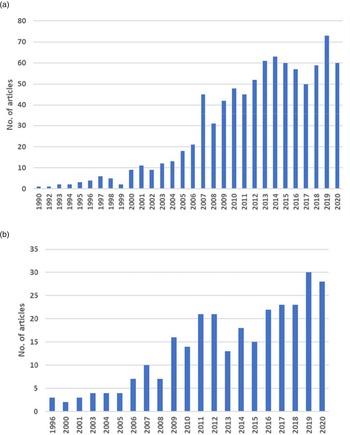
DMC traces its genesis to 1990, which is the first year in our sample. Preisendörfer and Voss (Reference Preisendörfer and Voss1990) explored the link between human capital and organizational mortality. Growth in this domain has been steady, with articles published in all the years studied (Figure 1a). The year 2007 marked a rapid increase in the number of articles published. This thrust was primarily driven by a special issue of ‘Human capital and technology’ in ET&P. The same journal had another special issue on ‘Social capital and entrepreneurship’ in 2013.
(a) DMC and entrepreneurship – year-wise growth. (b) DC and entrepreneurship – year-wise growth.
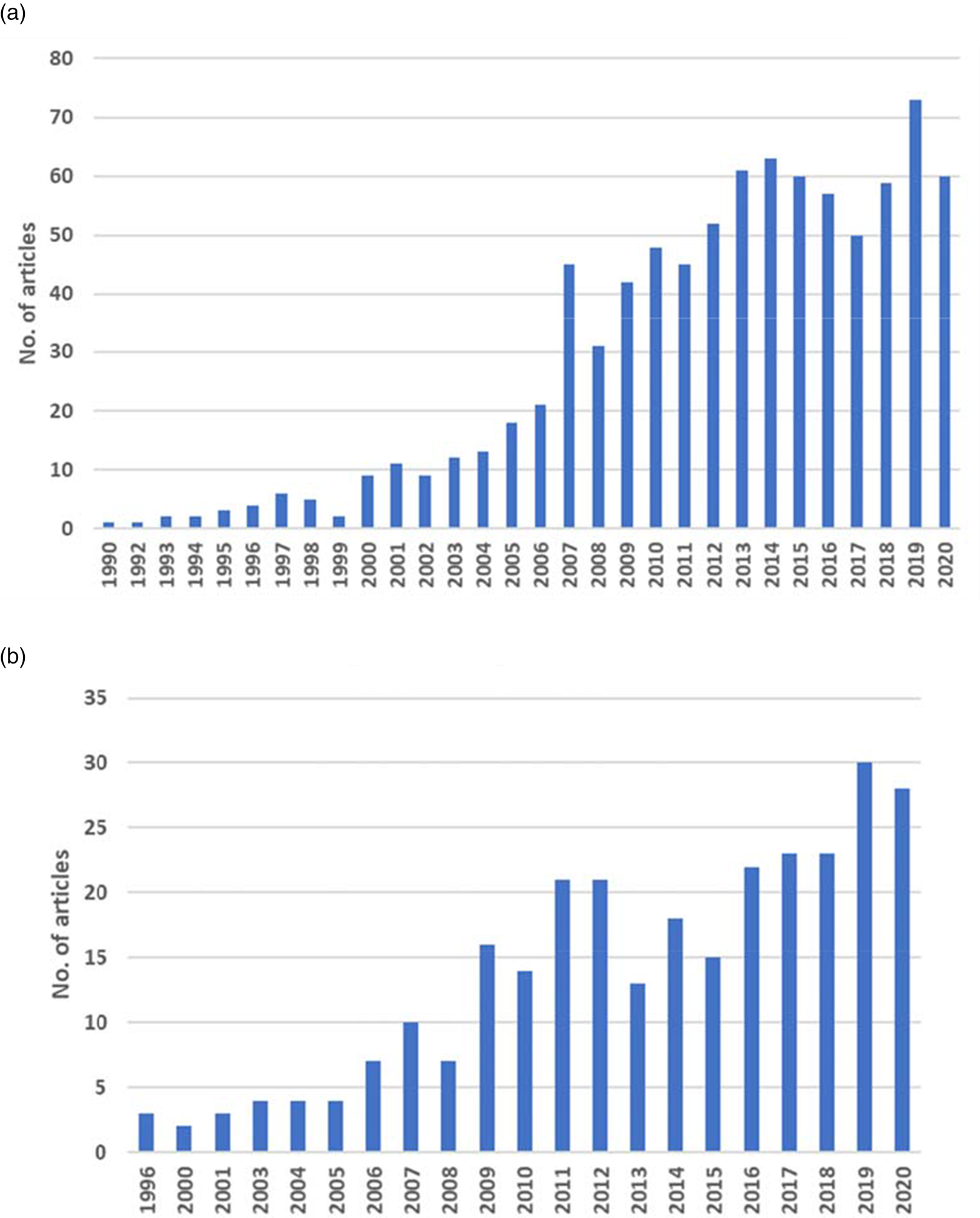
The DC literature's first foray into entrepreneurship was in 1996 (Baucus, Baucus, & Human, Reference Baucus, Baucus and Human1996; Dean & Meyer, Reference Dean and Meyer1996; Fladmoe-Lindquist, Reference Fladmoe-Lindquist1996); however, early work argued for the benefits of capabilities to be dynamic in nature without utilizing the formalized construct of DC. The first articles on entrepreneurship that utilized Teece, Pisano, and Shuen's (Reference Teece, Pisano and Shuen1997) concept of DC, as formalized in the strategic management literature, were published in 2000 (Deeds, DeCarolis, & Coombs, Reference Deeds, DeCarolis and Coombs2000; Majumdar, Reference Majumdar2000). Growth in the initial years was slow and sporadic. However, the domain has steadily evolved over the years (Figure 1b), and 2006–07 and 2011–12 marked major thrusts in the growth trajectory.
In comparing the two domains, three distinctions emerge: (a) the number of articles on DMC has been much higher (865 vs. 288), (b) published articles on DMC appear earlier, and (c) growth in the DMC domain has been steadier and more continuous (average growth rate of 25.85 vs. 20.83% discounting the first 5 years).
Publishing outlets
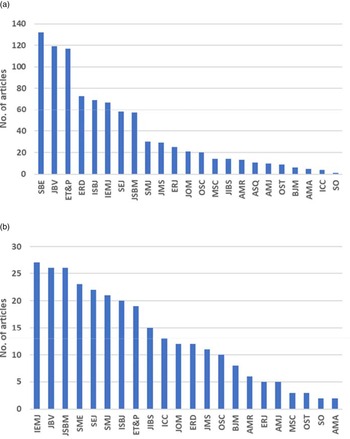
Core entrepreneurship journals are the leading outlets for published research in both DMC and DC. While SBE has a substantial lead in the DMC domain, IEMJ has a slight lead in the DC domain (Figures 2a and 2b). Other entrepreneurship journals, such as JBV, ET&P, and JSBM, follow similar trends having slight preferences for one of the two domains. For instance, while ET&P has been more receptive to DMC articles, JSBM has published more DC articles. Interestingly, while SMJ is ahead of many entrepreneurship journals in publishing DC studies, it largely follows the entrepreneurship journals in the DMC domain. Other management journals also exhibit specific preferences for one domain over the other. For instance, while ICC publishes a number of articles in the DC domain, it hardly publishes articles in the DMC domain. On the other hand, ASQ is yet to publish an article from the domain of DC and entrepreneurship while having published quite a number of articles in the domain of DMC.
(a) DMC and entrepreneurship – across journals. (b) DC and entrepreneurship – across journals. Academy of Management Annals (AMA), Academy of Management Journal (AMJ), Academy of Management Review (AMR), Administrative Science Quarterly (ASQ), British Journal of Management (BJM), Entrepreneurship and Regional Development (ERD), Entrepreneurship Research Journal (ERJ), Entrepreneurship: Theory and Practice (ET&P), Industrial and Corporate Change (ICC), International Entrepreneurship and Management Journal (IEMJ), International Small Business Journal (ISBJ), Journal of Business Venturing (JBV), Journal of International Business Studies (JIBS), Journal of Management (JOM), Journal of Management Studies (JMS), Journal of Small Business Management (JSBM), Management Science (MS), Organization Science (OSC), Organization Studies (OST), Small Business Economics (SBE), Strategic Entrepreneurship Journal (SEJ), Strategic Management Journal (SMJ), and Strategic Organization (SO).
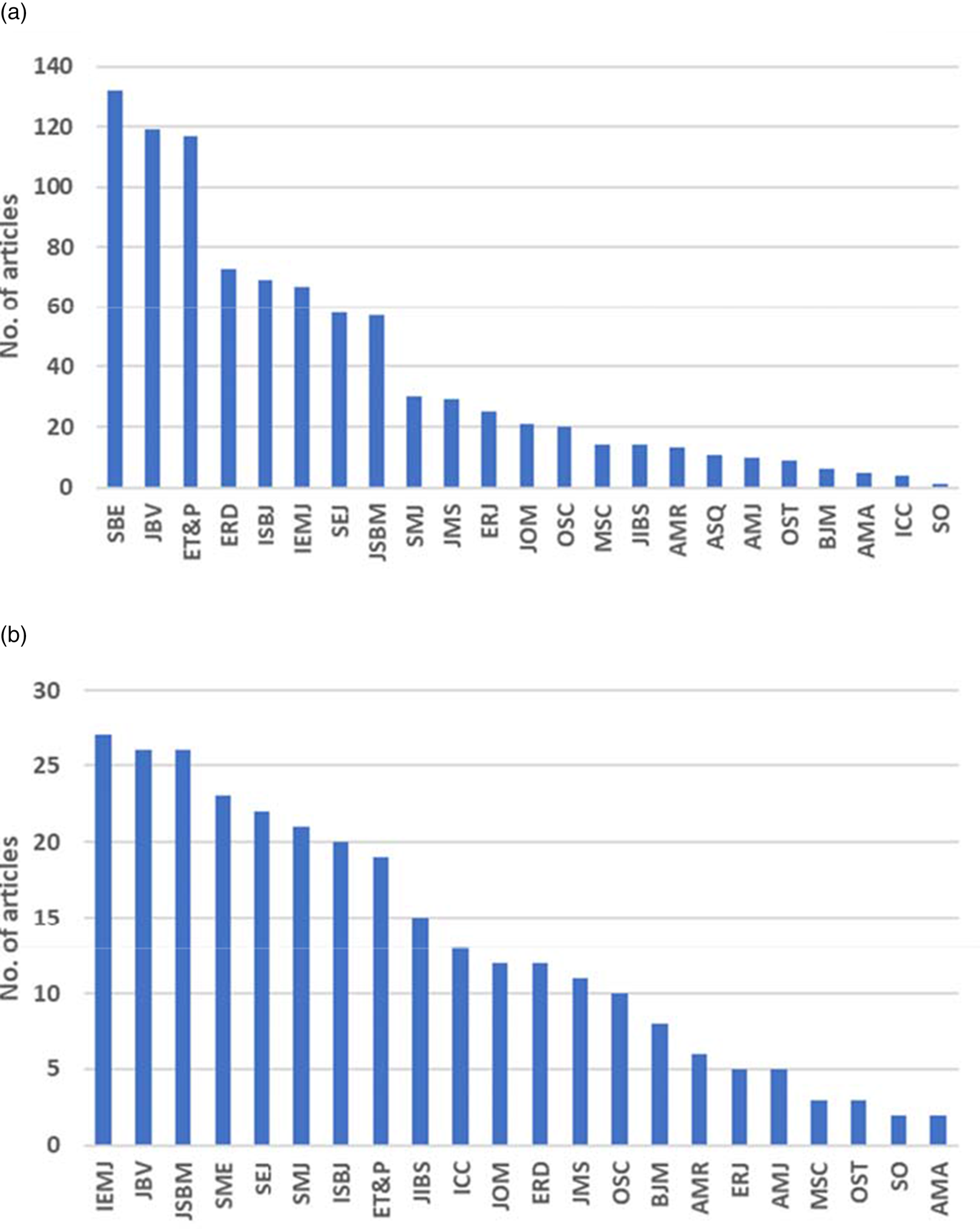
In comparing the two domains, two clear distinctions emerge: (a) DMC has greater representation in entrepreneurship journals (80 vs. 60% of articles published), (b) while journals exhibit selective preferences in publishing articles from one domain over the other, DMC has a slight edge over DC in having broader representations across journals.
Citations and co-citations
Dynamic managerial capabilities
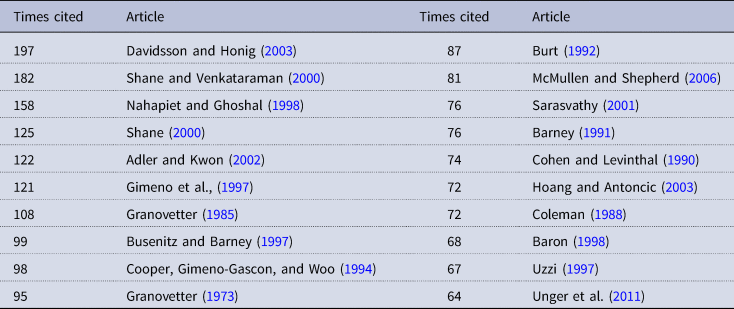
Davidsson and Honig (Reference Davidsson and Honig2003), which explores the role of both human and social capital among entrepreneurs, is the most cited article within the DMC domain. All the other top-cited articles are either published in entrepreneurship journals or utilize core entrepreneurship concepts (see Table 1). Thus, the DMC domain appears firmly rooted within entrepreneurship.
DMC and entrepreneurship – citations (only top 20 displayed)
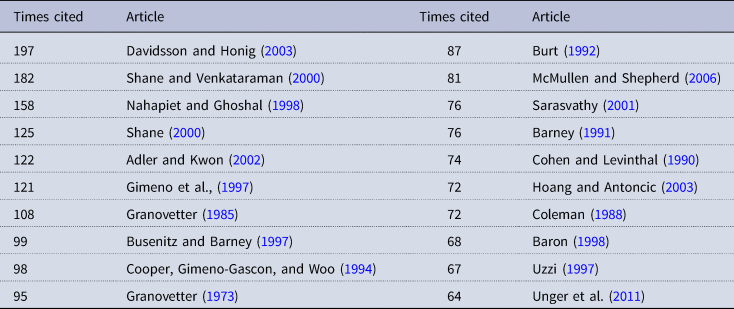
Most of the top-cited articles include research on the three components of DMC: social capital (including networks: Adler & Kwon, Reference Adler and Kwon2002; Nahapiet & Ghoshal, Reference Nahapiet and Ghoshal1998), human capital (Cooper, Gimeno-Gascon, & Woo, Reference Cooper, Gimeno-Gascon and Woo1994; Gimeno et al., Reference Gimeno, Folta, Cooper and Woo1997), and cognition (Baron, Reference Baron1998; Busenitz & Barney, Reference Busenitz and Barney1997). They also include entrepreneurship research that defines the field (e.g., Shane & Venkataraman, Reference Shane and Venkataraman2000) or is generic (e.g., Schumpeter, Reference Schumpeter1934).
Among the three components of DMC, research in social capital has gained the greatest traction. This component has the maximum share of articles that are highly cited. By contrast, the cognition stream is the least developed of the three. It has the least share among the highly cited articles. In fact, there is only one representative article (Busenitz & Barney, Reference Busenitz and Barney1997) among the top 10 (Table 1).
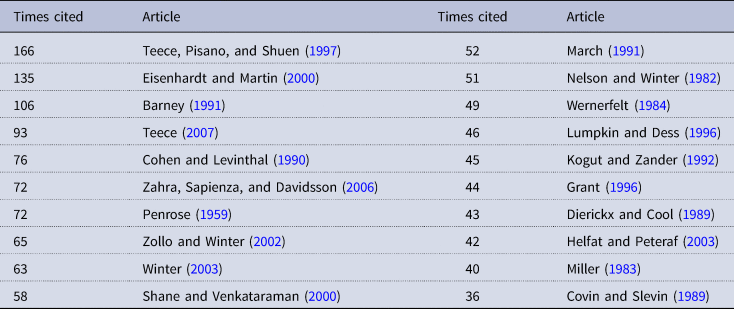
Except for the research by Davidsson and Honig (Reference Davidsson and Honig2003), there are no articles undertaking joint investigations within the highly cited lists. The co-citation table further attests to the lack of cross-component research (Table 2). All co-citations are between articles included under the same component. Other scholars, like Helfat and Martin (Reference Helfat and Martin2015), have also pointed out the lack of research integrating the components of DMC.
DMC and entrepreneurship – co-citations (only top 10 displayed)

Dynamic capabilities
The two most cited articles in the DC domain are the two conceptualizations of DC offered by Teece, Pisano, and Shuen (Reference Teece, Pisano and Shuen1997) and Eisenhardt and Martin (Reference Eisenhardt and Martin2000). The perspective advanced by Teece, Pisano, and Shuen (Reference Teece, Pisano and Shuen1997), however, has gained greater traction in entrepreneurship studies, as evidenced by: (a) higher citations of Teece, Pisano, and Shuen (Reference Teece, Pisano and Shuen1997) as compared to Eisenhardt and Martin (Reference Eisenhardt and Martin2000) and (b) the greater traction of the resource-based view (RBV) stream (where Teece's conceptualization is firmly rooted). As shown in Table 3, prominent RBV scholarship (Barney, Reference Barney1991; Penrose, Reference Penrose1959) is highly cited. Despite being published more recently, Teece (Reference Teece2007) has risen in the citation count and occupies the fourth position. Citations of research on routines (Nelson & Winter, Reference Nelson and Winter1982; Winter, Reference Winter2003; Zollo & Winter, Reference Zollo and Winter2002), which form the base for the other prominent conceptualization of DC, are second only to RBV. The knowledge-based view and organizational learning literature – close to both RBV and routines – occupy other top positions (Cohen & Levinthal, Reference Cohen and Levinthal1990; Grant, Reference Grant1996; Kogut & Zander, Reference Kogut and Zander1992; March, Reference March1991).
DC and entrepreneurship – citations (only top 20 displayed)

Core entrepreneurship research, that is, either published in entrepreneurship journals or utilizing entrepreneurship concepts, is limited to the review of DC in entrepreneurship by Zahra, Sapienza, and Davidsson (Reference Zahra, Sapienza and Davidsson2006) and research on entrepreneurial orientation (Covin & Slevin, Reference Covin and Slevin1989; Miller, Reference Miller1983). Other articles that are highly cited from entrepreneurship are limited to those defining the field (e.g., Shane and Venkataraman, Reference Shane and Venkataraman2000 – 10th position) or generic (e.g., Schumpeter, Reference Schumpeter1934 – 30th position).
Research in the DC–entrepreneurship domain is thus a mixture of various perspectives directly adopted from the strategic and general management literature. Unlike their peers in strategic management, entrepreneurship scholars do not perceive the differences in alternative conceptualizations of DC. This is apparent from the fact that the most common co-citation is Teece, Pisano, and Shuen (Reference Teece, Pisano and Shuen1997) and Eisenhardt and Martin (Reference Eisenhardt and Martin2000). Other articles with higher co-citations include a mix from the two streams, for example, Barney (Reference Barney1991) and Eisenhardt & Martin (Reference Eisenhardt and Martin2000), Nelson and Winter (Reference Nelson and Winter1982), and Teece, Pisano, and Shuen (Reference Teece, Pisano and Shuen1997) (see Table 4).
DC and entrepreneurship – co-citations (only top 10 displayed)

In comparing the two domains, the following distinctions become apparent: (a) DMC articles are either published in entrepreneurship journals or utilized entrepreneurship concepts, whereas DC articles are mostly from strategic management or general management (b) research in DMC has progressed along the three components, whereas research in DC is primarily split across two alternative conceptualizations.
Factor and cluster analysis
Dynamic managerial capabilities
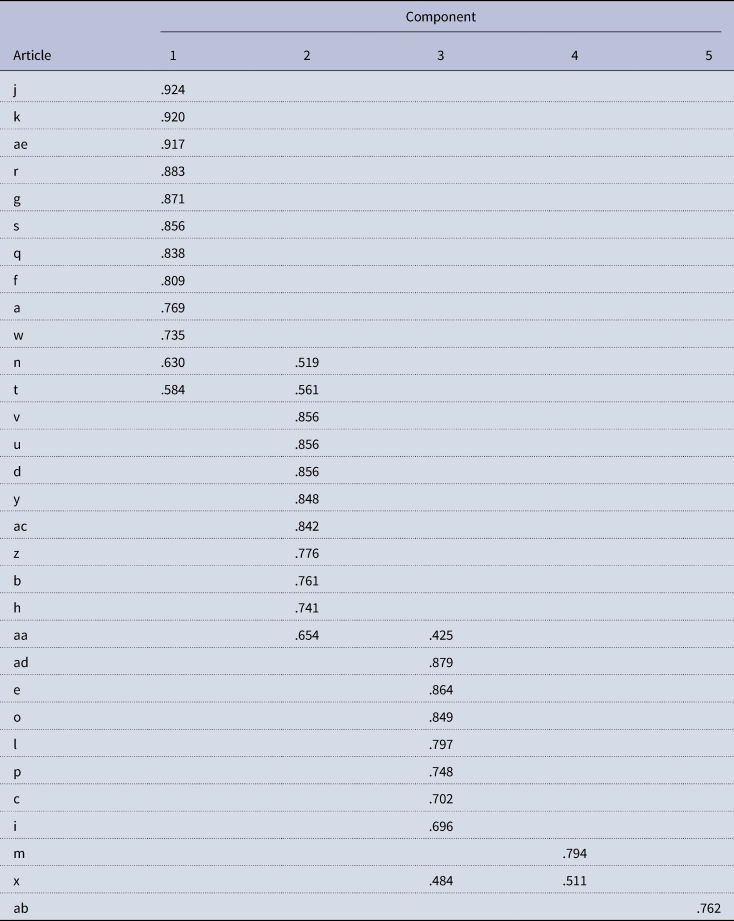
Research in the DMC domain can be largely mapped onto its underlying components. The DMC domain has distinct streams around its underlying components. The first stream consists of the social capital and network literature (Adler & Kwon, Reference Adler and Kwon2002; Burt, Reference Burt1992) (Table 5). This stream emerges as the most developed of the three, as evidenced by (a) this cluster having the highest number of articles and (b) all articles distinctly discussing the social capital literature.
DMC and entrepreneurship – factor analysis
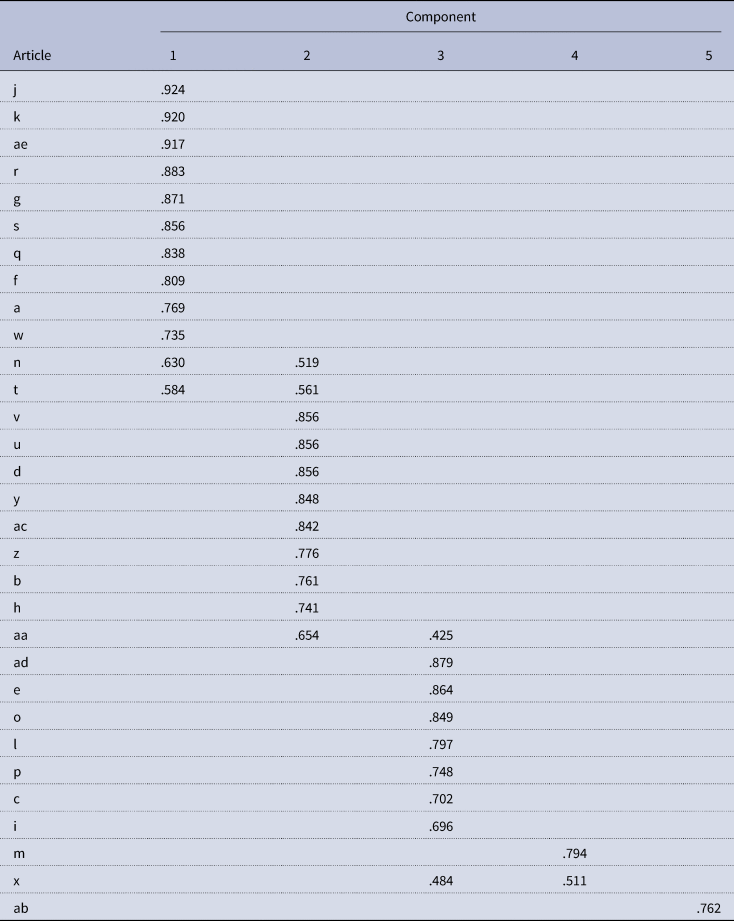
a – Adler and Kwon (Reference Adler and Kwon2002); b – Baker and Nelson (Reference Baker and Nelson2005); c – Barney (Reference Barney1991); d – Baron (Reference Baron1998); e – Brüderl, Preisendörfer, and Ziegler (Reference Brüderl, Preisendörfer and Ziegler1992); f – Brüderl and Preisendörfer (Reference Brüderl and Preisendörfer1998); g – Burt (Reference Burt1992); h – Busenitz and Barney (Reference Busenitz and Barney1997); i – Cohen and Levinthal (Reference Cohen and Levinthal1990); j – Coleman (Reference Coleman1990); k – Coleman (Reference Coleman1988); l – Cooper, Gimeno-Gascon, and Woo (Reference Cooper, Gimeno-Gascon and Woo1994); m – Davidsson and Honig (Reference Davidsson and Honig2003); n – Eisenhardt (Reference Eisenhardt1989); o – Evans and Leighton (Reference Evans and Leighton1989); p – Gimeno et al., (Reference Gimeno, Folta, Cooper and Woo1997); q – Granovetter (Reference Granovetter1985); r – Granovetter (Reference Granovetter1973); s – Hoang and Antoncic (Reference Hoang and Antoncic2003); t – Lumpkin and Dess (Reference Lumpkin and Dess1996); u – McMullen and Shepherd (Reference McMullen and Shepherd2006); v – Mitchell et al., (Reference Mitchell, Busenitz, Bird, Gaglio, McMullen, Morse and Smith2007); w – Nahapiet and Ghoshal (Reference Nahapiet and Ghoshal1998); x – Penrose (Reference Penrose1959); y – Sarasvathy (Reference Sarasvathy2001); z – Schumpeter (Reference Schumpeter1934); aa –Shane (Reference Shane2000); ab – Shane and Venkataraman (Reference Shane and Venkataraman2000); ac – Shane (Reference Shane2003); ad – Unger et al., (Reference Unger, Rauch, Frese and Rosenbusch2011); ae – Uzzi (Reference Uzzi1997).
The second stream consists of human capital and resources literature (Barney, Reference Barney1991; Cooper, Gimeno-Gascon, & Woo, Reference Cooper, Gimeno-Gascon and Woo1994; Evans & Leighton, Reference Evans and Leighton1989) (Table 5). Entrepreneurial scholars contributing to this stream consider the entrepreneur(s) or managers as bundles of resources and capabilities of the firm (Alvarez & Busenitz, Reference Alvarez and Busenitz2001; Klein, Mahoney, McGahan, & Pitelis, Reference Klein, Mahoney, McGahan and Pitelis2013).
The third stream consists of the cognition literature (Baron, Reference Baron1998; Busenitz & Barney, Reference Busenitz and Barney1997) (Table 5). This section of DMC literature is still at a developing stage. This is evident as (a) the articles discussing entrepreneurial cognition are both lower in number and more recent as compared to articles in other components, and (b) research discussing the entrepreneurship process were also included (e.g., Schumpeter, Reference Schumpeter1934; Shane, Reference Shane2003) (used in arguments to build legitimacy).
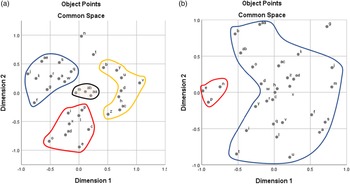
The final stream consists of generic entrepreneurship research and articles are on entrepreneurial opportunities (e.g., Shane & Venkataraman, Reference Shane and Venkataraman2000). While they form two distinct streams in the factor analysis, they emerge as a single cluster in the MDS map (Figure 3a). Davidsson and Honig's (Reference Davidsson and Honig2003) study is also included in this cluster. This may be attributed to it being the only study that integrates two components of DMC, as discussed earlier. This cluster lies at the center of the MDS map (Figure 3a).
(a) DMC and entrepreneurship – MDS. a – Adler and Kwon (Reference Adler and Kwon2002); b – Baker and Nelson (Reference Baker and Nelson2005); c – Barney (Reference Barney1991); d – Baron (Reference Baron1998); e – Brüderl, Preisendörfer, and Ziegler (Reference Brüderl, Preisendörfer and Ziegler1992); f – Brüderl and Preisendörfer (Reference Brüderl and Preisendörfer1998); g – Burt (Reference Burt1992); h – Busenitz and Barney (Reference Busenitz and Barney1997); i – Cohen and Levinthal (Reference Cohen and Levinthal1990); j – Coleman (Reference Coleman1990); k – Coleman (Reference Coleman1988); l – Cooper, Gimeno-Gascon, and Woo (Reference Cooper, Gimeno-Gascon and Woo1994); m – Davidsson and Honig (Reference Davidsson and Honig2003); n – Eisenhardt (Reference Eisenhardt1989); o – Evans and Leighton (Reference Evans and Leighton1989); p – Gimeno et al. (Reference Gimeno, Folta, Cooper and Woo1997); q – Granovetter (Reference Granovetter1985); r – Granovetter (Reference Granovetter1973); s – Hoang and Antoncic (Reference Hoang and Antoncic2003); t – Lumpkin and Dess (Reference Lumpkin and Dess1996); u – McMullen and Shepherd (Reference McMullen and Shepherd2006); v – Mitchell et al. (Reference Mitchell, Busenitz, Bird, Gaglio, McMullen, Morse and Smith2007); w – Nahapiet and Ghoshal (Reference Nahapiet and Ghoshal1998); x – Penrose (Reference Penrose1959); y – Sarasvathy (Reference Sarasvathy2001); z – Schumpeter (Reference Schumpeter1934); aa –Shane (Reference Shane2000); ab – Shane and Venkataraman (Reference Shane and Venkataraman2000); ac – Shane (Reference Shane2003); ad – Unger, Rauch, Frese, and Rosenbusch (Reference Unger, Rauch, Frese and Rosenbusch2011); ae – Uzzi (Reference Uzzi1997). (b) DC and entrepreneurship – MDS. a – Amit and Schoemaker (Reference Amit and Schoemaker1993); b – Autio, Sapienza, and Almeida (Reference Autio, Sapienza and Almeida2000); c – Barney (Reference Barney1991); d – Cohen and Levinthal (Reference Cohen and Levinthal1990); e – Covin and Slevin (Reference Covin and Slevin1989); f – Dierickx and Cool (Reference Dierickx and Cool1989); g – Eisenhardt (Reference Eisenhardt1989); h – Eisenhardt and Martin (Reference Eisenhardt and Martin2000); i – Grant (Reference Grant1996); j – Helfat et al. (Reference Helfat, Finkelstein, Mitchell, Peteraf, Singh, Teece and Winter2007); k – Helfat and Peteraf (Reference Helfat and Peteraf2003); l – Kogut and Zander (Reference Kogut and Zander1992); m – Leonard-Barton (Reference Leonard-Barton1992); n – Lumpkin and Dess (Reference Lumpkin and Dess1996); o – March (Reference March1991); p – Miller (Reference Miller1983); q – Nelson and Winter (Reference Nelson and Winter1982); r – Penrose (Reference Penrose1959); s – Peteraf (Reference Peteraf1993); t – Schumpeter (Reference Schumpeter1934); u – Shane (Reference Shane2000); v – Shane and Venkataraman (Reference Shane and Venkataraman2000); w – Teece, Pisano, and Shuen (Reference Teece, Pisano and Shuen1997); x – Teece (Reference Teece2007); y – Wernerfelt (Reference Wernerfelt1984); z – Winter (Reference Winter2003); aa – Zahra, Ireland, and Hitt (Reference Zahra, Ireland and Hitt2000); ab – Zahra and George (Reference Zahra and George2002); ac – Zahra, Sapienza, and Davidsson (Reference Zahra, Sapienza and Davidsson2006); ad – Zollo and Winter (Reference Zollo and Winter2002).
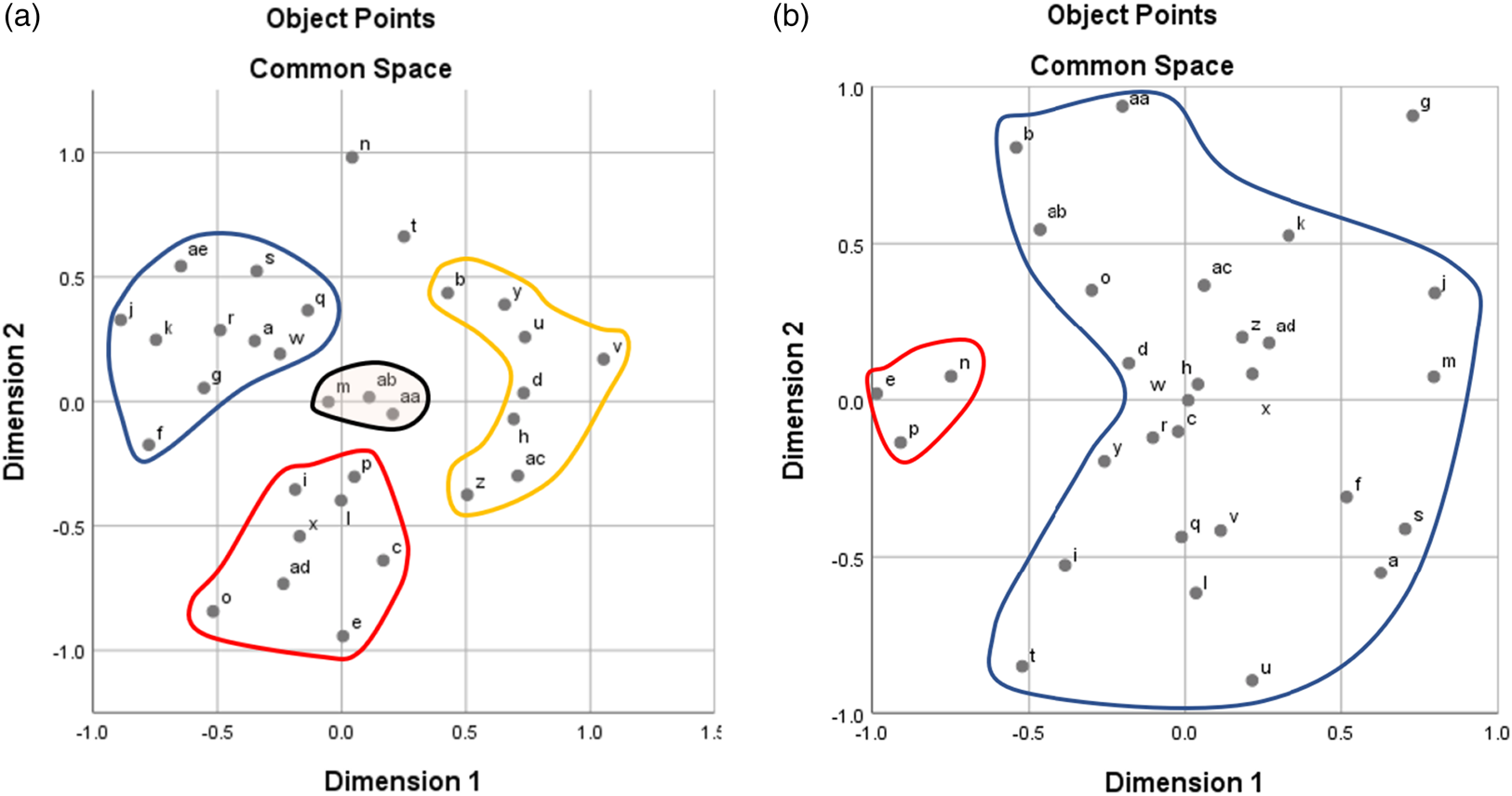
The MDS map largely follows the factor mappings. Clusters mapping the three components and the central cluster are distinctly visualized. The cognition and social capital streams lie on either side of the map. The human capital stream lies along the center and borders both of the other streams. There is a clear horizontal trajectory in which the articles move from cognition to human to social capital. From an individual level perspective, in which entrepreneurs rely on their cognition, the map illustrates the shift to skills acquired in coordination with others (human capital) to those that exist solely in unison with groups (social capital).
Few articles also exhibit cross-loading patterns, that is, they map onto more than one factor. Their positioning is clearer when interpreting these patterns along with the positioning on the MDS map (Figure 3a). Two such articles are Eisenhardt's (Reference Eisenhardt1989) work on case study research and Lumpkin and Dess's (Reference Lumpkin and Dess1996) work on entrepreneurial orientation. These articles have been used by scholars from both social capital and cognition streams. In the MDS map, they lie between these two clusters. Similarly, Penrose (Reference Penrose1959) cross-loads with the human capital factor and the core cluster. This is indicative of its seminal status. However, in the MDS map, it is clearly aligned with the human capital and resources literature. Finally, Shane's (Reference Shane2000) work on entrepreneurial opportunities cross-loads on both cognition and human capital factors. In the MDS map, it forms a part of the core cluster along with Shane and Venkataraman (Reference Shane and Venkataraman2000) and Davidsson and Honig (Reference Davidsson and Honig2003). This overlap highlights the influence of the opportunity literature in DMC research in entrepreneurship. All the three articles in the core cluster (Davidsson & Honig, Reference Davidsson and Honig2003; Shane, Reference Shane2000; Shane & Venkataraman, Reference Shane and Venkataraman2000) focus on the significance of opportunities in entrepreneurship.
Dynamic capabilities
Research in the DC domain maps does not map on to distinct factors as clearly as in the case of DMC. Two major factors display significant overlaps between themselves, as evident from their cross-loadings (Table 6). This overlap is not surprising given that these two factors contain a mix of articles from RBV (Barney, Reference Barney1991; Penrose, Reference Penrose1959), evolutionary economics (Nelson & Winter, Reference Nelson and Winter1982; Winter, Reference Winter2003), organizational learning (March, Reference March1991; Zahra & George, Reference Zahra and George2002), and entrepreneurship research (Schumpeter, Reference Schumpeter1934; Shane & Venkataraman, Reference Shane and Venkataraman2000). Thus, research of DC in entrepreneurship draws from multiple perspectives.
DC and entrepreneurship – factor analysis

a – Amit and Schoemaker (Reference Amit and Schoemaker1993); b – Autio, Sapienza, and Almeida (Reference Autio, Sapienza and Almeida2000); c – Barney (Reference Barney1991); d – Cohen and Levinthal (Reference Cohen and Levinthal1990); e – Covin and Slevin (Reference Covin and Slevin1989); f – Dierickx and Cool (Reference Dierickx and Cool1989); g – Eisenhardt (Reference Eisenhardt1989); h – Eisenhardt and Martin (Reference Eisenhardt and Martin2000); i – Grant (Reference Grant1996); j – Helfat et al., (Reference Helfat, Finkelstein, Mitchell, Peteraf, Singh, Teece and Winter2007); k – Helfat and Peteraf (Reference Helfat and Peteraf2003); l – Kogut and Zander (Reference Kogut and Zander1992); m – Leonard-Barton (Reference Leonard-Barton1992); n – Lumpkin and Dess (Reference Lumpkin and Dess1996); o – March (Reference March1991); p – Miller (Reference Miller1983); q – Nelson and Winter (Reference Nelson and Winter1982); r – Penrose (Reference Penrose1959); s – Peteraf (Reference Peteraf1993); t – Schumpeter (Reference Schumpeter1934); u – Shane (Reference Shane2000); v – Shane and Venkataraman (Reference Shane and Venkataraman2000); w – Teece, Pisano, and Shuen (Reference Teece, Pisano and Shuen1997); x – Teece (Reference Teece2007); y – Wernerfelt (Reference Wernerfelt1984); z – Winter (Reference Winter2003); aa – Zahra, Ireland, and Hitt (Reference Zahra, Ireland and Hitt2000); ab – Zahra and George (Reference Zahra and George2002); ac – Zahra, Sapienza, and Davidsson (Reference Zahra, Sapienza and Davidsson2006); ad – Zollo and Winter (Reference Zollo and Winter2002).
The overlapping of the two factors is further evident from the MDS map (Figure 3b). The two factors are almost indistinguishable and form one large uneven cluster. As such, this cluster could be termed as the foundational roots of the domain as they encompass a vast number of studies. It is also an indication that the domain has not followed any specific trajectory in its development that mark the research outputs distinct from each other. Eisenhardt's (Reference Eisenhardt1989) work on case study research, while forming a part of the second factor, is distinctly placed in the cluster analysis.
The third factor emerges distinctly from the other two factors (Table 6). This factor consists of the entrepreneurial orientation literature (Covin & Slevin, Reference Covin and Slevin1989; Lumpkin & Dess, Reference Lumpkin and Dess1996). Shane and Venkataraman's (Reference Shane and Venkataraman2000) conceptualization of entrepreneurship and Autio, Sapienza, and Almeida's (Reference Autio, Sapienza and Almeida2000) work on organizational learning also form a part of this cluster. Expectedly, they cross-load with the foundational roots cluster. In the MDS map, they are more aligned with the foundational roots cluster (Figure 3b). Other articles from the foundational roots cluster sharing cross-loadings include Teece (Reference Teece2007), Zahra, Sapienza, and Davidsson (Reference Zahra, Sapienza and Davidsson2006), and Schumpeter (Reference Schumpeter1934). Thus, the entrepreneurial orientation cluster seems to be an emerging cluster drawing on selected articles from the foundational roots cluster.
Finally, Teece, Pisano, and Shuen (Reference Teece, Pisano and Shuen1997) emerge as a distinct factor in the factor analysis (Table 6). While its positioning at the center of the MDS map corresponds to the core cluster in the DMC domain, it is subsumed within the foundational root cluster. Thus, we are unable to map out a core cluster as in the case of DMC research. Additionally, it is significant to note the lack of any entrepreneurship literature as a part of the core cluster.
In comparing the two domains, there are three distinctions. First, the DMC clusters are distinct, whereas there is substantial overlap among the two major DC clusters. Second, in the DMC domain, there is a distinct central cluster, while in the DC domain, Teece, Pisano, and Shuen (Reference Teece, Pisano and Shuen1997) is the only central article, and a core cluster cannot be mapped out. Finally, the components of DMC engage with entrepreneurship research in their development – the cognition component being the best example, whereas there are no corresponding trajectories in DC research. There is, however, an independent research trajectory developing on entrepreneurial orientation.
Analysis of keywords
Dynamic managerial capabilities
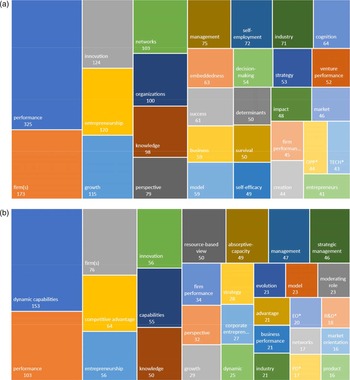
Performance is the top keyword in the DMC domain. Combined with its variations such as venture performance and firm performance, it is more than twice as frequent as the next keyword, firm(s). The next prominent keywords include innovation and entrepreneurship (Figure 4a).
(a) DMC and entrepreneurship – keywords treemap. *Abbreviations. Actual keywords used are: OPP, opportunities; TECH, technology. (b) DC and entrepreneurship – keywords treemap. *Abbreviations. Actual keywords used are: EO, entrepreneurial orientation; R&D, research-and-development PD – product development.

A number of keywords that are primarily relevant in the entrepreneurship field figure in this list of top keywords. These include self-employment, creation, and opportunities, among others. Others such as growth, survival, and success that have significant implications for entrepreneurship are also present in this list. Thus, research in this domain appears to be in close alignment with the nuances of the field of entrepreneurship.
Cognition is the only component of DMC that appears as a top keyword. However, we have already seen the traction of research in human capital and social capital in our factor and cluster analysis. In fact, knowledge and network are top keywords that largely imply research in human capital and social capital, respectively. Thus, this trend further confirms the emerging status of the cognition stream and the embeddedness of the human capital and social capital streams within entrepreneurship literature, as discussed earlier.
Finally, this domain is also noteworthy of having keywords that span levels of analysis, such as firm performance, networks, and self-efficacy, among others (Figure 4a).
Dynamic capabilities
In the DC domain, the top keyword is dynamic capabilities. A closely related keyword, capabilities, is also prominent in the list of keywords. This is an interesting trend that either reflects the popularity of the construct, dynamic capabilities, or the need for researchers to distinctly brand such research in entrepreneurship. Performance, firm(s), and competitive advantage are other top keywords in the list. This is followed by entrepreneurship and innovation (Figure 4b).
The influence of the field of strategic management is evident from a number of keywords such as strategy and strategic management. Others such as resource-based view, absorptive capacity, and competitive advantage also trace their origins in the more general strategy and management literature.
An exception to this trend is the research on entrepreneurial orientation that is more closely aligned with the field of entrepreneurship. However, as observed in the factor and cluster analysis, this stream of research exhibits only a limited influence within the domain.
Similar to the trend observed in the DMC domain, knowledge and networks are also prominent keywords in the DC domain, but their usage levels vary. In particular, the use of networks in the DC domain is rather low. In comparing the two domains, there are two major distinctions: first, the DMC domain builds upon several keywords distinctly used in entrepreneurship research, whereas the DC domain builds upon a number of keywords from strategic management research. Second, while the two domains share a number of similar keywords, such as performance, entrepreneurship, and networks, they have relatively higher weightage in the DMC domain.
Discussion
Our analysis allowed us to develop insights into the state of DMC and DC research within the entrepreneurship field. We now discuss some of the key implications of our study, which highlight the intellectual structure, that is, the kind of research driving the domain, and the research trajectory, that is, the path followed by various research streams within the domain.
The lens of DMC
Our findings from the detailed analysis of extant research of DMC and DC in entrepreneurship largely support our arguments for using DMC as a lens. The lack of an intellectual base and research trajectory embedded in entrepreneurship limits the use of DC to analyze entrepreneurship research. On the other hand, our analysis suggests that DMC is a better lens for analyzing entrepreneurship research on a number of counts. To highlight these advantages, we begin our discussion by describing the intellectual structure and research trajectory of DMC in entrepreneurship.
The entrepreneurship literature is firmly rooted in the intellectual base of DMC, evidenced by the large number of articles published in entrepreneurship journals that utilize the DMC lens to outline and study entrepreneurship concepts. The research base of this domain consists of the three underlying components of cognition, human capital, and social capital, in addition to a central base of highly cited articles in entrepreneurship that is closely aligned with the literature on opportunities
The three underlying components are in different stages of development. While theorizing in entrepreneurship, the scholars have also drawn upon related literature from other fields. Social capital is the oldest and most developed of the three. Consequently, review articles that attempt to re-define and reconceptualize the field are also prominent. This component draws upon a legacy of literature from the field of sociology (e.g., Granovetter, Reference Granovetter1973, Reference Granovetter1985). Second in development, comparatively, is research in human capital. It draws upon related literature from strategic management, especially research on resources (Barney, Reference Barney1991; Penrose, Reference Penrose1959), in defining its research agenda. Finally, research in cognition is still emerging, especially in comparison with the other components. While some of these articles draw upon the psychology literature (e.g., Baron, Reference Baron1998), others rely on seminal works within entrepreneurship, such as on entrepreneurial behavior (e.g., Knight, Reference Knight1921; Shane, Reference Shane2003).
An intellectual base that is well embedded in entrepreneurship and has a rich legacy of literature, unsurprisingly, had implications in shaping the DMC domain's research trajectory. Research in this domain is both older and has a much greater number of published articles. The representation of DMC in entrepreneurship journals is also much higher while still being popular across management and strategy journals. Overall, research in this domain has witnessed steady and continuous growth.
The three components of DMC present distinct clusters that draw from different streams of research in their development. These studies have not used entrepreneurship as a context and instead utilize entrepreneurship literature to define their research agenda. This is evident from their use of several themes that signify distinct trends in entrepreneurship research. The emerging stream of research on cognition presents an illustrative example of the development of the field, drawing upon seminal work in entrepreneurship to build arguments and gain legitimacy.
We propose that DMC's connection with entrepreneurship research needs to be extended further and suggest that DMC aids in clarifying the boundary conditions of DC. Scholars argue that the use of change-oriented routines, such as DC, may be less forthcoming to firms because they (a) cannot be easily developed, as they have path-dependent attributes, and (b) incur costs to the firm in their development and usage (Helfat & Winter, Reference Helfat and Winter2011; Winter, Reference Winter2003).
Entrepreneurial firms are often disadvantaged by the liabilities of size and newness (Aldrich and Auster, Reference Aldrich and Auster1986). Consequently, the use of DC may be unsuitable for such firms. Because of their small size, entrepreneurial firms may not be able to afford the costs of extensive changes to their resource base, that is, the use of DC. Similarly, because of their relatively young age and/or small size, entrepreneurial firms may also not possess the repertoire of routines or resources necessary to invoke DC (Bolívar-Ramos, Reference Bolívar-Ramos2019; Lanza & Passarelli, Reference Lanza and Passarelli2014).
Shifting the focus to the individual, however, negates these disadvantages. In many entrepreneurial firms, there is less of a formal structure or delineation of roles and responsibilities. In such situations, the role of the entrepreneur is paramount for all firm-level actions (Ensley, Pearce, & Hmieleski, Reference Ensley, Pearce and Hmieleski2006). As such, the costs and the experience required to create new routines would largely be borne by the founder(s) acting on their own levels of thinking, abilities, and skills. Driven by their attributes of cognition, human capital, and social capital, entrepreneurs will display strong goal-directed motivated behavior and ownership in sustaining the entrepreneurial firm (Kuratko, Hornsby, & Naffziger, Reference Kuratko, Hornsby and Naffziger1997; Markman & Baron, Reference Markman and Baron2003). This enables them to quickly and comprehensively make changes at the firm-level in response to external changes (DC).
Integrating this shift in focus to the individual-level with the literature on entrepreneurial opportunities (part of the core cluster), we are also able to contribute toward understanding the process of endogenous opportunity formation. The endogenous creation of opportunities by the actions of entrepreneurs is one of the core explanations to the seminal question as to ‘where do opportunities come from?’ (Alvarez & Barney, Reference Alvarez and Barney2007; Alvarez, Barney, & Anderson, Reference Alvarez, Barney and Anderson2013; McMullen, Plummer, & Acs, Reference McMullen, Plummer and Acs2007).
These opportunities are endogenously formed by the actions of entrepreneurs with limited differentiation in their DMC that are shaped by the underlying components of cognition, human capital, and social capital. This leads to a path-dependent evolutionary process where the process of creating these opportunities also changes the capabilities of the entrepreneurs (DMC) and those at the firm-level (DC). Thus, the relationship is of a dual nature, where DMC aids in the formation of opportunities, and these opportunities further shape the DMC and, subsequently, DC.
This reasoning resonates with Teece's (Reference Teece2012) argument that DC relies on managerial capitalism, which is entrepreneurial in nature. The DC of the firm is then rooted in managerial/founder capitalism and their entrepreneurial acts, which in turn determine the speed and degree to which the firm's resources can be aligned and realigned to match the opportunities in the environment (Arndt & Norbert, Reference Arndt and Norbert2015; Teece, Reference Teece2012).
In short, the use of DMC in entrepreneurship expands upon the limitations of DC (Helfat & Martin, Reference Helfat and Martin2015) and aids in advancing research on the evolution of opportunities (Alvarez & Barney, Reference Alvarez and Barney2020) and organizational capabilities (Barney, Reference Barney2018; Helfat & Peteraf, Reference Helfat and Peteraf2003). DMC interacts with the entrepreneurial processes and plays a vital role in the creation of firm-level capabilities. Extant research themes in DMC that span different levels of analysis confirm this trend. We urge future scholars to pursue this line of inquiry further. For instance, what are the entrepreneurial processes that shape the evolution of DMC to firm-level capabilities? How do firm-level capabilities interact with the exploitation of opportunities? What firm-level attributes shape its heterogeneous development across firms? The field of entrepreneurship may hold significant answers to strategic management scholars on understanding organizational capabilities.
DC in entrepreneurship
Our findings concur with Zahra, Sapienza, and Davidsson (Reference Zahra, Sapienza and Davidsson2006) that DC in entrepreneurship has evolved by drawing primarily from research on established companies. It is significant that even a decade after Zahra, Sapienza, and Davidsson's (Reference Zahra, Sapienza and Davidsson2006) observations, we were unable to identify a significant research trajectory that has heeded the call by these scholars to theorize specifically within entrepreneurship. This highlights the limitations of the extant research in the domain and reinforces our argument for the need to use a DMC lens in order to move the field forward. We now lay out a nuanced picture of these trends.
The intellectual base of the DC domain primarily consists of literature from strategic and general management. This literature primarily includes: (a) the two alternate conceptualizations of DC (RBV and routines) and (b) organizational learning. Among the alternate conceptualizations, the RBV is a more dominant paradigm, with a higher number of scholarly articles. The routines-based approach traces its roots to evolutionary economics (Nelson & Winter, Reference Nelson and Winter1982). Organizational learning complements both these paradigms using a similar lens of looking inside the firm.
For these major streams of research, engagement with the entrepreneurship literature is limited to those defining the field (e.g., Shane and Venkataraman, Reference Shane and Venkataraman2000) or generic studies (e.g., Schumpeter, Reference Schumpeter1934). The only exception to this trend is the research in entrepreneurial orientation, which represents a very small and limited base of research.
In the absence of an entrepreneurship research base, the DC–entrepreneurship domain has evolved by drawing upon the same scholarship base as strategy scholars. Entrepreneurship is thus used merely as a context. This is confirmed by the similarity in the intellectual structures within the entrepreneurship and strategy domains (see e.g., Peteraf, Di Stefano, & Verona, Reference Peteraf, Di Stefano and Verona2013; Vogel & Güttel, Reference Vogel and Güttel2013).
Research in this domain thus represents a convoluted mix from various streams of strategic and general management literature. The over-reliance on strategic management literature, which is itself built on differing perspectives, appears to be hampering the extension and independent development of the field. As such, their role in steering the field toward new knowledge is limited by their inability to present an integrated view. To drive new research, this domain needs to avoid an over-reliance on strategic management literature and instead look within the field of entrepreneurship.
We believe that the answers may lie in adopting a more nuanced perspective of the intellectual structure of DC research in entrepreneurship. The mix of various perspectives highlights how researchers have utilized DC in entrepreneurship. As discussed earlier, the perspectives range from an RBV (Barney, Reference Barney1991; Teece, Pisano, & Shuen, Reference Teece, Pisano and Shuen1997) to a routines-based view (Eisenhardt & Martin, Reference Eisenhardt and Martin2000; Nelson & Winter, Reference Nelson and Winter1982) to an opportunities-based view (Shane, Reference Shane2000; Shane & Venkataraman, Reference Shane and Venkataraman2000), among others. On the one hand, this may signify the appeal of the dynamic features of DC in explaining a firm's quest toward attaining competitive advantages. On the other hand, it may also indicate the inherent difficulties researchers face in conceptualization and operationalization of the construct as they draw support from various perspectives (Schreyögg & Kliesch-Eberl, Reference Schreyögg and Kliesch-Eberl2007; Zahra, Sapienza, & Davidsson, Reference Zahra, Sapienza and Davidsson2006).
We suggest that these difficulties can be offset by developing a multi-level theory of capabilities. While a sole focus at the firm level cannot account for the constraints faced by entrepreneurial ventures (Bolívar-Ramos, Reference Bolívar-Ramos2019), a sole focus at the individual level would not account for the role of collective actions or other processes that congeal into firm-level DC. Taking a cue from our concurrent analysis of the intellectual structures of DC and DMC, we believe that bridging the levels of analysis occurs from cognition, which is closest to an individual-level perspective, to human capital, which requires coordination at the team level for its development, to social capital, which relies on relationships between employees, that could largely be seen as a meso-level (Salvato & Vassolo, Reference Salvato and Vassolo2018).
Thus, the aggregation of individual actions to firm-level DC would rely on integrating the components of DMC. This approach supports extant research that seeks to understand the sources of dynamism in DC (Salvato & Vassolo, Reference Salvato and Vassolo2018) by building upon the inextricable link between DC and DMC (Arndt, Fourne, & MacInerney-May, Reference Arndt, Fourne and MacInerney-May2018; Huy & Zott, Reference Huy and Zott2018). Additionally, it reinforces the calls by scholars for the need to continue developing a multi-level theory of capabilities (Cristofaro & Lovallo, Reference Cristofaro and Lovallo2022; Helfat & Martin, Reference Helfat and Martin2015; Kurtmollaiev, Reference Kurtmollaiev2020).
Future directions for research
Our detailed review of the state of research in DC/DMC in entrepreneurship allows us to propose many avenues for future research.
The DC domain will benefit from moving beyond using entrepreneurship solely as a context. Theorizing within the entrepreneurship domain provides ample opportunities for development. More diverse conceptualizations from the field of entrepreneurship should be adopted, along with the use of more radical approaches, even at the risk of deviating from its foundational roots. In fact, moving away from the core cluster is what may be required for a domain that is too cohesively built.
Following the lead from DMC, DC scholars may look at exploring components analogous to cognition, human capital, and social capital. The microfoundations of DC (Teece, Reference Teece2007) already present such an opportunity. Sensing, seizing, and transformation activities may thus be explored (see e.g., Markovich, Efrat, & Raban, Reference Markovich, Efrat and Raban2022). An in-depth investigation into these components represents a shift toward drawing from the literature in psychology, sociology, behavioral economics, among others, and linking them with the components of DC. For instance, how do the biases of managers influence their ability to sense changes in the external environment? What is the role of the intra-firm managerial network in seizing market opportunities? Can managerial specializations account for firm heterogeneity in resource reconfiguration/transformation activities?
Our review has also demonstrated that the three components of DMC are explored distinctly in the extant research. There have been notable studies that have explored two components together (e.g., Davidsson & Honig, Reference Davidsson and Honig2003), which have been highly cited. We are not yet aware, however, of any studies that have explored all three components together, along with their interaction effects. This gap therefore represents a significant avenue for future research. The impact of these interactions on organizational change and organizational relationships would certainly deliver new insights, with the most prominent of these, as highlighted in our study, being DC.
Prior studies have investigated the components of DMC on organizational change. For instance, in a study of entrepreneurial firms, Laamanen and Wallin (Reference Laamanen and Wallin2009) found that cognition plays an important role in the development of capabilities by influencing their path-dependencies. Durán and Aguado (Reference Durán and Aguado2022) observe a positive relationship between CEOs' managerial cognition and firm-level capabilities. Helfat and Martin (Reference Helfat and Martin2015) argue that there is a positive effect of human capital on firm-level actions under conditions of change. Furthermore, Mitchell and Shepherd (Reference Mitchell and Shepherd2012) argue for human capital as a capability building mechanism that decreases decision incongruence in pursuing strategic opportunities. Social capital can compensate for the lack of resources needed to set up organizational routines (Hughes, Morgan, Ireland, & Hughes, Reference Hughes, Morgan, Ireland and Hughes2014). It has also been argued to be the key catalyst in developing innovative and competitive capabilities (Agarwal & Selen, Reference Agarwal and Selen2013). This implies that the creation and development of new routines within the firm, including those required to reconfigure existing resources (DC), necessitates such a skill. Furthermore, Koryak, Mole, Lockett, Hayton, Ucbasaran, and Hodgkinson (Reference Koryak, Mole, Lockett, Hayton, Ucbasaran and Hodgkinson2015) argued that, in entrepreneurial firms, both human and social capital might be viewed as organizational resources that influence the development of capabilities. Thus, the expectation for a positive relationship between DMC and DC is reasonable. However, their interactions over time are less clear. We hope future scholars will undertake longitudinal research that can track the presence of feedback loops in the DC–DMC relationship. Additionally, the role of contingent factors at the firm- and industry-levels also needs to be explored.
Finally, the field of opportunities in entrepreneurship offers further prospects for the two domains. While our study highlights the role of DMC in endogenous opportunity formation, further research is required to understand the underlying processes. Proponents and critiques of the opportunity construct have continued to emphasize the role of processes (Alvarez & Barney, Reference Alvarez and Barney2020; Davidsson, Recker, & von Briel, Reference Davidsson, Recker and von Briel2020; Foss & Klein, Reference Foss and Klein2020). However, extant investigations have primarily focused on the processes leading to the discovery or creation of opportunities. The bringing together of the DMC and DC constructs can potentially explore and account for multi-level heterogeneity in the processes of discovery, evaluation, and exploitation of opportunities. For instance, DMC can potentially explain a larger variance in the discovery/creation of opportunities at the individual or team level, while DC can potentially account for the larger variance in the exploitation of opportunities at the firm level. We urge future researchers to use multi-level analysis (e.g., Lin & Yi, Reference Lin and Yi2021; Nakara, Messeghem, & Ramaroson, Reference Nakara, Messeghem and Ramaroson2021) to unravel these processes. Such a nuanced treatment of the opportunities construct would further add to its usefulness as a central feature of entrepreneurship research (Alvarez & Barney, Reference Alvarez and Barney2020). In any case, the entrepreneurship field would definitely benefit from this two-pronged focus on the entrepreneurial process (Davidsson & Gruenhagen, Reference Davidsson and Gruenhagen2021; Eckhardt & Shane, Reference Eckhardt and Shane2003).
Conclusion
Firms with strong DC are entrepreneurial, not only in adapting to business ecosystems but also in shaping them (Teece, Reference Teece2007). The orchestration of knowledge and capabilities, or DC, brings the role of managerial skills right into the spotlight by encouraging firms to develop ‘capabilities that many management teams simply don't have’ (Teece, Reference Teece2014, p. 333). DMC fills this void as it potentially explains the heterogeneity in the skill set of managers, and thereby the differences in DC.
Through a systematic review, we have demonstrated the theoretical traction that this view is able to generate. This study also highlights the growth of DC within the entrepreneurship literature. Our findings imply that the lens of DMC is better suited for analyzing the field of entrepreneurship. We show that the use of DMC extends and clarifies the use of DC. The lessons from bringing together the two constructs in the entrepreneurship field contribute to the field of strategic management.
Bringing together the two constructs not only achieves the full spectrum of organizational capabilities – tracing the heterogeneity from different outcomes of organizational change to varying components of individual-level actions – but also reconciles some of the conflicting perspectives. For instance, the breaking down of the resource-based logic into simple rules and logic (Eisenhardt & Martin, Reference Eisenhardt and Martin2000) can still explain change at the managerial level. Similarly, an entrepreneurial firm without tangible organizational resources can still incur the costs of using organizational capabilities at an individual level. Change within the firm, or at an organizational level, can be best understood for the entrepreneur when integrated with his or her own abilities and competencies.