INTRODUCTION
Many researchers have noted that around the end of their first year, children frequently use gestures associated with objects (e.g. a combing gesture without a comb in the hand) in a manner that suggests they are naming objects or events, regardless of whether or not they have begun to speak (Werner & Kaplan, Reference Werner and Kaplan1963). These representational gestures, described as referential, recognitory, symbolic and characterizing, refer directly to objects and events (Volterra & Erting, Reference Volterra and Erting1994). For example, for telephoneFootnote 1 the child holds an empty fist to the ear; for sleeping the child rests his cheek on his hand and closes his eyes. However, it is not clear if these kinds of gestures can be considered to be true naming, as is the case with early spoken words or signs.
These gestures have also been defined as schemes of symbolic play, having their origins in actions with objects. Actions produced with objects in the hand and empty-handed gestures produced in a communicative context are not clearly separate categories but should be considered as forming a continuum; adults also produce gestures with an object in the hand for communicative purposes (Kendon, Reference Kendon2004).
Results of a recent study (Capirci, Contaldo, Caselli & Volterra, Reference Capirci, Contaldo, Caselli and Volterra2005) analyzing three Italian children in spontaneous interaction with their parents, followed longitudinally from age 0 ; 10 to 1 ; 11, indicate that there is a continuity between the production of first action schemes, first gestures and first words. Most of the actions produced by the three children had a ‘meaning correspondence’ with gestures and/or words later produced, indicating that the emergence of a particular action preceded the production of the gesture and/or word with the corresponding meaning.
Some studies have argued that the appearance of representational gestures and the first recognizable words at the same age and the fact that both go through similar stages of decontextualization support the claim that representational gestures do function sometimes as early words and signs. Gestures and words go through a gradual transition from presentational symbolization of a visible object or a happening event in the environment to a representational symbolization in the absence of perceptual support from the referred-to object or event. These gestures have been previously observed and described in longitudinal and cross-sectional studies (Acredolo & Goodwyn, Reference Acredolo, Goodwin, Volterra and Erting1994; Iverson, Capirci & Caselli, Reference Iverson, Capirci and Caselli1994; Capirci et al., Reference Capirci, Contaldo, Caselli and Volterra2005; Pizzuto & Capobianco, Reference Pizzuto and Capobianco2005) conducted on a small number of children observed at home during spontaneous interaction with their mothers or other caregivers, and often referred to different referents. Furthermore, these gestures were observed mainly in children raised in gesture prominent culture like the Italian culture (Kendon, Reference Kendon2004) while they have been less frequently noted in other cultures such as the American (Iverson, Capirci, Volterra & Goldin-Meadow, Reference Iverson, Capirci, Volterra and Goldin-Meadow2008). However, other studies have shown that American children exposed to enriched gestural input learn to use more symbolic gestures. In a two-year longitudinal study, parents were instructed to encourage the use of gestures for communicative purposes by inventing their own gestures or borrowing signs from American Sign Language (ASL) and using them simultaneously with selected words in the speech stream (Goodwyn, Acredolo & Brown, Reference Goodwyn, Acredolo and Brown2000). Goodwyn et al. (Reference Goodwyn, Acredolo and Brown2000) have suggested that exposure to symbolic gesturing may provide added ‘practice’ for the emerging symbolic function, thereby accelerating the development of object-related words.
Variation in the type of input to which children are exposed influences the extent to which one or other modality (manual or spoken) is used for representational purposes and assumes linguistic properties. For example, children systematically exposed to sign language input acquire and develop a complete language in the visual gestural modality. Cross-linguistic research shows that sign language acquisition follows developmental milestones similar to those of spoken language. First signs are semantically similar to words of children learning spoken languages: signs and words for people, animal, food and social routines closely related to the child's experience appear first, while the acquisition of more abstract signs and words (question items, cognitive verbs, negations) is related to vocabulary size (Mayberry & Squires, Reference Mayberry, Squires and Lieven2006).
In none of the previous studies were a large number of representational gestures collected, nor were they able to compare gestures produced by different children to represent the same referents. Furthermore, representational gestures have been very rarely analyzed according to the formational parameters of execution, following the framework usually adopted for describing the lexical units of a sign language.
In order to overcome these limitations, in the present study we designed a very simple structured task to facilitate the production of comparable gestures by young children. In a previous study, examining developmental changes in speech and gesture use in the context of a naming task, we were able to show that young children between two and seven years of age often produced pointing and representational gestures together with spoken responses. Analyses of developmental trends indicated that age was the strongest predictor of the number of gestures produced, but the number of correct spoken responses also accounted for a significant proportion of residual variance. A more detailed analysis indicated that only deictic gestures decreased with spoken naming accuracy, while representational gestures did not show a similar and clear trend (Stefanini, Bello, Caselli, Iverson & Volterra, Reference Stefanini, Bello, Caselli, Iverson and Volterra2009).
The present study is a first attempt to examine specifically the form of representational gestures produced by young children performing a simple naming task. We addressed the following questions: Which representational gestures do preschool children use when requested to name pictures? Are the gestures similar across children? Are there motoric constraints in the form the gestures take that are similar to those described for sign language? We describe and analyze these gesture forms using the same parameters commonly used in the analysis of the early signs produced by children acquiring a sign language.
In the following section we provide a brief summary of such studies, which may be relatively unknown outside sign language literature.
Articulatory development in signing children
Since Stokoe's pioneering work on the structure of ASL, signs have generally been described in terms of three major parameters: handshape, location and movement. Much of the research on early signs development has been driven by such questions as whether first signs appear earlier than first words or whether early signs are distinct from prelinguistic gestures (Volterra, Iverson & Castrataro, Reference Volterra, Iverson, Castrataro, Shick, Marschark and Spencer2006; Meier & Willerman, Reference Meier, Willerman, Emmorey and Reilly1995). The articulatory properties of early signs have received occasional attention. McIntire (Reference McIntire1977) examined the order in which ASL handshapes were acquired in a case study of a deaf child with deaf parents. Boyes-Braem (Reference Boyes-Braem, Volterra and Erting1994) developed a stage model of the order in which handshapes would be acquired.
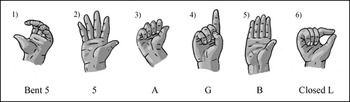
The handshapes in stage I are those that the prelinguistic infant is capable of producing in reaching: all fingers extended and spread (5 handshape);Footnote 2 grasping with fist (A handshape) and pointing with only the index finger extending from the fist (1 or G handshapes). In stage II, the handshapes are variants of those already mastered in stage I: all fingers extended but together (B handshape) and the thumb opposed to the index finger, with other fingers closed (bO or Closed L handshape). These are all considered to be unmarked handshapes, in that they involve the fewest number of selected features. The so-called marked handshapes contain the greatest number of selected features because they require inhibition and extension of the middle, ring and pinkie fingers, as well as control of non-adjacent fingers. Unmarked handshapes appear most often in all of the lexicons of the world's different sign languages (Sutton-Spence & Woll, Reference Sutton-Spence and Woll1999, for British Sign Language – BSL; Pietrandrea, Reference Pietrandrea, Caselli and Corazza1997, for Italian Sign Language – LIS), while marked handshapes have a more varied distribution. The handshapes of stage I and II as proposed by Boyes-Braem's model are shown in Figure 1.
The handshapes included in the stage I and II of Boyes-Braem model (Reference Boyes-Braem, Volterra and Erting1994).

Different studies provide supporting evidence for the primacy of a subset of Boyes-Braem's first two stages of handshape development, not only for children acquiring ASL (Conlin, Mirus, Mauk & Meier, Reference Conlin, Mirus, Mauk, Meier, Chamberlain, Morford and Mayberry2000) but also for other sign languages (among others Karnopp, Reference Karnopp, Morgan and Woll2002; Morgan, Barrett-Jones & Stoneham, Reference Morgan, Barrett-Jones and Stoneham2007).
There are only a few studies on the acquisition of location by signing children. Conlin et al. (Reference Conlin, Mirus, Mauk, Meier, Chamberlain, Morford and Mayberry2000) found that the majority of early signs were produced on the face/head or in neutral space with a few signs using the torso (trunk) or the arm as their place of articulation.
Regarding sign movement, Conlin et al. (Reference Conlin, Mirus, Mauk, Meier, Chamberlain, Morford and Mayberry2000) discuss three general properties of motor development that may predict the kinds of errors that children make in the formation of signs: repetition, sympathy and proximalization. It has been found (Meier, Mauk, Cheek & Moreland, Reference Meier, Mauk, Cheek and Moreland2008, for ASL; Juncos et al., Reference Juncos, Caamano, Justo, Lopez, Rivas and Lopez1997, for Lengua de Signos Espanola – LSE) that signing infants show highly accurate production of signs that have repeated movements in the adult sign language. This finding reinforces the well-known observation that deaf and hearing children (with or without sign exposure) produce prelinguistic gestures (vocal and manual babbling) characterized by repeated movements (Iverson & Thelen, Reference Iverson and Thelen1999). Sympathy refers to one of the basic principles operating in all sign languages studied to date. Some signs are one-handed whereas others are two-handed. Among the two-handed signs, in the ‘symmetry condition’ both hands execute identical movements (although the hands may be in or out or phase with each other); in the ‘dominance condition’ the dominant hand acts upon a static non-dominant hand. All children in the first year of life have difficulty inhibiting the action of one hand when the other hand is moving. The infant must learn to inhibit a tendency toward simultaneous bilateral movements (Wiesendanger, Wicki & Rouiller, Reference Wiesendanger, Wicki, Rouiller, Swinnen, Heuer, Massion and Casaer1994) in which the non-dominant hand tends to follow the dominant hand (Fagard, Reference Fagard, Swinnen, Heuer, Massion and Casaer1994). This motoric constraint may limit children's ability to separately control the two hands when signing (Cheek, Cormier, Repp & Meier, Reference Cheek, Cormier, Repp and Meier2001). Proximalization refers to the fact that for all infants motor control begins from the joints relatively proximal to the body (shoulder and elbow) and proceeds to joints that are further from the body (wrist and fingers). The proximalization tendency has also been found in infants acquiring ASL (Meier et al., Reference Meier, Mauk, Cheek and Moreland2008) and BSL (Morgan et al., Reference Morgan, Barrett-Jones and Stoneham2007). Both studies report that typical early signs may involve the articulation of relatively proximal articulators of the arm, elbow and shoulder, although open–close movements of the full hands may also frequently occur.
The goal of the present study
In the present study a qualitative analysis of the motor characteristics of gestures produced by children will be made adopting the same parameters used to describe early signs produced by deaf children. This will allow the possibility of analyzing similarities in the parameters of gesture execution across children and the verification of whether the same motor characteristics found in the sign production of young signing children also apply to representational co-verbal gestures produced by children. If the formal characteristics typical of the signing of young children are also found in the production of gestures used by hearing children who have not been exposed to sign language, we may argue that identical extralinguistic factors determine the articulation of both linguistic forms (signs) and non-linguistic forms (gestures).
METHOD
Participants
Eighty-seven Italian children (44 males and 43 females) participated in this study. The participants were in the age range of 2 ; 0 to 3 ; 1 (M=30·5 months; DS=4·2). Children were distributed relatively evenly across range with 33 children aged 2 ; 0–2 ; 4, 24 children aged 2 ; 5–2 ; 8 and 30 children aged 2 ; 9–3 ; 1. Children exposed to other languages, children with recurrent serious auditory impairment, twins and children with epilepsy or psychopathological disorders were excluded.
Materials and procedures
Lexical Production Task (LPT)
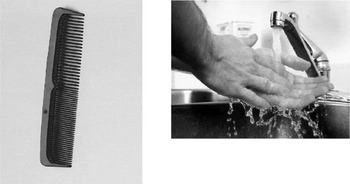
The ‘Lexical Production Task’ (LPT) is a naming task designed to be used with very young children between two and three years of age. Statistical procedures were used to select lexical items from the normative data of the ‘Primo Vocabolario del Bambino – PVB’ questionnaire, the Italian version of the ‘MacArthur-Bates Communication Development Inventory – CDI’ (for more details see Caselli & Casadio, Reference Caselli and Casadio1995). The version of the task employed here consists of 46 coloured pictures divided into two sets: a set of 24 pictures representing objects/tools (e.g. comb), animals (e.g. lion), food (e.g. banana) and clothing (e.g. gloves), and a set of 22 pictures representing actions (e.g. washing hands) and characteristics (e.g. small). Examples of the pictures are shown in Figure 2.
A picture representing the object comb and a picture representing the action of washing hands.

All of the children were tested individually at school. The two sets of pictures were presented separately in two different sessions and in random order, but the order of picture presentation within each set was fixed. After a brief period of familiarization, the experimenter placed the pictures in front of the child one at a time. For pictures of body parts, animals, objects/tools, food and clothing, the child was asked: ‘What is this?’; for pictures of actions, children were asked: ‘What is the child doing?’; and for pictures eliciting characteristics (adjectives or location adverbs) the child was asked: ‘How/where is it?’. When presenting the pictures, the experimenter sometimes pointed to the picture in order to help the child maintain focus, but otherwise avoided producing any other kind of gesture. The mean duration of the task was twenty-five minutes across the two sections and breaks were given as needed.
Coding
All sessions were videotaped for later transcription. The communicative exchanges between the child and the experimenter was coded from the time a picture was placed in front of the child to when the picture was removed. During these exchanges, children could, in principle, produce multiple spoken utterances and multiple gestures. All visible actions produced by the children as they interacted with the experimenter were coded as gestures (Kendon, Reference Kendon2004). These included gestures produced with and without speech, and those occurring both before and after the spoken response.
Given the specific nature of the task (asking children to name pictures), the criteria for coding an action as a gesture were as follows: (1) the gesture had to be produced after the adult request of picture naming; (2) the gesture could be performed with an empty hand or while holding the picture to be named; and (3) the gesture must not be an imitation of the adult's preceding gesture.
The analyses presented here were primarily limited to manual gestures and movements of the hands, although occasional reference will be made to other kinds of non-manual gestures (e.g. posture, body movements, facial expressions, glance). Various categories of gestures were produced by participants: deictic, representational, conventional, beats and self-adaptors (or thinking) gestures (for more details on this list of kinds of gestures see Butcher & Goldin-Meadow, Reference Butcher, Goldin-Meadow and McNeill2000; Stefanini et al., Reference Stefanini, Bello, Caselli, Iverson and Volterra2009). In the present study we considered only representational gestures.
Representational gestures were those pictographic representations of the meaning (or meanings) associated with the object or event represented in the picture. Two types of representational gestures were coded in our study: action gestures (e.g. in response to a picture of a comb: the child moves his fingers near his head as if combing his hair) and size–shape gestures (e.g. in response to a picture of gloves: the child shows both hands open and spread with the palm forward depicting the form of gloves). Action gestures depict the action usually performed by a character, possibly with an object, or the movement of an object. In action gestures (defined by Kendon, Reference Kendon2004, as ‘enactment’) body parts engage in a pattern of action that has features in common with the pattern of action that serves as the referent gesture. In contrast, size–shape gestures (defined by Kendon, Reference Kendon2004, as ‘modelling’ and ‘depiction’) depict the dimension, form or other perceptual characteristics of an object or an event. In these examples, the hands adopt a configuration that resembles the shape of the object to which the gesture refers, or engage in a pattern of movement that is recognized as ‘creating’ an object in the air.
All representational gestures produced (with and without speech) by the 87 children participating in the naming task were analyzed. The database consisted of a total of 269 gestures. Sixty-three out of 87 children (33 males and 30 females) produced representational gestures. The age of this group of 63 children was representative of the entire sample: 20 children aged 2 ; 1–2 ; 4; 21 children aged 2 ; 5–2 ; 8; 22 children aged 2 ; 9–3 ; 1.
The pictures which elicited a higher number of representational gestures from the children were chosen for more detailed analysis: five pictures depicting objects (comb, glass, gloves, lion, umbrella) and five pictures depicting actions (opening, turning, swimming, washing, phoning). Forty-five of the 63 children (24 males and 21 females) produced representational gestures for the ten selected items. The age of this group of 45 children was representative of the entire sample: 15 children aged 2 ; 1–2 ; 4, 15 children aged 2 ; 5–2 ; 8, 15 children aged 2 ; 9–3;1. This more restricted database consisted of 128 gestures ranging from 3 to 27 for each of the selected pictures.
Following the studies on sign language (SL) presented in the Introduction, each gesture was analysed in terms of the following parameters: number and symmetry of hands employed and handshapes; locations and place of contact; type and direction of movement; and children's use of various joints of the arm and hand according to the proximal-to-distal scale proposed by Meier et al. (Reference Meier, Mauk, Cheek and Moreland2008). In bimanual gestures we coded handshapes made by both hands. When parameters changed while in the performance of the gestures, we coded the initial as well as the final handshapes, locations and/or movements.
Reliability
Reliability between two independent coders was assessed for all gestures produced as well as for qualitative analysis of the form of gestures. The agreement between coders was 93·6% for the presence of representational gestures and 85% for the identification of parameters considered. The location of each disagreement was identified and disagreements were resolved by a third coder, who chose one of the two classifications proposed by the first two coders.
RESULTS
General trends
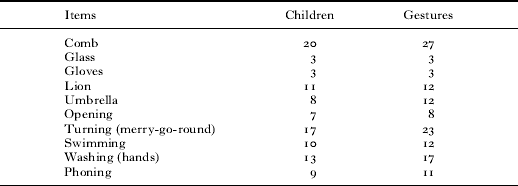
The number of children who produced representational gestures and the total number of gestures produced for each of the ten items is shown in Table 1. Sometimes a child produced more than one gesture referring to the same item.
Number of children performing gestures and total number of gestures produced for each item
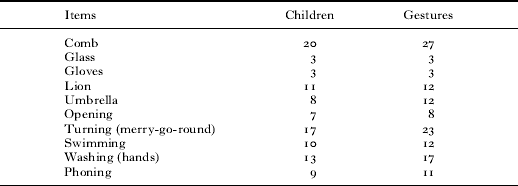
Almost all representational gestures (124/128) were produced together with speech. The majority of gestures represented an action (126/128). The representation technique used by children for almost all of these analyzed gestures was enactment (Kendon, Reference Kendon2004). All gestures imitated activities indicated in the picture (e.g. swimming or washing hands) or depicted actions (e.g. combing) performed with the object presented in the picture (the comb), or performed an action characterizing the animal to be named (the lion). Only two examples were clearly identified as size–shape gestures: showing the two open hands with the palm forward in front of the picture gloves and tracing a semicircular shape in front of the picture of a turning (merry go round).
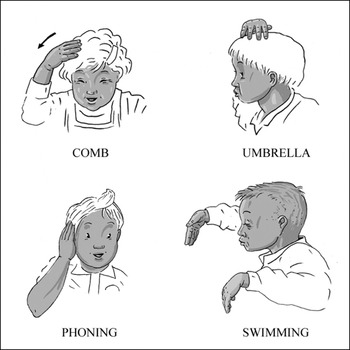
A general description of the gestures performed for the ten items by all children is reported in the Appendix and some examples are shown in Figure 3.
Examples of gestures.

Number and symmetry of hands employed
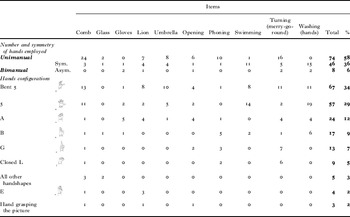
For each picture, Table 2 shows in the first three rows the number of gestures performed with one hand (unimanual) or with two hands (bimanual), and in the case of bimanual gestures indicates if the two hands are symmetrical (having the same handshape and movement) or asymmetrical (having different handshapes or movements). From this table it is clear that gestures performed for 6 out of 10 pictures show a marked preference (at least 75% of occurrences): 3 consistently unimanual and 3 consistently bimanual. Gestures for gloves (100%), swimming (92%) and washing hands (100%) were performed with two hands while gestures for comb (89%) opening (75%) and phoning (91%) were performed with one hand. Considering all gestures, unimanual gestures were produced significantly more frequently than bimanual gestures (58% versus 42%; Binomial Test: p<0·001). Children often produced bimanual gestures not only when the meaning was related to both hands (e.g. gloves or swimming) but also for other items not necessarily involving the use of two hands (e.g. umbrella, turning).
Number and symmetry of hands employed and handshapes

In the majority of bimanual gestures the hands were symmetrical (85%), confirming that actions requiring separate control of the two hands are late to emerge in all children, regardless of the mode of their communication.
Handshapes
The frequency of the various hand configurations that appeared in the data is shown in Table 2 and examples of the most frequent handshapes are shown in Figure 4.
Examples of the most frequent handshapes present in the gesture corpus.

We found a great variability in the use of handshapes for gestures referring to the same pictures. It was possible to reach a marked tendency, that is at least 75% of occurrences, only by collapsing the bent-5 handshape and the 5 handshape. These configurations mostly occurred in many of the gestures produced for umbrella (bent-5 handshape: 63%; 5 handshape: 31%); for swimming (5 handshape: 58%; bent-5 handshape: 33%); and for washing hands (5 handshape: 48%; bent-5 handshape: 28%). In the case of comb, the tendency found was near to the selected criteria (5 handshape: 33%; bent-5 handshape: 39%). These two handshapes, the bent-5 and the 5 (and its lax versionFootnote 3), were much more frequently used than any other handshape (62% of all handshapes observed). Other handshapes less frequently used were A (12%), G (6·5%), B (6%) and Closed L (corresponding to the baby O identified for ASL) (4·5%). The hand configuration E (2%) appeared only with a specific item (lion). The remaining handshapes were very rarely used together, accounting for only 9% of all handshapes observed.
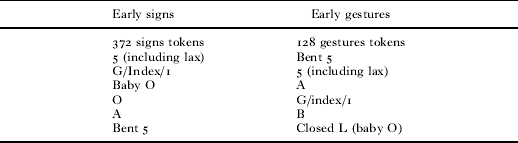
Five of the most frequently produced handshapes (5, bent 5, A, G, Closed L) closely correspond to those that Conlin et al. (Reference Conlin, Mirus, Mauk, Meier, Chamberlain, Morford and Mayberry2000) have identified in a corpus of 372 sign tokens produced by signing children acquiring ASL. A direct comparison of the Conlin et al. data with the gesture data from this study is shown in Table 3.
The most frequent handshapes in a signs corpus produced by children acquiring ASL (Conlin et al., Reference Conlin, Mirus, Mauk, Meier, Chamberlain, Morford and Mayberry2000) and in the gestures corpus exhibited by non-signing children in this study
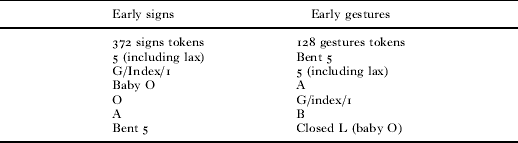
The only differences between the list reported by Conlin et al. (Reference Conlin, Mirus, Mauk, Meier, Chamberlain, Morford and Mayberry2000) and the present study were the following:
— Handshape B is present in our gesture corpus but absent in the sign corpus
— Handshape O (index and thumb opposed with other fingers extended) is present in the sign corpus but absent in our gesture corpus.
Both of these handshapes (B and O) were included in the group of stage II handshapes according to Boyes-Braem, while the other most frequent handshapes in both corpora were all included in the stage I handshapes (Boyes-Braem, Reference Boyes-Braem, Volterra and Erting1994).
Location and contact
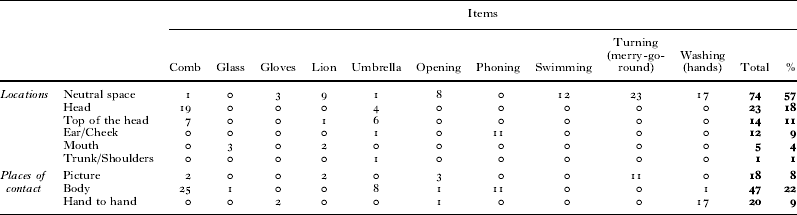
With respect to the place of articulation, we coded the following locations: neutral space, head/top of the head, ear/cheek, mouth, trunk/shoulder. Table 4 illustrates the number of gestures articulated in these locations for each item and indicates if the hand was contacting the picture, the body and/or the non-dominant hand.
Locations and places of contact
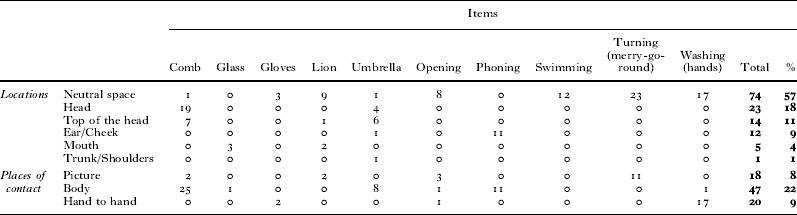
Gestures were articulated either in neutral space (57%) or on the body: head, face and/or shoulders (43%). As reported in the literature on signing children, the majority of signs are articulated in neutral space or on the face/head and very rarely on the trunk or shoulders (Conlin et al., Reference Conlin, Mirus, Mauk, Meier, Chamberlain, Morford and Mayberry2000; Morgan et al., Reference Morgan, Barrett-Jones and Stoneham2007). Gestures for specific items tended to be performed in the same location by all children. For seven out of ten pictures the children produced gestures on the same location. For example, almost all the gestures for comb (26/27) were performed on the head and all gestures for phoning were produced on the ear or cheek and gestures for gloves or turning were all performed in neutral space. For the remaining three items there was a marked tendency, as previously defined, to perform gestures on the same location (75% for lion), particularly if we collapse head and top of the head as one single location (96% for comb; 76% for umbrella).
A remarkably high percentage of gestures produced by the children contacted not only their body and/or non-dominant hand but also the picture (20%). In these cases, the picture itself became the manipulated object: for example, the child combs his/her hair using the picture of the comb or the child rotates the picture of the turning merry-go-round.
A closer look at Tables 2 and 4 indicates that gestures performed for the same pictures showed more variability in hand configurations than in locations across children. Variability in hand configurations occurrences ranged from three to ten, while variability in locations concerned only the gestures performed in the cases of three items: comb, lion and umbrella. For each item (except for umbrella) gestures performed showed more variability in hand configurations than locations.
With respect to these two parameters Conlin et al. (Reference Conlin, Mirus, Mauk, Meier, Chamberlain, Morford and Mayberry2000) observed more within-child variability on handshapes versus locations in early sign production.
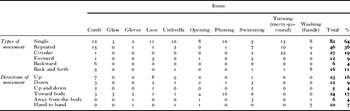
Types and directions of movements
Table 5 shows types and directions of movement involved in the gestures used by the children. A general finding is that children more frequently produced single-movement gestures (64%) than repeated-movement gestures (36%). Gestures performed for five out of ten pictures show a marked preference to be performed with a single movement: glass (100%), lion (92%), umbrella (83%), opening (100%), phoning (91%). In the other cases gestures did not show a marked preference for a specific type of movement.
Types and directions of movement

We found a great variability in the direction of movement of gestures and it was possible to reach a marked tendency for only two pictures out of ten items. In particular, gestures for turning evidenced a marked preference to be performed with a circular motion (96%), while gestures for phoning evidencing a movement directed toward the body (91%).
In almost all gestures, children adopted an internal role in performing the action. For example, in the case of lion the children ‘became’ the lion using their hands as if they were the paws of the character represented in the picture. Only with the picture turning merry-go-round did the majority of children adopt an external perspective.
As for the general properties – repetition, sympathy and proximalization – described for the movement parameter of early signs, we did not find a higher frequency of repeated movements but we found evidence for the other two properties. For the bimanual gestures, a marked tendency of the two hands to execute identical simultaneous movements was noted (80% sympathetic movements versus 20% asymmetrical movements). In addition, and separately to type and direction of movement, we coded the children's use of the various joints of the arm and hand according to the proximal-to-distal scale proposed by Meier et al. (Reference Meier, Mauk, Cheek and Moreland2008). We considered proximal those movements articulated at the joints of the shoulder or elbow and distal those movements articulated at the joints of the wrist and first and second knuckles of fingers. We did not find involvements of radioulnar articulations. The percentage of wrist and finger movements was 14%, evidencing that movements of the relatively proximal articulators of the arm, elbow and shoulder were more likely to occur.
To verify whether the articulatory properties found in the subset of the selected 10 items were also evident in the rest of sample, we analysed half of the remaining set of gestures randomly selected (for a total of 70) produced by 59 children corresponding to 18 pictures. We confirmed that 55% of the gestures were unimanual and 45% bimanual. Within the bimanual gestures, 97% were symmetrical. The most frequent handshapes were the same as already noted in the set of gestures previously analysed and only a few examples of other handshapes were found (V handshape=1; 3 handshape=2; F handshape=1; I handshape=1; 4 handshape=1). The list of locations was the same as already noted, the only new location was the eye, mostly used in the cases of the item crying, where the picture represents a child rubbing his eyes. With respect to the various joints involved in the gestures, a higher percentage of proximal movements was calculated (72%).
These additional analyses confirm the articulatory properties already evidenced in the selected subset of the most frequently elicited gestural responses.
DISCUSSION
The present study started from the observation that when asked to provide verbal labels for pictures, preschool children often accompanied their speech with gestures. A large sample of children between two and three years of age were asked to name a series of pictures. Many children produced representational content gestures when naming certain pictures, providing data for comparison. The subset of representational gestures produced in response to ten photos depicting five objects (comb, glass, gloves, lion, umbrella) and five actions (opening, turning, swimming, washing hands, phoning) were analyzed using the same parameters as in the study of sign languages: handshape, location and movement. All gestures imitated activities depicted in the pictures or expressed actions performed with the object presented in the pictures (glass) or performed an action characterizing the animal to be named (lion). Only two examples were size–shape gestures.
These findings demonstrate that the production of action gestures is not always linked to the direct and explicit presence of an action in the images presented. These results are consistent with the analyses conducted on a more extended database of representational gestures where the percentage of action gestures (83%) was much higher than the percentage of size–shape gestures (13%) (Stefanini et al., Reference Stefanini, Bello, Caselli, Iverson and Volterra2009). These authors did not focus on the motoric characteristics of gestures but, analysing spoken and gestural responses given by children aged between two and seven years, noted that almost all children produced gestures together with words while naming pictures. It is striking that children who are already able to correctly name pictures in speech still used gestures. The detailed analysis of formational parameters showed interesting similarities in the form of gesture produced by a large number of children confronted with the same visual stimulus: the choice of one or two hands and very similar locations. More variability was observed in handshapes and movements. This indicates that there is consistency in the way that different children gesture when they are given the same picture to name. Several studies assessing children's knowledge by reading their gestures have found similarities in the gestures that children produce when explaining various cognitive tasks (see Alibali, Kita & Young, Reference Alibali, Kita and Young2000, for a conservation task). A recent study examining speech and gestures produced by older children explaining a balance task identified a set of similar gestures that regularly accompanied verbal descriptions indicating weight and distance (Pine, Lufkin & Messer, Reference Pine, Lufkin and Messer2004).
Kendon (Reference Kendon2004) has also noted that in adult communication, the fact that gestural expressions are often very well articulated, are easily recognized and are distinct from one another suggests that they have undergone some considerable degree of conventionalization. He indicates how it is possible for gesturing to develop into a widely shared sign language, how forms used in loosely organized and context-dependent systems can become stabilized and standardized. We must acknowledge that our conclusions are based on some restricted set of gestures selected on the basis of the number of gestures produced in response to the same pictures, and we cannot exclude the possibility that the nature of the stimuli could have determined some of the properties of the children's gestures reported here. The task proposed in the present study was not originally devised in order to elicit gestures and this aspect was not controlled, but this point has to be taken into consideration in future studies on gestures.
Our study provides interesting evidence that co-speech gestures produced by hearing children have a function and form that are similar to the early signs produced by children exposed to a sign language, and does not support the claim of a clear boundary between non-linguistic and linguistic systems. Children who are already able to name referents verbally still use gestural enactment or depiction accompanying their naming to represent the object or the action, indicating functional similarities between representational gestures and lexical signs. Execution patterns identified in early sign development may also extend to gestural development in non-signing children: some motor characteristics found in the production of first signs, as reported in the SL acquisition literature, also apply to gestures produced by hearing toddlers. Gestures and early signs were both produced using the same restricted set of ‘basic’ handshapes and similar locations (the face/head and neutral space). In the majority of bimanual gestures the hands are symmetrical, confirming the observation that actions requiring separate control of the two hands are late to emerge in all children. These findings support the view that similar motoric characteristics operate in both cases and could be largely explained by the anatomy and physiology of the hand and the arm (Ann, Reference Ann1996). A high number of signs with repeated movements are reported in the sign language literature, while very young deaf infants tend to use a single movement producing communicative gestures such as pointing (Meier & Willerman, Reference Meier, Willerman, Emmorey and Reilly1995). Children from our sample tended to produce gestures with simple movements, highlighting that some differences between gestures and early signs in the execution of movement can exist. In adult signed languages, short repeated movements are often associated with nouns while single prolonged movements characterize verbs. In this study, representational gestures were always produced together with speech; we are currently conducting a more detailed analysis of the semantic and temporal relationship between gesture and speech to better explain possible associations in movement execution in both modalities: gestural and vocal. It would be possible, for example, that in the case of our children the non-repeated gestures are timed to match the non-repeated words.
An interesting question to consider is whether co-speech representational gestures produced by hearing children are similar to the corresponding signs in Italian Sign Language (LIS). Previous studies comparing hearing persons' gestures with signs produced by older children (Morford, Singleton & Goldin-Meadow, Reference Morford, Singleton, Goldin-Meadow, Emorrey and Reilly1995) or adults (Schembri, Jones & Burnham, Reference Schembri, Jones and Burnham2005) indicated that interesting similarities as well as important differences can be found. In particular, Schembri et al. (Reference Schembri, Jones and Burnham2005), who compared the performance of two groups of signers using different signed languages with the responses produced by hearing non-signing participants in descriptions of object movements, found that the high degree of similarity in the data from these groups is consistent with the claim that classifier constructions in SLs may be analyzed as blends of linguistic and gestural elements.
In another study carried out with hearing adult non-signers, exploring the underlying relationship between the communicative function of gesture and its form in situations which differed in how much speech or gesturing was allowed, Singleton, Goldin-Meadow & McNeill (Reference Singleton, Goldin-Meadow, McNeill, Emorrey and Reilly1995) show that gestural form changes incrementally, becoming more and more language-like as gesture assumes a progressively larger share (with respect to speech) of the total communicative burden.
For children who are at an early stage of spoken language development, gesture may carry a larger share of the communicative burden. It is possible that gestures produced by the children in our sample, who are still at an early stage of lexical development, exhibit some linguistic properties such as symbolization, conventionality and formal characteristics which are not yet completely stabilized in the spoken modality. As speech (in the vocal modality) increases, taking on well-defined linguistic properties, gesture (in the manual modality) does not take on these corresponding properties except in situations in which the use of the vocal modality is prevented (McNeill, Reference McNeill2005). These properties may reflect modality-independent cognitive processes which only get allocated to the spoken or gestural modality depending on experience and the linguistic input that the children are exposed to.
As reported by Kendon (Reference Kendon2004), the forms of expression in gesture have much in common with certain forms of expression in primary sign languages and there is common ground between gesture and sign. This assertion does not challenge the well-established distinctions between gestures and signs. Data on aphasic signers with unimpaired gesture production and impaired sign production, even when both share very similar forms, support the argument that gesture and sign are underpinned by distinct processing systems even though they may originate from a common conceptual semantic system (Marshall, Atkinson, Smulovitch, Tracker & Woll, Reference Marshall, Atkinson, Smulovitch, Tracker and Woll2004).
According to investigators who have observed and analyzed the relationship between speech and gesture in adult communication, gesture is part of language and language itself is considered a gesture–speech integrated system (Kendon, Reference Kendon2004; McNeill, Reference McNeill2005). Acts of speaking and gesturing are bound to each other at a general level and operate as an inseparable unit reflecting different semiotic aspects of the cognitive structure that underlies them both. The production of representational gestures in a naming task by young children supports the idea that gesture and speech share a common conceptual space as well as the activation of hand–mouth motor programs associated with specific objects or actions (Arbib, Oztop & Zukow-Goldring, Reference Arbib, Oztop and Zukow-Goldring2005; Gallese, Reference Gallese2000; Stefanini et al., Reference Stefanini, Bello, Caselli, Iverson and Volterra2009). The present findings provide evidence that hearing children produce similar forms of gestures for a common image and that some motor patterns identified in early sign development may also extend to gestural development in non-signing children. Such a result could have interesting implications for the notion of a continuum between gestures and signs.
APPENDIX
A general description of gestures used by all children depicting pictures of objects or animals. The total number of gestures analyzed is reported in parentheses.
COMB (27)
All gestures are enactments of the action of combing. The gestures are mainly one-handed (24/27), and are performed contacting the same location: the head. There are only three cases where both hands are involved symmetrically. The hand configurations used are mainly 5 or bent 5. The direction of movement is from the front to the back or up on top of the head and/or downward on the side of the head. Interestingly enough, in two cases the gesture of combing is performed handling the picture of the comb.
GLASS/WATER (3)
In all cases gestures represent the action of bringing something to the mouth. Gestures are performed with one (2) or two symmetrical hands (1) moving toward the mouth. The handshapes vary (bent T, bent B and C).
GLOVES (3)
One gesture depicts the action of putting on gloves; in the other two cases both hands are exhibited. All gestures are performed using two hands which move symmetrically (1) or asymmetrically (2) in the neutral space. However, in the two asymmetrical cases one hand becomes the location for the other hand (dominance condition). In one case, the hand with the B configuration moves on the other hand with the A configuration, while in the other case, the two hands alternatively close from 5 and bent 5 into A, moving alternately and reciprocally one on top of the other. In the symmetrical case, both hands open from configuration A to 5.
LION (12)
In all cases, the child acts as a ‘lion’ (person transfer or role-taking) moving one (7) or two hands (5) with a single movement in the neutral space. The handshapes frequently used are 5 or bent 5, sometimes closing into A (3). The direction of movement is up or forward, and in two cases there is contact with the picture: in one case the child grasps the picture itself while ‘performing the lion’; in the other case the child bangs on the picture of the lion. The facial expression is often fierce.
UMBRELLA (12)
Almost all gestures depict the action of covering or protecting the head, in some cases it remains unclear whether the hand models the object itself. The majority of gestures (8) are performed with one hand moving up toward the same location: on top of the head (10) and often with contact (8). The hand configurations are 5 or bent 5.
A general description of gestures used by all children depicting pictures of actions. The total number of gestures analyzed is reported in parentheses.
OPENING (8)
All gestures depict the opening or closing of the door.Footnote 4 The majority of gestures are performed with one hand (6/8) in the neutral space and with a single movement forward (1), down (2), toward the body or the hand (5), and in a few cases touching the picture (3). The handshapes are mostly A (4) and bent 5 (4).
PHONING (11)
All gestures (except one) are performed with one hand moving toward and touching the same body location: the ear/cheek.The hand configuration usually used is B (5).
SWIMMING (12)
All gestures (except one) are performed moving both arms in the neutral space with symmetrical hand configurations: 5 (14) or bent 5 (8) performing an action similar to that presented in the picture. The type of arm movements vary: single (3), repeated (5) and continuous (4), and the direction of movement is circular (2), forward (5), up (1), down (3) back and forth (1), and up and down (2) or away from the body (3).
TURNING (23)
Gestures are performed mainly with one hand (16/23). All gestures are executed in the neutral space with a single (13) or repeated (4) or continuous (6) movement. All gestures (except one) have a circular motion. Hand configurations vary, but the most frequent are bent 5 (11), G (7) and Closed-L (6). Almost half of the cases have contact with the picture, and in two cases the picture itself is rotated.
WASHING HANDS (17)
All gestures are performed with the two hands in contact moving in the neutral space, performing an action similar to that presented in the picture. For the most part, the hands are symmetrical, and in the few cases (2) in which they are asymmetrical, one hand becomes the location for the other hand (dominance condition). The handshapes are often 5 (19), bent 5 (11) and B (6).