1 Introduction
The collision of two droplets in a gaseous environment plays an essential role in many natural and industrial processes, such as raindrop and cloud formation, insecticide spraying, spray painting and spray combustion in various liquid-fuelled engines. For the most symmetrical event, namely the head-on collision between two identical droplets, it has been experimentally (Jiang, Umemura & Law Reference Jiang, Umemura and Law1992) and theoretically (Zhang & Law Reference Zhang and Law2011) demonstrated that, with increasing impact inertia, the droplets will first merge, then bounce, then merge again, and finally merge followed by further fragmentation with the concomitant production of secondary and even tertiary droplets.
For the collision between two droplets of unequal sizes, studies have been conducted on the global assessment of the merging efficiency. Specifically, Ashgriz & Poo (Reference Ashgriz and Poo1990) and Rabe, Malet & Feuillebois (Reference Rabe, Malet and Feuillebois2010) experimentally found that water droplets tend to remain permanently merged as the size differential increases, while Tang, Zhang & Law (Reference Tang, Zhang and Law2012) demonstrated that this behaviour also exists for hydrocarbons. The underlying physics is that viscous dissipation of the excess collisional energy within the merged droplet increases with size disparity so that the droplets can undergo collision with larger Weber numbers without further fragmentation. In addition, Anilkumar, Lee & Wang (Reference Anilkumar, Lee and Wang1991) experimentally studied the merging and subsequent mixing of initially stationary, low-viscosity droplets of equal and unequal sizes, and found that, while there is minimal mixing following merging of equal-sized droplets due to symmetry, there is considerable mixing for drops of unequal sizes, with the smaller drop penetrating into the larger drop in the form of a mushroom-like jet. Blanchette, Messio & Bush (Reference Blanchette, Messio and Bush2009) simulated the merging of two initially stationary droplets with different surface tensions and observed the jet-pattern mixing within the merged mass even for initially equal-sized droplets. Nobari (Reference Nobari1993) numerically studied the merging of two initially stationary droplets by using a front-tracking method and substantiated the enhanced mixing for small droplet viscosity and large size ratios. Liu et al. (Reference Liu, Zhang, Law and Guo2013) performed front-tracking simulation on the merging of unequal-sized droplets with Weber numbers
 $We$
up to
 $O(10)$
, and confirmed the crucial role of the surface tension energy of the merged interfaces in forming the jet. Furthermore, the situation of a droplet hitting a liquid pool, which can be treated as a limiting case of unequal-sized droplet collision with infinite size disparity, has also been extensively studied for vortex ring formation (Thomson & Newall Reference Thomson and Newall1885; Hsiao, Lichter & Quintero Reference Hsiao, Lichter and Quintero1988; Shankar & Kumar Reference Shankar and Kumar1995).
It is noted that, in addition to interest in the fundamental mechanisms governing merging and the subsequent internal mixing when merging is effected, there also exists considerable technological interest in manipulating these processes. As an example, owing to the low volatility of gelled hypergolic propellants used in rocket engines (Law Reference Law2012), ignition is effected by impinging and merging the bipropellant fuel and oxidizer droplets and jets. The resulting heat release rate would then depend on the internal mixing rate of the merged mass. Another example is the synthesis of novel materials through droplet merging, for which the uniformity or deliberate stratification of the synthesized material would depend on the nature of the internal mixing.
In the present investigation, we aim to experimentally identify the morphology and dynamics of the internal jet developed upon merging of two droplets of unequal sizes, particularly the dependence on the impact inertia as well as the physical properties of the fluid, and will show in due course that the nature and occurrence of the jet developed can be highly non-monotonic with respect to the impact inertia. The high-quality experimental images on the droplet collision and jet development event are also expected to be useful in the development and validation of numerical codes for the simulation of discrete gas–liquid two-phase systems. As an attempt, we numerically solved an axisymmetric formulation of droplet collision by using an improved volume-of-fluid (VOF) method and an adaptive mesh refinement algorithm. The validated simulation results provide auxiliary information on velocity and pressure fields, which generally are not readily obtained in droplet experiments.
In the following, we will first specify our experimental apparatus and numerical methodology in § 2. A series of time-resolved droplet collision images with internal flow patterns are shown in § 3, together with the mechanistic interpretation and numerical reproduction of these results.
2 Experimental and numerical specifications
2.1 Experimental apparatus
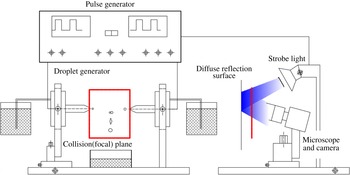
The schematic of the experimental apparatus is shown in figure 1. Two droplet streams are independently generated from each glass nozzle by using a circuit to drive a piezoelectric crystal. The sizes of the droplets are adjusted by using nozzles with different apertures. The space uniformity and frequency of the droplets are controlled by the droplet generation circuit. Time-resolved images of droplets were obtained through a stroboscope synchronized with the droplet generation circuit. Droplet pairs are carefully made to collide on the focal plane of the camera, and the sizes of the droplets can be determined from the images at the instant before they start interacting.
Schematic of the experimental apparatus. The front view of the collision plane captured by the camera is shown in the red rectangle on the left, and the corresponding side view is shown on the right for its relative position with respect to the camera and strobe light.

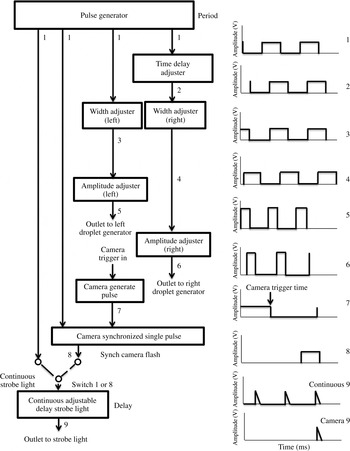
The pulse sequence for the phase control of the two droplet streams, the strobe light and the camera are shown in figure 2. The basic signal of the system is pulse 1. After careful tuning, the width and the amplitude of pulse 1 without/with an appropriate time delay, pulses 5 and 6, are used to drive the two droplet generators to form droplet streams. Additionally, pulse 1 is used to drive the continuous strobe light so that one can see the droplets from a channel of the microscope while adjusting the two droplet generators, which are anchored in three-dimensional positioners, to direct the two droplet streams against each other on the focal plane. By tuning the delay phase of the strobe light, one can see different time sequences of the droplet collision. In order to record the time-resolved images, a Nikon D80 camera is attached to another channel of the microscope, the continuous strobe light is switched to a single-shot mode, and the camera flash is synchronized (pulse 8). By flashing the strobe light twice within a pulse period, the camera can record exactly the same droplet with a short phase difference, allowing the determination of the instantaneous droplet velocity.
Pulse sequences and synchronization of signals. Switch 1: continuous strobe light illuminates the view for the experimenter to adjust the pulse for droplet generators; by tuning the delay of pulse 9, collisions at different phases are observed. Switch 8: when the collision at a fixed delay is ready, a camera-synchronized single pulse triggers the flash and the collision image at this specific delay is recorded.

In the present study, we tuned the delay of the droplet generator and the strobe light to obtain images of different droplet pairs, which are assumed to represent the collision processes of the same droplet pair at different time instants. Therefore, an essential requirement of the present experiment is to generate spatially and temporally stable droplets. The adopted methodology, including the droplet generation and visualization systems, have been sufficiently validated in many previous studies (Jiang et al. Reference Jiang, Umemura and Law1992; Pan, Law & Zhou Reference Pan, Law and Zhou2008; Tang et al. Reference Tang, Zhang and Law2012) on characterizing the droplet collision outcomes. However, it is extremely difficult to generate identical droplet pairs from two separate nozzles over extended periods of time to characterize droplet internal mixing. As a result, the temporal uncertainty of collision images is approximately 0.1 ms in the early stages (from droplet contact to merging) while it may be as large as 0.4–0.5 ms or 20–30 % in the late stages involving droplet oscillation and internal mixing.
In the present experiments, the radius of the smaller droplet was fixed at approximately
 $100~{\rm\mu}\text{m}$
. The size disparity can be changed by using a larger nozzle for the other droplet generator. To visualize the internal mixing pattern upon coalescence of the two droplets, a small amount (less than 0.1 % in volume) of a red food colouring dye (ingredients: water, Red 40, modified corn starch, etc.; Ateco Food Coloring, purchased from Amazon) was added to the smaller droplet for water droplet collision. For liquid hydrocarbons, Sudan Red II was used because the solubility of the red food colouring dye in hydrocarbons is very small; note that we were not able to identify alternative red dyes with greater solubility in liquid hydrocarbons than Sudan Red II. The physical properties of the dyed liquids were tested (the density, viscosity, surface tension of the dyed and undyed liquids were tested according to Chinese National Standard GB/T 1884-1992, GB/T 265-1988 and GB/T 6541-1986, respectively), and results show that such a small amount of dye addition has negligible influence on the liquid properties. To visualize the internal mixing process indicated by the red-dyed fluid, the collision plane should be on the focal plane of the microscope, and a rough surface should be used for the diffuse reflection light to illuminate the focal plane, as shown in figure 1.
Water,
 $n$
-decane and
 $n$
-tetradecane were used as testing liquids, and their viscosities and surface tensions are given in table 1. The selection of these three fluids provides a controlled study on the effects of surface tension and viscous loss, noting that, while water and
 $n$
-decane have close values of viscosity, their surface tensions are quite different, and while
 $n$
-decane and
 $n$
-tetradecane have close values of surface tension, their viscosities are quite different. The collision Weber number is defined as
 $We_{S}=2{\it\rho}_{l}R_{S}U^{2}/{\it\sigma}$
, where
 ${\it\rho}_{l}$
,
 $R_{S}$
,
 $U$
and
 ${\it\sigma}$
are respectively the liquid density, droplet radius, relative impact velocity and surface tension, while the subscripts
 $S$
and
 $L$
respectively designate the smaller and larger droplets, with the size ratio given by
 ${\it\Delta}=R_{L}/R_{S}$
. Because of the importance of viscous dissipation in droplet collision, the Ohnesorge number,
 $Oh=16{\it\mu}_{l}/({\it\rho}_{l}R_{S}{\it\sigma})^{1/2}$
, is adopted to measure the importance of viscous force relative to surface tension. In the present experiments,
 $We_{S}$
varies from 5 to 90,
 ${\it\Delta}$
from 1.5 to 2.9, and
 $Oh$
from 0.18 to 0.82. The modified Weber number,
 $We^{\ast }=We_{S}{\it\Delta}^{3}/[12(1+{\it\Delta}^{3})(1+{\it\Delta}^{2})]$
, defined by Tang et al. (Reference Tang, Zhang and Law2012), which measures the relative importance of the total kinetic energy of the droplets in the coordinate system of the centre of mass compared to the total surface energy of the droplets before collision, is also used as a parameter accounting simultaneously for the influence of Weber number and the size ratio. It is noted that
 $We^{\ast }$
is exactly the same as the ‘symmetric Weber number’ defined by Rabe et al. (Reference Rabe, Malet and Feuillebois2010), if the same definition of size ratio were adopted.
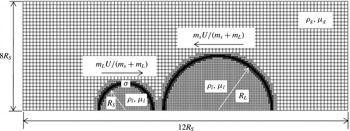
Computational domain and schematic adaptive mesh for the VOF simulation of unequal-sized droplet collision.

Properties of tested liquids.

2.2 Numerical methodology
The computational domain and schematic mesh for the two moving droplets, which are made to collide with each other, are shown in figure 3. A cylindrical coordinate is established so that the line connecting the centres of mass of the two spherical droplets forms the axial direction. The flow field in both the gas and droplet is treated as incompressible and viscous. The computational domain is an axisymmetric cylinder of
 $12R_{S}$
in length and
 $8R_{S}$
in radius. The natural oscillation time of the small droplet is
 $t_{\mathit{osc}}=(8{\it\rho}_{l}R_{S}^{3}/{\it\sigma})^{1/2}$
, by which a non-dimensional time,
 $T=t/t_{\mathit{osc}}$
, can be defined. The outflow boundary conditions are specified on all the boundaries expect the axis and further extension of the computational domain will not cause significant change in the results.
It is noted that droplet collision with finite Weber number is a multiple-scale and multiple-physics phenomenon, particularly for those processes involving the intervening gas flow between the impacting droplet surfaces and the subsequent coalescence triggered by the van der Waals force (Zhang & Law Reference Zhang and Law2011). The occurrence of coalescence depends on whether the clearance between the impacting surfaces can reach a critical range of distance, which is typically tens of nanometres. Furthermore, the gas-film thickness could vary by 3–4 orders of magnitude during the collision process, and as such poses immense challenges to the computational capacity for spatial resolution. In addition, since the thickness of the gas film can be comparable to the mean free path of the gas (Zhang & Law Reference Zhang and Law2011), the rarefied nature of the gas film before coalescence requires numerical artifacts (e.g. adjusting mesh resolution in the present study) in continuum-based numerical methods in order to capture the droplet coalescence and the related phenomena. As a result, quantitatively predictable simulation of droplet coalescence at non-vanishing Weber numbers is not available up to now. The present computational methodology for simulating droplet collision at non-vanishing Weber numbers is to tune the numerical mesh to capture the droplet deformation during the entire collision process and then use the validated simulation results for a more precise and detailed description of the experimental results. The good agreement in terms of droplet mixing in all test cases, to be shown shortly, verifies the adopted computational methodology.
The VOF method adopted by the study has been discussed in detail in Popinet (Reference Popinet2003, Reference Popinet2009) and implemented in the open-source code Gerris, which has been widely used in many multiphase incompressible flows (Fuster et al.
Reference Fuster, Agbaglah, Josserand, Popinet and Zaleski2009; Thoraval et al.
Reference Thoraval, Takehara, Etoh, Popinet, Ray, Josserand, Zaleski and Thoroddsen2012; Chen et al.
Reference Chen, Ma, Yang and Popinet2013; Deike, Popinet & Melville Reference Deike, Popinet and Melville2015). In summary, the method is characterized by the combination of the adaptive quad/octree spatial discretization, the geometrical VOF interface representation, the balanced-force/continuum-surface-force surface tension formulation and the height-function curvature estimation. In order to resolve the droplet interface and the internal flow within the droplet, the computational domain was divided into three zones, including the gas, the droplet interior and the droplet surface. The mesh for each zone can be adaptively refined to a prescribed level denoted by an integer
 $N$
, at which the minimum cell size in the zone is of the same order of
 $R_{S}/2^{N}$
. We can hence use (
 $N_{1},N_{2},N_{3}$
) to prescribe the refinement levels in all three zones. As an example, figure 3 shows an illustrative mesh of the refinement levels (
 $5,6,7$
), in which the total number of grid points is 13 851 and is equivalent to approximately 50 000 grid points on a fixed, uniform mesh system.
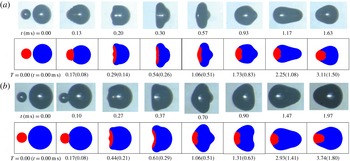
Head-on collision of two
 $n$
-tetradecane droplets for (a)
 $We_{S}=17.6$
,
 ${\it\Delta}=1.87$
and (b)
 $We_{S}=16.5$
,
 ${\it\Delta}=2.33$
. The oscillation time and the Ohnesorge number of the smaller droplet are
 $t_{\mathit{osc}}=0.48~\text{ms}$
and
 $Oh=0.82$
, respectively. Experimental images are adapted from Tang et al. (Reference Tang, Zhang and Law2012).

To validate the present numerical methodology, the head-on collision of two unequal-sized
 $n$
-tetradecane droplets was first simulated and compared with the experimental images of Tang et al. (Reference Tang, Zhang and Law2012), as shown in figure 4. The radius of the small droplet is kept as
 $100~{\rm\mu}\text{m}$
; thus the natural oscillation time and Ohnesorge number of the small droplet can be correspondingly obtained. The mesh refinement levels are (
 $5,10,12$
) so that the smallest grid size is approximately
 $R_{S}/2^{12}$
and the total number of grid points is 56 499, being equivalent to 12.6 million uniform grids. A typical simulation with the above computational domain and mesh generally takes 100 h of actual time on two Intel Xeon E5-2630 processors with 24 cores. We selected the computational images that resemble most closely the experimental ones and found that the corresponding times are not identical but are within the experimental uncertainty. The very good agreement between the simulation and experimental results in terms of the droplet deformation suggests that the adopted VOF method and computer code are suitable for the present problem. It is noted that previous experiments have observed a tiny bubble formed during the droplet coalescence, substantiating, albeit indirectly, that the coalescence occurs first at the circular rim. However, the bubble captured in the present VOF simulation is approximately
 $0.08R_{S}$
, which is significantly larger than that observed in the experiments (Thoroddsen, Etoh & Takehara Reference Thoroddsen, Etoh and Takehara2003; Bouwhuis et al.
Reference Bouwhuis, Van der Veen, Tran, Keij, Winkels, Peters, Van der Meer, Sun, Snoeijer and Lohse2012; Keij et al.
Reference Keij, Winkels, Castelijns, Riepen and Snoeijer2013). To eliminate the possible influence of the unphysically large bubble on the internal flow, we numerically filtered it by following the approach of Liu et al. (Reference Liu, Zhang, Law and Guo2013) without causing any significant change to the simulation results, as substantiated in figure 4.
3 Results and discussions
3.1 Collision of water droplets
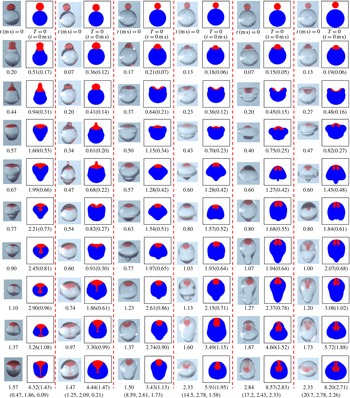
Figure 5 shows six sequences of time-resolved images of water droplet collision with increasing impact inertia of the smaller droplet, as represented by its Weber number,
 $We_{S}$
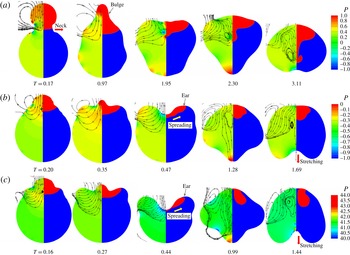
. The simulation shows good agreement with the images not only for the droplet deformation but also for the internal mixing patterns. The validated simulation provides additional information about the velocity and pressure fields of the phenomena, as shown in figure 6 for three representative cases. It is seen that, for a relatively small Weber number,
 $We_{S}=0.47$
and
 ${\it\Delta}=1.86$
, with the relative impact velocity being
 $0.37~\text{m}~\text{s}^{-1}$
, the droplets do not undergo substantial deformation before they actually come into contact, at
 $t=0$
. Upon merging, a transition region in the form of a ‘neck’ is formed around a contact point which connects the two droplets, as shown in figure 6. The diameter of the neck then increases rapidly up to
 $t=0.20~\text{ms}$
, during which no apparent mixing occurs. The merging of the remaining mass into the larger droplet eventually forms a bulge with large curvature and therefore capillary pressure. Subsequently a mushroom-like jet emerges around
 $t=0.67~\text{ms}$
, after the bulge has completely merged into the larger droplet. Mechanistically, owing to the size disparity, the capillary pressure within the smaller droplet exceeds that within the larger droplet by an order of magnitude of
 $(2{\it\sigma}/R_{S}-2{\it\sigma}/R_{L})$
. This pressure difference drives the smaller droplet into the larger one through the neck region to form the jet. This internal jet mixing pattern, which we shall designate as a ‘type I jet’, is similar to the observation of Anilkumar et al. (Reference Anilkumar, Lee and Wang1991) in the merging of initially stationary droplets. The same mushroom-like jet is observed for
 $We_{S}=1.25$
and
 ${\it\Delta}=2.09$
, formed at
 $t=0.97~\text{ms}$
.
Mixing pattern during collision of water droplets for (
 $We_{S},{\it\Delta},We^{\ast }$
). The oscillation time and the Ohnesorge number of the smaller droplet are
 $t_{\mathit{osc}}=0.33$
ms and 0.19, respectively. See supplementary material available at http://dx.doi.org/10.1017/jfm.2016.218.

Streamlines, pressure field and mixing pattern during collision of water droplets. The oscillation time and the Ohnesorge number of the smaller droplet are
 $t_{\mathit{osc}}=0.33~\text{ms}$
and
 $Oh=0.19$
, respectively. (a)
 $We_{S}=0.47$
,
 ${\it\Delta}=1.86$
,
 $We^{\ast }=0.09$
; (b)
 $We_{S}=8.59$
,
 ${\it\Delta}=2.61$
,
 $We^{\ast }=1.73$
; (c)
 $We_{S}=17.2$
,
 ${\it\Delta}=2.43$
,
 $We^{\ast }=2.33$
.

As the Weber number increases, the mushroom jet-like structure was however not observed, as shown for the cases of
 $We_{S}=8.59$
,
 ${\it\Delta}=2.61$
and
 $We_{S}=14.5$
,
 ${\it\Delta}=2.78$
. For the former case, the smaller droplet undergoes substantial deformation before it merges with the larger droplet around
 $t=0.17~\text{ms}$
. Subsequent to the initial merging, the bottom of the smaller droplet is rapidly flattened and an impact crater is formed at
 $t=0.37$
and 0.23 ms for
 $We_{S}=8.59$
and 14.5, respectively; note that the camera angle was slightly tilted for these two cases so that the crater surface can be readily observed. Such a crater surface is correctly captured by the present simulation. The relatively large deformation of the droplets indicates that the fluid is spread out to the ‘ear’ area instead of being concentrated along the centreline, hence obviating the jet formation, as shown in figure 6. The images further show that ripples are formed and move towards the ‘equator’ of the larger droplet and then up along the surface of the coalesced mass. The formation of these capillary ripples is related to the strong surface disturbance upon contact of the droplets (Weiss & Yarin Reference Weiss and Yarin1999), and these ripples were found to play an important role in bubble entrapment during the droplet interaction (Deng, Anilkumar & Wang Reference Deng, Anilkumar and Wang2007).
As the Weber number is further increased to
 $We_{S}=17.2$
, another type of mushroom-like jet, the ‘type II jet’, is observed, as seen at
 $t=2.84~\text{ms}$
. The mechanism of its formation is different from that for the type I jet, and has not been observed previously. Specifically, for collisions involving relatively small Weber numbers, it is the surface tension that drives the mass of the small droplet to form the jet structure. For larger Weber numbers, droplet inertia dominates the merging event, as shown by the substantial deformation of the smaller droplet when merging occurs around
 $t=0.07~\text{ms}$
, followed by the creation of the impact crater, which recesses into the larger droplet at
 $t=0.20~\text{ms}$
. As a result of the large deformation, the fluid originally from the smaller droplet is mostly spread out to the ‘ear’ area and only a small amount of the fluid remains around the centreline, as clearly seen in figure 6. Such a ‘fluid spreading’ is much more significant at higher Weber numbers and is crucial to the subsequent formation of the internal jet. The substantial distortion of the merged mass from spherical induces strong droplet oscillation, with substantial stretching in the direction of the impact when the type II jet begins to form at
 $t=1.27~\text{ms}$
. The fluid of the larger droplet subsequently tends to ‘wrap’ the dyed fluid as the droplet oscillates. This wrapping process carries the undyed fluids into the centre to push the dyed fluid to move forwards. As the dyed fluid moves forwards, its centre is gradually filled with the fluids from the undyed fluids to form a ‘two-pronged’ pattern, as seen from the image at
 $t=1.87~\text{ms}$
.
Mixing pattern during collision of
 $n$
-decane droplets for (
 $We_{S},{\it\Delta},We^{\ast }$
). The oscillation time and the Ohnesorge number of the smaller droplet are
 $t_{\mathit{osc}}=$
0.50 ms and 0.35, respectively.

3.2 Collision of hydrocarbon droplets
Figure 7 shows the collision sequences of
 $n$
-decane droplets; note again that Sudan Red II in liquid hydrocarbons is not as prominent as the food dye in the water case, although Sudan Red II is the most soluble dye that we could locate for liquid hydrocarbons. The images show that the droplet deformation and internal mixing patterns are similar to those of the water droplet collision, with the type I jet observed at
 $We_{S}=0.84$
and
 ${\it\Delta}=2.03$
. The internal jet can be more readily seen in the enlarged images and the present simulation also reproduced this observation, as shown in figure 8. The overall response of the hydrocarbon droplets, however, is substantially richer than that of the water droplets in that, as previously observed for the collision between equal-sized hydrocarbon droplets at atmospheric pressure (Jiang et al.
Reference Jiang, Umemura and Law1992; Pan et al.
Reference Pan, Law and Zhou2008), with increasing collision Weber number (from 0.84 to 2.9 to 18) the collision outcome results in a non-monotonic response of (soft) merging, bouncing and (hard) merging again. Subsequent to the hard merging, for
 $We_{S}=18$
, it is seen that the dyed fluid from the smaller droplet just lodges at the top of the larger droplet and gradually moves down as the droplet oscillates. At
 $We_{S}=26.7$
and 32.0, the type II jet is again observed, at
 $t=1.35$
and
 $1.42~\text{ms}$
respectively, although the images are not as prominent as that for the water droplets, as noted earlier.
Enlarged images (the last three in the first column of figure 7) show the internal jet during the collision of
 $n$
-decane droplets for the case (
 $We_{S}=0.84$
,
 ${\it\Delta}=2.03$
,
 $We^{\ast }=0.15$
).

Figure 9 shows the collision of
 $n$
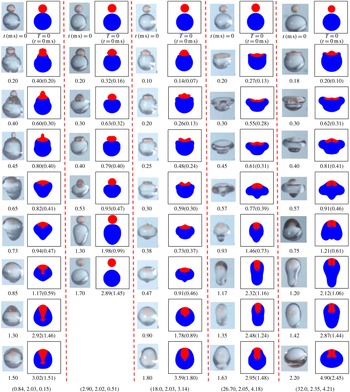
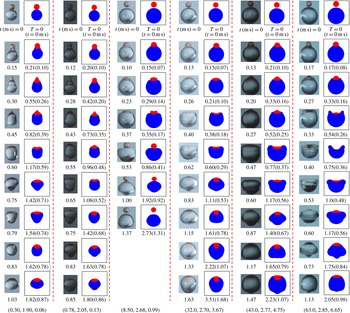
-tetradecane droplets. It is seen that neither a type I jet nor a type II jet is developed within the wide range of Weber numbers, from 0.3 to 63. To explain the absence of the jets, we first note that, since
 $n$
-tetradecane has only a slightly larger surface tension than
 $n$
-decane, and since surface tension is the driving force for the formation of a type I jet, the absence of the type I jet for
 $n$
-tetradecane droplet collisions is thus due to its larger viscosity, which is approximately three times those of water and
 $n$
-decane. The substantial viscous dissipation in
 $n$
-tetradecane droplets then suppresses jet formation, both type I and type II. We also note that, similar to
 $n$
-decane, bouncing was also observed for
 $n$
-tetradecane droplet collision, as it should be, while the deformation process of the coalesced mass is also similar to those of water and
 $n$
-decane.
Mixing pattern during collision of
 $n$
-tetradecane droplets for (
 $We_{S},{\it\Delta},We^{\ast }$
). The oscillation time and the Ohnesorge number of the smaller droplet are
 $t_{\mathit{osc}}=0.48$
ms and
 $Oh=0.82$
, respectively.

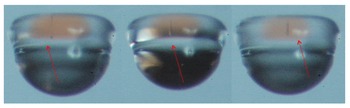
Gas charge entrapment during collision of
 $n$
-tetradecane droplets for
 $We_{S}\approx 63.0$
,
 ${\it\Delta}=2.85$
at
 $t\approx 0.5\pm 0.1~\text{ms}$
.

Another interesting phenomenon was observed for
 $We_{S}=63.0$
and
 ${\it\Delta}=2.85$
. Because of the high impact inertia, an obvious impact crater was observed at
 $t=0.27~\text{ms}$
, with the sidewall of the crater appearing to close in at
 $t=0.33~\text{ms}$
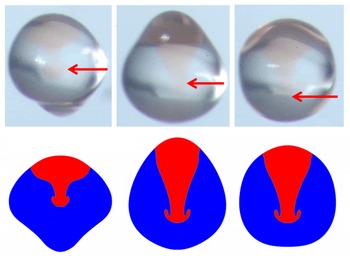
. As a result, some gas charge would be trapped in the merged mass if the sidewall closes before the crater completely recedes. This gas charge entrapment was consistently observed, as indicated by the dashed arrows in figure 10, with the trapped gas charge appearing as a filament instead of a bubble.
3.3 Regime nomogram of internal mixing pattern
Different internal mixing patterns in the parameter space of
 $1/Oh$
(instead of
 $Oh$
for mathematical convenience) and
 $We^{\ast }$
are illustrated in figure 11. The selection of these parameters is based on the following considerations. First, internal mixing is observed to be suppressed in highly viscous droplets. As such, the Ohnesorge number,
 $Oh$
, representing the relative importance of viscosity compared to surface tension, with
 $n$
-tetradecane having the largest
 $Oh$
while water has the smallest one, is an important parameter. Second, the facilitation of internal mixing with increasing size ratio is physically straightforward in that the jet-like mixing is absent for equal-sized droplets due to symmetry while it always occurs in the limiting case of a droplet impacting a liquid pool, which has an infinite size ratio. Consequently,
 $We^{\ast }$
or the symmetric Weber number (Rabe et al.
Reference Rabe, Malet and Feuillebois2010) is the physically meaningful combination to include the influence of both Weber number and size disparity.
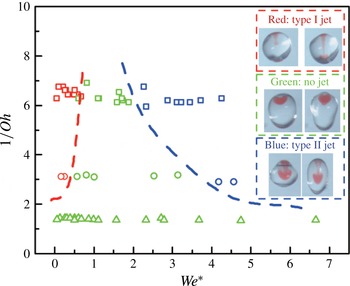
Regime nomogram for mixing pattern upon droplet coalescence: open squares, water; open circles,
 $n$
-decane; open triangles,
 $n$
-tetradecane.

Figure 11 shows that there exists a minimum
 $1/Oh$
below which jet-like mixing is absent, as least within the range of
 $We^{\ast }$
investigated. With increasing
 $1/Oh$
, jet-like mixing emerges. The phenomenon, however, is further enriched by its non-monotonic variation with the impact Weber number in that not only is the jet type I for low
 $We^{\ast }$
, soft merging, and type II for high
 $We^{\ast }$
, hard merging, but these two jet formation regimes are also separated by a
 $We^{\ast }$
regime in which no jet is formed. Mechanistically, for small
 $We^{\ast }$
, as a result of either sufficiently small
 $We_{S}$
or sufficiently large
 ${\it\Delta}$
,
 $1/Oh$
is the controlling parameter for a type I jet such that decreasing viscosity promotes jet formation. At higher
 $We^{\ast }$
, the dominating factor is the inertia of the impacting droplets, which favours penetration of the smaller droplet into the larger one to form the jet-like mixing pattern, while viscous dissipation should be sufficiently small to facilitate the penetration. Furthermore, it is also seen that the transition Weber numbers between the type I jet regime and the no-jet regime increase with
 $1/Oh$
, while those between the no-jet regime and the type II jet regime decrease with
 $1/Oh$
, resulting in a shrinking, albeit gradual, no-jet regime with increasing
 $1/Oh$
.
We finally note that, while mixing can occur for equal-sized droplets with variable surface tension (Blanchette et al. Reference Blanchette, Messio and Bush2009; Blanchette Reference Blanchette2010) and non-Newtonian fluids (Sun et al. Reference Sun, Wang, Zhang and Law2015a ,Reference Sun, Zhang, Law and Wang b ), and that pinch-off can also occur for a droplet impacting a liquid pool at sufficiently large Weber numbers (Thomson & Newall Reference Thomson and Newall1885; Hsiao et al. Reference Hsiao, Lichter and Quintero1988) or unequal-sized droplet collision with sufficient large size ratio (Blanchette & Bigioni Reference Blanchette and Bigioni2009), these auxiliary phenomena do not affect the central tenet of the present discussion, and can be grafted into the present regime nomogram for a more detailed texture.
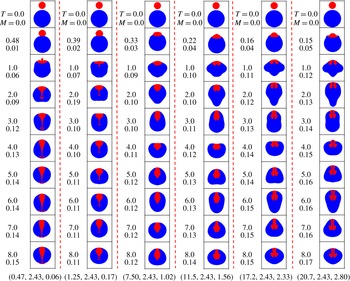
Calculated mixing pattern during collision of water droplets for (
 $We_{S},{\it\Delta}=2.43,We^{\ast }$
). Here,
 $Oh=0.19$
and
 $t_{\mathit{osc}}=0.33~\text{ms}$
.

3.4 Long-term dynamics of internal mixing
The evolution of the jet-like internal mixing patterns is of technological interest in manipulating the mixing process in many applications. For example, the long-term dynamics of the droplet mixing in merged bipropellant fuel and oxidizer droplets affects the subsequent liquid-phase reactions and gas-phase ignition (Solomon et al. Reference Solomon, Defini, Pourpoint and Anderson2013). However, corresponding experimental data are not available in the present study due to the following technical difficulties. First, droplet collision occurs on the vertical focal plane and the view of the camera which is connected to a microscope is limited. As a result, the droplet will move out of the view under gravity at longer times. While reducing the magnification factor of the microscope can capture the droplet in the camera for a longer time, it deteriorates the quality of the images showing the droplet internal mixing. Second, the accuracy of the time delay between the strobe light and the droplet generator is reduced because the droplet pairs become less stable after coming out from the droplet nozzle for a longer time.
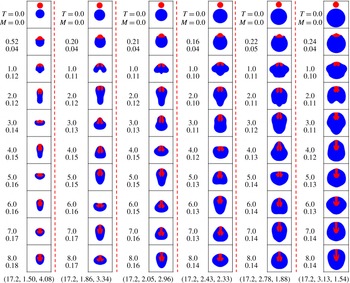
In consideration of these technical difficulties in characterizing the long-term dynamics of internal mixing experimentally, we conducted simulations of water droplet collision for a sufficiently long time up to eight characteristic oscillation times. Figure 12 shows the calculated mixing patterns for fixed
 ${\it\Delta}=2.43$
and
 $Oh=0.19$
but with varying
 $We_{S}$
and hence
 $We^{\ast }$
. Figure 13 shows the calculated mixing patterns for fixed
 $We_{S}=17.2$
and
 $Oh=0.19$
but with varying
 ${\it\Delta}$
and hence
 $We^{\ast }$
. The two figures share the same case, which has been shown in figure 5. Furthermore, all the cases reported in the figures use the same mesh for consistency. Consequently, the results shown in figures 12 and 13 can be considered as extensions of the experimental study by varying one parameter at a time and for a longer time.
Calculated mixing pattern during collision of water droplets for (
 $We_{S}=17.2,{\it\Delta},We^{\ast }$
). Here,
 $Oh=0.19$
and
 $t_{\mathit{osc}}=0.33~\text{ms}$
.

To quantitatively describe the internal mixing within the merged droplet, a mixing index
 $M$
varying between 0 and 1 can be defined as follows (Yeh et al.
Reference Yeh, Fang, Sheen and Yang2013):
 $$\begin{eqnarray}M=\frac{\displaystyle \int _{V}\!|C-C_{0}|S(f-1)\,\text{d}V}{\displaystyle \int _{V}\!|C_{0}-C_{\infty }|S(f-1)\,\text{d}V},\quad \!C=\frac{|{\it\phi}-0.5|}{0.5}C_{0},\quad \!C_{0}=\left\{\begin{array}{@{}c@{}}0,\,{\it\phi}=0\\ 1,\,{\it\phi}>0\end{array}\right\},\quad \!C_{\infty }=\frac{1}{1+{\it\Delta}^{3}}.\end{eqnarray}$$
Here
 $C$
,
 $C_{0}$
and
 $C_{\infty }$
are the distribution functions of the time-dependent ‘concentration’ of the small droplet liquid in the merged mass, in the unmixed droplet, and in the fully mixed mass;
 ${\it\Phi}$
is the spatially and temporally varying dye function, which is defined as 1 in the small droplet and 0 in the larger droplet; and
 $f$
is the VOF function, which is equal to 0 in the gas phase and 1 in the liquid phase. The Heaviside step function
 $S(f-1)$
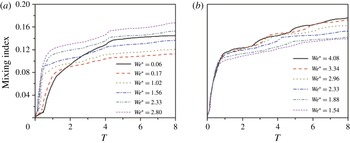
ensures that the integration is only for the droplets. The calculated mixing indices are shown in each image in figures 12 and 13 and summarized in figure 14.


Figures 12 and 13 show that the jets have been sufficiently developed during the reported times of the experiments. The subsequent event is characterized by a moderate variation of the jet shape due to the droplet oscillation, which will be eventually damped down by the viscous dissipation. Figure 12 again shows the expected phenomena that the jet-like mixing patterns are apparent at sufficiently small and large Weber numbers, while they become less distinct at intermediate Weber numbers. The corresponding long-term behaviour of the mixing indices, as shown in figure 14(a), quantitatively verify this observation, as the mixing indices after
 $T=4$
show non-monotonic variation with the Weber number (either
 $We_{S}$
or
 $We^{\ast }$
). In addition, figure 13 shows that the internal mixing is enhanced by increasing the size ratio, which can also be seen in figure 14(b) as the mixing indices after
 $T=4$
vary monotonically with
 $We^{\ast }$
, which decreases with increasing
 ${\it\Delta}$
.
4 Concluding remarks
Motivated by the interest to facilitate mixing of two impacting droplets, we have experimentally identified and numerically reproduced the influence of the impact inertia and the physical properties of the fluid on the merging tendency and the subsequent mixing characteristics. In particular, we have shown that, for liquids with large surface tension and small viscosity, such as water and
 $n$
-decane, mixing is facilitated by the development of distinctively different jet patterns for small and large values of the impact Weber number, and the absence of such jets and thereby effective mixing for intermediate values. Furthermore, jet formation is also inhibited for liquids with large viscosities that reduce the impact inertia. The regime nomogram classifying the mixing responses is expected to facilitate further optimization. To explain the observed phenomena, we attribute the formation of a type I jet at small Weber numbers to the merging of a liquid ‘bulge’ formed during the coalescence of the small droplet into the larger one at the contact point around the central line. At higher Weber numbers, the droplets undergo substantial deformation before coalescence so that the droplets merge at a significantly flattened surface, which suppresses the concentration of the droplet momentum along the central line and hence the jet formation. However, at even higher Weber numbers, the large droplet deformation results in the mass of the small droplet being first spread out away from the impact crater. The subsequent droplet oscillation, particularly droplet stretching in the direction of the impact, carries the mass of the small droplet into the larger droplet to form a type II jet, which is centrally hollow and is therefore different from the type I jet. It is also noted that the present interpretations of the formation mechanisms for type I and type II jets are largely mechanistic and phenomenological. Numerical simulation based on an improved VOF method with adaptive mesh refinement algorithm could further resolve the interface evolution upon droplet merging and the subsequent mixing process.
Acknowledgements
C.T. was a visiting student at Princeton University where the experiment was performed. The subsequent work at the Xi’an Jiaotong University was supported by the National Science Foundation of China (51206131), while that at the Hong Kong Polytechnic University was supported by Hong Kong RGC/GRF (PolyU/15221714) and SRFDP & RGC ERG Joint Research Scheme (M-PolyU509/13). The simulations were conducted using the resources of the High Performance Cluster Computing Centre, Hong Kong Baptist University. The first and second authors contributed equally to this work.
Supplementary data
Supplementary data is available at http://dx.doi.org/10.1017/jfm.2016.218.