As the population continues to age in the United States and globally, concerns for later life issues increase as well. One such concern is caregiving (e.g., Raschick and Ingersoll-Dayton, Reference Raschick and Ingersoll-Dayton2004). Biological and possible cognitive declines and disabilities of older adults and the subsequent needs for caregiving are challenging for many older adults and their caregivers. Research has addressed burdens and stress related to caregiving when the caregiver is a family member, such as the emotional and physical strains of caregiving (Polk, Reference Polk2005) as well as threats to the caregiver's marital relationship and job performance as a result of increased caregiving responsibilities (Lowenstein, Reference Lowenstein2010). Institutionalized caregiving is also under scrutiny where caregiver burnout and shortages in staff are common reasons for unsatisfactory caregiving experiences for senior residents. That said, one of the most extreme and disturbing expressions of problematic caregiving behaviors that has not been addressed properly is when these behaviors turn negative and lead to elder abuse and neglect. Elder abuse and neglect has been recognized over the years as an alarmingly increasing social problem by social workers, gerontologists, criminologists, clinical psychologists, and medical professionals globally.
Evidence has been gathered to enhance abuse detection and prevention and risk factors contributing to elder abuse and mistreatment (National Research Council, 2003). However, as the majority of the abuse cases are under-reported and hence by extension, not communicated, the magnitude of its problem remains subterranean. In fact, the issue has been labeled “The Hidden Problem” (Crystal, Reference Crystal, Pillemer and Wolf1986). In the communication field, unfortunately, elder abuse has received almost negligible attention compared with other forms of abuse, such as child abuse and spousal abuse (see however, Giles and Helmle, Reference Giles, Helmle, Duszak and Okulska2011). Research on aging and communication has documented dysfunctional intergenerational communication (e.g., so-called patronizing talk) that may create harmful effects on older adults’ psychological well-being, communication competence, and independent living. It also has confirmed the reinforcement of negative stereotypes and communication styles as a result of such interaction on the part of younger interlocutors. These results provide empirical grounds to investigate communicative issues surrounding elder abuse and suggest their implications in various contexts.
In this paper, our goal is to outline a communication model that explains the interactive patterns that result in elder abuse in the caregiving setting. Hence, it is an integrative review of literatures relevant to the proposed model. In proposing it, we focus on elder abuse in the informal caregiving context when the caregiver (or the offender/perpetrator) is the family member of the elderly victim. The literatures reviewed pertain to abuse and violence in the context of family caregiving. The prevalence and forms of elder abuse will be discussed first, followed by profiles of abuse victims and perpetrators. Theories currently used to explain elder abuse would also be reviewed briefly. Then we will introduce a communication pathway model of elder abuse and neglect that is rooted in intergroup dynamics, explaining ways in which elder abuse may take place and remain unreported and unnoticed (see however, Giles and Helmle, Reference Giles, Helmle, Duszak and Okulska2011).
A testable model of elder abuse focusing on a major path in foregoing model, abuser–abusee, will be proposed. It builds upon Bugental and her colleagues’ work (e.g., Reference Bugental, Blue and Cruzcosa1989, Reference Bugental, Brown and Reiss1996, Reference Bugental and Happaney2000) on child abuse with an emphasis on cognitive representations of the perceived powerlessness of the abuser. Since many of the contextual factors leading to child abuse are similar to those for elder abuse and because the experience of previous trauma (including child abuse) is a particular characteristic of perpetrators of elder abuse, we expand this model and apply it to the elder abuse context. This model introduces communication-oriented variables that may influence the interaction between the caregiver and the older care receiver, which give rise to elder abuse. It is argued that caregivers with certain characteristics are more likely to feel powerless in the caregiving situation and, therefore, the likelihood of elder abuse increases for these caregivers when the caregiving receiver displays non-accommodative behaviors in the interaction.
Elder abuse and neglect: prevalence, forms, and profiles
Elder abuse and neglect was recognized as an offence in the United States in the early 1970s (Stannard, Reference Stannard1973). It was first described as “granny battering” in 1975 (Baker, Reference Baker1975) and later in 1979, the US House of Representatives Select Committee on Aging labeled it “The Hidden Problem” (Crystal, Reference Crystal, Pillemer and Wolf1986). In 2003 (when the last figures were made available), the National Center of Elder Abuse estimated that between one and two million older adults were victims of abuse in the United States, and that more than half of the cases were not reported. Many of the reported cases were found to be legitimate (Bonnie and Wallace, Reference Bonnie and Wallace2003), and complaints about neglect or mistreatment tripled between 1990 and 2003. While the prevalence of the crime remains disturbingly high, ranging from 0.5% to 10% of elder caregiving recipients (Laumann et al., Reference Laumann, Leitsch and Waite2008), recent studies have begun to investigate the prevalence of different types of elder abuse and the risk factors associated with each one of these (e.g., Thomson et al., Reference Thomson2011). For instance, examining cases of elder abuse and neglect reported to the Mulwaukee County Department on Aging (MCDA) in Michigan, Thomson et al. (Reference Thomson2011) found that only 3% of the 5316 cases were reported by elderly victims, and approximately 58% of the reported cases were substantiated. The single most important predictor of all forms of elder abuse except financial exploitation was the elder care receiver's behavioral problems due to mental health issues (e.g., Post et al., Reference Post, Page, Conner, Prokhorov, Fang and Biroscak2010). Contextual factors, such as insufficient or the complete lack of social support, were associated with the occurrence of elder abuse (Dong et al., Reference Dong2010).
The pervasiveness of elder abuse is also found in other parts of the world. Preliminary research has already begun, for example, in the United Kingdom (Cooper et al., Reference Cooper, Selwood and Livingston2008), Ireland (Naughton et al., Reference Naughton2011), Israel (Lowenstein et al., Reference Lowenstein, Eiskiovits, Band-Winterstein and Enosh2009), South Africa (Ferreira and Lindgren, Reference Ferreira and Lindgren2008), and China (Dong et al., Reference Dong, Simon and Gorbien2007). Many of these studies delve into the complexity of elder abuse beyond the presentation of mere statistics. Efforts of the World Health Organization suggest that elder abuse and neglect is a violation of fundamental human rights. Suggested intercession on behalf of elder abuse victims includes raising awareness and education regarding elder abuse, empowering older adults to seek help when abused, improving intergenerational communication and relationships, training professionals to be sensitive to possible occurrences of abuse and mistreatment, and identifying cultural factors associated with abuse (Newman, Reference Newman, Summers and Hoffman2006). Therefore, research is greatly needed to address each of these areas, and many of these recommendations involve communication in some shape or form.
Harm directed at older adults is manifested in different ways; physical abuse is the most visible one. This involves any use of physical force used without the elder's consent to cause physical injuries or to impede older adults’ ability to function without their consent (National Center on Elder Abuse, 2002). Burning, inappropriate use of medication, and use of physical constraints are examples of physical abuse. Sexual abuse, another type of physical violation, refers to “non-consensual sexual conduct” with an older person, including forced nudity or unwanted touch (National Center on Elder Abuse, 2011). A comparatively invisible form of abuse, but no less harmful, is emotional or psychological abuse. Pain, anguish, or distress incurred by another person's detached or dehumanizing behaviors, such as threats, verbal assaults, intimidation, humiliation, or ridicule, are considered as emotional abuse (Amstadter et al., Reference Amstadter, Zajac, Strachan, Hernandez, Kilpatrick and Acierno2011b; Sorenson, Reference Sorenson, Summers and Hoffman2006). Another type of abuse that is also difficult for outsiders to assess is financial exploitation. The loss of a life-long accumulation of wealth may have serious psychological and practical implications. Older adults may become financially dependent upon their family or social welfare systems as a result of material depletion (Smith, Reference Smith1999) and experience frustration and become fearful.
Another form of elder abuse is neglect, which is defined as “the refusal or failure to provide an elderly person with such life necessities as food, water, clothing, shelter, personal hygiene, medicine, comfort, personal safety, and other essentials included in an implied or agreed-upon responsibility to an elder” (National Center on Elder Abuse, 2011). Communication neglect, a subtype of neglect (e.g., lack of meaningful and personable conversations with the older adult or avoid having any physical or social contact with the care receiver), can also cause the elder care receiver to feel abandoned (Sorenson, Reference Sorenson, Summers and Hoffman2006). Caregivers may continue to provide necessary duties and assistance for the older care receiver without spending any time engaging the older care receiver in conversation. Communication neglect may result from a true lack of time for chatting in the caregiver's hectic schedule, but it may also stem from age-based stereotypes and the perception that conversation with the elder care receiver will be long, tedious, or repetitive. Caregivers may even avoid physical contact or eye contact, which tends to signal openness for communication. Communication neglect can be intentionally committed as a way to punish the elderly care receiver. Giving “the silent retreatment” or talking over the elderly care receiver to a third party could be ways used to “discipline” the elderly care receiver.
In sum, victims’ reluctance to report, the lack of education and awareness of the issue among the general public, and the little to invisible attention in the media permit elder abuse and neglect to continue and remain hidden. Profiles of perpetrators and victims reviewed below pertain primarily to elder abuse in domestic settings.
Victims of elder abuse tend to be much older (late 70s) and are largely female (Biggs et al., Reference Biggs, Manthorpe, Tinker, Doyle and Brens2009). They are more likely to be abused by family members (e.g., child, spouse), whereas male victims are more likely to be mistreated by strangers or acquaintances. Using Adult Protective Services data, Teaster and colleagues (Reference Teaster, Otto, Dugar, Mendiondo, Abner and Cecil2006) found that 34.3% of victims were male, with an overwhelmingly high percentage of these cases (i.e., 89.3%) taking place in the home. Race of the victims tends to vary from study to study. Some research has suggested that victims are more likely to be Caucasian (Brownell and Wolden, Reference Brownell and Wolden2002), while others identified African Americans as primary targets for elder abuse (e.g., McCabe and Gregory, Reference McCabe and Gregory1998). Furthermore, victims of elder abuse tend to be socially isolated from the community and lacking in social support (Acierno et al., Reference Acierno2010). They also may be fearful, timid, agitated, and depressed (Anthony et al., Reference Anthony, Lehning, Austin and Peck2009). Contrary to conventional wisdom, cognitive or physical impairment per se may not directly link to elder abuse, but may put older people at a greater risk of such mistreatment (National Research Council, 2003; Biggs et al., Reference Biggs, Manthorpe, Tinker, Doyle and Brens2009).
Moving on to the prototype of the elder abuser, typically the malevolent acts are carried out by someone younger, such as a relative, caregiver, or professional predator; the latter sometimes has a colluding network as in the case of financial abuse (Rabiner et al., Reference Rabiner, O’ Keefe and Brown2005). Together, sons and spouses, especially male spouses are the largest group of offenders (Biggs et al., Reference Biggs, Manthorpe, Tinker, Doyle and Brens2009). Therefore, one can imagine that abuse and mistreatment normally occur in home settings where the abuser and the victim are in the same household, making the discovery and study of elder abuse difficult.
Results regarding the race of the offenders are again mixed. Powell and Berman (Reference Powell and Berman2006) suggested that over 60% of the elder abuse perpetrators were African American, whereas the investigation of National Incident-Based Reporting Systems (NIBRS) data showed that most abusers were white (Krienert et al., Reference Krienert, Walsh and Turner2009). Many of the abusers have mental health, behavioral- or stress-related issues not only associated with caregiving but also to life in general. Compared with non-abusers, a higher percentage of the abusers have a history of mental illness or psychiatric hospitalization (Anthony et al., Reference Anthony, Lehning, Austin and Peck2009; Amstadter et al., Reference Amstadter2011a). A significant percentage of perpetrators have a history of substance abuse, 44% in Greenberg et al.'s (Reference Greenberg, McKibben and Raymond1990) study, 26.6% in Amstadter et al.'s (Reference Amstadter2011a) study, and 20% in Naughton et al.'s (Reference Naughton2011) study. The abusers as well as the victims may be socially isolated and have a limited network of social support. Other characteristics of perpetrators point to financial dependency, lack of knowledge of caregiving, and a history of abusive behaviors within the family.
Theories of elder abuse and neglect
Traditional views of the causes of elder abuse and neglect lie in the “caregiver stress” theory. Long-term and consistent demands in caregiving, particularly care for older adults with dementia and depression, create a high level of stress on the caregiver that may cause them to resort to violence in response to excessive burdens. However, while caregiver stress does link to a higher chance of abuse, caregiving itself, even heavy loads of it, does not always lead to abusive behaviors. Instead, it is when stress results in mood disturbance (Bendik, Reference Bendik1992) or anger (Garcia and Kosberg, Reference Garcia and Kosberg1992) that caregivers are more likely to turn violent.
In addition to this, other theoretical models/perspectives have been offered to explain elder abuse (for a review, see Rathbone-McCuan and Hashimi, Reference Rathbone-McCuan and Hashimi1982). All of these models tend to “put the blame” on the abuser or the community in framing our understanding of victimology. In other words, elder abuse is a crime committed by the offender without any involvement of the elder care receiver. While such a mindset is valid, it omits the dyadic influence in the caregiving process where dysfunctional communication from both sides can escalate conflict and eventually trigger violence. Quayhagen et al. (Reference Quayhagen, Quayhagen, Patterson, Irwin, Hauger and Grant1997), for instance, argued for a dyadic approach to understanding mutual influence and reactive patterns in the caregiving process. We also take this position to formulate our own model of elder abuse, including the characteristics of the abuser and elderly victim as well as the communicative circumstances under which the abuse arises.
As referenced above, the severity and scope of elder abuse and neglect have remained hidden due to low reporting rate (Cohen et al., Reference Cohen, Levin, Gagin and Friedman2007; Thomson et al., Reference Thomson2011). Some plausible explanations have been offered. One explanation is family protection. A mindset of “what happens in the family, stays in the family” may be at work here when the abused elder does not wish to expose private matters to the public to avoid family shame (Kosberg, Reference Kosberg and Kosberg1983), and this may be particularly disturbing for other family members if the abuser is regarded highly by them (Quinn and Tomita, Reference Quinn and Tomita1986). In fact, if the relationship between the abuser and the elderly victim has been perceived as loving and positive, other family members may minimize the severity of abusive behavior and attribute it to situational factors such as caregiver stress (Fitzpatrick and Hamill, Reference Fitzpatrick and Hamil2011).
A second reason could be self-protection. In pursuit of this, an abused elder may need to calculate the risk of disclosing maltreatment in the face of possible retaliation and escalating abuse (Kosberg, Reference Kosberg and Kosberg1983). Moreover, self-protection could come from protecting one's own well-being as, with any victim, recounting the process of being abused, raped, or bullied could have psychological and emotional repercussions. A similar consideration is the protection of personal pride. Blundo and Bullington (Reference Blundo and Bullington2007) found that male victims of abuse were less likely than females to report such crime by 11%. The cultural and social implications of “being a man” may prevent men from making a formal complaint about abuse and may cause them not to speak about the offense to save their own face.
A third explanation for failing to disclose abuse relates to the social stigma associated with elder abuse and aging. Abuse and neglect are sensitive issues. Elderly victims may even consider speaking of abuse as taboo, not knowing how to break it to others (Afifi and Guerrero, Reference Afifi, Guerrero and Petronio2000). In addition, people may mistake signs of abuse as part of normal aging, such that bruises may be interpreted as older adults falling accidentally due to their physical feebleness. Stereotypes of aging may be internalized by the elderly themselves. Giles and Helmle's (Reference Giles, Gasiorek, Forgas, László and Orsolya Vincze2011) case study of an older abused woman's 911 call uncovered such self-stereotyping (Turner et al., Reference Turner, Hogg, Oaks, Reicher and Wetherell1987). The emergency call transcript revealed that this female caller repeatedly apologized for causing an inconvenience. It appears that she felt that even the police would not believe her, as seen in the statements below:
• “I am sorry, but someone is trying to kill me and I don't know what to do”
• “Nobody is going to listen to me”
• “This is real”
• “Really, I'm not kidding”
• “I am not just making this up”
• “I am not kidding this is real”
• “They are not going to believe me when they come out”
• “They are not going to find anything; they are going to think I am crazy”
A fourth explanation for failing to disclose elder abuse might be victim's inability to recognize the occurrence of abuse, particularly when the victim suffers from mental declines or illnesses and is unable to convincingly communicate the details to others. It can be even worse when the abused elder feels that his/her chronic illnesses and dependency on the family caregiver are the causes of the abuse. Over time, a victim may be conditioned by the abuser to believe that they somehow deserve such maltreatment and therefore should endure it (Giles and Helmle, Reference Giles, Helmle, Duszak and Okulska2011).
Despite the fact that legislation and policies are in place in the United States to guard against elder abuse, and institutions are mandated to report abuse when they suspect a possible case, the general public is not fully aware of what constitutes abuse or what steps to take when they see it (Hempton et al., Reference Hempton2011). The media affords little attention to elder abuse compared to its reporting of child abuse. The ratio of child abuse to elder abuse stories ranges from 7:1 in San Diego Union Tribune to 102:1 in New York Times (Payne et al., Reference Payne, Appel and Kim-Appel2008). When it is covered in the media, the majority of cases are framed as an individual-level issue (i.e., random cases), rather than as a societal-level problem. The media also focuses more on abuse cases that have occurred in institutional, rather than domestic, settings (Mastin et al., Reference Mastin, Choi, Barboza and Post2007). As a consequence, the significance and prevalence of elder abuse are minimized, marginalized, and treated as “individual misbehaviors” (Mastin et al., Reference Mastin, Choi, Barboza and Post2007, p. 787). Moreover, when most of the media coverage focuses on elder abuse at the institutional level, it may direct attention away from the offenses committed at home and by family members which, as a result, miss opportunities for it to be discovered (see Brossoie et al., Reference Brossoie, Roberto and Barrow2012).
The Communication pathways model of elder abuse and neglect
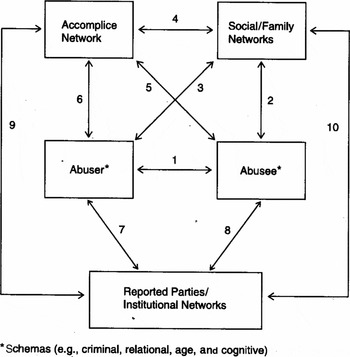
The literature already indicates that family violence is played out during social interaction (see Anderson et al. (Reference Anderson, Umberson, Elliott and Vangelisti2004) for a detailed review). As above, decisions to disclose/not disclose interactions between reporting parties, abuser and the person abused, or family and friends’ responses to family violence are part of the communication process. It is critical then to examine features of communication that give rise to, provide encouragement to, and/or culminate into elder abuse. Giles and Helmle (Reference Giles, Helmle, Duszak and Okulska2011) proposed a heuristic model (see Figure 1) to illustrate communication pathways implicated in elder abuse. A key feature of this model is that the pathways are bilateral, emphasizing mutually dependent influences that jointly create the flow of interactions. Prime among these is obviously the existing and developed mutual influences between abuser and abusee (Links 1 and 2; see also Rabiner et al., Reference Rabiner, O’ Keefe and Brown2005), together with the schemas they bring to, and those that emerge from, this relationship.
The Communication Pathways Model of Elder Abuse and Neglect (Giles and Helmle, Reference Giles, Helmle, Duszak and Okulska2011).

Empirical data attending features of this model are not yet available. However, many of the existing research studies on intergenerational communication, elder abuse, and family violence can provide grounds to support the validity of individual paths. Each path can be a separate research agenda and, for each path, different issues can be explored. For instance, for Link 1, researchers can study the abuse victim's privacy management and decisions to disclose/not disclose the abuse. They can also study verbal aggressiveness from both the abuser and the abusee that co-creates elder violence.
New pathways can be added to the model to strengthen its explanatory power. For example, a new path could be established between the reporting parties and media (e.g., journalists, editors). Payne et al. (Reference Newman, Summers and Hoffman2008), for instance, suggested that whether reporting agencies had an easy access to journalists was an important factor in this regard. Journalists’ understanding of the severity of elder abuse may also determine whether they explore a story and, even more critically, may determine how they frame it. Given that few elder abuse cases enter into the criminal justice system, it stands to reason that elder abuse rarely appears on the radar of the media. In summary, staff of a reporting agency (e.g., Adult Protection Services) may offer information of abuse to a journalist, but the editor's perceptions of “newsworthiness” (Payne et al., Reference Newman, Summers and Hoffman2008) and willingness to investigate the crime may largely define the nature of the communication between the two parties. This model provides a preliminary visual illustration of the ways in which elder abuse and neglect can be examined, and the remainder of this paper will focus on Link 1 in exploring the communication styles, cognitive appraisal, and individual characteristics that feed into the communication loop that eventually give rise to elder abuse.
Abuse in the family: the dark side of family communication
Although research on elder abuse from a communication perspective is, regrettably, minimal, we can establish the theoretical grounds for it by resorting to research on communication and violence within the family, which has sparked scholarly attentions for decades. Dysfunctional communication with intimate partners or close family members that results in, or is associated with, severe conflict and even violence, is well documented (e.g., Cahn, Reference Cahn, Cahn and Lloyd1996; Murphy and O’ Farrell, Reference Murphy and O'Farrell1997). Compared with nonviolent couples, violent couples tend to exhibit more negative affect (e.g., distrust, anger, criticize) toward the relationship and toward one another, and also display a lack of problem-solving skills (Berns et al., Reference Berns, Jacobson and Gottman1999). They are also more likely to be verbally aggressive and to express frustration about their spouse with researchers during interviews (Sabourin and Stamp, Reference Sabourin and Stamp1995). Members of abusive families are found to exhibit deficits in communication skills, and such abusive behaviors and communication skills deficits are bidirectional. That is, members of abusive families may not have proper conflict management or communication skills, in general, which lead to negativity in interaction or family violence that inhibit family members from acquiring needed communication skills, causing them to feel fearful and unworthy. Consequently, they are less able to engage in positive communication and, therefore, are more likely to further provoke destructive interactions (Anderson et al., Reference Anderson, Umberson, Elliott and Vangelisti2004).
In addition to interactional negativity, research has also identified a demand–withdraw pattern that appears in abusive marital relationship, only with a different twist. The original model emphasized a wife-demand and husband-withdraw tendency in marital conflicts (Christensen and Shenk, Reference Christensen and Shenk1991). That is, when attempts for discussion fail, wives are more likely to approach their husbands or to demand that they discuss issues and problems in their marriage, whereas husbands tend to withdraw so as to avoid further arguments. However, research shows that wives and husbands in abusive relationships display both demanding and withdrawing behaviors. Researchers argued for a hypothesis of power deficit, instead of a particular pattern (i.e., wife being demanding or husband being demanding) to explain occurrence of abuse. That is, the party that feels powerless in the relationship may resort to violence or coercive behaviors to regain control (Baucom et al., Reference Baucom, Atkins, Eldridge, McFarland, Sevier and Christensen2011). Verbal aggression or physical abuse may be the means by which the “powerless” partner uses to re-establish their status in the relationship. This is particularly the case when the “powerless” partner is not equipped with effective communication skills.
This power deficit hypothesis could provide a theoretical explanation for abusive behaviors that speaks into the nature of interaction during conflicts. Instead of viewing the abusive partner as possessing more power in the relationship, the power deficit hypothesis presents the opposite view, that is, where the abusive partner tends to be the one who possesses less power in the relationship and who interprets the other partner's behavior as threatening and hostile (Baucom et al., Reference Baucom, Atkins, Eldridge, McFarland, Sevier and Christensen2011). According to the power deficit hypothesis, the measure of powerlessness between partners is not entirely objective, and the mere perception of powerlessness can trigger violence. Such subjective appraisals reflect the abusive partner's cognitive appraisal of relative status in the relationship (Dugan et al., Reference Dugan, Umberson and Anderson2001). In other words, the abusive partner when perceiving and interpreting the interaction negatively, or feeling threatened by the partner's behavior may display aggression as a response mechanism (Baucom et al., Reference Baucom, Atkins, Eldridge, McFarland, Sevier and Christensen2011). The development of such negative interpretations may have their roots in the abuser's previous experiences with intimate relationships. Children who are abused in the family may develop a negative schema of the relationship that spills over to other relationships they form outside the family and later in life (Horsford et al., Reference Horsford, Parra-Cardona, Post and Schiamberg2011; Poon and Knight, Reference Poon and Knight2012). They may be prone to react to interpersonal conflicts with violence. Violence or abusive behaviors may thus be traced to the offender's “learned” cognitive appraisals, which later become habitual responses.
Bugental and her colleagues’ work (e.g., Reference Bugental1993, Reference Bugental and Lewis1999, Reference Bugental, Ellerson, Lin, Rainey and Kokotovic2002) on parents’ powerlessness and child abuse provides a cognitive approach to explaining dysfunctional and problematic parent–child interactions. Bugental and Lewis (Reference Bugental and Lewis1999, p. 52) defined self-perceived power as “the perceived capability to control the individual and joint outcomes of those within an interdependent relationship.” In parent–child relationships, parents appear to assert more influence on their children's behavior than vice versa. However, abusive parents often express a lack of power or loss of control in parenting. Parents who perceive themselves powerless in the parent–child relationship tend to seek coercive methods to obtain compliance (LePoire, Reference LePoire2006). As Kipnis (Reference Kipnis1976, p. 52) argued, “individuals come to seek the potential to harm others as a means of reaffirming their own sense of worth” (cited in Bugental and Lewis, Reference Bugental and Lewis1999).
To test these assertions, Bugental et al. (Reference Bugental and Lewis1989) examined the relationships between children's characteristics, parents’ perceived balance of control, and parents’ use of coercive (e.g., spanking, pushing, slapping) or abusive (e.g., kicking, biting, hitting, beating up, threatening with, or use of a weapon) behaviors. The results showed that mothers who scored lower on balance of control reported greater annoyance with their baby, felt negative about the interaction, and used more coercive behaviors to discipline the baby. Moreover, when a mother believes that she has no control over the baby's deviant behavior and the “bad behavior” is not due to uncontrollable/environmental factors (e.g., “the baby is tired,” or “the baby is having a bad day”), she is likely to use abusive tactics to manage the chaos.
In order to understand the functions of attributions/interpretations in asymmetrical relationships such as caregiving, Bugental (Reference Bugental1993) offered a theoretical explanation: a threat-oriented schema of interpersonal relationships where individuals with this schema may be more likely to identify situations as dangerous which simultaneously triggered emotions such as fear or anxiety. Applying this to caregiving situations, a caregiver with a threat-based schema may view the care recipient's noncompliance, non-responsive or overly demanding behaviors as a threat, which activates negative emotions associated with the schema. Accordingly, caregivers may rely on existing schematized actions/reactions instead of a careful scrutiny of incoming information. Bugental (Reference Bugental1993) asked parents who participated in her study to provide attributions to caregiving outcomes in terms of whether they are within the child's control or not using the Parent Attribution Test (PAT). A person with a threat-oriented schema is one that sees the caregiving outcomes as largely controlled by the child rather than by the adult.
Bugental's studies (Reference Bugental, Blue and Cruzcosa1989, Reference Bugental1993) provide evidence for the functions of a threat-based schema. In one study, adult participants who were identified as having a threat-oriented schema were asked to provide their interpretations of children's non-cooperative behaviors. The results showed that these participants were more likely to be negative about unpleasant interactions with the children (e.g., “I was wondering if he [the child] would have enough patience to concentrate on [the game]”; “He [the kid] seems developmentally slow”) compared with their non-threat-oriented counterparts. Also, their negative emotions were increased throughout the interaction once their initial “positive” caregiving attempt fails. When given the opportunity to display either happy faces or mad faces to the children in response to their performance at learning the game, the threat-oriented participants reduced giving happy faces over time to unresponsive children. This finding confirms that threat-oriented individuals employ the withdrawal-of-positive emotions strategy as a way to “punish” others they perceive as uncooperative (Bugental, Reference Bugental1993).
It should be noted that threat-oriented individuals do not always engage in a full-blown defensive mechanism unless they “smell” the threat. There was no difference between threat-oriented individuals and non-threat-oriented individuals in terms of responses to children when the cues of challenging caregiving situations were absent. In other words, the threat-based schema is activated only when such individuals encounter a “difficult” child, cues that confirm a potential threat to caregiving (Bugental et al., Reference Bugental, Brown and Reiss1996; Bugental and Happaney, Reference Bugental and Happaney2000). Applying this to the elder abuse context, we hypothesize that caregivers who have a threat-based schema are more likely to make negative and internal attributions about their elderly care receiver's non-responsive behaviors, and more quickly to lose patience with them than those who have more benign schemas.
Studies were conducted to confirm the moderating effect of caregivers’ perceptions of challenging caregiving situations on the likelihood of child abuse. Bugental and her colleagues (Reference Bugental, Ellerson, Lin, Rainey and Kokotovic2002) examined families that were identified at moderate levels of abuse based on a list of ten risk factors (e.g., parents’ own abuse history, parental perception of the child being difficult and unrealistic child expectations). The child's birth complication was selected as the measure of the “triggering factor” (i.e., “a difficult child to raise due to his/her birth complication such as a premature baby”). Without the parenting intervention program, almost half of these mothers employed harsh parenting tactics (e.g., physical abusive tactics or spanking/slapping) when facing their high-risk infants (i.e., the triggering factor). Bugental et al. (Reference Bugental, Ellerson, Lin, Rainey and Kokotovic2002, p. 254) believed that these mothers might feel powerless and helpless in the caregiving situations such that they interpret their infant's negative or unresponsive behaviors as “social rejection” to their mothers.
Whereas other models explain child abuse focus largely or solely on the abuser's characteristics, Bugental and her colleagues highlighted the complementary role of the child's verbal and/or nonverbal unresponsiveness as a triggering factor in the abuse:
As noted earlier, children who are more likely to be targeted for abuse have characteristics that can potentially elicit arousal and negative affect in others. In our own ongoing research, we have observed that the target children within the families studied here were verbally and nonverbally more unresponsive to adults (Bugental, Blue, & Lewis, Reference Bugental, Blue and Lewis1990). When such children are paired with adults with low perceived control, a dysfunctional match is created (Bugental et al., Reference Bugental, Blue and Cruzcosa1989, p. 538).
Thus, a “reciprocal determination” of an interaction cycle (Bugental et al., Reference Bugental, Shennum and Sahver1984) depicts the mutual contributions of both parties to destructive communication patterns, which expands the scope of family violence or abuse to include the role of the victim besides attributions made by the abuser/offender.
A power-based model of elder abuse and neglect: a communication approach
Borrowing from Bugental's conceptualization of child abuse and referencing the child abuse literature, a power-based model of elder abuse and neglect is proposed for domestic settings where the abuser is the family caregiver. We argue that Bugental's work on child abuse and the child abuse literature are relevant to our understanding of elder abuse based on the following reasons. First, both types of abuse are largely intergenerational and intimate in nature (i.e., parent–child relationship). Second, researchers have addressed coercive behaviors in problematic family interaction which account for dysfunctional familial relationships (LePoire, Reference LePoire2006). Third, perpetrators and victims in both types of abuse share similar characteristics (e.g., perpetrators have a history of substance use or violent/anti-social behaviors, and elderly victims are socially isolated and dependent on the perpetrators for daily needs), and fourth, both child and elder victims of abuse share similar reactions to the abuse such as low reporting rates of it to the authorities (Amstadter et al., Reference Amstadter, Zajac, Strachan, Hernandez, Kilpatrick and Acierno2011b).
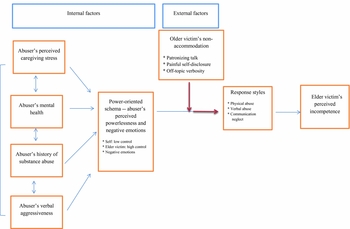
Like the Bugental et al. (Reference Bugental, Shennum and Sahver1984) model, this power-based communication model considers factors of both abuser and victim that may contribute to abuse. Our model depicts relationships among background characteristics of the abuser, two mediating factors – the abuser's cognitive appraisal, and the victim's communicative behaviors – and two outcome variables – forms of the abuse and the elderly victim's felt incompetence (see Figure 2).
A power-based model of elder abuse and neglect: a communication approach. Note: The textboxes in blue (i.e., internal and external factors) are not variables; they are to indicate the sources of the variables below. The internal factors refer to the variables internal to the caregiver/abuser. The external factors refer to the influence from the elderly care receiver/victim that function to increase the likelihood of the abuse. Hence, it is not part of the causal relationship, but an external factor. The abuser's power-based schema and the victim's non-accommodative behaviors are two mediating factors in this model.

Background characteristics
Four commonly identified background characteristics of the abuser are included in this model: perceived caregiving stress, mental health, history of substance abuse, and verbal aggressiveness. We recognize that several other risk factors are found in the elder abuse literature such as social isolation and socioeconomic status. We included the risk factors that have been consistently identified across studies and in different populations.
Perceived caregiving stress
Many adult child caregivers express fulfillment and satisfaction with caregiving experiences. However, caregiving can also be stressful and emotionally taxing as discussed above. According to the National Center on Elder Abuse (2002), spousal caregivers work for extensive hours, between 40 and 60 hours per week, which is more than a full-time job. Even when an adult child serves as a caregiver to the aging parent, they spend 15 to 30 hours every week, providing needed assistance. Caregivers may begin with tasks such as household chores, grocery shopping, and meal preparation commonly referred to as Instrumental Activities of Daily Living (IADLs). As care receivers’ dependency increases due to the progress of illness and/or aging, care givers may need to also be responsible for care receivers’ routines, including dressing, getting in and out of a bed or chair, and using the restroom, routines commonly referred to as Activities of Daily Living (ADLs).
Stress appears to be a significant indicator of caregivers at risk. Caregivers may experience physical pain, depression, or anxiety (Cooper et al., Reference Cooper, Selwood, Blanchard and Livingston2010a). Garcia and Kosberg (Reference Garcia and Kosberg1992), Johnson (Reference Johnson1991), and more recently Lee (Reference Lee2009), for example, argued that perceived caregiving stress, not the actual caregiving load, was the strongest predictor of elder abuse and neglect. Zarit and Toseland (Reference Zarit and Toseland1989) reported that caregivers’ perceived stress largely comes from their felt responsibilities of caregiving, interactions with the older care receiver, and possibly failed coping mechanisms (Cohen et al., Reference Cohen, Levin, Gagin and Friedman2007; Cooper et al., Reference Cooper, Selwood, Blanchard, Walker, Blizard and Livingston2010b). In fact, stressed caregivers are more likely to view older care receivers as “manipulative, unappreciative, or unreasonable” (National Center on Elder Abuse, 2002, p. 6).
Mental health
Research has suggested that caregivers’ stress is associated with factors of their mental health, such as depression or personality disorder (Anthony et al., Reference Anthony, Lehning, Austin and Peck2009). However, research is inconclusive as to whether extremely high levels of perceived stress result in mental health issues for caregivers or caregiving stress more greatly impacts caregivers with chronic mental health issues prior to taking on caregiving responsibilities. The tentative conclusion drawn from previous studies is that both perceived stress and mental health are associated with, and are considered risk factors for, elder abuse.
History of substance abuse
This is commonly associated with other risk factors as a significant perpetrator characteristic in elder abuse. The literature has identified a substantial number of perpetrators with a history of substance use (e.g., drugs and alcohol; e.g., 26.6% in Amstadter et al., Reference Amstadter2011a and 20% in Naughton et al., Reference Naughton2011). Again, it is unclear whether substance abuse is a dysfunctional coping strategy to caregiving stress or unemployment, or the behavioral manifestation of personality of verbal aggressiveness or mental health issues.
Verbal aggressiveness
Family violence has been linked to verbal aggression, which is a strong indicator of dysfunctional communication and intensive emotions in the interaction (e.g., Berns et al., Reference Berns, Jacobson and Gottman1999). Infante and Rancer (Reference Infante and Rancer1982) conceptualized verbal aggressiveness as a communication behavior that individuals use to attack another person's self-concept or self-worth in lieu of, or in addition to, arguing against the person's opinions or ideas. Criticism, bickering, swearing, or threats are common forms of verbal aggression. In the case of elder abuse, verbal assaults, humiliation, ridicule, or intimidation are harmful to the elderly in that they create psychological and emotional damage (Brandl, Reference Brandl2000). Verbal aggressiveness is a means by which aggressors use to express frustration or resume control when they feel powerless in the relationship (LePoire, Reference LePoire2006). In this paper, we approach verbal aggressiveness as an individual trait, a relatively enduring personal temperament with which an individual constantly responds to given situations. A caregiver with a trait of aggressiveness tends to respond to caregiving stress or older care receiver's uncooperative behaviors with violence.
Infante et al. (Reference Infante, Trebing, Shepherd and Seeds1984) and Wigley (Reference Wigley III, McCroskey, Daly, Martin and Beatty1998) suggest that social learning of aggression and an argumentative skill deficiency (ASD) explain why people resort to verbal aggression. Social learning theory is also supported in the family violence literature. Children who grow up in an abusive family are more likely to exhibit anti-social behaviors such as aggression and social detachment than are their non-abusive counterparts. It is possible that children who witness verbal aggression in their parents or family perceive this as succeeding, and are more prone to use it in a similar situation as they view verbal aggressiveness as a rewarding behavior. ASD assumes that individuals who are unable to generate rational arguments with an interlocutor in a conflict situation may turn to character attacks as a protective mechanism. This explanation is aligned with the aforementioned communication skill deficits hypothesis. Consequently, these children may suffer from an inability to formulate analytical thinking and arguments based on ideas. When applied to elder abuse, both explanations suggest that abusers may have learned and observed aggressive communication early on.
Abuser's power-oriented schema: cognitive appraisal and emotional responses
The first mediating factor included in our model, which is internalized in the abuser, is the abuser's power-oriented schema. In our model, through cognitive appraisal, caregivers interpret elderly victims’ non-accommodative messages such as confrontational, threatening, or uncooperative, which results in perceived powerlessness by the caregiver and an accompanying negative emotional response. Perceived powerlessness is a combination of two types of power attributions: (1) the caregiver feels a lack of control over the caregiving interaction, and (2) the caregiver attributes more power and control to the elder care receiver. Emotions accompanying perceived powerlessness are anger, anxiety, irritation, or apprehension. Similar to Bugental and Lewis’ (Reference Bugental and Lewis1999) argument, we also advocate that a power-oriented schema in which abusive caregivers feel powerless and fearful and that their care receivers may gain control over the interaction together with the associated negative emotions of anxiety, anger, and apprehension, are critical mediating factors through which coercion or abusive behaviors occur as chosen responses.
Elder victim's non-accommodative communication behaviors
The second mediating factor, following the communication accommodation theory, is elder victim's non-accommodative communication behaviors (see e.g., Giles and Gasiorek, in press). Based on Bugental and colleagues’ (Reference Bugental, Blue and Cruzcosa1989, Reference Bugental and Lewis1999, Reference Bugental, Ellerson, Lin, Rainey and Kokotovic2002) research on child abuse, a child's noncompliance and non-responsive behaviors can trigger a caregiver's threat-oriented schema. In the context of elder abuse, caregiving stress, family violence, and elder abuse literature also points to the victim's behaviors, at least at the perceptual level, as potentially contributing to their abuse. The abusive caregivers are threatened and agitated by the elderly person's behaviors, such as chronic crying or moaning, and interpret them as non-accommodating (Post et al., Reference Post, Page, Conner, Prokhorov, Fang and Biroscak2010; Schiamberg et al., Reference Schiamberg2012). Studies in family violence found that both partners in the conflict may be verbally abusive, and both may display demanding and withdrawing behaviors. Therefore, it is possible that the elder victim in the abuse case also expressed hostility and aggressive language. In our model we propose the following three types of behaviors from the older care receivers that are considered under-accommodative: patronizing talk, painful self-disclosure, and off-target verbosity (OVT).
Patronizing talk
Research on intergenerational communication suggests that while younger people may be over-accommodating in intergenerational communication (e.g., use patronizing talk), older adults may also contribute to problematic interactions by displaying under-accommodative behaviors (see Gasiorek and Giles, Reference Gasiorek and Giles2012). Patronizing talk from young people (which is more of an attribution than a communicative fact) is considered over-accommodating because the assumption is that young people modify their speech based on their perceptions of the older interlocutors’ communication capability. Patronizing from old people, on the other hand, is considered under-accommodation because it is believed that older adults fail to adjust their speech style to meet their younger interlocutors’ needs. Thus, older care receiver's patronizing talk is characterized as under-accommodation rather than over-accommodation. For example, an older care receiver might keep bringing up the reasons why the caregiver was unable to have a steady job or questioning why the caregiver could not quit drinking. Older adults’ under-accommodation is associated with young adults’ dissatisfaction of intergenerational communication. For example, Giles and Williams (Reference Giles and Williams1994) examined younger people's perceptions of the ways in which they were patronized by older people. Results showed that non-listening, disapproving/disrespecting youth, and over-protective/parental messages are three primary forms of patronizing talk from the elderly with varying degrees of negativity. Non-listening was seen as “under-accommodatively uncaring” (Giles and Williams, Reference Giles and Williams1994, p. 48), and disapproving/disrespecting youth can evoke the most negative emotions.
In the case of elder abuse, we can see how an older person's patronizing talk may trigger negative responses in a younger caregiver. Research already suggests that a substantial number of elder abusers were financially dependent on their elderly victims. A caregiver who is an adult child and is financially dependent on the aging parent may interpret comments from his/her aging parent as disapproving (e.g., he/she cannot be independent or “a grown-up”). Adult child caregivers may feel multiple levels of tension (i.e., being financially dependent, being the care provider, and being the child), which affect their perceptions of aging parents as non-accommodative.
Painful self-disclosure
Many older adults exhibit painful self-disclosures (PSDs) in their speech to the discomfort of their younger interlocutors (Coupland et al., Reference Coupland, Coupland, Giles, Henwood and Wiemann1988). This can occur, oftentimes out of the blue, when an elder introduces into the discourse (and sometimes at length) an occasion when they have suffered serious angst. The younger interlocutor may find it difficult suddenly to respond to older adults’ negative conversation topics (e.g., death, illness, immobility, loneliness). They may respond to these topics by remaining silent, trying to empathize with the older interlocutor, or searching for words to cheer up the older person (e.g., Barker, Reference Barker2007; Fowler and Soliz, Reference Fowler and Soliz2010). PSD is considered under-accommodative because the interlocutor neglects the feelings and needs of their counterpart and violates the conversation norms for appropriate topics for strangers who they just met.
Off-target verbosity
When older adults tend to be too wordy and lack focus, they are engaging in OVT (Ruscher and Hurley, Reference Ruscher and Hurley2000). OTV in older adults makes it hard for younger interlocutors to follow their train of thoughts and engage in meaningful interactions, and, therefore, conversations tend to become elder care receiver's monologues. Young adults tend to associate OTV with cognitive decline and low competence in older adults.
Older adults’ patronizing talk, PSD, and OTV evoke negative stereotypes of aging in younger communication partners. Presumptions about older adults’ cognitive decline, incompetence, or slow in learning eventually lead to dissatisfying interaction experiences as suggested by the Communication of Predicament of Aging Model (CPA; Ryan et al., Reference Ryan, Giles, Bartolucci and Henwood1986). In particular, traits such as older adults complaining and demanding are found to be associated with the production of PSD (Bonnesen and Hummert, Reference Bonnesen and Hummert2002). These findings should be applicable to family situations where caregivers of the elderly cannot avoid such repeated communication patterns and may not have enough patience, skills, or knowledge to turn the interactions into positive ones. Even if the caregivers may be able to empathize with the older care receivers or attempt to console them at first, having to do so on a daily basis could be challenging for the caregiver, especially one who is already highly stressed, suffers from mental instability, or has a tendency for verbal aggression. Neglect, mistreatment, or even abuses are all possible response styles. In our model, an elderly victim's non-accommodative behaviors are one external mediating factor that affects the occurrence of abuse.
Abusers’ abusive response styles and victims’ felt incompetence
Abusive response styles
Abusers’ response styles refer to different forms of elder abuse as discussed earlier. There is not enough evidence to suggest particular associations between older adults’ under-accommodation and particular forms of abuse. Moreover, recent studies have suggested that instead of one single type of abuse, many of the elder victims suffer from multiple abuse types. For instance, based on their Michigan survey data, Post et al. (Reference Post, Page, Conner, Prokhorov, Fang and Biroscak2010) estimated that approximately 51.4% of the elder victims experienced two or more abuse types. Thus, we include three major types of elder abuse in this model: Physical abuse (e.g., inappropriate use of medication, physical constraints, force-feeding), emotional abuse (e.g., verbal assaults, ridicule), and communicative neglect (e.g., ignore the older person's conversation). Note that financial exploitation, a prominent form of elder abuse, is not included here due to the nature of the model, that is, communication behaviors and cognitive appraisal during the interaction.
We argue that financial exploitation is less likely to take place during the actual caregiving interaction, and it can occur without any actual interaction prior to it. Therefore, financial exploitation is not included in this model as one abuse response style, although it does, of course, have its own unique communicative parameters. Neglect, we modestly propose to reconceptualize as communicative neglect, which is commonly found alongside emotional abuse with abusers who are verbally aggressive (Dong et al., Reference Dong, Simon and Gorbien2007). Instead of reacting to perceived powerlessness by “doing something” toward the elder victim, it is possible that the abuser may respond by acting “passive-aggressive,” withdrawing and ignoring the abuser, causing the elder victim to “feel” neglected (Sorenson, Reference Sorenson, Summers and Hoffman2006).
Elder victim's felt incompetence
The CPA model (Ryan et al., Reference Ryan, Giles, Bartolucci and Henwood1986) alluded to above suggests that intergenerational communication experiences driven by negative age-based stereotypes constrain older interlocutors’ ability to engage in meaningful conversations. Their younger counterpart's modified speech (e.g., patronizing talk) or avoiding attitude may cause older persons to doubt their own ability (i.e., self-stereotyping). In caregiving situations, even without the occurrence of abuse or mistreatment, modified speech styles or caregivers’ positive encouragement of older adults’ “dependent” behaviors may create a sense of incompetence in older adults. They may opt to withdraw from activities that seem difficult or challenging to avoid embarrassment (Ryan et al., Reference Ryan, Meredith, MacLean and Orange1995). In cases of elder abuse, it is possible that elderly victims are also convinced that they are incapable of taking care of themselves (i.e., learned helplessness) or they “deserve” abuse because of their own incompetence when their caregivers lash out in anger. Consequently, the elders’ sense of low self-efficacy or anxiety may cause fear of doing or saying anything to further provoke the hostility of their caregivers. The resulting psychological and behavioral paralysis may appear as non-responsive or noncompliance to the caregiver. A negative cycle is created when the abusers are agitated even more by such responses (e.g., Begle et al., Reference Begle, Strachan, Cisler, Amstadter, Hernandez and Acierno2011).
Conclusions
In this paper, we wish to call the attention to the dynamics of interactive patterns where dysfunctional communication between family caregivers and older care receivers is created leading to possible outcomes that promote continuous abuse. In particular, we ask for a closer look at elder victims’ non-accommodative communication behaviors in combination with abusers’ characteristics in interaction. Even though the immediate next step requires empirical studies to examine the utility of our model, each proposed variable could be supported by literature from related disciplines. Based on our model, we predict that non-accommodation from the elder victim interlaced by coercion from the abuser is a powerful communication potion for emergent harm to the elder. We also expect that the abuser's characteristics (i.e., perceived caregiving stress, mental health, history of substance abuse, and verbal aggressiveness) predict their perceived powerlessness in caregiving situations. In addition, we are curious about the relationship between the abuser's characteristics, elder victim's non-accommodative behaviors, and communication neglect. Is it possible that communicative neglect, a relatively passive response style of abuse, may only correlate with a particular type of abusers? Preliminary research findings show that emotional mistreatment may result in elder care receivers’ poor psychological health (Begle et al., Reference Begle, Strachan, Cisler, Amstadter, Hernandez and Acierno2011). Is it possible that we also see a similar pattern in our model? That is, abuser's verbal aggressiveness may be directly linked to verbal abuse and such a link will be strengthened by a high degree of elderly victim's non-accommodation behaviors. Moreover, is the abuser's perceived powerlessness a meaningful mediating factor for communication neglect? What is the relationship between these two mediating factors, the abuser's power-oriented schema and the victim's non-accommodative behaviors? These are the research questions that we wish to address as first steps in model testing.
While our proposed model is supported by solid empirical findings, we acknowledge its limitations. First, as aforementioned, further examination of each factor is needed to test the utility of this model. Second, because the emphasis of this model is on the process of communication and the antecedents related to communication, many risk factors for abuse, such as the abuser's socioeconomic status, the abuser's actual or perceived social support, or the victim's health status, are excluded to tease out effects in and of communication. Third, some types of abuse, such as self-neglect, cannot be explained by this model since it is a self-inflicted mistreatment. That said, it is possible that the elder victim chooses to engage in self-neglect behaviors while being mistreated by the caregiver. Future studies should explore why and to what extent self-neglect takes place concurrent to other abuse types.
Elder abuse is a complex social problem that requires careful scrutiny and collaborations between multiple entities to effectively address the ways in which one layer of the problem intersects with another. A starting place may even be to build more positive, intergenerational communication and experiences in our society in general. Caregiving in domestic settings is an intimate and intense intergenerational context where conflicts frequently emerge and, unfortunately for some, can escalate into abuse. A communicative approach to elder abuse allows people to see the ways in which it is provoked, maintained, and hidden, and as such (following Bugental's intervention studies) might suggest further educational programs for caregivers about the needs of aging adults, as well as inspire additional resources and social support in the community (Anthony et al., Reference Anthony, Lehning, Austin and Peck2009). A communicative approach also provides ways in which abuse can be revealed, intervened, and avoided. We hope that our model, which is rooted in such a perspective, can provide preliminary explanation for intergenerational communication that “turns sour.”
Conflict of interest
None.
Description of authors’ roles
Mei-Chen Lin and Howard Giles jointly define the scope of the paper and the variables of the proposed model. Both of them wrote different sections of the paper.
Acknowledgments
The authors would like to give thanks to Paul Haridakis, Jolanda Lindenberg, and anonymous reviewers for providing insightful comments and feedback on earlier drafts of this paper.