

ʾEven Shetiyah: The Early Rabbinic Texts
While the late biblical authors laud Jerusalem, Mt. Zion, and especially God's holy house, the Temple, as exceptional, unique, and divinely sanctioned, they never mention a particular divinely marked rock within the sanctuary.Footnote 1 The mythic ʾeven shetiyah appears first in the Mishnah, where we find this very brief notice:
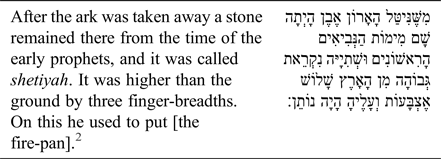
Without explaining what shetiyah means or refers to, this text highlights the antiquity of the stone (it was there from the time of the earliest prophets—therefore before Solomon built the Temple), and its location: at the place where the ark of the covenant used to rest, in the devir, or holy of holies, of the First Temple. Yet neither association to antiquity nor place explains the name shetiyah.
The related Tosefta passage adds another mythological layer, which helps explain what shetiyah means: “Rabbi Yose used to say, ‘the world was founded/woven [nishtat] from it [the stone], as it says: “From Zion the perfection of beauty, God shines forth” [Psalm 50:2].’”Footnote 3 In this passage shetiyah is understood to derive from shati/shatah, meaning “to create,” “found,” or “weave.”Footnote 4 The world, in Creation, began at this rock and grew from there into its present shape. The poetic language of the psalmic verse allows one to imagine the world as created like a tapestry woven on a divine loom—spreading out as God pushed the divine shuttle back and forth across the warp. Our Mishnah text makes no claim to prove or support this primordial association. While the ʾeven, or stone, just is, and one assumes, always was and always will be there as part of the bedrock upon which the temples once stood, the Mishnah text does not associate the ʾeven with Creation. Rather, it only recalls that the stone was there before the temples stood (“from the time of the early prophets”), that is, in the days of Samuel and David.
The toseftan passage, however, moves the stone's provenance back to primordial times. Psalm 50:2 (“From Zion the perfection of beauty, God shines forth”), for these rabbis, declares that good things, generative things, begin at Mt. Zion, Jerusalem. God shone forth God's glory (during the creation process, physically happening at Zion, on the crest of the mountain) and the world came into being. The world emanated, like the rays of the sun, from the rock, the first point of Creation. Here, Zion and the ʾeven are one. The world's existence is beholden to Zion; and the Jews are beholden to the rabbis, who visualize this rock in their reimagined holy of holies.
The Palestinian Talmud solidifies this primordial analogy even further by bringing in yet another “foundation-stone” text in support:

As my translation suggests, the rabbis play with the meaning of the root word shati to make it mean both “to found” and “to weave,” or otherwise to create the world. While the image of a divinely woven tapestry has aesthetic merits, a carpet is materially fleeting and can disintegrate easily. A rock, however, especially bedrock, is immovable. The added Isaian text supports the idea that this small piece of the mountain of Zion gains significance as the cornerstone/foundation stone of the world. The talmudic passage explains the shetiyah concept through the analogous stone images of impenetrable strength, foundation, and cornerstone. Even though this prophetic verse most likely uses the stone images as a metaphor for the spiritual strength grounded in Zion through the Temple cult, in rabbinic hands the foundation stone compares favorably to the physical and rock-solid cornerstone of the entire world, but it is still a stone, one piece of the mountain, embedded therein by God at Creation.
Scholars have shown that these motifs of creation, foundation, and divine presence all connect back to ancient Near Eastern cosmic mountain motifs, in which a deity (or two), usually living on a sacred mountaintop, founds the world and/or lives at the place where the world was created, and this mountain becomes the sacred center of that worshipping community.Footnote 6 These cosmic motifs were often applied to Jerusalem, Mt. Zion, and the First Temple in some late biblical literature, such as Isaiah, Psalms, and Ezekiel.Footnote 7 All these biblical texts indulge in theological fantasies about the shape and geography of divine presence on earth. The rabbis, however, focus on a small, barely elevated rock (only three fingerbreadths tall), not a mountain, city, or Temple building. In the mishnaic text they go backwards in time, to a place and time before the temples or Jerusalem existed for Israel. Moreover, these texts focus not on the mountain or Temple as a whole, nor even on the devir, the inner sanctum itself, and the priestly activity that supposedly took place there, but on the ark, and I argue, the word of God that resides within it. The ʾeven is bedrock support for the ark, as the rock sits hidden beneath the ark in the holy of holies.
Naftali Cohn argues that the rabbis inserted themselves retroactively into the no-longer functioning Temple ritual through their recreation of the Temple “map” in Mishnah Middot in order to bolster their legal authority. As Cohn writes, in Mishnah Middot the rabbis replace the holy of holies, the devir—the place where the high priest came face to face with God during his yearly ritual entry—with the chamber of hewn stones, the place where the Sanhedrin (the “proto-rabbis”) met and determined Temple ritual. In so doing they suggest that rabbinic interpretation of text, and especially Halakhah, even pertaining to the Temple, supersedes all other interpretations. The rabbis, in their own imagination at least, retroactively replace the priests as ritual experts in the Temple, implying thereby that they retain authority over all post-Temple Jewish ritual because of their “historic” position.Footnote 8 The rabbinic ʾeven shetiyah lends further support to their self-actualizing.Footnote 9 The rabbis here go beyond establishing their expertise over the layout and operations of the Temple. They claim knowledge about its primordial origins. One could argue that by linking cultic center, foundation stone, and container of Torah, they inserted their own ability to read and interpret Torah into the foundation myth of the Temple. As the rabbis have it, rabbinic authority, with its claim to the primordial ʾeven shetiyah, outstrips priestly authority by establishing pre-priestly divine authority.
Whatever the mishnaic rabbis had intended by “at the time of the early prophets,” other rabbinic traditions expand the rock's cosmogonic function and connect it to Creation. In so doing, they further bolster the authority of their interpretive enterprises. If the mishnaic text suggests that the ark sits on an important pre-Temple rock, it points to the rabbis’ belief that their authority predates the Temple, by pointing to a time before Jerusalem and the temples were central to Israel. The toseftan and Palestinian talmudic texts suggest that that rock is not just old, but primordial, like the ancient Near Eastern cosmic mountains. And similar to these mountains, this little insignificantly sized and mostly invisible rock provides the same mythic authority to the rabbis. In other words, the ʾeven is the bedrock support for their work, and that foundation originates with God, predating not only the temples, and Israel as a nation, but the world as a whole.
As a number of scholars have noted, ancient Near Eastern mythologies that had been “repressed” or reworked in the biblical texts reemerge in the rabbinic texts, and the cosmic mountain motif is no exception. However, as I will demonstrate below, that reemergence is eclectic, evolutionary, and contested. That is, various motifs pop up here and there, some are questioned, and the remainder only coalesce into a new all-encompassing rabbinic mythological narrative in later (post-talmudic) rabbinic texts.Footnote 10 We have already registered several variations from the ancient mishnaic rock to the primordial toseftan and Palestinian talmudic one. The Babylonian talmudic version, while upholding that the world was created from Zion, rejects all other mythological explanations for Creation. In so doing it positions itself polemically against other emerging religious positions concerning exclusive divine access to God at Jerusalem.
The Babylonian talmudic passage that expands on our earlier Mishnah presents several different origin scenarios for the ʾeven shetiyah and the creation of the world. The passage begins and ends with the “accepted” narrative, that shetiyah means “founded” and the proper biblical proof text, Psalm 50:2, places that event at Zion, but it raises three other possibilities, each to be rejected. The extended text runs as follows:

In this passage the rabbis reassert that the world was created from Zion, but they do so by reviewing and rejecting several other means of creation, all based on passages from Job. The whole passage seemingly revolves around God's challenge to Job and his friends, “Where were you when I established the earth?” (Job 38:4a), even as this verse is not cited directly. After establishing the accepted tradition, the text offers three other possibilities: that the earth was created from its insides, from its sides, or from a rock tossed into the sea. This last possibility has clear cosmic mountain connections, as in some ancient Near Eastern cases the world emerges as a mountain from the sea first.Footnote 12 Moreover, the proof text cited, “Upon what were its pedestals settled/sunk? Who set its cornerstone?” (Job 38:6), seems a logical rationale for the founding of the earth. The ʾeven shetiyah as the world's cornerstone, sunk deep into the earth or sea, makes poetic and visual sense. Yet, if the third case makes sense, the first two do not, at first glance. Nevertheless, the first two can come together as two sides of a cosmic riddle: Was the world created from the inside out or from the outside in? For these two options (inside out or outside in) the Job verses brought as proof seem random, but when all three proof texts are read together they all point to the underlying theme of this passage in Job: Who can possibly understand how God created the earth? The biblical text begins with God's retort to Job and his friends: “Where were you when I established the earth?” (Job 38:4a). This clearly is the rabbis’ starting point. While they, like Job, surely accept their humble human inferiority to God, the next verse challenges the reader: “Speak if you have wisdom!” (4b). This pericope takes up this challenge, as the rabbis speak and declaim: God laid the world's foundation in Jerusalem.
Yet the rabbis also reject the more logical analogy, the cornerstone, and deposit it at the bottom of the sea. Why? In the Palestinian Talmud, the ʾeven pinah as mentioned in Isaiah 28:16 (“Therefore I found/lay in Zion a stone, a tested stone, a firm/precious cornerstone; he who trusts need not fear”), is used to support the idea that the ʾeven shetiyah is found (and was founded) on Mt. Zion. Yet in the Babylonian Talmud, the ʾeven pinah sinks to the bottom of the sea. This maneuver might reflect a reaction to Christian interpretive moves that both relate the Isaian cornerstone to Jesus and place that stone on the ruined Temple Mount. For why should the ʾeven shetiyah, as an imaginary stone, not be the equally imaginary ʾeven pinah of Zion and therefore the world?
1 Peter 2:4–6 describes Jesus as a “living stone,” chosen and precious, drawing on Isaiah 28:16. Yet it also invokes Psalm 118:22, in which another stone, rejected by the “builders,” is made into a cornerstone by God. This divinely chosen cornerstone, a metaphor for Jesus, inspired many a Christian pilgrim to search out real and physical cornerstones in Zion, and especially on the Temple Mount, that could relate to the Gospel narrative. In one case, the fourth-century Pilgrim of Bordeaux merges the pinnacle of temptation at which Satan tempts Jesus in Matthew 4 with the prophetic rejected cornerstone and marks its location on the Temple Mount. Oded Irshai argues that in this case, the “cornerstone” of Isaiah 28 and Psalm 118 should be read as a “copestone,” that is, the stone that sits not at the corner but at the top of the building (i.e., the last stone to be put in place rather than the first).Footnote 13 If Christian pilgrims and writers marked out their religious history in stone on the Temple Mount, the rabbis may have done the same, at least in the pages of their texts.Footnote 14 The Babylonian tradition, at least, rejects this cornerstone option, perhaps for polemical reasons, through a word play on the central verb in verse 6, yarah, which in Job means the casting or setting into place of the cornerstone, yet which the rabbis read as “throwing” (the cornerstone into the sea).Footnote 15
The foundation stone came into existence not only to replace the temples, but to mark the spot of the primordial axis mundi, and to imply that rabbinic exegetical work not only replaces the ritual work of the Temple priests but has even deeper cosmic roots. Rachel Neis argues that in the rabbinic imagination, God could be “seen” only in the Temple, during priestly ritual. Absent the Temple, this locus of sanctity, where the Israelite came “face to face” with God, could be relocated to rabbinic personal and scholarly interactions. That is, an encounter with a true Torah scholar (gazing at an eminent rabbi) substitutes for the visual divine encounter, because the sage has become Torah incarnate.Footnote 16 Thus, rabbinic midrashic work as represented in rabbinic bodies replaces and reconstitutes priestly Temple-centered activity and continues to enable Israel's divine engagement.
The rabbinic foundation stone does more than just replace the priestly cult—it retroactively preempts it. Rabbinic work (exegesis) as represented in, or supported by, the primordial foundation stone, predates, or preexists, priestly cultic work. The memory of the Temple, but especially the memory or knowledge of God's presence, is embodied in a rabbinically conjured (imagined) piece of bedrock, preexisting, but hidden when the temples stood. In the language of Pierre Nora, the ʾeven shetiyah is a “site of memory,” for it is an imaginary memorial to those earlier and now lost divine encounters.Footnote 17 Yet, a site of memory is also forward thinking. Thus, the ʾeven shetiyah, while marking the innermost sanctum of the Temple (where God “resided” and was “seen”), also sat under the ark of the covenant in the First Temple, which contained God's words written in stone. If in Mishnah Middot, the equally imagined chamber of hewn stones is centrally important to Temple ritual; in Mishnah Yoma, where the ʾeven first appears, the ʾeven shetiyah supports the ark of the covenant, and the divine words it contains, in the same manner that the cherubim constitute the divine footstool. Thus, the ʾeven shetiyah, a rabbinically created yet presumed ancient piece of bedrock, embedded deep within the sanctuary structure, gives visual support to rabbinic aspirations: exclusive rights to God's words. Claiming/creating the foundation stone allows the rabbis to put themselves forward as the only sanctioned post-Temple leaders and interpreters of God's covenant. In this case the rabbis’ “site of memory” looks backward as well as forward, for it all but removes the priests from the rabbinic narrative. Rabbinic exegetical authority reaches back in time directly to primordial divine authority (Torah), which circumvents priestly authority.
From its beginnings, in the early rabbinic texts, the ʾeven shetiyah’s mythology grew and expanded from an ordinary, but well-placed, stone within the Temple compound into a cosmogonic piece of bedrock, the beginning point of Creation, in place eons before the temples even existed. This cosmogonic overlay further supports the rabbis' self-authorizing spiritual practices and leadership. In the next section I turn to other Temple-related myths that connect the Temple to the tehom (through the shard that is the seal on the tehom). These talmudic texts do not ever mention the ʾeven shetiyah. Nevertheless, the two tropes of ʾeven shetiyah and seal on the tehom become entwined in later (post-talmudic) midrashic works such as Pirke de Rabbi Eliezer.
The Seal on the Waters of Tehom and the Temple
In his essay “On Sealing the Abysses,” Daniel Sperber suggests that narratives concerning David digging the “pits,” or foundations of the Temple, and finding the source/opening of the tehom are integrally related to other rabbinic traditions of the “ʾeven ha-shetiyah cycle.”Footnote 18 However, the midrashim about David, the seal on the source of the abyss, and the Temple are not the same narrative, nor do they serve the same purpose as the traditions of the ʾeven shetiyah. While they do eventually merge in later texts (e.g., Pirke de Rabbi Eliezer and Targum Pseudo-Jonathan), in these talmudic texts they serve different rabbinic agendas. In the passages discussed above, the ʾeven shetiyah myth serves rabbinic leadership goals of securing post-Temple authority. In contrast, the “sealing of the tehom” myths explored below support a notion of continual divine activity in the world, despite the lack of a Temple to house the divine presence. These texts focus on God and divine presence, rather than on priestly or even rabbinic authority. They reassert divine dominion over and above any form of human authority, all the while keeping the narrative focused on Jerusalem, Zion, and Temple.
The Palestinian Talmud's version reads as follows:

In this midrash, as David excavates the foundations of the Temple, he digs so far down that he eventually reaches the waters of the tehom, the leftover waters of Creation. Luckily the waters are blocked by a clay pot that informs David that it has been there since God revealed Godself at Sinai. The midrash implies that chaos (represented by the checked waters of the deep) has been under control since God made a covenant with Israel, and Israel has worshipped God according to that covenant, which eventually led to the building of the temples on this spot. Nevertheless, David heedlessly removes the pot, threatening the world with chaos again. Only through some unnamed words can Ahithophel, David's erstwhile counselor, subdue the tehom, but without recourse to the pot, which disappears from the story.
The important details are that David was clearly excavating the foundations of the Temple, that the waters of the tehom could be accessed from Mt. Zion, and that after the pot was removed, only “some words” spoken by a wise man could subdue them again. Sperber suggests that this text, in which the tehom is “suppressed” (kavash) by the pot, reads very much like other magical texts, particularly those found in some Aramaic incantation bowls. Like the bowls, which were placed under house foundations in order to contain the resident demons, the midrashic pot claims to do the same: it contains chaos, the underwater demon. Ahithophel also manages to contain the chaos demon, but through a magical incantation spoken over the waters, rather than with a pot.Footnote 20
This narrative suggests that the revelation at Sinai was so cosmically momentous that the earth almost collapsed. But the very act of this revelation and its immediate result, the covenantal agreement between God and Israel, keep the earth in place and whole. Yet, Israel's agreement with God is likened to a clay pot, a vulnerable piece of pottery, something that can be destroyed or displaced with ease. Thus, David's presumptuous removal threatens the world again. Although this text implies that with or without the temples, the world depends on continual Israelite/Jewish covenantal behavior, it also suggests that Israel needs back up, be that direct divine intervention, or perhaps rabbinic esoteric knowledge (the secret words that wise man Ahithophel spoke). Nevertheless, the fact that the clay pot predates the temples both gives post-Temple rabbis an authoritative boost, but more importantly keeps God in the picture. (God is the ultimate power behind magical/esoteric words.)
Now let us compare this text to the Babylonian tradition, which reads as follows:

In this midrash, the rabbis imagine that while David was digging the shittin (“pits” or “channels,” not “foundations”; see below), the waters of the deep rose so high in his excavations that they threatened to overwhelm the world again. With some quick thinking, singing, and most importantly, the use of God's name written on a shard of pottery, David subdued the waters back to where they belonged. Thus, like the Palestinian tradition, this narrative situates the waters of chaos, the tehom, underneath the Temple Mount. Moreover, it emphasizes the power of God's presence, for it is only God's name, written on a human-made shard of pottery, that keeps the waters at bay.Footnote 22 According to biblical lore, God's name used to reside in the Temple when it stood on this hill.Footnote 23 Thus, the rabbis suggest, it is only God, and particularly God's presence as marked by God's name in the Jerusalem temples, and the worship that was conducted there, that once kept the waters of chaos below ground. More stridently than the Palestinian version, the Babylonian text reinserts God into the narrative. While in both texts a divinely created mechanism that predates the temples keeps the waters at bay, Israel's obedience to the covenant seemingly plays no part in the Babylonian tradition, where only God's name has power. These texts suggest that if God's presence, biblically tied to Jerusalem, and imagined as “dwelling” in the Temple, existed on this mountaintop even before those temples were built, why not also afterwards? These rabbinic narratives conjure up an ancient bare mountain imbued with God's presence represented by a shard or pot, the engraved divine name, and magical words invoking the divine name. Ahithophel's magical incantation in the Palestinian version has been embodied in an imaginary shard carrying both backward and forever forward the power of God's name inscribed upon it. The rabbis here reemphasize their stated belief that God's presence, as a protection against chaos, still works in this world, as it did before the temples existed. That divine protective presence remains tied to Jerusalem and the site of the temples.
Nevertheless, both of these midrashim clearly draw on older mythic tropes in which God subdues the waters of chaos, which are always at the ready to come back and undo God's creation, as they do in the Flood Narrative (Genesis 7:11; 8:12) or threaten to do in Ezekiel (29:16). As Daniel Sperber notes, the idea of sealing up the abyss, particularly with the name of God, as that act of subduing, also can be found in both ancient Near Eastern and more contemporary Hellenistic literature, but was already a common trope in Jewish and Christian circles by the second century CE.Footnote 24 Sperber highlights the similarities between the Babylonian talmudic text and one found in the Prayer of Manasseh, in which God is described as sealing up the Deep with his “terrible and glorious name.”Footnote 25 The important factor is the Name that can subdue.
Admittedly, I took it for granted that this midrash “takes place” on the Temple Mount, but the Babylonian text does not directly indicate absolute location. The Palestinian text firmly states that David was excavating on the Temple Mount when he discovered the tehom. It uses a Greek architectural term, themilios, to signify structural foundations.Footnote 26 The Babylonian version only says he was excavating the shittin. Scholars note the similarities between shittin and shetiyah and suggest they both derive from the same root, shati, discussed above.Footnote 27 Thus our Babylonian text might also understand shittin as “foundations” rather than “pits,” or possibly even “hollowed-out channels.”Footnote 28 Nevertheless, I suggest that the Babylonian text, though still situating its narrative on the Temple Mount, shifts the locus from the sanctuary building to the altar, under which, according to the Mishnah, the shittin reside.
Shittin are first mentioned in M. Middot 3:3, M. Meʿilah 3:3, and T. Sukkot 3:15. These passages mention the pits in passing, as part of the presumed Temple Mount infrastructure. The Mishnah claims that the wine libations flowed into them from the altar (M. Meʿilah 3:3) and that there was a trap door somewhere near the altar to access the shittin for cleaning (M. Middot 3:3). The Tosefta, however, connects the shittin to the abyss:

This text claims that the shittin descended all the way to the abyss and/or that the shittin perforated the abyss. Rabbi Yose makes this association through his reading of Isaiah 5:1–2, in which the main character, the beloved, who represents God, builds a vineyard, which R. Yose correlates loosely with the fixtures of the Temple Mount. The guard tower of the vineyard is the sanctuary and the wine vat stands in for both the altar and the shittin that lead from it. This analogy lends the infrastructure and Temple buildings a primordial and divine imprint, but also suggests that the offerings at the altar were swept away to the abyss—as if the sins thus atoned by the ritual at the altar were washed away to the desolate abyss in the same way that the sacrificial goat was sent out to the desert on Yom Kippur with the people's sins (Leviticus 16).
Thus, when our Babylonian midrash references the shittin, I think it more specifically references these primordial channels, not the foundations of the Temple. Moreover, our midrash occurs within a long-winded talmudic discussion of the priestly activities surrounding the Simḥat Bet Ha-shoʾevah, a Temple ritual conducted during the Sukkot festival. The rabbis discuss musical instruments, water vessels, and wine libations, among many other distinctly priestly activities and equipment. Within the description of the wine libations, we find another midrash about the shittin. Building on the Tosefta passage, the Babylonian text describes the shittin specifically as pits, cavities, or channels found next to and under the altar to collect the wine libations, and imbues them with even deeper primordial associations. Thus, when our midrash mentions David's shittin, they have already been fully described but a page before:

Here these shittin clearly have mythological origins: they were created at the beginning, they descend to the abyss, they are clearly pits or natural cavities divinely constructed into the mountain, when the mountain was created, but at the place where the altar would be built. In this way, the rabbis imbue the mountain with primordial, yet Temple-related functional significance. The shittin are integral to the mountain, and constitute structural support for the Temple, the altar, and the ritual performed there by the priests. The shittin themselves may or may not have existed historically in the infrastructure of the temples (they are first mentioned in the tannaitic literature), but even in these rabbinic hands they serve the priests and their ritual practice in the Temple, but in rabbinic garb. That is, as Cohn argues, any rabbinic “mapping” of the Temple Mount brings it, at least literarily in the pages of the Talmud, under their control, even in the days of the priests.Footnote 31
In the Palestinian tradition, David excavates the foundations for the Temple, a humanly constructed edifice. In the Babylonian, he excavates the cavities that already exist beneath the altar-to-be. Given their primordial origins, David presumably discovers what was already there integral to the mountain (and somehow also disturbs the natural/created order, which must be rectified with the inscribed shard). David as protagonist, tehom as destination, and the subduing of the chaotic waters as necessary action are the threads that tie these two Davidic narratives together. As a related pair of midrashim they establish a direct correlation between the presence of God or God's name on the Temple Mount to the fixed order of the universe: the waters of chaos stay submerged underground, where they belong, through God's constant presence now embodied in a buried pottery shard from the time of David.
With the shift from the building foundations to the altar, the Babylonian text also nuances the Palestinian text's original contention that the fate of the world, while primarily in God's hands, is also tied to Israelite covenantal behavior. The altar was the place where and means by which Israel atoned for its sins. The priestly rituals performed there, both individual and communal, neutralized the people's inadvertent transgressions. Without the altar and its concomitant sacrifices, Israel cannot be fully ritually cleansed. The priestly theology, as laid out in Leviticus, suggests that the sacrificial ritual keeps God's presence in the midst of Israel.Footnote 32 Without the ritual, God leaves, and Israel exposes itself to disaster and eventual demise. The Babylonian midrash expands that potential disaster not just to Israel, but to the whole world, through the threatening waters of the deep located at the bottom of the shittin. Without the cultic activity, only God's name can serve as the check on the tehom and keep the world safe. By expanding on the Levitical premise that God's presence is for Israel's benefit to include the whole world, the purpose of the Temple Mount's infrastructure must expand as well. If the Temple cult, practiced properly by Israel, kept God's presence in Jerusalem, then to keep the whole world safe from destruction, God must have implemented other mechanisms. The primordial shittin along with the presence of God's name—written on a shard, but invoked daily by Israel—provide those other mechanisms both before and after the Temple stood.
Moreover, in the Babylonian tradition, at least, the rabbis make no claim that they have anything to do with the placement of the Name on the tehom. Rather, David is responsible, both through the work of Ahithophel and through his hymn singing. In this passage David acts neither as priest nor rabbi, but in his role as king. As such, he is the precursor to the messiah, and acts as God's right-hand man in protecting the world from disaster. David has his own divine covenant, after all. It does not seem that the rabbis claim agency through David (though possibly they do as helpers through Ahithophel, who makes a very rabbinic kal va-ḥomer argument), but rather reinforce the idea that God has not abandoned Israel, even if the temples no longer exist, for the God-Israel relationship predates the temples. This David remains both strictly Jewish, working on the behalf of Israel, but also universal, saving the world from disaster. In effect the rabbis reclaim that more universal David, especially if others (e.g., Christians) both claim lineage from David and point to the destroyed Temple, and especially the ruined Temple Mount, as sure signs of divine disapproval and abandonment of Jewish Israel. Thus, I suggest that the rabbis choose David as protagonist to polemicize against such anti-Jewish positions.Footnote 33
The rabbis, more than just revising old mythologies, create new ones. These new mythic narratives reflect the rabbinic agenda rather than the biblical. On the one hand, the ʾeven shetiyah translates God's presence/blessing on Israel, from the devir, the holy of holies, through the ark/word of God to the rabbis and the work that the rabbis pursue—interpreting God's word, in order to keep up the Jewish people's end of the divine covenant. The rabbis invoke God's presence through their imaginary stone that mimics a cosmic mountain in its own right, following ancient Near Eastern tropes. Yet the stone serves the rabbinic self-authorizing agenda. This cosmic mountain supports God's word, which the rabbis lovingly and continuously interpret. The primordial nature of the ʾeven also suggests that the rabbinic enterprise and its authority reaches back before the priestly to a different and higher divine authority. The rabbis do not mimic the priests but preempt them.
In contrast, the myth of David, the shard, the abyss, and the shittin reaffirms God's eternal presence, the continued protection not only of Israel, but of the whole world, by invoking God as the deity that suppresses the waters of chaos, not just once, but continually, at the site of the temples. The episode of David is but an interlude to demonstrate this eternal presence. In their post-Temple world, the rabbis recreate and reinvigorate God-focused and covenant-oriented Jewish life for themselves and their followers; but only God can prevent the world from descending into chaos again. If the ʾeven shetiyah myths “take back” divine authority to support the rabbis as Jewish leaders through their interpretive enterprise, the seal on the tehom myths reemphasize divine authority in the world as a whole, but also as a way to assure Jewish obedience to that divine authority.Footnote 34
The Later Traditions
Daniel Sperber, Yehuda Liebes, and Joseph Heinemann are correct when pointing out that the ʾeven shetiyah myth subsumes the seal on the tehom myth in later rabbinic midrashim.Footnote 35 While the ʾeven remains a fixture in late rabbinic imagination, it becomes more of what the inscribed shard had been—a reminder of God's authority and continued presence, rather than an embodiment of rabbinic self-authorization. Thus, the original meaning and function of the ʾeven shetiyah (rabbinic authority) is lost and subsumed into the function of the inscribed shard (divine authority). In addition, the combined shard/stone gains new meaning: it points forward to Israel's promised redemption. In the increasingly precarious world of the sixth, seventh, and eighth centuries (with their plagues, famine, war, earthquakes), these writers perhaps felt more anxious about Jewish survival overall and turned their full attention to an all-powerful, world-controlling God for spiritual support.
A midrash from Targum Pseudo-Jonathan to Exodus 28:30, which first merges the two midrashic narratives, can serve as an example. There is little consensus on the exact dating of Pseudo-Jonathan, a paraphrastic targumic text; estimates range from the fourth century to the fourteenth. However, the eighth century arises as a likely starting point, since the targum manifests texts that also appear either in Tanḥuma and/or Pirke Rabbi Eliezer (PRE), and it seems to evolve in the same late Byzantine to early Islamic milieu with these other later rabbinic compilations.Footnote 36

Here, in a discussion of Aaron's breast-plate (ḥoshen), upon which, the targum claims, was inscribed the holy name of God, we are reminded that God's name was also inscribed on the ʾeven shetiyah.Footnote 38 According to this text, God used the divinely inscribed stone to seal up the waters of the deep (at the time of Creation) so that they would not overcome and flood the world. Clearly this midrash reflects and merges the myths mentioned above: God's name inscribed on a pottery shard keeping the waters at bay here becomes the ʾeven shetiyah, also inscribed with the Tetragrammaton, which acts as the earthly plug on the waters of chaos. (Though it is not clear from this text where the ʾeven is: at the bottom of the sea, as in PRE—see below—or in the devir as in the talmudic traditions.) The midrash asserts that one who invokes God's name (the very name engraved on the ḥoshen and on the ʾeven shetiyah) will be saved—both physically and spiritually—as the two engraved items attest. The ʾeven, inscribed with God's name, has preserved the world from returning to chaos since Creation. Here the targum harmonizes and resolves the problems of the earlier midrashim—God plugged up the tehom at Creation with the foundation stone. Moreover, the shard that once subdued or suppressed the waters has become a sealing stone, a ḥotem, as in the Prayer of Manasseh, that fully closes up the mouth of the tehom.
Finally, the midrash suggests that those who invoke God's name in their time of need will be protected and enlightened by the name (presumably with esoteric and salvific knowledge) as the name on the ḥoshen served to enlighten Aaron (with God's oracles). In addition, those who properly invoke the divine name will be granted “revelation of hidden things.” Thus, what they learn will also be their salvation, for through this cryptic language the targum suggests eschatological undertones, which I will return to, briefly, below.
The ʾeven shetiyah appears twice, in two separate midrashim, in Pirke Rabbi Eliezer. The first concerns Jonah (chap. 10) and the second Jacob (chap. 35). I will discuss only Jacob here by way of example. Jacob, after his dream at Bethel, “discovers” the ʾeven shetiyah:
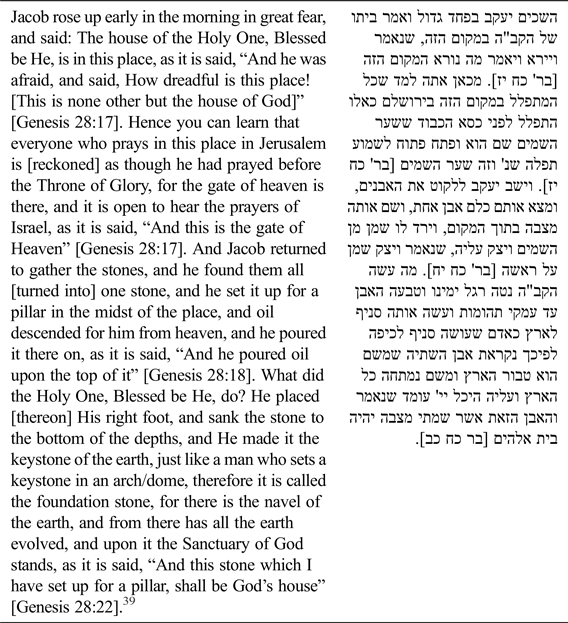
In this midrash, having landed for the night at Mt. Moriah (PRE reads “Beit El,” as “house of God,” and thus as one and the same with the Jerusalem Temple), Jacob gathers twelve stones (formerly used in the altar that Abraham built for the Akedah) upon which he sleeps and dreams his dream of a ladder reaching up to heaven. After Jacob realizes that he had bedded down in “God's house,” the twelve stones merge together into one monumental stone, which is anointed by heavenly oil; God submerges this stone into the tehom as the ʾeven shetiyah. Thus, the foundation stone is formed on the top of the mount (but is not integral bedrock of the mount) and is connected to both pivotal Abraham and Jacob narratives, yet it is submerged after its formation. The stone now sits directly under the Temple Mount, but way down in the depths of the tehom. It originates on the top of Mt. Moriah but resides at the bottom of the sea.Footnote 40
While the stone sits in the tehom, it does not explicitly serve as a plug on the chaotic waters, but retains its cosmic mountain characteristics: it is the navel of the earth—that stone from which the earth was originally formed. As a navel, the foundation stone becomes a fulcrum, the point from which the earth grew, like a human from its umbilical cord. Although the navel of the world has become a common epithet for Jerusalem, its usage in rabbinic literature is relatively late; this text is one of the first to make that connection. The other more-or-less contemporary rabbinic text, the Tanḥuma, which invokes the navel and the foundation stone in the same passage, actually calls the Land of Israel the navel of the world.Footnote 41 There the text states:

This may be the earliest rabbinic text that brings together the notion of a navel and the ʾeven shetiyah, albeit indirectly.Footnote 43 The text explicitly ties the earthly navel metaphorically to the human body and physical generation, as well as to a particular biblical text (Ezekiel 38:12).Footnote 44 This is an added layer to the talmudic discussion. As Jeffrey Rubenstein points out, the Tanḥuma text takes the Babylonian talmudic texts that discuss the location of Creation and merges the various options into one: Creation happened at Zion (as was stated in the Tosefta), which is now also the fulcrum of the world. The biblical exegesis is dropped and a new myth of the Land emerges: it is the navel from which the world began.Footnote 45 At the same time, the Tanḥuma mimics another mishnaic text in which holiness radiates out of the Temple in concentric circles.Footnote 46 Those layers of holiness become solidified into larger geographic markers moving from the whole world inward to the ʾeven shetiyah, which sits in front of the ark (rather than under it) in order to be geographically at the world's center. Nevertheless, the Tanḥuma's stone remains within the bounds of the Temple building.
While Pirke Rabbi Eliezer sinks the stone to the bottom of the sea, it still calls it the navel of the earth. In so doing it invokes yet another image: a keystone. According to PRE, the ʾeven is the keystone to the earth, like that of an arch: snif la-kippah. Thus, it is not just the birth point of the earth, but the key to its continued existence, for an arch cannot stand up and persist architecturally without a keystone to keep all the other stones in place. Moreover, this arch does not stand above or on the earth, but beneath it, supporting it as a vaulted space beneath a second story in a building. Yet, the author of PRE insists that the stone is both at the bottom of the sea and that the temples sit on top of it. This geographic inconsistency allows the ʾeven to function metaphorically also as a “plug”: both the keystone and the plug/seal keep the earth from falling back into chaos. Thus, several rabbinic myths come together here: the ʾeven is both at the bottom of the sea as the navel, beginning point, but also at the top of the arch/vault under the mountain, holding the world together at the point where the Temple, mountain, and tehom meet.
The movement from foundation stone to keystone may also reflect a new reality in the eighth century: a domed building sitting on the Temple Mount, supposedly covering that very foundation stone, newly rediscovered and memorialized by the Umayyad Dynasty in Jerusalem. Rachel Adelman argues that PRE's particular narrative of Jacob, Mt. Moriah, and the ʾeven shetiyah mimics and resists the Islamic night journey traditions in which Muhammad travels from Mecca to Jerusalem in one night in order to assert Islamic presence on this sacred space in Jerusalem.Footnote 47 In PRE, after Jacob identifies his sleeping spot as God's holy house, God anoints the stone and then sinks it through the earth to the tehom, as if to save it for a future day, but also to suggest that the real ʾeven shetiyah is not the stone the Dome of Rock protects, rather it sits way beneath the mountain where tehom and earth meet and its “discovery” is not tied to Muhammad, but to Jacob. In fact, like David writing God's name on the shard in the talmudic myth, Jacob participates in the creation of the stone by sanctifying the place when he gathered the stones into one place and “discovered” God's house. Finally, after this event, Jacob “lifted his feet and, in the twinkle of an eye, arrived in Haran,” his final destination, in reverse order to Muhammad's journey. Jacob's overnight visit, ladder vision, and God's confirming the ʾeven’s significance to Jacob, takes the stone, the mount, and the myth back for the Jews.Footnote 48
* * * * *
The talmudic ʾeven shetiyah was a site of memory for the rabbis, an imagined object that both holds the nostalgia and memory of an older and more perfect time, a time even before the temples existed, and also points forward to a viable rabbinic present and future, a time in which the rabbis wield superior and divinely sanctioned control and authority. The ʾeven shetiyah bridges Jewish communal leadership from before the time of the Temple cult and priests to the rabbinic Torah and rabbinic interpretation, thus rendering the priests all but redundant. Yet, by the time we find the ʾeven shetiyah at the bottom of the tehom in Pirke Rabbi Eliezer, it no longer bolsters rabbinic authority per se, but rather God's. The signifier has moved once again. That is, PRE's agenda is particularly concerned with Israel and Israel's place in the world, a world quite different from that of the talmudic rabbis. PRE's ʾeven must assure all of Israel that God is still on their side, and in particular that the divine promise to take care of Israel still holds, with or without priests and Temple, with or without rabbis. Thus, PRE's site of memory, its ʾeven shetiyah, while still pointing back to Creation, distinctively points forward not to a newly formed political reality (new human leadership in Israel), but beyond—to a return to God's full and attentive leadership and protection in some yet unknown but more hopeful and redemptive future.
In a genre of literature in which correct interpretation of Scripture is key, a mythological stone (or pottery shard), with no scriptural or historical basis, stands out. On some level, this rabbinic invention of the ʾeven shetiyah proved to be a solid creative idea with lasting power, for it became instrumental in the ongoing polemic of who provides the best spiritual access to God in a marketplace of competing religious and political options. Rather than just authorizing rabbinic leadership for Jews, the late rabbinic ʾeven (having subsumed the protective shard) reauthorizes or reemphasizes God's ultimate control over history and Israel's promised salvation. In these narratives, the stone takes on a stridently polemic stand: this stone, the rabbinic stone, is the true divine stone and eschatological axis mundi reserved exclusively for the Jews.


