INTRODUCTION
Natural resource managers are increasingly adopting multi-stakeholder ecosystem-based approaches to improve environmental conservation. Such approaches aim to address environmental issues by integrating human societies with their ecological support systems, working within ecological rather than artificial boundaries created by bureaucracies, understanding the dynamic complex character of natural systems and involving both government agencies and local people, integrating expert and local knowledge in collaborative adaptive management (Slocombe Reference Slocombe1993a; Grumbine Reference Grumbine1994; Aberley Reference Aberley and McGinnis1999; Yaffee Reference Yaffee1999).
The genesis of these approaches can be traced to proponents of regionalism in the 1930s and 1940s (Grumbine Reference Grumbine1994), conservation science in the 1950s (Dasmann Reference Dasmann1959) as well as poets, essayists and grass-roots activists such as Snyder (Reference Snyder1969) and Berg in the late 1950s and 1960s (see Aberley Reference Aberley and McGinnis1999). These ideas crystallized into the social philosophy of the countercultural deep ecology movement in the 1960s and early 1970s (Lewis Reference Lewis1992; Taylor Reference Taylor, Katz, Light and Rothenberg2000b) and were implemented mainly by small alternative communities (Taylor Reference Taylor2000a). This philosophy, termed ‘bioregionalism’ (van Newkirk Reference van Newkirk1975), focused on ‘bioregions’ in which there was dynamic and continually evolving interaction between their biophysical and human constituents, including indigenous people (Dasmann Reference Dasmann1988). Fostered by the Planet Drum Foundation in the USA (Alexander Reference Alexander1990), bioregionalism maintained that spiritual connections between humans and the place where they live led to environmental understanding and concern, which encouraged people to engage in responsible and cooperative land management (Dodge Reference Dodge1981; Sale Reference Sale1985; McTaggart Reference McTaggart1993; Diffenderfer & Birch Reference Diffenderfer and Birch1997; Berthold-Bond Reference Berthold-Bond2000). Land use would thus be determined by the capacity of natural systems, be appropriate to long-term ecological and social sustainability and lead to ecological restoration (Dodge Reference Dodge1981; McGinnis et al. Reference McGinnis, House, Jordan and McGinnis1999). Governance would as far as possible consist of integrated networks of cooperative non-hierarchical local groups rather than centralized government (Aberley Reference Aberley and McGinnis1999) and would involve shared power and responsibility as part of a ‘heteronomy’ (Lipschutz Reference Lipschutz and McGinnis1999) in which authority and management are based on issues peculiar to the region rather than on state or federal boundaries. The term bioregionalism has been used to describe both the social movement (McTaggart Reference McTaggart1993; Frenkel Reference Frenkel1994) and the philosophy underpinning it (Aberley Reference Aberley and McGinnis1999; McGinnis Reference McGinnis and McGinnis1999; Taylor Reference Taylor2000a; Carr Reference Carr2004).
Conversely, ideas about regional ecosystem-based approaches emerged in more scientific settings. Ecosystems were proposed as bases for planning (Caldwell Reference Caldwell1970) and in 1968 for conservation and research in biosphere reserves where conservation should be achieved along with human use (Dasmann Reference Dasmann1972a, b; Batisse Reference Batisse1982). Based on ecological criteria, distinct biogeographic regions (Udvardy Reference Udvardy1975) or biotic provinces (Dasmann Reference Dasmann1972b) were defined and recommended as key units for conservation and ecosystems were suggested as most appropriate for maintenance of biodiversity (Noss Reference Noss1983, Reference Noss1992).
The countercultural and scientific ecosystem-based approaches appeared to merge when Berg and Dasmann (Reference Berg and Dasmann1977) expanded the concept of a biogeographic region or a biotic province to that of a bioregion. It highlighted the bioregionalist idea of ‘living-in-place’ whereby a community ‘keeps a balance with its region of support through links between human lives, other living things, and the processes of the planet’, as the basis for addressing environmental degradation. Subsequently, key principles of bioregionalism, in particular participation of local communities in collaborative management of biophysically and culturally defined bioregions, were ‘discovered’ at an institutional level in the form of bioregional approaches to natural resource management and planning, but with little reference to any influence of countercultural ideas (Aberley Reference Aberley and McGinnis1999; McGinnis Reference McGinnis and McGinnis1999). Nevertheless, they are reflected in ecosystem management (Grumbine Reference Grumbine1990, Reference Grumbine1994; Slocombe Reference Slocombe1993b; Yaffee Reference Yaffee1996), watershed management (Schramm Reference Schramm1980; Parsons Reference Parsons1985; Slocombe Reference Slocombe1993a) and bioregional planning in relation to biosphere reserves (Brunckhorst et al. Reference Brunckhorst, Bridgewater, Parker, Hale and Lamb1997; Brunckhorst Reference Brunckhorst2000a; Figgis Reference Figgis2004). Principles of bioregionalism are claimed to have been applied in the Sierra Nevada (Diffenderfer & Birch Reference Diffenderfer and Birch1997) and to be related to ‘bioregionalization’ of large areas of California and the Northern Rockies (Taylor Reference Taylor2000a). However, these approaches do not necessarily include the institutional change and community-led governance derived from attachment to place championed by early practitioners of bioregionalism (Diffenderfer & Birch Reference Diffenderfer and Birch1997; McGinnis Reference McGinnis and McGinnis1999) and the term bioregion is given slightly different meanings in different contexts (Dasmann Reference Dasmann and Paelhke1995).
Biosphere reserves
The UNESCO (United Nations Educational, Scientific and Cultural Organization) Biosphere Conference of 1968 led to the Man and the Biosphere (MAB) Programme (UNESCO 1970; Batisse Reference Batisse1982), which aims to establish a network of reserves in which conservation is conducted in partnership with local communities (UNESCO 1974; Brunckhorst Reference Brunckhorst2000a). Each has a core area restricted to conservation, a buffer zone permitting low-impact sustainable activities such as education, tourism, scientific research and monitoring, and a transition zone that includes agricultural activities and settlements. The Seville Strategy raises the possibility of reserves embodying principles of bioregionalism, permitting reserves to include areas approaching the edge of cities and giving prominence to the human component of ecological management (UNESCO 1996). This Strategy emphasizes sustainable development through collaboration between community groups and sectors. Thus reserves may now extend further than concepts of ecosystems or national parks, and involve local private and public interests in collaborative land and water management (Price Reference Price1996), explicitly integrating ecological, social and economic goals (Brunckhorst Reference Brunckhorst2000a; Matysek et al. Reference Matysek, Stratford and Kriwowken2006).
The Champlain-Adirondack Biosphere Reserve (Vermont, USA) has been linked to bioregionalism through the experience of the Adirondack Park (Diffenderfer & Birch Reference Diffenderfer and Birch1997; Klyza Reference Klyza and McGinnis1999) while other reserves cited as examples of bioregional planning include Xilingol (China), Mount Kulal and Amboseli (Kenya), Urdaibai (Spain), Bookmark (Australia), California Chaparral, Chichuahuan and Sonoran Deserts and several more in the USA (Brunckhorst Reference Brunckhorst2000a). Although the majority of biosphere reserves have small human populations, an increasing number include many inhabitants and a variety of land uses. For example, Las Yungas (Argentina) has a population of 33700, the Rhön Reserve (Germany) 111000, Pays de Fontainebleau (France) 60000 and Champlain-Adirondak (USA) 400000. Of the 12 reserves in Australia, Bookmark, with a population of 17000, is exceptional for its ecological achievements, inclusion of urban populations, wide range of land uses and inclusion of both government-led and community-led management of common property through partnership between community, government and the private sector (Brunckhorst et al. Reference Brunckhorst, Bridgewater, Parker, Hale and Lamb1997; Brunckhorst Reference Brunckhorst2001; Figgis Reference Figgis2004). Its apparent success was instrumental in the initiation of the Mornington Peninsula and Westernport Biosphere Reserve (Australia) in 2002, with a population of 180000 (Anon. 2001).
Human failings of biosphere reserves have however included misunderstandings (Watson Reference Watson1993), antagonism between local communities and institutional resource managers, failure to endow local people with adequate decision-making power and limited access of indigenous communities to the protected areas, thereby threatening traditional practices and economic well-being (Richards Reference Richards1996; Young Reference Young1999; Maikhuri et al. Reference Maikhuri, Nautiyal, Rao, Chandrasekhar, Gavali and Saxena2000, Reference Matysek, Stratford and Kriwowken2001; Krishna et al. Reference Krishna, Chhetri and Singh2002; Negi & Nautiyal Reference Negi and Nautiyal2003; Sundberg Reference Sundberg2003). These have sometimes led to undermining of conservation efforts. At Wolong Biosphere Reserve (China), socially-dependent functions of environmental education and development were less well achieved than ecological goals (Lü et al. Reference Lü, Chen, Fu and Liu2003). There is tension between control by various levels of government, including the United Nations, and implementation of local self-determination and community-driven land management and conservation implied by the Seville Strategy.
Bioregionalism has been criticised because a bio-region/system is difficult to define (Alexander Reference Alexander1990; Taylor Reference Taylor, Katz, Light and Rothenberg2000b), scientific and moral problems of environmental determinism are ignored (Alexander Reference Alexander1990; Frenkel Reference Frenkel1994) and environmental protection is more frequently motivated by a desire to protect human health and livelihoods than a spiritual attachment to place (Taylor Reference Taylor, Katz, Light and Rothenberg2000b). Claims have also been made that it is romantic and utopian (Berthold-Bond Reference Berthold-Bond2000) in idealizing community life and local land management as a route to conservation (Lewis Reference Lewis1992) and oversimplifing the complexity of relationships of people to each other, to ecosystems and to political and economic systems (Taylor Reference Taylor, Katz, Light and Rothenberg2000b) since it is based on the false idea that society is cooperative and able to refrain from power struggles and construction of hierarchies (Lewis Reference Lewis1992; Taylor Reference Taylor2000a, b). Given that this critique of bioregionalism's apparent naivety about processes of collaboration has been directed at its implementation in small communities, it could be of even greater relevance in larger-scale biosphere reserves. Indeed, studies of such initiatives (Wondolleck & Yaffee Reference Wondolleck and Yaffee2000; Poncelet Reference Poncelet2004), including watershed partnerships (Leach & Pelkey Reference Leach and Pelkey2001) and ecosystem-based approaches (Slocombe Reference Slocombe1993b), reveal problems with internal politics and conflict. Many studies also stress the importance of social factors raised by theories of alternative dispute resolution (ADR) (Crowfoot & Wondolleck Reference Crowfoot and Wondolleck1990) and institutional analysis and development (IAD) (Ostrom Reference Ostrom1990) such as effective, local community-led leadership, inclusiveness, balanced community/government participation, technical information, funding, commitment, trust, consensus decision making, effective communication and coordination, flexibility and well-defined process rules (Wondolleck & Yaffee Reference Wondolleck and Yaffee2000; Leach & Pelkey Reference Leach and Pelkey2001). Moreover, conflict resolution mechanisms are suggested to be essential for social-ecological systems involving common pool resources (Anderies et al. Reference Anderies, Janssen and Ostrom2004).
Studies of the social factors which enable successful biosphere reserves are limited and it is unclear whether tenets of bioregionalism, reflected in the Seville Strategy, have any role to play in development or management of reserves worldwide or whether other factors are important. Since early reports of the Australian Bookmark Biosphere Reserve (BBR) pointed to outstanding conservation outcomes, it was selected as a case study to shed light on these issues. It became apparent that it had also encountered significant problems. This study aimed to understand whether principles of bioregionalism are manifested in BBR's development, achievements and difficulties, its objectives being to (1) explore the history of the reserve's establishment, development and outcomes, (2) examine evidence for and against a role for key aspects of bioregionalism, namely (a) ecological concern (Berg & Dasmann Reference Berg and Dasmann1977; Dodge Reference Dodge1981; Sale Reference Sale1985) derived from a sense of ‘living in place’ and recognition of the region's natural limits as drivers of conservation (Dodge Reference Dodge1981; McGinnis et al. Reference McGinnis, House, Jordan and McGinnis1999), (b) local participation and cooperation in conservation (Dodge Reference Dodge1981; McGinnis et al. Reference McGinnis, House, Jordan and McGinnis1999) and (c) governance based on integrated networks of local groups with shared power and responsibility (Aberley Reference Aberley and McGinnis1999; Lipschutz Reference Lipschutz and McGinnis1999).
METHODS
Study area
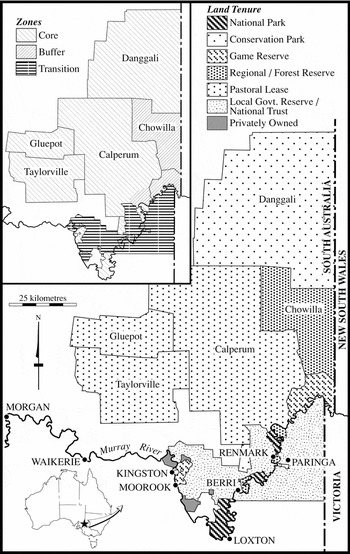
BBR is located in South Australia, close to the border of New South Wales and Victoria (30° 08′– 33° 30′ S; 140°–141° E). It covers an area of 900000 ha around the Murray River and its flood plain (UNESCO 2005) with a 657 723 ha core zone, a 101 280 ha buffer zone and 141 000 ha transition zone (Fig. 1). Under the Interim Biogeographic Regionalization of Australia (Thackway & Cresswell Reference Thackway and Cresswell1997), it lies within the Murray-Darling Depression consisting of warm desert and semi-desert with extensive fertile ancient flood plains. Average minimum temperatures are 4.5°C in winter and 14°C in summer with corresponding average maximum temperatures of 16°C and 31°C. Average annual rainfall is 150–550 mm yr−1. Although there has been much land clearing for agriculture, the area still possesses stands of mallee scrub (a multi-stemmed Eucalyptus sp.), which are home to the black-eared miner Manorina melanotis and mallee fowl Leipoa ocellata, birds listed under the national Environmental Protection and Biodiversity Conservation Act of 1999, and to threatened species of frogs and fish. Wetlands around the river are listed under the Ramsar convention and support many waterfowl and migratory birds (Bookmark Biosphere Trust 1995–1999).
Location, land tenure and zonation of Bookmark Biosphere Reserve (adapted from Brunckhorst Reference Brunckhorst2000b and Bookmark Biosphere Trust 2002b).

The Reserve supports c. 17 000 people (UNESCO 2005), virtually all of whom (Bookmark Biosphere Trust 2002b) live in the transition zone in the peripheral towns of Renmark, Paringa, Berri and Barmera. Before European settlement, five aboriginal tribes inhabited the area. Indigenous people make up c. 2.3% of the population in the BBR districts (Australian Bureau of Statistics 2001). Agricultural land use within the region consists of grazing, cropping of wheat, barley and rye, and production of grapes, citrus and stone fruit. This depends heavily on irrigation from the Murray River which, in the context of earlier clearing of native vegetation for fuel and the construction industry (Bookmark Biosphere Trust 2002b), has led to rising water tables and severe salinity problems on the flood plain affecting its productivity. Over the last decade, wine production has dramatically enhanced the local economy. Tourism is extensive (220 000 250 000 visitors annually) (Bookmark Biosphere Trust 2002b; UNESCO 2005), relying largely on river-based recreational activities, golf courses and, to some extent, the unique vegetation and wildlife.
Research design
This study uses an explanatory holistic case study research strategy (Yin Reference Yin2003) employing qualitative data from interviews, personal observation and documents. This approach is preferable in obtaining an account and explanations for events (Blaikie Reference Blaikie2000) and uses logical rather than statistical inference to analyse findings against theoretical constructs. The validity of this approach is strengthened when the case study is chosen in the light of relevant theory (Platt Reference Platt1988). In this instance, BBR was chosen because its reported achievement of conservation goals through both local ‘bottom-up’ and ‘top-down’ multi-stakeholder environmental management (Brunckhorst Reference Brunckhorst2000a) was suggestive of principles of bioregionalism being manifested in a bioregional planning initiative.
Initial communication with the Reserve was made through the contact listed on the MAB web site and through two representatives of State government who were prominent during Reserve establishment. Because population surveys would not necessarily reach people with the depth of knowledge required (Kumar et al. Reference Kumar, Stern and Anderson1993), nor provide accounts of events and explanations for them, key informants were selected for individual interview. Such people had been particularly active in their involvement, either as part of their employment, as members of the coordinating body or as leaders in conservation, and therefore had wide knowledge and understanding of BBR's history and governance. In order to minimize bias, 45 were selected to represent a wide range of employment, interests and types of involvement and were invited by mail to be interviewed at a location of their choice; 28 agreed to participate. More informants could not be obtained because the level of conflict between major sections of BBR discovered during the study made some unwilling to speak, because they were at the centre of ill will or wanted to distance themselves from it. Interviewees included one employee from federal and two from state government, two from local government and four employed by the Australian Landscape Trust (ALT), which managed Calperum in the core zone. Nineteen were key voluntary participants in BBR, namely the Chairman of Gluepot Reserve, four community managers of sections of Calperum or Taylorville, five engaged in various agricultural or pastoral activities, three engaged in tourism, four in teaching, a retiree and a small business owner. Four interviewees had served on BBR's coordinating body in its original form (two as chair and two as executive officer) and three in its revised form (one as chair and one as executive officer). I visited the Reserve twice, interviewing at Calperum, Chowilla, Gluepot, Taylorville, three smaller privately owned properties and all towns in the buffer zone. Three respondents were interviewed twice.
Semi-structured interviews of 1–2 hours were conducted. Questions were designed to gain insight into factors underlying the creation and development of BBR and participation in it. They addressed interviewees' understanding of the historical development of the reserve (Objective 1); opinion of the extent of sustainable ecological and social practice in BBR (Objective 1); sense of connection and associated responsibility to the region and to BBR (Objective 2a); participation and motivations (Objectives 2a and 2b); and role in governance and views of governance processes (Objective 2c).
Audiotapes of interviews were transcribed, then analysed and coded on the basis of the above themes and of sub-themes which subsequently emerged. Themes and events were then analysed further for evidence for or against demonstration of principles of bioregionalism. The validity of information and representativeness of opinions were assessed through comparison and cross-checking. Accounts and opinions within the two major groups in conflict were consistent. Reported key events in the development of the Reserve were also cross-checked with relevant available documentation which included periodic Reserve reports to UNESCO, public documents associated with the MAB Programme and with BBR, including its extensive Action Plan, web sites, newsletters and minutes of public meetings. Manuscript drafts were shown to key interviewees for verification.
RESULTS
Development of Bookmark Biosphere Reserve
Establishment
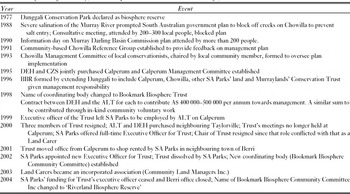
BBR formed through a complex set of events (Table 1). Locally, South Australian government plans to reduce salinity in the Murray River threatened Chowilla, an adjoining regional reserve (Fig. 1) regarded by the community, as an ex-Chair of BBR's coordinating body said, as ‘their playground for. . . . camping, fishing, yabbying, boating. . .and they didn't want to see it turned into a saline wasteland’. When a government representative scheduled a meeting to explain the plans, several hundred local people attended to protest. This demonstration of community ownership was instrumental in changing the plan and in establishment of a community-based Reference Group and a Management Committee.
History of Bookmark Biosphere Reserve (BBR). ALT = Australian Landscape Trust; BBR = Bookmark Biosphere Reserve; CZS = Chicago Zoological Society; DEH = Department of Environment and Heritage; SA = South Australian.

Independently, associates of the Chicago Zoological Society (CZS 2001) purchased Calperum, the property adjacent to Chowilla, for conservation purposes, jointly with the federal government Department of Environment and Heritage (DEH) (then the Australian Nature Conservation Agency) (Table 1). Together, they extended the scope of an existing biosphere reserve at Danggali beyond that of a government-managed national park to include the broader community in sustainable land management by adding Calperum, Chowilla and some other South Australian (SA) Parks' land to form BBR. Ownership was established under a Trust Deed that required that Calperum be held by the Australian Director of National Parks as the core zone and that a Calperum Management Committee consisting predominantly of local community members be established (Brunckhorst Reference Brunckhorst2001).
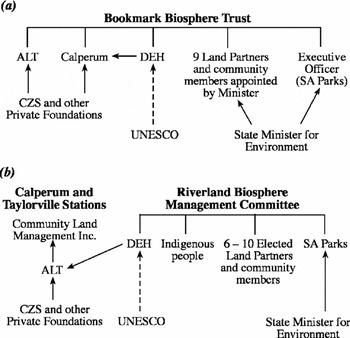
BBR's governing body, initially called the Murraylands Conservation Trust, but later the Bookmark Biosphere Trust (hereafter the Trust), was appointed by the South Australian Government (Fig. 2a). It consisted of 13 members, some from the management committee at Chowilla. The Calperum Management Committee included six members of the Trust, and met jointly with it every three months, with an executive committee of five meeting more frequently. Once the Trust's responsibilities were extended by law to include participation in the MAB Programme it was in the unusual position of being a statutory body under State government law, responsible for co-coordinating and developing a Programme administered through Federal government, involving lands owned or leased by private as well as State and Federal bodies (National Parks and Wildlife (Bookmark Biosphere Reserve Trust) Amendment Bill 1998).
Structure of (a) the original Bookmark Biosphere Trust and (b) the Riverland Biosphere Management Committee. ALT = Australian Landscape Trust; BBR = Bookmark Biosphere Reserve; CZS = Chicago Zoological Society; DEH = Department of Environment and Heritage; SA = South Australian; UNESCO = United Nations Educational, Scientific and Cultural Organization.

Growth and achievement
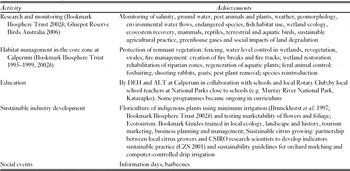
Because of its history of committed community interest in conservation and the energy and enthusiasm of key personnel of SA Parks, DEH and the CZS, BBR grew rapidly. The Trust employed a facilitator and resources to develop an Action Plan through an extensive community process involving consultative meetings, widely circulated discussion papers and ongoing monitoring and revision. Around 1000 local people were on the mailing list, with 80 actively involved. The Plan was based on the philosophy that ‘people are part of the world ecosystem’ and emphasized partnerships (Bookmark Biosphere Trust 1995–1999; Brunckhorst Reference Brunckhorst2000b). Subject to approval of UNESCO, additional land owners could join the Reserve as ‘Land Partners’ (Bookmark Biosphere Trust 1995–1999; Chicago Zoological Society 2001). Their range and number increased to include local government, community managers of Heritage land (such as the South Australian National Trust) and private freeholders and leaseholders of pastoral and horticultural properties. A wide range of conservation, education and research activities was undertaken, yielding remarkable achievements (Table 2). One of the most innovative was a Land Carer programme, in which 12 members of the local community were each granted rights of access to 6000–10 000 ha sections of Calperum in return for habitat management, predominantly fencing, and plant and animal pest control. To minimize negative impacts, access by non-members was restricted.
Conservation activities and achievements within BBR. ALT = Australian Landscape Trust; BBR = Bookmark Biosphere Reserve; CZS = Chicago Zoological Society; CSIRO = Commonwealth Scientific and Industrial Research Organization; DEH = Department of Environment and Heritage.

An important ingredient in BBR's growth was the high level of financial support from DEH and benefactors from the private sector associated with the CZS, largely through the ALT. This organization represented the environment portfolio of the Ian Potter Foundation, which had trustees from philanthropic organizations including the Meyer Foundation, Hugh Williamson Foundation and the John T. Reid Charitable Trust and later, the CZS. The McCormick Foundation and the Forest Park Foundation also donated funds. These sources financed conservation projects (Table 2) and professional personnel were employed in carrying out technical work and overseeing local volunteers. These funds also supported development of floriculture and ecotourism, which had been suggested at a public meeting of 150 people, to explore sustainable industries to improve regional economic viability. The Pacific Asia Travel Association (PATA) was invited by the CZS and DEH to explore possibilities for ecotourism as a low impact industry which could educate people about ecology and conservation and highlighted the attractiveness of BBR's unique scenery and wildlife, recommending establishment of Bookmark Guides based on the Savannah Guides model (PATA Task Force 1996). As a result, guides were trained in ecology and tourism management and were allowed to take tourists on to both public and private properties in return for minimizing impacts on those lands. Other suggested industries, including aquaculture and commercial use of feral and indigenous animals, were not developed.
Difference and difficulties
Gradually the different approaches used by government and the private foundations came into conflict. A major issue was domination of the Trust by the South Australian government (Fig. 2a) with the Executive Officer employed by SA Parks and community members appointed by the State Minister for the Environment. Since, as defined in law (National Parks and Wildlife (Bookmark Biosphere Reserve Trust) Amendment Bill 1998), the Trust was responsible for administering activities in the core zone, it could make decisions about land managed by the federal DEH and, under contract, the ALT (Director of National Parks 2001). In addition to resenting this, associates of the ALT complained that members of the Trust were more concerned with attending meetings and consensus decision making than with project implementation. Two orchardists claimed that SA Parks was unsupportive of projects in comparison to DEH.
SA Parks' need to operate according to particular government protocols frustrated some community projects. For example, representatives of a committed volunteer school group thought that SA Parks undermined the group's revegetation activities by failing to control kangaroos which subsequently destroyed seedlings that they had planted. Another protocol prevented reintroduction into a conservation area of an endangered marsupial species bred by a volunteer on his own land.
There was also dissatisfaction with the role of the private foundations. There was a feeling that their funds were too focused on rehabilitating Calperum rather than being spread among all Land Partners. This complaint, however, did not recognize that these bodies had a right to direct funds to the property which they owned and managed rather than to broader issues of regional sustainability. There was resentment of the use of these funds to pay personnel to organize volunteers on Calperum, rather than using a totally voluntary management approach, as employed by the Land Partner, Gluepot. The apparent exclusivity of the Land Carers' programme was another cause for resentment, with claims that it simply allowed members to engage in their hobbies, such as hunting feral animals and four-wheel driving. Such critics overlooked the fact that rights of access were a reward for conservation activities.
Dissent and disruption
The increase in control of Calperum by the ALT through a management contract with DEH in 1998 (Director of National Parks 2001) led to increasing tension. A decision to site the McCormick Environment Centre for school and community education at Renmark rather than Berri and misunderstanding about associated financial arrangements involving federal and local government also caused disagreement and significant ill will. Interviewees associated with either Calperum or the Trust spoke about those events as being dominated in some way by the other group. Two Land Carers referred to ‘them over there’ while those around Berri spoke of ‘those up there’. Deterioration of communication between members of the Trust and events in 1999–2000 (Table 1) culminated in separation of the Trust from the ALT and its dissolution (Bookmark Biosphere Trust 2002a). At that stage, public meetings were held to establish a path forwards. DEH and SA Parks hoped that the ALT would continue to provide funding and proposed to establish a community body to choose which projects should be funded. However, agreement on the terms of this proposal could not be reached.
Regrouping and revitalisation
Later in 2002, the executive officer, still employed by SA Parks, arranged a professionally facilitated meeting attended by approximately 60 people, including Land Partners and a range of community participants in BBR. This meeting initiated further discussions, leading to establishment of an incorporated organization, the Bookmark Biosphere Community Committee (BBCC) (Bookmark Biosphere Trust 2002a). Although invited, the employees of the ALT did not participate, but still continued management of Calperum and Taylorville and organization of the Land Carer programme.
The new BBCC, later called the Riverland Biosphere Management Committee, differed from the previous Trust by having a majority of elected rather than appointed members (Fig. 2b), reducing the power of the South Australian government and ensuring indigenous representation (Bookmark Biosphere Incorporated 2003; Cottam Reference Cottam2003). Withdrawal of SA Parks funds (Table 1) and lack of ALT involvement meant that financial support was dependent on grants from elsewhere. In 2003, only A$ 70000 was obtained for special events and projects and all activities were voluntary. Although some of those with the initial drive to establish BBR were no longer involved, others, fuelled by its past success, appeared to replace them, such that 85 out of c. 150 on the mailing list attended the Annual General Meeting. By 2004, momentum was recovered with the BBCC becoming a partner with federal government and conservation groups in a major wetland research and management project on Banrock Station, one of BBCC's Land Partners (Anon. 2004) and development of a range of research and rehabilitation projects on Gluepot (Baker-Gabb Reference Baker-Gabb2004; Gluepot Reserve Birds Australia 2006). A training programme for ecotourism was established in association with a tertiary training college based in the state capital and accredited by the tourism industry, and subsequent plans included establishing an independent foundation to support the Reserve. The name change to ‘Riverland Biosphere Reserve’ in 2004 better represented regional identity and assisted progress. By January 2005, the number of Land Partners had grown to 35. The type of activity broadened, such that, increasingly, people with insufficient land to be full Land Partners had become ‘Partners in Sustainability’ with a nominal joining fee. The federal government's ‘Cool Communities’ programme for energy conservation (Cottam Reference Cottam2002) was fostered for several years and a children's writing programme, ‘Eye on the Biosphere’ has celebrated both a local sense of place and conservation activity.
Management of Calperum and Taylorville stations continued under the ALT and, in 2002, the Land Carers became Community Land Management Inc. These properties are listed on a separate, but linked, federal government web site (Department of Environment and Heritage 2005a) to that of Riverland Biosphere Reserve (Department of Environment and Heritage 2005b). Research, monitoring, rehabilitation and educational programmes have continued with 200 volunteers contributing around 14000 volunteer hours per annum (Australian Landscape Trust 2005).
In association with a university, a facility for distance education on regional sustainability was planned between the ALT, local government and community. By 2006, membership of Community Land Management Inc. had increased to 77. Some were also Land Partners of the Riverland Biosphere Reserve and expressed interest in keeping links with it. New Riverland Biosphere logos and signs were being developed, replacing those of BBR, to ‘brand’ produce, particularly food, grown in an ecologically sustainable way. Further information exchange trips with Xilingol were under discussion.
Regional sense of place and identity
The region of which BBR is a part could be considered as a bioregion as defined by Berg and Dasmann (Reference Berg and Dasmann1977). It has a distinct biogeographical identity as defined by the Biogeographic Regionalization of Australia (Thackway & Cresswell Reference Thackway and Cresswell1997) and is dominated by the Murray River, its flood plain and surrounding semi-desert. Evidence of a ‘place spirit’ providing cultural identity (Dodge Reference Dodge1981) is apparent in both the landscape and community, which have been affected by the region's history of impoverishment by exploitative land use, deforestation and resulting salinity and, more recently, by rapid growth of a successful wine industry. There is also common recognition of the region's natural character with the name ‘Riverland’ defining it for tourism (South Australian Tourism Commission 2007), viticulture (Riverland Wine Industry Development Council 2007) and for cultural and sporting events (Totaltravel.com 2007). In the early 1990s, BBR, as part of that region, was regarded by participants as an overarching entity working towards regional environmental conservation and sustainability. However, since interviewees claimed that relatively few in the broader community knew what BBR represented and since Reserve participants were prepared to divide into two separately coordinated sections in 2002, a similar identity for BBR was neither clear nor strong enough to withstand internal difficulties.
Motivations for conservation
Proponents of bioregionalism claim that attachment of people to the place in which they live generates ecological responsibility and is vital for commitment to conservation (Berg & Dasmann Reference Berg and Dasmann1977; Dodge Reference Dodge1981; Sale Reference Sale1985). There is evidence both for and against this in BBR. Long association of the community with the region and its persistent role in managing Chowilla was an important factor in BBR's formation and provided ongoing energy and commitment for conservation work as well as for continuing the Biosphere Reserve after its division in 2002–2003. Some of those involved in BBR had been in the region for generations and had been engaged in activities to rehabilitate degrading lands since the early 1980s. Local private and public landowners were sufficiently motivated to contribute their land in buffer and transition zones to BBR and interviewees regarded their participation as important. The SA Parks representative who had served as executive officer of the Trust wanted ‘my kids and their kids, now, to keep catching fish in this creek down here, like I've done, and my father did, and to keep doing that for generations and for it not to change’. Although Land Carers' motivation for removing feral animals was claimed to be satisfaction of desires for shooting and recreation, as they became more familiar with Calperum, they subsequently initiated monitoring of threatened species.
Conversely, living in the region was neither sufficient nor necessary for engagement in BBR. Only 10% of the regional population participated in its planning, fewer maintained active involvement and the local indigenous community did not participate even when a place was reserved for them on the new Management Committee. Except for the executive officers and those employed by the ALT or SA Parks, interviewees claimed primary allegiance to smaller conservation groups, their own business enterprise, industry group (for example citrus growers), or the Riverland as a whole and that BBR just furthered these interests. Some BBR participants had only short association with BBR, being migrants to the region, attracted by agricultural opportunities, a rural lifestyle or by employment in industrial or business sectors. One of the major initiators in the employ of the CZS was from the USA and had resided in the region only since 1979, claiming to have no sense of regional belonging and ‘no sense of Bookmark at all’, but being motivated instead by ideas about the importance of conservation and community involvement. There were high levels of voluntary conservation activity at Calperum and Taylorville (for example 4000–8000 h yr−1 in 2002 and 2003; Director of National Parks 2003, 2004) and Gluepot (121305 h during 1997–2003; Baker-Gabb Reference Baker-Gabb2004). However, many volunteers, especially at Gluepot, came from elsewhere in Australia or overseas, combining tourism and conservation. Such people, lacking long-term knowledge of either the place or the people, claimed to be motivated by commitment to the general environmental cause.
Recognition of the bioregionalist principle that natural ecosystem limits should determine human land use (Berg & Dasmann Reference Berg and Dasmann1977; Dodge Reference Dodge1981; McGinnis et al. Reference McGinnis, House, Jordan and McGinnis1999) was, to some extent, evident. Realization that grazing levels were unsustainable led to removal of stock from lands leased by the federal government at Calperum, Taylorville and Gluepot, and to decreased grazing on the regional reserve, Chowilla. Extensive rehabilitation activities were attempts to achieve a sustainable balance between the community and the environment. However, whether BBR had really respected natural limits at Calperum was questioned by some informants. One community member claimed that there was ‘more activity out there now than ever there was when it was a sheep station’. This observation may, on the other hand, reflect recognition that rehabilitation of degraded lands requires human intervention.
Reduction of water use in citrus, grape and horticulture industries on private land and development of floriculture were also initiatives to restore the balance between people and nature. Nevertheless, these measures have not eliminated dependence on irrigation in a semi-desert area or slowed the rate of salinization (Primary Industries and Resources SA 2007) and have been influenced by government regulation regarding water allocations, licensing and trading (River Murray Catchment Water Management Board 2002). Ecotourism had potential to provide livelihoods with less environmental impact than agriculture, but only three of the 10 Bookmark guides found it economically viable, constrained by the tourism market rather than by ecological limits. The viability of floriculture has not yet been fully validated and emphasis is shifting toward seed production. Indeed, it is questionable whether any of BBR's efforts to develop sustainable industries could have been attempted without financial contributions from outside the region.
Participatory local action
Right from commencement, BBR was marked by local leadership and participation. As the Action Plan (Section 3.1) stated, ‘community involvement in the Bookmark Biosphere Programme is not about labour substitution for the Land Partners. Rather, groups and individuals from the community can develop their stewardship of the environment through participating in projects where they and other partners establish working relationships, consulting and sharing knowledge and experience, with satisfaction at the end of the day for a job well done’ (Bookmark Biosphere Trust 1995–1999). Collaborative relationships were established with regional environmental organizations such as Local Action Planning groups, boards for irrigation, water and soil management, secondary schools and Service Clubs such as Rotary.
Informants conveyed a strong sense that working together as a community achieved shared conservation goals and increased community cohesion and pride in the district. All recognized that the philosophy underlying BBR was vital for sustainability and that the multiple diverse interactions between groups and individuals was empowering for those with the will, but, perhaps, insufficient resources, to contribute to conservation. One Land Partner with privately owned property thought that ‘It was very timely, it was sort of a cathartic thing that happened. Moved people from one paradigm to the other, where they were not just visiting National Parks, but were saying National Parks don't necessarily need to finish there, they can be part of our community. . . . . it was part of that whole revegetation thing that was happening in the 90s. . . . . It was starting to look at ecosystems instead of starting to look at fence lines. That whole sort of paradigm shift Bookmark bridged.’ It brought together environmentally-minded groups and individuals who had previously worked independently and whose energy was mutually reinforcing.
Conversely, collaboration was not restricted to the local community. It included working with the Murray-Darling Basin Commission and scientific experts from educational and research institutions from other parts of the country, such as the Commonwealth Scientific and Industrial Research Organization. As well as contributing to local and scientific knowledge, many of these activities enabled students and ordinary people to learn of research findings through attending information days and working on joint projects. Links were also established with other biosphere reserves in Australia, Rhön in Germany, Xilingol in China (Bookmark Biosphere Trust 1997) and a proposed reserve in Zimbabwe, making the community feel part of a global network. As indicated in earlier reports of BBR, the ‘synergy’ between community, government and the private sector (Brunckhorst et al. Reference Brunckhorst, Bridgewater, Parker, Hale and Lamb1997) promoted new ideas, interactions and projects, provided a supportive framework which enabled individuals to pursue their individual conservation goals and was fundamental to BBR achievements.
Governance
Some aspects of governance were compatible with tenets of bioregionalism in that BBR consisted of an integrated network of local groups and aimed to be autonomous, participatory and democratic. However, its effectiveness was compromised because little attention was paid to the realities of institutional and personal differences in motivations, allegiances, goals, management styles or discrepancies in levels of power and resources. Lack of acknowledgement of these factors is evident in the initial structure and powers of the Trust. It had appointed rather than elected members and responsibility under the Trust Deed for coordinating activities on federal lands managed by private enterprise. As well as trying to incorporate local participation, it had responsibility to UNESCO through federal government, although State government had greater power through SA Parks and the Minister for Environment. The different agendas and styles of government, private enterprise and local community also generated conflict. SA Parks was constrained by regulatory protocols, Trust processes and institutional inertia.
It took a long while to realize that it was not appropriate, as one government representative stated, to ‘adopt a government-centric model of management for something that involved the private sector and the community’ and that, instead, a style of leadership was needed in which somebody was not guiding and directing from the front but rather people were facilitating by working together. The high levels of energy, vision and determination of individuals instrumental in development of BBR actually became disruptive when applied to supporting divergent approaches to management and governance. Conflict was avoided initially because the original executive officer of the Trust was employed by SA Parks and was able to work productively with DEH, the ALT and the community. However, when he was seconded by the ALT to be a manager at Calperum, his approach to BBR was not matched by his replacement. As another government representative noted, ‘you need a psychologist or someone with those skills to deal with a complex programme like this, not a bureaucrat, who's trying to just implement a process and doesn't really care what the outcome is going to be’.
Further conflict arose from the ALT's and CZS's capacity to direct private sector funds to specific projects which had not been agreed to by consensus decision making and from their impatience with the Trust. These difficulties were compounded by personality conflicts between representatives of public and private sectors.
Even though governance fell foul of in-fighting and alienated many dedicated conservationists, it was regarded by a Land Partner with private property as an ‘enormous social experiment’ which was a ‘perfect learning process, not the perfect process’. It paved the way for formation of two separate coordinating bodies each of which was community-based, had shared goals for conservation, community participation and capacity building and was energetic and productive in landscape and habitat restoration, education and research.
DISCUSSION
Although BBR, as an example of bioregional planning, cannot be regarded as representing bioregionalism, factors that are key to this philosophy have played a role in the Reserve's achievements. These are recognition of the region's unique identity, the local community's sense of connection with and responsibility for it, respect for the limits of its natural resources, integration of local knowledge, the presence of motivated local leaders, and cooperative, community-based management and action through a network of groups. Perspectives of bioregionalism may help overcome deficiencies of rational planning approaches to natural resource management (Harrill Reference Harril, Noble and Costa1999).
However, these factors were not sufficient. Only a small portion of the local community was involved in BBR, and being a resident was insufficient alone to ensure participation. As bioregionalism's critics suggest (Taylor Reference Taylor, Katz, Light and Rothenberg2000b), some conservation behaviours were driven by pragmatic, anthropocentric factors such as a regulatory framework which placed restrictions on use of natural resources, such as water.
More importantly, BBR's successes would not have been possible without the overarching framework of the MAB programme, which gave legitimacy as well as ensuring ongoing participation of federal government. As described for watershed partnerships (Leach & Pelkey Reference Leach and Pelkey2001), IAD (Ostrom Reference Ostrom1990), ADR (Crowfoot & Wondolleck Reference Crowfoot and Wondolleck1990) and bioregional planning (Brunckhorst Reference Brunckhorst2000a), strategic linkages with local, state and federal government agencies were vital in providing funding, coordination and technical and scientific information. Equally, if not more important, was the role of the private sector in both Chicago and other parts of Australia whose financial contributions enabled the initial purchase of Calperum and provided ongoing funding for their employees. Even the locally initiated ecotourism and floriculture industries and tourism education institutions depended on customers from outside the region.
The involvement of leaders and volunteers from outside the region was also crucial. This may be a manifestation of a ‘cosmopolitan bioregionalism’ in which people lacking long-term connections to particular places, now, increasingly common in a globalized world, may find a groundedness, a ‘spirit of wholeness with community’ through a rapid identification with the new places in which they find themselves (Thomashow Reference Thomashow and McGinnis1999) and contribute to conservation in distant places (Taylor Reference Taylor, Katz, Light and Rothenberg2000b). However, involvement of outsiders may have contributed to disruption because of insufficient connection to the region and its people.
This study also shows that, as in other Biosphere Reserves, the importance of social dynamics was ignored and indicates the relevance of criticisms (Lewis Reference Lewis1992; Berthold-Bond Reference Berthold-Bond2000; Taylor Reference Taylor, Katz, Light and Rothenberg2000b) of bioregionalism which assumes that collaborative, productive decision making and management will automatically flow from bioregional commitment. Similar critiques have been directed towards participatory processes in institutionalized natural resource management (Ostrom Reference Ostrom1990; Wondolleck & Yaffee Reference Wondolleck and Yaffee2000; Cleaver Reference Cleaver, Cook and Kothari2001; Leach & Pelkey Reference Leach and Pelkey2001) in which consensus decision making, balanced power between different levels of government and well-defined decision and process rules appear to be important success factors. In spite of individual and institutional commitment to conservation and the tendency of participants in multi-stakeholder partnerships to avoid and manage conflict (Poncelet Reference Poncelet2004), ongoing collaboration between major Land Partners in BBR was confounded by fundamental deficiencies in the original coordinating structure which lacked inclusiveness and had power imbalances. Effective coordination by the Trust was undermined by differing objectives of state government, UNESCO through the federal government, private sector foundations and local volunteers, and differing expectations about the degree and nature of their control and participation. This meant that SA Parks and the ALT were, or appeared to be, engaged in power struggles which frustrated individuals whose primary concern was to restore the local environment. Compounding this was the lack of flexibility and personality clashes of some members and differences in members' histories of relationship to the region such that decision making through consensus was untenable in the absence of conflict resolution processes.
Pathways for access to funds and perceived inequities in their distribution were also major reasons for division. Large financial inputs on Calperum from private foundations changed part of BBR's image from that of an extended National Park to that of private enterprise in the business of conservation. While this was essential for much project implementation and for engaging individuals with innovative, but expensive projects, it introduced philosophies and procedures associated with corporate practice, making it possible and even desirable for actions to be taken without lengthy consensus decision-making.
Since BBR was concerned primarily with environmental management and education, it did not represent bioregionalism's ideal of integrated regional governance. Nevertheless, it could be regarded as part of a multi-layered larger-scale form of bioregionalism (Klyza Reference Klyza and McGinnis1999) where overlapping areas have different mixes of responsibility, leaving overall social, economic and legal tasks to another level of regional governance. That BBR had difficulties even within the environmental domain points to difficulties in expecting any bioregional approach, including bioregional planning and ecosystem management, to be more comprehensive.
The division within BBR did not lead to destruction of the whole initiative, but was part of an evolutionary process creating two models for community participation and government commitment to sustainable management of both private and public land. The split seemed to have invigorated both groups who are successful, so far, in terms of governance, conservation outcomes and continuing community involvement. The success of the approach on Calperum and Taylorville supports a model for biosphere reserves in which individuals may be more empowered for conservation through provision of funds and advice (Cleaver Reference Cleaver, Cook and Kothari2001) rather than engagement in consensus decision making to coordinate community activities. Such an approach, however, might not involve quite the range of stakeholders included in the alternative model adopted by Riverland Biosphere Management Committee. Such a model, as indicated for watershed partnerships (Leach & Pelkey Reference Leach and Pelkey2001), involves an elected coordinating body where power is distributed equally among institutional and community stakeholders with an effective chairperson or facilitator, skilled in negotiation, to moderate the conflicts that are inevitable when a diverse range of interests is represented. Rather than dictating action, the primary role of the coordinating body would be to oversee a network which provides opportunities for knowledge exchange, social support and strategic alliances between members for particular purposes, including application for financial support from outside organizations for projects. However, as in watershed and ecosystem management (Yaffee et al. Reference Yaffee, Phillips, Frentz, Hardy, Maleki and Thorpe1996), such a structure may be inadequate to circumvent obstacles encountered by volunteers working on government-managed land or those resulting from personality conflicts.
As with some other reserves (Krishna et al. Reference Krishna, Chhetri and Singh2002; Lü et al. Reference Lü, Chen, Fu and Liu2003), BBR has been more successful in achieving conservation, scientific research and education goals than economic and social aspects of sustainability. At these reserves, achievements might have been greater and conflict reduced if, as in BBR, some principles of bioregionalism had been incorporated and there had been a greater role for local people in their establishment and ongoing management, particularly where land entitlements of indigenous communities were involved.
CONCLUSIONS
This study shows that features of both bioregionalism and bioregional planning have contributed to the development and outcomes of BBR. It is a considerable challenge for emerging biosphere reserves, both in Australia and elsewhere, with a diversity of land use and including urban areas with industrial components, to work productively with the complexity of processes of federal, state and regional governments and needs of local people to achieve goals of the MAB Programme. It will be important for biosphere reserves and other bioregional approaches to conservation to harness the strengths of bioregionalism, even though it has countercultural origins, drawing on community sense of living-in-place, connection and commitment to the region and local leadership. But access to leadership, funds and volunteer labour from outside the region are also important. At the same time, weaknesses of bioregionalism need to be avoided with recognition of the human aspects of conservation through establishing structures and processes which are inclusive, equitable in power and funding distribution, which provide agency support for community initiatives and have means of conflict resolution.
ACKNOWLEDGEMENTS
I thank all those associated with Riverland/Bookmark Biosphere Reserve who have contributed to this research. I am grateful for a grant from the Monash University Faculty of Arts.