It is generally accepted that the primary aim of child protection systems is to ensure the safety of children brought to the attention of the child protection authority, through the prevention of further harm. Despite this intent, previous studies in the United States and elsewhere have indicated child abuse and neglect recurrence rates of between 9 and 30% (Lipien & Forthofer, Reference Lipien and Forthofer2004), with studies focused on abusers in treatment reporting rates of between 16 to 67% recidivism (Fluke, Yuan & Edwards, Reference Fluke, Yuan and Edwards1999). Given recent research in the area of child protection highlighting the negative impacts of cumulative harm incurred by children who experience multiple episodes of child abuse or neglect (DePanfilis & Zuravin, 1999), the need for investigation into child and family characteristics which increase the risk of re-referral for child protection concerns is evident.
Earlier studies have identified a number of family and child characteristics associated with increased likelihood of child protection re-referral. Specifically, socio-economic status, poverty (Jonson-Reid, Emery, Drake & Stahlschmidt, 2010), intimate partner violence (Sledjeski, Dierker, Brigham & Breslin, Reference Sledjeski, Dierker, Brigham and Breslin2008), parental experience of maltreatment (Casanueva, Martin & Runyan, Reference Casanueva, Martin and Runyan2009), and parental substance abuse (Wolock, Sherman, Feldman & Metzger, Reference Wolock, Sherman, Feldman and Metzger2001) are family factors found to be associated with child protection re-referral. Child factors thought to increase re-referral risk include health problems (Courtney, Reference Courtney1995) and disability (Fluke et al., Reference Fluke, Yuan and Edwards1999). The majority of studies have suggested that younger children experience a higher rate of re-referral than older children (Lipien & Forthofer, Reference Lipien and Forthofer2004; Fluke et al., Reference Fluke, Yuan and Edwards1999), however the predictive value of age in child protection re-referral is contested within the literature (Levy, Markovic, Chaudry, Ahart & Torres, Reference Levy, Markovic, Chaudry, Ahart and Torres1995). Moreover, evidence suggests that the alleged perpetrator's familial relationship is associated with re-referral risk, with children who experience abuse at the hands of an intra-familial perpetrator being significantly more likely to be re-referred to child protection authorities (Fuller, Wells & Cotton, Reference Fuller, Wells and Cotton2001).
The vast majority of previous research examining child protection re-referral has focused solely on child protection data obtained from the relevant child protection entity. As Fuller et al. (Reference Fuller, Wells and Cotton2001) notes, the use of such a dataset restricts the ability of research to fully examine associated family and child characteristics, because the data is limited by what is known and recorded by child protection employees. The current study analyses re-referral in a multidisciplinary Suspected Child Abuse and Neglect (SCAN) team database, which was constructed through information sharing on complex child protection cases between the police service, the child protection authority and the health service. As such, the resulting dataset provides a more comprehensive view of child and family characteristics associated with re-referral in complex cases than that which could be gained from one data source alone.
In addition to providing a unique examination of child protection re-referral by using a broad dataset focused on complex cases, the current study investigates re-referral within an Australian setting. To date, little research in the area of re-referral has been conducted in Australia, with most previous studies examining US and UK samples. The current study, therefore, aids the conceptualisation of child protection re-referral in Australia, in addition to investigating the factors that increase re-referral risk in complex child protection cases utilising a dataset derived from a variety of sources.
Method
Site
In 1980, the Queensland State Government initiated the development of a state-wide system of Suspected Child Abuse and Neglect (SCAN) teams, designed to ensure a coordinated and multi-disciplinary response to complex cases of child abuse and neglect. Thirty-nine SCAN teams were established across Queensland, one of which was located at the Royal Children's Hospital, a tertiary paediatric hospital in Brisbane, Australia. SCAN teams included core members from State Government Health, Police and statutory Child Protection Services. Other agencies that were invited to participate in SCAN meetings included State Government Education and Mental Health services and Aboriginal and Torres Straight Islander Agencies.
All participating agencies had the right to refer perceived complex cases of abuse or suspected abuse to the SCAN team for review. Whilst no formal guidelines were set around the definition of ‘complex cases’, referrals were made by individual participating agencies when a case was perceived to be complex and warranting SCAN review. Due to the difficulties in establishing formal guidelines to adequately capture all complex cases, all such referrals were accepted for review by the team. The SCAN process was not designed to replace or duplicate the services of the Child Protection authority but, rather, to support an integrated governmental response to complex child protection related cases. Upon referral each participating agency provided information they held relating to the child and their family, and the SCAN team subsequently made recommendations for interagency case management. Cases remained open at SCAN until such time as agreed case management strategies had been undertaken. The current study reviewed all cases referred to the SCAN team located at the Royal Children's Hospital, Brisbane, over the period of January 1980 to January 2005.
Procedure
All 6669 cases referred to Brisbane's Royal Children's Hospital SCAN team between 1980 and 2005 were analysed in the study. During the course of the SCAN team operation, data related to each presentation were compiled based on information sharing by health, police and child protection government authorities alongside participating non-government organisations. During each SCAN meeting, paper-based pro formas were completed, detailing the child and family characteristics for each case. Data from these paper-based SCAN pro forma records completed at the time of assessment for each case were entered by four trained data entry staff over a six-year period, from 2001 to 2007. Data on out-of-home care placement status and child protection authority substantiation status following initial referral were not ascertained for all cases because the SCAN team was not privy to these developments following their review unless they were re-referred to the team at a later time. Ethical approval for the study was received from the Royal Children's Hospital and Health Service District Human Research Ethics Committee.
Data preparation
Re-referral:
The dependent variable of re-referral was a composite score of the number of unique presentations of a child's case to the SCAN team. As such, further concerns received over the course of an open SCAN investigation for a child were not recorded as re-referrals. Rather, only referrals made after the previous presentation's case closure were classified as re-referrals. The number of referrals, including initial referral and any subsequent re-referrals, was calculated for each child. Where multiple children resided in a family, each child was classed as being re-referred only when they were specifically listed as being subject children in the re-referral document. There are some circumstances where every child in a family was regarded as a subject child in the re-referral, whilst in other cases there was a concern of physical, sexual or emotional abuse related only to one child in a family, only that child would be classed as having experienced re-referral.
Child and Family Variables:
Child and family-related variables were scored based upon pro formas completed by the interagency SCAN team during the child's initial SCAN review. These variables comprised of the following:
• Age of the child (days at initial intake): The number of abuse types at initial presentation, calculated on the abuse type(s) (physical, sexual, neglect, emotional and domestic violence) indicated as the reason for the referral, with a range of 1–5.
• Financial stress in the family, dichotomously scored based upon the SCAN participating agencies knowledge of employment and housing difficulties for each case, data which is routinely collected by numerous participating agencies where contact with the child has occurred.
• Disabled children in family, scored from 0–2 based upon the physical disability status of the referred child and their siblings (where a score of 1 equated to one disabled child, and a score of 2 to two or more disabled children)
• Familial origin of alleged perpetrator(s), a dichotomous score based on the familial status of alleged perpetrators.
• The parental factors of substance abuse, abuse as a child, mental illness, physical disability, intellectual disability and history of violence, scored from 0 to 2, where records indicated these experiences for none, one or both parents.
All known data on the abovementioned variables was shared by each agency during initial review, with many participating agencies collating this information routinely when contact with the family had occurred. As such, the dataset featured collated information from multiple agencies on child and family variables. Bivariate analysis and linear regression was utilised to analyse the relationship between the continuous dependent factor of re-referral and the above listed family and child predictor variables. IBM SPSS version 19 (IBM, 2010) was used to conduct all analyses.
Results
Sample Characteristics
Over the 25-year period, 5943 unique children featured in the cases of complex abuse or suspected abuse and neglect reviewed by the SCAN team. The vast majority (90.5%, n = 5378) of children were referred only once, with the remaining 9.5% of children experiencing re-referral. Two referrals were listed for 7.4% (n = 442) of children, with three referrals made for 1.7% (n = 102) of children. A very small number of children experienced four or more referrals, with 0.3% (n = 16) of children referred on four separate occasions. Four children (0.1%) experienced referral to the SCAN team five times, and one child was referred on six occasions.
Children with multiple case presentations over the 25-year period were found to be significantly younger than those with only one referral when compared on a bivariate level, (F (1, 5748) = 3.84; p = 0.05). Children with multiple referrals were on average 5.76 years old at age of first presentation, as compared to children with only one case presentation, who presented at mean age of 6.19 years.
Bivariate Correlations
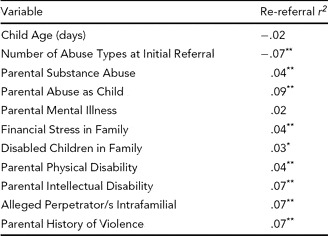
The relationship between re-referral and each of the predictor variables was initially examined through analysis of bivariate correlations. As presented in Table 1, re-referral shared significant positive associations with family financial difficulties, parent's history of violence, physical disability of parents, intellectual disability of parents, disabled children in family, parent abused as child, alleged perpetrator/s in initial allegation of intrafamilial origin, and parental substance abuse. The number of abuse types present within the first referral shared a significant negative correlation with re-referral, such that those children with more abuse types listed within their initial concerns were found to be less likely to be re-referred to the team. No significant association was found between parental mental illness and re-referral, nor between child age and re-entry, although in the case of the latter a negative correlation which approached significance (p = .08) was present.
Bivariate correlations between re-referral and demographic variables

Note. *p < .05. **p < .001.
Regression Analysis
Given that child age and parental mental illness were not found to share significant bivariate correlations with re-referral, these variables were excluded from the linear regression analysis. The variables of number of abuse types at initial referral, parental substance abuse, parental abuse as a child, financial stress in family, alleged perpetrator/s familial status, disabled children in family, parental physical disability, parental intellectual disability and parental history of violence were entered into the regression analysis to examine their ability to predict re-referral.
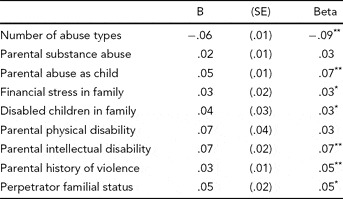
The results of the regression analysis indicated that the abovementioned model was significant in predicting re-referral and accounted for 3% of the variance in re-referral (F (9, 4982) = 16.95; p <0.001). As is evident in Table 2, all variables were found to make significant unique contributions to the prediction of re-referral with the exception of parental substance abuse and parental physical disability. The strongest predictor of re-referral was found to be the number of abuse types present, with higher number of abuse types relating to a lower likelihood of re-referral. Parental abuse as a child, parental intellectual disability, parental history of violence, perpetrator of intrafamilial origin, disabled children in family, and financial stress in family followed respectively as predictors of re-referral, with higher levels of each of these factors relating to an increased likelihood of re-referral. Although non-significant, the unique contribution of both parental substance abuse and parental physical disability to the prediction of re-referral approached significance, with p values of 0.057 and 0.062 respectively.
Linear regression analysis of family and child factors on re-referral

Note: * p <.05. **p <.001.
Discussion
Focused on 25 years of Australian data on complex child abuse and neglect cases, the current study appears to indicate a similar rate of re-referral to that reported in international, mainstream child protection investigations. The finding that the vast majority (90.5%) of children were referred only once is similar to results of previous research, such as Bae et al. (Reference Bae, Solomon and Gelles2009) who reported that 86.6% of their Florida sample experienced only one referral to child protection authorities. Thus, the current study suggests that Australian children with complex child abuse and neglect cases experience a similar level of child protection re-referral to their international mainstream child protection involved counterparts.
The relationship between child and family factors and re-referral for complex cases was examined through both bivariate analysis and linear regression. Through regression analysis, the factors of number of abuse types present at the initial concern, parental abuse as a child, parental intellectual disability, parental history of violence, perpetrator of intrafamilial origin, disabled children in family, and financial stress were found to significantly predict re-referral. Clearly, many of these factors are inherently likely to increase re-referral risk given the added stress placed on the family unit through such circumstances, and the previously documented relationship between family stress and child protection re-referral risk (DePanfilis & Zuravin, Reference DePanfilis and Zuravin2002). Previous studies have identified relationships between re-referral in mainstream child protection cases and alleged perpetrators of intrafamilial origin (Fuller et al., Reference Fuller, Wells and Cotton2001), disability status of children (Fluke et al., Reference Fluke, Yuan and Edwards1999), financial stress of families (Jonson-Reid et al., Reference Jonson-Reid, Drake, Chung and Way2003), history of violence towards partners (DePanfilis & Zuravin, Reference DePanfilis and Zuravin2002), and mother's abuse as a child (Casanueva et al., Reference Casanueva, Martin and Runyan2009), which are findings supported by the current study. Parental intellectual disability has not previously been reported to predict re-referral risk, however the current study indicates that parental disability significantly increases child protection re-referral risk in complex cases.
These results have implications for risk assessment and identifying potential support mechanisms for at-risk families who have experienced referral to child protection agencies and services. Given the predictive value of each of these variables to re-referral for complex cases, families presenting to child protection authorities with one or more of the above factors may require more intensive support to minimise re-referral risk than families without these identified risk factors.
Current practices within the Queensland child protection authority, like many states in Australia, rest upon structured decision making tools developed and utilised in the US. The particular tool utilised in Queensland, developed by the US based National Council on Crime and Delinquency Children's Research Center (2012), utilises an actuarial framework, whereby risk is assessed based upon research evidence on factors shown to be associated with re-referral. Such decision making tools draw on analysing the child protection risk factors in the particular situation at hand, with concerns received at intake undergoing review to determine the need for investigation. Further structured tools are then utilised throughout the child protection assessment process to determine the nature of any harm that may have occurred or be at risk of occurring, and the levels of intervention to be utilised with the family. These processes should be reviewed in light of the findings of this and other studies that identify risk factors for child protection re-referral, to ensure that risk is adequately gauged within these decision-making tools. Certainly, to the author's knowledge, a number of the factors identified within the current study have not been incorporated into decision-making tools utilised within the state of Queensland to date. Various authors have questioned the validity of such structured assessment processes for risk assessment, suggesting that these measures do not adequately gauge child protection risk (Goddard, Saunders, Stanley & Tucci, Reference Goddard, Saunders, Stanley and Tucci1999). Ultimately, incorporating such factors into risk assessment tools will ensure that children and families who are notified to child protection authorities are more appropriately assessed and receive the necessary supports required to minimise future child protection risk.
Although identified as sharing a significant bivariate correlation with re-referral, the unique contribution of both parental substance abuse and parental physical disability to the prediction of re-referral was not significant when examined in light of the other family and child related variables, although both variables did share a relationship with re-referral which approached significance. Thus, the bivariate relationship shared between re-referral and both parental physical disability and parental substance abuse appears to be mediated by other factors included in the study. Given previous literature highlighting the increased child protection risk in children of substance using parents (McGlade et al., Reference McGlade, Ware and Crawford2009) and children of parents with mental health problems (Walsh et al., Reference Walsh, MacMillan and Jamieson2002), it seems surprising that these factors were not found to be predictive of re-referral. One potential explanation for this finding may relate to the fact that the potential mediating factor of out-of-home care status was not captured within the dataset. It certainly seems likely that low levels of parental substance use and/or less severe parental mental health problems may increase re-referral risk, but with higher levels of substance use or more severe mental health issues increasing the likelihood of child placement in out-of-home care, this decreases the likelihood of re-referral. Additionally, the failure of the dataset to differentiate between the type of substance being abused, and likewise the specific mental health problems being faced by parents, provided a further barrier for analysis of their impact upon re-referral risk. The failure to identify significant relationships between these factors and re-referral could be explained by the differing impact of these parental factors relative to their type, level of severity and the child's out-of-home care placement status, all of which were not adequately explored within the current study due to dataset limitations.
Similarly, the finding that children who experienced a higher number of abuse types were less likely to experience re-referral appears, on face value, to be somewhat contradictory. Indeed, previous authors have suggested that the nature and severity of abuse is likely to increase re-referral risk (Inkelas & Halfron, Reference Inkelas and Halfron1997). With regard to the current study, an obvious confound relating to the removal of children from the family exists. Clearly, it is probable that children who are referred with a large number of suspected abuse types would represent cases that were more likely to result in removal of the child from the home. The lack of information relating to the out-of-home care status of children in the current study prevents the influence of this factor from the analysis of variables related to re-referral. It is suspected that the positive relationship found between higher numbers of abuse concerns types and lower levels of re-referral is as a direct result of the mediating factor of placement of the child in out-of-home care minimising re-referral risk.
The fact that age was significantly lower in children with multiple case presentations, but was not found to share a significant correlation with the composite score of re-referrals, indicates that age alone does not predict re-referral. Children of a younger age may be more likely to have multiple case presentations solely as a result of older children reaching age cut-offs and phasing out of the child protection system, however age alone does not significantly increase risk of further concerns being raised. The results of this study would support work by others such as Levy et al. (Reference Levy, Markovic, Chaudry, Ahart and Torres1995) who have questioned the predictive value of age in re-referral risk.
The current study examined re-referral in relation to reports made to the SCAN team, which did not include information on the substantiation status allocated to the presentation by the child protection authority. Although the inability to contrast substantiation status limits the comparability of this study to some of those conducted previously, it is notable that previous work has indicated that little difference in family and child factors exist between those cases which are substantiated and those which are not (Hussey et al., 1998). According to an examination conducted by Wolock et al. (Reference Wolock, Sherman, Feldman and Metzger2001), cases are equally likely to be re-referred regardless of substantiation status, with substantiation referred to by these authors as a ‘random occurrence’, which ‘may not be representative of a family's [child protection] risk’ (p. 43). Indeed, authors such as English et al. (1998) have argued that re-referrals should be examined regardless of case substantiation status as an outcome measure for child protection research. Thus, while the exclusion of substantiation data does limit the ability to contrast the current findings with some of those studies previously conducted in the area, this omission is unlikely to have significantly impacted upon the generalisability of the study's findings.
When reviewing the results of the study, it should be noted that the data analysed does not reflect that of a government child protection service and therefore, differences between child protection and SCAN data are to be expected and may impact upon the translation of the findings to mainstream child protection services. Given the emphasis is on referral of ‘complex’ child protection issues, cases presenting to the SCAN team are likely to represent children with higher mean levels of abuse severity than the general child protection population. As such, one would expect that children referred to the SCAN team would have been more likely to be placed in out-of-home care than their non-referred counterparts, and the rate of re-referral reflected in the current sample may not adequately represent that of the general population engaged with child protection services. Similarly, re-referral may have been minimised for children referred to the SCAN team, given the higher level of scrutiny provided to these cases through the review process. It should also be noted that cases experiencing re-referral to child protection authorities were not automatically re-referred to SCAN, thus re-referral to the child protection agency alone would be expected to be higher than that evident at SCAN. It is, however, notable that the findings of the current study in relation to the proportion of children experiencing re-referral are similar to those featured in recent data from the tertiary government child protection agency in Queensland, Child Safety Services, which suggests that 8% of children who experience an unsubstantiated report of abuse or neglect will go on to experience a substantiated report within 12 months (Child Safety Services, 2009).
The fact that the study related to data from a small geographic area potentially limits the generalisation of results. Being focused specifically on the Royal Children's Hospital Brisbane district, the study is restricted in its ability to follow the re-referral patterns of families who relocated during the study period. Similarly, the fact that the focus of SCAN teams is on complex cases is also likely to impact the ability of such results to be generalised to the child protection population at large. Furthermore, it is frequently acknowledged that child abuse and neglect remains under-reported within our society (Finkelhor, Reference Finkelhor, Loseke, Gelles and Cavanaugh2005), and thus taken alongside the small geographic area examined, the actual rate of child abuse and neglect recurrence within the community is likely to be significantly higher than the results from this study would suggest.
Despite these limitations, the study examined a large time span of data obtained from a variety of sources, and is unique in its ability to provide an analysis of such a comprehensive, long-term dataset in relation to child protection re-referral for complex cases. The findings of the study provide evidence that Australian re-referral patterns for complex cases are similar to those documented elsewhere, with child and family factors identified in this dataset indicative of risk factors that can identify families for targeted intervention. In order to best ensure the safety of children who have experienced abuse and neglect, such risk factors should be adequately incorporated into child protection authority decision-making processes.