Introduction
Anorexia nervosa (AN) is a serious mental illness, affecting 0.5–1% of women and 1/10th as many men. The illness is characterized by severe restriction of food intake resulting in inappropriately low body weight, fear of weight gain, and preoccupations with body shape and weight (American Psychiatric Association, 2013). Mortality rates associated with AN are high – the standardized mortality ratio is six times that expected for young women (Arcelus et al. Reference Arcelus, Mitchell, Wales and Nielsen2011; Fichter & Quadflieg, Reference Fichter and Quadflieg2016). Many individuals struggle with symptoms for years (Coniglio et al. Reference Coniglio, Becker, Franko, Zayas, Plessow and Eddy2017). Despite decades of research, there has been little improvement in its treatment (Steinhausen, Reference Steinhausen2002).
A key challenge in treating AN is the limited knowledge of underlying bio-behavioral mechanisms. One recent mechanistic model proposes that restrictive eating behaviors typical of AN are learned sequences of behaviors that become relatively automatic responses to specific cues (Walsh, Reference Walsh2013; Steinglass & Walsh, Reference Steinglass and Walsh2016), meeting the definition of habits (Verplanken & Orbell, Reference Verplanken and Orbell2003). They may have been initiated to achieve a specific goal, and repeated because of a positive result or reward. With repetition, the actions become increasingly automatic and fixed. Once fixed, little or no conscious effort is required to maintain the behavior in response to the stimulus or cue. Extensive neuroscience research has demonstrated that habitual behaviors are mediated by dorsal frontostriatal systems, which include the dorsal striatum and dorsolateral prefrontal cortex (Balleine & O'Doherty, Reference Balleine and O'doherty2010). Initial fMRI research provides preliminary, albeit indirect, support for the habit model of AN: an examination of neural circuits among individuals with AN during decision-making about food revealed that the dorsal striatum guided food choice for patients with AN, but not their healthy counterparts (Foerde et al. Reference Foerde, Steinglass, Shohamy and Walsh2015). Here, we further tested the habit model of AN by administering a psychotherapy intervention that targets cues for illness-related behaviors. If disrupting the cue–behavior relationship changes maladaptive behavior, this would provide proof-of-concept support for the importance of habits in the perpetuation of AN.
Numerous behaviors that promote and maintain low weight show characteristics of habit. A person with AN may have originally chosen to eat a low-fat diet to achieve a rewarding outcome, such as weight loss. Later, she or he may continue to select low-fat foods at every meal, even if the weight loss goal has been achieved. As the individual becomes entrenched in the disorder, and as the behaviors of illness become increasingly problematic, antecedent cues remain potent for eliciting behavior even after the rewarding outcome has been achieved. A wide variety of cues can elicit restrictive food choices, including emotional states (Mayer et al. Reference Mayer, Schebendach, Bodell, Shingleton and Walsh2012; Engel et al. Reference Engel, Wonderlich, Crosby, Mitchell, Crow and Peterson2013). Patterns of maladaptive food choice are associated with poorer longer-term prognosis (Schebendach et al. Reference Schebendach, Mayer, Devlin, Attia, Contento and Wolf2008). Disordered mealtime behaviors have been documented among individuals with AN using videotaped meals, including tearing food, nibbling and picking, and delaying eating (Gianini et al. Reference Gianini, Liu, Wang, Attia, Walsh and Steinglass2015). Restrictive eating, body checking, binge eating, and compensatory behaviors (e.g. vomiting, exercise) among individuals with AN tend to occur at predictable times of day and be preceded by changes in mood (Engel et al. Reference Engel, Wonderlich, Crosby, Mitchell, Crow and Peterson2013; Lavender et al. Reference Lavender, De Young, Wonderlich, Crosby, Engel and Mitchell2013), suggesting a cue–behavior relationship.
In animal research, the habitual nature of behavior is tested by decreasing the value of the outcome (e.g. adding an aversive taste to the food reward, or providing food until satiation) and then measuring whether the behavior persists (Graybiel, Reference Graybiel2008). This experimental design has been challenging to translate into human research. Human cognitive neuroscience instead primarily relies on computer task assessments of habit formation that assess habit learning proclivity within a laboratory session. These studies probe the functioning of neural systems related to habit, but are less informative about the habitual nature of the existing behavior. Behavioral science research has found a solution to this problem through the construct ‘habit strength,’ which is defined as the likelihood that a behavior will be elicited by a particular stimulus or context (i.e. cue). Habit strength can be reliably quantified and can predict future behavior: as habit strength increases, explicit intentions (or outcomes) have been shown to be less relevant in guiding behavior (Danner et al. Reference Danner, Aarts and De Vries2008). For example, among smokers, higher habit strength scores predicted the persistence of unintended smoking behaviors (Orbell & Verplanken, Reference Orbell and Verplanken2010). The Self-Report Habit Index (SRHI; Verplanken & Orbell, Reference Verplanken and Orbell2003) was selected for the current study because it is a well-defined, empirically validated assessment of habit strength (Gardner, Reference Gardner2015). Among individuals without eating disorders, the SRHI has been a useful measure of the habit strength of dietary behaviors, physical activity, and sedentary behaviors (Kremers & Brug, Reference Kremers and Brug2008; Gardner et al. Reference Gardner, De Bruijn and Lally2011). Habit reversal therapy has been developed for psychiatric illnesses and successfully changes complex behaviors, though these studies have not measured habit strength (Deckersbach et al. Reference Deckersbach, Rauch, Buhlmann and Wilhelm2006; Teng et al. Reference Teng, Woods and Twohig2006; Woods et al. Reference Woods, Wetterneck and Flessner2006).
In the current study, we tested the habit model of AN by targeting the cues for repetitive behaviors with psychotherapy. We conducted a proof-of-concept, pilot, randomized controlled study adjunctive to inpatient treatment by comparing standard Supportive Psychotherapy (SPT) with a brief behavioral intervention aimed at reducing maladaptive repetitive behaviors, called Regulating Emotions and Changing Habits (REaCH). We hypothesized that REaCH, compared with SPT, would be associated with greater reduction in habit strength in AN, as measured by the SRHI. Because the habit model predicts that habit is the mechanism underlying persistence of AN, we also hypothesized that REaCH would be associated with greater clinical improvement than SPT. We assessed eating disorder psychopathology and eating behavior, measured as food intake in a laboratory meal and as observer-rated, meal-related behaviors on the inpatient unit.
Methods
Participants
Participants were inpatients older than 16 years of age meeting DSM-5 (American Psychiatric Association, 2013) criteria for AN at the time of hospital admission. For this trial, we planned to include approximately 20 individuals. All patients with AN admitted to the New York State Psychiatric Institute (NYSPI) eating disorder program between October 2015 and September 2016 were offered study participation. This structured inpatient behavioral program aims for weight restoration (>90% ideal body weight; Metropolitan Life Insurance, 1959), corresponding to a body mass index (BMI) of ~20.0 kg/m2 (Attia & Walsh, Reference Attia and Walsh2009). Patients were excluded if they had a comorbid diagnosis of psychotic, bipolar, or substance use disorder, were taking antipsychotic medication, had a severe cognitive impairment, or acute suicidality. No one refused study participation; three patients were not assigned to study treatments (two had a BMI >19.0 kg/m2, one had left the unit). Eleven patients were enrolled in each treatment. Four patients (two in each treatment group) received psychotropic medication during the trial. This study (ClinicalTrials.gov NCT02382055) was reviewed and approved by the NYSPI Institutional Review Board. All participants provided written informed consent (individuals under age 18 provided assent with parental consent).
Procedures
One week after hospital admission, participants were randomly assigned to receive twelve, 45-min sessions of either REaCH or SPT, delivered three times per week over 1 month. Both treatments were adjunctive to inpatient treatment. Random assignment was made using a computer-generated block randomization procedure. Patients were informed of their treatment assignment after completion of baseline assessments.
Eating disorder diagnosis was assessed using the Eating Disorder Assessment for DSM-5 (EDA-5; Sysko et al. Reference Sysko, Glasofer, Hildebrandt, Klimek, Mitchell and Berg2015). Co-occurring diagnoses were assessed by the Structured Clinical Interview for DSM-IV Axis I Disorders (SCID-I; First et al. Reference First, Spitzer, Gibbon and Williams2002). Outcome measures were administered prior to randomization and after the study intervention.
Study interventions
Regulating emotions and changing habits
REaCH is a manualized psychotherapeutic intervention with four principal components: (1) cue-awareness (Mansueto et al. Reference Mansueto, Golomb, Thomas and Stemberger1999), (2) creation of new behavioral routines, (3) suppression of maladaptive habits (Woods et al. Reference Woods, Piacentini, Chang, Deckersbach, Ginsburg and Peterson2008), and (4) emotion regulation (Wonderlich et al. Reference Wonderlich, Peterson, Smith, Klein, Mitchell and Crow2015). REaCH was adapted from behavior therapies that have been effective in the treatment of other complex behaviors, including habit reversal therapy for Tourette's syndrome (Woods et al. Reference Woods, Piacentini, Chang, Deckersbach, Ginsburg and Peterson2008) and trichotillomania (Mansueto et al. Reference Mansueto, Golomb, Thomas and Stemberger1999). As behavior change can create distress in individuals with AN, and emotion regulation deficits do not significantly change with inpatient treatment (Haynos et al. Reference Haynos, Roberto, Martinez, Attia and Fruzzetti2014), we included emotion regulation skills.
In the first of four intervention phases, the rationale for REaCH was presented. This included psychoeducation that habits can be adaptive in some contexts, i.e. when cues stimulate behavior without using other cognitive resources. Neuro-circuitry of habitual behavior was described (Graybiel, Reference Graybiel2008), and how this neuro-circuitry may underlie routines/habits in AN and contribute to the perpetuation of illness. The introduction culminated in the development of a patient-identified inventory of habitual behaviors. Behaviors to be targeted during treatment were selected collaboratively.
In phase two, sessions included fine-grained behavioral analysis of target behaviors (Mansueto et al. Reference Mansueto, Golomb, Thomas and Stemberger1999; Barlow, Reference Barlow2008). The habit was placed at the end (far right) on a behavior timeline to encourage consideration of the complex sequence of antecedent cues. Similar to other illnesses characterized by behavioral disturbance, such as trichotillomania (Mansueto et al. Reference Mansueto, Golomb, Thomas and Stemberger1999), external and internal cues were considered. External cues included settings where the behavior takes place (e.g. mirror, dining table) and visual, tactile, or olfactory sensations (e.g. portion size, food texture, aroma). Internal cues included affective (e.g. anxiety, disgust, sadness) or cognitive (e.g. ‘My portion is larger than her's’ or ‘If I eat that cookie, I will lose control’). Sessions concluded with between-session assignments to monitor behaviors, thereby enhancing cue-awareness.
In phase three, strategies for habit change were introduced, including habit reversal (competing responses), stimulus control, urge exposure, and emotion regulation. Habit reversal, used successfully to treat tics, stuttering, excoriation, and trichotillomania (Woods et al. Reference Woods, Piacentini, Chang, Deckersbach, Ginsburg and Peterson2008), is particularly effective with highly automatic behaviors. Competing responses are motoric counteractions that can be done frequently until the urge subsides, and must be incompatible with the target habit. In AN, an individual who ruminates food might touch her tongue to the roof of her mouth, or someone with frequent fidgeting might sit on her hands. Stimulus control interventions involve alteration of the environment to discourage the behavior or encourage an alternate behavior (i.e. repositioning a food package to reduce the likelihood of checking/rechecking the nutrition label). In urge exposure, the patient was guided to actively seek opportunities to experience the urge, and practice suppressing the habitual response via habit reversal or systematic delay. This included attending to the urge to vomit.
While developing habit change strategies, the concept of alternate rewards was introduced. Behavioral psychology and neuroscience have demonstrated that behavior recurs because it is rewarded (Skinner, Reference Skinner1938; Balleine & O'Doherty, Reference Balleine and O'doherty2010). Therefore, the development of new behaviors – to replace habits – requires identifying and amplifying the reward experienced with the new behavior. Alternate rewards tended to be positive affect or relief from negative affect (e.g. social pleasure from engaging in mealtime conversation, or decreased sense of ‘burden’ of the illness). In addition, emotion regulation skills such as relaxation, connection with values, awareness, and distress tolerance were introduced as needed to support self-control, enhance tolerance of discomfort that comes with change, allow for suppression of maladaptive habit behaviors, and increase use of new behavioral routines (Woods et al. Reference Woods, Wetterneck and Flessner2006; Wonderlich et al. Reference Wonderlich, Peterson, Smith, Klein, Mitchell and Crow2015). Sessions included a review of the strategy attempted, its utility, strategies for modification, and alternate rewards experienced. Between-session self-monitoring was assigned.
In phase four, patients evaluated their progress in responding to cues with alternative actions and reflected on the alternate rewards produced. Generalization of behavior change was highlighted, and a new habit was selected to target with a return to phase two of the intervention. Typically, two or three behavioral routines were addressed over the course of REaCH. In the final session, an inventory of successful behavior change strategies was provided.
Supportive psychotherapy
SPT is based on the Specialist Supportive Care manual for outpatient treatment (McIntosh et al. Reference Mcintosh, Jordan, Carter, Luty, Mckenzie and Bulik2005), with inpatient modifications. In brief, SPT consists of non-specific therapeutic factors, such as empathy, genuineness, warmth, and collaboration. A non-directive style employs clinician praise, reassurance, advice, and ego-lending (Winston et al. Reference Winston, Pinsker and Mccullough1986). This intervention emphasizes psychoeducation, goal-setting, exploration of psychosocial stressors, and an empathic stance toward the challenges of body change and meal completion. The first goal was to identify the individual's motivations for inpatient treatment, assess core patterns and features of the illness, and empathize with the challenges of transitioning to the hospital. Next, therapy addressed the patient's progress through the inpatient program, barriers to implementing therapeutic recommendations, and difficulties of weight gain while supporting and encouraging the patient to complete meals and discontinue maladaptive coping strategies. Treatment concluded with consolidating learning about effective coping strategies, identifying upcoming challenges, and discussing issues related to termination.
Measures
Baseline assessments included the Eating Disorder Examination-Questionnaire (EDE-Q) (Fairburn, Reference Fairburn2008), Beck Depression Inventory (BDI) (Beck & Steer, Reference Beck and Steer1993), and Spielberger State Trait Anxiety Inventory-Trait version (STAI-T; Spielberger et al. Reference Spielberger, Gorsuch, Lushene, Vagg and Jacobs1983) to assess eating disorder severity, depression, and anxiety, respectively. Higher scores indicate more severe symptomatology. Habit strength, EDE-Q, food intake, and emotion regulation were measured before randomization and again after treatment.
Habit strength
The primary outcome measure was the SRHI (Verplanken & Orbell, Reference Verplanken and Orbell2003). The SRHI is a 12-item self-report questionnaire that measures repetition (behavioral frequency), automaticity (controllability/level of awareness) and degree of identification with a behavior. For example, ‘I start doing X before I realize I'm doing it’ and ‘X belongs to my (daily, weekly, monthly) routine.’ Psychometric studies of the SRHI have shown convergent validity (r = 0.58) and excellent internal consistency (coefficient α = 0.89), as well as high test–retest reliability (r = 0.91, p < 0.001; Verplanken & Orbell, Reference Verplanken and Orbell2003).
In this study, we measured a behavior in four eating disorder-relevant domains. Participants self-selected a behavior within these categories: (1) restrictive food intake, (2) compensation for eating, (3) delay of eating, and (4) rituals around eating. Participants were asked to consider one behavior that they identified as a routine in each domain, and then answer SRHI questions for that behavior. Examples of self-reported habits among individuals with AN have included: selecting non-fat foods (restrictive food intake), salad without dressing (restrictive food intake), vomiting or exercising in relation to amount consumed (compensatory behavior), restricting at the next meal (compensatory behavior), eating the first meal of the day in the evening (delay of eating), waiting to begin eating until others have started their meal (delay of eating), cutting food into small pieces (rituals), and eating one food item at a time (rituals). Each SRHI item is rated on a seven-point Likert scale from ‘strongly disagree’ to ‘strongly agree.’ Items were averaged to determine habit strength for each of the four behaviors rated. As the measure was completed prior to randomization, the identified behaviors may have – but did not necessarily – overlapped with behaviors targeted in REaCH. Higher scores reflect greater habit strength. In a group of 16 individuals with AN and 17 healthy volunteers, habit strength scores differed significantly in each SRHI domain (all p’s < 0.001; Steinglass et al. Reference Steinglass, Glasofer, Walsh, Peterson, Walsh and Attia2017).
Secondary outcomes
Multi-item laboratory meals (Steinglass & Guzman, Reference Steinglass, Guzman and Wade2015) were administered within the first week of admission, prior to randomization, and within 1 week of completion of the study intervention (range: 1–6 days). On the morning of each test meal, patients received a standardized breakfast at 8 AM and had nothing to eat or drink between breakfast and the study meal, 5 h later. The laboratory lunch meal consisted of 25 food items (items available upon request). Participants were instructed to eat as much or as little as they liked and press a bell when they were done. Intake was calculated by measuring the weight of the food (Acculab 7200 balance) before and after the meal and calculating calories consumed.
Staff on the inpatient treatment team (blind to treatment assignment) rated participants’ behavior on a Mealtime Observation Scale for 1 week (five randomly selected meals) prior to randomization and the last week of the study intervention. Assessors rated the presence or absence of 21 features including arriving late to the meal, cutting food into small pieces, and rearranging food on the tray. Items were summed; higher scores indicate more eating disorder behaviors. Randomly selected meals were co-rated by research staff (total: 66 meals). Interrater reliability was calculated by Fleiss’ kappa each week of co-rated meals; mean kappa was 0.48 (range 0.35–0.77), indicating moderate agreement (Landis & Koch, Reference Landis and Koch1977).
Emotion regulation was measured using the Difficulties in Emotion Regulation Scale (DERS). This self-report measure assesses acceptance, awareness, understanding, ability to engage in a goal-directed behavior when distressed, impulsivity, and ability to use effective emotion modulation strategies. It has established reliability and validity (Gratz & Roemer, Reference Gratz and Roemer2004), and has been used with individuals with eating disorders (Racine & Wildes, Reference Racine and Wildes2013). Higher scores indicate greater difficulties in emotion regulation.
Treatment acceptability
Expectations of Treatment, completed after randomization, evaluated appropriateness and importance of the intervention, likelihood of success, and confidence that the treatment will help. The Treatment Satisfaction questionnaire, completed post-treatment, queried about appropriateness, helpfulness, the success of treatment, and the patient's plan to incorporate intervention ideas in the future. Items were rated from 0 to 10, with higher scores reflecting higher treatment expectations and satisfaction. A mean score was calculated for each participant.
Data analysis
Means and standard deviations were calculated for demographic characteristics and baseline measures of general and eating disorder psychopathology. Clinical characteristics between groups were compared using independent samples t tests. After confirming that the SRHI domain scores were highly correlated (Pearson's r = 0.65 to 0.91, all p's ⩽ 0.001), a total habit strength score was calculated by summing the four domain scores. The primary outcome (habit strength) was tested using ANCOVA which allowed for a between groups test (REaCH v. SPT) of post-treatment SRHI score with pre-treatment SRHI score included as a covariate; this statistical method is less affected by baseline differences and generally has greater statistical power than other tests of treatment effects (Vickers & Altman, Reference Vickers and Altman2001; Curran-Everett & Williams, Reference Curran-Everett and Williams2015). As secondary and exploratory analyses, the same approach was used to test DERS, caloric intake in the laboratory meal, SRHI domains, clinician-rated mealtime behaviors, and EDE-Q global scores and subscales post-end-of-treatment. The effect size of ANCOVA was measured using partial eta squared (Cohen, Reference Cohen1998), and post-treatment differences using Cohens d. The association between SRHI and caloric intake was explored using Pearson's correlation. Treatment acceptability was measured by independent samples t test between treatment groups for Expectations of Treatment and Treatment Satisfaction. All statistical analyses were carried out using SPSS for Windows, version 23.
Results
Twenty-three women with AN were assigned to treatment; one was withdrawn from the study after disclosing substance dependence (her data are not included). Participants were between 17 and 48 years of age. All participants were female. Mean BMI increased from 15.8 ± 1.6 kg/m2 to 18.9 ± 1.3 kg/m2 with no difference between treatment groups in BMI change (t 20 = −0.56, p = 0.58). Approximately half the patients were diagnosed with AN restrictive subtype (SPT: n = 6, 54.5%; REaCH: n = 5, 45.5%; χ2 = 0.18, p = 0.67). There were no significant group differences at baseline.
Habit strength (Primary Outcome)
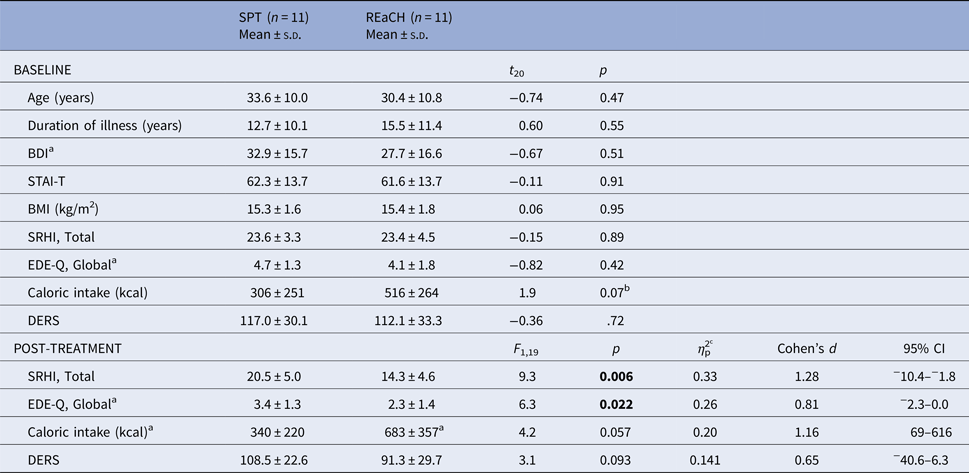
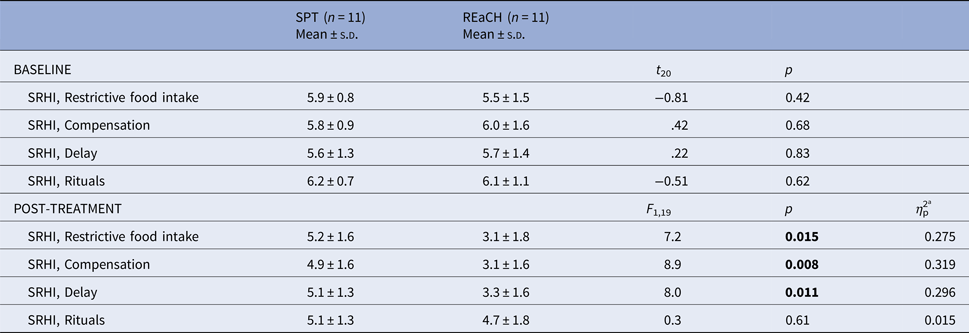
Covarying for baseline, there was a significant effect of treatment type on end-of-treatment total SRHI (Table 1). In exploratory analyses of each SRHI domain (Table 2), there was a significant treatment type effect in restrictive food intake, compensatory behaviors, and delay of eating. There was no significant treatment-type difference in eating-related rituals.
Demographics and clinical characteristics

BDI, Beck Depression Index; BMI, Body Mass Index; DERS, Difficulties in Emotion Regulation Scale; EDE-Q, Eating Disorder Examination Questionnaire; REaCH, Regulating Emotions and Changing Habits; SPT, Supportive Psychotherapy; SRHI, Self-Report Habit Index; STAI-T, Spielberger State-Trait Anxiety Inventory, Trait version.
Baseline variables were compared using Independent samples t test.
Post-treatment variables were compared using ANCOVA, covarying for the baseline value.
a Caloric intake post-treatment is missing for two participants in the REaCH group; BDI data are missing for three participants in the REaCH group and one participant in the SPT group; EDE-Q Global data are missing for one participant in the REaCH group.
b Independent samples t test including only individuals who participated at both timepoints: t 18 = 1.5, p = 0.16.
c Effect size interpretation guidelines for eta squared: 0.01 = small, 0.06 = medium, 0.14 = large.
Self-report habit index subscales
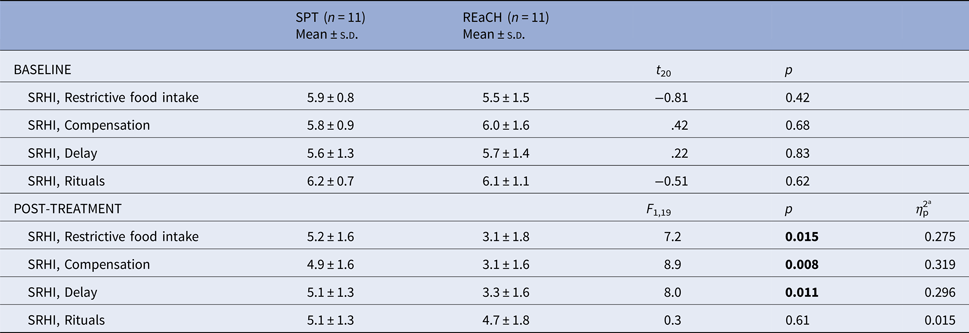
REaCH, Regulating Emotions and Changing Habits; SPT, Supportive Psychotherapy; SRHI, Self-Report Habit Index.
Baseline variables compared using Independent samples t test.
Post-treatment variables compared using ANCOVA, controlling for baseline value.
a Effect size interpretation guidelines for eta squared: 0.01 = small, 0.06 = medium, 0.14 = large.
Secondary outcomes (Table 1)
There was a significant effect of treatment type on eating disorder psychopathology in the end-of-treatment EDE-Q global score (see online Supplementary Table S1 for subscales). Treatment type did not significantly impact end-of-treatment DERS total. Two patients in the REaCH group did not participate in the post-intervention laboratory meal (one left the inpatient unit; one chose not to participate). There was a non-significant trend toward a difference between groups when including all participants; when comparing only those who participated at both time points, the groups were not significantly different (t 18 = 1.5, p = 0.16).
Treatment type was associated with greater caloric intake in the end-of-treatment laboratory meal, at a trend-level. There was no effect of the intervention on clinician-rated mealtime behavior scores (F 1,18 = 0.58, p = 0.46).
Following effect size interpretation guidelines for eta squared (Miles & Shevlin, Reference Miles and Shevlin2001), 0.01 is a small effect, 0.06 is a medium effect, and 0.14 is a large effect. The effect sizes for total SRHI, food intake, and DERS were large (Table 1).
Treatment acceptability
Both interventions were rated positively at the outset (scores >5), with mean ratings on Expectations of 8.2 ± 1.4 for REaCH and 6.2 ± 2.2 for SPT (t 20 = 2.4, p = 0.02). Data inspection showed one individual in the SPT group who rated Expectations poorly, with a score of 0.75. Satisfaction was also positive and similar between treatments, with mean ratings of 8.8 ± 1.2 for REaCH and 8.1 ± 1.6 for SPT (t 20 = 1.2, p = 0.22).
Correlation findings
SRHI was marginally associated with caloric intake at baseline r = −0.41, p = 0.06) and significantly associated after treatment (r = −0.60, p = 0.005), such that higher habit strength on SRHI was associated with less food intake.
Discussion
This randomized, controlled pilot trial provides preliminary evidence that maladaptive behaviors characteristic of AN are cue-dependent, consistent with relying on mechanisms underlying habits, and that the habit strength of these behaviors is modifiable. An intervention that specifically targeted the relationship between cues and behaviors was associated with lower habit strength of illness-related behaviors at end-of-treatment, as compared with a standard, active-control psychotherapy. While this is a small, preliminary study, the clinical impact of this therapeutic approach (evidenced by EDE-Q scores and a trend in laboratory caloric intake) supports the habit-centered model of AN (Walsh, Reference Walsh2013) and suggests the potential utility of including these methods for targeting habit strength as a treatment tool.
Like exposure and response prevention for obsessive-compulsive disorder (OCD) and anxiety disorders, REaCH can be considered a specific approach within CBT. CBT is an established treatment for eating disorders (Fairburn et al. Reference Fairburn, Marcus, Wilson, Fairburn and Wilson1993; Pike et al. Reference Pike, Carter, Olmsted, Grilo and Mitchell2010) based on principles of cognitive therapy (Beck et al. Reference Beck, Rush, Shaw and Emery1979), relapse prevention (Marlatt & Gordon, Reference Marlatt and Gordon1985), and behavioral techniques. Traditional CBT for eating disorders focuses broadly on the dietary pattern (and increasing total intake for individuals with AN), ‘forbidden’ foods, and attitudes about body shape and weight. Interventions include cognitive restructuring, systematic problem solving, and engagement in anxiety-provoking behavioral experiments. REaCH is a treatment tool that essentially ‘zooms in’ on the behavioral routines experienced as highly automatic by individuals with AN. The intervention does not directly target overall dietary pattern or specific cognitive distortions about eating, body shape, or weight. Rather, REACH emphasizes fine-grained behavioral analysis, antecedent and in-the-moment cues, and proximal rewards. As is, REaCH can be considered a potentially useful, adjunctive approach to include within a structured treatment setting (i.e. inpatient, residential, and partial hospital programs). For outpatient settings, further development of REACH is needed.
To date, few studies have assessed the role of habits in eating disorders. In one study of 20 individuals with AN and 20 healthy volunteers, eating/weight-related behavioral routines were self-identified as habits, and habit strength was significantly higher among the individuals with AN (Steinglass et al. Reference Steinglass, Glasofer, Walsh, Peterson, Walsh and Attia2017). Additionally, one study reported that habit strength for restrictive food intake (assessed via the SRHI) was related to the severity of food restriction on a different measure (Coniglio et al. Reference Coniglio, Becker, Franko, Zayas, Plessow and Eddy2017). A range of behaviors in AN may meet the definition of habit, which may speak to the difficulty in achieving clinical change using contemporary treatments with adult patients.
Habit strength as measured by the SRHI has been shown to be predictive of a range of health behaviors. For example, among individuals with sleep apnea, SRHI scores predicted usage of the treatment apparatus (CPAP machine; Brostrom et al. Reference Brostrom, Nilsen, Gardner, Johansson, Ulander and Fridlund2014). Among college students, SRHI scores predicted binge drinking episodes (Gardner et al. Reference Gardner, De Bruijn and Lally2012). SRHI scores have also predicted the frequency of exercise (Tappe et al. Reference Tappe, Tarves, Oltarzewski and Frum2013). In a study targeting habit strength through habit formation, the success of an intervention designed to increase children's consumption of vegetables by making the behavior more habitual was assessed through SRHI scores (McGowan et al. Reference Mcgowan, Cooke, Gardner, Beeken, Croker and Wardle2013). In overweight adults, an intervention aimed to establish habits that would promote weight loss resulted in greater automaticity of these behaviors as measured by SRHI, as well as greater weight loss (Lally et al. Reference Lally, Chipperfield and Wardle2008). The current study supports the utility of the habit strength construct and measure in this clinical population.
The importance of understanding and changing persistent maladaptive behaviors is relevant across psychiatric diagnoses. Habit-related constructs have been examined in disorders such as substance use and OCD. In OCD, which has long-recognized phenomenological similarities with AN, the term ‘compulsive’ is used to describe persistent maladaptive behaviors, although such behaviors share characteristics of habits. Neurocognitive tasks probing goal-directed learning have shown evidence of increased reliance on habit-mechanisms in OCD (Gillan et al. Reference Gillan, Papmeyer, Morein-Zamir, Sahakian, Fineberg and Robbins2011), supporting habit neurobiological models (Robbins et al. Reference Robbins, Gillan, Smith, De Wit and Ersche2012). Similarly, in AN, some studies of goal-directed learning have shown reliance on habitual learning associated with eating pathology (Voon et al. Reference Voon, Derbyshire, Ruck, Irvine, Worbe and Enander2014; Gillan et al. Reference Gillan, Kosinski, Whelan, Phelps and Daw2016; Godier et al. Reference Godier, De Wit, Pinto, Steinglass, Greene and Scaife2016). In our prior research using a reinforcement learning task that relies on the dorsal striatum, individuals with AN had more difficulty than controls, providing further neurocognitive support for the habit model (Foerde & Steinglass, Reference Foerde and Steinglass2017). Taken together, this body of research provides evidence of the involvement of habit-related behavioral and neural mechanisms in the persistent symptoms of AN.
We view this randomized trial as a proof-of-concept study. The trial was preliminary and did not assess the sustainability of habit change. Given the small sample size, the trend suggesting greater intake in the laboratory meal after REaCH relative to SPT (as well as the large effect size) is particularly encouraging, as food intake in AN is impressively resistant to change. For example, weight normalization during inpatient treatment has been found to have limited impact on patient-selected caloric intake objectively assessed in a laboratory setting (Mayer et al. Reference Mayer, Schebendach, Bodell, Shingleton and Walsh2012). The current study is limited by the fact that the interventions were administered on an inpatient unit, in conjunction with other interventions that aim to change behavior.
Of note, some outcomes did not change with REaCH (e.g. eating rituals). The method of objective rating of behavior may have had limitations, as the kappa scores for inter-rater reliability were modest. Future iterations of REaCH may need to better address emotion regulation in AN, as there was a non-significant change in the DERS. REaCH relied upon emotion regulation strategies adapted from a treatment for bulimia nervosa (Wonderlich et al. Reference Wonderlich, Peterson, Smith, Klein, Mitchell and Crow2015). It may be that emotion regulation difficulties differ among individuals with AN such that the strategies introduced in REaCH may need to be tailored further for this population. There was no significant effect of REaCH on BMI or on clinician ratings of behavior. It may be difficult to see an effect on BMI in an inpatient setting, where existing treatment is highly effective. However, given the known difficulty of changing eating behavior (Mayer et al. Reference Mayer, Schebendach, Bodell, Shingleton and Walsh2012), and the high relapse rate, additional treatment tools such as REaCH are needed.
The focus of this study on a recently hypothesized mechanism of illness (habit) and an intervention target (habit strength) is consistent with the NIMH strategy for development and testing of treatments relying on a Rational Therapeutics approach. While this study was primarily a test of the underlying model, the findings can be used to guide much-needed treatment development in AN.
Supplementary material
The supplementary material for this article can be found at https://doi.org/10.1017/S003329171800020X
Acknowledgements
The authors wish to acknowledge the staff of the Eating Disorders Research Unit (4-Center) at the New York State Psychiatric Institute.
This work was funded by the National Eating Disorders Association (NEDA) Feeding Hope Fund, the Hilda and Preston Davis Foundation, and New York State Office of Mental Health.