The arterial switch operation for the treatment of d-transposition of the great arteries has evolved to produce excellent surgical outcomes since its introduction in 1975. The mortality rate has decreased to single digits with low rates of morbidity as well.Reference Qamar, Goldberg, Devaney, Bove and Ohye 1 – Reference Gottlieb, Schwartz, Bischoff, Gauvreau and Mayer 3 This is especially true for those with d-transposition of the great arteries with intact ventricular septum and for those with the usual coronary pattern. Many operative series include a cohort of patients with more complex anatomy who undergo the arterial switch operation including forms of double-outlet right ventricle or Taussig–Bing anomaly and surgical defects including ventricular septal defects, outflow tract obstruction, coronary anomalies, and aortic arch obstruction or hypoplasia with varying rates of increased morbidity and mortality.Reference Hayes, Jones and Quaegebeur 4 , Reference Schwarz, Blaschczok and Sinzobahamvya 5
Although it may be intuitive that these additional defects lead to more complex and perhaps longer surgeries with greater cost and resource utilisation, the impact of these additional defects on surgical outcomes remains poorly defined in the current era. The purpose of this retrospective study was to evaluate the surgical outcomes and costs associated with this complex group of patients. We hypothesised that in the current era complex forms of d-transposition of the great arteries and double-outlet right ventricle undergoing the arterial switch operation require increased resource utilisation, but have similar mortality and morbidity outcomes to simple forms of d-transposition of the great arteries.
Materials and methods
This retrospective study was approved by the Institutional Review Boards of Primary Children’s Hospital and the University of Utah. The need for individual consent was waived.
Patients were identified by searching the Primary Children’s Hospital cardiovascular database for patients who had undergone the arterial switch operation between 2005 and 2014 for d-transposition of the great arteries or double-outlet right ventricle. We further classified those with the following associated malformations: ventricular septal defect, aortic arch obstruction including coarctation, hypoplasia, and Taussig–Bing anomaly. Patients with d-transposition of the great arteries who underwent a staged approach, patients with heterotaxy, and those with congenitally corrected transposition were excluded. Hospital and clinical records were used to collect information including patient demographics, imaging studies, hospital course, and treatment.
Coronary transfer difficulties and aortic arch augmentation carry the greatest risk for negative outcomes. The Society of Thoracic Surgeons (STS) data reflect that ventricular septal defect closure adds little in terms of increased mortality and morbidity to those with intact ventricular septum. 6 It is for this reason that patients were grouped into “simple” and “complex forms” based on the presence of arch augmentation, Taussig–Bing anomaly, or coronary anomalies.
Patients in the simple group had normal coronaries and an intact ventricular septum or a ventricular septal defect. Coronary anatomy was classified using the Leiden convention.Reference Wernovsky and Sanders 7 For the purpose of analysis, simple coronary forms included the usual coronary pattern (1LC×2R) and the circumflex artery from the right (1L2C×R). All other forms were considered complex. The complex group included aortic coarctation or arch hypoplasia, all other forms of coronary anatomy, and forms of double-outlet right ventricle or Taussig–Bing anomalies.
The need for prostaglandin E1 and balloon atrial septostomy was determined by the patient’s preoperative condition. Septostomy, performed at the bedside or in the cath lab suite, based on provider preference, was reserved for those with hypoxia or echocardiographic evidence of a restrictive atrial septum. Preoperative coronary catheterisation was used to define the coronary anatomy when it was not clearly identified on echocardiography.
Surgical repair was accomplished via median sternotomy with cardiopulmonary bypass. Aortic cannulation and single atrial versus bicaval venous cannulation was used at the surgeon’s discretion. Moderate hypothermia (24–28°C) was typically used with a brief period of hypothermic circulatory arrest for the closure of atrial defects. Deep hypothermic arrest or regional cerebral perfusion was used for more complex repairs and arch reconstructions. Typical arch reconstruction consisted of excision of the coarctation using pulmonary homograph patch augmentation of the undersurface of the arch. The Lecompte manoeuvre was typically performed, except in certain cases, at the surgeon’s discretion. In many of the cases the cross-clamp was removed before reconstruction of the neo-pulmonary root. Sternal closure was performed at the surgeon’s discretion with the majority of chests being left open with routine closure usually performed within 2–3 days in the cardiac ICU.
Outcome measures
Primary outcomes were mortality, major morbidity, and hospital costs. Major morbidity was defined using the STS definitions: cardiac arrest, need for extracorporeal membrane oxygenation, a major coronary event, need for cardiac, surgical, or catheter-based re-intervention, stroke, or placement of permanent pacemaker, bleeding requiring re-exploration, sepsis, and mediastinitis. Secondary outcomes included hospital and ICU length of stay, and mechanical ventilation duration. Hospital costs were obtained from the hospital’s activity based accounting system and were inflation adjusted to 2015 dollars.
Statistical analysis
Patient demographics, clinical characteristics, surgery-related factors, and major and minor complications were summarised as mean, standard deviation, median, interquartile range (IQR), and range for continuous variables or as count (%) for categorical variables, and compared between the patients with simple and complex arterial switch operation. For continuous variables with an approximately normal distribution, t-tests were used; otherwise, Wilcoxon rank sum tests were used. For non-time-dependent categorical variables, a χ2 or Fisher’s exact test – when any expected cell count was less than 5 – was used. The majority of patient morbidities were time-dependent, occurring either during the hospital stay or after discharge. As dates were available for these variables, and because hospital stay was fairly long for these patients (median=19 days, IQR=14.2–23), we conservatively analysed them as time-to-event variables using log-rank tests. The Kaplan–Meier method was used to plot complication-free survival. Procedure cost was summarised by simple and complex arterial switch operation as the median with interquartile range for overall cost and sub-categories of cost. We also described the percentage of cost difference between simple and complex arterial switch operations for each sub-category of cost namely room and nursing care, operating room, pharmacy, respiratory therapy, operating room supplies, laboratory, blood bank, imaging, professional services, anaesthesia, and other clinical services in which the denominator was the sum of the median cost differences across sub-categories, such that the percentages would sum to 100%. We compared total postoperative costs between simple and complex arterial switch operations using gamma regression with a log-link function. Statistical analyses were conducted in R software version 3.1.2 (http://cran.us.r-project.org/), significance was evaluated at the 0.05 level, and all tests were two-tailed.
This investigation was supported by the University of Utah Study Design and Biostatistics Center, with funding, in part, from the National Center for Research Resources and the National Center for Advancing Translational Sciences, National Institutes of Health, through Grant 8UL1TR000105 (formerly UL1RR025764).
Results
A total of 98 patients were eligible for inclusion in this study. The median follow-up time was 35.6 months. In all, six patients were not included in the analysis of surgical and catheter-based re-interventions as follow-up occurred at another institution and records were not available after discharge from our hospital.
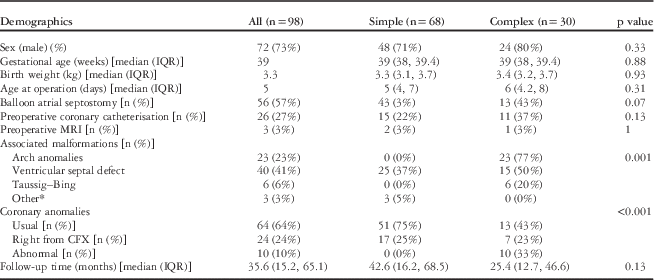
The simple group consisted of 68 patients and the complex group consisted of 30 patients. In the simple form, 25 (37%) of the patients had ventricular septal defects, including six patients with multiple ventricular septal defects. In all of these patients the major ventricular septal defect was closed and the other small defects were felt to be insignificant. Within the complex group, 15 patients (50%) had a ventricular septal defect including three with multiple defects. Overall, 23 patients (77%) had aortic arch anomalies, 10 patients (33%) had coronary anomalies, and six patients (20%) had a Taussig–Bing anomaly that was considered distinct from the group with a ventricular septal defect.
The median gestational age for the entire group was 39 weeks and did not differ between the simple and complex groups (Table 1). Similarly, there were no differences in average birth weights (3.3 kg). There was no statistical difference in the proportion of patients requiring balloon atrial septostomy (simple 63% versus complex 43%, p=0.07) or in the rate of preoperative coronary catheterisation (simple 22% versus complex 37%; p=0.13).
Patient characteristics.

CFX=circumflex artery; IQR=interquartile range;
* Other malformations: aortopulmonary collaterals in two patients; partial anomalous pulmonary venous return
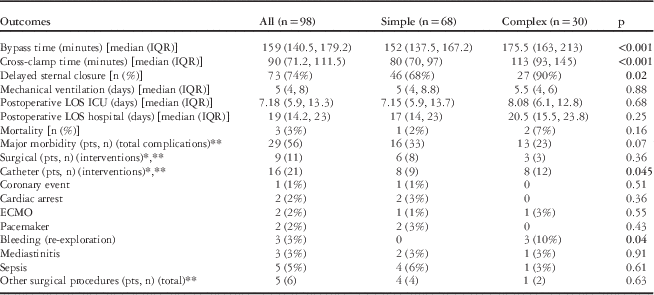
Patients who underwent a complex arterial switch operation had increased cardiopulmonary bypass times (simple 152 versus complex 175.5 minutes, p<0.001) and longer cross-clamp times (simple 80 versus complex 113 minutes, p<0.001). The rate of delayed sternal closure was significantly higher in the complex group (90%) versus the simple group (68%), p=0.02.
Morbidity and mortality
The overall rate of mortality for the entire group was 3%, with one death in the simple group and two deaths in the complex group (2 versus 7%, p=0.23). All three deaths occurred in the perioperative period.
The frequency of individual events including extracorporeal membrane oxygenation, cardiac arrest, presence of a pacemaker, and catheter-based or surgical re-intervention was low (see Table 2 for details), such that a composite of all major complications was required to compare major morbidity between the two groups. In all, 13 patients experienced a total of 23 major complications in the complex group and in the simple group 16 patients experienced 33 complications (p=0.07).
Outcomes.

ECMO=extracorporeal membrane oxygenation; IQR=interquartile range; LOS=length of stay; Pts=patients
Log-rank test p-value.
* Six patients’ records missing: simple, four; complex, two
** Analysis for this variable was conducted at the patient level. P<0.05=significance
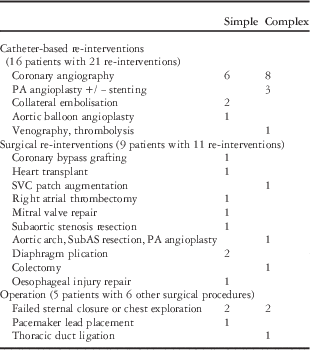
There was no difference in major surgical re-interventions between the simple and complex groups. Overall, nine patients underwent a total of 11 major surgical re-interventions excluding extracorporeal membrane oxygenation cannulation and decannulation (Table 3). The patient with multiple surgical re-interventions underwent failed coronary arterial bypass grafting, followed by cardiac transplantation, and, ultimately, died. A second patient died after reoperative surgery to repair a thrombosis of the superior caval vein. Other cardiac surgical procedures and timing of reoperation following index surgery included removal of a right atrial thrombus at 1 month, mitral valve repair at 4 years, resection of a subaortic stenosis at 4 years, and aortic arch reconstruction with subaortic membrane resection and pulmonary arterial reconstruction at 7 months.
Re-interventions

PA=pulmonary artery; SubAS=subaortic stenosis; SVC=superior caval vein rather
The number of patients requiring postoperative cardiac catheterisations differed slightly between the two groups (simple 12 versus complex 27%, p=0.05) with a total of 16 patients undergoing a total of 21 cardiac catheterisations. The majority of interventions were coronary angiographies, with three patients receiving multiple angiographies. All pulmonary balloon angioplasties and pulmonary artery stenting occurred in a single patient. In all, four patients had collaterals embolised and one patient had an aortic re-coarctation treated with balloon angioplasty. The patient who underwent a venography of the superior caval vein and thrombolysis, later had a surgical re-intervention and, ultimately, died.
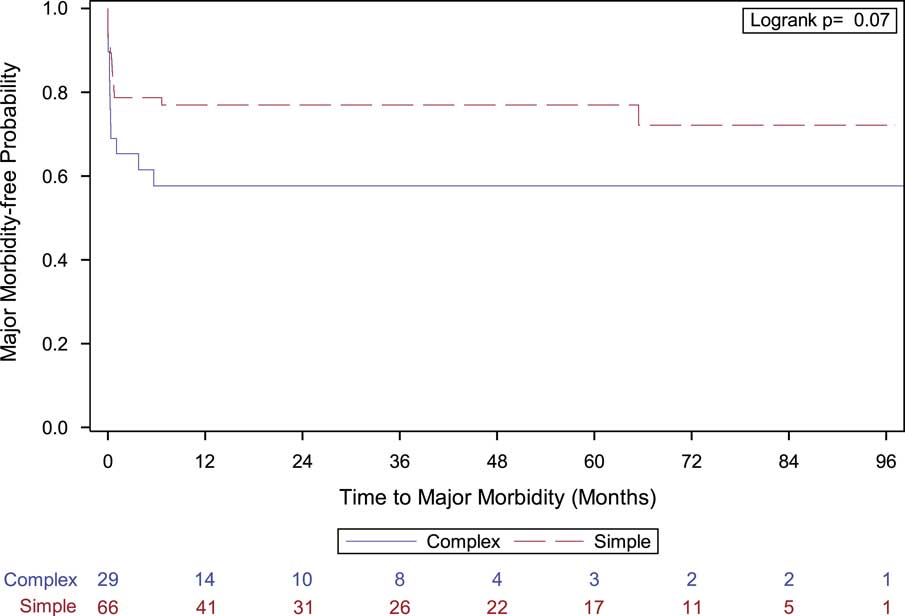
The Kaplan–Meier plot in Figure 1 shows no difference in the complication-free survival curves between the simple and complex groups (p=0.07). The median time to the first major complication was 17 days (interquartile range 2.25–101.8 days), with the majority of events occurring within the perioperative period in both groups, with fairly infrequent late complications.
Complication-free survival in patients undergoing simple or complex arterial switches. Complications were defined as cardiac arrest, extracorporeal membrane oxygenation, a major coronary event, need for surgical or catheter-based re-intervention, stroke, or presence of a permanent pacemaker.

The rates of minor surgical procedures, mediastinitis, and sepsis were similar for both groups. There was a higher risk for bleeding requiring re-exploration in the complex group (simple 0% versus complex 10%, p=0.04) (Table 2). Table 3 shows the breakdown of the other surgical procedures performed.
Secondary outcomes
The median time of mechanical ventilation in the simple cohort was 5 days (interquartile range 4–8.8) versus 5.5 days (interquartile range 4–6) in the complex group. Although the median postoperative ICU length of stay of the complex group was slightly longer than the simple groups (simple 171 versus complex 194 hours, p=0.68); this was not statistically significant. The median postoperative hospital length of stay was also similar between the two groups (simple 298 versus complex 297 hours, p=0.68).
Resource utilisation
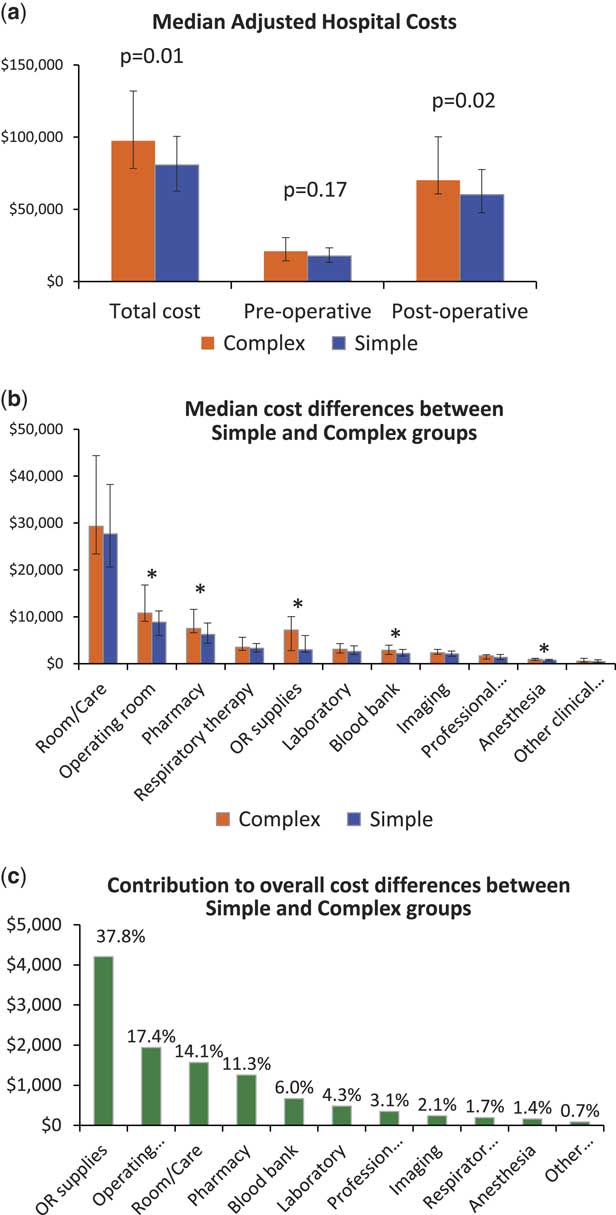
Overall adjusted costs were increased in the complex group (simple $80,749 versus complex $97,388, p=0.013) (Fig 2a). Preoperative costs did not differ between the two groups (simple $17,588 versus complex $20,980, p=0.17); however, postoperative costs were significantly higher for complex switches (simple $60,642 versus complex $70,133, p=0.024).
Analysis of hospital cost performed in 2015-adjusted dollars. ( a ) Total costs. Postoperative costs included the operative day. ( b ) Comparison of hospital costs divided into 11 categories. *Statistically significant between simple and complex groups. ( c ) The contribution of each category to the overall cost difference was calculated by dividing the category cost by the sum of all the differences between the simple and complex categories. Operating room, profession, services including physical, occupational, and speech therapy, anaesthesia, and non-provider anaesthesia costs.

Median postoperative costs in the complex group were higher across every category but only reached statistical significance for operating room costs, operating room supplies, blood bank, pharmacy, and non-physician anaesthesia charges. The costs associated with delayed sternal closure, which largely occurred in the cardiac ICU, were captured in the operating room costs and operating room supply categories (Fig 2b). Room and nursing care was the most expensive category, but the difference between the groups was not significant. The contribution of each cost category to overall cost differences showed that operating room supplies were the largest factor, accounting for 37.8% of the difference (Fig 2c). Operating room costs, room and nursing care, and pharmacy were the other major contributors.
Within the complex group, analysis for increased postoperative costs based on the presence of coronary anomaly, aortic arch repair, or Taussig–Bing anomaly did not show statistical significance. In addition, analysis of adjusted costs compared between two time eras, 2005–2009 and 2010–2014, did not show any differences.
Discussion
Advancements in anaesthesia, intensive care, and operative techniques have combined to improve the survival and decrease morbidity in patients undergoing congenital heart surgery including in those with simple and complex forms of d-transposition of the great arteries. Most recent studies reporting outcomes of the arterial switch operation focus on patients with simple forms of d-transposition of the great arteries; however, a significant portion of patients undergoing the arterial switch operation have other congenital abnormalities that complicate repair or require additional procedures, prolonging ischaemia and operative times, potentially leading to increased morbidity and mortality. Our recent experience shows that these patients can safely undergo complex repairs with minimal additional morbidity or mortality.
The 3% overall mortality rate is consistent with those from other reports within the literature on simple d-transposition of the great arteries, d-transposition of the great arteries or ventricular septal defect, and reports on the Taussig–Bing anomaly.Reference Qamar, Goldberg, Devaney, Bove and Ohye 1 , Reference Gottlieb, Schwartz, Bischoff, Gauvreau and Mayer 3 – Reference Schwarz, Blaschczok and Sinzobahamvya 5 , Reference Khairy, Clair and Fernandes 8 – Reference Villafane, Lantin-Hermoso and Bhatt 10 The finding that complex arterial switch operation can be accomplished with mortality rates nearly similar to those of simple switches fits with the overall trend of decreasing operative mortality across many complex congenital repairs.Reference Hawkins, Kaza, Burch, Lambert, Holubkov and Witte 11
The one coronary event in our series occurred in the simple cohort in a patient with usual coronary anatomy. There were no deaths, coronary events, or extracorporeal membrane oxygenation use in the 10 patients with abnormal coronaries. Other centres have also reported that abnormal coronary looping patterns and coronary anomalies are adequately addressed with current surgical techniques and are no longer risk factors for major morbidity or mortality.Reference Qamar, Goldberg, Devaney, Bove and Ohye 1 , Reference Pasquali 12 , Reference Stoica, Carpenter and Campbell 13
Low mortality rates have pushed the focus of improvement into decreasing the overall morbidity of the operation. The rates of major morbidities remain quite high with 16 patients in the simple group and 13 patients in the complex group experiencing a major complication. Catheter-based re-interventions were the most common type of complication followed by surgical re-interventions. The rates of coronary events or cardiac arrest were extremely low.
Delayed sternal closure was not counted as a morbidity or re-intervention as this is considered routine practice for the majority of arterial switch operations at our institution; however, it may play a role in the increased cost seen in the complex group in which delayed sternal closure was used more frequently.
The complex switches required increased resource utilisation. The intuitive theory that increased mechanical ventilation and ICU stay would contribute to cost increase did not bear out, as the modest increases in mechanical ventilation, ICU and hospital stay were not statistically significant. Detailed cost group analysis confirmed these findings. Respiratory therapy and room and nursing care costs were somewhat higher in the complex group but not statistically significant.
The complex arterial switch operation required complex repairs leading to longer bypass and operating room times as well as to a higher rate of delayed sternal closure. These clinical findings were reflected in the cost group analysis. Operating room and operating room supplies constituted almost two-thirds of the cost difference with room or care, pharmacy costs, and blood bank costs making up a majority of the rest. Increased delayed sternal closure usage and longer bypass times in the complex group are possible reasons for the difference in operating room costs. Pulmonary homografts ($7000–$11,000) used in aortic arch reconstruction likely account for the large difference in the operating room supplies category.
Room and nursing care costs remain the largest contributors to the overall cost of the arterial switch operation making it the best target for cost savings. The savings accomplished through reduction in length of stay by 1–2 days would likely overshadow the small savings seen through minimising use of laboratory, pharmacy, or imaging resources. Early operative intervention has been shown to decrease costs.Reference Anderson, Ciarleglio, Hayes, Quaegebeur, Vincent and Bacha 14 These savings likely come on the front end of the length of stay. Savings on the back end may come through interventions such as early family discharge teaching of feeding protocols, or nasogastric tube nutrition at home. These measures could be studied for possible steps to expedite hospital discharge while ensuring patient safety.
The small number of deaths in this population limits the ability to perform multivariate analysis; however, composite variable analysis indicates that many of the surgical complexities found in patients with d-transposition of the great arteries undergoing the arterial switch operation can be safely addressed with current surgical techniques and intensive care without increased mortality and only minor increased morbidity. Cost differences between simple and complex arterial switches are largely accounted for by inherent differences in the operations – longer operating room times and greater operating room supply usage. These differences in cost may not be surmountable, but efforts to reduce the overall cost should mirror the continued efforts to decrease the overall morbidity and mortality in these patients.
Acknowledgements
None.
Financial Support
This work was supported by the University of Utah Study Design and Biostatistics Center, with funding, in part, from the National Center for Research Resources and the National Center for Advancing Translational Sciences, National Institutes of Health, through Grant 8UL1TR000105 (formerly UL1RR025764).
Conflicts of Interest
None.
Ethical Standards
The authors assert that all procedures contributing to this work comply with the ethical standards of the relevant national guidelines of a retrospective electronic medical record review and have been approved by the Institutional Review Boards of Primary Children’s Hospital and the University of Utah (IRB_00078580). The need for individual consent was waived.