


Introduction
Case conceptualization is considered a core psychotherapy skill (Eells, Reference Eells2007). It is considered “the heart of evidence-based practice” because it distills theory in order to apply it to the understanding of particular cases (Bieling and Kuyken, Reference Bieling and Kuyken2003; p.53). Definitions of case conceptualization have differing emphases, but generally converge on a theory-driven set of hypotheses about a client's clinical presentation that can guide treatment.
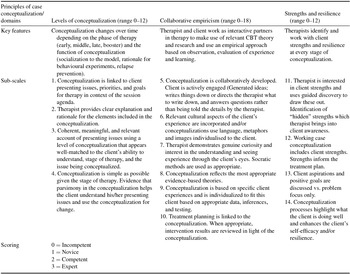
Kuyken, Padesky and Dudley (Reference Kuyken, Padesky and Dudley2009) proposed an approach to cognitive behavioural therapy (CBT) case conceptualization that emphasized: (1) levels of case conceptualization that develop over time and integrate client experiences with empirical theory and practice, (2) collaborative empiricism, and (3) incorporation of client strengths and resilience. Their approach posits that case conceptualization is most likely to be acceptable to clients and contribute to effective therapy outcomes if it is dynamically and collaboratively co-created by the client and therapist. It further advocates that a series of co-created case conceptualizations should evolve systematically over the course of therapy. Finally, the approach emphasizes a focus on clients’ strengths in order to build clients’ sense of self-efficacy, provide therapists with a more holistic view of their clients, and identify pathways to change that build on clients' pre-existing strengths (Table 1).
Description of the domains comprising the Collaborative Case Conceptualization-Rating Scale (CCC-RS)

Kuyken et al. (Reference Kuyken, Padesky and Dudley2009) further argued that there is a need to systematically train CBT therapists in case conceptualization. Alongside many commentators, they also suggested a need for research into the claims made about the importance of case conceptualization in CBT generally (Bieling and Kuyken, Reference Bieling and Kuyken2003; Persons, Roberts, Zalecki and Brechwald, Reference Persons, Roberts, Zalecki and Brechwald2006) and also the claims made in their model specifically (Kuyken et al., Reference Kuyken, Padesky and Dudley2009).
Unfortunately, there is currently no psychometrically robust tool to assess CBT competence in case conceptualization either in training or research settings. Arguably, this gap in the literature exists in part because of the extraordinary time and effort required to develop detailed coding systems, train raters, and then painstakingly review and rate therapy recordings (von Consbruch, Clark and Stangier, Reference von Consbruch, Clark and Stangier2012).
Although a number of authors stress the importance of conceptualization competence within CBT (e.g. Kazantzis, Reference Kazantzis2003; Fothergill and Kuyken, Reference Fothergill and Kuyken2002), there is currently no way to systematically assess this construct or measure its relationship with therapeutic outcome. Further, although there are instruments designed to measure general CBT competence (e.g. The Cognitive Therapy Rating Scale Revised or CTS-R; Blackburn et al., Reference Blackburn, James, Milne, Baker, Standart and Garland2001), we believe that competence in case conceptualization is a subdomain of general CBT competence that is currently untapped by and/or conflated with other aspects of competency in extant scales. Therefore, and given its predicted positive relationship with outcome over and above general competence, we believe that the development of a psychometrically sound tool for the assessment of CBT case conceptualization skills is in order.
This study describes the development and psychometric properties of The Collaborative Case Conceptualization Rating Scale (CCC-RS). The CCC-RS was developed to enhance CBT training in case conceptualization and for use in research trials assessing the relationship between competence in case conceptualization and therapy outcome. Data for this study were selected from a larger dataset of a published randomized controlled trial of the effectiveness of CBT versus usual care for adults with treatment resistant depression (CoBalT: Cognitive Behavioural Therapy as an adjunct to Pharmacotherapy for Treatment Resistant Depression in Primary Care; Wiles et al., Reference Wiles, Thomas, Abel, Ridgway, Turner and Campbell2013).
We hypothesized that the CCC-RS would exhibit adequate reliability (i.e. above .75), in the form of acceptable Cronbach's alpha and Guttman's split-half coefficients. Further, we predicted that the scale would possess adequate inter-rater reliability, with an ICC falling within the acceptable range of values (.81–1; Shrout, Reference Shrout1998). Moreover, we hypothesized that total scores on the CCC-RS would be positively correlated with total scores on a general measure of CBT competence (e.g. CTS-R). Finally, we hypothesized that, where sub-scales of the CCC-RS assess a specific case conceptualization domain that mirrors a more generic CBT domain, they would be significantly correlated with the equivalent items on general measures of CBT competence. Therefore, we hypothesized that the collaboration scale of the CCC-RS would be positively correlated with the CTS-R scale of the same name (Collaboration; Item 3), and that total scores on the CCC-RS would correlate with scores on item 10, Conceptual Integration, of the CTS-R.
Method
Treatment, therapists and clients
The study was embedded within the CoBalT trial (Wiles et al., Reference Wiles, Thomas, Abel, Ridgway, Turner and Campbell2013), utilizing data from the CBT arm of the trial. We reasoned that case conceptualization might be particularly important in CBT with this population given the high levels of co-morbidity, longstanding cognitive and behavioural patterns, and in many cases previous unsuccessful treatment. CBT was typically 12–18 sessions using seminal cognitive therapy manuals designed for the treatment of depression (Beck, Rush, Shaw and Emery, Reference Beck, Rush, Shaw and Emery1979) and treatment resistant depression (Moore and Garland, Reference Moore and Garland2003). In addition, therapists were encouraged to use case conceptualization to guide CBT. Each session lasted approximately 50 minutes, and was audio-recorded for which specific patient consent was obtained.
For the purposes of this trial, we selected audio-recorded sessions from nine (eight female) of the 11 CoBaLT trial therapists who treated the majority of clients and for whom the largest pool of data was available. Therapists’ average age was 37 years (SD = 5.6; range 27–44), and their experience as CBT therapists ranged from 0 (newly qualified) to 14 years (M = 7.4; SD = 4.9). Of the nine therapists, four had a mental health nursing background, four were clinical psychologists and one had a vocational/academic background (MSc in psychological therapies). Eight of the nine were accredited by the BABCP, or eligible for accreditation.
We reasoned that therapists’ case conceptualization should vary across clients and stage of therapy. For example, a therapist might differ in competency in lower-level descriptive conceptualizations (i.e. early sessions) and explanatory/longitudinal/resilience-based conceptualizations (more typical of later sessions). Moreover, clients with more straightforward presentations might require less individualized case conceptualization than clients with significant co-morbidities. Therefore, for each therapist, we randomly sampled 2–3 clients from their case loads, and for each client selected one session from early in therapy (sessions 2 to 6) and another from later in therapy (sessions 7 to 17). Selection was limited to 40 audio-recorded sessions as this represented the maximum number that could be rated due to the costs of paying independent experienced therapists to rate the recordings.
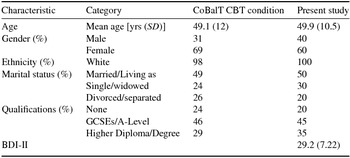
Table 2 provides demographic characteristics for participants selected for inclusion in the present study in comparison to those in the CoBalT CBT condition. As can be seen, the sub-sample is broadly comparable to the larger sample receiving CBT within the CoBalT trial.
Baseline demographic and psychiatric characteristics of participants in the CoBalT CBT condition (N = 234) compared to the present study (N = 40)

Note: BDI -II = Beck Depression Inventory - II
Measures
Development and characteristics of the CCC-RS (Padesky, Kuyken and Dudley, Reference Padesky, Kuyken and Dudley2011)
In developing the CCC-RS, our goal was to produce an assessment tool that could reliably and comprehensively rate the conceptualization process and skill of CBT therapists. As such, it provides an operational definition of the concept of CBT case conceptualization, as described by Kuyken et al. (Reference Kuyken, Padesky and Dudley2009). The CCC-RS was constructed in line with previous research on case conceptualization (Chadwick, Williams and Mackenzie, Reference Chadwick, Williams and Mackenzie2003; Kazantzis, Reference Kazantzis2003; Kuyken, Fothergill, Musa and Chadwick, Reference Kuyken, Fothergill, Musa and Chadwick2005) and other theories and models of the construct (Eells, Reference Eells2007).
The measure is designed to capture the three principles or domains of CBT case conceptualization set out in the collaborative case conceptualization approach (Table 1; Kuyken et al., Reference Kuyken, Padesky and Dudley2009). The authors of the model operationalized the criteria items and wrote an accompanying scoring manual, which included detailed descriptions of both the over-arching domains and the sub-scales intended to capture each domain. Peer review and input was received from CBT researchers/trainers/practitioners, including Michael Easden, Sheena Liness, Freda McManus and Jacqueline Persons.
The three domains rated are Levels of Conceptualization, Collaborative Empiricism, and Strengths/Resilience focus. The second domain is further subdivided into two separate components, Collaboration and Empiricism. As such, the scale is hypothesized to possess three domains that can account for most of the variance in scores. Each domain is comprised of several sub-scales (Table 1).
The face validity of the proposed approach to assessing competency in case conceptualization was evaluated by the authors who used the CCC-RS to rate sample therapy session recordings (August-October 2010). The scale appeared to have good face validity based on the ease with which ratings could be made, the number of sessions falling into each category and raters' judgements about each item's ability to quantify competency in case conceptualization. Items were revised and combined based on raters' feedback. Ratings of additional session recordings led to finer grained differentiations in the descriptors provided for different levels of competency for the various scale items.
The initial version of the CCC-RS comprised 19 items, which were created jointly by CP, WK, and RD. This original version of the scale was subjected to an iterative review process whereby authors, researchers, and colleagues scrutinized the face and content validity of the items. The outcome of this process resulted in the reduction from 19 to 14 rated items. This study utilized this refined 14-item version of the scale. The instrument is designed to be scored by observers on a 4-point Likert-style scale (0 = incompetent; 1 = novice; 2 = competent; 3 = expert) to assess the presence and degree of a number of specific case conceptualization related skills in relation to established criteria for competency. Scores on the scale can range from 0–42, with higher scores indicative of greater competence in CBT collaborative case conceptualization.
The Cognitive Therapy Rating Scale (CTS-R; Blackburn et al., Reference Blackburn, James, Milne, Baker, Standart and Garland2001)
The CTS-R is a 12-item observer-rated scale that is widely used in the measurement of therapist competence in cognitive therapy. The CTS-R was completed for each of the 40 audio-recorded sessions. Items are rated on a 0 to 6 scale to give a total score, with higher scores indicating higher levels of competence (range 0–72). The CTS-R builds upon the original Cognitive Therapy Scale (Vallis, Shaw and Dobson, Reference Vallis, Shaw and Dobson1986) and has demonstrated adequate reliability (.63, p < .01), high internal consistency (Cronbach alphas between .92–.95), is sensitive to change and can detect varying levels of skill in therapists (Blackburn et al., Reference Blackburn, James, Milne, Baker, Standart and Garland2001; McManus, Westbrook, Vazquez-Montes, Fennell and Kennerley, Reference McManus, Westbrook, Vazquez-Montes, Fennell and Kennerley2010).
Procedure
CCC-RS raters were trained by the scale's authors after raters read the book describing the Collaborative Case Conceptualization model (Kuyken et al., Reference Kuyken, Padesky and Dudley2009), attended workshops on the model, and received didactic training regarding the CCC-RS. Training involved rating small batches of pre-rated session recordings with comparisons and discussions of scoring differences until reliability was consistently established across this batch of session recordings. To rate sessions, raters listened to a session's audio-recording in its entirety, making notes of evidence that would bear on ratings to ensure ratings were based on the benchmarks for each level of competency for each CCC-RS item (Padesky et al., Reference Padesky, Kuyken and Dudley2011). Inter-rater reliability for the CCC-RS was assessed in line with Brosan, Reynolds and Moore (Reference Brosan, Reynolds and Moore2008). Six session recordings, coded independently by WK and PG, were compared using intra-class correlations (ICC).
CTS-R ratings were completed by highly experienced CBT trainers at the Oxford Cognitive Therapy Centre (part of Oxford Health NHS Foundation Trust). The raters’ experience ranged from 15 to 25 years. All CCC-RS and CTS-R ratings were completed blind to client characteristics, scores on the alternate scale, and therapy outcome.
Ethical considerations
The authors assert that all procedures contributing to this work comply with the ethical standards of the relevant national and institutional committees on human experimentation and with the Helsinki Declaration of 1975, as revised in 2008.
Statistical analysis
After data cleaning and checking, means and standard deviations for the CCC-RS and CTS-R total scores were obtained. Means and standard deviations were computed for CCC-RS subscale totals. Subsequently, item-total correlations for the CCC-RS were calculated in order to evaluate individual items within the measure. Further, scale score reliabilities in the form of Cronbach'sα and Guttman's split-half coefficients were obtained for the dependent variables (i.e. CCC-RS and CTS-R). Moreover, we calculated the ICCs for total scores on the CCC-RS, as well as for subdomains of this scale. Finally, Pearson's correlation coefficients between the CCC-RS and CTS-R were obtained. Significance levels were set at α = .05 for all of the tests undertaken in this study.
Results
CCC-RS descriptive statistics
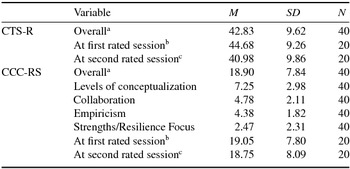
Means, standard deviations and sample sizes for each the CCC-RS scales for the 40 audio-recorded sessions are provided in Table 3. Overall score on the CCC-RS (M = 18.90, SD = 7.84) corresponds to an average item score of 1.4, or between the “novice” and “competent” level. Average scores within the levels of conceptualization, collaboration, empiricism and strengths/resilience focus subscales indicate that therapists tended to focus session activity on client problems, vulnerabilities and history of adversity rather than working to identify client strengths during conceptualization. This was also reflected in individual item scores; over the 40 sessions rated, none of the therapists received an “expert” rating of 3 on any of the items in the strengths/resilience subscale. Similarly, descriptive statistics of the data also revealed that, over the 40 sessions rated, none of the therapists achieved a score of 3 (expert) on Item 8 (“the conceptualization reflects the most appropriate evidence-based theories”) or Item 6 (“relevant cultural aspects of client's experience are incorporated and/or conceptualizations use client's language, metaphor, and images”). With regards to Item 8, therapists tended to use and individualize generic models of CBT in conceptualization rather than use disorder specific models. With regards to Item 6, therapists tended to use client language effectively, but fell short of using culture as something of central importance to the conceptualization, which would warrant an expert rating of 3 on this item.
Descriptive statistics for CCC-RS

Notes: CCC-RS = Collaborative Case Conceptualization Rating Scale; CTS-R = Cognitive Therapy Rating Scale.
a Overall CTS-R or CCC-RS score over the 40 audio-recorded sessions;
b CTS-R or CCC-RS score from audio-recordings rated at the beginning to mid-point of therapy (sessions 2-6);
c CTS-R or CCC-RS score from audio-recordings rated at the mid-point to end of therapy (sessions 7–12/17).
Reliability
Item evaluation
Data from 40 recorded sessions were analysed. To identify possible item redundancy and improve the overall reliability of the measure, item-full score correlations were obtained. This analysis revealed that correlations with total scores ranged from .59 to .89 for 12 of the 14 items. Items 13 (Client aspirations and goals) and 11 (Therapist interest in strengths) produced the lowest correlations with total scores (r = .42 and .48, respectively).
Consistency
Scale score analyses revealed that the CCC-RS and CTS-R possessed Cronbach's α coefficients of .94 and .97, respectively. The CCC-RS and CTS-R exhibited Guttman's split-half reliabilities of .82 and .96, respectively. The subscales of the CCC-RS possessed Cronbach α coefficients of .92 (Levels of Conceptualization), .89 (Collaboration), .86 (Empiricism), and .88 (Strengths/Resilience).
Inter-rater reliability
To establish the inter-rater reliability of the CCC-RS, intra-class correlations (ICC) were calculated for six session recordings coded independently by two authors (WK and PG). This was .82 and falls in the substantial range of agreement (.81 – 1.0; Shrout, Reference Shrout1998). The reliabilities of the CCC-RS subscales all fell in the substantial agreement range, and were as follows: levels of conceptualization ICC = .91, p < .01; collaboration ICC = .91, p < .01; empiricism ICC = .93, p < .01; strengths and resilience focus ICC = .92 p < .01.
Validity
As planned, Pearson's correlation coefficients between CCC-RS scores and scores on the CTS-R were calculated. Total scores on the CCC-RS and CTS-R were significantly and positively correlated, r = .54, p <.01. As predicted, scores on the Collaboration subscale of the CCC-RS were positively correlated with scores on item 3 (Collaboration) of the CTS-R, r = .44, p < .01. Finally, total scores on the CCC-RS were positively and significantly correlated with scores on item 10 (Conceptual integration) of the CTS-R, r = .44, p < .01.
Discussion
The results of this preliminary study revealed that the CCC-RS is a reliable measure with adequate face, content and convergent validity. The instrument evidenced excellent internal consistency and split-half reliability. Further, the inter-rater reliability analysis revealed that scores on the measure are highly consistent between observers. The ICC for the measure as a whole (.82) – as well as for individual sub domains within the measure – fell within the acceptable range of ICC established in the literature (Shrout, Reference Shrout1998; Streiner and Norman, Reference Streiner and Norman1989). Furthermore, the derived ICC statistic for the CCC-RS was higher in value to ones obtained by Vallis et al. (Reference Vallis, Shaw and Dobson1986) for the CTS. As such, the measure exhibited adequate reliability for use with a clinical sample. This demonstrated that, after a period of training (which amounted to approximately 40 hours), high levels of inter-rater agreement can be established on the CCC-RS.
The item analysis for the CCC-RS revealed that the item-total correlations were excellent for most items, with the exception of items 11 and 13. At this point, it is difficult to determine whether the relatively poor consistency of these items is due to the characteristics of this study or whether this poor consistency represents true deficits in the items’ performance and construction. As a next step, it would be important to consider replicating the study with therapists with more extensive training in identification of client strengths and incorporation of these into case conceptualization in order to test whether these items, which represent a greater emphasis on client strengths/resilience than is typical in classic CBT, perform better. Padesky and Mooney (Reference Padesky and Mooney2012) have recently begun articulating a strengths-based CBT approach that might provide a useful training model.
Consistent with our hypothesis, we found that the CCC-RS to be moderately correlated with a measure of general CBT competence, namely the CTS-R. Further, scores of the hypothesized factors (e.g. collaboration) of the CCC-RS were significantly correlated with CTS-R item/subscale purported to measure a theoretically similar construct. Finally, total scores on the CCC-RS correlated significantly with an item on the CTS-R that is supposed to measure treatment conceptualization (item 10), which provided further evidence of the CCC-RS’ convergent validity.
The results of the correlational analyses discussed above partially support the validity of the CCC-RS, as total scores on the measure, as well as scores of its subdomains, were meaningfully associated to theoretically related constructs. The CCC-RS represents a psychometric step to measure competence in CBT case conceptualization. As general CBT competence was moderately correlated with case conceptualization skills, it is reasonable to assume that these are overlapping but not identical constructs.
Shaw et al. (Reference Shaw, Elkin, Yamaguchi, Olmstead, Vallis and Dobson1999) argue that CBT competence is “the skilfulness of the therapist in providing a therapeutic milieu, in conceptualizing the patient's distress and problems within a specific framework, and in applying recognized techniques or methods consistent with the goals of treatment” (p. 838). The results of the current study support such a definition, as these results indicated that competence in CBT case conceptualization accounts for a significant proportion of variance in general CBT competence. The direction of the association of general CBT competence and case conceptualization competence is difficult to establish given the correlational nature of these results. Therefore, it is likely that therapists generally competent in CBT were also likely to be competent in case conceptualization. Future research might offer specific intermediate/advanced training in CBT case conceptualization for CBT therapists to assess if this enhances their effectiveness in terms of patient outcomes.
The current study had a number of notable strengths. As mentioned above, this is the first study to examine the psychometric properties of a measure, the CCC-RS, designed specifically to assess competence in CBT case conceptualization. This study begins to address a major gap in the CBT literature and provides a foundation for the CCC-RS to be used in training and research with some confidence. Second, inter-rater reliability was established in accordance with accepted guidelines in the literature (Shrout, Reference Shrout1998). Third, we paid a great deal of attention to item construction and the face validity of the scale; the scale was subjected to a number of revisions and was peer-reviewed by colleagues and researchers in the field. Finally, although the sample size was modest, the study was still powered to test and detect the hypothesized effects.
The study also suffered from a number of limitations. First, the characteristics of the participants in this study were highly homogenous; all participants suffered from treatment resistant depression and all were White in ethnicity. Second, even though the sample size was adequate to detect zero-order correlation coefficients, the sample size was too modest for factor analysis, possible moderational/mediational analyses, and other higher-order tests. Also, it was not possible to further establish the validity of the CCC-RS. For instance, there was no test of the scale's unique ability to predict outcome, over and above that of general CBT competence. There were also no tests of the scale's discriminant validity (e.g. demonstration of poor association of CCC-RS with constructs that are theoretically unrelated). Finally, therapist characteristics were not systematically controlled in this study, despite the fact that there may be a significant amount of variance in outcome that is attributable to therapist characteristics (Crits-Christoph and Mintz, Reference Crits-Christoph and Mintz1991).
With these limitations in mind, the results of this study still answer a number of previously unaddressed questions. As such, the aims of the study were met, namely to establish and discuss the preliminary psychometric properties of the CCC-RS. Future research can address the limitations of the current study and extend our understanding of the links between case conceptualization and CBT outcomes. First, future projects with ample power should examine the factor structure of the CCC-RS. It is predicted that the scale will consist of a three-factor structure, in accordance with the model on which it is based (Table 1; Kuyken et al., Reference Kuyken, Padesky and Dudley2009). An exploratory factor analysis is expected to reveal substantive loadings of the items in the scale onto its factors; any divergence from expected factor loadings will suggest whether the scale will benefit from a further refinement in item content. Second, once an exploratory factor analysis is completed, future research should subject the CCC-RS to confirmatory factor analysis in order to more definitively measure its factor structure.
Third, future research should examine the instrument within a number of contexts where case conceptualization is indicated; not limited to treatment resistant depression. This is important because high quality case conceptualization may look different with different client presenting issues. For example, in this study therapists tended to use generic rather than disorder-specific models of case conceptualization. Perhaps this is appropriate for depression. One would predict a higher reliance on disorder-specific models in anxiety treatment and, when this is lacking, poorer treatment outcome. As argued by Zivor, Salkovskis, Oldfield and Kushnir (Reference Zivor, Salkovskis, Oldfield and Kushnir2013), we believe that low-cost, targeted and disorder-specific training can improve a clinician's abilities to produce quality conceptualizations in CBT. This training can also aid clinicians in making culturally-informed and sensitive conceptualizations with their diverse clients.
Finally, and in accordance with Cronbach and Meehl's (Reference Cronbach and Meehl1955) Nomological Network theory, future studies should further establish CCC-RS's construct validity. Although this study partially established the scale's face, content and convergent validity, other aspects of validity (i.e. discriminant; predictive) should be tested. For instance, we hypothesize that competence in case conceptualization would predict outcome in CBT, over and above outcome predicted by general CBT competence. Future research with an ample sample size should employ hierarchical regression techniques in order to test this hypothesis.
The current study examined the preliminary psychometric properties of a scale designed to measure competence in CBT case conceptualization. This was a necessary step to address a gap in the literature, as a number of sources have argued that case conceptualization represents a core feature of evidence-based practice generally (Bieling and Kuyken, Reference Bieling and Kuyken2003), and an element that underpins cognitive therapy specifically (Beck, Reference Beck1995). This study is the first step in establishing the psychometric robustness of the CCC-RS for use in CBT training and research.
Acknowledgements
The CCC-RS was developed by CP, WK and RD (2011). This study was conceived by WK, CP, RD and SB, the manuscript was drafted by WK and SB with significant input from the other co-authors; data coding and analysis was conducted by AA, NG, PG, FM and SB. All authors approved the final manuscript. The study was embedded in the COBALT Trial, which was supported by a National Institute for Health Research grant, and the Department of Health Primary Care Trusts, NHS Greater Glasgow and Clyde Health Board in meeting the treatment and service support costs. The Mental Health Research Network (MHRN), Scottish Mental Health Research Network (SMHRN), Primary Care Research Network (PCRN) and Scottish Primary Care Research Network (SPCRN) all assisted with the COBALT trial data collection. We are grateful to Jean Mulligan, Laura Thomas and Nicola Wiles for their support throughout the data selection process, and William Henley, Peter Thomas and Sarah Thomas for statistical advice. Finally, we would like to thank the following colleagues who have contributed to the work of the study, through co-ordination of the main trial, recruitment and retention of clients, providing cognitive therapy/clinical supervision or through providing administrative support: Nicola Wiles, Glyn Lewis, Debbie Sharp, Tim Peters, David Kessler, Sandra Hollinghurst, Katrina Turner, Bill Jerrom, Caroline Baker, Alex Burrage, Joy Farrimond, Nathan Filer, Katrina Ford, Samantha Green, Jean Mulligan, Meyrem Musa, Emma Riggs and Mary Yarwood in Bristol; John Campbell, Anna Abel, Miriam Cassell, Clare Bootle, Caroline Jenkinson, Alice Garood, Rob Kidney, Holly Sugg and Rachel Winder in Exeter; and Jill Morrison, Chris Williams, June Anderson, Monica Cairns, Seonaid Cleare, Catriona Kent, Katy Park and Janice Reid in Glasgow.



Comments
No Comments have been published for this article.