Introduction
The modernisation of public services in the UK coupled with an emphasis on democratic renewal through enhanced public participation has been a key concern of the Labour government since being elected in 1997 (Barnett, Reference Barnett2002). A focus has been placed on greater ‘joining up’ across central government, and between local government and other stakeholders – including local communities themselves – in order to develop better and more responsive processes of governance and service delivery, especially in the most deprived areas (Cabinet Office, 1999).
In conceptual terms it has been argued that the role of the state should increasingly be viewed as one of ‘steering and regulating’ rather than ‘rowing and providing’ (Rose, Reference Rose2000), and within this context, the concept of ‘active citizenship’ is important. Such a conception of the active citizen rests upon the notion that ‘bottom–up’ approaches generate better solutions to particular problems facing the state than those led from the ‘top’ (Oliver, Reference Oliver1991: 15).
Against this backdrop, there has been a recent re-awakening of interest in the UK in the co-production approach to involve service users in the delivery and planning of modernised public services. Co-production moves beyond ‘engagement’ and ‘participation’ in that it can involve users and their communities being actively involved in (1) shaping service planning and decision-making processes and (2) actually delivering service outcomes, rather than simply being invited by professional and managerial staff to participate or engage in pre-designed service management and delivery frameworks (Bovaird, Reference Bovaird2007). Indeed, Bovaird (Reference Bovaird2007: 847) defines co-production as
the provision of services through regular, long-term relationships between professionalized service providers and service users or other members of the community, where all parties make substantial resource contributions.
Although the concept was initially referred to in the 1970s as part of the ‘service delivery’ phase (Ostrom, Reference Ostrom1996), it has now been extended to consider the whole process of users and their communities in service planning, design, commissioning, managing, delivering, monitoring and evaluation activities. In this respect, a range of professional–user relationships can be identified for each of these areas, ranging from ‘traditional professional service provision with user–community engagement/participation on service planning and design’ to other arrangements such as (1) ‘user co-delivery of professionally designed/planned services’, (2) ‘full user–professional co-production in planning, designing and delivering services’ and (3) ‘traditional self-organised community provision’ where professionals have no direct involvement in services (Bovaird, Reference Bovaird2007). Each of these will be dependent upon different motivations on behalf of both service providers and the users and communities involved (ibid.)
Consequently, if attention is turned to one of the Government's flagship programmes to address child poverty and intergenerational exclusion – Sure Start – it can be noted that the approach (launched in 1999) placed a strong emphasis on joining up and improving mainstream services in the most deprived areas of the country in order to better prepare young children for school by enhancing their health, well-being and education (Glass, Reference Glass1999). It also attempted to involve parents/carers in the delivery of such activities (Williams and Churchill, Reference Williams and Churchill2006). This was argued to be a key strength of Sure Start Local Programmes (SSLPs) (Glass, Reference Glass1999).
Hence Sure Start has been recognised as exhibiting a form of co-production involving ‘user co-delivery of professionally designed services’, where professionals dictated service design and planning but users and community members delivered the service (Bovaird, Reference Bovaird2007). To both extend and develop upon the approach, the ‘Interdepartmental Childcare Review’ in 2002 set out plans to initially create a further 2,500 Sure Start Children's Centres (SSCCs) across England that built upon the principles developed, as well as lessons learned, through SSLP settings (Cabinet Office, 2002). In practice, although SSCCs have retained many of the aims of SSLPs, there are a number of notable differences that can be identified including:
(i) a greater role for local government in the management of SSCCs compared to SSLPs;
(ii) the inclusion of all neighbourhoods across England (3,500 centres – one for every community by 2010) as part of delivering the Government's broader Every Child Matters (ECM) agenda – and not just the 524 deprived areas targeted originally by SSLPs; and
(iii) a greater emphasis upon increasing parental employment – since the centres have to provide full day-care – which was not a requirement of the original SSLPs. (Glass, Reference Glass2005)
Given the changing governance structures and geographies of intervention for SSCCs, this paper focuses upon one particular case study area to primarily consider the nature and level of involvement of service users and communities in the co-production of service delivery, service planning and in monitoring and evaluation activities for the new SSCCs. In addition, attention is also drawn – where possible – on the extent to which the shift to the new arrangements has led to any notable differences in the relative involvement of individuals in these areas of co-production, and the implications that arise for the effectiveness of the new arrangements.
Case study selection and methodology
Greater Merseyside currently has some of the highest levels of deprivation and child poverty in England (see Indices of Deprivation 2007 – Department of Communities and Local Government (DCLG), 2007). Consequently, as part of a broader research programme focusing upon how EU Objective 1 funds could be utilised to address such issues – and to support the new SSCC arrangements – the analysis was focused upon four SSCCs within the sub-region (two in Knowsley and two in Wirral). These were selected on the basis of the fact that they had been fully operational for over 12 months (many others were still in the process of being established) and the fact that two of these had previously been SSLPs (since 2001/02). In this way, it was envisaged that this would highlight any significant differences emerging with the new SSCC arrangements (compared to SSLPs) through the conceptual window of co-production.
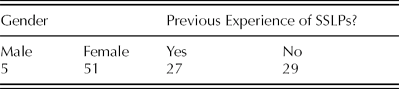
A total of 56 semi-structured interviews were conducted with service users over a six month period (May–October 2007) and with a broadly equal split in terms of those associated with the two ‘new’ SSCCs (and thus being involved for around 15 months or less), as well as those involved with SSCCs that had emerged from previous SSLPs (and with this cohort on average being involved in SSLP/SSCC arrangements for three years or more). In addition, there was a general balance according to whether individuals had previously experienced/had not previously experienced SSLP services (see Table 1 below), and with the sample reflective of a strong gender (female) bias amongst users of SSCC services.
Gender and previous experience of SSLPs among current SSCC service users in the case study areas
Interviewees included a mixture of users who had experience of varying involvement in activities of co-production, which included being members of management boards and working groups, as well as those who described themselves as only ‘service users’. However, the views of the latter group were of equal interest, particularly in relation to their level of awareness of the opportunities for involvement in SSCC arrangements, as well as perceived and actual barriers to engagement in co-production activities.
Whilst the research findings are not intended to be wholly representative of co-production in SSCCs, they are designed to provide an insight into the extent to which the new SSCC arrangements exemplify co-production and to inform broader (related) research considering the ability of SSCCs – as well as other policy initiatives – to both involve, and respond to, the needs of those experiencing ‘deep exclusion’ (Levitas et al., Reference Levitas, Panatzis, Fahmy, Gordon, Lloyd and Patsios2007).
Sure Start Children's Centres and co-production in service delivery
As the National Evaluation of Sure Start (NESS) criticised the original SSLPs for not effectively engaging the most ‘excluded’ individuals and families, for example those from Black and Minority Ethnic (BME) communities (Craig et al., Reference Craig, Adamson, Nasreen, Shehzad, Dadze-Arthur, Elliott, McNamee and Murtuja2007), it is the government's expectation that SSCCs will help such individuals to both receive (and benefit from) services provided through SSCC arrangements, as well as being actively engaged in their delivery. This is because of (1) the availability of ‘best practice’ information as identified in various guidance documents by the former DfES (DfES, 2006a; 2006b) and (2) new support from the Together for Children (TfC) consortium – a group of professional experts (appointed by the former DfES) to help SSCCs/local authorities to identify priority and excluded families and develop appropriate strategies for reaching the excluded.
However, interviews with both parents and carers across all of the SSCCs revealed that a mixed picture was emerging with regards to the degree that they were able to both target – and subsequently engage – those individuals experiencing economic and social exclusion. For example, over a quarter of interviewees (15 in total) from both ‘new’ SSCCs and those that had previously been involved with SSLPs felt that those individuals with the most difficulties were still not accessing services/activities being delivered through SSCC arrangements in their areas.
Thus from a co-production perspective, it appears that the new arrangements had yet to move any further forward than previous SSLP arrangements with regards to actual involvement of those who could potentially benefit most from SSCC activities in service delivery. This in some part may be related to the lack of time by professionals to create links and to build up trust with users. Furthermore, it appears that there may actually have been a regression of involvement in the co-delivery of services in that a number of SSCCs were now being developed on school sites. This had led a number of interviewees to comment over the negative perceptions that individuals were associating with these types of locations (particularly if they had a poor educational experience), and thereby hindering involvement in service co-production.
Indeed, given the obvious lack of male participation in the research and in SSCC activities across the four centres more generally, it was suggested that their involvement in SSCC delivery activities needed to be strengthened in a number of ways. Examples included (1) a better consideration to the timing of SSCC activities/services, since many father's appeared to be working during the day, (2) a greater delivery of ‘male-orientated’ activities, such as sports schemes/sessions with perhaps an element of competition and (3) greater involvement of father's at an earlier stage in parenthood.
It was additionally noted that few members of local BME groups participated in the general activity sessions on offer under the new arrangements at all four SSCCs, paralleling findings in relation to the previous SSLPs. Notwithstanding this, the creation of a BME-only activity session in order to promote the co-delivery of targeted services to such groups at a new SSCC in one area (Wirral) was regarded negatively by some interviewees who viewed such activities as ‘favoritism’ towards particular groups of individuals over others. This exemplifies some of the difficulties facing SSCC managers in terms of balancing individual needs against broader social cohesion issues.
In terms of SSLPs, it has also been pointed out that children/families were frequently better targeted and involved in the delivery of services by health-led SSLPs because of their (enhanced) ability to access health agency databases and which provided the ability to establish relationships with parents at the pre-natal stage (Anning et al., Reference Anning, Stuart, Nicholls, Goldthorpe and Morley2007). Therefore guidance documents recommend that SSCCs develop effective relationships with the relevant health sector organisations operating in their area. In turn, this could assist with engaging potential and actual service users in the co-production of services at the earliest opportunity. Recent research, however, shows that there is a need to strengthen such partnership arrangements in some instances (Bourne, Reference Bourne2006; Department of Health (DOH), 2007) and whilst it was encouraging to find that around half of all interviewees in our research had received information about SSCC services through a health professional (such as a midwife/health visitor), the actual involvement of individuals in co-delivery was less evident. A number of individuals were therefore of the opinion that a greater degree of information delivered in the pre-natal period would have assisted in this process.
The fact that SSCCs are now envisaged to deliver services over a wider geographical area than SSLPs was welcomed by a number of users in terms of extending potential benefits to a greater number of children/families:
I knew of someone in the next street who in the past couldn't attend because she lived outside the SSLP area – that's crazy, it's much better now that anyone can go if they need to.
Interviewee 23 (Female aged 20–9, Wirral)But from a co-production perspective, this geographical extension – according to most interviewees who had been involved with previous SSLPs – was impacting detrimentally due to the fact that: (1) they were unable to respond to the increased demand for certain activities (such as day trips that they had organised); (2) outreach activities were having to be ‘spread’ more widely with the implication that they were both having to become more reliant on professionals to undertake such activities (and who were also struggling to sustain the same level of intensity of outreach), as well as having less ability themselves (lack of financial resources and time) to target and engage those families requiring most support in SSCC activities. This is a crucial point given that the research has indicated that SSCCs are yet to fully engage all groups/individuals at the most basic level – i.e. as service users. It is not surprising to note that national research in this regard suggests that the move to the new SSCC arrangements may be hindered by insufficient resources – as has been the case in the US context for those programmes upon which SSLPs were originally based (Gray and Francis, Reference Gray and Francis2007), and particularly in relation to outreach provision (Bourne, Reference Bourne2006).
On a more positive note, Bovaird (Reference Bovaird2007) has highlighted that the involvement of parents in service delivery can have an added impact in terms of furthering the future involvement of other parents/carers and to an extent this was borne out through the research on Greater Merseyside. For example, a number of parents (around one-quarter of those interviewed and concentrated in the SSCCs that had emerged from SSLPs) had volunteered to befriend/support ‘newer’ parents/carers at activity sessions and suggested that they were acting as the ‘faces’ of certain initiatives within their local community to encourage involvement in appropriate SSCC activities. Given that the research indicated that this appeared to be helping to generate trust by others who ‘were in the same boat’, this did not appear to have markedly changed their relationship with others within their community as of yet in terms of any accusations that they had ‘gone native’. In contrast, several interviewees highlighted that they were afraid of speaking to professionals (such as health visitors) about their concerns without such support.
In addition, a further five interviewees from both ‘new’ SSCCs and ones that had been established from SSLPs highlighted that they either worked on the reception desk at a centre or helped out at childcare sessions in order to try and ensure services were accessible and user friendly, whilst one further interviewee noted that they had recently been put forward by staff to receive baby massage training in order that they could deliver such a service in the future. In this respect, the evidence suggests that some parents/carers were becoming paid co-producers of services, although this appears to be a small minority at present: the majority appear to be unpaid with regards to their wider involvement in service planning and monitoring and evaluation activities.
To summarise, it certainly appears at this (admittedly) early stage of implementation that there are clear opportunities to extend the involvement of users in the co-delivery of SSCC services, and particularly in terms of both targeting and engaging those who SSLPs found more difficult to engage, such as BME groups and males (fathers). However, this will require a greater consideration of how to overcome (negative) perceptions of socially excluded individuals, where SSCCs have emerged on school sites; better intelligence on the location, characteristics and needs of such persons; and sufficient resources for outreach activities over a wider geographical area.
Sure Start Children's Centres and co-production in service planning (design, commissioning and managing services)
The current ECM website – drawing upon best practice from SSLPs and other interventions – suggests that parents should now be involved in all aspects of SSCC centre design and delivery in order to better tailor services to meet local needs and in recognition of the fact that
families are unlikely to take up any service provision that they feel has been imposed on them. (www.everychildmatters.gov.uk, 12 November 2007)
Subsequently it recommends a number of ways in which parental involvement in the governance arrangements of SSCCs could be enhanced, and which are based upon previous experience:
• by holding meetings at times parents are available;
• by limiting the use of practitioner jargon;
• by making sure groups are inclusive and that all members are made to feel that their views are important; and
• by providing training where necessary to give parents the techniques and confidence to understand and represent the views of others. (ibid.)
Such approaches appear to be crucial to stimulating the engagement of parents/carers in SSCC governance arrangements as interviewees felt that ‘business-oriented meetings’ tended to attract fewer people:
The first time you go (to a board meeting) it's daunting . . . talk about budgets and targets does kind of go over your head.
Interviewee 35 (female aged 30–9, Wirral)Within the case study area there appeared to be a number of ways in which parents/carers had participated in both planning and designing SSCC services, as well as their subsequent management (commissioning was regarded as a relatively recent development in the context of SSCCs and with frameworks still being developed). Examples included individuals being members of parent's forums or on working parties. The provision of childcare was noted by interviewees as being very helpful in facilitating such involvement along with relevant training to participate in more formalised board meetings concerned with the nature and costs of delivering particular services.
However, what also emerged from the research was that there were a substantial number of interviewees (over 30 per cent) who did not appear to be aware of any opportunities for involvement in SSCC service planning, design, commissioning or management. Furthermore, if analysis is broken down in terms of considering the responses of those who were previously involved in SSLPs, it appeared that a similar situation existed under SSLP arrangements and that the move to SSCCs had simply perpetuated a lack of awareness of how to become involved in the co-production of the above activities. Thus, it appeared from analyzing interview transcripts that it was only parents/carers who had been approached specifically with regards to becoming engaged in SSCC decision-making and who had become involved beyond the level of either service user or service co-deliverer.
Notwithstanding the fact that those within these latter categories often found it difficult to verbalise what aspects of SSCC service design or management they would most like to influence, a number of examples were provided by interviewees, including:
• involvement in shaping the types of subsistence provided at SSCC activities;
• identifying places to breastfeed;
• highlighting anti-social behaviour issues in the neighbourhood and ‘problem’ parents;
• support for children with special needs; and
• road and outdoor safety (and safe outdoor play) as opposed to home safety.
For both service users and those who had become involved in SSCC planning/management arrangements, there appeared to be less interest in becoming involved for increasing one's own confidence or employability (and remuneration). Instead, the prime motivation was to try and influence future outcomes for their children, which highlights their role as unpaid co-producers. But among those who had been involved in decision making at the highest level, the most frequently reported impact of this involvement upon the interviewee was an increase in their self confidence – and this has also been found to be the case in other studies (Williams and Churchill, Reference Williams and Churchill2006). In turn, it was suggested that this was providing additional benefits in terms of improving the confidence of their children.
Nevertheless, there are also a number of limitations to co-production in terms of service design, planning, commissioning and management that need to be recognised, such as differences in values between the stakeholders in the co-production relationship, ‘burnout’ of co-producers, a potential dilution of accountability and the political difficulties of handing over power (Bovaird, Reference Bovaird2007).
The research undertaken within Greater Merseyside picked up on a number of these points. First, whilst ‘burnout’ could not readily be ascertained in relation to the ‘new’ SSCC interviewees that were targeted through the research, it was generally apparent also that this did not appear to be a problem as of yet for those who had previously participated in SSLP arrangements: in basic terms it appeared that the same individuals were involved. Whilst this finding clearly relates to a need to broaden involvement in co-production activities per se in order to try and achieve more appropriate and effective policy solutions, perhaps the more pressing issue relates to higher levels of turnover highlighted in respect of professional staff. This was because practitioners and service users alike reported that many officers who had previously been involved in SSLP arrangements had left with the shift to SSCCs due to changes introduced with regards to their terms and conditions of employment and the changing role of local authorities in becoming lead accountable bodies under the new arrangements.
The latter point is relevant to the other difficulties raised by Bovaird (Reference Bovaird2007) in relation to changes in political accountability and ‘power’ with the move to SSCCs. Within this context, SSCC guidance issued by the former DfES specifies that under the new arrangements parents/carers should be proportionally represented (‘one-third’ parents) alongside statutory agencies on management boards. This is in order to try and ensure that their views are given equal weight in terms of the decisions taken over the commissioning and management of services (DfES, 2006a, 2007). Nevertheless, the evidence from interviewees who were involved with both the ‘new’ SSCC management boards and those involved with those that had developed from previous SSLPs was that this wasn't happening. In the words of one interviewee:
It does feel a bit like the big bosses are taking things forward . . . more could be done to ask parents for their views . . . on a board of 20 there is often now only one parent.
Interviewee 53 (Female aged 30–9, Knowsley)Compounding the situation is the fact that with local authorities becoming the accountable bodies for SSCCs they have now assumed responsibility for ‘signing off’ the budgets agreed by the respective management boards. This – it was argued by those who had previously been involved with SSLPs – was in some situations beginning to dilute local accountability and power over decision-making, and a number of interviewees suggested that it had actually contributed to former SSLP staff deciding to take up alternative employment. Additionally, concerns were also raised in the co-production context of the suitability of head teachers and/or school governors to remain impartial where SSCCs were being based on school sites.
In sum, although there is evidence of the involvement of some service users in the planning, design and (subsequent) management of SSCC services, there could be opportunities both within the case study area and beyond to strengthen the representative involvement of parents/carers in the new arrangements in order to facilitate entry into a more equal co-production relationship. One way this could be undertaken is to ensure that they are provided with adequate training and access to crèche facilities, along with support from a mentor where necessary (either a parent or practitioner). There is also a requirement for such representation to be meaningful in terms of their ability to influence decisions on budget allocations and service planning, as this will impact on the subsequent engagement and retention of users in the design, planning, commissioning and management of SSCC activities.
Sure Start Children's Centres and monitoring and evaluation activities – the missing element of co-production to date?
In the context of co-production Wilks-Heeg (Reference Wilks-Heeg, Imrie and Raco2003: 213) has noted that many attempts to introduce more innovative, community-based approaches to evaluation at the local level have generally ‘run into sand’. As a result, there is a particular interest in the extent to which the SSCCs are building upon the NESS evaluation and actively involving interviewees in monitoring and evaluation activities.
Around ten interviewees across the four SSCCs noted that feedback was often sought via completion of questionnaires, usually at the end of a period of involvement in an activity session delivered via the SSCC. Some parents noted that this had resulted in changes to services in certain instances (for example, the creation of a new group for under 1s). But there appeared to be no mention of formalised monitoring and evaluation approaches that drew upon users and their communities in shaping, developing and implementing such activities, although some individuals who were involved in both previous SSLP arrangements and the ‘new’ SSCCs reported gathering views from other parents by way of questionnaires, ‘suggestion boards’ and over the telephone as part of their role on parent's forums.
Consequently, interviewees were also asked for their views about the aims of SSCCs in order to help frame the extent to which they felt that current government indicators to measure the success of SSCCs fitted with locally identified, community priorities. Whilst the Government's focus has increasingly concentrated on issues such as the employability and education of parents in terms of both work-related and parenting skills (Glass, Reference Glass2005), the majority of parents/carers in the case study area appeared to be unfamiliar with such outcomes. Moreover, concerns were raised over the relevance of some of the national indicators being used to assess outcomes and their current relevance to local circumstances. In this respect, the breastfeeding indicator set for SSCCs generated considerable (negative) responses from parents, especially as it was felt that the indicator influenced a somewhat negative attitude from many health professionals towards parents who did not select this method to feed their baby (also see Clarke, Reference Clarke2006). Likewise, an indicator concerned with obesity was also viewed as being problematic for some parents:
What about children who don't eat and who are malnourished? . . . the problem of anorexia, for example.
Interviewee 7 (Female aged 20–9, Wirral)Further issues of relevance to evaluation indicators raised by interviewees related to the ‘Stay Safe’ target often being focused towards improving safety in the home, whereas road safety and anti-social behaviour problems were deemed by individuals to be of more relevance in the local context.
More generally, the use of ‘fixed’ quantitative indicators by the Government was criticised on the basis that they often failed to adequately capture individual (qualitative) experiences of children/families and that their needs can change quite dramatically over time:
Increasing the number of parents initiating breastfeeding – it doesn't say anything about how long they are expected to do it – is that once, for a week, or for 6 months?!
Interviewee 15 (Female aged 30–9, Knowsley)Therefore, interviewees argued for more priority to be placed on qualitative indicators such as individuals’ experiences of the quality of service provision, as well as in relation to measuring changes in individuals’ levels of confidence and trust over time. Other suggestions also included measuring ‘a mother's well being’ as a key measure of success, as this was felt to underpin all the other outcomes. But the likelihood of moving away from quantitative measurements of performance is arguably limited given positivist traditions of evaluation (Wilks-Heeg, Reference Wilks-Heeg, Imrie and Raco2003) and the fact that quantitative data are often the preferred choice by central government departments, even in relation to programmes focussed upon community-driven services. This is borne out in a recent report by the National Audit Office (NAO) of SSCCs (Bourne, Reference Bourne2006) which largely recommended an evaluation model based on the collection of statistical data gathered by SSCCs themselves and through collecting data from central government departments, such as the Department of Work and Pensions (DWP).
A number of interviewees did suggest, however, that some statistical information would be useful to help SSCCs identify the proportion of local children/families that were actually engaging with the centre. This is interesting, as monitoring ‘reach’ into particularly excluded groups is identified as being important in the performance management of SSCCs and in the context of comments from researchers who have criticised NESS for its lack of focus upon service up-take (Barrett, Reference Barrett2007).
To summarise, more could be done to engage service users in developing a local monitoring and evaluation model for SSCCs, which goes beyond the simple completion of questionnaires. This would help in capturing both levels of ‘reach’ and local issues of relevance, as many users’ responses were mainly concerned with measuring non-economic outputs and outcomes, such as improving children's education, as well as providing parents and children with opportunities to socialise, as it was suggested that this would reduce the isolation of parents and improve children's confidence (and subsequently strengthen social networks).
Conclusion
Accepting the limitations of the focus on one case study area and the relatively recent development of SSCCs, the paper indicates that the move from SSLPs to SSCCs in this part of England appears to have not yet provided significant opportunities for users to shape and engage with service delivery. In contrast, there appears in the case study area to have been a slight shift from the co-delivery of professionally designed services associated with SSLP approaches to more traditional models involving the planning and designing of services involving either ‘distributed commissioning’ or ‘user consultation’ rather than users and their communities solely delivering services themselves. Indeed, from a service planning and monitoring and evaluation perspective there is even less evidence of user/professional co-production. This is illustrated in issues over the lack of equal representation for parents/carers on some of the new SSCC management boards, as well as through the enhanced role for local authorities in ratifying funding allocations for subsequent service delivery. It is also seen in the current failure to involve and develop the skills of parents/carers in shaping the relevant local indicators of progress.
Barriers that appear to be of relevance to the greater involvement of users in such co-production activities include: (1) a lack of time to implement (and develop trust within) the new arrangements; (2) a subsequent lack of awareness of the opportunities to participate in SSCC service planning and management activities; (3) the location of a number of SSCCs on school sites and the promotion of a broader education/economic agenda arguably at the expense of non-economic local priorities; and (4) the geographical extension of SSCC boundaries (compared to SSLPs) impacting upon the intensity of outreach with those least likely to up-take/participate in SSCC activities (such as BME groups and males).
The fact that a more education/economic agenda aimed at parents is being promoted by SSCCs may also be detrimentally impacting upon user motivations to engage and maintain their involvement in the new arrangements. This is because the majority of interviewees highlighted that their primary motivation for becoming involved in service delivery or service planning was non-economic and more focused around increasing their own self-confidence and on enhancing opportunities for their children. In turn, this may impact upon rates of ‘burnout’ and retention of their interest in the future, and particularly if local authorities (as accountable bodies) are perceived as having ‘control’ over the nature and delivery of services, as well as how their impact is assessed.
As a result, the practical recommendations that emerge from the research that could assist in addressing such difficulties/barriers to user co-production include sufficient funds being allocated to support outreach activities that are conducive to the targeting and involvement of excluded individuals by SSCCs, and the subsequent modification of design and delivery arrangements for services as appropriate, as well as ensuring that parents/carers are equally represented in the highest levels of decision making on SSCC boards (and that they have equal influence over decision-making). The latter could be undertaken through raising awareness of such opportunities and the provision of training/childcare, mentoring and suitable meeting times, as appropriate. Interviewees also pointed out the need for a greater focus on how current national performance indicators/targets for SSCCs acknowledge changing local circumstances as well as the quality of service provision being experienced.
Without such actions, the SSCC approach may simply involve users becoming service ‘recipients’ and that co-production fails to provide integration and enhanced effectiveness in policy-making, service delivery and in the monitoring and evaluation activities of SSCCs. This would ultimately compromise efforts through such interventions to address the needs of those experiencing pronounced difficulties (Levitas et al., Reference Levitas, Panatzis, Fahmy, Gordon, Lloyd and Patsios2007) and broader government efforts to address levels of intergenerational exclusion and child poverty.