Recent calls to “Make America Great Again” beg the questions of what, exactly, constitutes greatness and when this phenomenon peaked. Although such calls appear to reference the post–World War II era, when the U.S. manufacturing sector outcompeted rivals, union jobs paid middle-class wages, major civil rights legislation still lay on the horizon, second-wave feminism had not crested, and racist immigration policies advanced white nationalist aspirations, President Donald Trump has also hearkened back to an earlier time. At an Ohio rally that began with a profession of enthusiasm for being “back in the center of the American heartland,” in the midst of “thousands of true American patriots,” the President heralded the era before things had gone so wrong: the waning days of the Gilded Age.
The great president from the state of Ohio, William McKinley and you know William McKinley, does anybody know who the hell he is? Do you know who he is? William McKinley understood that when America protects our workers and our industries, we open up a higher and better destiny for our people. We don't protect our people. We don't protect. Trade comes in, goods come in.Footnote 1
Leaving aside the confounding question of who the hell McKinley was, this statement is difficult to follow as it jumps from past to present, destiny to destiny thwarted.Footnote 2 But the conclusion is clear: the Ohioan William McKinley deserves to be labeled great because he was a border enforcer. He is a touchstone in a rally peppered with references to walls, defense, policing, patrolling, gatekeeping, security, and protection—that is, on hunkering and bunkering down. To find true greatness, we need to go back before the so-called American century, back before our own global age, to the time when heartland values ruled and goods did not come in.
To those of us who have an inkling of who the hell McKinley was, this statement may seem to be one more brick in the edifice of imperial denial. By associating McKinley only with the 1890 tariff he pushed through as a member of Congress (the inflationary implications of which contributed to a Democratic takeover of the White House and House of Representatives in the election of 1892), this statement casts McKinley as the defender of a vulnerable nation, not as the imperial president who supported the wars and annexations of 1898.Footnote 3 This statement does not invite reflection on the ways that the higher and better destiny for “our people” was connected to forms of violence against others, most notably the imperialist war in the Philippines that killed, according to low-end estimates, half a million people, and as many as three million in other tabulations.Footnote 4 As President, McKinley's keywords were not “wall-building” but “benevolent assimilation,” the euphemism for bullet-backed rule. Like the missionaries who poured out of the rural Midwest, McKinley's dream was to remake the world along normative middle-class American lines.Footnote 5 Back in the day of McKinley, the region that later became known as the American heartland was not the last refuge from an unfair and dangerous world but the beating heart of a rising power.
Casting McKinley and the nation he led as vulnerable and self-protective rather than power-wielding and aggressive may be the most obvious way this reference to greatness both draws on and contributes to nationalist mythologies. But it is not the only way. By insinuating that in this heyday of greatness goods did not come in, thanks to the wall-building efforts of heartlanders epitomized by McKinley, this celebration of protectionism builds on and advances the assumption that the “true American patriots” of the Midwest have stood staunchly behind turnstile borders that have enabled U.S. exports and access while keeping foreign goods and people out. Claiming that the United States once achieved security by throwing up barriers suggests that the nation's destiny has rested in its own hands. Such claims misrepresent not only the backstory to the modern heartland but also the world system that created this ostensibly most American of places.
In my remarks today, I am going to delve a little deeper into the time of McKinley to offer some historical reflections on the larger mythologies that President Trump has been tapping into: American innocence in a predatory world, the association between the heartland and wall-building proclivities, and a tradition of self-made security. I'll do so by drawing on my research on the home county of the other William McKinley—Congressman William Brown McKinley, who represented my district in east-central Illinois from 1904 to 1921.Footnote 6 As a predominantly rural and majority white area, central Illinois cannot stand in for the Midwest as a whole. But since the nationalist mythologies encapsulated by the word “heartland” hold up the rural Midwest in particular as the quintessentially all-American place, digging deeper into the history of the rural Midwest can help us get to the bottom of taproot assumptions about a well-bounded national core.Footnote 7 Although local history is my launching pad, my goal is not to dwell on a specific place. Rather, I use local history research as a method through which to uncover the shaping of social consciousness in a marketplace society.
Those of you with a background in either agricultural or foreign relations history—or more unusually, both agricultural and foreign relations history—are no doubt thinking: been there, done that! And indeed, fifty years ago this year, William Appleman Williams covered this ground in The Roots of the Modern American Empire: A Study of the Growth and Shaping of Social Consciousness in a Marketplace Society. As readers of Williams's work well know, he rejected the idea of national innocence, insisting instead on American empire. He likewise rejected the idea of isolationist impulses, emphasizing instead the agrarian pursuit of export markets. And he acknowledged the limits of national will by alluding to the financial power wielded by Europe.Footnote 8
But Williams only got the half of it. Although he depicts the rural heartland as a wellspring of empire, he does not regard it as imperial in itself. His account evades the settler colonialist politics that created this region within the United States, instead spotlighting the power wielded by East Coast and European capital. It also overlooks the history of goods coming in, thereby contributing to the perception that only the export side of the ledger is relevant to economic advancement. Having missed the full extent of the rural Midwest's globality, Williams misleadingly suggests that the roots of the modern American empire were thoroughly domestic. Given that this is a lunchtime address, I hope that my remarks will illuminate part of the backstory to our contemporary food system. But my main goal is to build on Williams's work by exploring the gap between the walled-off heartland of white nationalist myth and the more open terrain of history.
Settler Colonialism
Williams's attention to the roots of the modern American empire misses the deepest taproots of all, for it does not address the histories of colonial violence that brought Indigenous peoples’ lands into the hands of white U.S. farmers.Footnote 9 Williams may have periodized the history of North American colonialism as the premodern prequel to his history of the modern American empire, but settler colonialism was still very much a work in progress in the late nineteenth century, its effects palpable across the Midwest. Colonial incursions continued to inflict harm on the Indigenous people of the Midwest, in part through further land losses resulting from allotment.Footnote 10
Midwestern farmers not only took land from proximate peoples—they also sought land further to the west. An 1890 railway ad published in the Chicago-based Prairie Farmer hawked homeseekers’ excursions to several western states and territories, “including the great Sioux Reservation” in North Dakota.Footnote 11 A later ad for “Homeseekers’ Excursions” published in another Illinois newspaper mentioned British Columbia and Manitoba as well as “Indian Territory” as destinations.Footnote 12 Predicting that immigration and natural increase would cause midwestern farmland to become increasingly scarce and expensive, the Prairie Farmer encouraged readers to regard Canada, Mexico, and the West Indies as places that could be added to “our land resources.”Footnote 13 As the search for land reveals, the imperialist impulse emanating from the Midwest involved far more than just a quest for markets.
Indigenous people also moved in this time period, though less willingly in the context of forced dislocation, land losses, and violent onslaughts. The Kickapoo people, who once lived in what is now Ontario, serve as an example: having moved in the eighteenth century into areas in the present-day states of Michigan, Indiana, Wisconsin, and Illinois, most were forced from their villages in the first half of the nineteenth century. Resisting the policies that aimed to sedentarize them on reservations and as farmers, housekeepers, and desk-bound students, some moved to Coahuila, Mexico, over the course of the nineteenth century, hoping to find the freedom of mobility and national self-determination denied to them in the United States. In 1873 a U.S. cavalry regiment under the command of Colonel Ranald S. Mackenzie rode eighty miles into Mexico to kill and kidnap Kickapoos suspected of cross-border raiding. Finding most of the men out on the hunt, Mackenzie took women and children as hostages to force their family members to move to Oklahoma where they could be closely guarded. The Kickapoos who managed to stay in northern Mexico soon found their access to land, game, and water reduced by expatriate American ranch owners, hunters, and mining interests. For Gilded Age and Progressive Era midwesterners such as the Kickapoos, colonialism was not just an artifact of history—it was the pressing political economy of the present.Footnote 14
Goods Come In: Importing the Means of Production
As The Roots of the Modern American Empire suggests, historians’ attentiveness to export markets has overshadowed attention to the matter of goods coming in. Even the arch tariff supporter, Congressman McKinley of Ohio, came to support tariff reductions, recognizing that the home market had limited potential, that any lasting trading regime depended on multidirectional flows, and that U.S. market dominance could only emerge from market access.Footnote 15 Check the advertisements for the small-town stores that dotted the rural Midwest and you will find references for Scotch and English worsteds and woolens and German-made linens.Footnote 16 Wholesale houses shipped in bananas, oranges, and lemons.Footnote 17 Furniture salesmen maintained that “mahogany holds its place in the fore front [sic] of the favorite woods;” toothache sufferers sought comfort in cocaine.Footnote 18 Declarations of a humanitarian desire to feed the world notwithstanding, a main purpose of exports was to bring in payments from overseas so as to buy such goods. As an Illinois Grange supporter phrased the matter in 1877, “The farmers of Illinois can supply the world, if need be, with meat and grain—with wheat, corn, hogs and cattle, and why they should not be suffered to buy as freely as they are allowed to sell in the markets of the world, is one of the infamous outrages of the age and time.”Footnote 19
In demanding reduced tariffs, this farmer may have been thinking of the imported consumer goods associated with prosperity. But his demand to buy freely may also have referenced the means of production. The white settlers who took Indigenous people's lands tended not to favor indigenous crops, with the major exception of maize. Yet even their corn differed from the varieties that Indian women had grown on the same plots of land. The common yellow dents of midwestern cornfields came from crossing white southern dents, of mostly Mexican origin, with flints from the Northeast.Footnote 20 The other crops planted by white settlers came from further afield, resulting in a massive biological transformation of the region that stretched from pioneer times into the twentieth century.
Although the pioneers came to the swamps, prairies, and forests of the Midwest bearing seeds, their descendants looked wider afield for plant material. Wheat, oats, rye, sorghum, millet, barley, alfalfa—all imported. Apples, pears, raspberries, onions, currants, turnips, walnuts, peaches, potatoes—imports. Though present from the start, efforts to enhance taste and productivity through the introduction of new and improved varieties took off after the Civil War. Congressmen distributed seeds (some of dubious quality) to farmers in their districts; fledgling land grant colleges tested other introductions—such as the sugar beet—on their plots prior to wider distribution.Footnote 21 Commercial purveyors played a major role in spreading plants. One Chicago nursery hawked European varieties of artichoke, cabbage, peas, and leeks, along with Early Paris, Large Asiatic, and Italian New Early Giant cauliflowers and French scarlet and Belgian green top carrots.Footnote 22 Attention to places of origin prompted farmers to understand their embeddedness in global systems of horticultural development.Footnote 23
Joining commercial nurseries in the effort to introduce new plants, bioprospectors employed by the U.S. government scoured the globe for promising germplasm following the establishment of the Section of Seed and Plant Introduction in the U.S. Department of Agriculture in 1898.Footnote 24 In 1899, President McKinley praised the National Department of Agriculture for importing grains, grasses, fruits, legumes, and vegetables.Footnote 25 That same year, the Illinois Agriculturist reported on Asian varieties of cow peas (black-eyed peas).Footnote 26 By 1900, midwestern farmers were experimenting with the Japanese “soja bean,” encouraged by reports that it was “relished by stock both for its seeds and vines.”Footnote 27
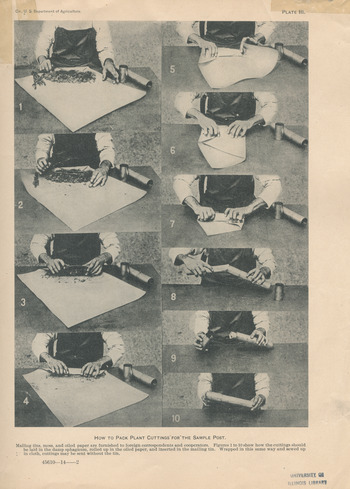
David Fairchild, the “Agricultural Explorer in Charge of the Office of Foreign Seed and Plant Introduction,” provided guidelines on packing roots and grafts (also referred to as cuttings and scions) for shipment to his office. He admonished readers to provide the fullest details possible for “each new plant immigrant.” David Fairchild, “How to Send Living Plant Material to America,” United States Department of Agriculture, Bureau of Plant Industry, Office of Foreign Seed and Plant Introduction, 1913, plate 3.

The rich soil of the Midwest meant that its farmers did not need to join with those in the U.S. southeast to import guano from Pacific and Caribbean islands to fertilize their fields.Footnote 28 Yet they nonetheless altered the chemical composition of their soil by purposefully introducing a German bacteria with the capacity to produce nitrogen.Footnote 29 Adding to their ecological impact, Euro-American farmers transformed the wet prairies east of the Mississippi by employing European drainage techniques to fast-track water out of swampy fields.Footnote 30 They marked their boundaries in part through the European practice of hedging.Footnote 31 To bind the sheaves of grain that dotted their fields, they relied on twine made of the Yucatecan fibers henequen and sisal.Footnote 32
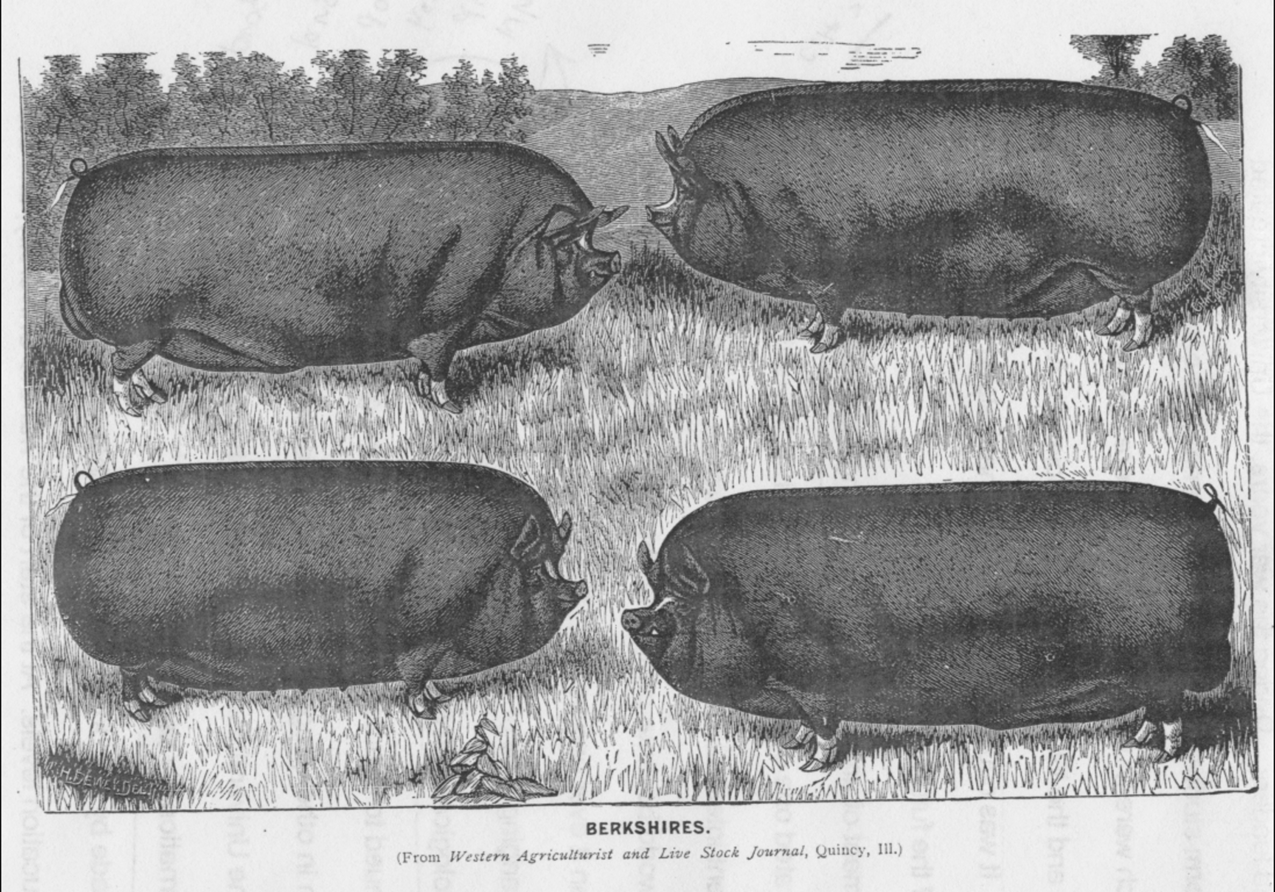
Along with importing seeds, bacteria, methods, and fibers, midwestern farmers imported animals. The popular Berkshire hog had been developed by farmers in Berkshire, England, who crossed their pigs with Chinese pigs, carried from East Asia on the ships of empire.Footnote 33 Many of the pedigreed Shorthorn cattle found on midwestern farms had come to the United States from Britain via Ontario, whose breeders and dealers had close connections to Britain.Footnote 34 The Illinois State Fair awarded poultry prizes for “Spanish,” “Hamburg,” “Polish,” “French-Houdan,” and “Asiatic” categories (the latter of which encompassed the Brahma variety, with South and East Asian ancestors). Additional prizes went to Cotswold rams.Footnote 35 The Percheron, Clydesdale, and English Shire horses that performed heavy farm labor before the widespread adoption of mechanical tractors had recent immigrant forebears as well.Footnote 36 Importations extended to honeybees, with apiary owners preferring Italian bees to Cyprian, Carniolan, and German bees.Footnote 37 The editor of the American Corn and Hog Journal summed up the matter: “We have imported the valuable stock of all nations, until we have the best stock produced on earth.”Footnote 38
The popular Berkshire hog—trumpeted as an Anglo-Saxonist pig that could uplift lesser breeds—traced its ancestry back to English and Chinese forebears. George Washington Curtis, Horses, Cattle, Sheep and Swine, 2nd ed. (New York: The Rural Publishing Co., 1893), 295.

The pioneers believed that the best stock included people. As American exports drove European grain prices down between 1871 and 1891, hard-pressed European farmers decamped for cities, Latin America, British settler colonies, and the United States.Footnote 39 A fifth of the population of Illinois between 1860 and 1880 was foreign-born.Footnote 40 In 1900, over 60 percent of Illinois voters were immigrants or the children of immigrants.Footnote 41 Local histories praised the most successful of these immigrants and their children as examples of type, as in the case of a farmer named Herman Schwanderman, said to represent “that sterling and industrious stock of people that came out of Germany.”Footnote 42 Although some native-born farmers worried that their immigrant neighbors stuck to themselves, resisted assimilation, and (in the case of German-speakers) posed a worrisome security threat during World War I, they also saw many of these neighbors as they saw their pedigreed animals—as the kind of high-grade types that would advance the greater cause of regional development and prosperity. President McKinley's pledge to “secure the United States from invasion by the debased and criminal classes of the Old World” referenced the southern and eastern Europeans who provided much of the labor needed by industry rather than the earlier arrivals from northwestern Europe who had been able to purchase land recently wrested from Indians.Footnote 43
Alliance Politics
Midwestern farmers sought foreign goods such as plants and animals not only from ambitions of betterment but also from an acute sense of threat in the late nineteenth century. Looking out at the world, a number of midwestern farmers feared being outcompeted, especially as advancing settler colonialism, railroad and shipping links, livestock investments, and improvements in refrigeration knit the farmers and ranchers of Russia, Australia, Argentina, Uruguay, Paraguay, Brazil, Chile, and India (among other places) more thoroughly into global commodities markets.Footnote 44 The realization that U.S. agricultural implement manufacturers were selling to potential rivals only added to feelings of dread.Footnote 45 European tariff barriers and ostensibly health-based restrictions on American pork made things worse.Footnote 46
The growing sense of vulnerability and foreboding caused some farmers to demonize Britain and lesser European powers for blocking the expansion of American exports and to embrace the protective tariffs so dear to the hearts of Republicans from manufacturing districts.Footnote 47 But even tariff supporters did not want to wall themselves off from the great European empires of the day, as evidenced not only by their ongoing search for export markets but also by their eager pursuit of scientific agriculture.
The 1862 Morrill Land-Grant Act that advanced the cause of scientific agriculture through establishing land grant colleges originated in lobbying efforts that cited European agricultural institutions as precedents and standards.Footnote 48 The subsequent development of rural extension programs likewise owed debts to European models.Footnote 49 From their inception, agricultural institutions subscribed to European agricultural publications, hosted European and Canadian agricultural experts, tested new strains and methods, and collected biological specimens. Their faculty—a notable number of them European and Canadian in origin or educated in Europe and Canada—corresponded with overseas colleagues—mostly in northern Europe—and crossed the Atlantic to visit agricultural shows and international exhibitions.Footnote 50 In justification of their cosmopolitan practices, supporters of scientific agriculture insisted, “We must not allow ourselves to be left behind in this most important occupation of many of our people.”Footnote 51
Newly fledged land grant colleges offered more than technical education: they also offered language instruction and humanities courses on other parts of the world.Footnote 52 Although part of the goal was to learn about human attainment and culture, the value of area studies knowledge for market access was not lost on farmers. After urging “an intelligent application of those practical methods which are the result of the combined thought and experience not of America, but of the world itself,” the U.S. commissioner of agriculture alluded to the commercial value of geographic knowledge: “Our people, competing as they do in foreign markets, ought to have the advantage of every avenue which promises the latest information relative to foreign needs and foreign methods.”Footnote 53 Scientific agriculturalists strongly believed that knowledge should come in, for the enrichment of the country.
The Heart of an Empire
As their close partnerships with European agriculturalists suggest, midwestern farmers aligned themselves with the European powers. Indeed, they literally nourished these industrializing powers—Britain especially—by supplying them with grains and meat, including notable amounts of the beef and salt pork used for military rations.Footnote 54 To the extent that they supported tariffs, midwestern farmers wanted to enhance their own position in the European-dominated world system of the day, not to upend that system.Footnote 55
Their indebtedness to that system could be seen not only in their export ledgers but also on their farms, including in the hogs, chickens, and soja plants with recent Asian ancestors. The bioprospectors who scouted for economically valuable germplasm relied on European colonial institutions, including botanical gardens and tropical agricultural stations, European transport lines, and European military power for access and protection. Even some American plants bore European imprimaturs. Although tomatoes are South and Central American in origin, nineteenth-century nursery catalogs hawked English and French varieties.Footnote 56
All the attention to tariff walls—both at the time and subsequently—deflected attention from a fundamental and enduring set of political commitments: transimperial forms of white solidarity. Feelings of affiliation grew not only from the sense of a shared culture, religion, and ancestry, but also from ongoing commercial connections. Livestock breeders, for example, traveled to Europe and Canada to seek out breed information and purchase animals.Footnote 57 Interpersonal networks extended beyond livestock breeding associations and research expeditions to the fair circuit, in which Canadian and European breeders figured prominently.Footnote 58 As they inspected pedigreed animals with aristocratic names, they cultivated relationships that crossed national boundaries.Footnote 59
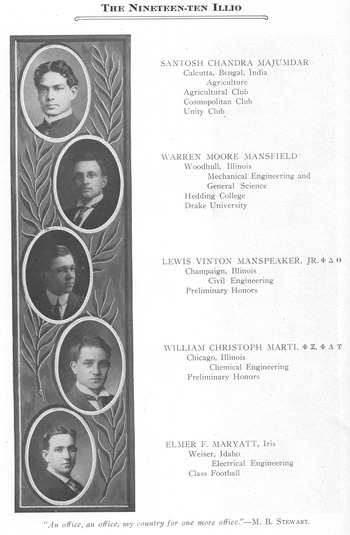
Among the students listed as “active members” of the University of Illinois Cosmopolitan Club in 1908 were thirteen students from the Philippine Islands: A. S. Arguelles, J. A. Abboleda, A. T. Cruz, S. Gallardo, A. Gerrero, P. Gutierrez, J. Hilario, F. V. Larracas, R. Sicup, J. De la Rama, J. G. Sanvictores, H. Sevilla, and N. Velez. Other club members came from Argentina, China, Germany, India, Japan, Mexico, Spain, and the United States. The 1908 Illio, vol. 14, University of Illinois (Urbana-Champaign Campus) Yearbook, 1908, 317.

These economic partnerships contributed to a larger sense of alignment that can help explain the political commitments of Congressman William Brown McKinley of central Illinois, who crossed the Atlantic thirty times before the age of air travel to advance the work of the Inter-Parliamentary Union. This group brought together legislators on behalf of international arbitration and related causes. But their professed desire for world peace hid another set of politics: nearly all the legislators who participated hailed from Europe, North America, and Australia. Their global governance aspirations fit with commitments to imperialist politics.Footnote 60 Like the Ohio McKinley, the Illinois McKinley did not aspire to live small, but to govern large. As a member of the Foreign Affairs Committee, he inspected U.S. colonial outposts in the Caribbean and the Philippines, reporting favorably on his findings.Footnote 61
McKinley's travels lent weight to his policy pronouncements, but he was not the only person in his district with firsthand stories to tell of newly acquired islands. Newspapers in his district reported on the return of Philippine-American War veterans and the activities of local residents turned colonial agents, among them Elva A. Deason, whose husband ran the government experimental farm on the Island of Negros in the Philippines.Footnote 62 After the United States entered World War I, more Philippine hands moved to McKinley's district, to staff a newly constructed military base.Footnote 63 And if he had cared to speak to colonial subjects, McKinley could have reached out to the Filipino students who had come to central Illinois to study scientific agriculture, among other subjects. These students joined with classmates from places such as Mexico, India, and China to advocate for a more radical kind of politics than those espoused by the Inter-Parliamentary Union—a politics of anticolonial solidarity.Footnote 64 If the rural Midwest lay at the heart of a rising empire, it also nurtured seeds of resistance that likewise benefitted from cross-pollination.
Conclusion
Depicting President McKinley solely as a wall-builder may be an effective way to suggest that border-enforcing, go-it alone policies emanating from the all-American heartland are the time-tested traditions that once made America great. But this characterization represses President McKinley's move away from barriers to trade and immigration and his role in expanding U.S. imperialism far beyond the shores of North America.Footnote 65 As William Appleman Williams well knew, to mind the GAPE is to remember that the struggle for commercial dominance has historically lent itself not only to the domestic disparities in wealth and power brought to mind by the term Gilded Age but also to wider cross-border inequities.Footnote 66
Yet Williams, who wrote The Roots of the Modern American Empire as the United States was sending more troops to Vietnam, could not anticipate the economic toll the war in Southeast Asia would take, much less the defensive wall-building rallies of the deindustrialized Midwest fifty years down the pike. Now, on the other side of the arc of global empire that arose in the age of McKinley, the Gilded Age and Progressive Era hold additional lessons pertaining to the important roles that white supremacist policies, incoming goods, and collaborative efforts played in the expansion of U.S. power. Just as holding up McKinley only as the consummate protector deflects attention from histories of American empire, suggesting that the heartland became what it is today by walling itself off from the world cuts the big red heart of the United States off from its own globalist past.
Acknowledgments
I would like to express my gratitude to Robert Johnston, who commented on this talk on the eve of its delivery, and to Alan Lessoff for a stimulating conversation on its contents and for his comments prior to submission for publication. Parts of this essay draw on research published in my recent book, The Heartland: An American History (New York: Penguin Press, 2019).