Introduction
The concept of the native speaker is, by many, attributed to Chomsky, who states that ‘[a] grammar is . . . descriptively adequate to the extent that it correctly describes the intrinsic competence of the idealized native speaker’ (Chomsky Reference Chomsky1965: 24). Based on this view, any linguistic theory is conceptualized around the model of an idealized native speaker. This has been a point of departure for many language theorists and researchers for many years. The area of native and non-native speaker research, though, is relatively young in applied linguistics and second language education. Only a few books have been written on the topic over the last 25 years: Coulmas (Reference Coulmas1981), Paikeday (Reference Paikeday1985), Davies (Reference Davies1991), Medgyes (Reference Medgyes1994), Singh (Reference Singh1998), Braine (Reference Braine1999), and Belcher & Connor (Reference Belcher and Connor2001). These seven volumes, as the pioneering books on native and non-native speakers, played a significant role in opening new areas of inquiry and shaping the more recent books. In an effort to extend scholarly discussion, the four volumes reviewed here engage readers with some unprecedented questions about native and non-native speakers of English, in general, and their role in the language teaching profession, in particular. Through lively autobiographies, histories and curricula, theoretical insights, empirical studies, and rich ethnographic accounts, the contributions in these volumes suggest that this issue is becoming a field of study in its own right. The aim of this review article is to examine and compare the recent additions to the study of native and non-native speakers of English, and consider what insights they offer us about different perspectives on theory, research, and practice in second language education.
Recent volumes: a review
The books under review here were chosen for three main reasons. First of all, because they are current. Second, their authors have conducted research and published in this area elsewhere. This is particularly the case with Davies (Reference Davies1991, Reference Davies, Cook and Seidlhofer1995, Reference Davies and Spolsky1999, Reference Davies, Davies and Elder2004) and Braine (Reference Braine1998, Reference Braine1999, Reference Braine, Byrd and Nelson2003, Reference Braine, Gnutzmann and Intemann2005), who are well-established authorities in the field. Third, these books deal with a wide range of issues and topics related to native and non-native speakers, including theoretical underpinnings, classroom practice, perceptions, and teacher training. The conclusions will thus provide readers with a thorough overview of the progress made within the past 25 years. To some extent, this review article follows my own path through the literature on native and non-native speakers of English.
The native speaker: Myth and reality, written by Alan Davies, is a new edition of his The native speaker in applied linguistics (Davies Reference Davies1991), with two additional chapters that address two issues that were raised about the concept of the native speaker after the publication of the first edition some ten years earlier. The title of the book has changed to reflect Davies's most recent view of the native speaker. There are ten chapters in the book. In chapter 1, Davies introduces the concept of a native speaker as ‘referring to people who have a special control over a language, insider knowledge about “their” language’ (p. 1) and as ‘models we appeal to for the truth about the language, they know what the language is’ (p. 1). Davies admits that the term ‘native speaker’ is ambiguous in that various theoretical and applied linguists (e.g., Ferguson, Chomsky, Halliday, Crystal, and Bloomfield) have presented different perspectives on the notion of nativeness. What is important, though, is the practical implication of the concept for employment opportunities for non-native teachers. After grappling with these terminological concerns, in chapter 2, Davies discusses the psycholinguistic dimensions of the native speaker by suggesting four approaches: (1) ‘idiolectal native speaker’: being a speaker of one's own idiolect, (2) ‘first acquired language’ speaker: being a speaker of only one language, his or her mother tongue, (3) having ‘unitary competence’: being a bilingual speaker, and (4) semilingual: being a limitedly competent speaker of a language (pp. 26–30). Davies directs his argument to the role of competence as the core of a learner's language-specific cognitive system and to how a learner's selection of his or her L1 and L2 systems may result in insecurity in one and a lack of confidence in another.
If the native speaker is the ideal model, then it would be important to study the characteristics of his or her competence. In chapter 3, Davies thus attempts to explore the linguistic aspects of the native speaker's competence by looking at three types of grammar: (1) ‘the grammar of the individual's idiolect’; (2) ‘the grammar that we share with other native speakers with whom we identify’; (3) ‘the human faculty of language’. Davies believes that only the second approach will help us understand the native speaker. A consideration of the sociolinguistic aspects of the native speaker, his fourth chapter emphasizes that a non-native speaker assuming native-speaker status is politically symbolic, which is of importance in three high mobility contexts: ‘the immigrant ethnic community, the New English situation, [and] the international English situation’ (p. 76). In chapter 5, Davies provides an overview of four types of knowledge to distinguish between competence and performance: metalinguistic, discriminating, communicational, and skills. He argues that the first three refer to competence whereas skills is closely related to performance. Also, the last three determine the level of language proficiency, which is the primary expected difference between native and non-native speakers. Given this, Davies believes that under certain circumstances, it is possible for a bilingual non-native individual to become a native speaker.
Elaborating his views on the notion of competence, in his sixth chapter Davies identifies ‘the linking of proficiency to situation’ as the most important feature of communicative competence: one that is more available to the native speaker than to the non-native speaker (p. 117). He accounts for this advantage in terms of the native speaker's unconscious operation of language skills due to his or her extensive exposure to, and knowledge of, native language and culture. This is not impossible to attain for the non-native speaker but requires a lot of contextual experience. To further explain the concept of native speaker, Davies introduces two main ideas in chapter 7: speech community and norms. Speech community, ‘a group of people who share critical attitudes about linguistic communities’ (p. 127), is greatly influenced by its members' views and attitudes – norms. ‘Acceptance of norms leads to the creation of a standard language’ (p. 149), the violation of which is only recognized by the native speaker of that language.
In chapters 8 and 9, Davies deals mainly with the political aspects of the native speaker controversy. In addition, Davies moves here from theory to the practical implications of this issue for language teaching and testing. Reporting on his two replication studies in chapter 9, the author investigates decisious made by native and non-native speaking individuals to check their grammaticality judgements of English sentences as well as their pragmatic competence in expressing gratitude in English. He concludes that ‘non-native speakers can become native speaker like in the target language in terms of proficiency, communicative competence and linguistic competence’ (p. 196). Davies emphasizes the role of language proficiency in determining native speaker status, which in his view underpins the role of language tests as tools to assess teachers' ‘adequate partial proficiencies’ (p. 197).
In his final chapter, Davies concludes his discussion by referring to six qualities of native speakers. While they do not have childhood language acquisition opportunities, Davies believes that non-native speakers can become native speakers of their L2 through the development of the other five qualities: intuitions about idiolectal grammar, intuitions about group language grammar, discourse and pragmatic control, creative performance, and interpreting and translating. The native speaker, he concludes, is a myth as it is needed as a model and learning goal, yet a reality, as it is connected to ‘feelings of confidence and identity’ (p. 213).
Teaching English to the world by George Braine, a follow-up to his earlier volume (Braine Reference Braine1999), is a collection of fifteen original articles written by non-native speaker teachers of English from across the world. Each contributor describes the history of languages, both in his or her personal life and in the public context in his or her country. Though arranged alphabetically, these chapters can be roughly organized into four sections with respect to the status of English: former British colonies (India, Hong Kong, Singapore, and Sri Lanka), European countries (Germany, Hungary, and Poland), former colonies of other nations (Brazil, Indonesia, and Lebanon), and countries without a colonization history (China, Japan, Israel, Saudi Arabia, and Turkey). Below I outline the contents of this book.
Chapters 4, 6, 13, and 14 describe English language teaching in countries that have a colonial past. In these countries, English already performs several institutionalized functions in science and technology, law, administration, and commerce. In chapter 4, Icy Lee describes English education in Hong Kong as having two parallel tracks, the Anglo-Chinese and the Chinese, a pattern typical of many postcolonial countries. In chapter 6, Premakumari Dheram mentions that the history of English language teaching (ELT) in India goes back to 1934 when Lord Macaulay indicated the need to ‘form a class who may be interpreters between us and the millions we govern; a class of persons, Indians in blood and color, but English in taste’ (Macaulay, cited in Braine Reference Braine, Gnutzmann and Intemann2005: 61). As in Hong Kong, English in India continues to be taught both in English- and vernacular-medium schools and continues to play a prominent role in governmental settings. Likewise, in chapter 14, Minoli Samarakkody & George Braine discuss a similar impetus for ELT in Sri Lanka, where the focus is mostly on the teaching of literature. While both India and Sri Lanka experienced exclusively British influence, the first English lessons in Singapore were given by British and American Christian missionaries. At the heart of the ELT curriculum in Singapore, as Antonia Chandrasegaran explains in chapter 13, lies the issue of literacy.
Chapters 3, 5, and 11 feature English language teaching in European countries. In chapter 3, Claus Gnutzmann confirms that the focus of English teaching is mostly communicative although it varies depending on the nature of the school. While English holds sway in the foreign language teaching landscape in Germany, both in Hungary (chapter 5 by Péter Medgyes) and Poland (chapter 11 by Joanna Radwanska-Williams & Liliana Piasecka), learning at least one foreign language is mandatory. Learners have an array of languages to choose from (Italian, German, Russian, and French for instance) and the choice is sometimes politically and socioeconomically driven.
Chapters 1 (Kanavillil Rajagopalan & Cristina Rajagopalan), 7 (Junaidi Mistar), and 10 (Kassim Shaaban) are about English language teaching in countries with a non-English colonial past. While English is viewed as a vehicle for success, it is also viewed with ambivalence and, occasionally, resentment; Rajagopalan & Rajagopalan maintain that in Brazil ‘English is typically associated with the hegemonic power of the United States and with what many in South America view as a takeover of their continent by their mighty neighbor in the northern hemisphere’ (p. 2). Nevertheless, ELT is a thriving business in Brazil. In Indonesia and Lebanon, the growing popularity of English over Dutch and French symbolizes an attractive breakaway from the colonial past. English, a third language in Lebanon's school system, gives learners an opportunity to prepare themselves for the wider world. However, in Indonesia, as Mistar observes (p. 73), ELT has not had a stable dynamic owing to the country's political turmoil, lack of instructional materials, and educational policies.
Finally, chapters 2, 8, 9, 12, and 15 feature histories, policies, and practices of ELT in countries that have no colonial past. In Japan, China, and Saudi Arabia the current dominance of English in the educational system is directly linked to advancements in economic policies. For example, according to Khalid Al-Seghayer, English is the only foreign language taught in schools in Saudi Arabia, and a major goal of ELT is to help students ‘in their chosen vocations and introduce them to the outside world’ (p. 128). In Israel, however, ELT has a very rigid set of goals specifically intended to satisfy the academic needs of its heterogeneous population. Unlike in Japan and other countries, the native English speaker has no priority in Israel, though the absence of trained teachers compels academic institutions to hire them. Similar state-mandated practices in the ELT curriculum are also seen in Turkey.
After engaging conceptually with language learning and the teaching trajectories of professionals in their distinct geopolitical contexts, both Kamhi-Stein's Learning and teaching from experience: Perspectives on nonnative English-speaking professionals and Llurda's Non-native language teachers: Perceptions, challenges and contributions to the profession offer a concrete look at the status, roles, and contributions of non-native teachers. From a historical overview of the field, to research on NNESTs (Non-native English Speakers of TESOL), both volumes provide converging insights into debates on language teaching, self-perceptions, and teacher-training, and constitute very welcome additions to the existing body of literature on NNES professionals.
The first of these two books is a collection of sixteen chapters organized into four sections, and is written by both native and non-native English-speaking professionals. The first section, ‘Theoretical underpinnings’, consists of three chapters. First, George Braine offers a historical account of the Non-Native English Speaking (NNES) educators' movement from the birth of TESOL's Caucus for Non-native Speakers and reviews recent research in this area, especially masters- and doctoral-level studies. The next chapter is a self-reflective piece by Jun Liu, who describes his three dilemmas as a former international graduate student and a current faculty member in the US, and how he has dealt with them through three stages: ‘puzzlement’, ‘endeavor’, and ‘empowerment’. In the third chapter, Jette G. Hansen describes her experience as an invisible NNES teacher and how she faced and dealt with the challenging stereotype of ‘looking like’ a native speaker while not ‘sounding’ like one.
There are four chapters in the second section, ‘Focus on research’. Nuzhat Amin reports her research findings on the challenges that minority women teachers in Canada face and how they use their NNES ‘identities as a source of empowerment’ (p. 68). She underlines policy-makers' responsibilities and calls for a re-evaluation of teacher education programs. The second chapter in this section (Kamhi-Stein et al.) studies the perceptions of both Native English Speakers (NES) and NNESs in regard to job preparation and satisfaction within US-based K-12 programs. Ahmar Mahboob et al. report on the survey they developed to study NNES teachers' hiring issues in the US. Their data, collected from more than 100 program administrators, reveal, among other results, that when the ‘native English speaker’ criterion is in place, fewer NNES teachers are hired in intensive English programs. In the final chapter of this section, Mahboob attempts to explore students' perceptions of NES and NNES teachers and the factors that influence their judgments about them – instructional, linguistic, or personal.
The five chapters in the third section focus on teacher preparation in various contexts. Mindy Pasternak & Kathleen M. Bailey investigate issues concerning NNES teachers' procedural and declarative knowledge of the target language, teaching, and the target culture. Focusing on five teachers, they also discuss the relationship between language proficiency and professional development. The chapter by Aya Matsuda & Paul Kei Matsuda argues for collaboration between NES and NNES teachers as a means of development. As two graduate teaching assistants from Japan, they share teaching ideas and L2 writing issues with two NES teaching assistants. In a similar study, Donna M. Brinton uses dialog journals to explore difficulties faced by both undergraduate and graduate NNES teachers-in-preparation. Her findings address confidence and linguistic, methodological and cultural issues. In another US-based teacher education program, Brock Brady & Gloedele Gulikers examine an MA-level TESOL practicum course in order to redesign its components to better address the needs of NNES student teachers. In a totally different context, Icy Lee looks for ways to empower NNES teachers in Hong Kong by using e-forum discussions and e-mail dialog journal writing to discuss teachers' strengths and the importance of upgrading language skills.
The fourth and final section of the book, ‘Focus on the classroom’ consists of four chapters. Elza Magahlães Major & Ayako Yamashiro, both NNES professionals, reflect on their professor–student collaboration to better understand L2 educational issues in Japan and their implications for teacher education programs in an English-dominant country such as the USA. Carmen Velasco-Martin discusses the position of the NNES teacher as an inter-cultural speaker in the European Union in general and the Spanish context in particular through two projects in her classes: students' understanding of the target-language culture and their own foreign-language reality. The next two chapters look into the value of collaboration between NES and NNES educators in the classroom. Luciana C. de Oliveira & Sally Richardson, a non-native speaker and a native speaker, respectively, provide a detailed history of their own collaborative relationship and describe their similarities and differences. They conclude that there are a number of benefits to such collaborative work, not only for the NNES and NES professionals, but also for their students. Finally, Marguerite Ann Snow, Maysoun Omar & Anne M. Katz study collaboration among NES and NNES professionals during the development of an educational project in Egypt. The outcomes of such a collaboration, they report, include NNES teachers' improved perceived status, roles, and goals on the road to professional development as well as the steps they need to take to improve their knowledge, skills, and attitudes.
Enric Llurda's volume Non-native language teachers: Perceptions, challenges and contributions to the profession, along with groundbreaking events such as the establishment of the NNEST Caucus, clearly confirms that the field has progressed both in research and in providing visibility to this community of teachers. The first of the five sections of Llurda's volume features two chapters. First, George Braine, the pioneer of the NNEST Caucus at TESOL, provides an overview of the field considering the issues of self-perception and students' perceptions of NNES teachers. This is followed by Marko Modiano's account of recent breakthroughs in ELT ideologies around the world. According to Modiano, the teaching of English in Europe can and should do away with British influence by embracing cultural pluralism.
The next set of chapters covers a range of theoretical and experimental accounts of how NNESTs and their teaching performances are viewed. Drawing upon his earlier theory of multicompetence (Cook Reference Cook1992), Vivian J. Cook outlines the characteristics of L2 users and their implications for language teaching. Maintaining the same theoretical spirit, Ernesto Macaro explores the effective use of code-switching from a number of perspectives. Adopting a functional approach to code-switching, this chapter insists that since this linguistic behavior is a valuable skill, a systematic way of integrating it into the ESL curriculum needs to be identified. The chapters by Josep Cots & Josep Diaz and Artur McNeill provide qualitative and quantitative analyses of teacher performance from two different angles: constructing social relationships and teachers' abilities to determine students' control over vocabulary.
The next three chapters address teacher training in North American institutions of higher education. Llurda presents the results of a survey conducted among thirty-two practicum supervisors across several graduate TESOL programs. In an ethnographic study, Jun Liu focuses on five Chinese teaching assistants teaching NES students. The surprises and uncertainties arising from their own teaching and the challenges they faced while establishing solidarity with the students confirm Llurda's finding that NNS teachers are anything but a homogeneous, unified group of teachers. With critical reflexivity, Tracey Derwing & Murray Munro outline their experiences in two TESOL programs in Canada.
The next section focuses on an important dimension of NNEST research, namely student perceptions about NNESTs. Eszter Benke & Péter Medgyes present a questionnaire-based examination of the perceptions of 422 Hungarian-speaking students and list the advantages and the disadvantages of NES and NNES teachers. In their respective chapters, David Lasagabaster and Juan Sierra, and Dorota Pacek explore student preferences with regard to native and non-native language teachers.
The concluding section of the volume explores NNS teachers' self-perceptions. In a study of 102 participants (NS and NNS) in an Israeli EFL setting, Ofra Inbar-Lourie examines the self and ascribed identities of EFL teachers. This study reports a gap between the self and perceived identities of NNES teachers, meaning that the teachers acknowledge the multi-identity reality of the contexts in which they function. In the final chapter, Kanavillil Rajagopalan reports the findings from a larger study conducted at the Institute of Sao Paulo, Brazil. Drawing upon the causes behind the negative self-perceptions of NNS teachers, Rajagopalan develops a ‘pedagogy of empowerment’ to assist NNES teachers to overcome their ‘second-class citizenship’.
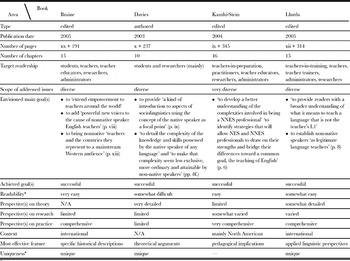
Given that these four books have different thematic design, it is not an easy task to present a comparative evaluation by following their outlines. For that reason, and also for the sake of readability, I will compare the four books with respect to the perspectives they offer on theory, research, and practice. A summary of this comparison is presented in Table 1 below.
Overview of form and contents.

* The way the book relates to other three books
Perspectives on theory
The key theoretical issue in the area of the native and non-native speaker is the native speaker construct. Among the four volumes, Davies, with its broad range of issues, is the most thorough, detailed and authoritative text in this regard. Kamhi-Stein chooses not to define the construct (p. 3), and concludes that labeling speakers as native and non-native ‘only serves the purpose of separating people into different camps’ (p. 3). Apart from the first chapter by Braine (and to some extent Amin's article), which presents a synthesis of research on non-native teachers and briefly addresses the native speaker construct, other contributors follow Kamhi-Stein's own approach. I wonder, then, why she has grouped her chapters 2 and 3, two self-reflective descriptions, under ‘Theoretical underpinnings’ when they do not address the theoretical aspects of the native speaker construct.
Likewise, Llurda's book does not discuss the construct in detail, except for the chapter by Cook and the elegantly written final chapter (Rajagopalan), which together with the chapters by Cots & Diaz and Inbar-Lourie are among the most interesting parts of his book. Several chapters from both Llurda and Kamhi-Stein volumes challenge the native–non-native dichotomy as being short-sighted and too simplistic. For instance, based on the findings of his own survey, Llurda concludes that NNES speakers are far from being a uniform, homogeneous group. According to Llurda, the diversity of the group prevents them from being able to come together to reassert their status. But the diversity Llurda identifies as a problem creates an ideal situation for viewing language proficiency and professional expertise on a continuum, a point that Pasternak & Bailey, in Kamhi-Stein's volume, explore.
Davies moves beyond the earlier linguists, saying that learners of a second language can become, and so pass as, native speakers of that language. As such, he claims that the native and non-native speaker construct is in essence a sociolinguistic construct. However, the editors of, and/or the contributors to, the other three volumes support the idea that the native speaker concept is more political and socio-cultural than linguistic. Davies's contribution is notable for his attempt to re-define the native speaker construct as inclusive of both native and non-native speakers (p. 9). However, Davies's arguments give rise to two questions. Despite his detailed discussion, the reader feels confused at the conclusion that the native–non-native dichotomy is created not only by native speakers themselves, but also by their non-native counterparts. Moreover, at the end of the book, Davies mentions that ‘even if I cannot define a native speaker I can define a non-native speaker negatively as someone who is not regarded by him/herself or by native speakers as a native speaker’ (p. 213). This brings his whole discussion back to the challenge he has faced over the years: Who is to judge? If, for example, a non-native speaker, according to Davies, assumes confidence and identity as a native speaker, but is still, for any reason whatsoever, not perceived and accepted as a native speaker by other native speakers, what then? Davies does not address this issue, and his argument for acceptance (i.e., membership) as a determining factor remains open to question. This stands contrary to his declaration that although ‘the theoretical debate about native speakers may be unresolved, . . . in the daily practice of language teaching and testing resolution is necessary’ (p. 161). Moreover, Davies's goal of establishing an understanding of the native speaker status that is ‘more ordinary and attainable by non-native speakers’ (p. 9) seems unrealizable in the face of his apparently contradictory comment that only very few non-native speakers could reach that level in reality. These questions, among others, emphasize the problematic nature of the native speaker construct when it is understood, as it is by Davies, as having a relatively unitary and fixed status. Recent research shows that the native speaker construct is in fact multifaceted, shifting, dialogic, critical, complex, contextual, and negotiable (Soheili-Mehr Reference Soheili-Mehr2008).
Perspectives on research
Although it relies heavily on previous published research investigating NNES professionals, Kamhi-Stein's volume is, together with Llurda's, more research-oriented in comparison with the other two volumes under discussion here. Participants in the studies presented in Kamhi-Stein, ranging in number from 1 to 118, include native and non-native speakers, international students, teachers, administrators, undergraduate and graduate students, pre-service and in-service student teachers, teacher educators, and education leaders. The main participants in the studies presented in Llurda's volume, ranging in number from 1 to 450, are teachers, graduate students, teaching assistants, and language learners. The volume by Braine, on the other hand, is a collection of descriptions of the history and curriculum of English language teaching in various settings accompanied by one autobiographical piece outlining the author's personal perspective – very much like his first book (Braine Reference Braine1999). In fact, in the latter section of his book the voices of non-native teachers, as insiders, are projected through their personal, revealing, and reflective pieces on the struggles and triumphs of learning, teaching, and training in English. Davies's approach, as he acknowledges, is not experimental; rather, it is more speculative in nature. Therefore, his book contains more theory than actual data. As a result, his conclusions stand in need of support by empirical research.
As far as research design and methodology are concerned, the studies in Kamhi-Stein and Llurda utilize both quantitative and qualitative approaches. The data collection strategies in Kamhi-Stein are self-reflection, interviews, narratives, surveys, fictional accounts, and dialog journals. Llurda, on the other hand, makes use of micro-analysis of discourse (which is unique in the field), ethnographic case studies (which are rare), surveys, questionnaires, interviews, focus groups, self-reports, and action research. Another strength of Llurda's book is that it takes an applied linguistic approach (e.g., code-switching and functional linguistics), in its very true sense, providing a well-grounded empirical challenge to Davies's views. In this way, Llurda's book is unique among the four.
A review of all the research methods represented in these volumes reveals that more innovative research designs are needed in the area of the native and non-native speaker. What is missing from these studies is longitudinal ethnographies integrating diverse research paradigms with multiple research methods (i.e., mixed methods design; see Soheili-Mehr Reference Soheili-Mehr2008).
Perspectives on practice
In this section I evaluate the four volumes with respect to their implications for language teaching and/or language teacher education.
Despite the fact that the book by Davies is basically intended to tackle the complexities of the theoretical perspective on the native speaker, the author does pose a number of interesting applied questions. Kamhi-Stein's volume is strongest in terms of its implications for practice. It covers a number of practical topics: professional credibility, language proficiency, job opportunities, classroom management, mentoring, students' perceptions, teacher collaboration, professional development, practicum, and cultural issues in language teaching. One other merit of Kamhi-Stein's book is its usefulness for a large, diverse audience: teachers-in-preparation, practitioners, teacher educators, researchers, and administrators. As such, it can serve as an excellent textbook in ELT and TESOL programs.
Llurda's book, too, includes a great variety of practice-related topics, some of which are unique – especially the chapters by Llurda, Liu, and Derwing & Murray, e.g., the role of English as an international language, L2 user, code-switching, the classroom behavior of teachers, teacher linguistic identity, and teacher anxiety.
While it covers a broad range of issues, Kamhi-Stein's collection focuses mainly on ESL settings in the North American context (e.g., the chapter by Brinton). Although the editor claims that some chapters ‘have been specifically written with an EFL audience in mind’ (p. 5), only four of the articles deal with issues outside North America (Egypt, Brazil, Hong Kong, Japan, and Spain). In this sense, it is not balanced. Llurda presents a more international perspective by including chapters dealing with issues from different parts of the world, not only the North American context. In fact, Llurda's book is exceptional in that it pays particular attention to the local, going beyond the mainstream North American conducted research in the area, i.e., Spain, Hong Kong, Sweden, Canada, Hungary, UK, Israel, and Brazil (9 out of the 12 chapters report on research done outside North America). As much as his earlier volume (Braine Reference Braine1999) focused on North America, Braine's Teaching English to the world is the most diverse as far as the geographical and linguistic context is concerned. His fifteen chapters cover a wide range of countries in which English is a non-native language: Asia (7 countries), Middle East (4), Europe (3), and South America (1). As such, Braine advances the field by documenting the local features of less represented areas, Middle Eastern countries in particular. But one may wonder why, despite this diversity, Braine considers his main audience to be Western readers. In all of the volumes the absence of African countries is striking. As a whole, the majority of the chapters and sections in the books under review reflect a fact about the research on the native and non-native speaker: it is still mostly contextualized in English-speaking environments, e.g., the US (Mahboob Reference Mahboob2003), or more recently Canada (Soheili-Mehr Reference Soheili-Mehr2008).
Concluding remarks
In concluding this review, some brief remarks are in order in regard to the writing style, readability, criticality, and tone of the books. One of the challenges of editing a collection is establishing consistency in writing style and standards across the chapters. In this respect Llurda is less successful than Braine and Kamhi-Stein. There are also a few minor typographical errors in both Llurda and Davies. As for readability, Davies is somewhat difficult, at some points inaccessible and even confusing, not only because of his very idiosyncratic and wordy writing style, but also because he sometimes introduces additional, sometimes tangential, yet important, concepts in the middle of his discussion. At times, one feels that he brings up a new issue without having pinned down the previous one. Braine is the most reader-friendly of all.
As for the critical perspectives of the volumes, Kamhi-Stein's book, a great collection of success stories, is definitely an excellent source of inspiration and empowerment for non-native speakers. However, it is mainly descriptive and suffers from the lack of a critical standpoint (Amin's chapter is an exception: it uses a critical racial theoretical perspective), and fails to go beyond the established mainstream native–non-native agenda. Overall the book does not problematize the idealized native speaker concept. In this sense, Llurda's book is more successful in that it takes a critical inquiry position in discussing native speaker supremacy, and further reinforcing the status of English as an international language. With regard to the arguments, Davies, at times, and some of the chapters in the other three volumes (e.g., Llurda's final chapter) are stimulating and highly provocative.
All these books are invaluable, intriguing, and thought-provoking additions to the growing body of literature in the area of the native and non-native speaker in second and foreign language education, and will contribute significantly to the lives of both native and non-native teachers out there in the field by making them more sensitive to the challenges, needs, requirements, responsibilities and (re-)constructions of professional identities. In A Festschrift for native speaker, Mey (Reference Mey and Coulmas1981: 70) stated that ‘Native Speaker is the final criterion of matters linguistic: his verdict settles all disputes, be they about sentences, linguistic postulates, innate ideas, or what have you. Like the Kings of Old, Native Speaker can do no wrong. He is above all laws: he is the Law himself, the Rule of the realm, the referee of the linguistic ballpark.’ The four volumes discussed in this review reflect the changes that have taken place since Mey's time some 25 years ago, and present the expanding paradigm of the native and non-native speaker. If there is only one contribution these volumes have made, it is that they have questioned the supreme, absolute authority of the idealized and idolized native speaker. ‘Native Speaker’ has ceased to exist as heavenly and divine; s/he is now a very down-to-earth being, among other beings! Today, with the spread of English internationally, non-native language teachers greatly outnumber their native counterparts (Canagarajah Reference Canagarajah and Braine1999). Research on the non-native speaker is ongoing and advancing, and more books are published as a result, e.g., Curtis & Romney (Reference Curtis and Romney2006) (in which they look at TESOL professionals of colour through critical race theory), or Snow (Reference Snow2007) (which caters to non-native teachers' real classroom needs by discussing the concepts and methods of English language teaching). Today, even if the native speaker is still stranded between theoretical myth and practical reality, and if ‘despite good professional intentions, . . . chauvinistic native-speakerism is very real’ (Holliday Reference Holliday2007: 360), the non-native speaker is not an imaginary theoretical construct; it is a reality. In view of this, I would like to call the four volumes (even Davies's book, for his acknowledgement of the reality of the self-identified, responsible non-native speaker) a collective Festschrift for non-native speaker.
Acknowledgements
I owe a great debt of gratitude to Subarna Banerjee (Post Doctoral Fellow, University of Pennsylvania) whose involvement in the initial stage of framing this review was an invaluable source of insights. Also, I would like to thank Language Teaching editors, Ewa Jaworska and Graeme Porte, and two anonymous reviewers for their very helpful comments on an earlier version of this paper.
Amir H. Soheili-Mehr is Sessional Instructor in Linguistics at University of Toronto, and TESL Teacher Educator at Centennial College of Applied Arts and Technology in Toronto, Canada, where he coordinates and teaches TESL courses and supervises teacher candidates. His research areas include immigrant non-native English-speaking ESL professionals, critical pedagogy and linguistic diversity, teachers' identity and cognition, and socio-cultural theories of second language learning/teaching.