Introduction
European Union (EU) politics has come to rely on two channels of democratic representation. European citizens are represented in their national parliaments that control the governments that decide over EU issues in the Council of the EU and the European Council, and they are represented directly in the European Parliament (EP), which increasingly serves as a co-legislator on a par with the Council. This two-channel structure of representation is not a transitional phenomenon; it has developed over time and is well entrenched in the EU’s multilevel institutional structure (it is also affirmed in Article 8A.2 of the Treaty of Lisbon). However, in the EU, in contrast to state-based federal systems, there is no ‘natural’ division of labour between the two channels. Precisely what kind of aggregate representative structure has been wrought, and how the two channels can cooperate so as to reinforce the overall level of parliamentary representation in the EU, are questions that merit attention.
Conceptualization lags behind this institutional development; what has been lacking is an appropriate conceptual apparatus to capture the (co)operation of two channels of democratic representation that are as prominent as they are different in the EU. Citizens may understand and trust the way their national parliament works. They may also understand and trust the way the EP works. They lack, however, any overall framework that permits them to assess how the two channels, that they are represented through, operate in relation to one another. This state of affairs is also reflected in the political science literature. Much research has been dedicated to the role of the EP and to national parliaments in EU decision-making, but these studies generally consider these channels (EU and national) in isolation from each other. Some studies have come to thematize the coexistence of the two channels, but do so mainly in descriptive terms. Up until now an appropriate analytical framework to study the inter-relations between the two channels has been lacking. Such an integral analytical framework is all the more needed to link the empirical analysis of parliamentary representation to the normative-theoretical debates about the prospects for democracy beyond the nation-state. To fill this void, this article puts forth the notion of a ‘Multilevel Parliamentary Field’: a heuristic device to chart how inter-parliamentary relations are structured in the EU, how this reflects upon the distribution of authority in EU decision-making, and what the democratic implications might be.
To demonstrate the existence of a conceptual void, the shortcomings of the existing vocabulary, and the heuristic value of the concept of the Multilevel Parliamentary Field, we proceed as follows. In the next section, we briefly spell out the evolution of the two channels of democratic representation in the EU. Thereafter, we review two typical ways of conceiving of inter-parliamentary relations. The first posits that the best way of conceiving of the structure of democratic representation in the EU is that of an integrated two-channel system, like that of a federal polity, whereas the second posits that the structure of inter-parliamentary relations in the EU is better understood as a parliamentary network. Both of these conceptions are found wanting. In the subsequent section we introduce the notion of the Multilevel Parliamentary Field as a more suitable heuristic for capturing the distinctive traits of the EU’s structure of democratic representation. This conception seeks to define the EU not so much in terms of political sovereignty and institutional hierarchy, but rather in terms of a set of norms that delineate certain basic values and a shared democratic practice. We spell out the relevant analytical dimensions of the Multilevel Parliamentary Field. Further, we identify the core issues and challenges that this notion permits us to address, and we spell out the concept’s distinctive merits for capturing the present-day EU’s representative character.
The consolidation of two channels of representation in the EU
The two channels of democratic representation in the EU have been extensively studied. On the one hand, political scientists have documented how the Common Assembly, which was established as part of the European Coal and Steel Community (1951), has developed from what was at most an embryonic parliament into the EP as we know it today, as a co-legislator almost on a par with the Council of Ministers (Rittberger, Reference Rittberger2005). One important milestone was the introduction of direct elections of members of the European Parliament (MEPs) in 1979, replacing the delegated national parliamentarians it had been composed of until then. Thus, the EP was ready to enhance its powers when European cooperation accelerated in the 1980s and 1990s. Step by step, from the 1986 Single European Act to the now defunct Treaty of Lisbon, the scope of its legislative power has been expanded so as to bring the EP almost on a par with the Council. Also, the EP has steadily developed its powers of scrutiny over the Commission.
In the course of this process, the EP has steadily moved towards becoming a mature ‘normal’ parliament with its internal dynamics resembling that of other, national parliaments (Hix et al., Reference Hix, Roland and Noury2007). MEPs have organized themselves in ideological formations corresponding to the ideologies that dominate at the national level: Christian-Democrats and (moderate) conservatives, Social-Democrats, Liberals, Greens, (Post-)Socialists, and Conservatives. MEPs’ voting behaviour has come to conform to ideological cleavages such as left vs. right, economy vs. environment, conservative vs. progressive, hence downplaying national difference as the most salient organizing dimension.
Thus, it appeared that as EU affairs slipped out of the control of national parliaments, the EP would gain powers to fill the gap, and to provide EU politics with the necessary democratic legitimacy. Yet, formal gaps persist in that certain powers have come to be shared at the European level without the EP becoming fully involved, as is, for instance, the case in the Common Commercial Policy and the Common Agricultural Policy. However, there remains a deeper problem beyond extending formal powers to the EP. As has been pointedly observed by former MEPs Michiel van Hulten and Nick Clegg (Reference Van Hulten and Clegg2003: 4), ‘While [the EP] has steadily increased its powers in the legislative and inter-institutional arrangements of the EU, it has not yet succeeded in translating its authority into a more visible role amongst Europe’s electorates’. This is also reflected in the fact that elections for the EP remain ‘second order elections’ (Reif and Schmitt, Reference Reif and Schmitt1980; Marsh, Reference Marsh1998): turnouts systematically lag behind those for national elections; voting behaviour reflects, above all, attitudes towards national politics; and voters are more likely to cast their votes for smaller parties, which reflects the perception that there is less at stake. These observations reinforce the perception of a persistent democratic deficit, as the EP, however much its powers have increased, fails to make up fully for the representative losses at the national level (Weiler et al., Reference Weiler, Haltern and Mayer1995; Follesdal and Hix, Reference Follesdal and Hix2006).
The limitations in the EP’s ability to become the principal focus of democratic representation in the EU, naturally brings attention back to the role of national parliaments. As was made apparent in the Protocol on National Parliaments attached to the 1997 Treaty of Amsterdam, national parliaments have, in the words of Raunio and Hix (Reference Raunio and Hix2000), ‘learned to fight back’; they no longer passively accept the weakening effects of European integration on their powers. Yet, as subsequent research has shown, there remain major variations between parliaments in the extent to which they have been successful in doing so (Maurer and Wessels, Reference Maurer and Wessels2001). Still, in the Treaty of Lisbon the reappraisal of the role of national parliaments continued with the inclusion of a special article on the role of national parliaments in the EU (Article 8C Treaty of Lisbon) and of a protocol that would ensure them to be kept fully abreast on EU policy-initiatives. Most notably, this treaty would have established an ‘early warning mechanism’ to allow national parliaments to act upon subsidiarity infringements.
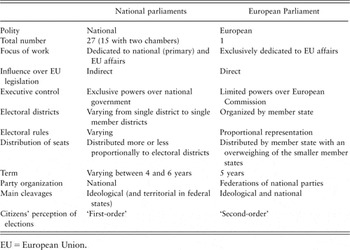
There are thus two channels of representation in the EU that are not likely to replace one another. Although they share the same vocation of representing the people, there are important structural differences between national parliaments and the EP. For one, a single integrated supranational parliament, like the EP, operates in a manner that is different from the coordinated effort of 27 national parliaments. Furthermore, the EP is exclusively dedicated to EU decision-making, whereas national parliaments see the EU as their secondary, and the national as their primary task. At the same time, national parliaments enjoy powers over the full range of tasks that the government subject to their oversight undertakes, while the EP has no proper government to control, neither does it exercise the same amount of control over all issues that the other EU bodies (notably the Council) are engaged with.
What is more, the two channels of parliamentary representation are based on different principles of representation (see Table 1). The indirect channel through the national parliaments entails that interests are first aggregated at the national level across the ideological division lines that may be present, and then governments encounter each other in the Council primarily as national representatives with their ideological personae taking second place. There is, moreover, considerable variation in the national electoral systems through which voters choose their national parliamentarians. On the other hand, for the EP-elections, all member states follow by now the principle of proportional representation. Still, each member state operates as an electoral district (which may be subdivided again) with a given number of seats to distribute and its own lists on which national parties compete. While Euro-parliamentarians are elected on their national party platform, they join up in transnational party-groups only after being elected. European party organizations have taken shape, but for now the locus of political control remains firmly at the level of national parties. Thus, the national parliaments and the EP are anything but perfect equivalents. What is more, given the wide range of variation among national parliaments in the EU, the division of roles with the EP is likely to vary from one state to another.
While most research thus far has focussed on only one of the two channels, some researchers have started to thematize their coexistence. From the mid-1990s onwards, Neunreither (Reference Neunreither1994, Reference Neunreither2006) has charted the relations between the EP and the national parliaments, as well as the range of proposals that have been put forward over time to improve this relation. Kiiver’s critical review of the potential of national parliaments to influence EU decision-making eventually has him return to the importance of ‘bolstering a solid European Parliament’ (Kiiver, Reference Kiiver2006: 182). Speaking to the EP, Wessels and Diedrichs (Reference Wessels and Diedrichs1997) have underlined that a proper evaluation of the EP’s legitimacy requires ‘a new concept of legitimacy for a new kind of parliament’, which can appreciate its performance in the wider context of the EU’s multilevel system in which European, national, and sub-national processes of decision-making are increasingly fused. Maurer (Reference Maurer2002) actually uses the concept of European multilevel-parliamentarism (europäischen Mehrebenenparlamentarismus) as an overarching label for his empirical analysis of the EP’s and national parliaments’ engagement in EU affairs.
The most ambitious theoretical attempt to integrate the study of the channels of representation in the EU has come from Benz (Reference Benz2003), who has proposed to conceive of the EU as a ‘compound polity’, with a multiplicity of interacting structures of interest representation. Benz highlights the fact that while EU policy-making allows for a wide range of channels of interest representation, it is still able to deliver policies effectively. However, he concedes that this comes at the price of democratic accountability: it becomes indiscernible where decisions are taken, who can be held responsible, as well as how they can be corrected.
In different ways these studies highlight the need for (rather than that they themselves furnish) an overarching analytical framework that allows us to capture the two channels of representation in relation to each other – which includes recognizing the structural differences between them. Given the distinctive traits of the EU’s representative system, such an overarching framework is a prerequisite for a proper evaluation of the representative-democratic quality of EU decision-making as a whole. Such a framework would make it possible to relate the empirical research on democratic representation in the EU to the normative debates about the EU’s democratic deficit and, indeed, to the prospects for representative democracy beyond the nation-state in general.
A proper conception of the EU’s representative-democratic structure will rest on certain ideas about the nature of the EU polity. Clearly, the EU can neither be considered an international organization, nor a state. For this reason, we outline and review three conceptions of the structure of democratic representation in the EU: a federal two-channel system, a parliamentary network, and the Multilevel Parliamentary Field. The first two of these are quite well established conceptions that analysts have, to different degrees, applied to the EU. The third, the Multilevel Parliamentary Field, is new but is, we will argue, the most apt way of conceptualizing the distinctive structure of democratic representation in the EU.
EU inter-parliamentary relations as a federal system
The most obvious way to conceive of the structure of democratic representation in the EU is in terms of a federal system. Like the EU, federal systems are marked by the fact that they have two channels of representation. Generally, a federation provides for a representative body at the federal level, while at the same time the autonomy of its component parts is recognized by providing for a second channel of representation that runs through the states. Within the federal system, the two channels are incorporated in an integrated structure of representative bodies, where the relations among these are constitutionalized with a clear division of tasks.
In practice, two variants of federalism can be distinguished depending on how competences are divided between the two levels (cf. Scharpf, Reference Scharpf1988: 242ff). On the one hand, dual or bipolar federalism is premised on a clearly delineated division of competences between the federal and the state level. This variant assumes institutional symmetry across levels: the institutional structure of the government at the federal level is duplicated at the state level. The parliament at the federal level has as its constituency the entire polity, but has its powers limited to those issue-areas that are under federal jurisdiction. Each parliament at the state level has that state as its constituency, and bears on those issue-areas that are under state jurisdiction. The most salient contemporary examples of bipolar federalism are the United States, Canada, Australia and India.
The other federal variant can be labelled the unipolar model of federalism, and sees the federal compact as embedded in a set of central institutions that have binding force on the parties to the federal compact. The central institutions are based on a combination of two principles of representation: representation by population and representation by territory. The people are represented in the central institutions directly through elected representatives and indirectly through representatives from each member state/entity. The closest contemporary variant of this is the German version of federalism (Jeffery and Savigear, Reference Jeffery and Savigear1991).
For both variants it is clear that the federal constitution requires a considerable degree of coherence in the structure of democratic representation, across levels and among the individual states. While the unipolar model relies on a highly integrated representative structure at the federal level, the bipolar model requires a high level of compatibility and comparability of the political structures throughout the federal system. In the end, in both variants the structure of democratic representation is subject to formal rules that define the division of roles and the hierarchical relations between them. In the bipolar system, the two levels of representation delineate the limits of each other’s action, as each level has its own repository of competences. In some contrast, the unipolar system is based on a distinctive form of hierarchy between the two representative principles: direct polity-wide election of the federal parliament (in Germany, the Bundestag) and indirect representation of the citizens of each state through their representatives in the federal chamber of state representatives (in Germany, the Bundesrat). Here the federal level takes on primacy, given that it is where the two, direct and indirect, principles of representation are harmonized. The state level is more preoccupied with implementation.
Even if the competences of the EU level have been circumscribed, decision-making in the EU tends to resemble the unipolar rather than the bipolar version of federalism. As highlighted above, the EU level combines two channels of democratic representation, where one (the EP) is elected directly by the people, and the other (the Council) represents the people indirectly through their states. Within this modified unipolar structure, national parliaments exercise democratic control over EU decision-making through their national governments. Though the EU has traits of a unipolar federal system, there are several characteristic features of the EU that make it stand out from the federal models we are familiar with. Moreover, while these differences may be less pertinent when it comes to questions concerning, for instance, the division of competences between levels, they have a particular bearing on the structure of democratic representation.
Four characteristics of the EU stand out in this respect. First, even if the EU may be taken as an overarching constitutional structure, it lacks a federal government. In fact, most executive responsibility for EU policies goes back to the national governments. At the EU level, executive powers have traditionally been delegated to the European Commission, which is supposed to execute its tasks to the general interest of the Union, regardless of ideological orientation. Besides the Commission, the secretariat of the Council of the EU and a host of independent European agencies have come to administer substantial executive tasks. Rather than putting EU executive power under parliamentary control, the predominant idea seems to be that it is to be controlled by fragmenting it. In the absence of an EU-level government at its apex, the EU has far less coherence as a political system than does any federal state. The implication of this is that the EP, as the supposedly ‘federal-level parliament’, lacks a proper governmental counterpart or at least finds it dispersed across different institutions and levels.
Second, in contrast to any democratic federal constitution that would see to it that all powers are subject to democratic control, the evolution of democratic representation systematically lags behind the allocation of competences to the EU level. Even if the powers of the EP have steadily expanded, it is still excluded from a substantial range of EU-level decisions. There thus remains a significant level of incongruence between the tasks actually allocated to the EU level on the one hand, and the representative body’s ability to control these at that very same level, on the other.Footnote 1 What is more, when it comes to institutional revisions in the EU’s basic law, the Treaties, the procedures do not require the involvement of the EP or any alternative elected body at the European level.
Third, and this is an element that makes the EU quite unique as a polity in today’s world, is that it is a modified polycentric, not a classical monocentric, system of governance. A system of polycentric governance is ‘an arrangement for making binding decisions over a multiplicity of actors that delegates authority of functional tasks to a set of dispersed and relatively autonomous agencies that are not controlled – de jure or de facto – by a single collective institution’ (Schmitter and Kim, Reference Schmitter and Kim2005: 6). There is then, essentially, no single institution, and not even a single level, within the EU that can be seen as the centre where sovereignty is embodied. Indeed, in many respects the national governments operate as distinct political (sub-)centers for their citizens, even if they have come to pool and delegate important powers to the European level. When it comes to political representation, this polycentric character is reflected in the fact that, as ‘second-order elections’, the elections for the EP are rather perceived as 27 parallel elections than as amounting to a truly EU-wide ballot.
This leads to the fourth, and final, feature that sets the EU apart from federal states. Compared to basically all federal systems (India is to some extent excepted notably in cultural but not in institutional terms), it is marked by an almost unprecedented cultural pluralism and institutional heterogeneity. What matters most here is the great amount of institutional diversity that shows up in the huge discrepancies in the size of the Member States; significant vertical institutional incongruence, through federal, quasi-federal, and unitary arrangements at the member-state level, and a great amount of horizontal institutional heterogeneity at the Union level through different systems of representation and accountability, and far more so at the Member State level, where there are great variations in how power is shared and organized from one member state to the next (see also Table 1 in the previous section and the accompanying text). This lack of institutional symmetry makes it extremely difficult to work out any division of powers and competences in a manner consistent with federal organizational models.
National parliaments and the European Parliament compared

EU = European Union.
Thus, there are a number of distinctive traits of democratic representation in the EU that do not sit well with federal organizational models. Applying established federal organizational models risks blinding us to some of the distinctive traits and dynamics that are at work within and between the EU’s parliamentary institutions. Thus, it is necessary to consider alternative notions to that of the federal system.
EU inter-parliamentary relations as a parliamentary network
The network notion suggests itself for various reasons as an alternative, more open, concept to conceive of the structure of democratic representation in the EU. For one, the concept of ‘network’ is frequently adopted by parliaments themselves to characterize their inter-relations. For instance, in its opinion on the European Commission’s proposal for ‘A Competitive Automotive Regulatory System for the 21st Century’, the EP proposes to establish ‘an inter-parliamentary network on automotive issues’ (European Parliament, 2007: 3).
At the same time, within the field of EU studies, the network concept has found favour among scholars who consider the EU as a case of ‘multilevel governance’ (Hooghe and Marks, Reference Hooghe and Marks2003; Kohler-Koch and Rittberger, Reference Kohler-Koch and Rittberger2006). This approach underlines how authority in the political system of the EU is no longer concentrated or hierarchically ordered as it was supposed to be in traditional (state) systems of government. Instead, authority has come to be dispersed across levels and even between public and private actors. Thus, as Eising and Kohler-Koch (cited in Kohler-Koch and Rittberger, Reference Kohler-Koch and Rittberger2006: 34) elucidate, EU governance can be characterized as ‘a system of network governance’ in which ‘the “state” is vertically and horizontally segmented and its role has changed from authoritative allocation “from above” to the role of an “activator”. Governing the EU involves bringing together the relevant state and societal actors and building issue-specific constituencies’. These analytical-empirical theories resonate with normative theory, notably the theoretical position of ‘directly-deliberative polyarchy’ (Cohen and Sabel, Reference Cohen and Sabel1997). This position highlights how EU democracy combines decentralization and diversity of policy-making with the deliberative capacities of the societal actors involved. Notably, in the directly-deliberative polyarchy approach, legislatures are no longer engaged in substantial policy-making but are left with the procedural task of ensuring that the conditions necessary for ‘deliberation within and among units’ are maintained (Cohen and Sabel, Reference Cohen and Sabel1997: 331).
The applicability of the network concept to inter-parliamentary relations in the EU is less self-evident than it may appear at first sight. The prevailing uses of the concept leave little room for attributing a distinctive status to parliaments in the governance process (cf. Peters and Pierre, Reference Peters and Pierre2004). Rather parliaments appear as just another set of actors vying for authority (Slaughter, Reference Slaughter2004: Ch. 3). Even less likely is it that the network notion actually allows us to capture the particular dimensions along which parliaments operate in EU decision-making and the structural differences that exist between them.
The network notion is useful to describe how previously independent bodies have become linked in a horizontal structure with functional relations between them. European integration has located the national parliament and the EP within one single European political system. Within this structure the national parliaments fulfil similar representative functions, albeit in different places, and have developed informal and more formal links (also with the EP), in order to grapple with similar issues and to benefit from exchanging experiences and coordinating their actions.
The concept of parliamentary network has some analytical purchase on the EU, as it can accommodate considerable diversity in the character and in the interaction between parliaments. In some cases, the interaction may be quite intense and even become institutionalized. In other cases the link can be quite weak. In fact, rather than each and every parliament needing to be connected to all the others, the network notion allows for more dispersed patterns of interaction. The network is also open: New parliaments can easily be included in the network. The network notion thus sits well with the EU’s polycentric character, and allows for a wide range of diverse practices in how national parliaments bring their influence to bear on EU decision-making.
But the flexible – or rather indiscriminate – character of the network notion also limits its analytical utility. For one, its focus is on the relations among the components of the network, not on how each organization that makes up the network is structured. Thus, the network notion leaves little room for appreciating the norms that constitute them and their behaviour. This is of course of particular concern when it comes to parliamentary institutions whose existence is crucially premised on certain normative expectations about democratic representation.
The indiscriminate character of the network concept becomes particularly apparent when one considers how it is to accommodate the role of the EP. Though the EP is certainly unable to shoulder the democratic legitimacy of the EU by itself, it now fulfils a crucial function in the EU’s structure of democratic representation that the national parliaments cannot do without. However, this is not apparent when it is conceptualized as a part of the parliamentary network, as this notion does not provide the means to conceptualize the EP’s distinctive status as a supranational parliament, with distinct functions emanating from that particular role, which puts it in a specific relation to the national parliaments. The network notion really only holds two options: either it treats the EP as just another parliament, that is, assumes that the EP is not structurally and functionally distinct from the national parliaments, or it disqualifies the EP as a parliament like all the others and relegates its role to that of an accessory ‘in networking with national parliamentarians and helping serve as a catalyst for their interactions with one another’ (Slaughter, Reference Slaughter2004: 124).Footnote 2
The network notion also does not provide any clear perspective on the totality of institutions and the structured character of their inter-relations, as a collection of institutions. Given its loose character, the network notion directs us to see democratic representation in the EU as essentially decentralized and fragmented. By implication one is led to expect only a limited degree of coherence among national parliaments in their oversight over EU decision-making. More generally, one can say that the horizontal orientation of the network notion makes it difficult to incorporate properly the distinctive vertical, multilevel dimension that shapes inter-parliamentary relations in the EU.
As a consequence, the network concept cannot make sense of the fact that by now parliamentary relations within the EU have taken on certain systemic properties, so that individual parliaments not only act on each other as isolated entities but rather as intrinsic parts of the process of Europeanization which acts on them in turn (Featherstone and Radaelli, Reference Featherstone and Radaelli2003; Schmidt, Reference Schmidt2006). What is more, the network notion cannot conceive of the impact of the network as a whole, as an integrated structure. Such a more integral assessment is necessary if we are to understand the overall democratic quality of the structure that is being wrought.
In sum, then, to capture the representative character of the EU, the notion of parliamentary network cannot be considered an improvement on the proven terminology of a federal system. Yet, we believe there is a third option: the Multilevel Parliamentary Field.
EU inter-parliamentary relations as a Multilevel Parliamentary Field
As a third conception of the structure of democratic representation in the EU, we propose the Multilevel Parliamentary Field. The concept of the Multilevel Parliamentary Field – a conceptual innovation first developed in this article – is a heuristic device to chart how inter-parliamentary relations are structured in the EU, to establish how this reflects upon the distribution of authority in EU decision-making, and to clarify the character and quality of EU democracy. The field is defined by the joint function that its constitutive institutions are supposed to serve, namely democratic representation. Thus, the field can encompass a wide range of parliamentary institutions at different levels within the EU. The field notion highlights, in particular, the emergence of institutions and norms that serve the coordination of the EU’s constituent parliaments.
The concept of the Multilevel Parliamentary Field draws together two hitherto separate bodies of literature with different disciplinary origins: on the one hand the notion of parliamentary-representative government with origins in political science and democratic theory, and on the other hand the notion of organizational field with origins in organizational sociology. The former has been referred to and will be returned to ahead; the latter requires some elaboration here. DiMaggio and Powell (Reference DiMaggio and Powell1983: 148) characterize an ‘organizational field’ as ‘those institutions that, in the aggregate, constitute a recognized area of institutional life’, with some element of connectedness and structural equivalence. This notion of an organizational field needs to be slightly revised when it is to be applied to the realm of inter-parliamentary relations. For Powell and DiMaggio and their followers (Powell and DiMaggio, 1991), the ‘recognized area of life’ to which the field refers has generally been defined in sectoral terms. In contrast, the EU’s Multilevel Parliamentary Field is not foremost a (professional) sector; what keeps its components together is a shared function and the role perception that comes with it: that of representing people’s interests in EU decision-making.
Thus, in constructing our notion of Multilevel Parliamentary Field we draw on a broad range of sources, including the godfather of the field notion, Pierre Bourdieu (Reference Bourdieu1980, Reference Bourdieu1989). Also, in Bourdieu’s conception, a field serves to denote a complex of relations between institutions or actors. However, in his account, sectoral delineation is only one aspect of what defines the field. Equally important are the normative orientations that hold the field together and the resources that can be turned into effective use in the field. This also entails that the delineation of the field is much less of a voluntarist matter, wherein individual elements can be added and detached from the field at will, as if it were a network. Rather in Bourdieu’s conception, the nature (identity) of the institutions in the field is essentially defined by virtue of their position in the field in relation to the other constitutive units. While Bourdieu does not discard the distinctive capacities of the individual institutions and actors, he insists that the field takes on certain properties and dynamics that are of a structural character and that therefore cannot be reduced to its individual components.
This structural trait of the Multilevel Parliamentary Field helps to make clear that to establish the democratic quality of the EU we cannot simply sum up the performance of each individual parliament involved. Such an approach would fail to appreciate the way in which these institutions link up together. For instance, while an increase in the powers of the EP or a strengthening of the scrutiny powers of the Danish Folketing clearly serves those parliaments, the impact on the representative-democratic quality of the EU requires those changes to be assessed in the wider context, with a view to the impact that they have on other representative institutions (which emulate, learn, and copy from each other), and on the system as a whole.
The Multilevel Parliamentary Field thus recognizes – as does the network – that democratic representation in the EU is more disaggregated than a full-fledged EU-federal representative system would have been. But the field notion is premised on a greater level of coherence, if not in organizational structures, then at least in norms and orientations than would be a EU parliamentary network. Further, the field concept is better equipped to recognize the normative character of parliaments as sites of democratic representation, and to recognize the qualitative differences that exist between them, including the distinctive role of the EP. As a consequence, the field notion is also more attentive to the ways in which the different sites of democratic representation in the EU condition each other’s behaviour.
With federalism, the Multilevel Parliamentary Field shares the focus on parliaments as representative institutions and on the division of tasks and competencies across levels. However, the field expands beyond federal organizational models, because it neither presupposes institutional symmetry among representative bodies, nor that they need to fit into a clearly laid out (hierarchical) organizational structure. The Multilevel Parliamentary Field allows for greater variation among the component units and patterns of formal and informal parliamentary interaction (horizontally and vertically), and hence is compatible with less hierarchical and more loosely coupled patterns of interaction. Such coupling is however premised on norms that delineate a set of basic values and a shared democratic practice. These traits also make the field well suited to caption the European process of integration, in which constitutional constraints are gradually worked out as the system becomes further cemented.
Our conception of the Multilevel Parliamentary Field deviates most explicitly from the previous uses of the field notion in its normative implications. For sociologists like Bourdieu, Powell and DiMaggio, the concept of the field serves primarily empirical functions by revealing relations and processes that might otherwise go unnoticed. Beyond providing more complete and exact knowledge that actors can use to whatever purposes they choose, the concept serves no normative or critical function. However, since the Multilevel Parliamentary Field is about democratic representation, any empirical depiction of the field will immediately bear upon the normative standards embedded in democratic theory. In fact, this interplay between the empirical uses of the Multilevel Parliamentary Field and normative conceptions of democracy can be seen as one of its foremost merits.
Ultimately, then, the Multilevel Parliamentary Field serves to address the following complementary concerns: What is the character of the EU’s Parliamentary Field? And what does this tell us about the character and quality of EU democracy? To establish the characteristic features of the EU’s parliamentary field, it is necessary to consider: (a) the character and density of inter-parliamentary interaction; (b) the character of the field’s constitutive units (parliaments); and (c) the manner in which these two dimensions relate and interact to give overall shape to the field. These findings then yield vital input to the second question, namely the character and quality of EU democracy.
Inter-parliamentary interaction
The concept of the Multilevel Parliamentary Field is, as indicated, premised on inter-parliamentary interaction. For this we can first of all look at formal mechanisms for inter-parliamentary interaction that have been established along both horizontal (among national parliaments) and vertical lines (EP-national parliaments). These include formal procedures for consultation and sounding-out across levels, procedures for establishing whose responsibility an issue is (cf. subsidiarity provisions), institutionalized meeting-places, exchanges of information, personnel and resources, and procedures for the conveyance of best practices. One prominent example of a meeting place is the Conference of European Affairs Committees (COSAC) in the context of which members of national parliaments’ European Affairs Committees come together bi-annually (Blichner, Reference Blichner2000). Further, national parliaments have, for instance, set up offices in Brussels to monitor the work of the EP and have taken measures to involve MEPs in their work. In turn, the EP has also developed various means to engage national parliaments (Neunreither, Reference Neunreither1994: 310).
While the development of such formal mechanisms of inter-parliamentary interaction is interesting in itself, recent research suggests that very much of the inter-parliamentary coordination is in fact of an informal character (Neunreither, Reference Neunreither2006). Another point to note is that coordination need not necessarily take place through parliamentary settings, but also takes place in other fora, not least through political parties (Raunio, Reference Raunio2000). With better knowledge of the breadth and depth of informal contacts, we are in a better position also to establish the actual salience of formal mechanisms.
However, the Multilevel Parliamentary Field is not just about establishing frequency and form of inter-parliamentary interactions; it is particularly concerned with the norms and role conceptions that guide and structure these interactions. One way to conceive of these norms is in terms of Bourdieu’s concept of ‘habitus’. The concept of ‘habitus’ refers to the mental dispositions and presuppositions that the actors in the field rely on. Thus, they all share the same role conception as parliamentarians. At the same time, Bourdieu’s notion also acknowledges that these may differ between actors and between contexts: what is understood as natural, self-evident or, even, logical behaviour for a parliamentarian from Sweden may be quite different from what counts as such for a parliamentarian from Bulgaria. An alternative approach to capture the deeply institutionalized, normative character of representative arrangements is to conceive of actors’ norms, role conceptions, and institutionalized identities in terms of the ‘logic of appropriateness’ (March and Olsen, Reference March and Olsen1989).
The Multilevel Parliamentary Field thus provides us with a natural reference for the analysis not only of the formal arrangements for inter-parliamentary cooperation and their actual deployment, but also for parliamentarians’ role-conceptions, institutional identities, and sense of appropriateness. The latter will likely be quite coloured by national templates. Yet, they may also be expected to change as parliamentarians from different European backgrounds are exposed to each other, which is of course particularly the case within the EP.
Constitutive units
Beyond analysing inter-parliamentary interactions, a proper depiction of the Multilevel Parliamentary Field also requires explicit attention to the character of the constitutive units, the parliaments, themselves. As noted, the Multilevel Parliamentary Field can help to clarify both commonalities and variations among representative institutions. Actors’ role conceptions, institutional identities, and perceptions of the EU and its democratic character and quality are likely to vary across countries, parties, and issue areas. Such differences do not stand on their own but shape and condition the relations between parliaments and the character of the field at large. This is all the more the case, as differences are likely to come with power differentials.
Applied to democratic representation in the EU, the Multilevel Parliamentary Field is a particularly useful analytical vehicle to analyse variations in the relations between the two levels of democratic representation: Do representatives at the EU and the national level reinforce each other or do they rather operate as competitors for authority? Where national parliaments are strong,Footnote 3 in particular with regard to EU affairs, one might expect a nation’s MEPs to take on less prominence. In contrast, where national parliaments are weak on EU affairs, this could be compensated for by prominent (national) MEPs. Yet, one might also hypothesize to the contrary that a strong engagement of national parliamentarians in EU affairs will go together with a high standing of MEPs. The implication of this view is however that in certain countries weak democratic mandates in EU affairs would reinforce each other. This could lead to democratic asymmetries in the EP, and these asymmetries might then also be amplified, rather than compensated for, at the level of the field as a whole.
Similar issues can be considered at the level of parties: some parties may approach EU issues mostly from the national level, whereas in others MEPs may take the lead. Nationality is probably a relevant factor, but one might also expect such variation to correlate with party size, with ideological position, and with involvement in government. Again, however, the bottom-line is that there may be systematic differences between citizens and constituencies as to the way and, by implication, the efficacy of their representation in EU affairs. The Multilevel Parliamentary Field directs us to consider whether representative deficits may be amplified throughout the system or whether they can be compensated for through alternative channels within the parliamentary field.
Such an analysis may also benefit from Bourdieu’s vocabulary, in this case his concept of ‘capital’, which refers to the resources that actors can draw upon within a field. Capital in this sense refers not only to material resources, but also to immaterial ones that are valued in the field, such as knowledge, experience, and authority. As Bourdieu underlines, what counts as capital, and how much it is worth, is not determined in objective terms, but inter-subjectively: ‘capital does not exist or function except in relation to a field’ (Bourdieu and Wacquant 1992, cited by Emirbayer and Johnson, Reference Emirbayer and Johnson2008: 3). In fact, it can be seen that within the EU’s parliamentary field, parliamentarians may derive ‘capital’ from a whole range of resources: from formally assigned powers, via material resources and lines of authority, up to the cultural status and linguistic prerogatives they enjoy within the multilevel political system of the EU.
Bourdieu’s concept of capital is particularly useful because it directs us to relations of power; any field is political in character and the relations that are constituted within it are also relations of power. In fact, in the field, power is present in both its relational dominating form (power over), as well as in its collective, constitutive sense (power to) (cf. Lukes, Reference Lukes1974: 28ff). In its relational form, one can identify power relations that allow one actor to dominate over others. Some parliamentarians, due to their position in the field and the capital that they command, are more influential in the EU decision-making process than are others. This may be a matter of formal powers, but it may also involve less formal resources, such as access to information, seniority, contacts, etc. Here the Multilevel Parliamentary Field offers a vantage point for the analysis of the relationship between changes in role conceptions and identities on the one hand, and power relations on the other; a relationship that is of obvious importance to democratic governance.
In the constitutive sense, the field can be seen as a field of power in that it allows for a structure of action in which certain effects can effectively be brought about and attain meaning. The EU’s Parliamentary Field contributes to shape the exercise of oversight over, and the conferral of democratic legitimacy on, decision-making in the multilevel constellation that makes up the EU. This also naturally directs our attention to the overarching character and dynamics of the field.
Field dynamics
Knowledge of patterns of formal and informal inter-parliamentary interaction, coupled with knowledge of the commonalities and variations in the constitutive units of the field together help clarify both the character of the field and the field’s dynamics over time. On field dynamics, DiMaggio and Powell (Reference DiMaggio and Powell1983) place much emphasis on the idea of isomorphism: that the institutions in a field will become more similar over time through processes of competition, exchange and mutual learning. However, the complex EU setting contains a broad range of forces that do not necessarily pull in the same direction. Indeed, a warning against simply presuming intensified inter-relations to issue in convergence comes from the Europeanization literature that examines the (feedback) effects of European integration on national policies and politics (Radaelli, Reference Radaelli2004). While there are obvious examples of European integration leading to convergence among the member states, most notably when this has been imposed by harmonization requirements, member states’ responses to the EU can also diverge greatly, due to distinct traditions, capabilities and political orientations (Schmidt, Reference Schmidt2006).
Nevertheless, certain convergence mechanisms can be identified within the realm of democratic representation. One such is the role played by EP party-groups and the party federations that emerge in tandem with them. These central institutions can have a normalizing effect, both through the formal requirements they impose upon their members and through informal mechanisms of socialization. Another mechanism is that some national parliaments, like the Danish Folketing and the Finnish Eduskunta, have acquired an exemplary status for how they have organized parliamentary scrutiny of the government’s involvement in EU affairs. Many national parliaments in the new EU members of 2004 have modelled their scrutiny systems on these precedents.
At the same time, the national EU scrutiny systems also provide some vivid illustrations of systematic differences. For instance, scrutiny systems have been relatively slow to develop in the six founding member states. Also, there are significant differences between member states in their levels and forms of decentralization, and in their electoral systems, and these are unlikely to be eradicated by the EU. As a consequence, one can expect substantial cross-national variations within the EU parliamentary field to persist.
The question is whether such differences will remain a source of tension, or whether the parliamentary field can ever reach some state of equilibrium or finalité? One might suggest that the parliamentary field is only a transitory notion for as long as the EU has not completed its evolution into a federal state, or is reduced again to a purely intergovernmental regime. In many respects, however, there is much to say for the claim that the EU is a political system of a distinct character, at least for the foreseeable future. As long as that is the case, there is a need for a notion like the Multilevel Parliamentary Field to make sense of its representative character. Indeed, since the EU is still developing, and since parliaments have been a driving force behind the process of EU democratization, analysing the field may shed light not only on the direction in which the EU develops but also on the democratic character and quality of the EU.
The Multilevel Parliamentary Field and democracy
Precisely because it offers an integrated conception of the structure of democratic representation in the EU and simultaneously speaks to patterns of variation, the Multilevel Parliamentary Field is a particularly useful tool to clarify the character and quality of EU democracy. The Multilevel Parliamentary Field is not programmed on one specific theory of democracy; while it naturally highlights representative conceptions of democracy, it also speaks to deliberative versions of democracy.
When we seek to apply the Multilevel Parliamentary Field to clarify the character and quality of EU democracy, we need to keep in mind that the issue of what democratic standards are appropriate to the EU and how they are to be applied are matters of deep contention with manifold proposals (cf. Lord, Reference Lord1997; Majone, Reference Majone1998; Eriksen and Fossum, Reference Eriksen and Fossum2007). There is wide agreement to the effect that the democratic standards that are generally applied to the nation-state cannot be directly transposed to the EU. There is however more contestation over how well the basic norms and principles underlying the democratic constitutional state (as these have for instance been elucidated by Habermas, Reference Habermas1996) can be sustained beyond the nation-state.
In fact, in most of the prevailing, liberal approaches to governance beyond the nation-state, the network-concept prevails; parliaments are treated as just another actor vying for authority and are generally only associated with the nation-state (e.g. Keohane, Reference Keohane2002; Slaughter, Reference Slaughter2004). However, the role that parliaments have been granted in the EU points to an alternative scenario in which the idea of representative democracy may be extended beyond the nation-state, even if it needs to be reconstructed in this new context. In that light, the concept of the Multilevel Parliamentary Field – as a transnational sphere of democratic representation integrated around a set of norms that delineate certain basic values and a shared democratic practice – is closer to more cosmopolitan approaches to global governance (e.g. Held et al., Reference Held, McGrew, Goldblatt and Perraton2000).
However, in contrast to the more world-federalist impulses that underpin some of the cosmopolitan approaches, the Multilevel Parliamentary Field is more attentive to decentralized and fragmented patterns of democratic representation. In this sense it rather follows Habermas, who argues that cosmopolitan democracy ‘[r]ather than a state, [it] has to find a less demanding basis of legitimacy in the organizational forms of an international negotiation system, which already exist today in other political arenas’ (Habermas, Reference Habermas2001: 109). Indeed, in many respects the Multilevel Parliamentary Field sits well with Habermas’ deliberative conception of democracy. It reflects his understanding of representative bodies as bearers of institutionalized discourses (Habermas, Reference Habermas1996: Ch. VIII), and deliberation is a crucial element when we are to assess the ways parliaments interact. It should however be noted that Habermas remains ambiguous on the status of representation and on the relationship between representation and deliberation; his perspective tends to privilege deliberation over representation.Footnote 4
Going beyond Habermas’ position, some theorists of deliberative democracy suggest that couching the debate on the EU’s democratic character as a representative defect is akin to barking up the wrong tree: It fails to recognize that representative democracy is inappropriate to grapple with the legitimacy challenges that the Union faces, and further, that the EU has developed alternative ways of entrenching democracy (Cohen and Sabel, Reference Cohen and Sabel1997; Bohman, Reference Bohman2007). Thus, Bohman argues that, in today’s interdependent world ‘[t]he main issue is not the real or supposed democratic deficit, but the democratic criterion itself’ (Bohman, Reference Bohman2007: 10). The meaning of democracy needs to be reconsidered, in particular the presupposition that democracy requires one single demos. In Bohman’s alternative, trans-national, conception of democracy, the onus shifts from representation of one single demos, to deliberation between multiple demoi. To him, deliberative democracy, when properly institutionalized within a decentred reflexive system, can serve as a democratically viable near-substitute for representative democracy.
The concept of the Multilevel Parliamentary Field offers a different track. It acknowledges the validity of the critiques and recognizes that the majoritarian representative arrangements of the nation-state cannot simply be transposed to the EU without significant tensions. However, rather than to give up on representative democracy beyond the nation-state, the concept of the Multilevel Parliamentary Field seeks to retain and to reconstruct the notion of representation in the context of the multilevel system of the EU on the presumption that representation is indispensable to any political system that is to be democratically legitimated.
From the perspective of the Multilevel Parliamentary Field, the particular challenge involved in theorizing appropriate democratic standards for the EU lies not in the EU’s size, not even in its international or supranational character, but in the (horizontal and vertical) dispersion of democratic representation across multiple sites. This fact fundamentally challenges the traditional assumption that any given polity can be adequately represented by a single institution (i.e. parliament) (cf. Pitkin, Reference Pitkin1967). Instead, the Multilevel Parliamentary Field speaks to the need to conceive of democratic representation as the result of the interplay of a multiplicity of processes that need to be assessed on the basis of their overall effect.
Thus, rather than dispensing with the notion of representation and its concomitant norms and values, the analytical framework provided by the Multilevel Parliamentary Field opens the way for reconstructing representation within the context of the EU. Such a reconstruction can start from the foremost standards of representative democracy.Footnote 5 One obvious challenge concerns, for instance, the key democratic standard of ‘political equality’. In light of the range of possible variations within the field noted above, one might well ask what meaning, if any, it leaves for political equality. However, the standard of political equality is by no means unequivocal. The EU’s structure of democratic representation contains several readings of political equality, at different levels of aggregation (national and European). As is reflected by the formal organization of the Multilevel Parliamentary Field, the EU mediates between the equality of citizens and the equality of states. So obviously the standard of political equality still matters, even if its meaning needs to be reconstructed and the outcome of this remains under-determined for the moment.
Only after a theoretically informed empirical reconstruction has been conducted along these lines, can the findings be submitted to a normative assessment of whether they can be accommodated theoretically or not. Such a reflective mode of proceeding – from emerging practices in the Multilevel Parliamentary Field to reconceived standards of democracy and back again – appears as the most fruitful way to reconstruct the meaning of democratic representation in the EU.
Conclusion and prospects
The multilevel configuration that makes up the EU raises many conceptual and empirical challenges; this article has focussed on the one that emanates from the EU’s two channels of democratic representation. If it is accepted that representation through the national parliaments and through the EP are both indispensable elements of the EU’s democratic legitimacy, and that their interaction escapes any integral federal arrangement, then more traditional polity approaches cannot adequately conceive of the structure of democratic representation in the EU. To fill this gap we have developed the notion of the Multilevel Parliamentary Field.
The Multilevel Parliamentary Field paves the way for the integrated analysis of democratic representation in the EU. More particularly, we have argued that conceiving of inter-parliamentary relations in the EU in terms of a Multilevel Parliamentary Field serves to expand the analysis of inter-parliamentary relations as it points to the importance of: empirical depth that includes not only formal arrangements but also actual interactions and the norms governing them; internal variation in norms and resources and its implications for the distribution of power; the dynamic character of inter-parliamentary relations over time; and the intrinsic link between the actual developments in the EU and normative theories of democracy beyond the nation-state.
The notion of the Multilevel Parliamentary Field has implications well beyond the analysis of the two channels of parliamentary representation in the EU. The study of the interaction and the coherence of the two parliamentary channels can be seen as a first step towards a more comprehensive analysis of democracy in the EU. Obviously, parliaments and formal political institutions do not exhaust the ways in which citizens are represented in the decision-making process in the EU. Many studies have pointed to the role of civil society, interest groups and NGOs as alternatives or complements to electoral representation. Such non-parliamentary channels can be accommodated by broadening and revamping the parliamentary field as ‘a representative field’. One could go even further and propose ‘a democratic field’ which would also accommodate democratic engagement through directly democratic devices (like the referendums that have been regularly employed by member states on EU issues and the Citizens’ initiative proposed in the Treaty of Lisbon), the media and the public sphere in more general terms. Obviously, however, such extensions greatly raise the complexity of the analysis and, as a consequence, will make it much harder to get to any concrete findings.
Another avenue for research may be to apply the notion of the parliamentary field (comparatively) to other multilevel political systems. Here, one can think of other international organizations to the extent that they provide for some additional mechanisms of democratic involvement besides the member states channel. However, the notion of a parliamentary field may be particularly fruitful when projected on federal states that are marked by great internal complexity and asymmetry. Canada appears as the most obvious such asymmetrical case in point, but one could also consider the cases of Belgium and Spain.
As political communities are becoming ever more translucent in this era of globalization, it becomes more difficult to think of single parliamentary institutions offloading the task of representing ‘the people’. Under these conditions political scientists, and indeed ‘the people’ themselves, need to be able to conceive of representative institutions in relation to each other. The concept of the Multilevel Parliamentary Field can be seen as a first step towards that end.
Acknowledgements
Research for this article has been undertaken as part of the RECON Integrated Project sponsored by the European Commission under its sixth Framework Programme, contract no. FP 6-028698. Earlier versions of the article were presented in Brussels, Pisa, Amsterdam, and Oslo. We thank the participants on these occasions, as well as two anonymous reviewers and the journal for their stimulating comments that have helped to improve this article.