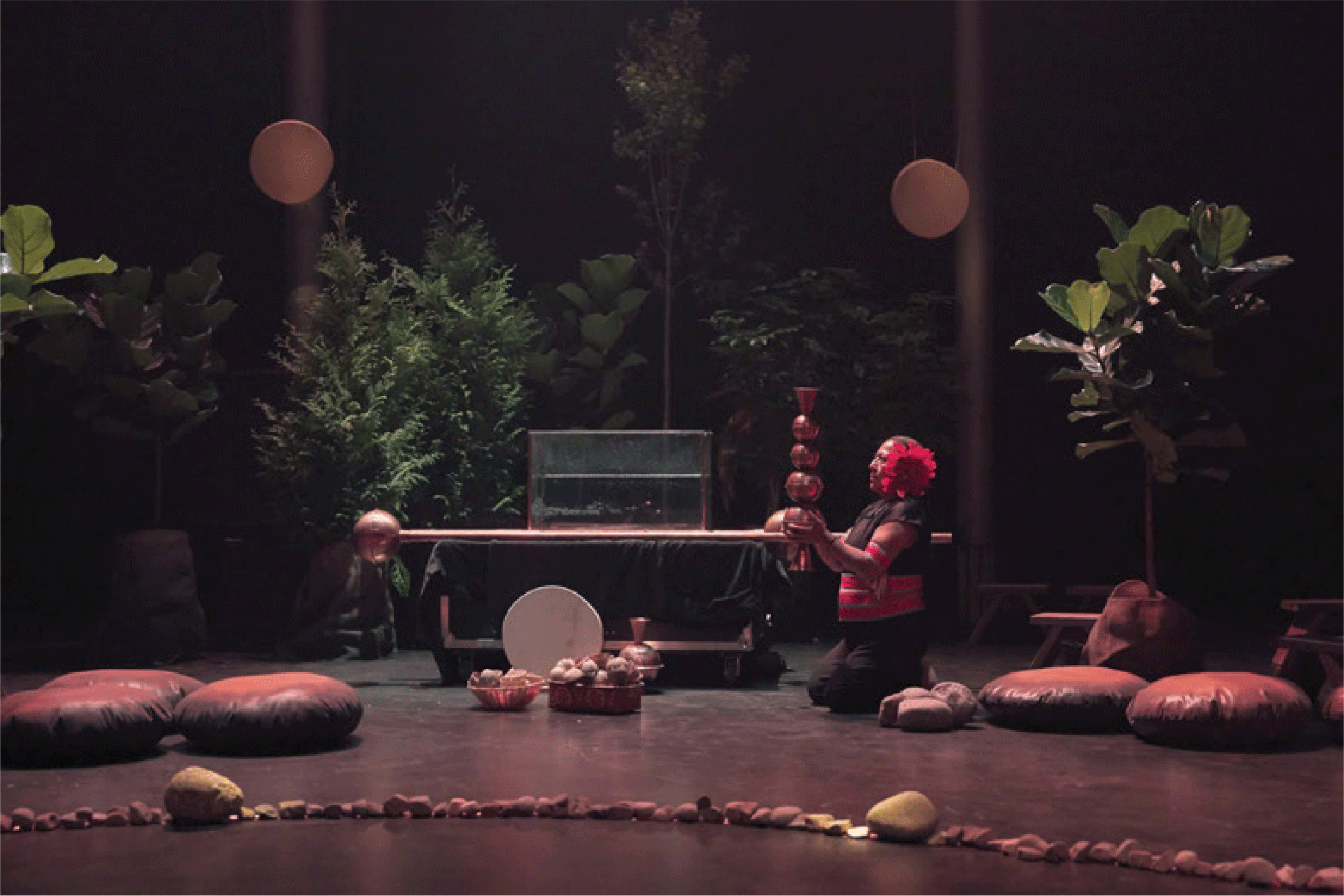
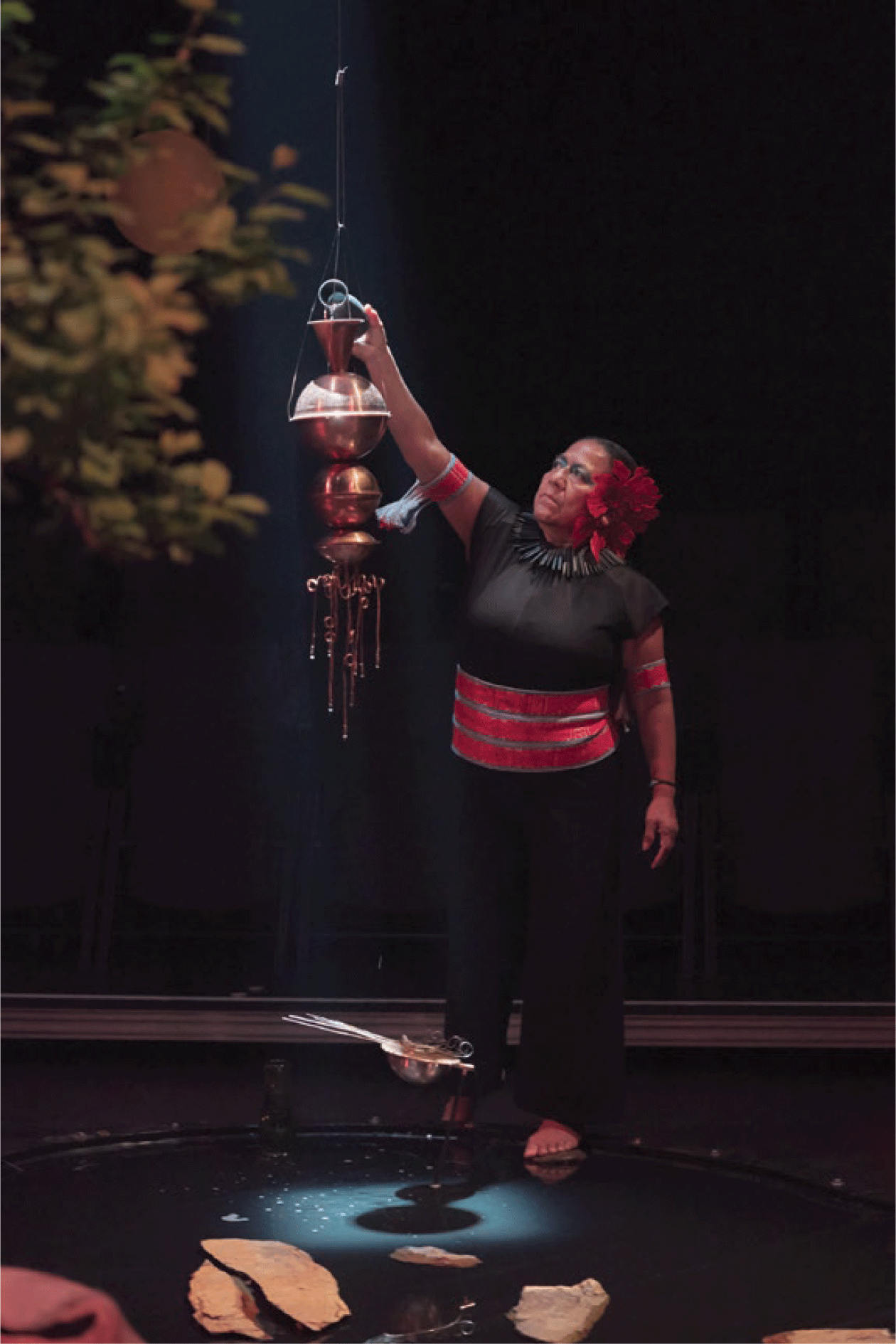
Waira Nina carries a copper receptable created by Leonel Vásquez. Espace Go, Montreal, 11 May 2024. (Photo by Antoine Raymond)

My sense of entering a new space begins as two artists guide us into the scene, inviting us to sit on cushions, low stools, and benches interspersed throughout.Footnote 1 They wear simple, elegant tunics.Footnote 2 To “accentuate their connection to the ear,” each sports a bright ruffled crest of red feathers around one auricle (Monnet Reference Monnet2024). The low lighting shifts and twists; imagistic projections and compositions enfold us in a mise-en-scène that is at once spacious and intimate. Sounds catch me off guard: layered whispers, cries, and moans. I twitch at a sudden noise that could be an animal’s rattling call. Uncertain, darting, subtly jarring and softly teasing, the sonic slithers in from all directions. Our visual plane is not that of an audience staring at a stage. We are surrounded, sightlines blocked by living trees in wheeled pots (these will later be planted in Montreal/Tiohtià:ke/Mooniyang), rocks, small containers and receptacles of water, humans, a large boat, and gleaming copper implements. As I find my place in the black box performance space, I feel both nestled in a cozy space and hidden away in a forest. The soundscape holds the situation, and we must listen for it.Footnote 3
Solidarity in the Impasse
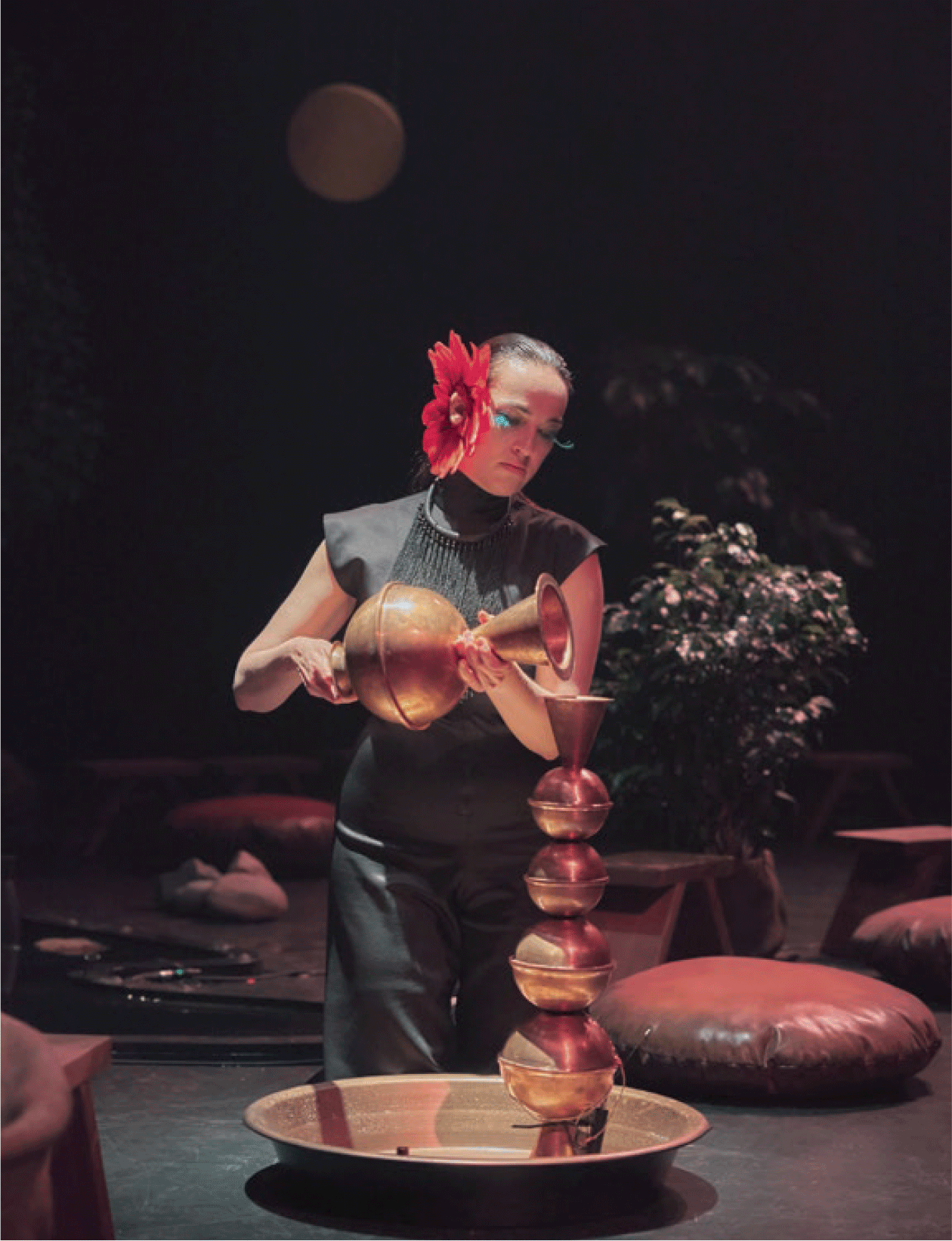
Émilie Monnet pours water into a copper receptable created by Leonel Vásquez. Espace Go, Montreal, 11 May 2024. (Photo by Antoine Raymond)

Nigamon/Tunai challenges genre. We might call it a collage/sound environment/audio documentary/ceremony/sonic forest/silent song/silenced song/stolen song/sculpture/ritual/incantation/immersion/installation/harmonization/interaction with the more-than-human—or something else. One of its creators, the Anishinaabe-French artist Émilie Monnet, calls Nigamon/Tunai a “singing forest” (FTA 2024a). Among its performers are rocks, copper, a large translucent fiberglass canoe, water, potted saplings, Monnet, and the Inga artist Waira Nina Jacanamijoy Mutumbajoy, who hails from Caquetá, a bioregion in Colombia where the Amazon rainforest meets the foothills of the Andes.
Nigamon means song in Anishinaabemowin, tunai in the Inga language. Both Monnet and Nina are sound collectors in their local terrain; for over a decade, the two have gathered and archived ambient and wild sounds, as well as the thoughts of Indigenous community leaders and environmental activists. Throughout Nigamon/Tunai, we hear animals, five human languages, hybrid human-animal sounds, nose flutes, water flutes, singing bowls, turtle shell rattles, the yakomama (an Inga turtle shell instrument), and rock music—songs sung by rocks. Collaged with these sounds are passages from the artists’ audio documentary about an ecological catastrophe unfolding in Waira Nina’s tribal lands: the extraction of rare earth metals by the multinational mining concern Libero Copper and Gold to supply copper and molybdenum for e-vehicles and other so-called green energy devices. This extraction has ravaged a highly biodiverse part of the world, impinging upon several Indigenous nations’ territories, as well as their economic and political systems, yet another example of how the Global South is at the front lines of climate devastation for the benefit of Northern elites like me.
Given this living problem, Nigamon/Tunai’s central research question is: “How do you be a good ally, particularly in the context of a relationship between a [mixed Indigenous and white] person from the North, living in the land known as Canada, and an Indigenous person from the South whose country has been devastated by Canadian mining and oil companies? What does it mean to be a friend, in the profound sense of friendship?” (FTA 2024a). Additional questions are: How can we grapple with the intensifying losses associated with the “Great Acceleration” (see Engelke and McNeill Reference Engelke and McNeill2014) or “Great Derangement” (see Ghosh Reference Ghosh2016), as the extraction machine wrecks planetary ecosystems, this time under the sign of green energy? Also: What does it mean to listen? That is, what does it mean to listen to stones, water, fossils, trees, elders, ancestors, abuelos, and the voices of the missing and murdered? Nigamon/Tunai is, as critic Mario Cloutier (Reference Cloutier2024) notes, a la fois apaisant et inquiet, and as such asks us, in both subtle and lacerating ways: Can the privileged settlers of the Global North, inheritors of colonial modernity, realign our frequencies to grasp “submerged perspectives” beyond settler consciousnesses and cosmologies (Gómez-Barris Reference Gómez-Barris2017:1)? Can we tune in?
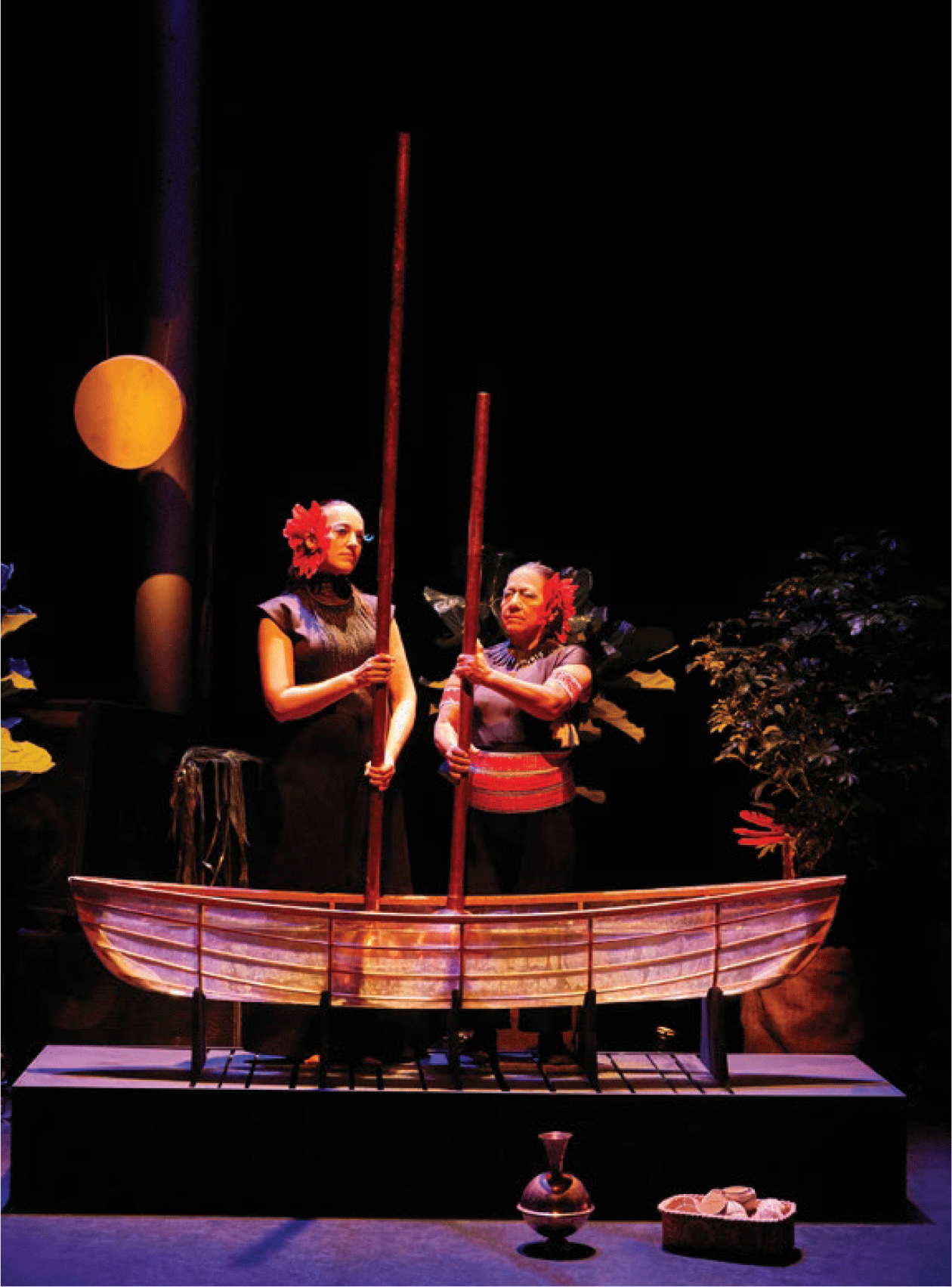
But this is not all that Nigamon/Tunai asks. The piece is not only a call to listen to Global South Indigenous voices; it is not only, or even primarily, addressed to settlers. Nigamon/Tunai is also a meeting place for artists who are members of Anishinaabe, Inga, Wendake, Abenaki, Atikamekw, and Cree nations. Beyond the people whom we see onstage, there are nearly two dozen Indigenous and non-Indigenous artistic contributors.Footnote 4 So Nigamon/Tunai is also about how a performance can offer a space of trans-Indigenous solidarity, as it tells a story of Nina and Monnet, who have known each other as “friends, allies, and artistic collaborators” since 2003 (FTA 2024b). Nigamon/Tunai expands the idea of friendship to explore intergenerational, North-South, trans-Indigenous solidarities and alliances, affections, commonalities, and relationalities. In examining their friendship through dramaturgy, Monnet and Nina find many connections in their communities’ belief systems—and these are not coincidental. Monnet says: “I think that these exchanges have always happened, our ancestors had them” (in Eckersall and Ferdman Reference Eckersall and Ferdman2021:154). Trans-Indigenous interactions are symbolized by the canoe, “how the ancestors used to connect with each other” across nations—and the canoe also conjures a “symbol of dreams and the psyche,” representing dream travel (Monnet Reference Monnet2024). Nigamon/Tunai embodies trans-Indigenous connections as ongoing processes of movement and exchange that have transpired over thousands of years, in both material and speculative forms.
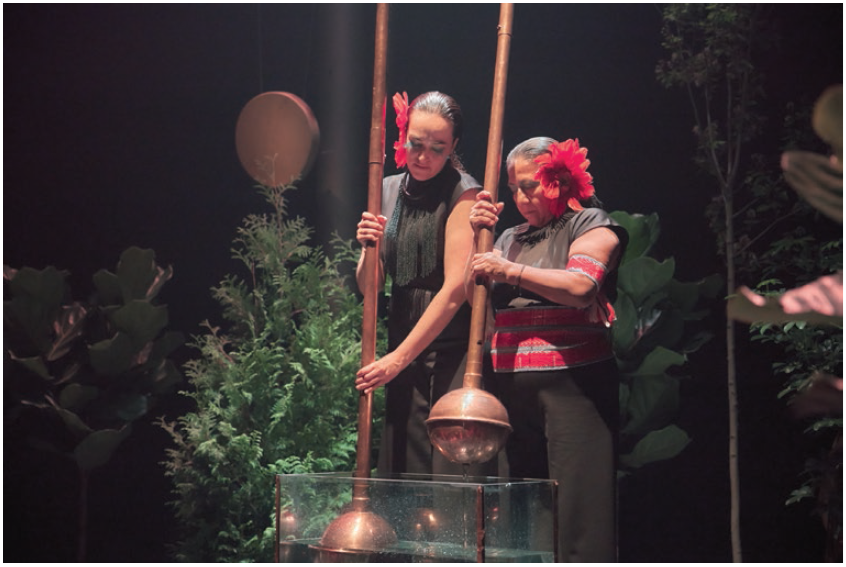
Émilie Monnet and Waira Nina fill copper receptacles created by Leonel Vásquez with water from a fiberglass canoe. Espace Go, Montreal, 18 May 2024. (Photo by Marjorie Guindon)

As enacted by Monnet and Nina, friendship is a form of love, and solidarity is a form of collective friendship. This thematic axis structures Monnet’s oeuvre writ large. Nigamon/Tunai is the second installment in Monnet’s tetralogy on the topic of love. The first play in the cycle, Neecheemus (2023), focuses on love, pleasure, sensuality, and eroticism among Indigenous and Black women. Monnet is currently working on a third piece about love and trees (“how can trees teach us how to be more loving?” is a guiding question) (Monnet Reference Monnet2024). Through performance, the two women explore and embody the multifaceted concept of friendship as an intervention in grief and a part of healing practices, taking in both ecological loss and individual deaths. As Monnet has noted:
Waira is a tremendously brave Indigenous leader, a storyteller, and an interdisciplinary artist. […] Waira’s life has been impacted by tragic events. Her community has found itself in the middle of several armed conflicts […] Her land has been ravaged by paramilitary forces, the former Revolutionary Armed Forces of Colombia (FARC), […] other armed groups, illegal cultivation (coca, poppy, etc.), mineral extraction […] Two of her brothers, who were Indigenous leaders and environmental activists, were assassinated. (FTA 2024a)
As an advocate of Indigenous feminisms who has been recognized for her work in national and international forums, Nina has survived multiple assassination attempts and has had to wear a bulletproof vest for many years (Monnet Reference Monnet2024).
This is the impasse that Nigamon/Tunai confronts: a nexus of destruction, corruption, and precarity that forces anti-Indigenous racism and poverty into contact with ecological destruction and gendered political violence. As such, the performance also addresses the context of the Colombian Amazon region, deeply marked by mass displacement, killings, and intimidation, as are many other areas of the country, in the long history of Colombia’s civil war. Yet Nigamon/Tunai does not remain in a place of anger, melancholy, or cynicism. As Nina observes, the piece
Involves us in feeling the emotions that our bodies have experienced on the land, from violence to joy, from silence to listening to all those soundscapes that are only understood by those who have lived them. This process led us to share our personal stories and those of our peoples […] We listen to the songs of north and south, of elders, of women; we listen to the statements made by people who defend their lands in order to protect them and live there in peace, coexisting with animals, as part of water. (FTA 2024b)
Nigamon/Tunai’s “plurilingual sonic universe” allows for “another way of getting in touch with other beings, which is based on listening” (FTA 2024b). Stimulating deep listening can allow for the emergence of “voices that are often inaudible” and which we “rarely hear” (Saint-Pierre Reference Saint-Pierre2024).
Process
Beginning
Process is integral to Monnet’s work in trans-Indigenous artistic exchanges: “We’re not focused on the result, how the work will be received, or whether audiences will come. We’re focused on the process, on just being together” (in Eckersall and Ferdman Reference Eckersall and Ferdman2021:153). The art that emerges is that of “being able to create a space that tends to the creative fire of the group, that cultivates safety, is nurturing, and [permits] the conversations we wish to have” (153). Nigamon/Tunai becomes a juncture where aesthetic process and ritual process are coactive. Languorous and episodic, the piece unfolds over roughly two hours and through eight conjoined lunas (moons): thematic episodes linked through a dramaturgical arc. Monnet and Nina created “moon dramaturgy” together as a methodology to overcome language barriers and shared inexperience with performance—neither had planned to make art when they met. Monnet told me that Nigamon/Tunai was the work that “taught both of us how to be artists” (Monnet Reference Monnet2024). They began with the use of colors to elicit responses, as colors “represent a powerful dramaturgical approach, allowing us to examine the perceptions of each one and develop a pathway via which our respective worldviews and knowledge come together” (FTA 2024b). Over more than a decade and across at least three countries, the work took shape.
Nigamon/Tunai was (and is) “a slow process which [has taken] us years” (FTA 2024b). The work’s creation, beginning in 2014, involved many intertwined processes: Monnet’s and Nina’s collaborative editing of their accumulated sound footage; integration of the work of Colombian sound artist Leonel Vásquez; and “documentary theatre, dance and movement, voice and sound work, video [and projections].” The creative process is ongoing, as Nina and Monnet are still “changing things and trying different things” (Monnet Reference Monnet2024). They are currently adding at least one luna for Nina’s daughter, Belém Jacanamijoy-Mutumbajoy.
Nigamon/Tunai adapts to each space where it is presented.Footnote 5 One of the requirements for the piece, Monnet told me, is that it be performed in a venue that allows for intimacy and reciprocity. Without this, it would be impossible. Nigamon/Tunai “is and will always be immersive—it has to be.” Intimacy breeds interactivity, and Monnet has noted that children in particular have “connected with [the performance] and […] would offer to come up and help with things, touch the trees” (Monnet Reference Monnet2024). The performance that I attended was replete with sociality: I observed audience members grazing their fingers over the saplings around them, relaxing into each other, and making noises of their own.
Hum/an, More Than
As my eyes adjust to the dimness, the warm glow of light on metallic vessels strikes my senses. Later I learn that these vessels are made of copper; when I first see them, not knowing they are made of metal, I find them evocative, auratic. They call out to me. Or, perhaps, they gesture. “Extended out beyond a body, a gesture is carried perhaps by air, perhaps by stone, perhaps by film, light, pixels, passed through algorithms, or perhaps by body-to-body transmission” (Schneider Reference Schneider2018:286–87).
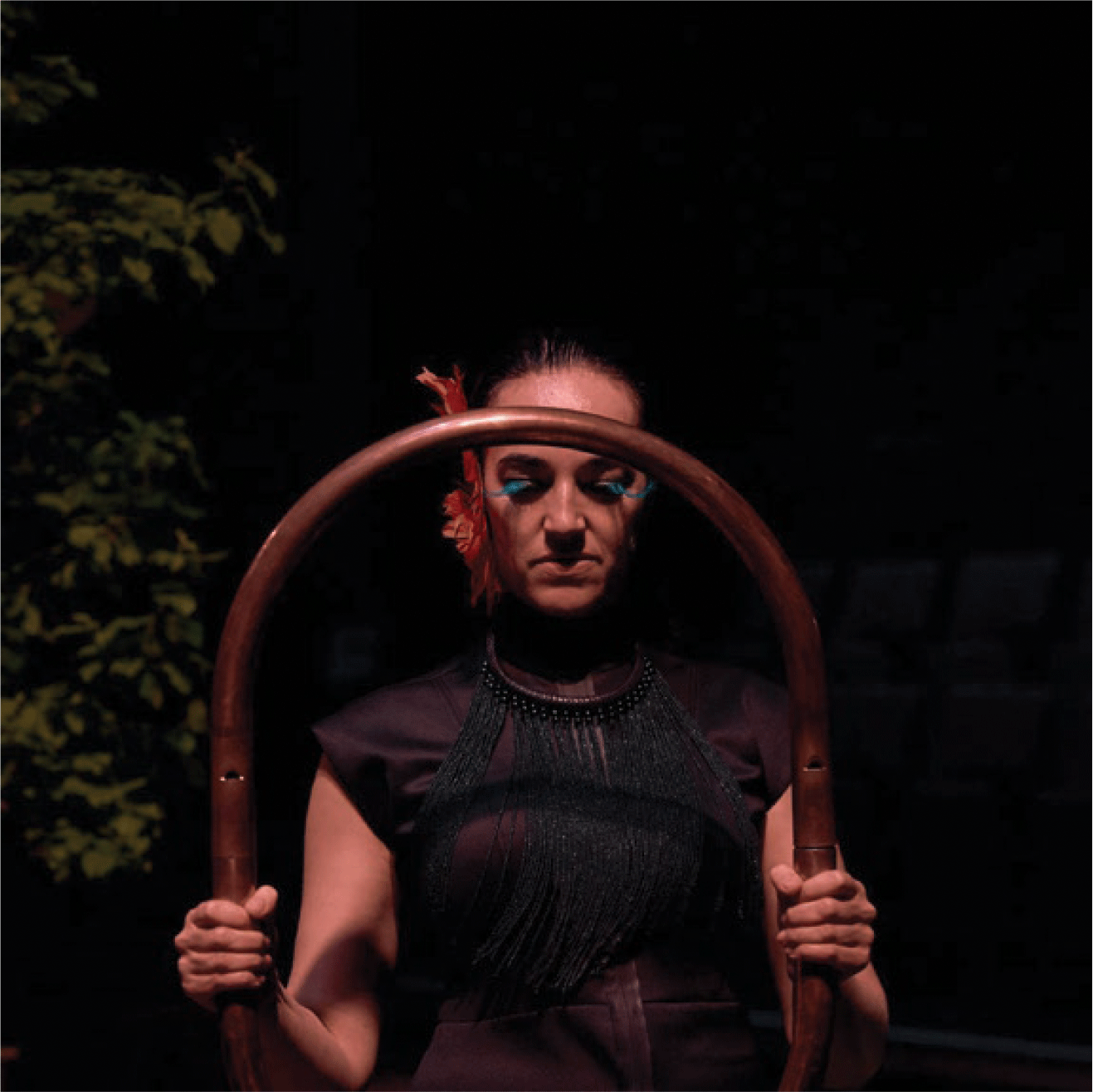
I am hailed by the sumptuously curved forms, which resemble ritual objects: scepters, ciboria, amphorae. One is large and U-shaped, a circular water flute that produces a theremin-like hum when moved forward and back. Monnet and Nina vibrate this instrument gently around our faces. They move in intervals, pausing to activate the humming object. “Hearing and touch meet where the lower frequencies of audible sound pass over to tactile vibrations […] Hearing is a way of touching at a distance” (Schafer [Reference Schafer1977] 1994:11). The tactility of sound, its material basis in vibration, fuses intimacy and sociability. The water flute’s hum pulls me into a sensuous relationship; I feel the texture of my skin prickle, in a reverberating duet. Monnet calls this opening ceremonial practice “smudging with sound” (Monnet Reference Monnet2024). As the artists “smudge the space with the sound, [the circular water flutes] activate each person, activate the copper, connect and welcome us into the space.” Sound smudging and other sonic acts channel sound’s intentionality—not as representing something, but as a stimulating agent that moves us into and through the process.Footnote 6 This opening gesture “stretch[es] the moment of greeting” to prime us for the deep listening to come (Monnet Reference Monnet2024).
Émilie Monnet plays a circular water flute created by Leonel Vásquez. Espace Go, Montreal, 12 May 2024. (Photo by Leonel Vásquez)

As my body attunes to the sounds issuing from the warmly glowing metal, I notice copper vessels interacting with small basins of water located throughout the space, some embedded in the stage floor, others simulated with the use of a reflective material, still others raised. Nina and Monnet manipulate the pressure in long, flutelike vessels, which draw in water. The artists transport these vessels around the space, releasing the water into receptacles dispersed throughout. Other chalice-like containers emit water autonomously in slow, rhythmic droplets. Some of these are pendula, swaying gently as water moves through them. Water, flowing and dripping, is all around us. The human performers suddenly become, in my mind, conduits for the circulation of water. Are the long tubes carried through the space by the performers, or do these vessels move the people? Who is transporting whom? It becomes hard to tell, as subject/object and human/nonhuman hierarchies blur. As the order of things dissolves, we can harmonize in new ways, becoming intersubjectively enmeshed with more-than-human actants or “actuators” (Monnet Reference Monnet2024). The copper forms vibrate around, with, and through us. They are both part of the piece and apart from it; they are both objects and strikingly alive, material but not inert.Footnote 7
These sonic sculptures are made of “copper in disuse” (cobre en desuso) sourced from Bogotá landfills and recycling centers by Colombian artist Leonel Vásquez. Vásquez shifts the conventions of sound-making from human performer and objectified instrument into a transfer of energies that supersedes, surrounds, and re-sounds the human. The copper that Vásquez employs is perceived to have outlived its so-called useful life. But in the sonic vessels, the metal transforms into something entirely different: it is made available to our senses in new ways. In our interview, Vásquez described his work with nonhuman/more-than-human actants or actuators as a “risky” intervention that “broke with the logic of a piece of theatre, becoming a [chance-oriented] work within a [scripted] work” (Vásquez 2024).Footnote 8 In the project of giving voice to nonhuman and often inaudible beings, Vásquez’s work permits us to engage closely with, and cede authorship of, sonic practices.
Waira Nina pours water into a copper receptacle created by Leonel Vásquez. Espace Go, Montreal, 11 May 2024. (Photo by Antoine Raymond)

Vásquez refers to the copper instruments as amphibious: they resonate differently in and outside of water. To produce sound, they undergo aleatory, indeterminate, and experimental processes. Vásquez applies a variety of conditions to the molded copper: chance, gravity, centrifugal and centripetal force, vibrations, geological and metallurgical processes, electrical currents, heat, and cold. These experimental practices play with the metal’s properties to tease out its unique qualities. Copper can be molded easily; it allows sound to resonate in idiosyncratic ways. With acoustics, as with electricity, it provides an excellent conduit. Copper also heats and cools easily, and it possesses “an incredible memory”—it retains coolness or warmth for a long time. Copper, Vásquez told me, is a sensitive material and a medium of transmission: physically, industrially, aesthetically, and spiritually (Vásquez 2024).
Although Vásquez did not identify himself to me as Indigenous, he describes his sound work and collaboration with Monnet and Nina through Indigenous-centered frameworks to “reevaluat[e] the epistemology constructing the world” and re-attune to the nontransactional ontologies of land (“los territorios”), water, and other forces (Vásquez 2024). Copper’s metaphysical properties of transmissibility, fluidity, resonance, and memory are linked to Anishinaabe and Inga traditions of coppersmithing and ritual practices that Nigamon/Tunai explores in its audio documentary portions. We hear fragments of commentary by Inga and Anishinaabe elders, activists, metalworkers, and others on the changes to their lands wrought by climate change and extractive industries (Morin Reference Morin2024). Indigenous traditions practice extraction too, but they do not shear off mountaintops. They are far less invasive forms of mining, focusing primarily on surface-level copper. These mining practices have long understood copper as one of the seres agrados (kind/generous beings), like gold, whose extraction has shored up Indigenous ritual and aesthetic worlding practices. Vásquez cited the balsa muisca, an exquisitely crafted miniature raft composed primarily of gold, but also including trace quantities of copper and silver, that was created between 600 and 1600 CE (Banrepcultural 2023). This votive figure (ofrenda) is a spectacular example of the Andean Muisca people’s goldworking and provides insight into Indigenous elites’ ritual practices, as the investiture ceremony for Muisca leadership took place in a spectacular ritual in which the succeeding leader was covered with fine gold dust, navigating on a raft over water.Footnote 9 Indigenous peoples in what is known as Canada began working copper at least 7,000 years ago, and likely earlier. In addition to copper’s malleability and beauty, “oral histories indicate that copper was often closely linked to spirituality and supernatural beings.” Moreover, “[c]opper [sourced near] Lake Superior was traded across thousands of kilometres.” Large caches, such as one buried roughly 4,000 years ago near Lake Nipigon, Ontario, have been found to contain dozens of copper “tools, jewellery, and other objects” (Canadian Museum of History 2025). The extraction of these metals has never been separated from their spiritual value.
Émilie Monnet and Waira Nina fill copper receptacles created by Leonel Vásquez with water at Espace Go, Montreal, 11 May 2024. (Photo by Antoine Raymond)

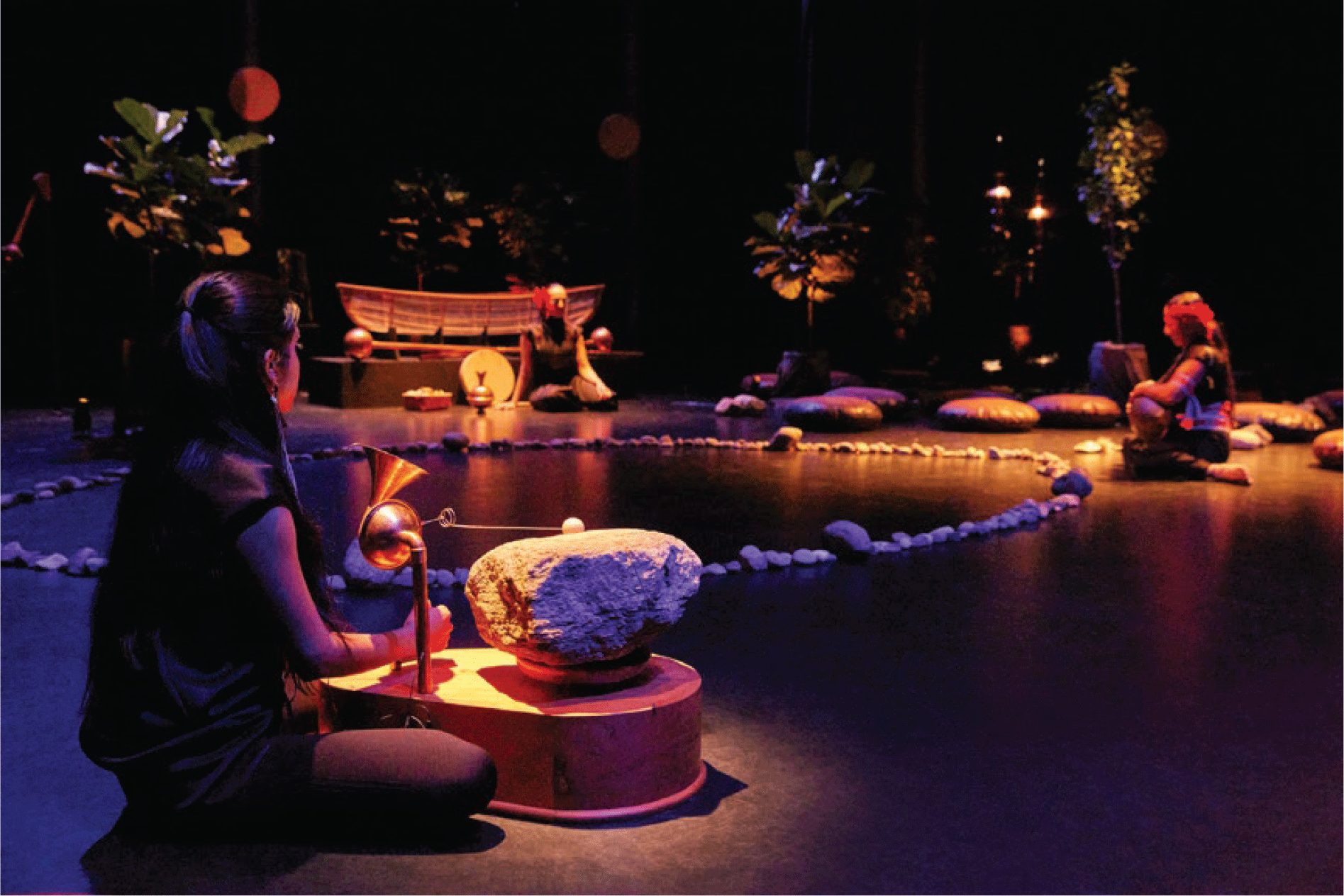
In the foreground, Belém Jacanamijoy-Mutumbajoy operates the lithic turntable created by Leonel Vásquez. To her right, Émilie Monnet and Waira Nina sit in the stone circle. Espace Go, Montreal, 18 May 2024. (Photo by Marjorie Guindon)

Rock Music
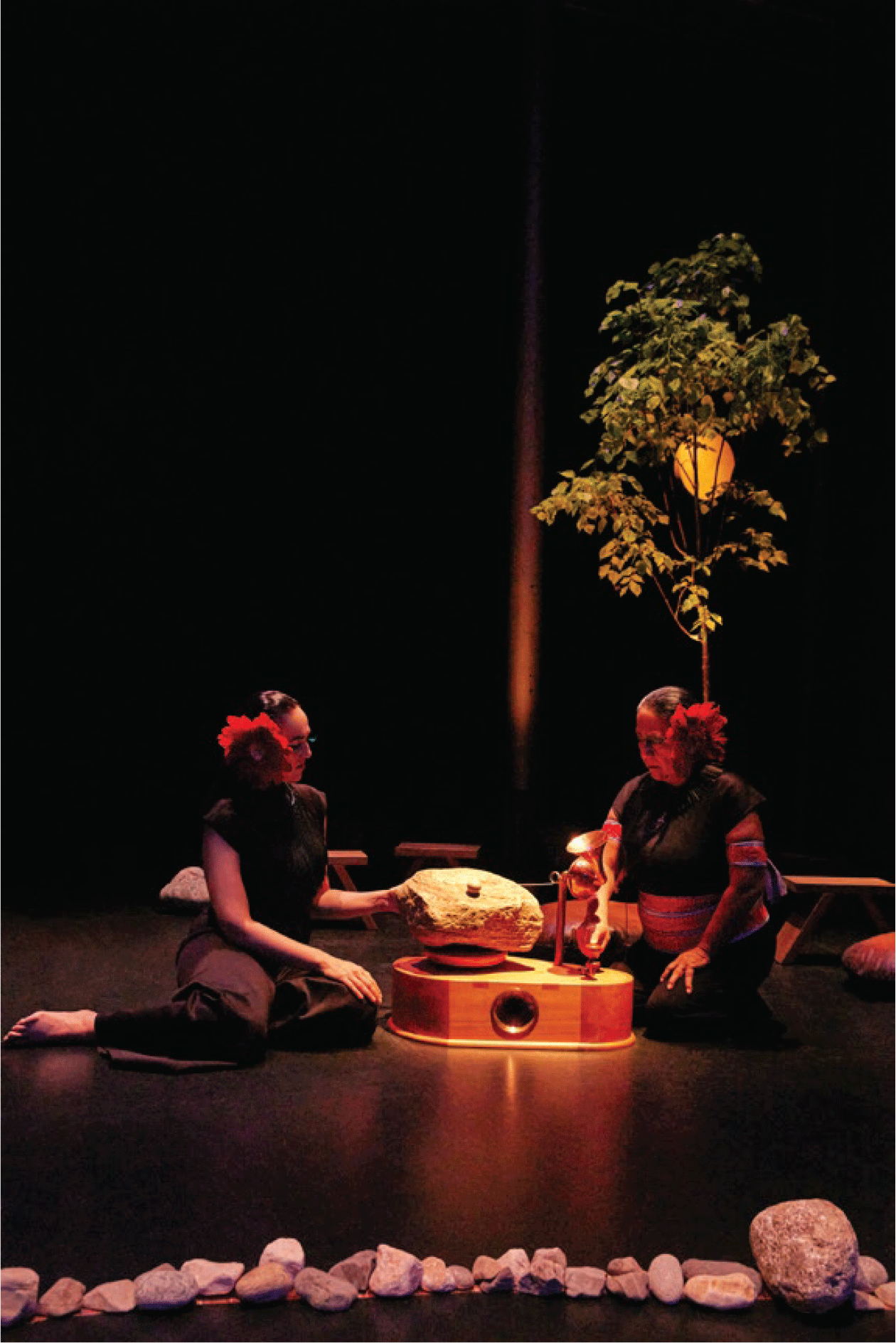
In our interview, Vásquez discussed humans’ complex histories of metallurgy and stone-working and noted, “as humans, we are the product of a geological relation” (Vásquez 2024). This sense of our minerality surfaces forcefully in Nigamon/Tunai when Belém Jacanamijoy-Mutumbajoy comes onstage to secretively activate a heavy boulder that becomes a geological turntable. A copper ball at the end of a metal rod—like a stylus at the end of a tonearm—touches down on the surface of the rock, and the stone begins to spin. The voice of taita (Inga traditional healer) Luciano Mutumbajoy emerges from the rock. Taita Luciano tells us, through the groove of this rock record, about the road that the Colombian mining subsidiary of Libero Copper and Gold, Libero Cobre, has built through sacred Inga lands and through his village, the destabilization of the terrain, and the contamination of the local water source. Hearing an elder’s voice emerge from the turning stone—as at another moment in the piece when a now-deceased elder’s song emanates from a tree—changes the quality of our listening.
Émilie Monnet and Waira Nina operate the lithic turntable created by Leonel Vásquez. Espace Go, Montreal, 18 May 2024. (Photo by Marjorie Guindon)

I asked Vásquez about this voice materializing from the oscillating rock and metal. The lithic turntable is part of an ongoing project entitled Canto rodado (river stone) (Vásquez n.d.).Footnote 10 A canto rodado is a small stone that has been smoothed over time by the pressure of a running river; rodado is from rodar, to roll. And the word canto also means “song” and “singing.” The rock that forms the base of the record player comes from a dry riverbed in Colombia (un río de piedras secas). For millions of years, the water shaped rocks with its flow, but now the drought-stricken river has no flowing water, Vásquez told me, and “all of the information is in the rock. How can the silence of the rock and river allow us to hear again [volver a escuchar] and connect us with […] seventy million years ago?” The rock holds the memory of water in its form, “the silence of the river that the rock holds […] as a mechanism of the sound’s memory” (Vásquez 2024). Perhaps the water continues to sound in the rock, much as a needle, when touched to a record’s vinyl groove, can produce a melody.Footnote 11 At once record and record player, the rock is a technique of “transduction and a mechanism of sound—a gramophone.” In this sense, “it is not an artist encountering a silenced river—a rock is an artist who speaks through [another] artist.”Footnote 12 In Inga and Anishinaabe cosmologies, stones are ancestors who comfort and accompany the living. The ancestor rocks, las abuelas rocas, are “not there to yell at us or shame us but to give us a bit of calm, peace, and time to contemplate” (Vásquez 2024). They travel to us through the rock record, like the spinning friction of needle on stone, registering in the intertemporal groove.
Vásquez’s record-playing rock playfully (re)animates the rock record, the geologists’ view of rock and fossil matter as “data-storage medium,” which humans have long “received and decoded” to “narrat[e] the long history of the earth” (Luciano Reference Luciano2016). Rocks may be the ultimate archive, and their minerals are increasingly important to us. Rebecca Schneider notes, citing Bruno Latour, that “‘humans are now rocks.’ Latour is […] referring to the fact that now, in the racial Capitalocene, humans are geologic agents on a course of climate change.”Footnote 13 As Schneider observes, linking Paleolithic handprints to contemporary smart phones, “we have always had ‘rock in hand and hand in rock’” (2018:302). Current extractive industries continue the same trajectory as the mining of gold, silver, and other prized metals during Europe’s conquest of the Western Hemisphere. About this massive human death event, motivated by lust for minerals and metals, the rock record says little. The violence and disease inflicted on Indigenous populations across the hemisphere may correlate with two points that have shown up in stratigraphic records: first, what some call the “Orbis Spike” is marked by a dip in carbon dioxide levels around 1610, adduced in ice cores (Lewis and Maslin Reference Lewis and Maslin2015). The dip may be attributed to the depopulation of the “New World,” although this is debated. Another effect recorded in the rock and fossil record is the global reorganization of plants, animals, and pathogens benignly called the “Columbian exchange” (including an exchange of agricultural importations that would forge colonial modernity: corn and other products transported to Europe, and sugarcane and coffee to the Caribbean) (Nunn and Qian Reference Nunn and Qian2010). Geology is silent on the politics of colonial modernity, its desolation and inequity and sheer cruelty. Against this history of extraction, we can propose a different, oppositional reading, wrought by a rock that tells a story.
If stones and mountains are ancestors, abuelos and abuelas, then they are altogether different and more than inert matter containing precious alloys. If they are not just these things, then we can hear them sing.
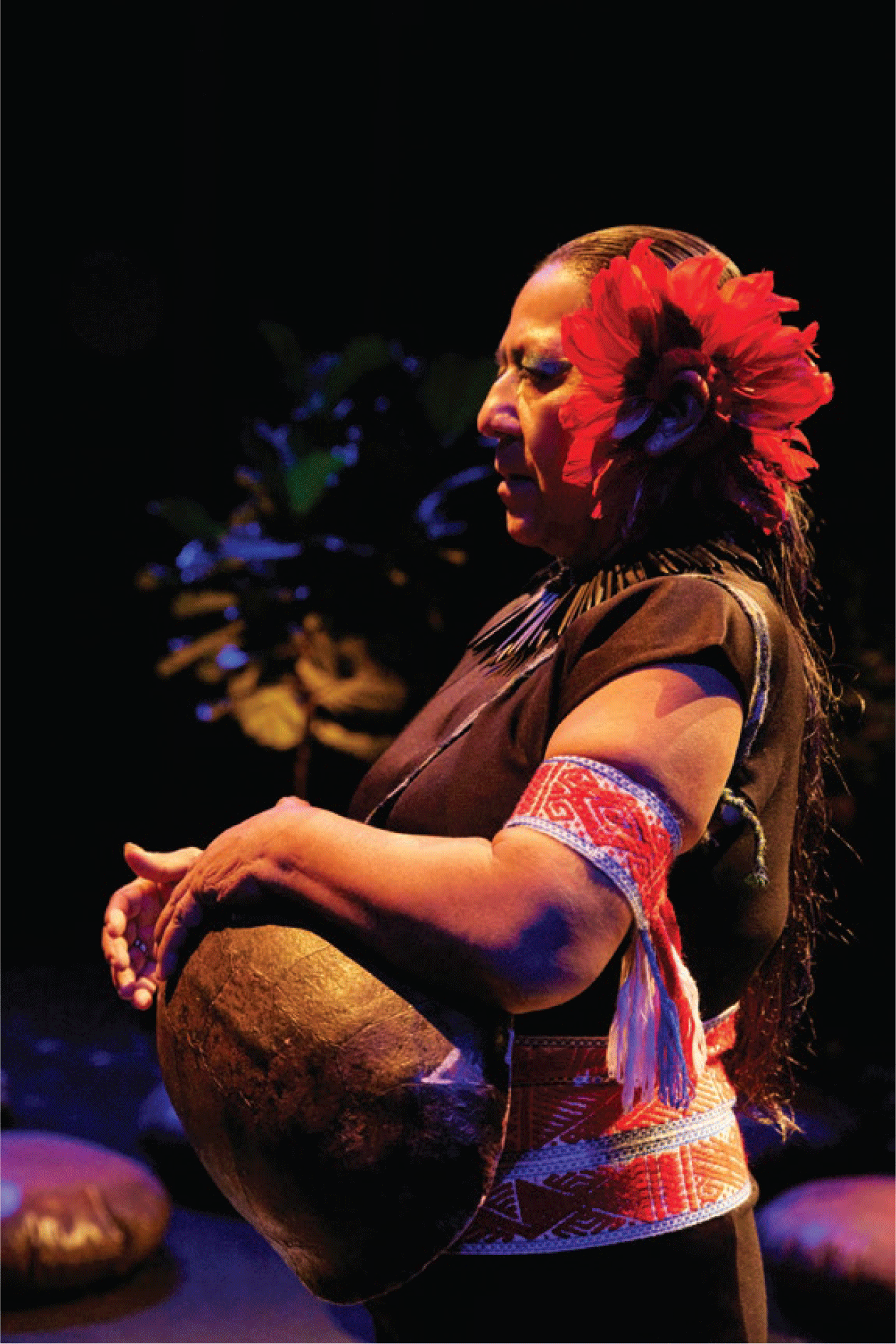
Waira Nina plays the yakomama. Espace Go, Montreal, 18 May 2024. (Photo by Marjorie Guindon)

Yakomama
Another sonic intervention in Nigamon/Tunai is the yakomama (or yacumama), played by Nina, who has been crucial in reviving this traditional Inga instrument. The yakomama, Nina told me, is made of a large Amazonian turtle’s shell and only played by women; she learned to play it from her mother, who in turn learned from her mother. To create the instrument, a turtle is traditionally sacrificed, “giving women their song” (Jacanamijoy Mutumbajoy 2025). The turtle shell becomes the resonant drum of the yakomama. To play the yakomama, Monnet explained, “you place it on your belly, put beeswax on the part where the head would be, and rub it to make it sing. It can really wear down your finger skin, it is very hard to play. It makes a humming sound, ‘oooohhh.’ ” Nina added: “not too much pressure, not too little—to make sound, you can’t have salt or grease on your hands, only beeswax” (Jacanamijoy Mutumbajoy 2025). The yakomama is played during Inga ritual events such as the Atun Puncha, the new year’s celebration in late February and early March (Arwi Reference Arwi2022).
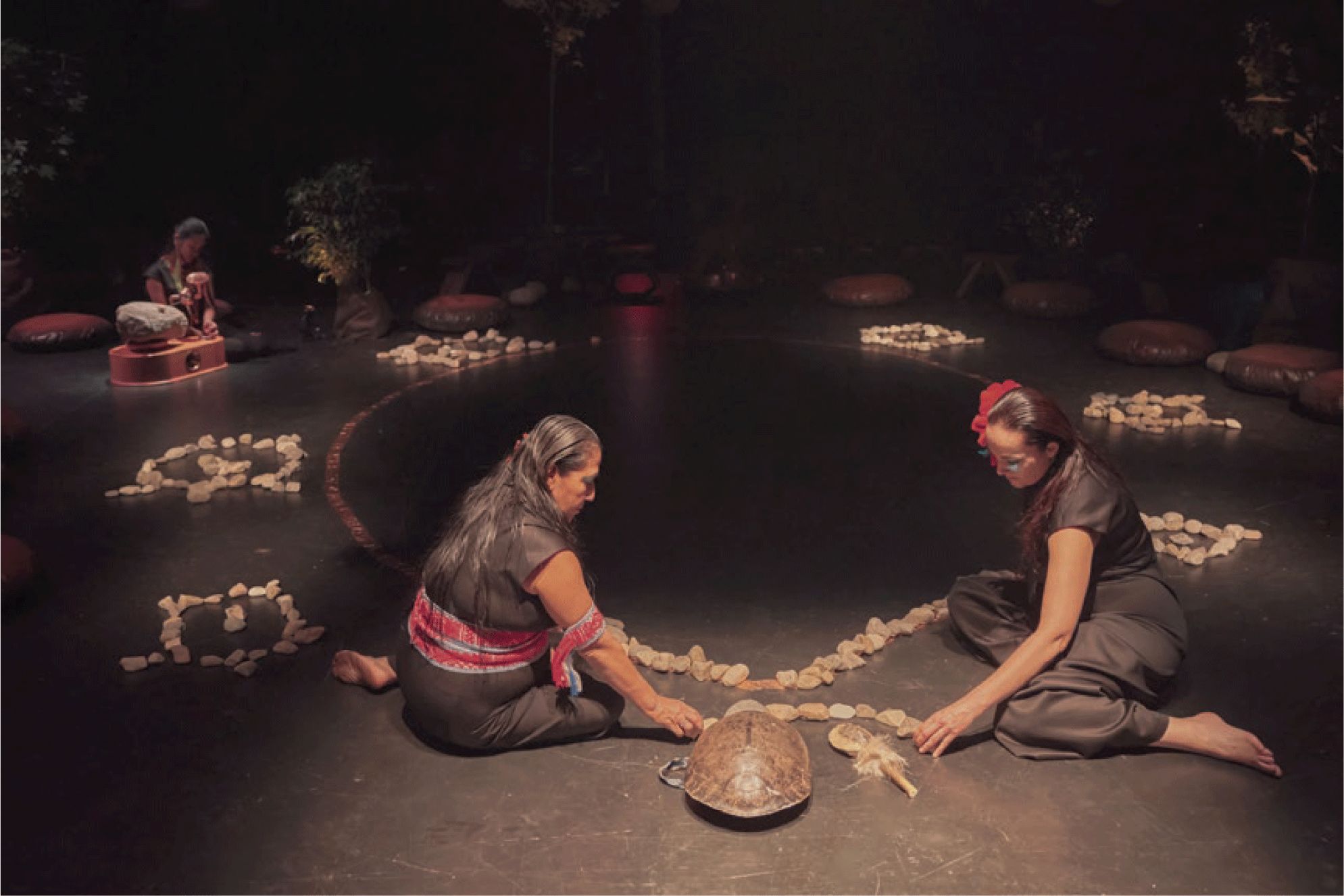
The figure of the turtle is a foundational element of Nigamon/Tunai, as it forms a bridge between Inga and Anishinaabe cosmovisions and creation stories. As Nina recounted to me, Inga people believe that turtles are connected to water, the lunar cycle, earth, and stars; turtle symbology evokes women and feminine properties for both Inga and Anishinaabe peoples (Jacanamijoy Mutumbajoy 2025). Anishinaabe ceremonies and artisanship often feature the shell of the tortue serpentine (common snapping turtle) (Saint-Pierre Reference Saint-Pierre2024). In Inga mythology, the turtle is the “mother of the waters”: once a year, the turtle sacrifices herself to offer a song that protects the water, “the source of all life.” And Anishinaabe creation stories feature the turtle centrally as a being who “is said to support the world, and […] an icon of life itself,” giving the continent its name: Turtle Island (Robinson and Filice Reference Robinson and Filice2018). Turtle symbology is present throughout Nigamon/Tunai: during one of the final lunas, the turtle descends to the ground as a cool blue shimmering projection created by Abenaki-Québécoise artist Mélanie O’Bomsawin. Around this image, the artists create the silhouettes of turtles with stones, forming a new kind of rock record. As Monnet told me, “we bring […] rocks to the trees—a protective circle becomes a turtle shell. There are seven rocks for seven generations, part of Anishinaabe myth” (2024).
Turtles are emblems of trans-Indigenous solidarity through their prevalence across many Indigenous worldviews. Turtle Island can in fact extend beyond the eastern region of the North American landmass and into Central America, the Andes, and the Amazon. In Mayan cosmological thought and architectural practices, for example, the turtle is a central figure: “turtle carapaces symbolize the surface of the earth and the crack from which the Maize God and other supernatural [beings] emerged at the time of creation” (Werness-Rude and Spencer Reference Werness-Rude and Spencer2015:21). For the ancient Maya, “the turtle represented the surface of the earth floating in primordial waters” (33). Mayan terms for “turtle” also describe architectural features of Mayan building practices, bringing together the turtle’s spiritual properties with its materiality as a stabilizing force.
In Nigamon/Tunai, the artists hybridize Anishinaabe and Inga instruments. In addition to Nina’s playing of the yakomama onstage, Monnet and Nina created a new instrument for the performance that combines Inga and Anishinaabe sonic practices. During fieldwork with Nina, Monnet told me, they happened upon a large, empty turtle shell on the banks of the Amazon River. They filled this shell with corn husks and small stones to make a rattle, which they shake together during Nigamon/Tunai (Monnet Reference Monnet2024). This instrument recalls hundreds or even thousands of years of Anishinaabe musical practices: walking through the Canadian Museum of History recently, I came across a mounted turtle shell drilled with holes, whose wall text read, “Turtle-shell rattles: turtle shells, filled with small stones, may have been used as rattles in public ceremonies.”Footnote 14 Unlike this archival description, which does not tell us very much about the instrument (who made it; who acquired it; how, when, where, why, and by whom it was played, and other important information), Monnet’s rattle, created with a turtle from Nina’s tribal lands, tugs the past into the present, braiding together the inanimate and animate through the conduit of embodied sound, and imbuing ceremonial practice with trans-Indigenous solidarity.Footnote 15
In Hungry Listening, Stó:lō/Skwah artist and scholar Dylan Robinson asserts that “Indigenous song has the ontological status of ‘work’ or ‘doing’ and that ‘songwork’ makes things happen in the world” (2020:228). The work that song does includes “reaffirming rights and privileges of families and individuals, documenting important changes including marriages and the transfer of rights and privileges, healing, documenting history and rights to territory, and conveying knowledge about the lands of which Indigenous people are caretakers” (231–32). Sounds can be “epistemologies of doing”; Robinson asks: “What would it mean to understand […] contemporary Indigenous song not simply as aesthetic, but as doing something or bringing something into being through its performance or utterance? Recognizing this fact is to reframe our ontological understanding of song and speech” (238–39).
Reverberation
Together, the instrumental sculptures in Nigamon/Tunai—copper singing bowls, nose flutes, water flutes, lithic turntable, and yakomama—share a sound in common: they hum. An ambient noise, the hum is the consolidation, to our ears, of an oscillation. Sound is a product of several parts of the body vibrating along with the frequencies that interact with these vibrations. A hum is a sonic affect, a vibration that registers before we might call it autonomous sound, created by the resonance of air through passageways. This sound can be disturbing or irritating, but it can also be relaxing and comforting.Footnote 16 A hum penetrates us; the reverberation of sound is a bodily act. “[E]ven the […] most quiescent body is vibratory and vibrated,” and “[e]ven in the most tranquil, enclosed sonic space, all bodies give off and receive sonic traces, emanations, and reflections” (Akiyama Reference Akiyama2020:42).Footnote 17 Just as my body responded to the water flute’s hum as if it were a kind of touch, sound’s reverberations can connect bodies aurally and haptically. Nigamon/Tunai’s use of vibratory sound resonates with Iris Blake’s discussion of Rebecca Belmore’s iterative sound artworks, which “allow visitors to experience echo as vibrational, as sonic, as position/posture, and as an orientation” to political questions (Blake Reference Blake2020:20).
A hum resounds at the interface of figure and ground. Often construed as background or white noise, the hum is something a listener may ignore or strive to put out of mind. But Nigamon/Tunai encourages us to tune into the hum, to listen deeply enough that that marginal, ambient sound we may overlook or even wish away becomes central to our practices of signification. This activates us in new ways. As Monnet has said, “it’s been very stimulating to think of sound as a cradle for cultivating a different quality of listening” (in Eckersall and Ferdman Reference Eckersall and Ferdman2021:158). The hum cradles us, indeed. Monnet feels that:
[t]he interaction of [Leonel Vásquez’s] practice with ours, along with our Indigenous cultures, enriches the plurilingual sonic universe that we offer the audience. Onstage, we share the space with trees. Water, birds, and wind blowing through the branches each have their own specific songs. But for many of us humans, our ability to listen has become impoverished. We can no longer recognize what a bird is telling us, nor are we able to communicate with other species. In Nigamon/Tunai, we [ask:] How can we […] create a space for deep listening in order to hear the voices of our communities’ spiritual leaders, custodians of knowledge, those who are fighting to defend the land and save lives? Voices that others have often eradicated, oppressed, or tried to kill? Today, more than ever, it’s important that we listen to them, because that’s where answers may be found. (FTA 2024b)
Listening to the Impasse
In Nigamon/Tunai, sound moves through us, and we move through sound, in a complex progression, a sequence beginning with the water-activated copper and sonic smudging, into dissonance, rupture, and healing. After activating us with humming implements, Monnet and Nina re-enter the performance space, exploring its contours while vocalizing the cries of birds. Their sounds, created in consultation with a birdcall specialist, evoke the birds that inhabit each artist’s local terrain. Some are recognizably avian, while others sound like heavy-bodied sighs, guttural grunts, and disturbing rumbles or cackles—exhalations of different frequencies, vibrating in the air around us. As Monnet described it to me, “Birds from the North meet birds from the South” (Monnet Reference Monnet2024). The choreography embodies a flirtatious, dialogic chorus, as the two approach each other in shadows. After their migratory convergence, Nina and Monnet transmute their voices into syllables, then sentences in their respective languages. The trees begin to sing through small speakers buried in their soil. They sing water songs, voiced by elders and ancestors such as the Inga Taita José Becerra, who passed away in 2025. Sounds are spatialized; they emanate from throughout the scene. For Monnet, this resonance of land and sound pushes the inaudible into a sounding that permits “the sacred song of an elder [to] emerge from a tree trunk” (FTA 2024a). The distribution of sounds in space allows audience members to tune into the rich recounting of North-South Indigenous peoples’ shared cosmogonies, histories of coppersmithing, and struggles for recognition and land rights against multinational extractive intervention.
As I begin to tune in and grasp the complex resonances among listening, extraction, and the more-than-human/nonhuman, Nigamon/Tunai threads its central throughline, the narration of an ongoing conflict between the Inga people (and other Indigenous groups in the region, including the Nasa and Kametsa peoples) and the Canadian-led copper and molybdenum mining concern Libero Copper and Gold Corporation (Torres Garzón Reference Garzón2023), as of 2025 known as Copper Giant Resources. Libero Copper has identified one of the largest copper deposits in Colombia, and one of the largest molybdenum deposits in the world, at the 27,000-acre site in the Amazon/Andean Piedmont region. The mining company, which has been exploring in the region since 2018, frames its “discovery” in the language of green energy, which Colombia’s former Minister of Mines and Energy Irene Vélez Torres noted, “has an enormous demand for strategic minerals. At the global level that means extraction frontiers are under pressure” (in Torres Garzón Reference Garzón2023). The project is ensconced in nationalist, colonial, and global rhetorics: for Colombia, the mine has been called a national project to facilitate “clean” energy systems and build wind turbines, solar panels, and electric vehicles. This would be the first major legal mining project in the Colombian Amazon—which itself has been a symbol of Colombia’s national pride and pledge to protect the planetary ecosystem (Liévano Reference Liévano2023). Since 2021, Colombian administrations have criticized oil and coal, supporting the mining of Colombia’s copper. The goal of successive Colombian governments to protect the Reserva Forestal Protectora de la Cuenca Alta del Río Mocoa clashes with the mine’s breaching of the protected area’s boundaries (Liévano Reference Liévano2023). The Canadian multinational Libero Copper is also a global corporate entity, competing with other mining firms in an arms race to extract mineral resources. Libero Copper has partnered with mining firm Anglo Asian, which involves both US political dynasty heir Michael Charles Sununu (son of Republican politician John H. Sununu) and the company’s Iranian-born CEO and President Reza Vaziri. An infographic developed by the Centro Latinoamericano de Investigación Periodística (CLIP) links the Colombian subsidiary Libero Cobre to the Canadian Libero Copper and Gold Corporation through several shell companies registered in the British Virgin Islands (CLIP 2023).
Nina’s people live in Colombia’s Caquetá Department. Her family has been involved in the “political, cultural, and spiritual revival of their people” and they have been targets of the violence wrought by extractive industry.Footnote 18 For Monnet, knowing that these things have happened to Nina brings into sharp relief the problems with the so-called green energy transition. While noting that the large-scale mining project is destabilizing the Amazon—a region already beset by political, social, and ecological challenges—Nigamon/Tunai introduces an impasse: the need to choose between clean energy or protecting territory, when both are necessary. This is an impasse in which we are all implicated: some as denizens of the “sacrifice zones” of global capitalism, others as consumers of the goods produced through the harvesting of rocks, minerals, and “resources” in these zones (Dias Reference Dias2023). Who will be the beneficiaries of copper- and molybdenum–intensive clean energies, we might ask? And why are our societies seeking to change energy sources without also examining our unsustainable energy consumption? We can’t undo the global demand for resources, but we can—and must—proceed with caution, collectively consume less energy, and repurpose the metals currently circulating in our systems.
The mining in Waira’s home region is particularly destructive given the looseness of the mountains’ rock and soil and the high degree of biodiversity. Mining in the Amazon pollutes waterways, tears apart unstable geological formations to catalyze dangerous landslides, and takes people away from the chaga (traditional Indigenous agroforestry) system in the region. In an impoverished area where unemployment is high, mining jobs, even those paying very little, are valuable, and they are breaking down traditional societal structures and leading to an increase in gender-based violence (Torres Garzón Reference Garzón2023). Indigenous communities have launched legal challenges to the mining concern: the Inga people “presented a successful appeal for lack of prior consultation” in May 2022, and the Organización Zonal Indígena del Putumayo (OZIP) is working with lawyers to determine how mining waste will be disposed of, since such runoff frequently pollutes surface and groundwater (Torres Garzón Reference Garzón2023; OZIP n.d.). As we hear in the audio documentary portions, copper is an antimicrobial metal; traces of copper in the Colombian Amazon’s waterways have historically aided in the purification of river water. The removal of copper from a water source will irrevocably alter the water’s pathogenic composition in ways that we don’t understand; the workings of these ecosystems are much more complex than we know. In dismantling them, we are losing things that we have barely begun to comprehend. How can we view green tech not as a panacea but as requiring vast quantities of energy, water, rock, and metal, causing great ecological damage, and perpetuating global economic inequity?
Process
End
Toward the end of Nigamon/Tunai, there is an inevitable shattering. Something rips through the space. We hear recordings of industrial noise, and the moist, dense darkness fractures into abstracted flames. The sound of crackling arises, and the circle transforms into a burner, blue-hot. Monnet described this to me as “an explosion: the circle becomes a ring of fire.” Yet the piece does not end there; the artists do not want to “dwell in the violence.” Instead, the women “go to the singing bowls, the sitars, to stop the fire with water” (Monnet Reference Monnet2024). The performance culminates with song, as Monnet invites Nina to sing with her. In response to the impasse, Nina’s and Monnet’s friendship takes flesh. Their duet echoes a previous moment in Nigamon/Tunai, in which the two women come together to engage in a mediated kiss, their mouths separated by a small wooden box, a nose flute. Facing each other, placing their lips on opposite sides of the flute, they make music together in a queer embrace. Monnet’s and Nina’s dance of relationality reminds me in turn of a story Nina told us during Aki/Alpa, a workshop connected to the performance at Espace Go. Nina recalled her mother taking Nina’s daughter Belém on a walk through their land when Belém was a child. Along the way, they were stung by wasps. Belém started to cry but decided to continue, calling the stings a “kiss from the forest.” Over and against pain, we link bodies in a kiss, an embrace of solidarity.
Nigamon/Tunai connects grief to friendship through Nina’s repetitions and Monnet’s careful support as coperformer and witness. The two are never onstage without each other; Monnet’s presence tempers Nina’s performance anxiety. Monnet says of Nina, “It’s healing for Waira to do art. She gets to express her grief. Solidarity is being able to offer her these experiences—this work. Work both in grief work and material work, earning money and not needing to hustle, but having a space to think, reflect, environ, take action, connect” (2024). This encompasses both parts of grief work: grieving through transforming (individual, pathologized) trauma into (public, shared) art; and remunerated labor, which allows Nina respite.Footnote 19 Nina told me that converting grief—“tears like a knot in my throat for many years”—into sound was “healing, transformative” (Jacanamijoy Mutumbajoy 2025).Footnote 20
Repetition helps with the processing of difficult matters, and processual aesthetics figure into the grief work of performance by foregrounding repetition without teleology (Colbert, Jones, and Vogel 2020:24–26). The processual structure of Nigamon/Tunai, in its eight thematic lunas, invites us in. Monnet told me that audiences have often expressed their feeling of being welcomed into the piece, and that a sense of reciprocity is integral to the performance (Monnet Reference Monnet2024). If there is mourning, then we are all implicated in it, as the two women spasm in a mournful dirge that surrounds us. But emotions flow together, circulating like the water that moves around the space. There is no clear and lasting boundary between the grief of a broken planet and the pleasure of continuing to be alive in it.
One of the most moving parts of Nigamon/Tunai is when, after the final luna, we are invited to walk around the space and see all the elements up close. It feels like visiting the ruins of a sacred place, the sense of a landscape that has been depleted. It is over. The lights are low but chalky. The sound is off. There is dust in the air. The magical qualities are gone, replaced with the everyday. We’ve lost what we had, and it isn’t coming back. And yet, as Monnet remarked to me, it is important to the artists that they greet us and give us a cup of water after the performance ends. Monnet said, “people are allowed to be there for as long as they want. It makes the transition gentle” (Monnet Reference Monnet2024). I feel this care as I linger, pausing and looking and listening. I walk around the circle, where stone formations lie, forming the shapes of turtles, and copper winks in the dull light, teasing me with the promise of animacy. As Vásquez remarked to me, “the sound is the message: the affects, emotions put our bodies in a state of calm, recuperation, and deep listening to the languages of rocks—not a language that humans can translate, but something that can still be communicated” (Vásquez 2024). Activated by the sounds, I feel reanimated, attuned to cadences, rhythms, and timbres beyond the quotidian. Maybe our vibrations can align and touch, momentarily, across these inequitable abysses, before we split apart again.
Emerging into the soft evening air of the city, I carry with me the questions that Nigamon/Tunai asks about how we live with this impasse. And one year later, as I wander through my memories to tease out the juncture where my singular finite feeling connects to the ongoing ecological crisis that we are all experiencing, at different intensities, my body still feels the hum.
Foreground, Émilie Monnet and Waira Nina sit near the yakomama, making seven turtles from rocks, as Belém Jacanamijoy-Mutumbajoy operates the lithic turntable created by Leonel Vásquez in the background. Espace Go, Montreal, 11 May 2024. (Photo by Antoine Raymond)